


 Скачать презентацию Error Diffusion Halftoning Methods for High-Quality Printed and
081a3857b25352ca88ca6555be5f29e2.ppt
- Количество слайдов: 63
 Error Diffusion Halftoning Methods for High-Quality Printed and Displayed Images Prof. Brian L. Evans Embedded Signal Processing Laboratory The University of Texas at Austin, TX 78712 -1084 USA http: : //www. ece. utexas. edu/~bevans Ph. D. Graduates: Dr. Niranjan Damera-Venkata (HP Labs) Dr. Thomas D. Kite (Audio Precision) Graduate Student: Mr. Vishal Monga Other Collaborators: Prof. Alan C. Bovik (UT Austin) Prof. Wilson S. Geisler (UT Austin) Last modified November 7, 2002
 Outline • Introduction • Grayscale halftoning methods • Modeling grayscale error diffusion – Compensation for sharpness – Visual quality measures • Compression of error diffused halftones • Color error diffusion halftoning for display – Optimal design – Linear human visual system model • Conclusion 2
 Introduction Need for Digital Image Halftoning • Examples of reduced grayscale/color resolution – Laser and inkjet printers ($9. 3 B revenue in 2001 in US) – Facsimile machines – Low-cost liquid crystal displays • Halftoning is wordlength reduction for images – – Grayscale: 8 -bit to 1 -bit (binary) Color displays: 24 -bit RGB to 12 -bit RGB (e. g. PDA/cell) Color displays: 24 -bit RGB to 8 -bit RGB (e. g. cell phones) Color printers: 24 -bit RGB to CMY (each color binarized) • Halftoning tries to reproduce full range of gray/ color while preserving quality & spatial resolution 3
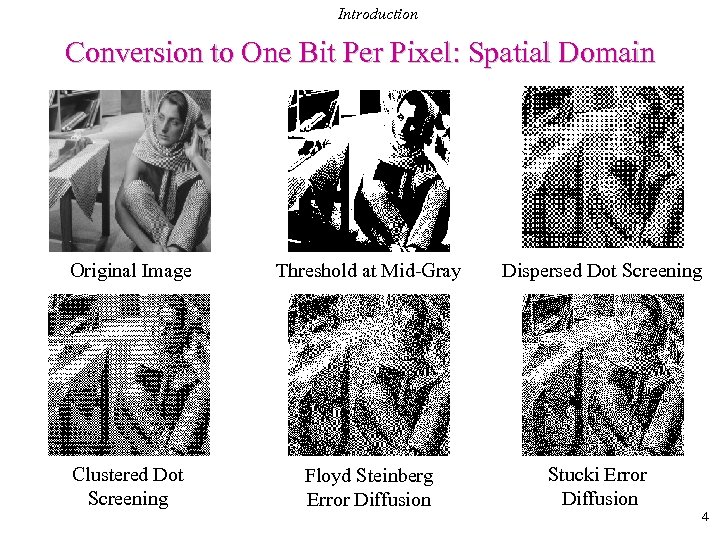 Introduction Conversion to One Bit Per Pixel: Spatial Domain Original Image Threshold at Mid-Gray Dispersed Dot Screening Clustered Dot Screening Floyd Steinberg Error Diffusion Stucki Error Diffusion 4
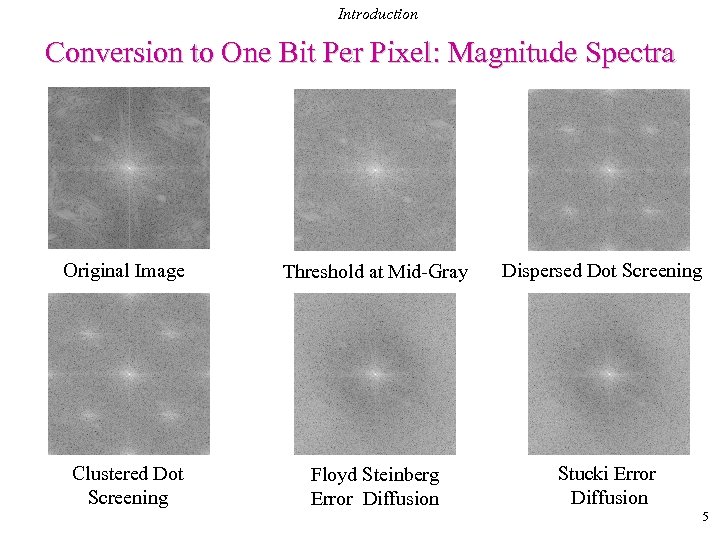 Introduction Conversion to One Bit Per Pixel: Magnitude Spectra Original Image Threshold at Mid-Gray Clustered Dot Screening Floyd Steinberg Error Diffusion Dispersed Dot Screening Stucki Error Diffusion 5
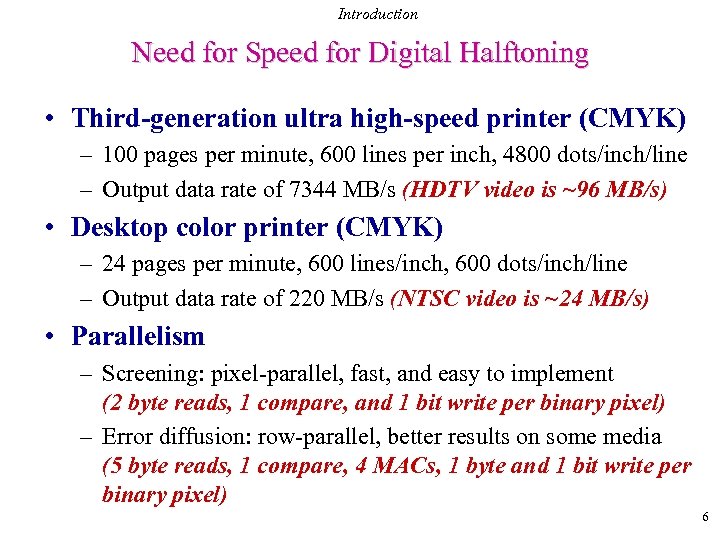 Introduction Need for Speed for Digital Halftoning • Third-generation ultra high-speed printer (CMYK) – 100 pages per minute, 600 lines per inch, 4800 dots/inch/line – Output data rate of 7344 MB/s (HDTV video is ~96 MB/s) • Desktop color printer (CMYK) – 24 pages per minute, 600 lines/inch, 600 dots/inch/line – Output data rate of 220 MB/s (NTSC video is ~24 MB/s) • Parallelism – Screening: pixel-parallel, fast, and easy to implement (2 byte reads, 1 compare, and 1 bit write per binary pixel) – Error diffusion: row-parallel, better results on some media (5 byte reads, 1 compare, 4 MACs, 1 byte and 1 bit write per binary pixel) 6
 Outline • Introduction • Grayscale halftoning methods • Modeling grayscale error diffusion – Compensation for sharpness – Visual quality measures • Compression of error diffused halftones • Color error diffusion halftoning for display – Optimal design – Linear human visual system model • Conclusion 7
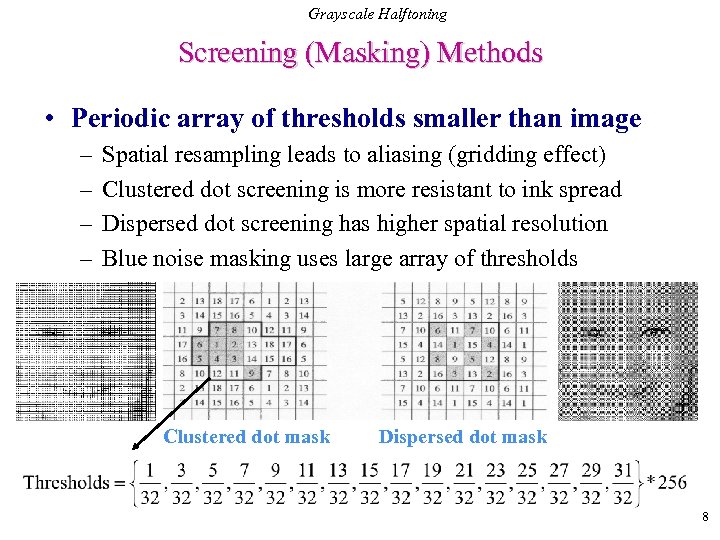 Grayscale Halftoning Screening (Masking) Methods • Periodic array of thresholds smaller than image – – Spatial resampling leads to aliasing (gridding effect) Clustered dot screening is more resistant to ink spread Dispersed dot screening has higher spatial resolution Blue noise masking uses large array of thresholds Clustered dot mask Dispersed dot mask 8
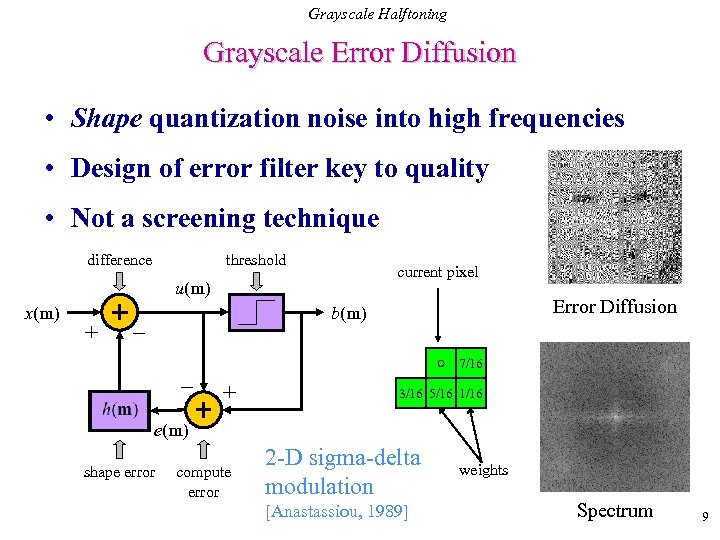 Grayscale Halftoning Grayscale Error Diffusion • Shape quantization noise into high frequencies • Design of error filter key to quality • Not a screening technique difference threshold current pixel u(m) x(m) + Error Diffusion b(m) _ _ 7/16 + 3/16 5/16 1/16 e(m) shape error compute error 2 -D sigma-delta modulation [Anastassiou, 1989] weights Spectrum 9
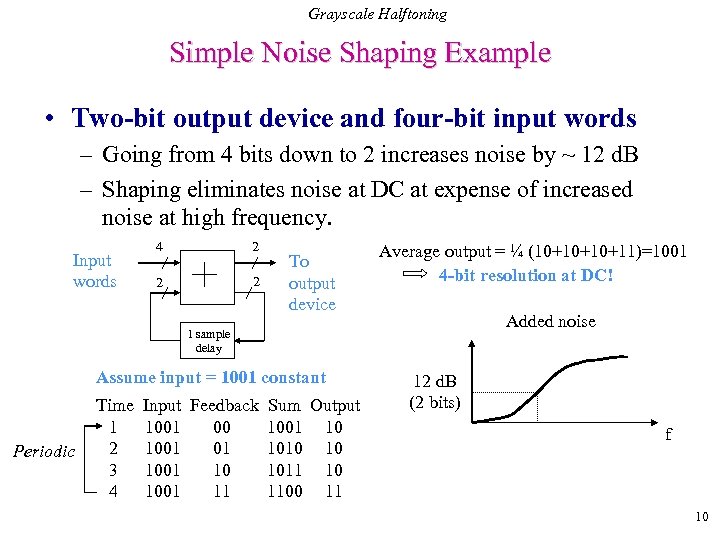 Grayscale Halftoning Simple Noise Shaping Example • Two-bit output device and four-bit input words – Going from 4 bits down to 2 increases noise by ~ 12 d. B – Shaping eliminates noise at DC at expense of increased noise at high frequency. Input words 4 2 2 2 To output device Average output = ¼ (10+10+10+11)=1001 4 -bit resolution at DC! Added noise 1 sample delay Assume input = 1001 constant Periodic Time Input Feedback Sum Output 1 1001 00 1001 10 2 1001 1010 10 3 1001 1011 10 4 1001 1100 11 12 d. B (2 bits) f If signal is in this band, then you are better off 10
 Grayscale Halftoning Direct Binary Search (Iterative) • Practical upper bound on halftone quality • Minimize mean-squared error between lowpass filtered versions of grayscale and halftone images – Lowpass filter is based on a linear shift-invariant model of human visual system (a. k. a. contrast sensitivity function) • Each iteration visits every pixel [Analoui & Allebach, 1992] – At each pixel, consider toggling pixel or swapping it with each of its 8 nearest neighbors that differ in state from it – Terminate when if no pixels are changed in an iteration • Relatively insensitive to initial halftone provided that it is not error diffused [Lieberman & Allebach, 2000] 11
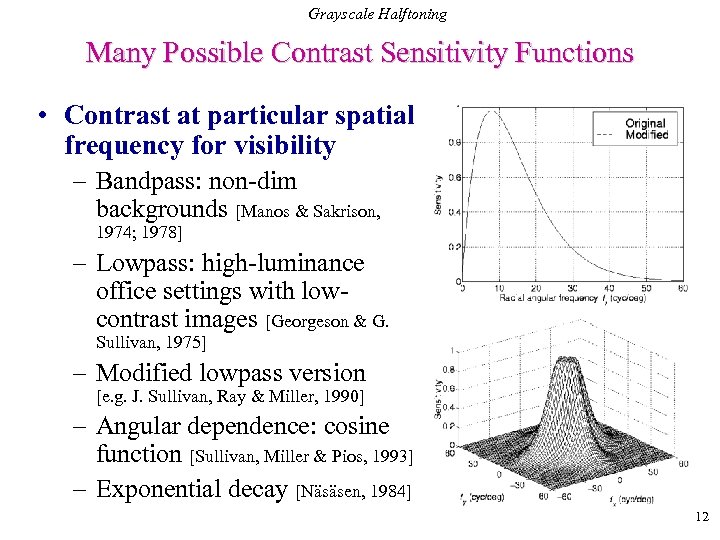 Grayscale Halftoning Many Possible Contrast Sensitivity Functions • Contrast at particular spatial frequency for visibility – Bandpass: non-dim backgrounds [Manos & Sakrison, 1974; 1978] – Lowpass: high-luminance office settings with lowcontrast images [Georgeson & G. Sullivan, 1975] – Modified lowpass version [e. g. J. Sullivan, Ray & Miller, 1990] – Angular dependence: cosine function [Sullivan, Miller & Pios, 1993] – Exponential decay [Näsäsen, 1984] 12
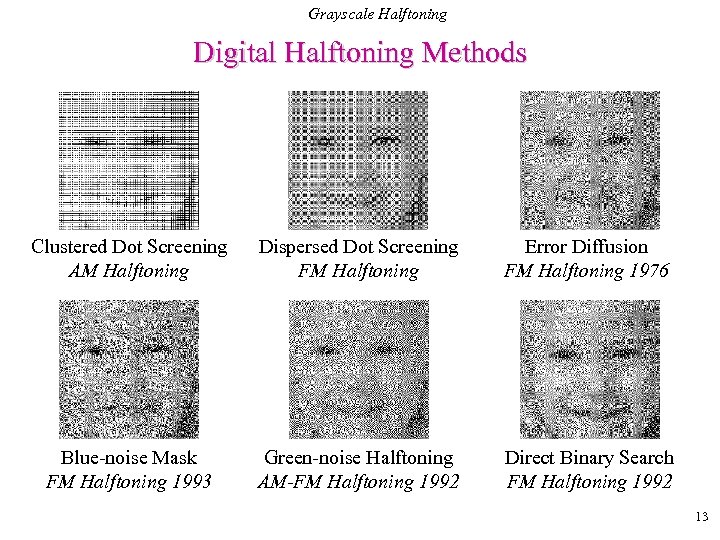 Grayscale Halftoning Digital Halftoning Methods Clustered Dot Screening AM Halftoning Dispersed Dot Screening FM Halftoning Error Diffusion FM Halftoning 1976 Blue-noise Mask FM Halftoning 1993 Green-noise Halftoning AM-FM Halftoning 1992 Direct Binary Search FM Halftoning 1992 13
 Outline • Introduction • Grayscale halftoning methods • Modeling grayscale error diffusion – Compensation for sharpness – Visual quality measures • Compression of error diffused halftones • Color error diffusion halftoning for display – Optimal design – Linear human visual system model • Conclusion 14
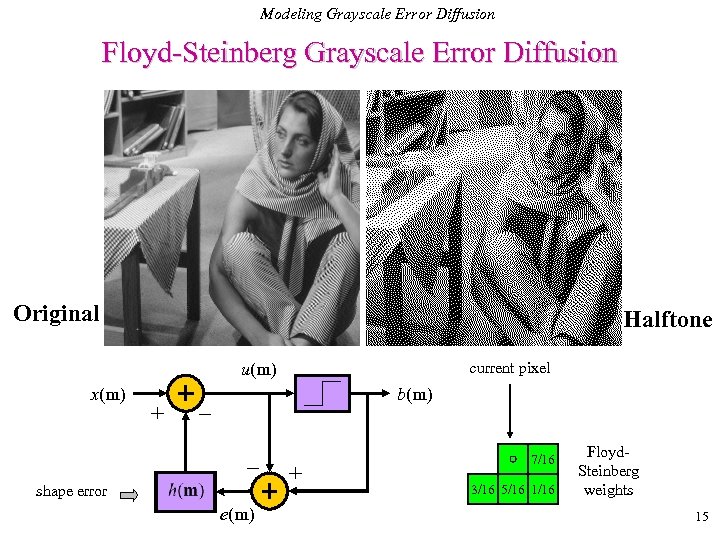 Modeling Grayscale Error Diffusion Floyd-Steinberg Grayscale Error Diffusion Original Halftone current pixel u(m) x(m) + b(m) _ _ shape error e(m) + 7/16 3/16 5/16 1/16 Floyd. Steinberg weights 15
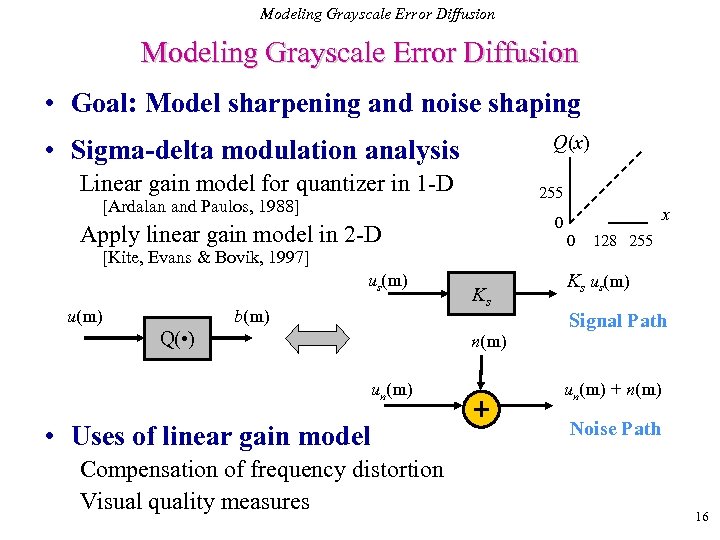 Modeling Grayscale Error Diffusion • Goal: Model sharpening and noise shaping Q(x) • Sigma-delta modulation analysis Linear gain model for quantizer in 1 -D 255 [Ardalan and Paulos, 1988] Apply linear gain model in 2 -D 0 [Kite, Evans & Bovik, 1997] us(m) u(m) b(m) Q( • ) x 0 Ks 128 255 Ks us(m) Signal Path n(m) un(m) • Uses of linear gain model Compensation of frequency distortion Visual quality measures un(m) + n(m) Noise Path 16
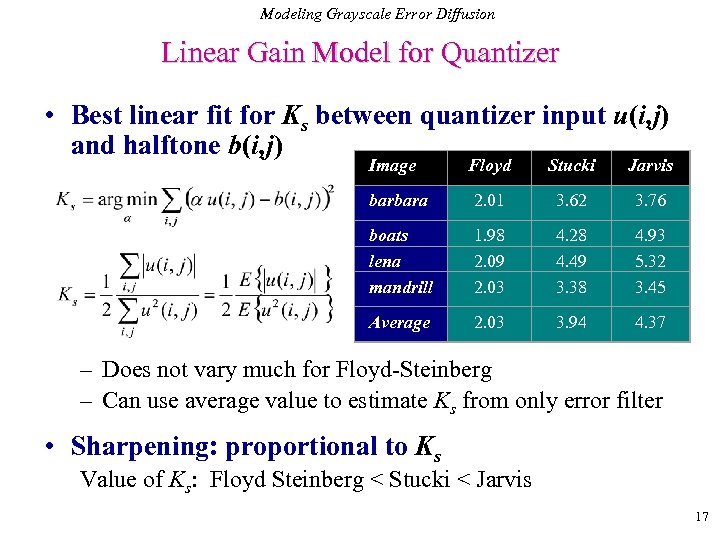 Modeling Grayscale Error Diffusion Linear Gain Model for Quantizer • Best linear fit for Ks between quantizer input u(i, j) and halftone b(i, j) Image Floyd Stucki Jarvis barbara 2. 01 3. 62 3. 76 boats lena mandrill 1. 98 2. 09 2. 03 4. 28 4. 49 3. 38 4. 93 5. 32 3. 45 Average 2. 03 3. 94 4. 37 – Does not vary much for Floyd-Steinberg – Can use average value to estimate Ks from only error filter • Sharpening: proportional to Ks Value of Ks: Floyd Steinberg < Stucki < Jarvis 17
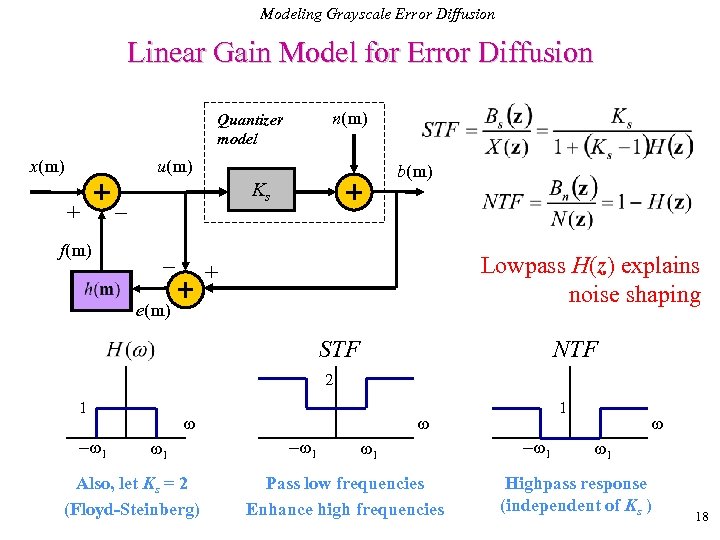 Modeling Grayscale Error Diffusion Linear Gain Model for Error Diffusion n(m) Quantizer model x(m) u(m) + f(m) b(m) Ks _ _ Lowpass H(z) explains noise shaping + e(m) STF NTF 2 1 - 1 1 Also, let Ks = 2 (Floyd-Steinberg) 1 - 1 1 Pass low frequencies Enhance high frequencies - 1 1 Highpass response (independent of Ks ) 18
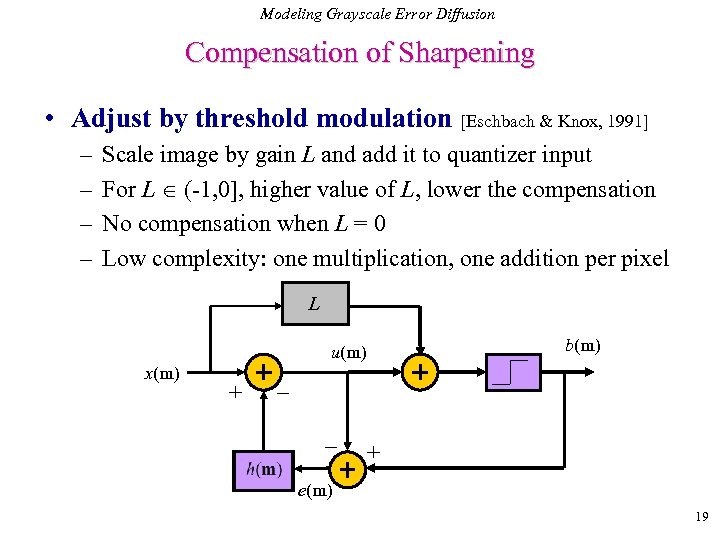 Modeling Grayscale Error Diffusion Compensation of Sharpening • Adjust by threshold modulation [Eschbach & Knox, 1991] – – Scale image by gain L and add it to quantizer input For L (-1, 0], higher value of L, lower the compensation No compensation when L = 0 Low complexity: one multiplication, one addition per pixel L u(m) x(m) + b(m) _ _ + e(m) 19
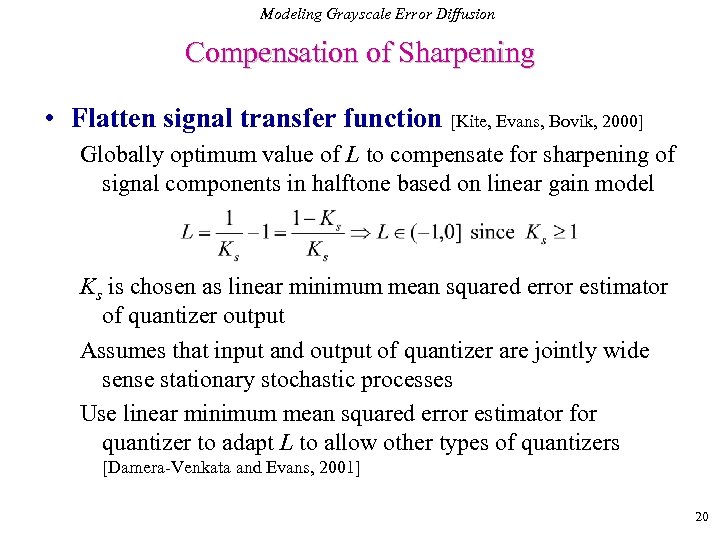 Modeling Grayscale Error Diffusion Compensation of Sharpening • Flatten signal transfer function [Kite, Evans, Bovik, 2000] Globally optimum value of L to compensate for sharpening of signal components in halftone based on linear gain model Ks is chosen as linear minimum mean squared error estimator of quantizer output Assumes that input and output of quantizer are jointly wide sense stationary stochastic processes Use linear minimum mean squared error estimator for quantizer to adapt L to allow other types of quantizers [Damera-Venkata and Evans, 2001] 20
![Modeling Grayscale Error Diffusion Visual Quality Measures [Kite, Evans, Bovik, 2000] • Impact of](https://present5.com/presentation/081a3857b25352ca88ca6555be5f29e2/image-21.jpg "Modeling Grayscale Error Diffusion Visual Quality Measures [Kite, Evans, Bovik, 2000] • Impact of") Modeling Grayscale Error Diffusion Visual Quality Measures [Kite, Evans, Bovik, 2000] • Impact of noise on human visual system Signal-to-noise (SNR) measures appropriate when noise is additive and signal independent Create unsharpened halftone y[m 1, m 2] with flat signal transfer function using threshold modulation Weight signal/noise by contrast sensitivity function C[k 1, k 2] Floyd-Steinberg > Stucki > Jarvis at all viewing distances 21
Modeling Grayscale Error Diffusion Visual Quality Measures [Kite, Evans, Bovik, 2000] • Impact of noise on human visual system Signal-to-noise (SNR) measures appropriate when noise is additive and signal independent Create unsharpened halftone y[m 1, m 2] with flat signal transfer function using threshold modulation Weight signal/noise by contrast sensitivity function C[k 1, k 2] Floyd-Steinberg > Stucki > Jarvis at all viewing distances 21
 Outline • Introduction • Grayscale halftoning methods • Modeling grayscale error diffusion – Compensation for sharpness – Visual quality measures • Compression of error diffused halftones • Color error diffusion halftoning for display – Optimal design – Linear human visual system model • Conclusion 22
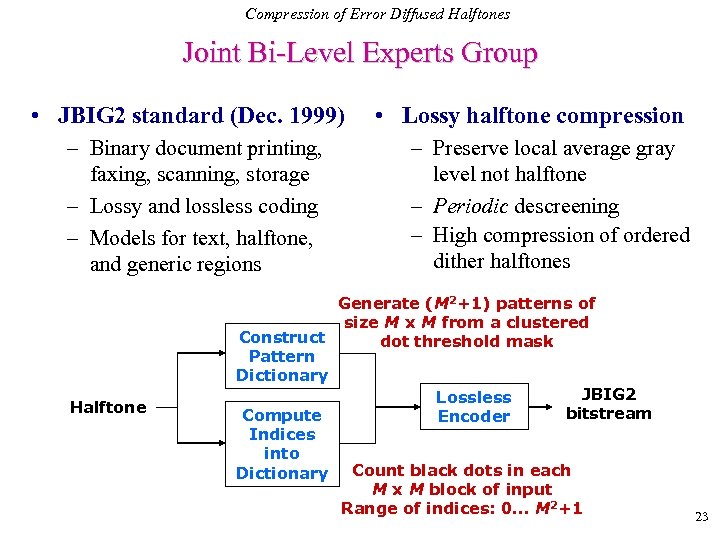 Compression of Error Diffused Halftones Joint Bi-Level Experts Group • JBIG 2 standard (Dec. 1999) – Binary document printing, faxing, scanning, storage – Lossy and lossless coding – Models for text, halftone, and generic regions Halftone • Lossy halftone compression – Preserve local average gray level not halftone – Periodic descreening – High compression of ordered dither halftones Generate (M 2+1) patterns of size M x M from a clustered Construct dot threshold mask Pattern Dictionary JBIG 2 Lossless bitstream Compute Encoder Indices into Count black dots in each Dictionary M x M block of input Range of indices: 0. . . M 2+1 23
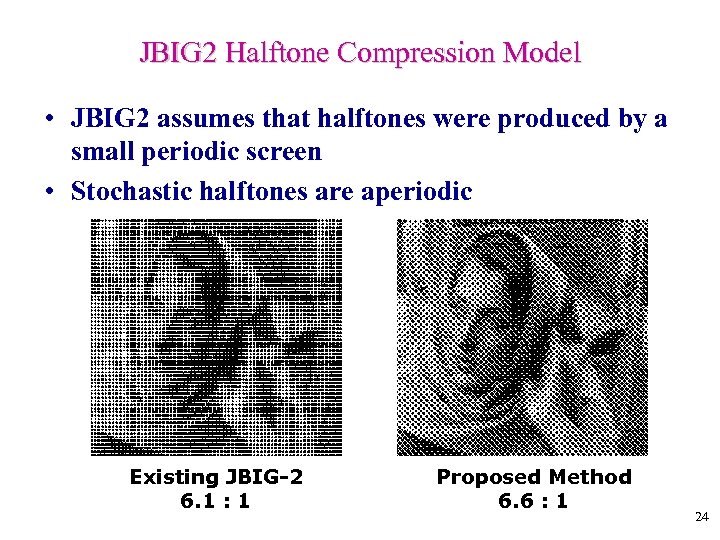 JBIG 2 Halftone Compression Model • JBIG 2 assumes that halftones were produced by a small periodic screen • Stochastic halftones are aperiodic Existing JBIG-2 6. 1 : 1 Proposed Method 6. 6 : 1 24
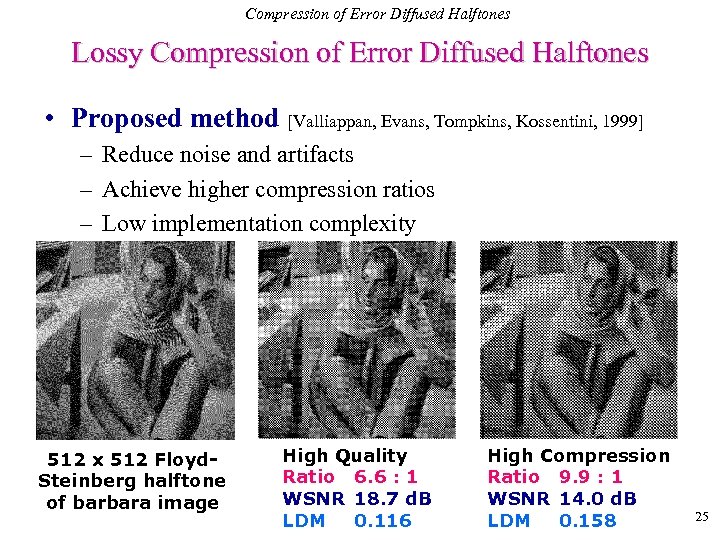 Compression of Error Diffused Halftones Lossy Compression of Error Diffused Halftones • Proposed method [Valliappan, Evans, Tompkins, Kossentini, 1999] – Reduce noise and artifacts – Achieve higher compression ratios – Low implementation complexity 512 x 512 Floyd. Steinberg halftone of barbara image High Quality Ratio 6. 6 : 1 WSNR 18. 7 d. B LDM 0. 116 High Compression Ratio 9. 9 : 1 WSNR 14. 0 d. B LDM 0. 158 25
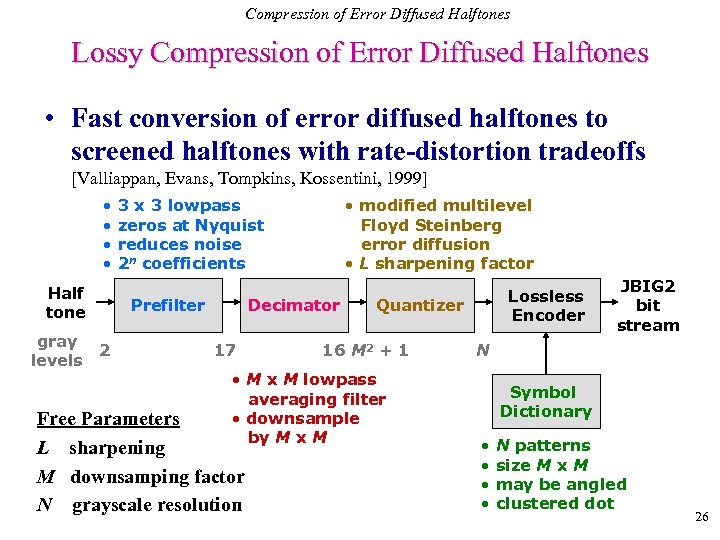 Compression of Error Diffused Halftones Lossy Compression of Error Diffused Halftones • Fast conversion of error diffused halftones to screened halftones with rate-distortion tradeoffs [Valliappan, Evans, Tompkins, Kossentini, 1999] • • Half tone gray levels Prefilter 2 • modified multilevel Floyd Steinberg error diffusion • L sharpening factor 3 x 3 lowpass zeros at Nyquist reduces noise 2 n coefficients Decimator 17 Quantizer 16 M 2 + 1 • M x M lowpass averaging filter • downsample by M x M Free Parameters L sharpening M downsamping factor N grayscale resolution Lossless Encoder JBIG 2 bit stream N Symbol Dictionary • • N patterns size M x M may be angled clustered dot 26
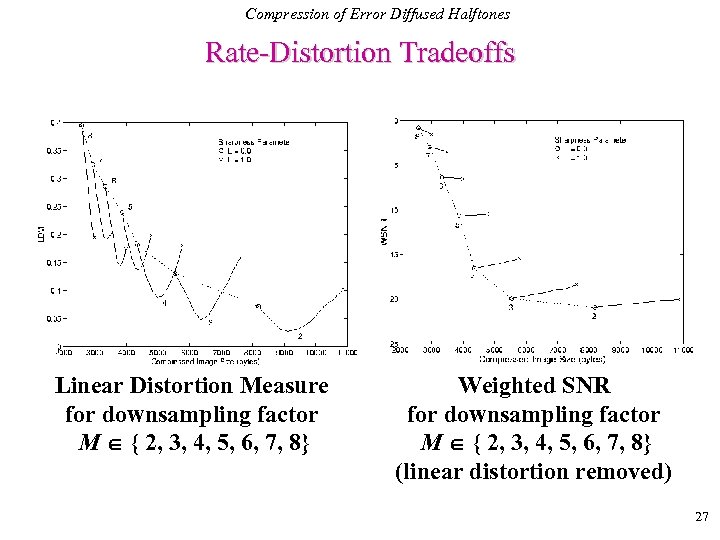 Compression of Error Diffused Halftones Rate-Distortion Tradeoffs Linear Distortion Measure for downsampling factor M { 2, 3, 4, 5, 6, 7, 8} Weighted SNR for downsampling factor M { 2, 3, 4, 5, 6, 7, 8} (linear distortion removed) 27
 Outline • Introduction • Grayscale halftoning methods • Modeling grayscale error diffusion – Compensation for sharpness – Visual quality measures • Compression of error diffused halftones • Color error diffusion halftoning for display – Optimal design – Linear human visual system model • Conclusion 28
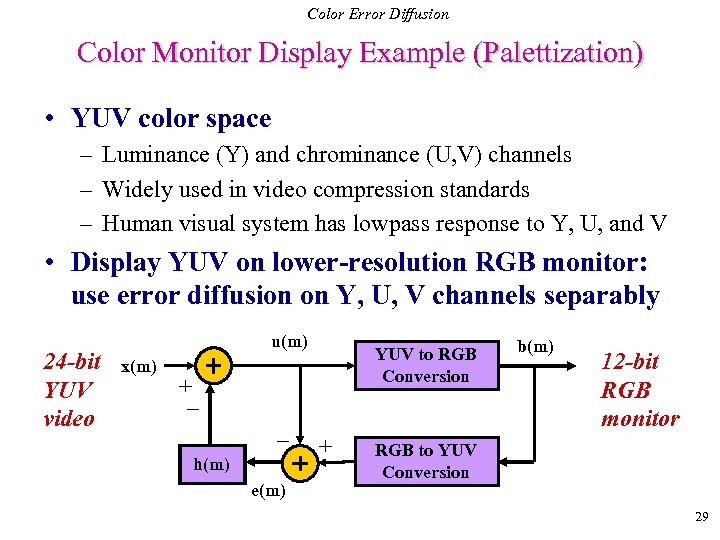 Color Error Diffusion Color Monitor Display Example (Palettization) • YUV color space – Luminance (Y) and chrominance (U, V) channels – Widely used in video compression standards – Human visual system has lowpass response to Y, U, and V • Display YUV on lower-resolution RGB monitor: use error diffusion on Y, U, V channels separably 24 -bit YUV video u(m) x(m) YUV to RGB Conversion + _ _ h(m) e(m) + b(m) 12 -bit RGB monitor RGB to YUV Conversion 29
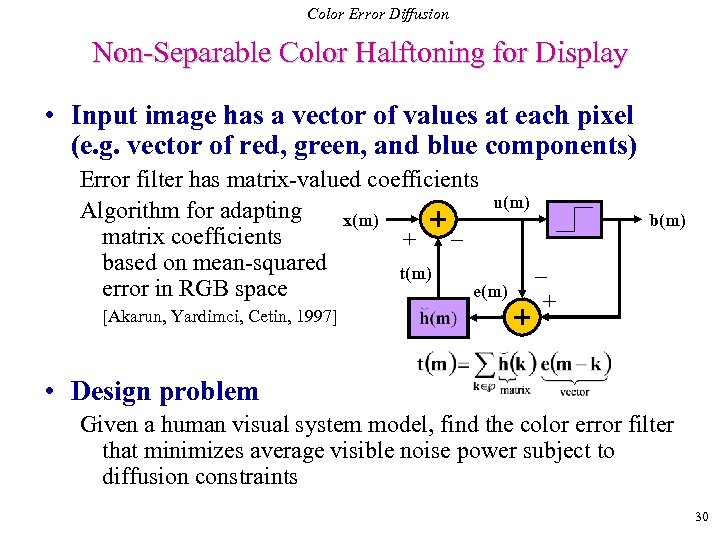 Color Error Diffusion Non-Separable Color Halftoning for Display • Input image has a vector of values at each pixel (e. g. vector of red, green, and blue components) Error filter has matrix-valued coefficients u(m) Algorithm for adapting x(m) matrix coefficients + _ based on mean-squared _ t(m) error in RGB space e(m) + [Akarun, Yardimci, Cetin, 1997] b(m) • Design problem Given a human visual system model, find the color error filter that minimizes average visible noise power subject to diffusion constraints 30
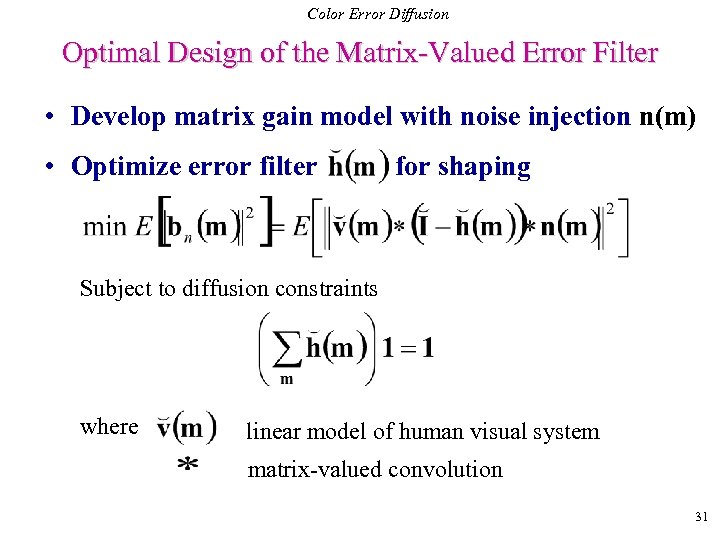 Color Error Diffusion Optimal Design of the Matrix-Valued Error Filter • Develop matrix gain model with noise injection n(m) • Optimize error filter for shaping Subject to diffusion constraints where linear model of human visual system matrix-valued convolution 31
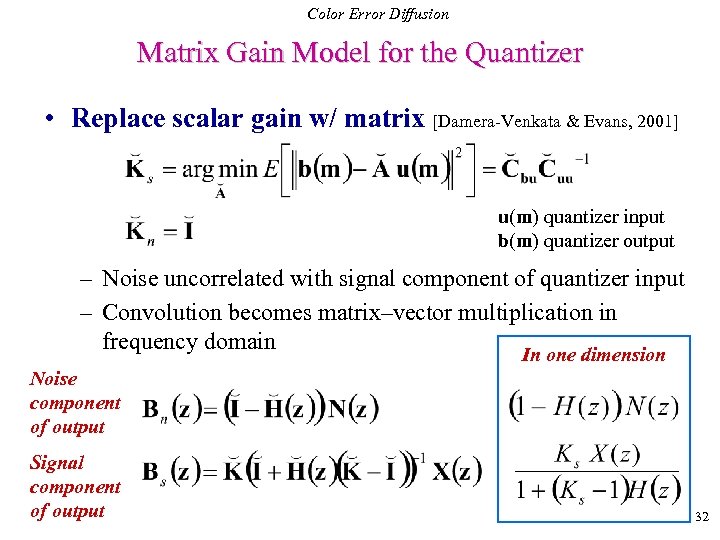 Color Error Diffusion Matrix Gain Model for the Quantizer • Replace scalar gain w/ matrix [Damera-Venkata & Evans, 2001] u(m) quantizer input b(m) quantizer output – Noise uncorrelated with signal component of quantizer input – Convolution becomes matrix–vector multiplication in frequency domain In one dimension Noise component of output Signal component of output 32
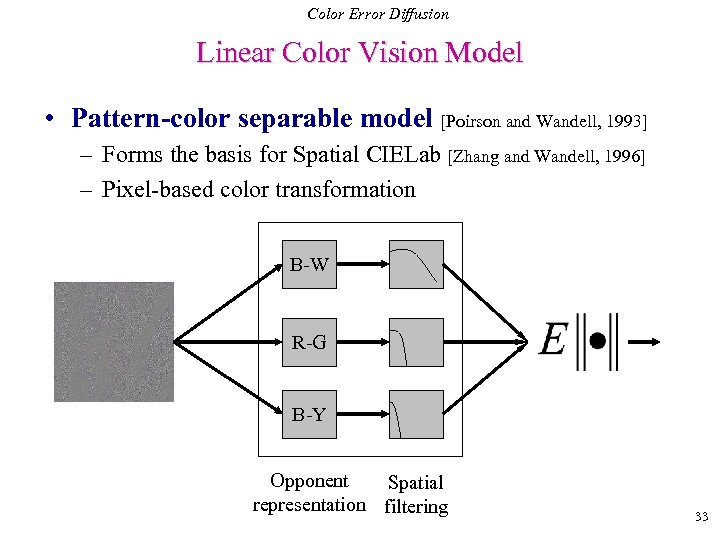 Color Error Diffusion Linear Color Vision Model • Pattern-color separable model [Poirson and Wandell, 1993] – Forms the basis for Spatial CIELab [Zhang and Wandell, 1996] – Pixel-based color transformation B-W R-G B-Y Opponent Spatial representation filtering 33
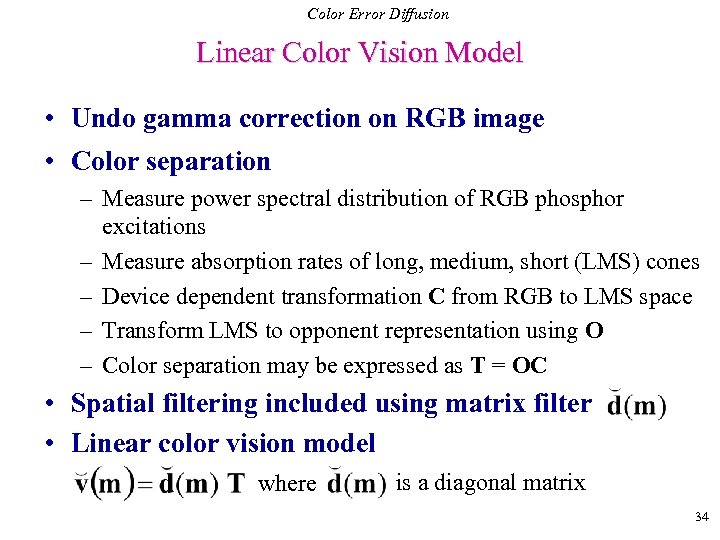 Color Error Diffusion Linear Color Vision Model • Undo gamma correction on RGB image • Color separation – Measure power spectral distribution of RGB phosphor excitations – Measure absorption rates of long, medium, short (LMS) cones – Device dependent transformation C from RGB to LMS space – Transform LMS to opponent representation using O – Color separation may be expressed as T = OC • Spatial filtering included using matrix filter • Linear color vision model where is a diagonal matrix 34
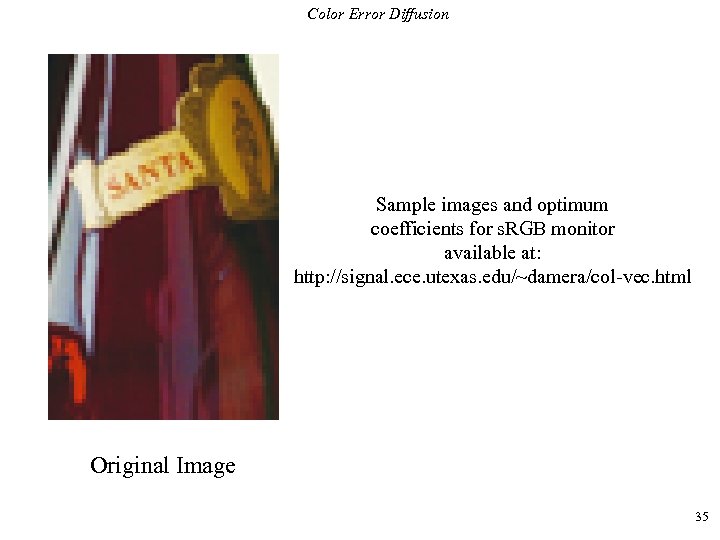 Color Error Diffusion Sample images and optimum coefficients for s. RGB monitor available at: http: //signal. ece. utexas. edu/~damera/col-vec. html Original Image 35
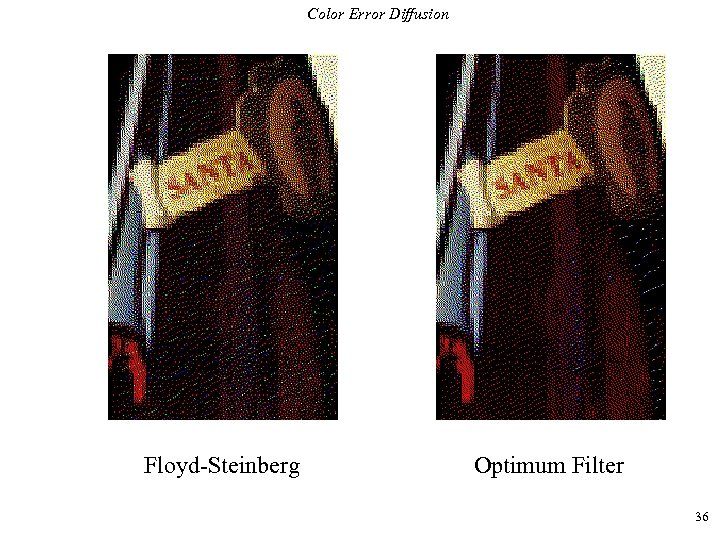 Color Error Diffusion Floyd-Steinberg Optimum Filter 36
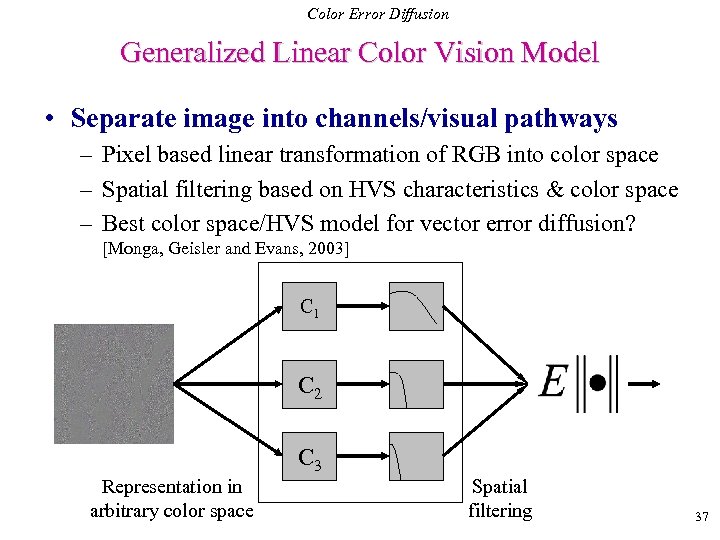 Color Error Diffusion Generalized Linear Color Vision Model • Separate image into channels/visual pathways – Pixel based linear transformation of RGB into color space – Spatial filtering based on HVS characteristics & color space – Best color space/HVS model for vector error diffusion? [Monga, Geisler and Evans, 2003] C 1 C 2 C 3 Representation in arbitrary color space Spatial filtering 37
 Color Error Diffusion Color Spaces • Desired characteristics – Independent of display device – Score well in perceptual uniformity [Poynton color FAQ http: //comuphase. cmetric. com] – Approximately pattern color separable [Wandell et al. , 1993] • Candidate linear color spaces – – Opponent color space [Poirson and Wandell, 1993] YIQ: NTSC video Eye more sensitive to luminance; reduce chrominance bandwidth YUV: PAL video Linearized CIELab [Flohr, Bouman, Kolpatzik, Balasubramanian, Carrara, Allebach, 1993] 38
 Color Error Diffusion Monitor Calibration • How to calibrate monitor? s. RGB standard default RGB space by HP and Microsoft Transformation based on an s. RGB monitor (which is linear) • Include s. RGB monitor transformation T: s. RGB CIEXYZ Opponent Representation [Wandell & Zhang, 1996] Transformations s. RGB YUV, YIQ from S-CIELab Code at http: //white. stanford. edu/~brian/scielab 1 -1 -1/ • Including s. RGB monitor into model enables Webbased subjective testing http: //www. ece. utexas. edu/~vishal/cgi-bin/test. html 39
![Color Error Diffusion Spatial Filtering • Opponent [Wandell, Zhang 1997] Data in each plane](https://present5.com/presentation/081a3857b25352ca88ca6555be5f29e2/image-40.jpg "Color Error Diffusion Spatial Filtering • Opponent [Wandell, Zhang 1997] Data in each plane") Color Error Diffusion Spatial Filtering • Opponent [Wandell, Zhang 1997] Data in each plane filtered by 2 -D separable spatial kernels • Linearized CIELab, YUV, and YIQ Luminance frequency response [Näsänen and Sullivan, 1984] L average luminance of display r radial spatial frequency Chrominance frequency response [Kolpatzik and Bouman, 1992] Chrominance response allows more low frequency chromatic error not to be perceived vs. luminance response 40
Color Error Diffusion Spatial Filtering • Opponent [Wandell, Zhang 1997] Data in each plane filtered by 2 -D separable spatial kernels • Linearized CIELab, YUV, and YIQ Luminance frequency response [Näsänen and Sullivan, 1984] L average luminance of display r radial spatial frequency Chrominance frequency response [Kolpatzik and Bouman, 1992] Chrominance response allows more low frequency chromatic error not to be perceived vs. luminance response 40
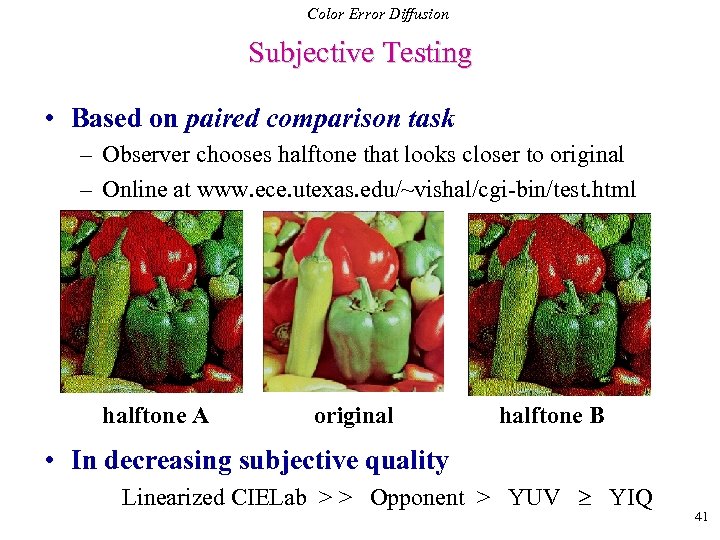 Color Error Diffusion Subjective Testing • Based on paired comparison task – Observer chooses halftone that looks closer to original – Online at www. ece. utexas. edu/~vishal/cgi-bin/test. html halftone A original halftone B • In decreasing subjective quality Linearized CIELab > > Opponent > YUV YIQ 41
 Conclusion Color Error Diffusion • Design of “optimal” color noise shaping filters – We use the matrix gain model [Damera-Venkata and Evans, 2001] • Predicts sharpening • Predicts shaped color halftone noise – Solve for best error filter that minimizes visually weighted average color halftone noise energy – Improve numerical stability of descent procedure • Choice of linear color space – Linear CIELab gives best objective and subjective quality – Future work in finding better transformations • Use color management to generalize device characterization and viewing conditions 42
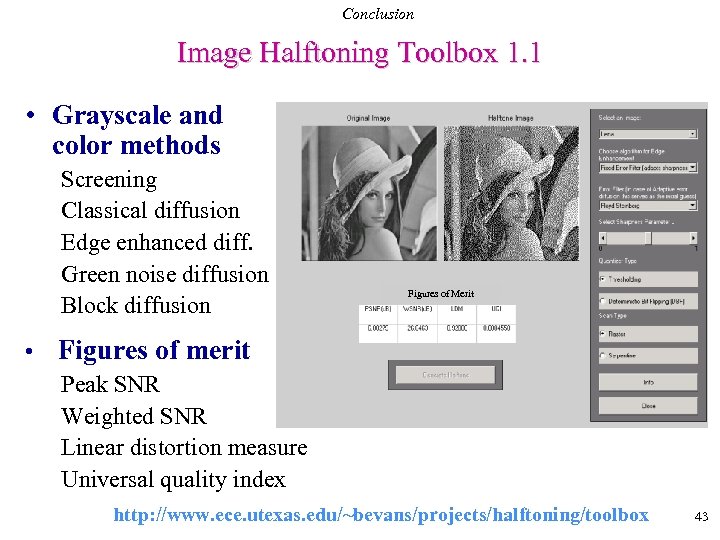 Conclusion Image Halftoning Toolbox 1. 1 • Grayscale and color methods Screening Classical diffusion Edge enhanced diff. Green noise diffusion Block diffusion Figures of Merit • Figures of merit Peak SNR Weighted SNR Linear distortion measure Universal quality index http: //www. ece. utexas. edu/~bevans/projects/halftoning/toolbox 43
 Backup Slides
 Grayscale Halftoning Problems with Error Diffusion • Objectionable artifacts – Scan order affects results – “Worminess” visible in constant graylevel areas • Image sharpening – Larger error filters due to [Jarvis, Judice & Ninke, 1976] and [Stucki, 1980] reduce worminess and sharpen edges – Sharpening not always desirable: may be adjustable by prefiltering based on linear gain model [Kite, Evans, Bovik, 2000] • Computational complexity – Larger error filters require more operations per pixel – Push towards simple schemes for fast printing 45
![Grayscale Halftoning Correcting Artificial Textures [Marcu, 1999] • False textures in shadow and highlight](https://present5.com/presentation/081a3857b25352ca88ca6555be5f29e2/image-46.jpg "Grayscale Halftoning Correcting Artificial Textures [Marcu, 1999] • False textures in shadow and highlight") Grayscale Halftoning Correcting Artificial Textures [Marcu, 1999] • False textures in shadow and highlight regions • Place dot if minimum distance constraint is met – – – Raster scan Avoids computing geometric distance Scans halftoned pixels in radius of the current pixel Radius proportional to distance of pixel value from midgray Scanned pixel location offsets obtained by lookup tables • One lookup table gives number of pixels to scan (256 entries) • One lookup table gives offsets (256 entries) – Affects grayscale values [1, 39] and [216, 254] 46
Grayscale Halftoning Correcting Artificial Textures [Marcu, 1999] • False textures in shadow and highlight regions • Place dot if minimum distance constraint is met – – – Raster scan Avoids computing geometric distance Scans halftoned pixels in radius of the current pixel Radius proportional to distance of pixel value from midgray Scanned pixel location offsets obtained by lookup tables • One lookup table gives number of pixels to scan (256 entries) • One lookup table gives offsets (256 entries) – Affects grayscale values [1, 39] and [216, 254] 46
![Grayscale Halftoning Correcting Artificial Textures [Marcu, 1999] 47](https://present5.com/presentation/081a3857b25352ca88ca6555be5f29e2/image-47.jpg "Grayscale Halftoning Correcting Artificial Textures [Marcu, 1999] 47") Grayscale Halftoning Correcting Artificial Textures [Marcu, 1999] 47
Grayscale Halftoning Correcting Artificial Textures [Marcu, 1999] 47
![Grayscale Halftoning Correcting Artificial Textures [Marcu, 1999] 48](https://present5.com/presentation/081a3857b25352ca88ca6555be5f29e2/image-48.jpg "Grayscale Halftoning Correcting Artificial Textures [Marcu, 1999] 48") Grayscale Halftoning Correcting Artificial Textures [Marcu, 1999] 48
Grayscale Halftoning Correcting Artificial Textures [Marcu, 1999] 48
 Grayscale Halftoning Direct Binary Search • Advantages – Significantly improved halftone image quality over screening & error diffusion – Quality of final solution is relatively insensitive to initial halftone, provided is not error diffused halftone [Lieberman & Allebach, 2000] – Application in off-line design of screening threshold arrays • Disadvantages – Computational cost and memory usage is very high in comparison to error diffusion and screening methods – Increased complexity makes it unsuitable for real-time applications such as printing [Kacker & Allebach, 1998] 49
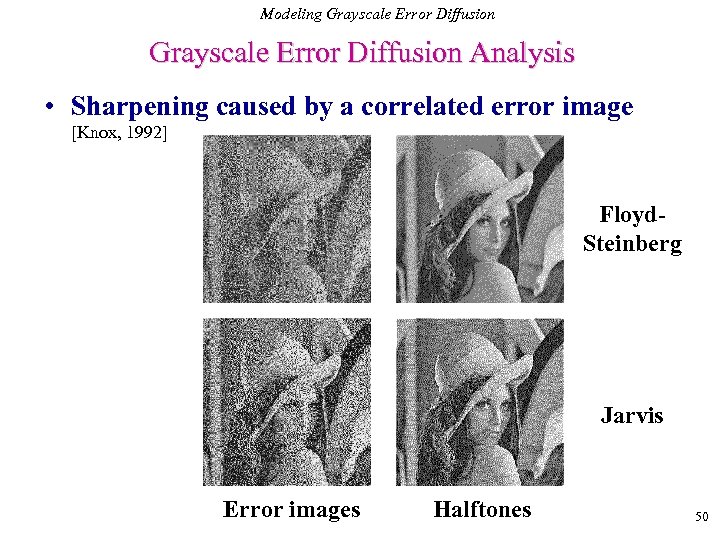 Modeling Grayscale Error Diffusion Analysis • Sharpening caused by a correlated error image [Knox, 1992] Floyd. Steinberg Jarvis Error images Halftones 50
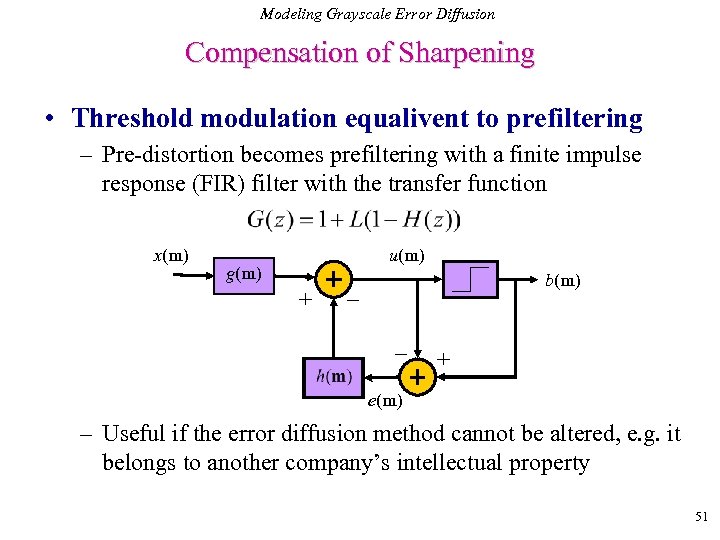 Modeling Grayscale Error Diffusion Compensation of Sharpening • Threshold modulation equalivent to prefiltering – Pre-distortion becomes prefiltering with a finite impulse response (FIR) filter with the transfer function x(m) u(m) g(m) + b(m) _ _ + e(m) – Useful if the error diffusion method cannot be altered, e. g. it belongs to another company’s intellectual property 51
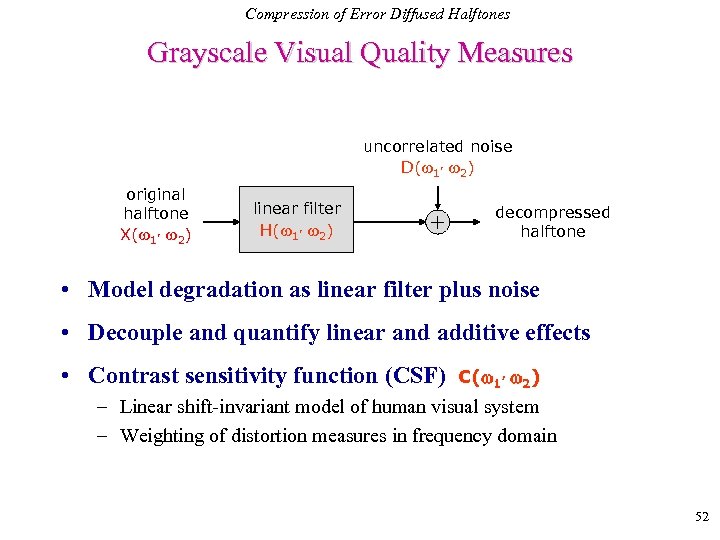 Compression of Error Diffused Halftones Grayscale Visual Quality Measures uncorrelated noise D( 1, 2) original halftone X( 1, 2) linear filter H( 1, 2) decompressed halftone • Model degradation as linear filter plus noise • Decouple and quantify linear and additive effects • Contrast sensitivity function (CSF) C( 1, 2) – Linear shift-invariant model of human visual system – Weighting of distortion measures in frequency domain 52
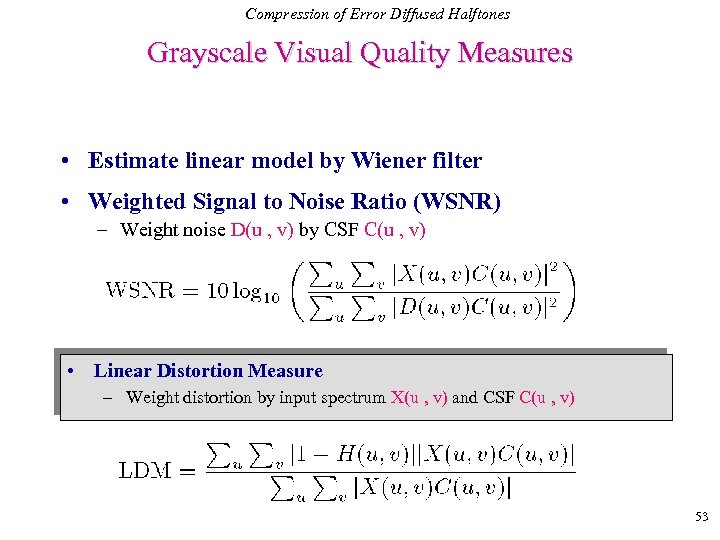 Compression of Error Diffused Halftones Grayscale Visual Quality Measures • Estimate linear model by Wiener filter • Weighted Signal to Noise Ratio (WSNR) – Weight noise D(u , v) by CSF C(u , v) • Linear Distortion Measure – Weight distortion by input spectrum X(u , v) and CSF C(u , v) 53
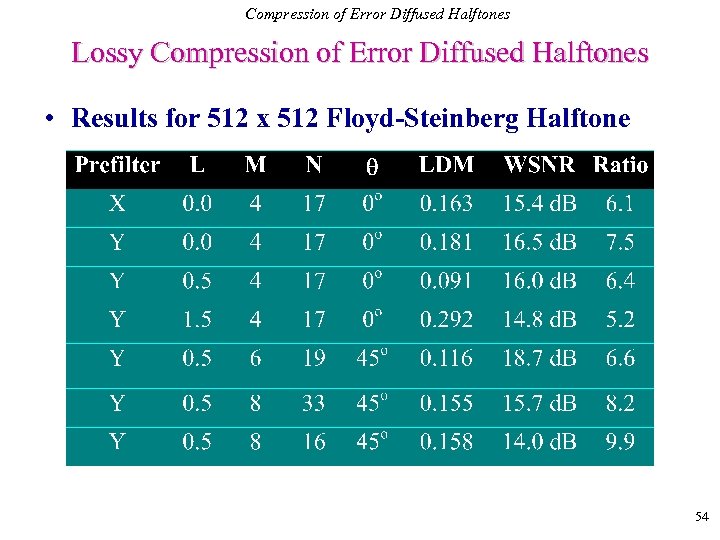 Compression of Error Diffused Halftones Lossy Compression of Error Diffused Halftones • Results for 512 x 512 Floyd-Steinberg Halftone 54
 Color Error Diffusion Optimum Color Noise Shaping • Vector color error diffusion halftone model – We use the matrix gain model [Damera-Venkata and Evans, 2001] – Predicts signal frequency distortion – Predicts shaped color halftone noise • Visibility of halftone noise depends on – Model predicting noise shaping – Human visual system model (assume linear shift-invariant) • Formulation of design problem – Given human visual system model and matrix gain model, find color error filter that minimizes average visible noise power subject to certain diffusion constraints 55
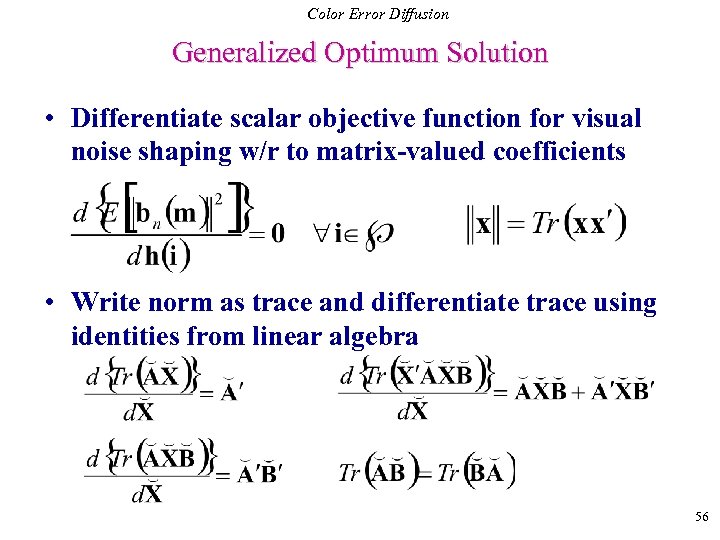 Color Error Diffusion Generalized Optimum Solution • Differentiate scalar objective function for visual noise shaping w/r to matrix-valued coefficients • Write norm as trace and differentiate trace using identities from linear algebra 56
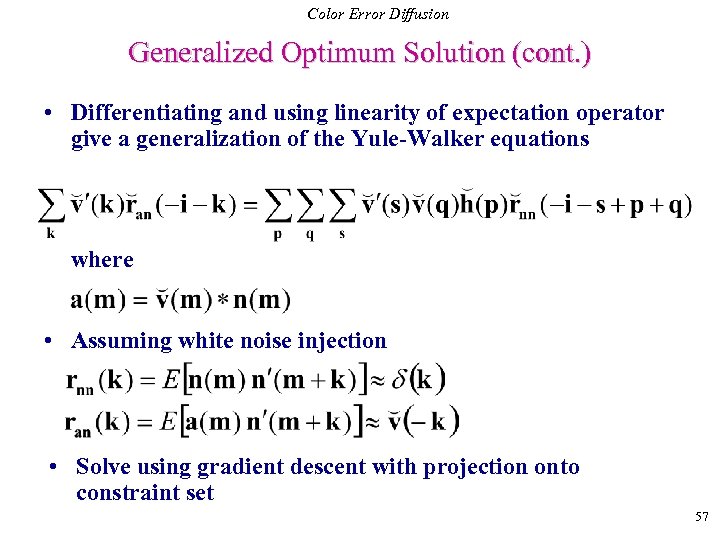 Color Error Diffusion Generalized Optimum Solution (cont. ) • Differentiating and using linearity of expectation operator give a generalization of the Yule-Walker equations where • Assuming white noise injection • Solve using gradient descent with projection onto constraint set 57
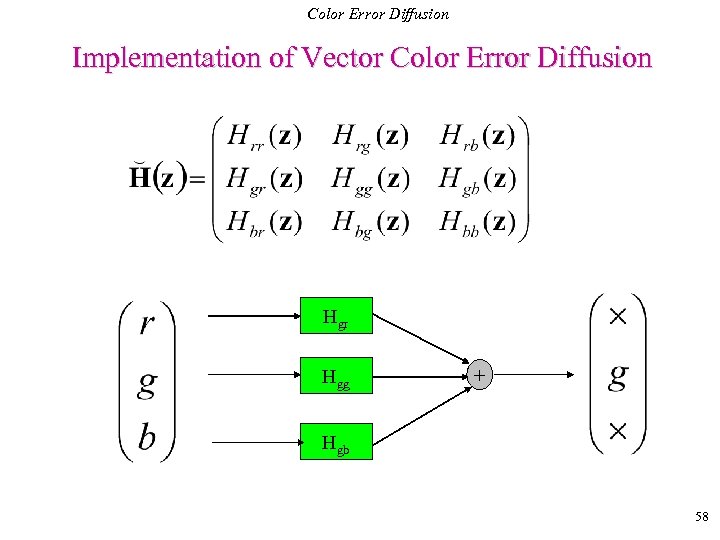 Color Error Diffusion Implementation of Vector Color Error Diffusion Hgr Hgg + Hgb 58
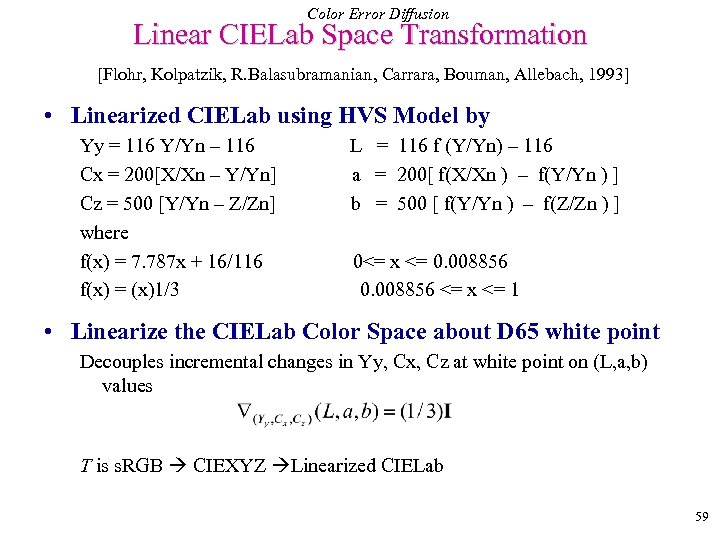 Color Error Diffusion Linear CIELab Space Transformation [Flohr, Kolpatzik, R. Balasubramanian, Carrara, Bouman, Allebach, 1993] • Linearized CIELab using HVS Model by Yy = 116 Y/Yn – 116 L = 116 f (Y/Yn) – 116 Cx = 200[X/Xn – Y/Yn] a = 200[ f(X/Xn ) – f(Y/Yn ) ] Cz = 500 [Y/Yn – Z/Zn] b = 500 [ f(Y/Yn ) – f(Z/Zn ) ] where f(x) = 7. 787 x + 16/116 0<= x <= 0. 008856 f(x) = (x)1/3 0. 008856 <= x <= 1 • Linearize the CIELab Color Space about D 65 white point Decouples incremental changes in Yy, Cx, Cz at white point on (L, a, b) values T is s. RGB CIEXYZ Linearized CIELab 59
![Color Error Diffusion Spatial Filtering • Opponent [Wandell, Zhang 1997] – Data in each](https://present5.com/presentation/081a3857b25352ca88ca6555be5f29e2/image-60.jpg "Color Error Diffusion Spatial Filtering • Opponent [Wandell, Zhang 1997] – Data in each") Color Error Diffusion Spatial Filtering • Opponent [Wandell, Zhang 1997] – Data in each plane filtered by 2 -D separable spatial kernels – Parameters for the three color planes are Plane Weights wi Spreads σi Luminance 0. 921 0. 0283 0. 105 0. 133 -0. 108 4. 336 Red-green 0. 531 0. 0392 0. 330 0. 494 Blue-yellow 0. 488 0. 0536 0. 371 0. 386 60
Color Error Diffusion Spatial Filtering • Opponent [Wandell, Zhang 1997] – Data in each plane filtered by 2 -D separable spatial kernels – Parameters for the three color planes are Plane Weights wi Spreads σi Luminance 0. 921 0. 0283 0. 105 0. 133 -0. 108 4. 336 Red-green 0. 531 0. 0392 0. 330 0. 494 Blue-yellow 0. 488 0. 0536 0. 371 0. 386 60
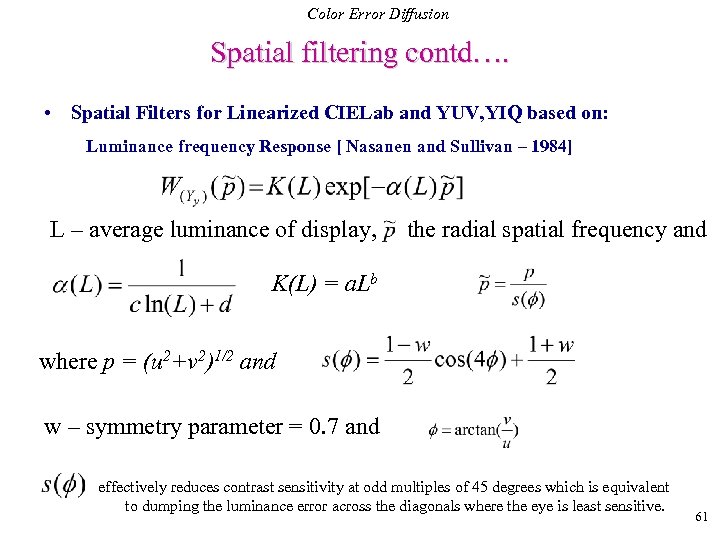 Color Error Diffusion Spatial filtering contd…. • Spatial Filters for Linearized CIELab and YUV, YIQ based on: Luminance frequency Response [ Nasanen and Sullivan – 1984] L – average luminance of display, the radial spatial frequency and K(L) = a. Lb where p = (u 2+v 2)1/2 and w – symmetry parameter = 0. 7 and effectively reduces contrast sensitivity at odd multiples of 45 degrees which is equivalent to dumping the luminance error across the diagonals where the eye is least sensitive. 61
![Color Error Diffusion Spatial filtering contd… Chrominance Frequency Response [Kolpatzik and Bouman – 1992]](https://present5.com/presentation/081a3857b25352ca88ca6555be5f29e2/image-62.jpg "Color Error Diffusion Spatial filtering contd… Chrominance Frequency Response [Kolpatzik and Bouman – 1992]") Color Error Diffusion Spatial filtering contd… Chrominance Frequency Response [Kolpatzik and Bouman – 1992] Using this chrominance response as opposed to same for both luminance and chrominance allows more low frequency chromatic error not perceived by the human viewer. • The problem hence is of designing 2 D-FIR filters which most closely match the desired Luminance and Chrominance frequency responses. • In addition we need zero phase as well. The filters ( 5 x 5 and 15 x 15 were designed using the frequency sampling approach and were real and circularly symmetric). Filter coefficients at: http: //www. ece. utexas. edu/~vishal/halftoning. html • Matrix valued Vector Error Filters for each of the Color Spaces at http: //www. ece. utexas. edu/~vishal/mat_filter. html 62
Color Error Diffusion Spatial filtering contd… Chrominance Frequency Response [Kolpatzik and Bouman – 1992] Using this chrominance response as opposed to same for both luminance and chrominance allows more low frequency chromatic error not perceived by the human viewer. • The problem hence is of designing 2 D-FIR filters which most closely match the desired Luminance and Chrominance frequency responses. • In addition we need zero phase as well. The filters ( 5 x 5 and 15 x 15 were designed using the frequency sampling approach and were real and circularly symmetric). Filter coefficients at: http: //www. ece. utexas. edu/~vishal/halftoning. html • Matrix valued Vector Error Filters for each of the Color Spaces at http: //www. ece. utexas. edu/~vishal/mat_filter. html 62
 Color Error Diffusion Subjective Testing • Binomial parameter estimation model – Halftone generated by particular HVS model considered superior if picked over another 60% or more of the time – Need 960 paired comparison of each model to determine results within tolerance of 0. 03 with 95% confidence – Four models would correspond to 6 comparison pairs, total 6 x 960 = 5760 comparisons needed – Observation data collected from over 60 subjects each of whom judged 96 comparisons • Data resulted in unique rank order of four models 63