


 Скачать презентацию ERNDIM QUANTITATIVE ORGANIC ACIDS IN URINE HIGHLIGHTS AND
5e347a261aa38407f46d97f2a98e8f5a.ppt
- Количество слайдов: 1
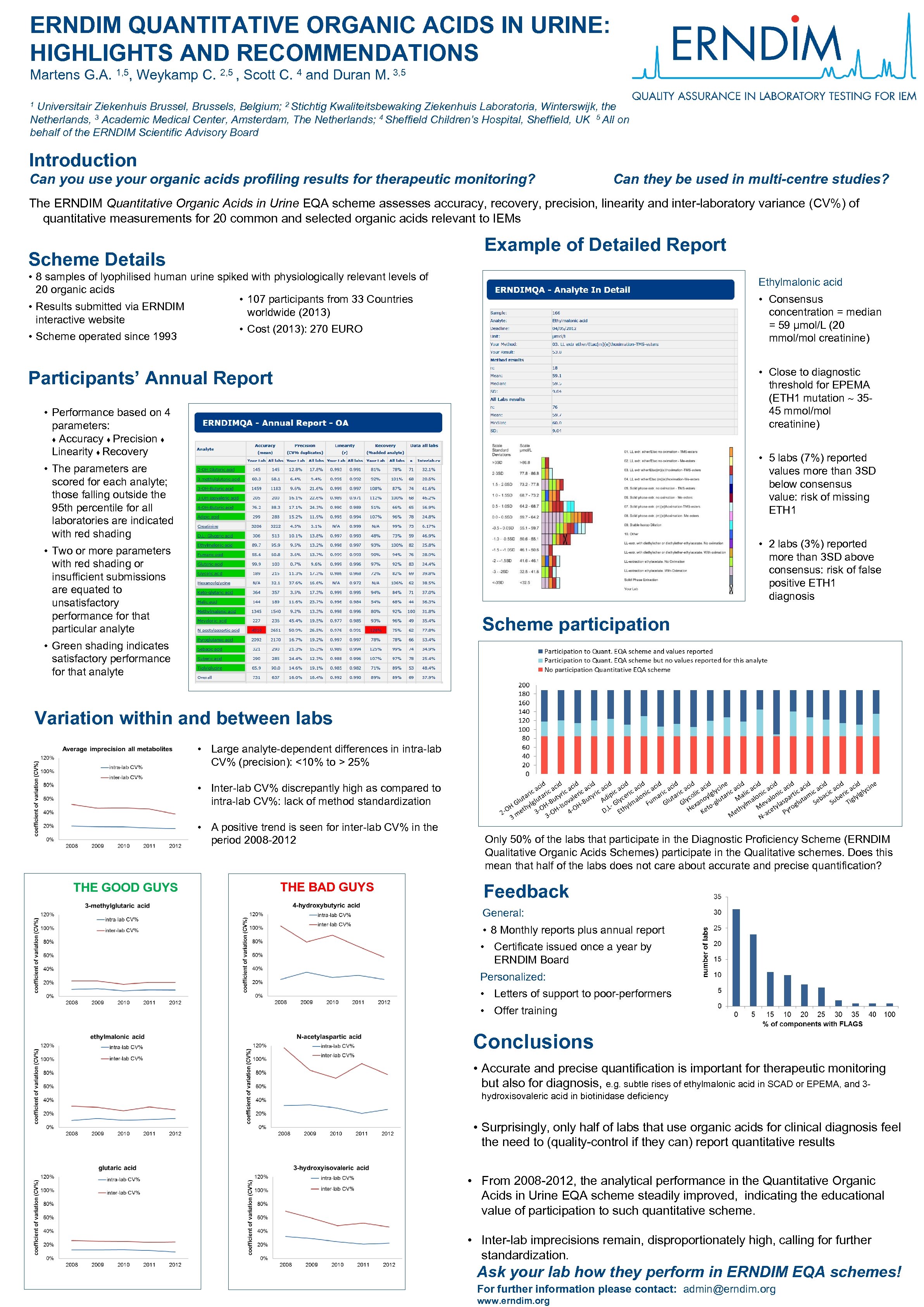 ERNDIM QUANTITATIVE ORGANIC ACIDS IN URINE: HIGHLIGHTS AND RECOMMENDATIONS Martens G. A. 1, 5, Weykamp C. 2, 5 , Scott C. 4 and Duran M. 3, 5 Universitair Ziekenhuis Brussel, Brussels, Belgium; 2 Stichtig Kwaliteitsbewaking Ziekenhuis Laboratoria, Winterswijk, the Netherlands, 3 Academic Medical Center, Amsterdam, The Netherlands; 4 Sheffield Children’s Hospital, Sheffield, UK 5 All on behalf of the ERNDIM Scientific Advisory Board 1 Introduction Can you use your organic acids profiling results for therapeutic monitoring? Can they be used in multi-centre studies? The ERNDIM Quantitative Organic Acids in Urine EQA scheme assesses accuracy, recovery, precision, linearity and inter-laboratory variance (CV%) of quantitative measurements for 20 common and selected organic acids relevant to IEMs Example of Detailed Report Scheme Details • 8 samples of lyophilised human urine spiked with physiologically relevant levels of 20 organic acids • 107 participants from 33 Countries • Results submitted via ERNDIM worldwide (2013) interactive website • Cost (2013): 270 EURO • Scheme operated since 1993 Ethylmalonic acid • Consensus concentration = median = 59 µmol/L (20 mmol/mol creatinine) • Close to diagnostic threshold for EPEMA (ETH 1 mutation 3545 mmol/mol creatinine) Participants’ Annual Report • Performance based on 4 parameters: ♦ Accuracy ♦ Precision ♦ Linearity ♦ Recovery • 5 labs (7%) reported values more than 3 SD below consensus value: risk of missing ETH 1 • The parameters are scored for each analyte; those falling outside the 95 th percentile for all laboratories are indicated with red shading • 2 labs (3%) reported more than 3 SD above consensus: risk of false positive ETH 1 diagnosis • Two or more parameters with red shading or insufficient submissions are equated to unsatisfactory performance for that particular analyte Scheme participation • Green shading indicates satisfactory performance for that analyte Variation within and between labs • Large analyte-dependent differences in intra-lab CV% (precision): <10% to > 25% • Inter-lab CV% discrepantly high as compared to intra-lab CV%: lack of method standardization • A positive trend is seen for inter-lab CV% in the period 2008 -2012 THE GOOD GUYS THE BAD GUYS Only 50% of the labs that participate in the Diagnostic Proficiency Scheme (ERNDIM Qualitative Organic Acids Schemes) participate in the Qualitative schemes. Does this mean that half of the labs does not care about accurate and precise quantification? Feedback General: • 8 Monthly reports plus annual report • Certificate issued once a year by ERNDIM Board Personalized: • Letters of support to poor-performers • Offer training Conclusions • Accurate and precise quantification is important for therapeutic monitoring but also for diagnosis, e. g. subtle rises of ethylmalonic acid in SCAD or EPEMA, and 3 hydroxisovaleric acid in biotinidase deficiency • Surprisingly, only half of labs that use organic acids for clinical diagnosis feel the need to (quality-control if they can) report quantitative results • From 2008 -2012, the analytical performance in the Quantitative Organic Acids in Urine EQA scheme steadily improved, indicating the educational value of participation to such quantitative scheme. • Inter-lab imprecisions remain, disproportionately high, calling for further standardization. Ask your lab how they perform in ERNDIM EQA schemes! For further information please contact: admin@erndim. org www. erndim. org