


 Скачать презентацию Ergodic Theory and Information Lupain Marina The
Eng book (LupainML).pptx
- Количество слайдов: 12
 Ergodic Theory and Information Lupain Marina
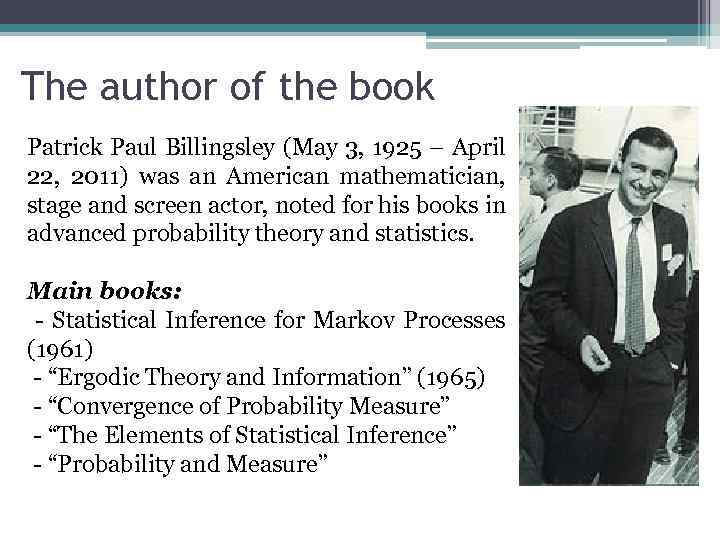 The author of the book Patrick Paul Billingsley (May 3, 1925 – April 22, 2011) was an American mathematician, stage and screen actor, noted for his books in advanced probability theory and statistics. Main books: - Statistical Inference for Markov Processes (1961) - “Ergodic Theory and Information” (1965) - “Convergence of Probability Measure” - “The Elements of Statistical Inference” - “Probability and Measure”
 The author of the book • After earning a Ph. D. in mathematics at Princeton University in 1955, he was attached to the NSA until his discharge from the Navy in 1957. • In 1958 he became a professor of mathematics and statistics at the University of Chicago, where he served as chair of the Department of Statistics from 1980 to 1983, and retired in 1994. • In 1964 -65 he was a Fulbright Fellow and visiting professor at the University of Copenhagen. In 1971 -72 he was a Guggenheim Fellow and visiting professor at the University of Cambridge (Peterhouse). • From 1976 to 1979 he edited the Annals of Probability. • In 1983 he was president of the Institute of Mathematical Statistics. He was given the Lester R. Ford Award for his article "Prime Numbers and Brownian Motion. “ • He was elected a Fellow of the American Academy of Arts and Sciences in 1986.
 Content
 Content
 Content
 Content
 Content
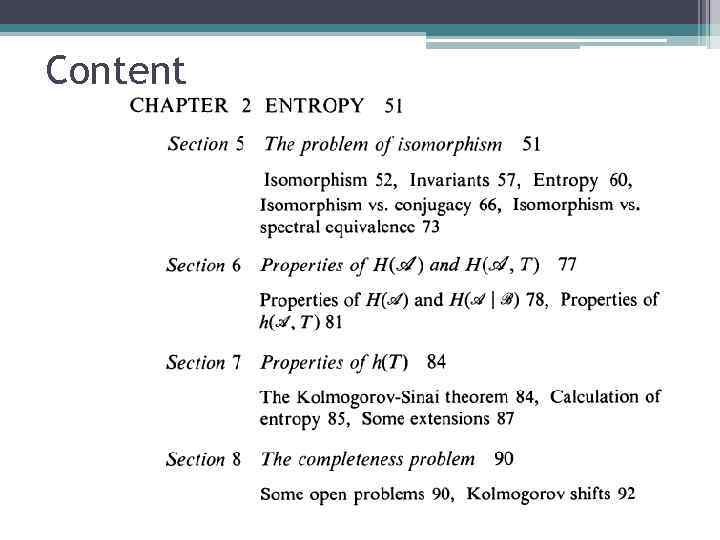
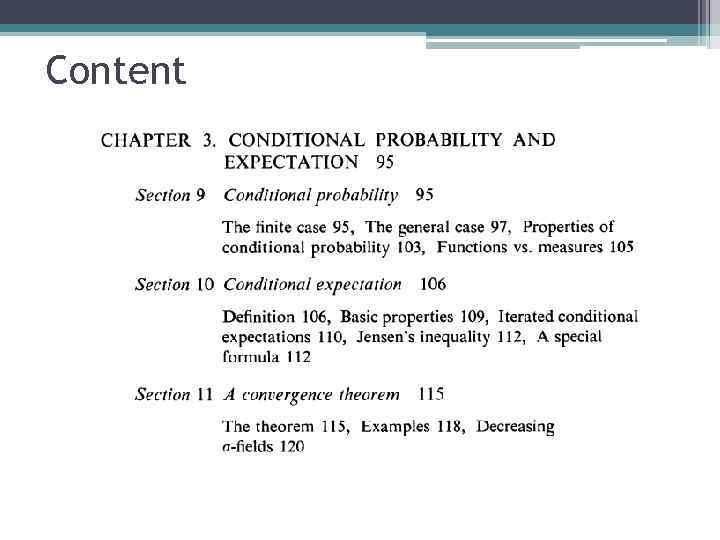
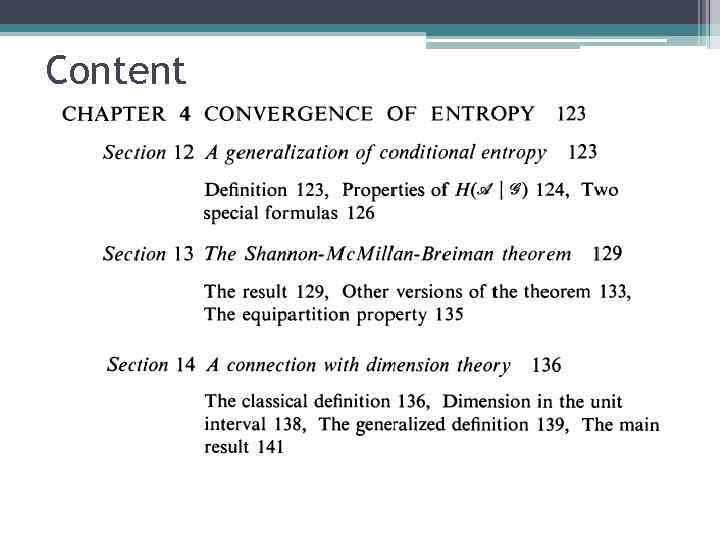
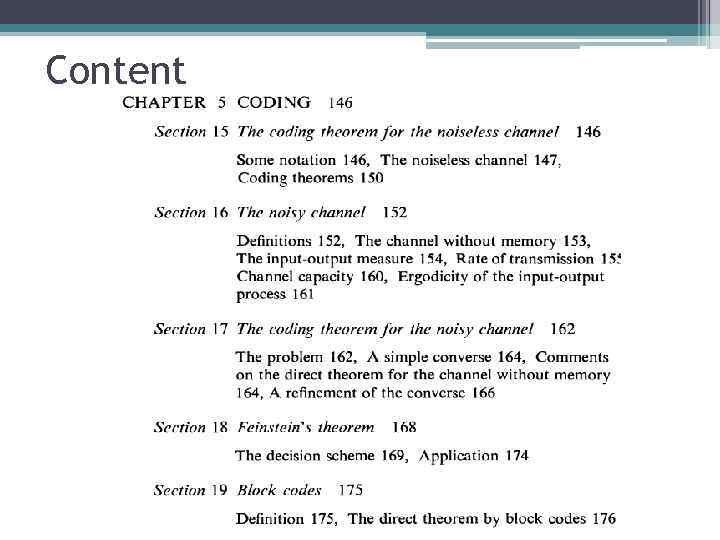
 • I think that book has logical construction. It consist of 5 main chapters: Ergodic Theory, Entropy, Conditional Probability, Convergence of Entropy and Coding. • Each following section includes information from the previous section. So the book is based on the principle of continuity and gradual material. • At the same time all this chapters are independent and can be used like separate monographs. • Also every chapter has 3 parts: theory which includes historical information, examples and application. The structure of this type is very easy to assimilate the new material. It presented in an accessible but strictly Scientifical forms. Therefore, this book is useful for scientists and greatly clear to students.
 The 1 -st, 2 -nd and 3 -rd chapters are directly connected to the topic of my thesis. • 2 -st chapter. ENTROPY. This Chapter consist of 4 sections. Chapter 2 treats the Kolmogorov-Sinai application of Shannon’s entropy to the isomorphism problem of ergodic theory. • 3 -rd chapter. CONDITIONAL PROBABILITY AND EXPECTATION. There are 3 section in this chapter. 1 -st and 2 -nd section include theoretical material about conditional probability and expectation. The 3 -rd section consider a convergence theorem, applications.
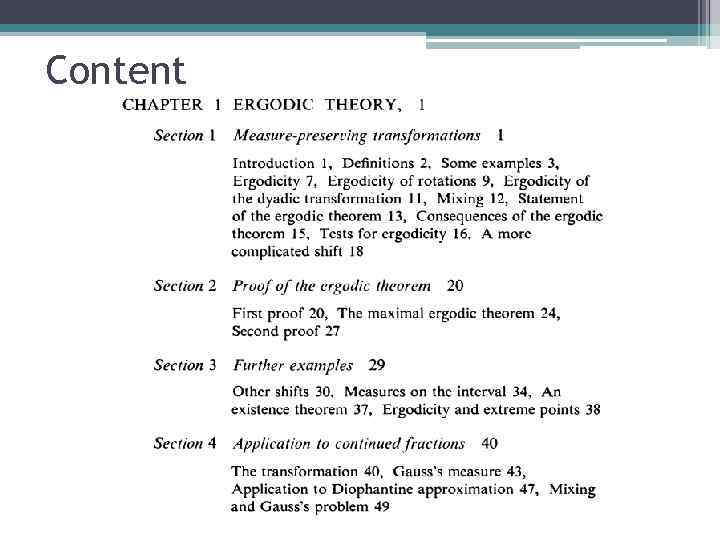
 The 1 -st chapter more than others related to the topic of my research. • 1 -st chapter. Ergodic theory This Chapter consist of 4 sections: - Measure-preserving transformtions; - Proof of the ergodic theorem; - Further examples; - Appliction to continued fractions.
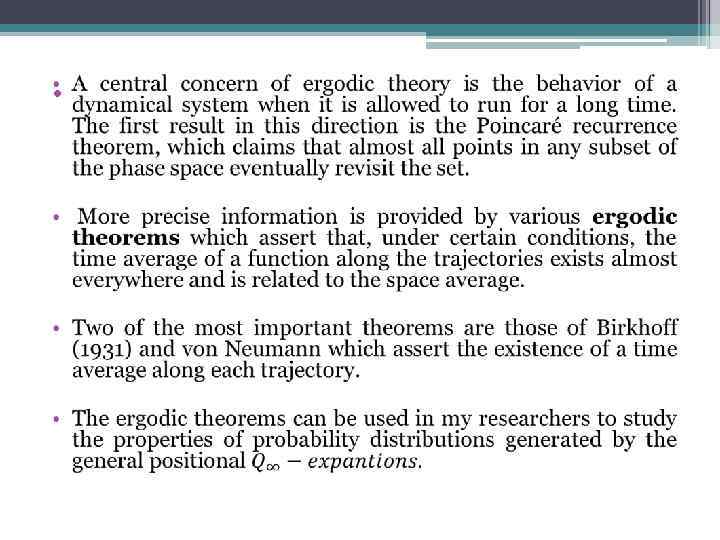 •
•