


 Скачать презентацию erformance in Run 2005 4 the last 10
e13aceeaf2b7c35896cb447fff8b3dec.ppt
- Количество слайдов: 1
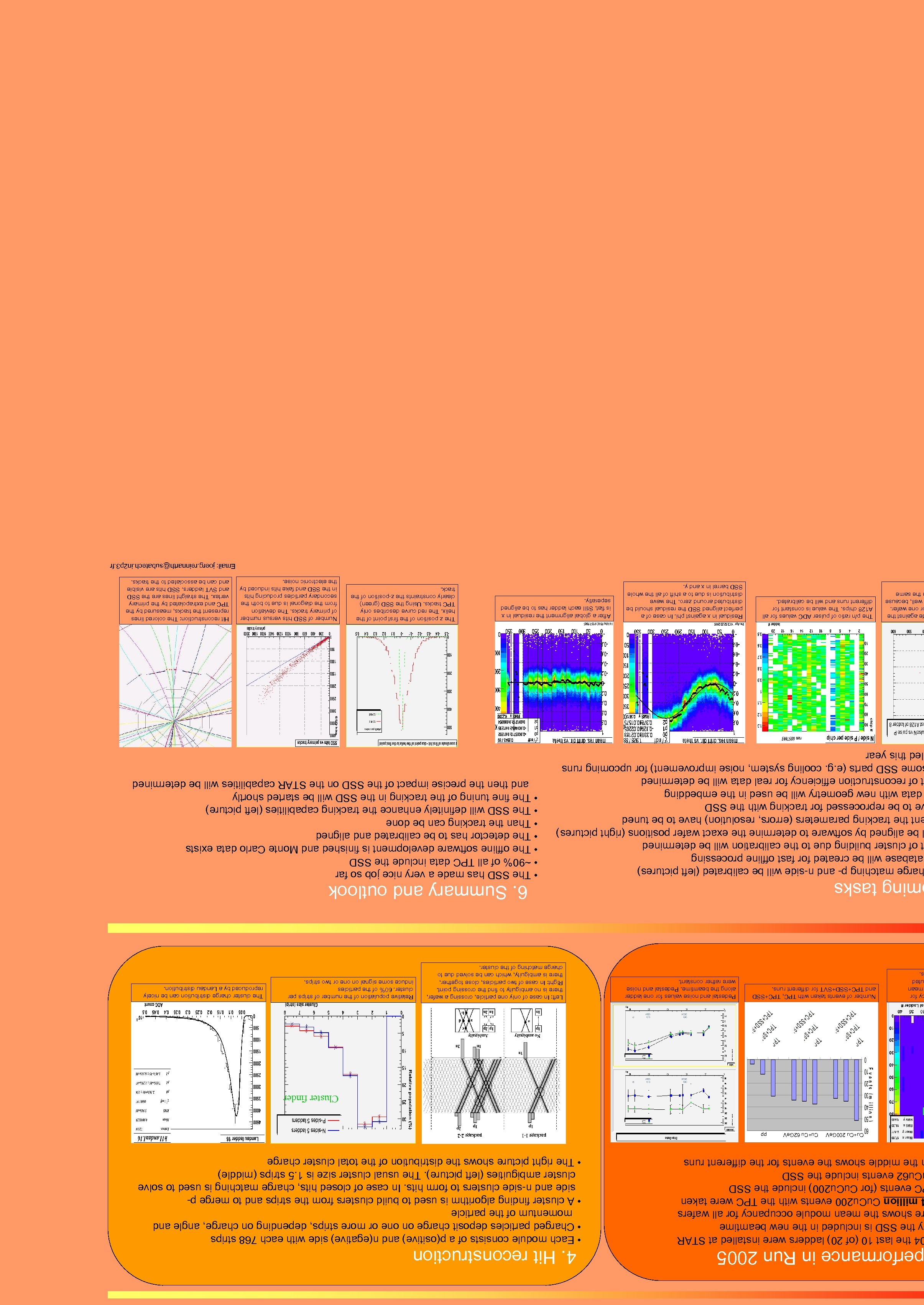 erformance in Run 2005 4 the last 10 (of 20) ladders were installed at STAR y the SSD is included in the new beamtime e shows the mean module occupancy for all wafers million Cu. Cu 200 events with the TPC were taken C events (for Cu. Cu 200) include the SSD Cu 62 events include the SSD the middle shows the events for the different runs 4. Hit reconstruction • Each module consists of a p(ositive) and n(egative) side with each 768 strips • Charged particles deposit charge on one or more strips, depending on charge, angle and momentum of the particle • A cluster finding algorithm is used to build clusters from the strips and to merge p- side and n-side clusters to form hits. In case of closed hits, charge matching is used to solve cluster ambiguities (left picture). The usual cluster size is 1. 5 strips (middle) • The right picture shows the distribution of the total cluster charge Cu+Cu 200 Ge. V Cu+Cu 62 Ge. V pp Cluster finder y for mean ted . Number of events taken with TPC, TPC+SSD and TPC+SSD+SVT for different runs. Pedestal and noise values for one ladder along the beamtime. Pedestal and noise were rather constant. Left: In case of only one particle, crossing a wafer, there is no ambiguity to find the crossing point. Right: In case of two particles, close together, there is ambiguity, which can be solved due to charge matching of the cluster. The p/n ratio of pulser ADC values for all A 128 chips. The value is constant for different runs and will be calibrated. Relative population of the number of strips per cluster. 60% of the particles induce some signal on one or two strips. The cluster charge distribution can be nicely reproduced by a Landau distribution. 6. Summary and outlook ming tasks arge matching p- and n-side will be calibrated (left pictures) atabase will be created for fast offline processing t of cluster building due to the calibration will be determined be aligned by software to determine the exact wafer positions (right pictures) nt the tracking parameters (errors, resolution) have to be tuned e to be reprocessed for tracking with the SSD data with new geometry will be used in the embedding t of reconstruction efficiency for real data will be determined ome SSD parts (e. g. cooling system, noise improvement) for upcoming runs led this year e against the r one wafer. well, because the same Residual in x against phi. In case of a perfect aligned SSD the residual should be distributed around zero. The wave distribution is due to a shift of all the whole SSD barrel in x and y. • The SSD has made a very nice job so far • ~90% of all TPC data include the SSD • The offline software development is finished and Monte Carlo data exists • The detector has to be calibrated and aligned • Than the tracking can be done • The SSD will definitely enhance the tracking capabilities (left picture) • The fine tuning of the tracking in the SSD will be started shortly and then the precise impact of the SSD on the STAR capabilities will be determined After a global alignment the residual in x is flat. Still each ladder has to be aligned seperatly. The z position of the first point of the helix. The red curve describes only TPC tracks. Using the SSD (green) clearly constraints the z-position of the track. Number of SSD hits versus number of primary tracks. The deviation from the diagonal is due to both the secondary particles producing hits in the SSD and fake hits induced by the electronic noise. Hit reconstruction: The colored lines represent the tracks, measured by the TPC and extrapolated by the primary vertex. The straight lines are the SSD and SVT ladders. SSD hits are visible and can be associated to the tracks. Email: joerg. reinnarth@subatech. in 2 p 3. fr