


 Скачать презентацию Erasmus Mundus Info Day Riga 25 02
e3fd324889b088247f5ccaf28b6559f6.ppt
- Количество слайдов: 64
 Erasmus Mundus – Info Day Riga, 25. 02. 2011 Edith Genser Programme Manager 1
 EM –Info Day • • • Erasmus Mundus Programme Call for proposals – relevant documents 3 Action Award criteria Keywords Selection Precess 2
 Erasmus Mundus aims • Promote European higher education • Improve and enhance students’ career prospects • Promote intercultural understanding through cooperation with third countries • Contribute to the sustainable development of third countries in the field of higher education 3
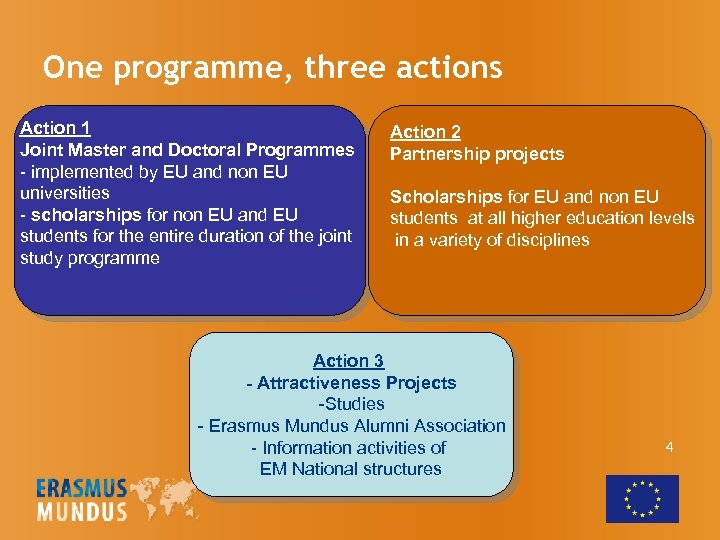 One programme, three actions Action 1 Joint Master and Doctoral Programmes - implemented by EU and non EU universities - scholarships for non EU and EU students for the entire duration of the joint study programme Action 2 Partnership projects Scholarships for EU and non EU students at all higher education levels in a variety of disciplines Action 3 - Attractiveness Projects -Studies - Erasmus Mundus Alumni Association - Information activities of EM National structures 4
 EM Call for Proposals 2011 • One programme, three actions = one Call • Call published 16 December 2010 • Deadline 29 April 2011, Selection July 2011 For Action 1 Proposals: 12 h 00 !! (Central European Time) • Key documents: – Programme Guide – Guidelines for Applicants (Action 2) – Call for Proposals 5
 Key documents: - Erasmus Mundus Programme Guide • For project beneficiaries and scholarship grantees • Programme objectives, activities, eligibility criteria, conditions for support • Valid for 2009 -2013 period • For use with individual Calls for Proposals documents, Guidelines for Applicants 6 (Action 2) and Application Form instructions
 Key documents: - Erasmus Mundus Guidelines (Action 2) • • • Lists geographical lots Budget per lot minimum mobility flows Thematic priorities (disciplines) Specific criteria for partners/partnerships Types of mobility funded and duration 7
 Key documents: - Call notice: Official Journal C 341, 16. 12. 10 • Brief programme description • Targets and/or budget per Action • Summary of award criteria • Priorities under Action 3 • Submission deadlines 8
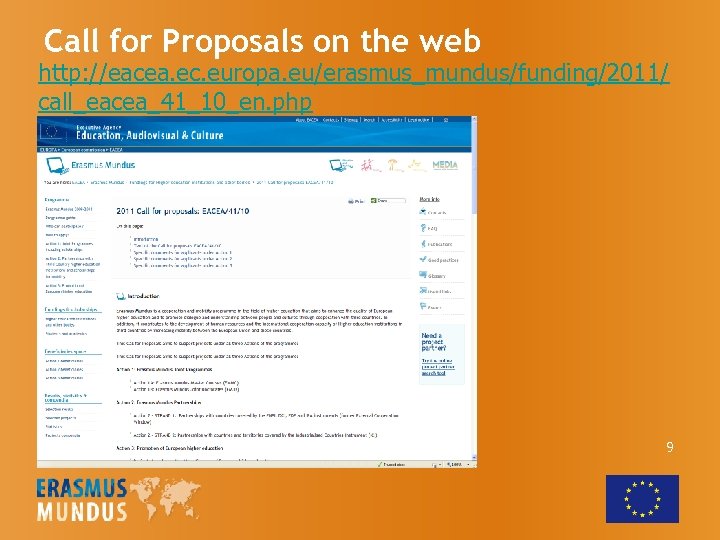 Call for Proposals on the web http: //eacea. ec. europa. eu/erasmus_mundus/funding/2011/ call_eacea_41_10_en. php 9
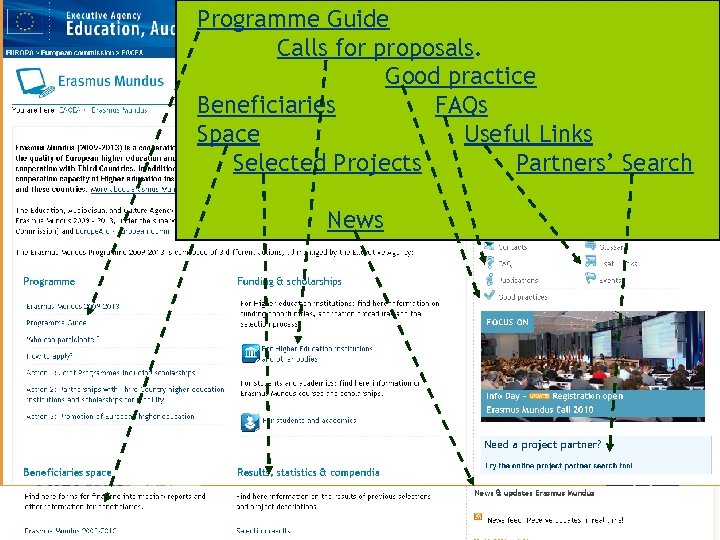 Programme Guide 10 ERASMUS MUNDUS ON EACEA WEBSITE Calls for proposals. Good practice Beneficiaries FAQs Space Useful Links Selected Projects Partners’ Search News
 Action 1 – Joint Programmes 11
 What is an EM Joint Programme? 1. 2. 3. 4. 5. 6. An integrated programme at masters (60 to 120 ECTS) or doctoral (3 to 4 years) level; Jointly designed, delivered and managed by a consortium of HEIs representing at least 3 different EU/EEA states and, optionally, non EUR HEIs; That includes a mandatory mobility component; That is fully recognised and leads to the award of a double, multiple or joint degree; That aims at attracting the best students, doctoral candidates and scholars, worldwide Offers full study scholarships to EU and non-EU nationals (students, doct. candid. , scholars) 12
 Action 1 – facts & figures so far • 123 Masters courses (EMMCs) with scholarships in 2011 • 24 Joint Doctorates (EMJDs) • 380 different HEIs as full partners in these 147 programmes • 10 920 student scholarships 2004 -2010 • 2750 scholarships 2004 -2010 13
 EM Call 2011 – Action 1 • Action 1 Call targets – EMMCs: 10 to 15 new Masters & up to 22 renewals – EMJDs: 9 or 10 new Doctorates • PDF version of application form & Instruction document now on line • E-forms to be used for final applications • Summary sheets (on paper version) by 31 March 2011 • Application Deadline: 29 April MIDDAY ! 14 (Central European Time)
 An EM Joint Programme must (1): 1. be coordinated by an eligible EU HEI applicant; 2. have min. 3 different EUR countries represented as partners (EU / EEA) - additional partners may be from EUR or third countries; 3. be an integrated programme in all its aspects; 4. be fully developed at application stage and ready to run for 5 consecutive editions as summer 2012 5. be based on consortium agreement signed by the governing bodies of the partner HEIs (signed before signature of the first specific grant agreement); 6. include a mandatory mobility component in at least 2 15 EUR countries;
 An EM Joint Programme must (2): 7. be fully recognised (by summer 2012 at the latest); 8. lead to the award of a double, multiple or joint degree (the latter will be favoured) 9. provide for the use of national European languages 10. attract and recruit top class students / doctoral candidates / scholars worldwide 11. provide high quality services to enrolled candidates (visa / residence permit support, mandatory insurance, support to family and special needs) 12. sign agreements with students / doctoral candidates on rights and obligations of each party 16
 EM Joint Programmes: Contractual and Financial conditions (1) If selected for funding 1. Framework Partnership Agreement covering 5 consecutive editions (5 to 8 years, in accordance with the length of the joint programme) 2. 5 yearly Specific Grant Agreements covering the financial support for each of the 5 editions: – Management of the joint programme: flat rate amount (30, 000 € for EMMCs, 50, 000 € for EMJDs) per edition – Fixed number of Individual scholarships / fellowships (exact number fixed yearly – autumn year “n-1” - in accordance with the “seniority” of the joint programme) • Two types of scholarships / fellowships – – Category A: third country individuals, not resident, and have not carried out their main activity in Europe for more than 12 months over the last 5 years Category B: any individual who does not fulfil category A requirement 17
 EM Joint Programmes: Contractual and Financial conditions (2) Different types of scholarships / fellowships • For students or doctoral candidates – Category A: third country individuals, not resident, and have not carried out their main activity in Europe for more than 12 months over the last 5 years – Category B: any individual who does not fulfil category A requirements • For scholars in Joint Programmes at masters level – Non European: scholars enrolled in any non European HEI – European: scholars enrolled in partner EUR HEIs, under the condition that the consortium includes student mobility to 18 non EUR partners
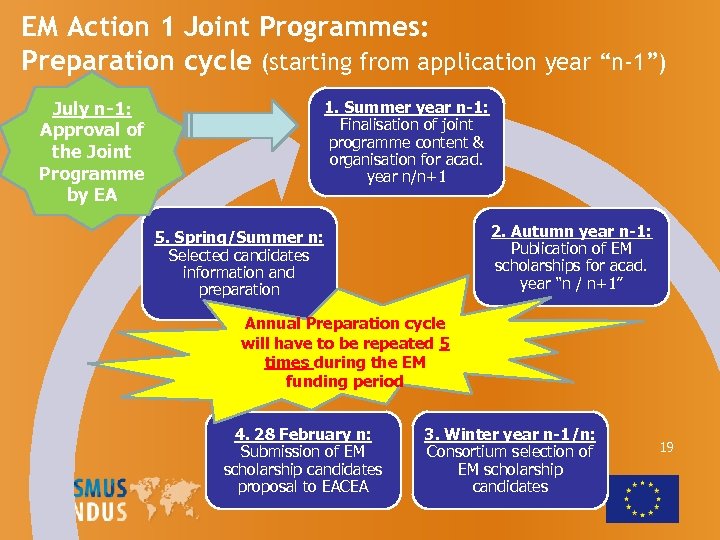 EM Action 1 Joint Programmes: Preparation cycle (starting from application year “n-1”) July n-1: Approval of the Joint Programme by EA 1. Summer year n-1: Finalisation of joint programme content & organisation for acad. year n/n+1 2. Autumn year n-1: Publication of EM scholarships for acad. year “n / n+1” 5. Spring/Summer n: Selected candidates information and preparation Annual Preparation cycle will have to be repeated 5 times during the EM funding period 4. 28 February n: Submission of EM scholarship candidates proposal to EACEA 3. Winter year n-1/n: Consortium selection of EM scholarship candidates 19
 Joint Programmes at masters level (EMMCs) : Specific features (1) • All partners must be able to act as host institution and deliver part of the curriculum – min. 20 ECTS (for one year EMMCs) or 30 ECTS (for longer EMMCs) for European HEIs – min. 15 ECTS for third country HEIs • The EMMC must last between 1 (60 ECTS) and 2 academic years (120 ECTS) – final examination results to be known at the latest in October of the year in which the EMMC finishes 20
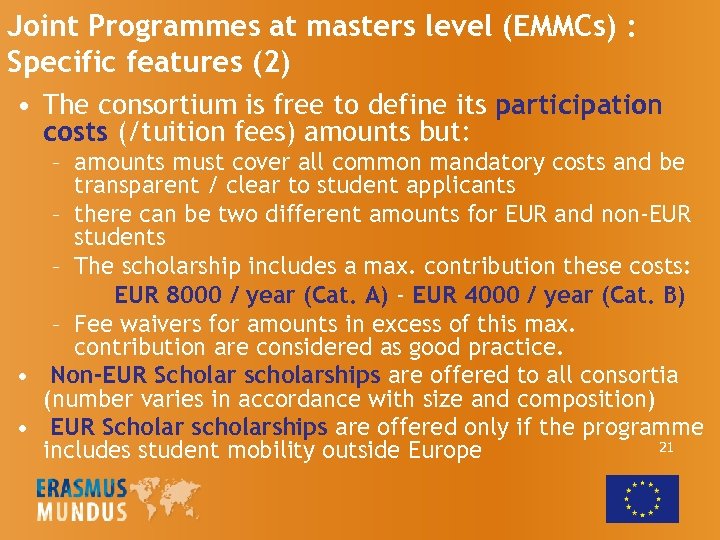 Joint Programmes at masters level (EMMCs) : Specific features (2) • The consortium is free to define its participation costs (/tuition fees) amounts but: – amounts must cover all common mandatory costs and be transparent / clear to student applicants – there can be two different amounts for EUR and non-EUR students – The scholarship includes a max. contribution these costs: EUR 8000 / year (Cat. A) - EUR 4000 / year (Cat. B) – Fee waivers for amounts in excess of this max. contribution are considered as good practice. • Non-EUR Scholar scholarships are offered to all consortia (number varies in accordance with size and composition) • EUR Scholar scholarships are offered only if the programme 21 includes student mobility outside Europe
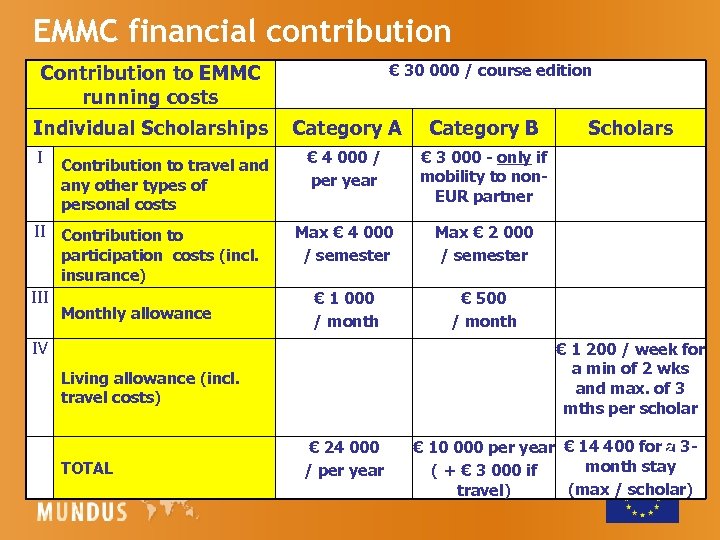 EMMC financial contribution Contribution to EMMC running costs Individual Scholarships I Contribution to travel and any other types of personal costs II Contribution to participation costs (incl. insurance) III Monthly allowance € 30 000 / course edition Category A Category B € 4 000 / per year € 3 000 - only if mobility to non. EUR partner Max € 4 000 / semester Max € 2 000 / semester € 1 000 / month € 500 / month IV € 1 200 / week for a min of 2 wks and max. of 3 mths per scholar Living allowance (incl. travel costs) TOTAL Scholars € 24 000 / per year a € 10 000 per year € 14 400 for 22 3 month stay ( + € 3 000 if (max / scholar) travel)
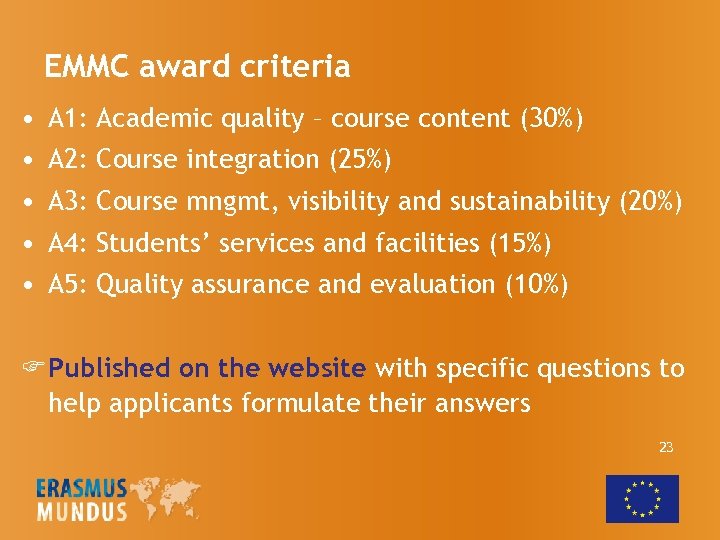 EMMC award criteria • A 1: Academic quality – course content (30%) • A 2: Course integration (25%) • A 3: Course mngmt, visibility and sustainability (20%) • A 4: Students’ services and facilities (15%) • A 5: Quality assurance and evaluation (10%) F Published on the website with specific questions to help applicants formulate their answers 23
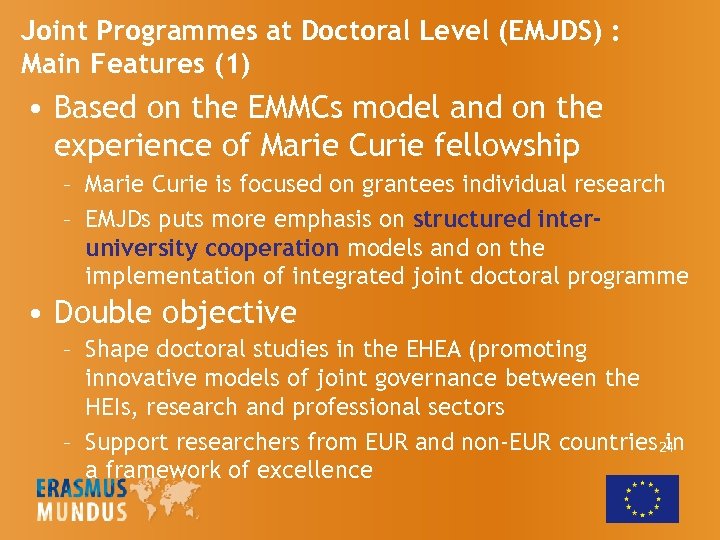 Joint Programmes at Doctoral Level (EMJDS) : Main Features (1) • Based on the EMMCs model and on the experience of Marie Curie fellowship – Marie Curie is focused on grantees individual research – EMJDs puts more emphasis on structured interuniversity cooperation models and on the implementation of integrated joint doctoral programme • Double objective – Shape doctoral studies in the EHEA (promoting innovative models of joint governance between the HEIs, research and professional sectors – Support researchers from EUR and non-EUR countries 24 in a framework of excellence
 Joint Programmes at Doctoral Level (EMJDS) : Main Features (2) • Organisations other than HEIs can be formal partners of the consortium if they – provide teaching, training or research opportunities and/or – recruit, employ, host doctoral candidates • EMJDs of 3 or 4 years duration BUT fellowships for max 3 years • For each EMJD edition – Start individual research project at the latest in March of the acad. year concerned – Candidates final results (/thesis defence) at the latest in October of the fourth year • Training / research for a minimum total of 6 months in at least two of the consortium EUR countries. 25
 Joint Programmes at Doctoral Level (EMJDS) : Main Features (3) • Clear definition and justification (needs analysis / added value) of thematic area(s) covered by the EMJD • Recruitment of doctoral candidates under employment contracts (unless prohibited by national regulation) • Follow the principles of the European Charter for Researchers and the Code of Conduct for the recruitment of Researchers • Free determination of participation costs but – must be transparent and clear to potential candidates – 2 different fixed amounts for laboratory and non laboratory based research 26
 Joint Programmes at Doctoral Level (EMJDS) : Main Features (4) • Employment contracts is the EMJD recruitment method that guarantees adequate and equitable social security provisions: - Sickness and parental benefits - Health and accident insurance - Pension rights and unemployment benefits and is in accordance with existing national legislation and with national or sectoral collective bargaining agreements • An EMJD is supposed to be laboratory-based if the research projects carried out by the doctoral candidates require the usage of expensive equipment/material, the execution of external fieldwork or involve particularly high costs that would exceed the 300 EUR/month included in the fellowship amount for 27 « non-laboratory-based » research projects
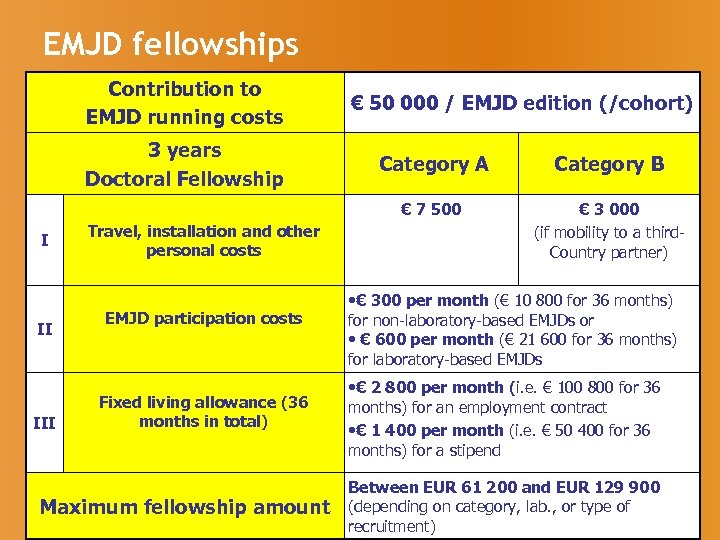 EMJD fellowships Contribution to EMJD running costs 3 years Doctoral Fellowship € 50 000 / EMJD edition (/cohort) II III Travel, installation and other personal costs EMJD participation costs Fixed living allowance (36 months in total) Maximum fellowship amount Category B € 7 500 I Category A € 3 000 (if mobility to a third. Country partner) • € 300 per month (€ 10 800 for 36 months) for non-laboratory-based EMJDs or • € 600 per month (€ 21 600 for 36 months) for laboratory-based EMJDs • € 2 800 per month (i. e. € 100 800 for 36 months) for an employment contract • € 1 400 per month (i. e. € 50 400 for 36 28 months) for a stipend Between EUR 61 200 and EUR 129 900 (depending on category, lab. , or type of recruitment)
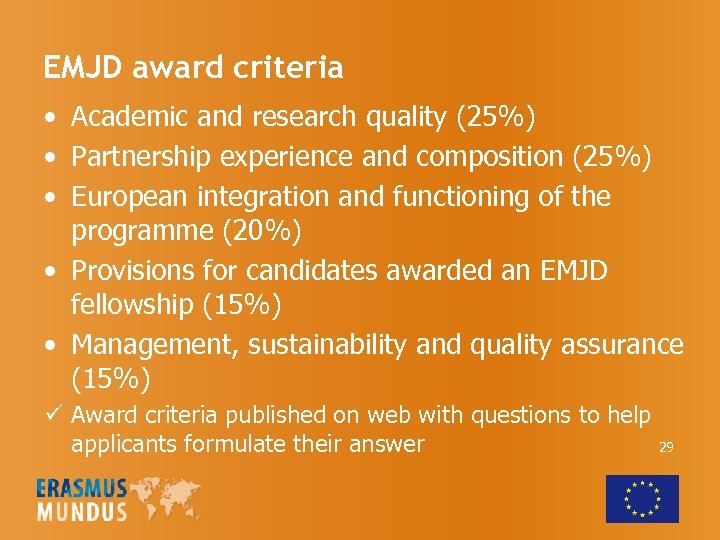 EMJD award criteria • Academic and research quality (25%) • Partnership experience and composition (25%) • European integration and functioning of the programme (20%) • Provisions for candidates awarded an EMJD fellowship (15%) • Management, sustainability and quality assurance (15%) ü Award criteria published on web with questions to help 29 applicants formulate their answer
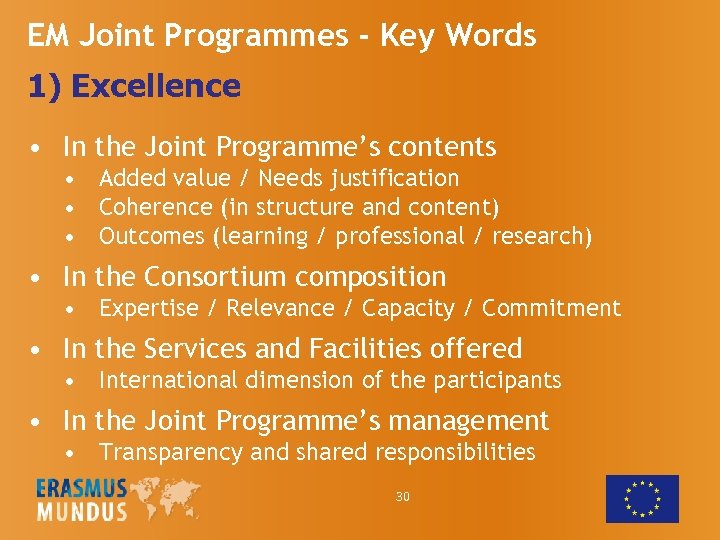 EM Joint Programmes - Key Words 1) Excellence • In the Joint Programme’s contents • Added value / Needs justification • Coherence (in structure and content) • Outcomes (learning / professional / research) • In the Consortium composition • Expertise / Relevance / Capacity / Commitment • In the Services and Facilities offered • International dimension of the participants • In the Joint Programme’s management • Transparency and shared responsibilities 30
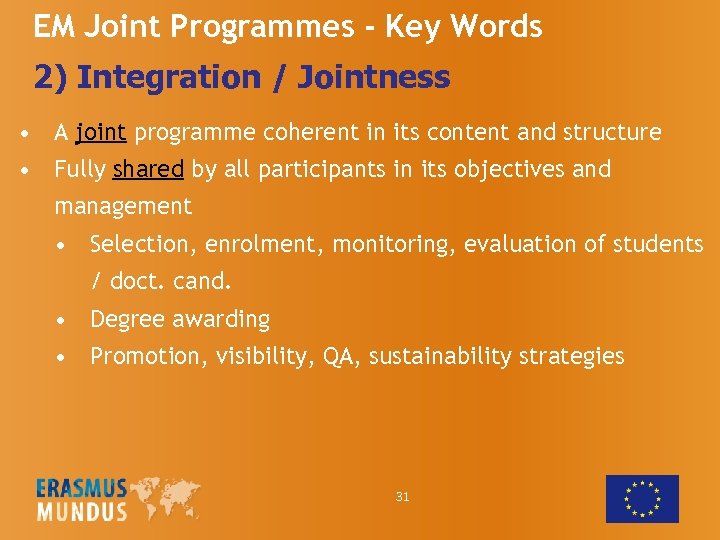 EM Joint Programmes - Key Words 2) Integration / Jointness • A joint programme coherent in its content and structure • Fully shared by all participants in its objectives and management • Selection, enrolment, monitoring, evaluation of students / doct. cand. • Degree awarding • Promotion, visibility, QA, sustainability strategies 31
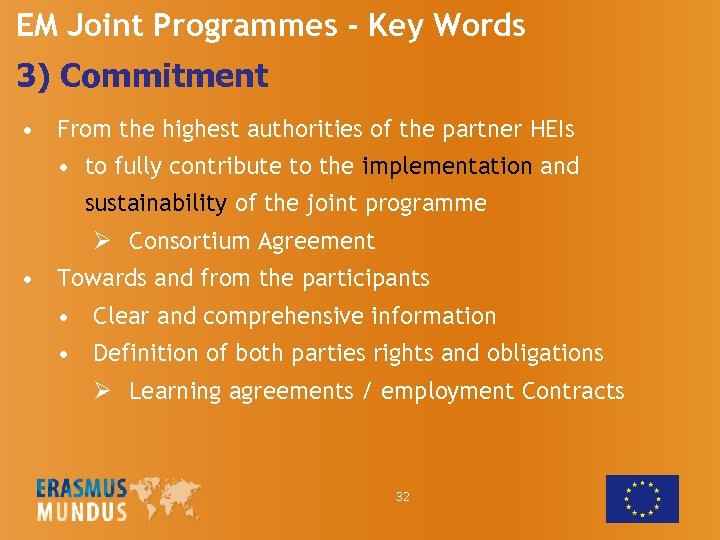 EM Joint Programmes - Key Words 3) Commitment • From the highest authorities of the partner HEIs • to fully contribute to the implementation and sustainability of the joint programme Ø Consortium Agreement • Towards and from the participants • Clear and comprehensive information • Definition of both parties rights and obligations Ø Learning agreements / employment Contracts 32
 EM Joint Programmes - Key Words 4) Sustainability • EM grant must be envisaged as “seed funding” (up to 9 years) • From (/prior to) the start of the programme • Secure “own” funding / support • Involve stakeholders (public / private; in and outside EUR) • Continuous evaluation of relevance, excellence, innovation, attractiveness of the joint programme 33
 EM Joint Programmes - Key Words 5) Employability • Coherence between objectives and expected learning/professional outcomes • Implication of non educational actors in the programmes evaluation • Learning by doing (internships, fieldwork, project based activities), • Employment oriented skills and competences • Brain drain / gain / circulation (Non-EUR dimension) 34
 EM Joint Programmes - Key Words 6) Transparency • Within the consortium and towards its participants, transparency regarding: • the joint programme’s content and delivery conditions, • the application, selection, enrolment, evaluation, degree awarding, etc. procedures • both parties’ obligations, rights and expectations 35
 EM Joint Programmes : How to stand out from the Crowd ? • • Solid integrated consortium Solid / coherent learning/research programme Strong links with society needs (in and out EU) Strong academic/research quality and innovation potential Ø Consult information available on good practices (see EM Joint Programmes useful links) Ø Get advice from experienced colleagues and EM National Structures 36
 EM Joint Programmes Useful Links Ø EMQA - Erasmus Mundus Quality Assessment Ø http: //www. emqa. eu Ø JOIMAN - Joint Degree Management and Administration Network Ø https: //www. joiman. eu/Pages/Project. aspx Ø ENQA – European Association for Quality Assurance Ø http: //www. enqa. eu/ Ø ECA - European Consortium for Accreditation Ø http: //eacea. ec. europa. eu/erasmus_mundus/results_compendi a/selected_projects_en. php 37 37
 Action 2 - Partnerships 38
 Action 2 Partnerships - cooperation • Large partnerships between higher education institutions in EU and third countries in a specific region • Countries / regions covered by the EU’s external co-operation instruments • Erasmus-style cooperation mechanisms, transfer of know-how • Definition of priorities according to the needs of third countries involved 39
 Action 2 – Mobility • Scholarships of varying length (1 month to 3 years) • Bachelor, master, doctorate and postdoctorate students and HE staff (training, teaching, research activities) • Mobility not linked to specific programmes • Special attention paid to socioeconomically disadvantaged groups and populations in a vulnerable situation 40 (Strand 1 only)
 Action 2 shape and finance • Composition – At least 5 European HEIs from at least 3 EU countries – At least 1 HEI from each country of the Lot (S 1) – At least 3 HEIs from two countries of the Lot (S 2) Check the specific lot for details • Maximum eligiblity period: 48 months • Partnership management flat rate = EUR 10, 000 x number of partners (max EUR 200, 000) • Individual scholarships using flat rates cover: – – Travel Subsistence costs Fees Insurance and visa costs 41
 Action 2 individual mobility • 5 possible levels of higher education: – Undergraduate – Masters - Doctorate - Post-Doctorate – Staff • Variable length mobility: – 1 – 36 months for both degree-seeking and other students • 3 target groups – Target Group 1: students/staff from partners institutions – Target Group 2: other nationals from third countries – Target Group 3: national of third countries in lot in vulnerable situation 42
 Action 2: common & specific elements • Common to all Action 2 lots – – – A range of target groups for mobility A range of duration for mobility Up to 5 levels of higher education covered Project must start operations in year of selection (year ‘n’) Mobility may start in different ‘cohorts’ throughout partnership life • Specific to individual lots (See Guidelines) – – Which target groups covered by mobility Which levels of higher education covered Thematic fields of study Partnership composition 43
 Action 2 individual mobility • Strand 1 – TG 1 at least 50% of individual mobility – Third-country mobility at least 70% of individual mobility – European mobility maximum 30% of individual mobility (ENPI and IPA) – No mobility for Europeans under DCI or ACP • Strand 2 – Only TG 1: no undergraduate level – European mobility at least 60% of individual mobility – Third-country mobility to Europe no higher than 40% of individual mobility 44
 EM Call 2011 – Action 2 What’s new in 2011? • New distribution of lots in Mediterranean • Libya newly-eligible (Lot 1) • Student selections may be in up to three annual cohorts • Extended duration for – Masters: up to 24 months – Doctorates: up to 36 months 45
 EM Call 2011 – Action 2: Strand 1 • 16 Lots for countries covered by ENPI, DCI, EDF, IPA • 38 projects expected • Total budget EUR 94. 5 million • Mobility for at least 3, 335 individuals 46
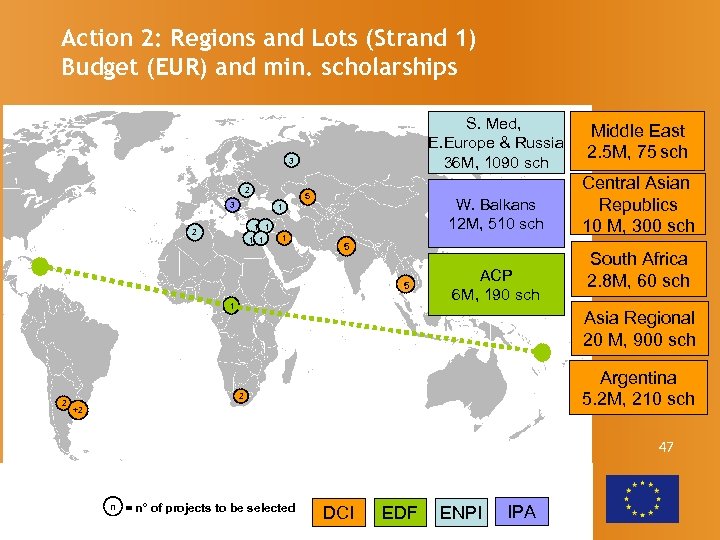 Action 2: Regions and Lots (Strand 1) Budget (EUR) and min. scholarships S. Med, E. Europe & Russia 36 M, 1090 sch 3 2 3 5 W. Balkans 12 M, 510 sch 1 1 1 2 1 5 5 1 2 ACP 6 M, 190 sch Middle East 2. 5 M, 75 sch Central Asian Republics 10 M, 300 sch South Africa 2. 8 M, 60 sch Asia Regional 20 M, 900 sch Argentina 5. 2 M, 210 sch 2 +2 47 n = n° of projects to be selected DCI EDF ENPI IPA
 Action 2 award criteria: Strand 1 1: Relevance (25%) 2: Quality (65% total) – 2. 1. Partnership composition and cooperation mechanisms (20%) – 2. 2. Organisation & implementation of mobility (25%) – 2. 3. Student/staff facilities and follow-up (20%) 3: Sustainability (10%) 48
 EM Call 2011 – Action 2: Strand 2 (Industrialised Countries Instrument) • • 4 Lots for countries covered by ICI 4 projects expected Total budget EUR 6. 3 million Mobility for at least 140 individuals 49
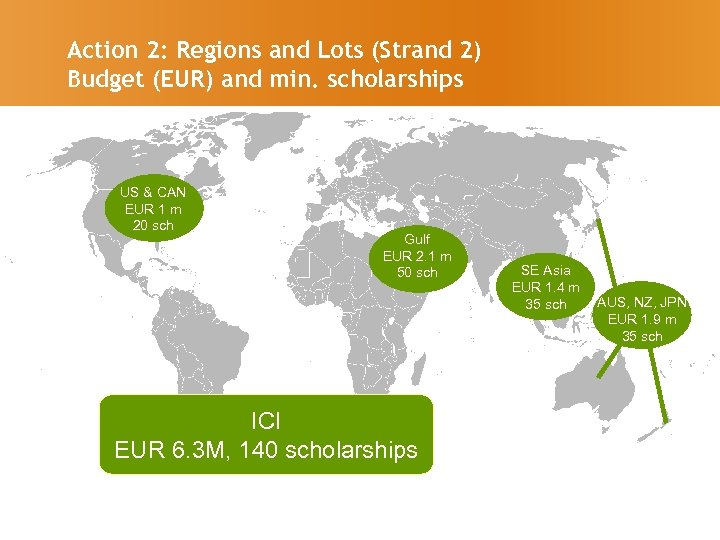 Action 2: Regions and Lots (Strand 2) Budget (EUR) and min. scholarships US & CAN EUR 1 m 20 sch Gulf EUR 2. 1 m 50 sch ICI EUR 6. 3 M, 140 scholarships SE Asia EUR 1. 4 m 35 sch AUS, NZ, JPN EUR 1. 9 m 35 sch 50 50
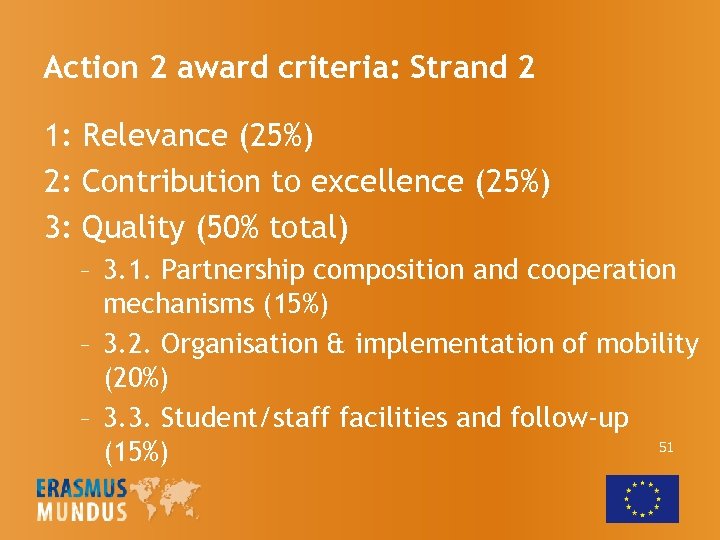 Action 2 award criteria: Strand 2 1: Relevance (25%) 2: Contribution to excellence (25%) 3: Quality (50% total) – 3. 1. Partnership composition and cooperation mechanisms (15%) – 3. 2. Organisation & implementation of mobility (20%) – 3. 3. Student/staff facilities and follow-up 51 (15%)
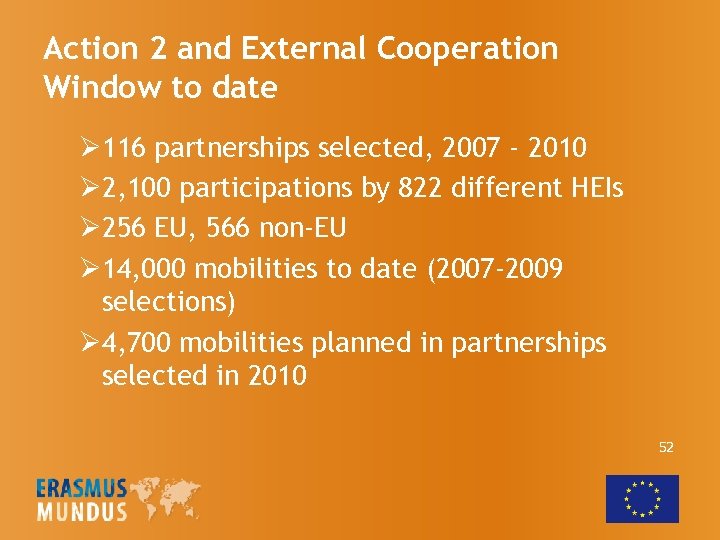 Action 2 and External Cooperation Window to date Ø 116 partnerships selected, 2007 - 2010 Ø 2, 100 participations by 822 different HEIs Ø 256 EU, 566 non-EU Ø 14, 000 mobilities to date (2007 -2009 selections) Ø 4, 700 mobilities planned in partnerships selected in 2010 52
 Action 3 53
 Action 3 • Promotion projects and “clustering” activities • Information grants for Erasmus Mundus National Structures • Erasmus Mundus Students and Alumni Association (EMA) • Studies 54
 EM Call 2011 – Action 3 • Budget EUR 1. 3 million • Target: 6 projects • Indicative project size: from EUR 100, 000 to 350, 000 • European co-financing to max 75% • Project duration: 12 – 36 months • Min. 3 European and 1 third-country partner 55
 Action 3 results to date: promotion projects • 54 projects selected under former A 4 (2004 -2008) • Total budget: € 13. 36 m • 8 projects selected under A 3 (2010) • Total budget: € 2. 32 m 56
 EM Call 2011 – Action 3 (open call only) Action 3 priority areas - projects aiming to: • Promote European HE in certain geographical areas with priority to the less-represented in Erasmus Mundus (e. g. Africa, industrialised countries) • Improve services for international students and doctoral candidates • Address the international dimension of Quality Assurance • Strengthen relation between HE and research in Europe • Promote European study opportunities for doctoral candidates • Promote the Erasmus Mundus programme towards 57 European students
 EM Call 2011 – Action 3 Project requirements • Clear European dimension and wide geographical scope • Clear international (third-country) dimension • Must contribute to fostering intercultureal dialogue and mutual understanding between cultures • Ensure no overlap with other EU programmes for higher education 58
 Action 3 award criteria 1. Relevance to the EM programme (25%) 2. Expected impact to help enhance attractiveness of European HE worldwide (25%) 3. Arrangements for dissemination of results and experiences, quality assurance and plans for sustainability and long-term exploitation of results (15%) 4. Consortium composition and cooperation mechanisms (15%) 5. Work plan and budget (20%) 59
 Action 3 results to date – Projects focused on specific fields: • Promotion of Education Higher Education to the world • Doctoral studies & research • Services for international students & doctoral candidates • Quality Assurance • Recognition of degrees & joint programmes development • Promotion of specific academic disciplines 60
 Action 3 results to date – Projects focused on specific regions: • Asia • Africa • Europe • Latin America • North America and Industrialised Countries 61
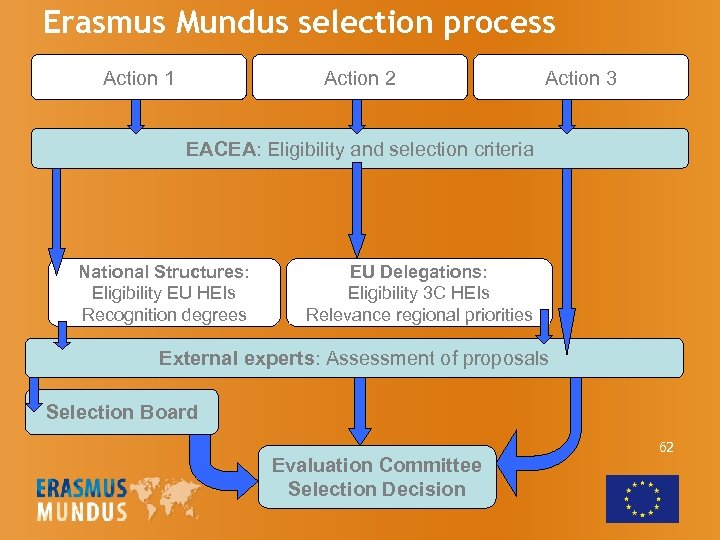 Erasmus Mundus selection process Action 1 Action 2 Action 3 EACEA: Eligibility and selection criteria National Structures: Eligibility EU HEIs Recognition degrees EU Delegations: Eligibility 3 C HEIs Relevance regional priorities External experts: Assessment of proposals Selection Board Evaluation Committee Selection Decision 62
 Assessment by external experts • Selected by Agency after Call for expression of interest – http: //eacea. ec. europa. eu/about/call_experts/ call_experts_2007_en. php • Two individual assessments are consolidated. If significant divergence, a third assessment • Expertise in international HE cooperation – plus thematic expertise for Actions 1 & 3; – geographical expertise for Action 2 • Summary sheets (Action 1) help pre-select experts in correct fields 63
 Erasmus Mundus website http: //eacea. ec. europa. eu/erasmus_mundus/index_en. php Erasmus Mundus Infoday site • Presentations • Link to webstreaming and chat • Videos shortly after event http: //eacea. ec. europa. eu/erasmus_mundus/events/infoda y_2011_en. php 64