 Скачать презентацию ERAIFT s contributions to the sustainable management of natural
4a1fe89ff4d9851ea1b7be3198ce2568.ppt
- Количество слайдов: 20



ERAIFT’s contributions to the sustainable management of natural resources in Sub. Saharan Africa: Building Capacity 18 th September 2014 Baudouin MICHEL Director of ERAIFT b. michel@unesco. org Baudouin. michel@ulg. ac. be
slide 2
Structure of ERAIFT Implementing Agency International Supervision Committee (ISC) Governing Council (GC) Academic and Research Board (A&RB) slide 3
The foundations of ERAIFT The foundations ÉRAIFT is built upon are the approaches used by the Man and Biosphere Programme (MAB), its World Network of Biosphere Reserves and experiences from the Draft Integrated Pastoral Development Training in the Sahel (FAPIS). The systemic approach promoted by the School is interdisciplinary, participatory, holistic and integrated. ERAIFT’s mission is to train a new type of qualified specialist for the management of tropical forests and territories in Sub-Saharan Africa. Training provided by the school is at a postgraduate level. slide 4
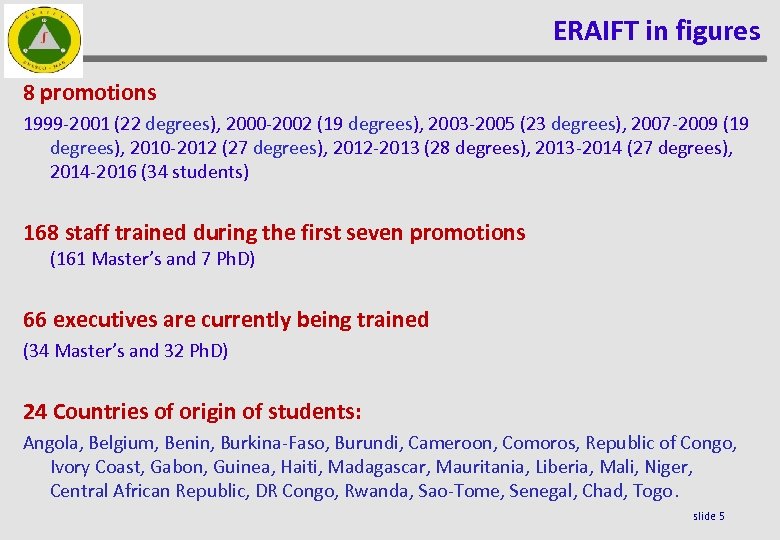
ERAIFT in figures 8 promotions 1999 -2001 (22 degrees), 2000 -2002 (19 degrees), 2003 -2005 (23 degrees), 2007 -2009 (19 degrees), 2010 -2012 (27 degrees), 2012 -2013 (28 degrees), 2013 -2014 (27 degrees), 2014 -2016 (34 students) 168 staff trained during the first seven promotions (161 Master’s and 7 Ph. D) 66 executives are currently being trained (34 Master’s and 32 Ph. D) 24 Countries of origin of students: Angola, Belgium, Benin, Burkina-Faso, Burundi, Cameroon, Comoros, Republic of Congo, Ivory Coast, Gabon, Guinea, Haiti, Madagascar, Mauritania, Liberia, Mali, Niger, Central African Republic, DR Congo, Rwanda, Sao-Tome, Senegal, Chad, Togo. slide 5
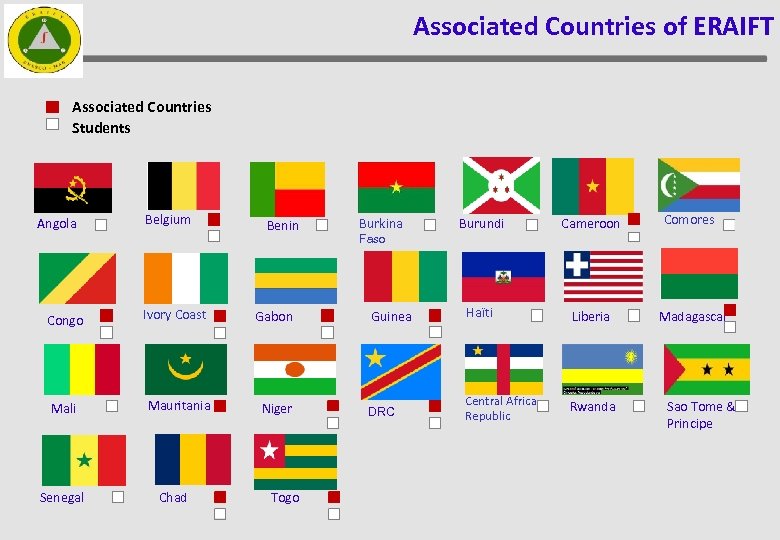
Associated Countries of ERAIFT Associated Countries Students Angola Congo Mali Senegal Belgium Benin Ivory Coast Gabon Mauritania Niger Chad Togo Burkina Burundi Cameroon Guinea Haïti Liberia DRC Central Africa Republic Rwanda Comores Faso Madagascar Sao Tome & Principe
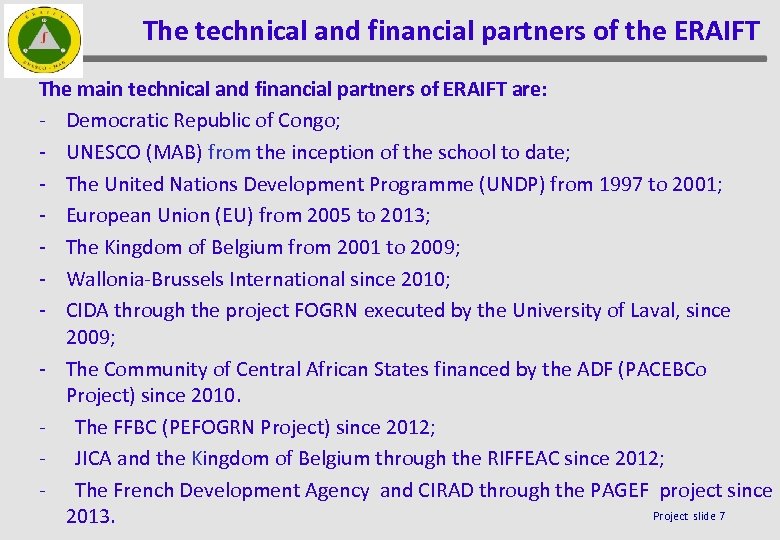
The technical and financial partners of the ERAIFT The main technical and financial partners of ERAIFT are: - Democratic Republic of Congo; - UNESCO (MAB) from the inception of the school to date; - The United Nations Development Programme (UNDP) from 1997 to 2001; - European Union (EU) from 2005 to 2013; - The Kingdom of Belgium from 2001 to 2009; - Wallonia-Brussels International since 2010; - CIDA through the project FOGRN executed by the University of Laval, since 2009; - The Community of Central African States financed by the ADF (PACEBCo Project) since 2010. - The FFBC (PEFOGRN Project) since 2012; - JICA and the Kingdom of Belgium through the RIFFEAC since 2012; - The French Development Agency and CIRAD through the PAGEF project since Project slide 7 2013.
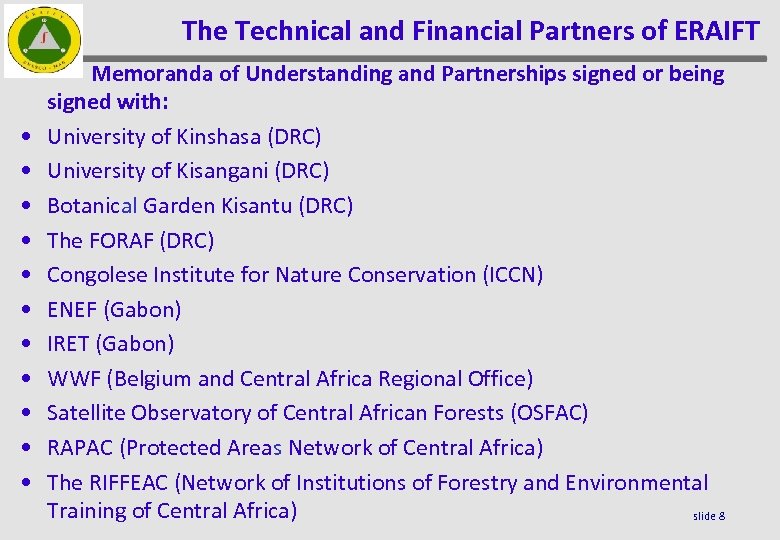
The Technical and Financial Partners of ERAIFT • • • Memoranda of Understanding and Partnerships signed or being signed with: University of Kinshasa (DRC) University of Kisangani (DRC) Botanical Garden Kisantu (DRC) The FORAF (DRC) Congolese Institute for Nature Conservation (ICCN) ENEF (Gabon) IRET (Gabon) WWF (Belgium and Central Africa Regional Office) Satellite Observatory of Central African Forests (OSFAC) RAPAC (Protected Areas Network of Central Africa) The RIFFEAC (Network of Institutions of Forestry and Environmental Training of Central Africa) slide 8
The Technical and Financial Partners of ERAIFT • • • • Royal Museum of Central Africa (Belgium) The National Botanical Garden of Belgium (Belgium) The Royal Institute of Natural Sciences (Belgium) University of Laval (Quebec, Canada) The Federal University of Para, Belém (Brazil) The Indonesian Institute of Sciences (Indonesia) CIFOR (Bogor, Indonesia). University of Laval (Québec, Canada), University of Marne-la-Vallée (France), CIRAD through its « Makala » project, The Federal University of Para, Belém (Brésil), The Indonesian Institute of Sciences (Indonésie), The Hanoi University of Agriculture(Vietnam). slide 9
ERAIFT’s Training at ERAIFT in Integrated Management and the Economics of Tropical Forests leads to the following degrees: • Mater’s Degree (DESS) • Philosophiæ Doctor (Ph. D) The Master’s degree from ERAIFT has been recognized by the African and Malagasy Council for Higher Education (CAMES) in its regular session held at Abidjan (Côte d'Ivoire, 2001). This degree is equivalent to a Master of Research ("Master 2" System License-Master-Doctorate (LMD) of the Order of Bologna). slide 10
Training The School organises regional and national in-house or distance learning courses, using 1 - to 3 -week modules on topics such as: o Planning o Management of human resources o Managing for results o Cost-benefit analysis o Research funding o Methods to assess programmes and projects o Calculate Protected Areas’ Total Economic Value o GIS, optical and radar Remote Sensing o Environmental governance o Forest certification etc. slide 11
Training Partners and target groups come from national and regional: o o Public sectors (ICCN, MECNT, RAPAC, RIFFEAC. . . ) Private sector (FIB. . . ) National and international NGOs (WCS, CSF, WWF, . . ) and TFPs (BTC, USAID, FDA, UE, . . . ) slide 12
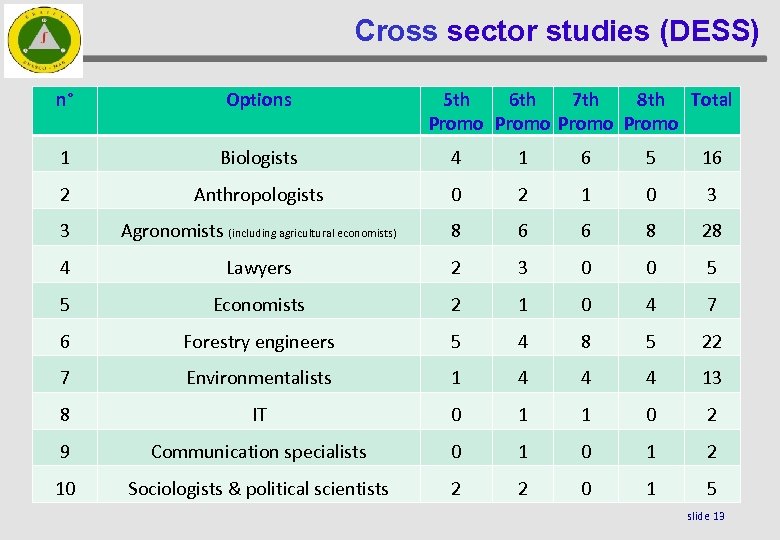
Cross sector studies (DESS) n° Options 5 th 6 th 7 th 8 th Total Promo 1 Biologists 4 1 6 5 16 2 Anthropologists 0 2 1 0 3 3 Agronomists (including agricultural economists) 8 6 6 8 28 4 Lawyers 2 3 0 0 5 5 Economists 2 1 0 4 7 6 Forestry engineers 5 4 8 5 22 7 Environmentalists 1 4 4 4 13 8 IT 0 1 1 0 2 9 Communication specialists 0 1 2 10 Sociologists & political scientists 2 2 0 1 5 slide 13
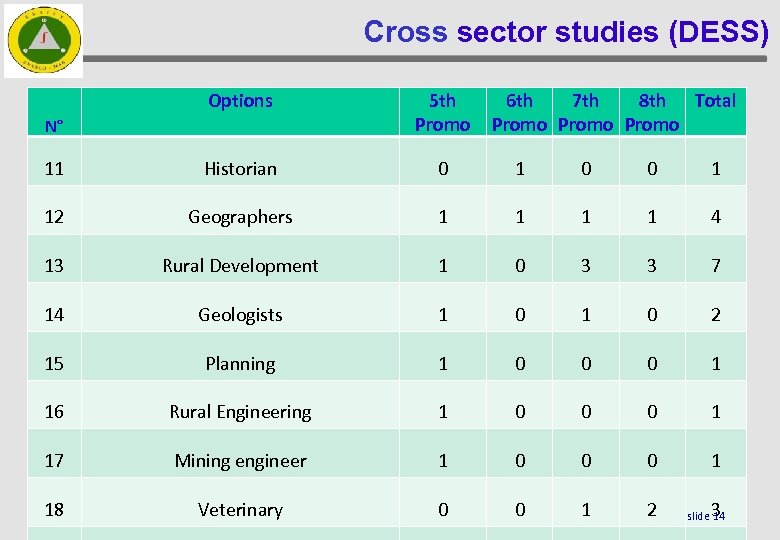
Cross sector studies (DESS) Options 5 th Promo 11 Historian 0 1 0 0 1 12 Geographers 1 1 4 13 Rural Development 1 0 3 3 7 14 Geologists 1 0 2 15 Planning 1 0 0 0 1 16 Rural Engineering 1 0 0 0 1 17 Mining engineer 1 0 0 0 1 18 Veterinary 0 0 1 2 N° 6 th 7 th 8 th Total Promo 3 slide 14
Support for project formulation and assessment at ERAIFT has developed internal expertise to provide political leaders and TFP with quality service to support projects / programs formulation and assessment in the DRC and in the Central African region. Some references on the subject : o Support to calculate economic opportunity costs of REDD+ in DRC (2012, World Bank financing) o Draw the Master Plan of the Boma-Matadi-Kinshasa-Kikwit Corridor (2012 -2013 World Bank funding) see Figure 3. o The Mid-way assessment through the project-Djamba Djale (2012, DGC) slide 15
The training program (1) Chair 1 : Basic concepts and systemic analysis applied to the integrated planning and development (Professor : Prof. Jan Bogaert, ULG) Chair 2 : Interactions population-forest-savanna and Environmental Governance (Professor: Prof. Théodore Trefon, MRAC) Chair 3 : Integrated territories management, including human settlements (cities and urbanization) (Professor: Prof. Nzuzi Lelo) Chair 4 : Optical remote sensing and digital mapping (Professor : Prof. Raymond Lumbuenamo with Philippe Mayaux & Carlos de Wasseige as collaborators of the chair) Chair 5 : Radar’s remote sensing, geodesy and GIS data’s supplementary, and probably LIDAR (Professor : Prof. Rudant, University of Marne la Valée). Chair 6 : Inter-sector and integrated approach: forest, agriculture, livestock, fisheries and tourism (Professor : Prof. Baudouin Michel) Chair 7 : Sustainable management of wildlife (Professor: Dr Cédric Vermeulen, ULG) Chair 8 : Sustainable management and certification of tropical forests : (Professor : Prof. Jean-Louis Doucet, ULG) Chair 9 : Sustainable management of aquatic fauna including the notions of Limnology and slide 16 Hydrobiology (Professor: Prof. Jean Claude Micha, FUNDP)
The training program (2) Chair 10 : Communication and Sustainable Development (Professor : Prof. Mweze Dominique (UCC) & Prof. Aimé Kayembe as chair’s collaborator) Chair 11 : Environmental Impact Study (Professor : Prof. Isaac Tchouamo, University of Dschang) Chair 12 : Climate change (Professor : Prof. Maurice Tsalefac, University of Dschang) Chair 13 : Aspects of legislation, internationals conventions, decentralization and integrated development (Professor : to be appointed ) Chair 14 : Nutrition planning and health (Professor : Prof. Kashala Tumba, UNIKIN) Chair 15 : Education and environmental ethics (Professor : Prof. Lumande Kasali, UNIKIN) Chair 16 : Methodology and implementation of integrated development (Professor : Prof. Bernadette Dossou, University of Benin) Chair 17 : Introduction to Scientific Research + project’s development (Professor Théodore Trefon, MRAC) Chair 18 : Developement and monitoring of projects ( Professor : Prof. Baudouin Michel, ERAIFT-ULG) Chair 19 : Field training of integrated planning and development (STADI) ( Professor Ass. Isaac Diansambu, ERAIFT) slide 17
ERAIFT Capacity Development: Lessons Learned • Results of a study on impacts conducted among students of previous promotions; • Logic of institutional sustainability versus "project approach"; • Role of TFPs and the role of the institution; • Relevance of the approach developed by ERAIFT and efficiency of the institution; • Cross-sector issues and Sustainable Development; • The challenges of coordination and coherence of TFPs (Paris’s Declaration, ownership and transaction costs). slide 18
National, Regional and International challenges facing ERAIFT • Promotion of bilingualism, French & English, for all activities at the School (teaching, research, continuous training. . . ); • Conduct a feasibility study to establish an ERAIFT branch in The Ivory Coast; • Development of partnerships at national, regional and international levels; • Introducing the LMD system at a pace compatible with capabilities of national institutions and regional partners; • Development of research activities and supervision of Ph. D students in partnership with internationally recognised doctoral programmes; • Implementation of distance learning / education; • Diversification of training on offer for graduates and provision of continuous training, to meet future needs in the labour and research markets, at national, regional and international levels. slide 19
THANK YOU
Скачать презентацию ERAIFT s contributions to the sustainable management of natural
4a1fe89ff4d9851ea1b7be3198ce2568.ppt