


 Скачать презентацию Equity Outlook Recovery gains momentum- Macro Indicators
4299bbd40a397561af3169f4f48af5a0.ppt
- Количество слайдов: 35

 Equity Outlook
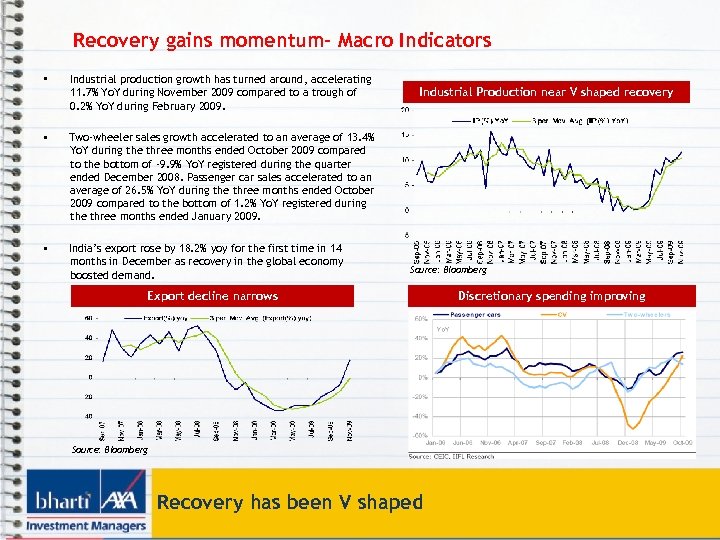 Recovery gains momentum- Macro Indicators • Industrial production growth has turned around, accelerating 11. 7% Yo. Y during November 2009 compared to a trough of 0. 2% Yo. Y during February 2009. • Two-wheeler sales growth accelerated to an average of 13. 4% Yo. Y during the three months ended October 2009 compared to the bottom of -9. 9% Yo. Y registered during the quarter ended December 2008. Passenger car sales accelerated to an average of 26. 5% Yo. Y during the three months ended October 2009 compared to the bottom of 1. 2% Yo. Y registered during the three months ended January 2009. • India’s export rose by 18. 2% yoy for the first time in 14 months in December as recovery in the global economy boosted demand. Industrial Production near V shaped recovery Source: Bloomberg Export decline narrows Source: Bloomberg Recovery has been V shaped Discretionary spending improving
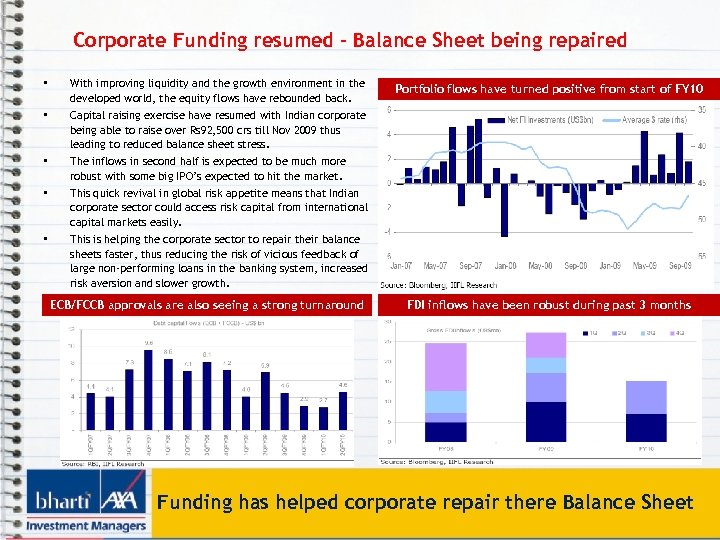 Corporate Funding resumed – Balance Sheet being repaired • With improving liquidity and the growth environment in the developed world, the equity flows have rebounded back. • Capital raising exercise have resumed with Indian corporate being able to raise over Rs 92, 500 crs till Nov 2009 thus leading to reduced balance sheet stress. • The inflows in second half is expected to be much more robust with some big IPO’s expected to hit the market. • This quick revival in global risk appetite means that Indian corporate sector could access risk capital from international capital markets easily. • This is helping the corporate sector to repair their balance sheets faster, thus reducing the risk of vicious feedback of large non-performing loans in the banking system, increased risk aversion and slower growth. ECB/FCCB approvals are also seeing a strong turnaround Portfolio flows have turned positive from start of FY 10 FDI inflows have been robust during past 3 months Funding has helped corporate repair there Balance Sheet
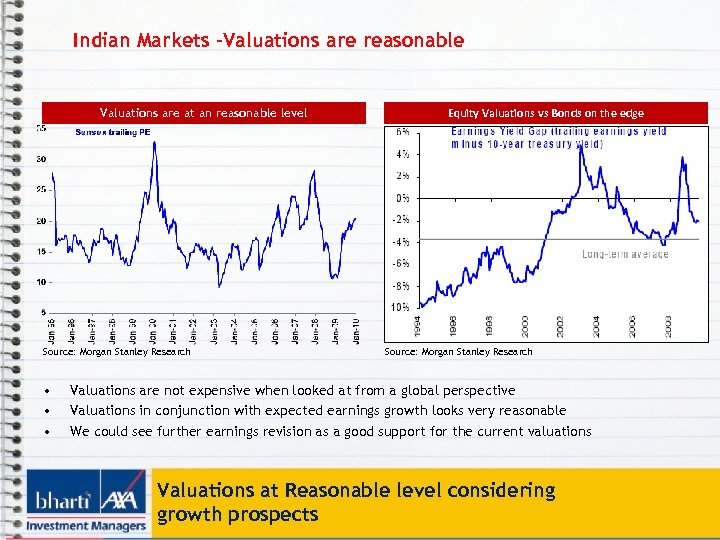 Indian Markets –Valuations are reasonable Valuations are at an reasonable level Source: Morgan Stanley Research • • • Equity Valuations vs Bonds on the edge Source: Morgan Stanley Research Valuations are not expensive when looked at from a global perspective Valuations in conjunction with expected earnings growth looks very reasonable We could see further earnings revision as a good support for the current valuations Valuations at Reasonable level considering growth prospects
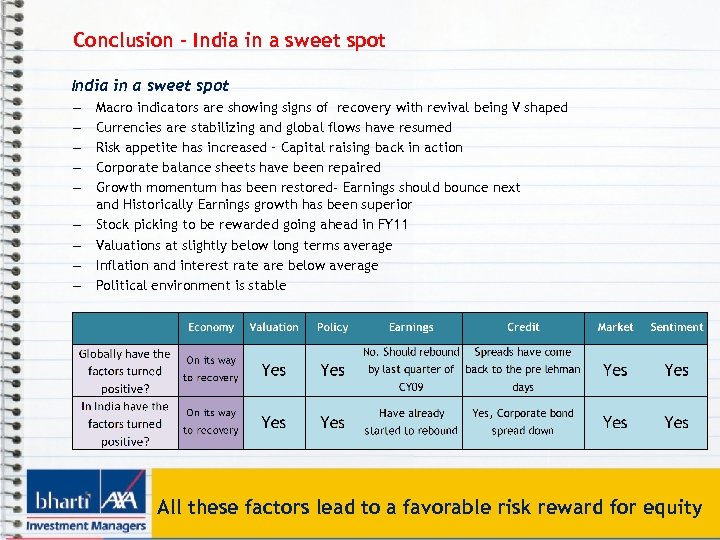 Conclusion - India in a sweet spot – – – – – Macro indicators are showing signs of recovery with revival being V shaped Currencies are stabilizing and global flows have resumed Risk appetite has increased – Capital raising back in action Corporate balance sheets have been repaired Growth momentum has been restored- Earnings should bounce next and Historically Earnings growth has been superior Stock picking to be rewarded going ahead in FY 11 Valuations at slightly below long terms average Inflation and interest rate are below average Political environment is stable All these factors lead to a favorable risk reward for equity
 Infrastructure growth momentum to continue
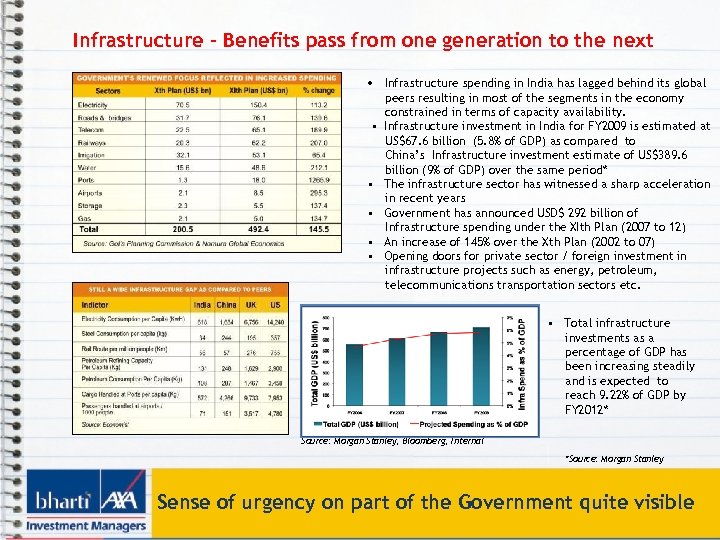 Infrastructure – Benefits pass from one generation to the next • Infrastructure spending in India has lagged behind its global peers resulting in most of the segments in the economy constrained in terms of capacity availability. • Infrastructure investment in India for FY 2009 is estimated at US$67. 6 billion (5. 8% of GDP) as compared to China’s Infrastructure investment estimate of US$389. 6 billion (9% of GDP) over the same period* • The infrastructure sector has witnessed a sharp acceleration in recent years • Government has announced USD$ 292 billion of Infrastructure spending under the XIth Plan (2007 to 12) • An increase of 145% over the Xth Plan (2002 to 07) • Opening doors for private sector / foreign investment in infrastructure projects such as energy, petroleum, telecommunications transportation sectors etc. • Total infrastructure investments as a percentage of GDP has been increasing steadily and is expected to reach 9. 22% of GDP by FY 2012* Source: Morgan Stanley, Bloomberg, Internal *Source: Morgan Stanley Sense of urgency on part of the Government quite visible
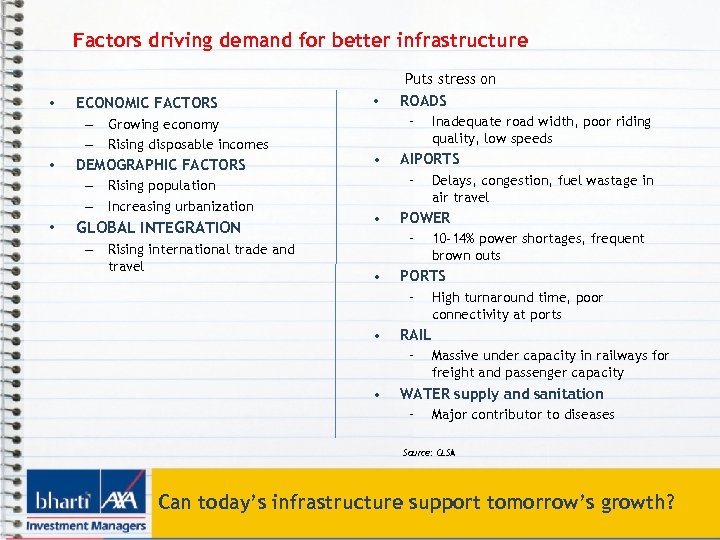 Factors driving demand for better infrastructure • • • ECONOMIC FACTORS – Growing economy – Rising disposable incomes DEMOGRAPHIC FACTORS – Rising population – Increasing urbanization GLOBAL INTEGRATION – Rising international trade and travel • Puts stress on ROADS – Inadequate road width, poor riding quality, low speeds • AIPORTS – Delays, congestion, fuel wastage in air travel • POWER – 10 -14% power shortages, frequent brown outs • PORTS – High turnaround time, poor connectivity at ports • RAIL – Massive under capacity in railways for freight and passenger capacity • WATER supply and sanitation – Major contributor to diseases Source: CLSA Can today’s infrastructure support tomorrow’s growth?
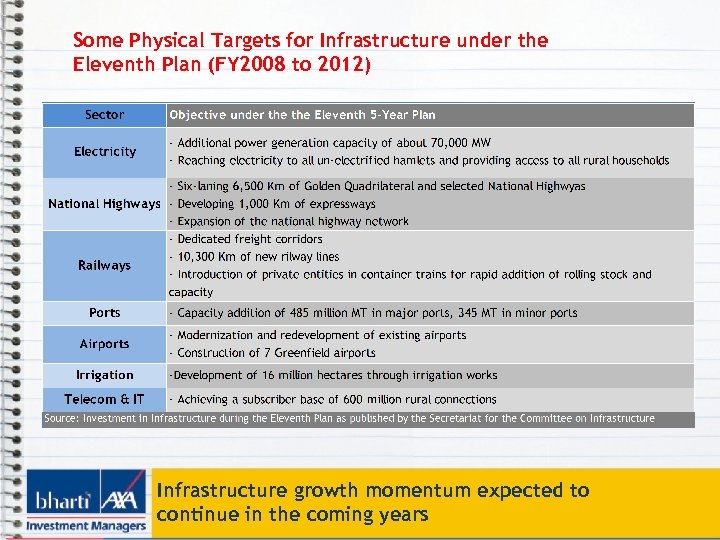 Some Physical Targets for Infrastructure under the Eleventh Plan (FY 2008 to 2012) Infrastructure growth momentum expected to continue in the coming years
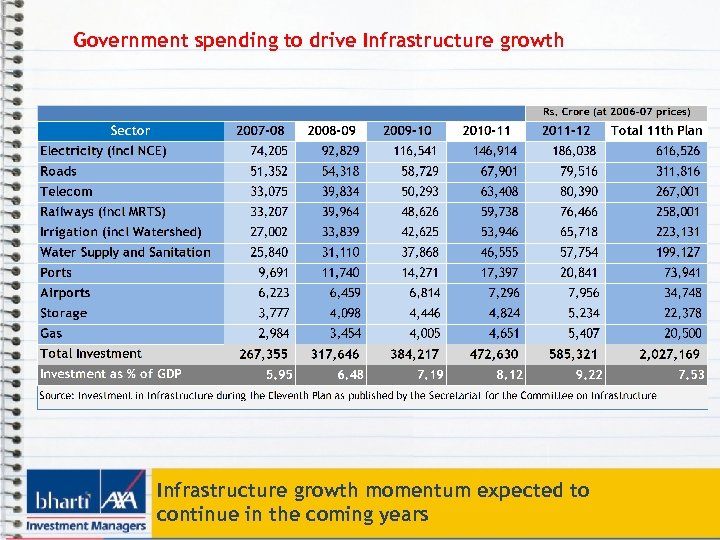 Government spending to drive Infrastructure growth momentum expected to continue in the coming years
 Core infrastructure needs focus…
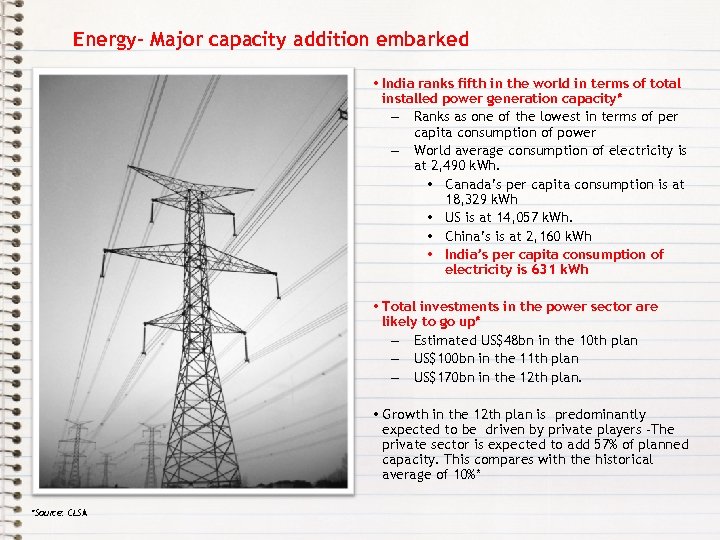 Energy- Major capacity addition embarked • India ranks fifth in the world in terms of total installed power generation capacity* – Ranks as one of the lowest in terms of per capita consumption of power – World average consumption of electricity is at 2, 490 k. Wh. • Canada’s per capita consumption is at 18, 329 k. Wh • US is at 14, 057 k. Wh. • China’s is at 2, 160 k. Wh • India’s per capita consumption of electricity is 631 k. Wh • Total investments in the power sector are likely to go up* – Estimated US$48 bn in the 10 th plan – US$100 bn in the 11 th plan – US$170 bn in the 12 th plan. • Growth in the 12 th plan is predominantly expected to be driven by private players -The private sector is expected to add 57% of planned capacity. This compares with the historical average of 10%* *Source: CLSA
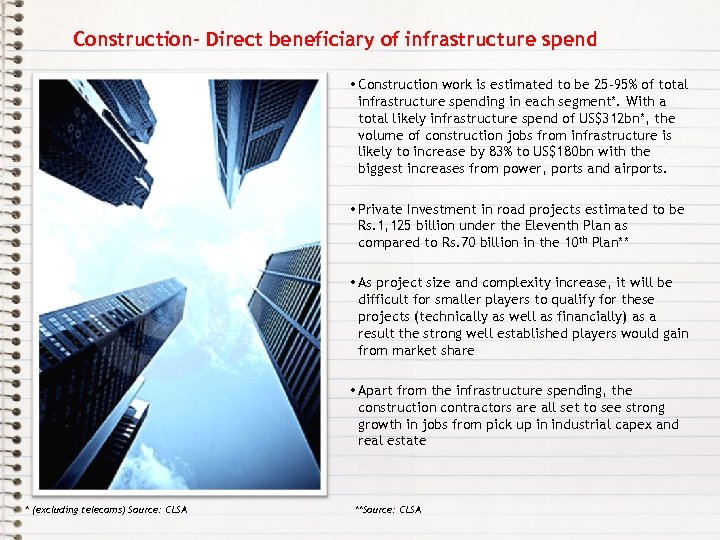 Construction- Direct beneficiary of infrastructure spend • Construction work is estimated to be 25 -95% of total infrastructure spending in each segment*. With a total likely infrastructure spend of US$312 bn*, the volume of construction jobs from infrastructure is likely to increase by 83% to US$180 bn with the biggest increases from power, ports and airports. • Private Investment in road projects estimated to be Rs. 1, 125 billion under the Eleventh Plan as compared to Rs. 70 billion in the 10 th Plan** • As project size and complexity increase, it will be difficult for smaller players to qualify for these projects (technically as well as financially) as a result the strong well established players would gain from market share • Apart from the infrastructure spending, the construction contractors are all set to see strong growth in jobs from pick up in industrial capex and real estate * (excluding telecoms) Source: CLSA **Source: CLSA
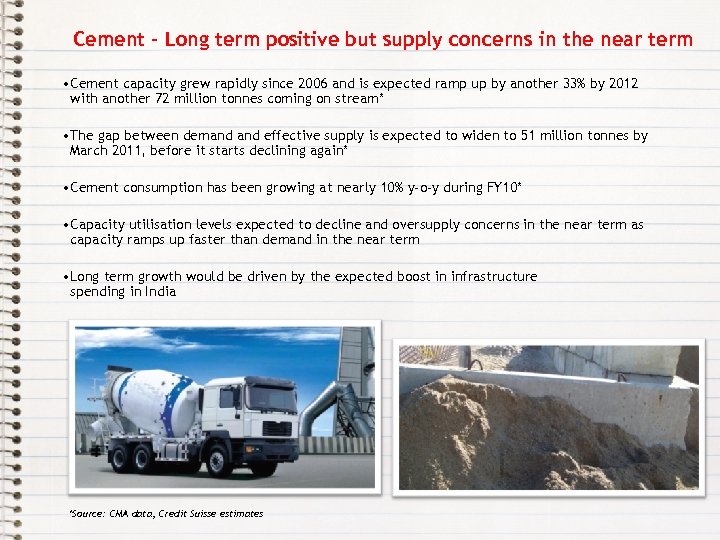 Cement – Long term positive but supply concerns in the near term • Cement capacity grew rapidly since 2006 and is expected ramp up by another 33% by 2012 with another 72 million tonnes coming on stream* • The gap between demand effective supply is expected to widen to 51 million tonnes by March 2011, before it starts declining again* • Cement consumption has been growing at nearly 10% y-o-y during FY 10* • Capacity utilisation levels expected to decline and oversupply concerns in the near term as capacity ramps up faster than demand in the near term • Long term growth would be driven by the expected boost in infrastructure spending in India *Source: CMA data, Credit Suisse estimates
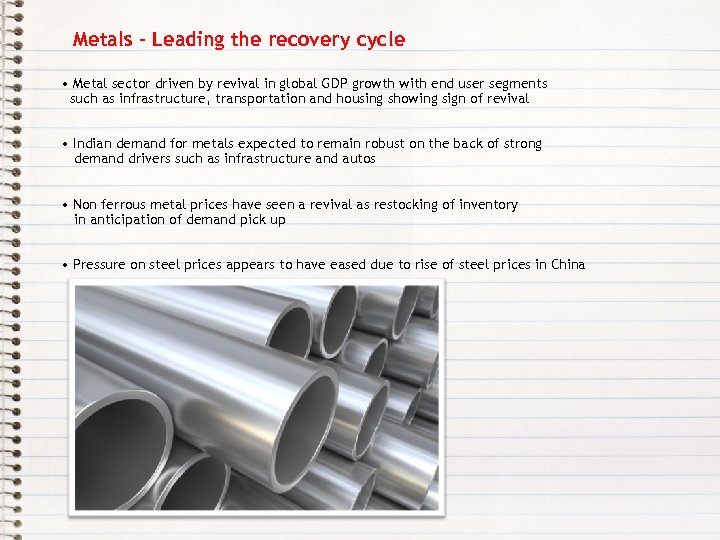 Metals – Leading the recovery cycle • Metal sector driven by revival in global GDP growth with end user segments such as infrastructure, transportation and housing showing sign of revival • Indian demand for metals expected to remain robust on the back of strong demand drivers such as infrastructure and autos • Non ferrous metal prices have seen a revival as restocking of inventory in anticipation of demand pick up • Pressure on steel prices appears to have eased due to rise of steel prices in China
 Telecom – Near term pressure remain • The Indian telecom industry has grown by a CAGR of 80% over the last 7 years to reach a total subscriber base of 400 million in FY 09* • India witnessed robust subscriber growth despite the economic downturn averaging 9 million plus additions per month over the last six months • Current penetration levels of approximately 40% still leave growth opportunities over the next few years** • Advent of 3 G in the Indian telecom would provide the next step of growth • Potential value unlocking through the infrastructure business of telecom majors • However advent of new players has increased competitive intensity in the industry which would lead to near term pressure on the profitability of the existing players *Source: Merril Lynch **Source: COAI, TRAI
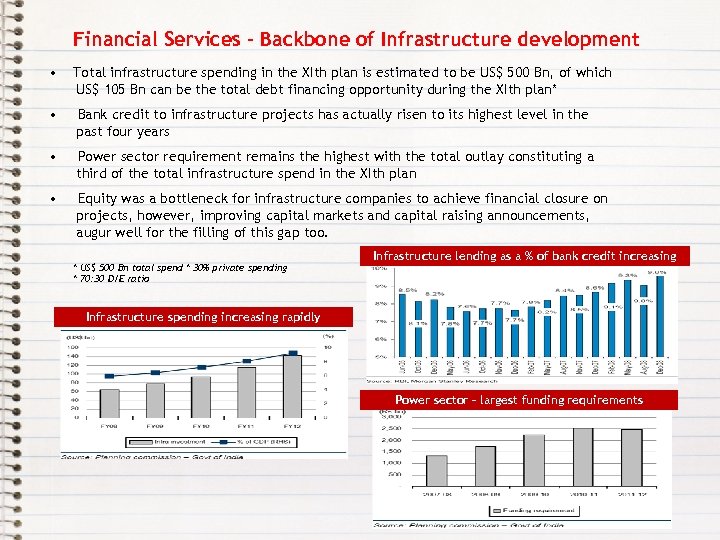 Financial Services – Backbone of Infrastructure development • Total infrastructure spending in the XIth plan is estimated to be US$ 500 Bn, of which US$ 105 Bn can be the total debt financing opportunity during the XIth plan* • Bank credit to infrastructure projects has actually risen to its highest level in the past four years • Power sector requirement remains the highest with the total outlay constituting a third of the total infrastructure spend in the XIth plan • Equity was a bottleneck for infrastructure companies to achieve financial closure on projects, however, improving capital markets and capital raising announcements, augur well for the filling of this gap too. * US$ 500 Bn total spend * 30% private spending * 70: 30 D/E ratio Infrastructure lending as a % of bank credit increasing Infrastructure spending increasing rapidly Power sector – largest funding requirements
 Why Bharti AXA Focused Infrastructure Fund?
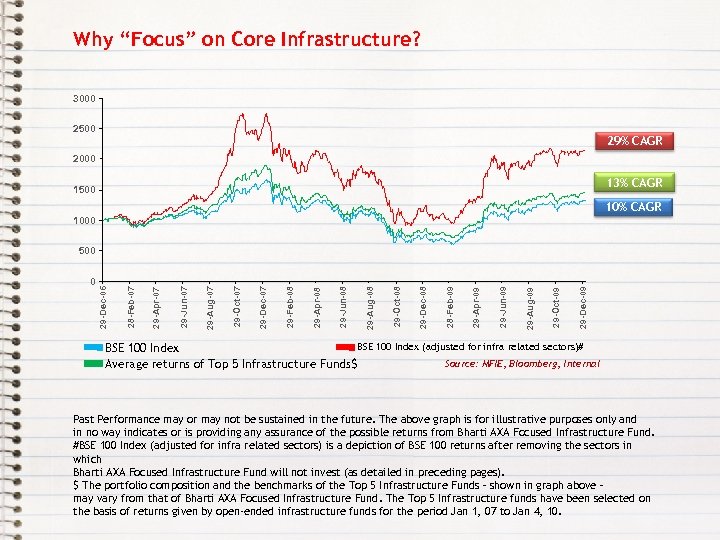 Why “Focus” on Core Infrastructure? 3000 2500 29% CAGR 2000 13% CAGR 1500 10% CAGR 1000 29 -Dec-09 29 -Oct-09 29 -Aug-09 29 -Jun-09 29 -Apr-09 28 -Feb-09 29 -Dec-08 29 -Oct-08 29 -Aug-08 29 -Jun-08 29 -Apr-08 29 -Feb-08 29 -Dec-07 29 -Oct-07 29 -Aug-07 29 -Jun-07 29 -Apr-07 28 -Feb-07 0 29 -Dec-06 500 BSE 100 Index (adjusted for infra related sectors)# BSE 100 Index Source: MFIE, Bloomberg, Internal Average returns of Top 5 Infrastructure Funds$ Past Performance may or may not be sustained in the future. The above graph is for illustrative purposes only and in no way indicates or is providing any assurance of the possible returns from Bharti AXA Focused Infrastructure Fund. #BSE 100 Index (adjusted for infra related sectors) is a depiction of BSE 100 returns after removing the sectors in which Bharti AXA Focused Infrastructure Fund will not invest (as detailed in preceding pages). $ The portfolio composition and the benchmarks of the Top 5 Infrastructure Funds – shown in graph above – may vary from that of Bharti AXA Focused Infrastructure Fund. The Top 5 Infrastructure funds have been selected on the basis of returns given by open-ended infrastructure funds for the period Jan 1, 07 to Jan 4, 10.
 Methodology and Analysis of returns • In order to analyze the performance of the focused infrastructure sectors as identified by us under Bharti AXA Focused Infrastructure Fund, we plotted the BSE 100 Index (broad diversified index) against an adjusted BSE 100 Index after removing all the companies that belong to non infrastructure sectors (as identified by us under Bharti AXA Focused Infrastructure Fund) • The results show that the core infrastructure sectors have returned a CAGR of 29% over the period Jan 1, 07 to Jan 4, 10 as compared to a CAGR of 10% for the BSE 100 over the same period • During this period, the Top 5 infrastructure funds, depicted above, have given a CAGR of 13% • History shows that focusing on core infrastructure has paid handsome dividends in the past • We believe this trend will continue in the coming years given the impetus on infrastructure investment both from the government as well as public-private partnerships
 Bharti AXA Focused Infrastructure Fund ≠ Company Concentration • Bharti AXA Focused Infrastructure Fund is also different from the “Focused” Funds currently available • We are “Focused” in terms of the sectors that we will invest in, while NOT being “Focused” with regards to Company Concentration What does this mean in terms of portfolio allocation? • SEBI regulations in terms of maximum single issuer concentration limit of 10% would also apply to the portfolio • In addition, prudent single stock concentration limits would apply to ensure that there is no excess concentration towards any single company • Thus, while the Fund Manager can take a concentrated position in a particular infrastructure related sector, he has to maintain adequate diversification in terms of number of stocks invested in
 A “Truly Focused” INFRASTRUCTURE FUND
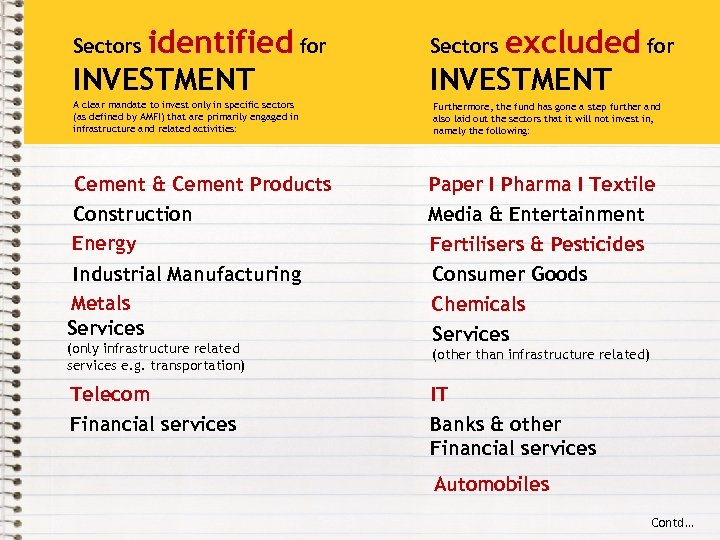 identified for INVESTMENT excluded for INVESTMENT Sectors A clear mandate to invest only in specific sectors (as defined by AMFI) that are primarily engaged in infrastructure and related activities: Furthermore, the fund has gone a step further and also laid out the sectors that it will not invest in, namely the following: Cement & Cement Products Construction Energy Industrial Manufacturing Metals Services (only infrastructure related services e. g. transportation) Telecom Financial services Paper I Pharma I Textile Media & Entertainment Fertilisers & Pesticides Consumer Goods Chemicals Services (other than infrastructure related) IT Banks & other Financial services Automobiles Contd…
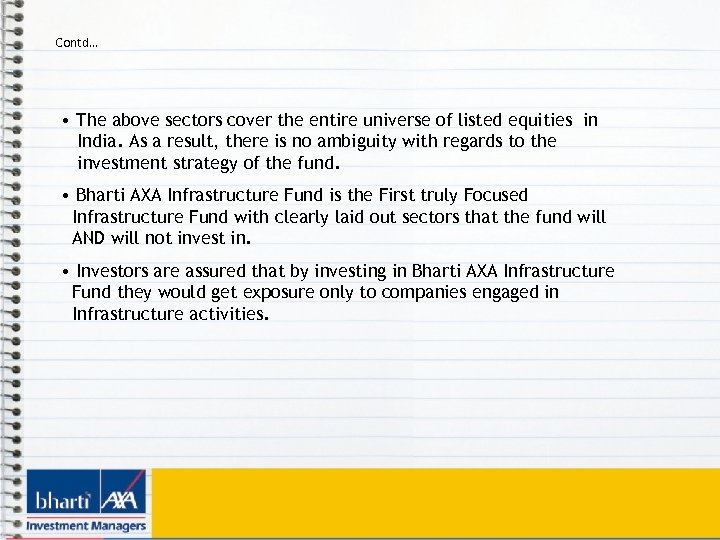 Contd… • The above sectors cover the entire universe of listed equities in India. As a result, there is no ambiguity with regards to the investment strategy of the fund. • Bharti AXA Infrastructure Fund is the First truly Focused Infrastructure Fund with clearly laid out sectors that the fund will AND will not invest in. • Investors are assured that by investing in Bharti AXA Infrastructure Fund they would get exposure only to companies engaged in Infrastructure activities.
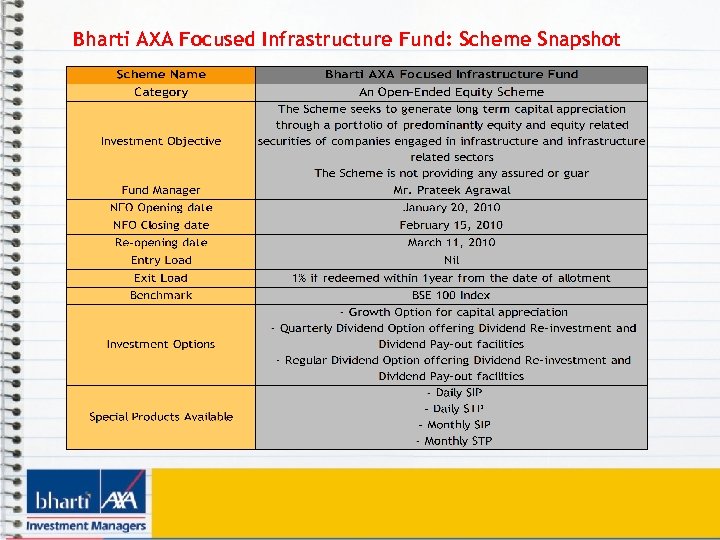 Bharti AXA Focused Infrastructure Fund: Scheme Snapshot
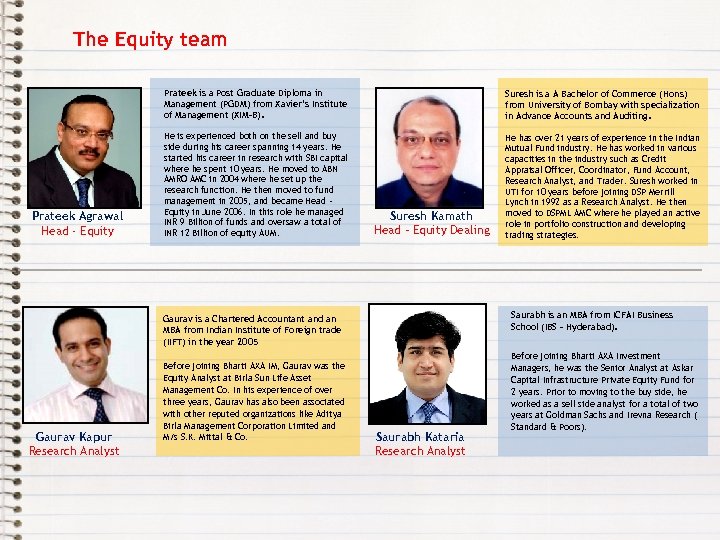 The Equity team Prateek is a Post Graduate Diploma in Management (PGDM) from Xavier’s Institute of Management (XIM-B). Prateek Agrawal Head - Equity Suresh is a A Bachelor of Commerce (Hons) from University of Bombay with specialization in Advance Accounts and Auditing. He is experienced both on the sell and buy side during his career spanning 14 years. He started his career in research with SBI capital where he spent 10 years. He moved to ABN AMRO AMC in 2004 where he set up the research function. He then moved to fund management in 2005, and became Head Equity in June 2006. In this role he managed INR 9 Billion of funds and oversaw a total of INR 12 Billion of equity AUM. He has over 21 years of experience in the Indian Mutual Fund industry. He has worked in various capacities in the industry such as Credit Appraisal Officer, Coordinator, Fund Account, Research Analyst, and Trader. Suresh worked in UTI for 10 years before joining DSP Merrill Lynch in 1992 as a Research Analyst. He then moved to DSPML AMC where he played an active role in portfolio construction and developing trading strategies. Suresh Kamath Head – Equity Dealing Saurabh is an MBA from ICFAI Business School (IBS - Hyderabad). Gaurav is a Chartered Accountant and an MBA from Indian Institute of Foreign trade (IIFT) in the year 2005 Gaurav Kapur Research Analyst Before joining Bharti AXA IM, Gaurav was the Equity Analyst at Birla Sun Life Asset Management Co. In his experience of over three years, Gaurav has also been associated with other reputed organizations like Aditya Birla Management Corporation Limited and M/s S. K. Mittal & Co. Saurabh Kataria Research Analyst Before joining Bharti AXA Investment Managers, he was the Senior Analyst at Askar Capital Infrastructure Private Equity Fund for 2 years. Prior to moving to the buy side, he worked as a sell side analyst for a total of two years at Goldman Sachs and Irevna Research ( Standard & Poors).
 Performance & portfolio of existing equity funds
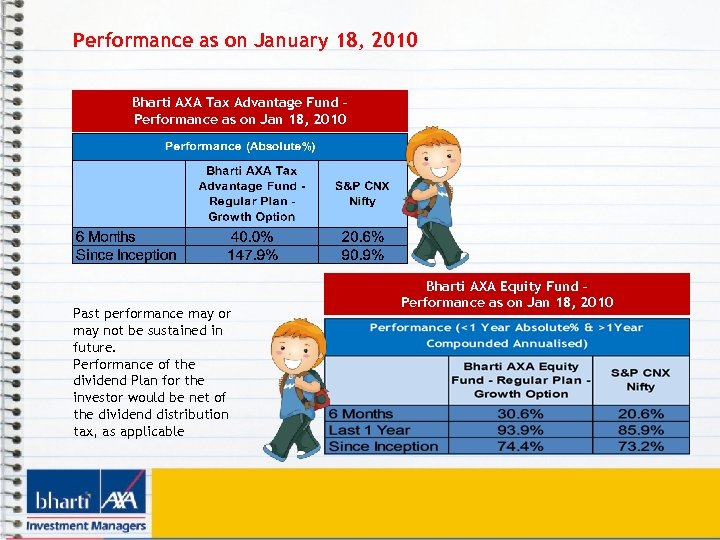 Performance as on January 18, 2010 Bharti AXA Tax Advantage Fund – Performance as on Jan 18, 2010 Past performance may or may not be sustained in future. Performance of the dividend Plan for the investor would be net of the dividend distribution tax, as applicable Bharti AXA Equity Fund – Performance as on Jan 18, 2010
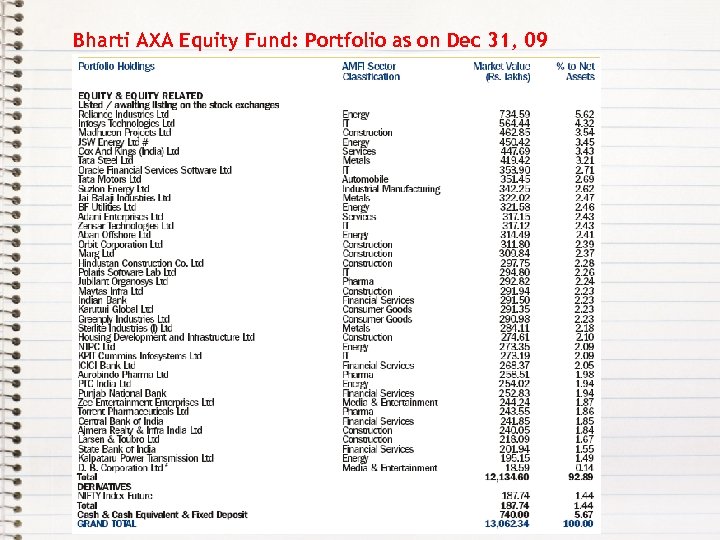 Bharti AXA Equity Fund: Portfolio as on Dec 31, 09
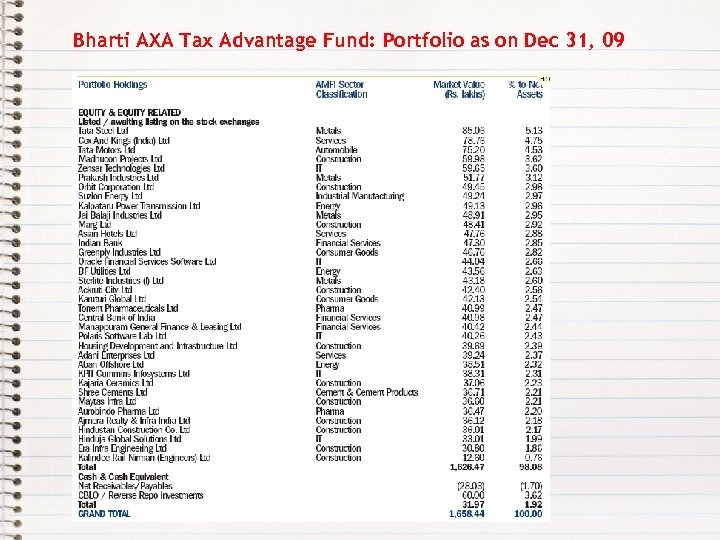 Bharti AXA Tax Advantage Fund: Portfolio as on Dec 31, 09
 Statutory Details / Risk Factors Statutory Details: Bharti AXA Mutual Fund has been set up as a Trust (under the Indian Trust Act, 1882) by AXA Investment Managers, Sponsor of the Fund. The Sponsor is not responsible for any loss resulting from the operations of the schemes beyond the contribution of an amount of Rs. 1 lakh made by it towards setting up the Mutual Fund. Trustee: Bharti AXA Trustee Services Private Limited, a limited liability company. Investment Manager: Bharti AXA Investment Managers Private Limited, a limited liability company. Risk Factors: All mutual funds and securities investments are subject to market risks and there can be no assurance that the Scheme’s objectives will be achieved and the NAVs of the Schemes may go up or down depending upon the factors and forces affecting the securities market. The names of the Schemes do not in any manner indicate either the quality of the Scheme(s), their future prospects or returns. Past performance of the Sponsors and their affiliates / AMC / Mutual Fund and its Scheme does not indicate the future performance of the Scheme of the Mutual Fund. Investors in the Scheme are not being offered any guaranteed / assured returns. Bharti AXA Focused Infrastructure Fund is an open-ended equity scheme. Investment Objective: The Scheme seeks to generate long term capital appreciation through a portfolio of predominantly equity and equity related securities of companies engaged in infrastructure and infrastructure related sectors. Asset Allocation Pattern: Equity and equity related securities of companies engaged in infrastructure and infrastructure related sectors – 65% to 100% and Debt & money market securities/instruments# - 0 to 35%. # no investments will be made in securitized debt. Term of Issue: Units are being offered at Rs. 10/- per unit during the New Fund Offer Period and at NAV based prices upon re-opening. Scheme Re-opens for continuous sale and repurchase on: March 11, 2010. Load Structure: Entry Load – Nil, Exit Load – 1% if redeemed within 1 year from date of allotment. Bharti AXA Equity Fund is an open-ended Equity Growth fund, . Investment Objective: To generate income and long-term capital appreciation through a diversified portfolio of predominantly equity and equity-related securities including equity derivatives, across all market capitalizations. Bharti AXA Tax Advantage Fund is an open-ended equity linked savings scheme. Investment Objective: The Scheme seeks to generate long-term capital growth from a diversified portfolio of predominantly equity and equity-related securities across all market capitalisations. The Scheme is in the nature of diversified multi-cap fund. Copies of Scheme Information Document /Key Information Memorandum/ Statement of Additional Information can be obtained at any of our Investor Service Centres or on the AMC Website www. bhartiaxa-im. com. Mutual Fund investments are subject to market risks. Investors are requested to read the Scheme Information Document, Statement of Additional Information & Addenda carefully before investing.
 Disclaimers Information given herein is as of January 19, 2010. Statements relating to outlook and forecast are the opinions of the Author. The views expressed by the author are personal and are not necessarily that of Bharti AXA Investment Managers Private Limited (AMC). Information given here is not intended to be any investment advice. Please make independent research / obtain professional help before taking any decision of investment / sale. AMC makes no representation as to the quality, liquidity or market perception on any securities/ issuer / borrower; if described above, nor does it provide any guarantee whatsoever. Information and material given here is believed to be from reliable sources. However, AMC does not warrant the accuracy, reasonableness and/or completeness of any information. AMC does not undertake to update any information or material given herein. Decisions taken by you based on the information provided are to your own account and risk. AMC and any of its officers, directors and employees shall not be liable for any loss or damage of any nature, as also any loss of profit in any way arising from the use of this material in any manner. AMC or its directors, officers and employees, including author / persons involved in the preparation or issuance of this material may, from time to time, have long or short positions in, and buy or sell the securities, if any, mentioned herein or have other potential conflict of interest with respect to any recommendation and related information and opinions given over here. The information given herein, or any part of it, should not be duplicated, or contents altered / modified, in whole or in part in any form and or re-distributed without AMC’s prior written consent. © Bharti AXA Investment Managers Private Limited 2009.
 NFO Opens: January 20, 2010 NFO Closes: February 15, 2010 Offer Re-Opens on: March 11, 2010
 THANK YOU