


 Скачать презентацию Equity markets and share valuation Chapter 7
123d656f17ab3b3a570c00349ad477b1.ppt
- Количество слайдов: 41
 Equity markets and share valuation Chapter 7
 Key concepts and skills • Understand how stock prices depend on future dividends and dividend growth • Be able to compute stock prices using the dividend growth model • Understand how corporate directors are elected • Understand how stock markets work • Understand how stock prices are quoted Copyright 2011 Mc. Graw-Hill Australia Pty Ltd PPTs t/a Essentials of Corporate Finance 2 e by Ross et al. Slides prepared by David E. Allen and Abhay K. Singh 7 -2
 Chapter outline • Ordinary share valuation • Some features of ordinary and preference shares • The share markets Copyright 2011 Mc. Graw-Hill Australia Pty Ltd PPTs t/a Essentials of Corporate Finance 2 e by Ross et al. Slides prepared by David E. Allen and Abhay K. Singh 7 -3
 Cash flows for stockholders • If you own a share of stock, you can receive cash in two ways: 1. The company pays dividends. 2. You sell your shares, either to another investor in the market or back to the company. • As with bonds, the price of the stock is the present value of these expected cash flows. – Dividends → cash income – Selling → capital gains Copyright 2011 Mc. Graw-Hill Australia Pty Ltd PPTs t/a Essentials of Corporate Finance 2 e by Ross et al. Slides prepared by David E. Allen and Abhay K. Singh 7 -4
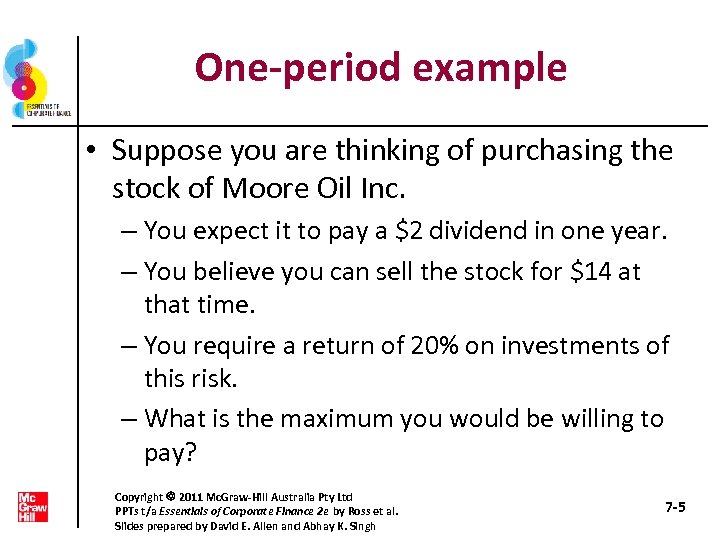 One-period example • Suppose you are thinking of purchasing the stock of Moore Oil Inc. – You expect it to pay a $2 dividend in one year. – You believe you can sell the stock for $14 at that time. – You require a return of 20% on investments of this risk. – What is the maximum you would be willing to pay? Copyright 2011 Mc. Graw-Hill Australia Pty Ltd PPTs t/a Essentials of Corporate Finance 2 e by Ross et al. Slides prepared by David E. Allen and Abhay K. Singh 7 -5
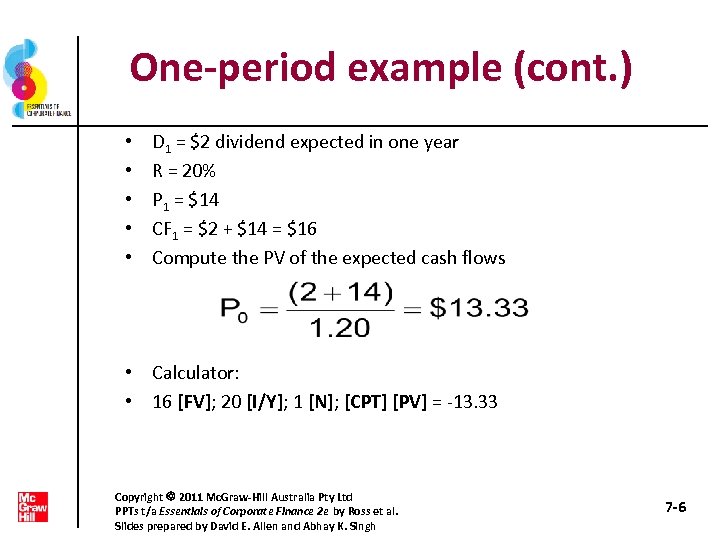 One-period example (cont. ) • • • D 1 = $2 dividend expected in one year R = 20% P 1 = $14 CF 1 = $2 + $14 = $16 Compute the PV of the expected cash flows • Calculator: • 16 [FV]; 20 [I/Y]; 1 [N]; [CPT] [PV] = -13. 33 Copyright 2011 Mc. Graw-Hill Australia Pty Ltd PPTs t/a Essentials of Corporate Finance 2 e by Ross et al. Slides prepared by David E. Allen and Abhay K. Singh 7 -6
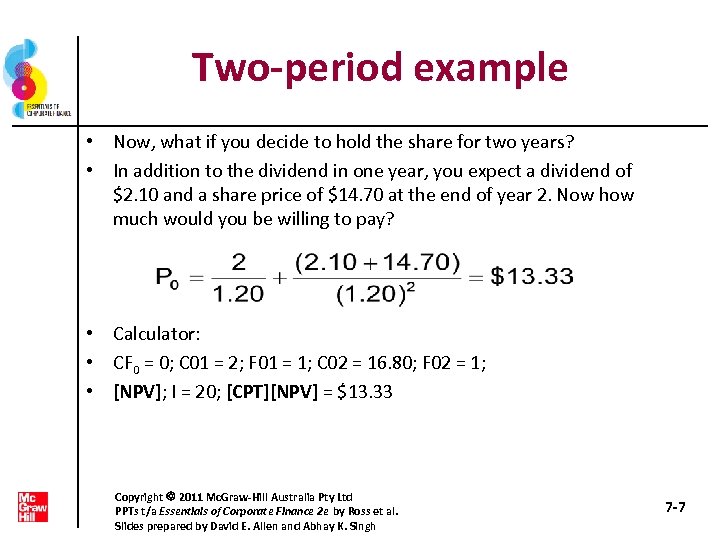 Two-period example • Now, what if you decide to hold the share for two years? • In addition to the dividend in one year, you expect a dividend of $2. 10 and a share price of $14. 70 at the end of year 2. Now how much would you be willing to pay? • Calculator: • CF 0 = 0; C 01 = 2; F 01 = 1; C 02 = 16. 80; F 02 = 1; • [NPV]; I = 20; [CPT][NPV] = $13. 33 Copyright 2011 Mc. Graw-Hill Australia Pty Ltd PPTs t/a Essentials of Corporate Finance 2 e by Ross et al. Slides prepared by David E. Allen and Abhay K. Singh 7 -7
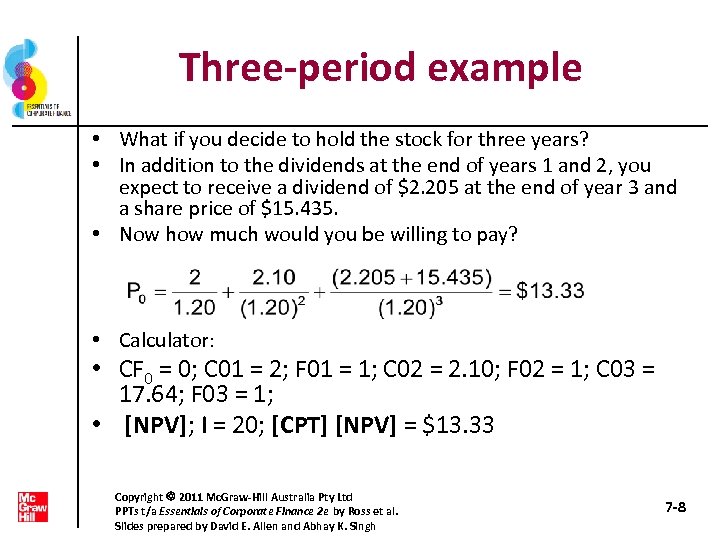 Three-period example • What if you decide to hold the stock for three years? • In addition to the dividends at the end of years 1 and 2, you expect to receive a dividend of $2. 205 at the end of year 3 and a share price of $15. 435. • Now how much would you be willing to pay? • Calculator: • CF 0 = 0; C 01 = 2; F 01 = 1; C 02 = 2. 10; F 02 = 1; C 03 = 17. 64; F 03 = 1; • [NPV]; I = 20; [CPT] [NPV] = $13. 33 Copyright 2011 Mc. Graw-Hill Australia Pty Ltd PPTs t/a Essentials of Corporate Finance 2 e by Ross et al. Slides prepared by David E. Allen and Abhay K. Singh 7 -8
 Developing the model • You could continue to push back when you would sell the share. • You would find that the price of the share is really just the present value of all expected future dividends. Copyright 2011 Mc. Graw-Hill Australia Pty Ltd PPTs t/a Essentials of Corporate Finance 2 e by Ross et al. Slides prepared by David E. Allen and Abhay K. Singh 7 -9
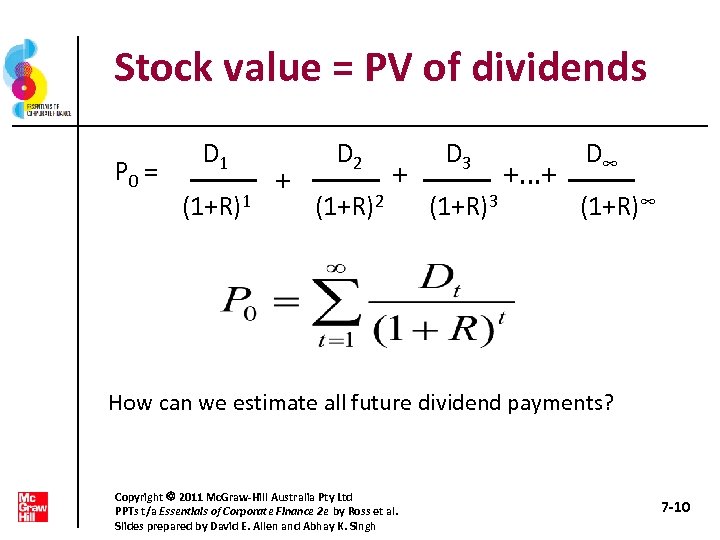 Stock value = PV of dividends P 0 = D 1 (1+R)1 + D 2 (1+R)2 + D 3 (1+R)3 +…+ D∞ (1+R)∞ How can we estimate all future dividend payments? Copyright 2011 Mc. Graw-Hill Australia Pty Ltd PPTs t/a Essentials of Corporate Finance 2 e by Ross et al. Slides prepared by David E. Allen and Abhay K. Singh 7 -10
 Estimating dividends: Special cases • Constant dividend – The firm will pay a constant dividend forever – This is like a preference share – The price is computed using the perpetuity formula • Constant dividend growth – The firm will increase the dividend by a constant percentage every period • Supernormal growth – Dividend growth is not consistent initially, but settles down to constant growth eventually Copyright 2011 Mc. Graw-Hill Australia Pty Ltd PPTs t/a Essentials of Corporate Finance 2 e by Ross et al. Slides prepared by David E. Allen and Abhay K. Singh 7 -11
 Zero growth • If dividends are expected at regular intervals forever, this is like a preference share and is valued as a perpetuity – P 0 = D/R • Suppose a share is expected to pay a $0. 50 dividend every half-year and the required return is 10% with half-yearly compounding. What is the price? – P 0 =. 50 / (0. 1 / 2) = $10 Copyright 2011 Mc. Graw-Hill Australia Pty Ltd PPTs t/a Essentials of Corporate Finance 2 e by Ross et al. Slides prepared by David E. Allen and Abhay K. Singh 7 -12
 Constant growth stock • Dividends are expected to grow at a constant percentage period. – D 1 = D 0(1+g)1 – D 2 = D 0(1+g)2 – Dt = Dt(1+g)t – D 0 = Dividend JUST PAID – D 1 – Dt = Expected dividends Copyright 2011 Mc. Graw-Hill Australia Pty Ltd PPTs t/a Essentials of Corporate Finance 2 e by Ross et al. Slides prepared by David E. Allen and Abhay K. Singh 7 -13
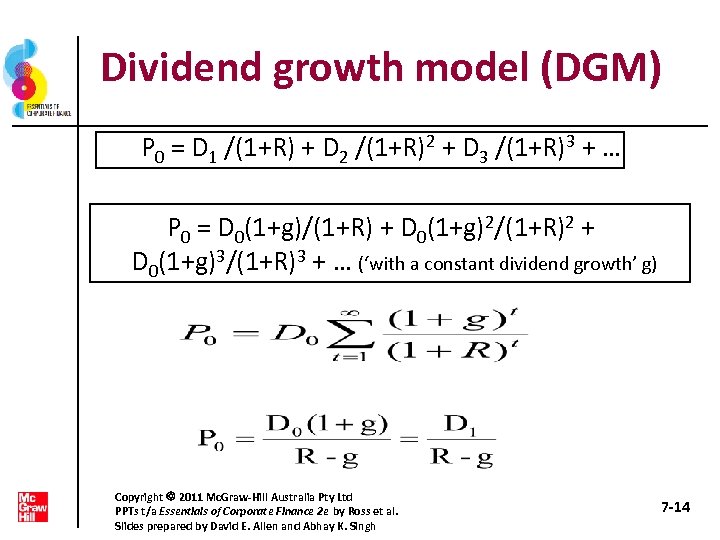 Dividend growth model (DGM) P 0 = D 1 /(1+R) + D 2 /(1+R)2 + D 3 /(1+R)3 + … P 0 = D 0(1+g)/(1+R) + D 0(1+g)2/(1+R)2 + D 0(1+g)3/(1+R)3 + … (‘with a constant dividend growth’ g) Copyright 2011 Mc. Graw-Hill Australia Pty Ltd PPTs t/a Essentials of Corporate Finance 2 e by Ross et al. Slides prepared by David E. Allen and Abhay K. Singh 7 -14
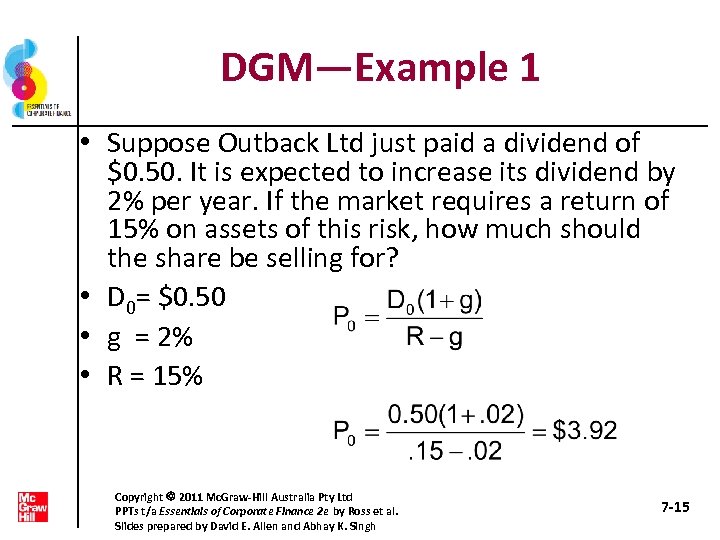 DGM—Example 1 • Suppose Outback Ltd just paid a dividend of $0. 50. It is expected to increase its dividend by 2% per year. If the market requires a return of 15% on assets of this risk, how much should the share be selling for? • D 0= $0. 50 • g = 2% • R = 15% Copyright 2011 Mc. Graw-Hill Australia Pty Ltd PPTs t/a Essentials of Corporate Finance 2 e by Ross et al. Slides prepared by David E. Allen and Abhay K. Singh 7 -15
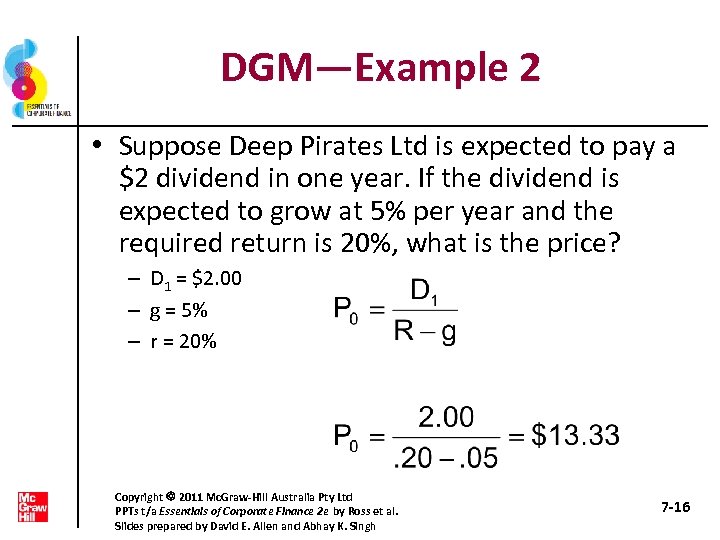 DGM—Example 2 • Suppose Deep Pirates Ltd is expected to pay a $2 dividend in one year. If the dividend is expected to grow at 5% per year and the required return is 20%, what is the price? – D 1 = $2. 00 – g = 5% – r = 20% Copyright 2011 Mc. Graw-Hill Australia Pty Ltd PPTs t/a Essentials of Corporate Finance 2 e by Ross et al. Slides prepared by David E. Allen and Abhay K. Singh 7 -16
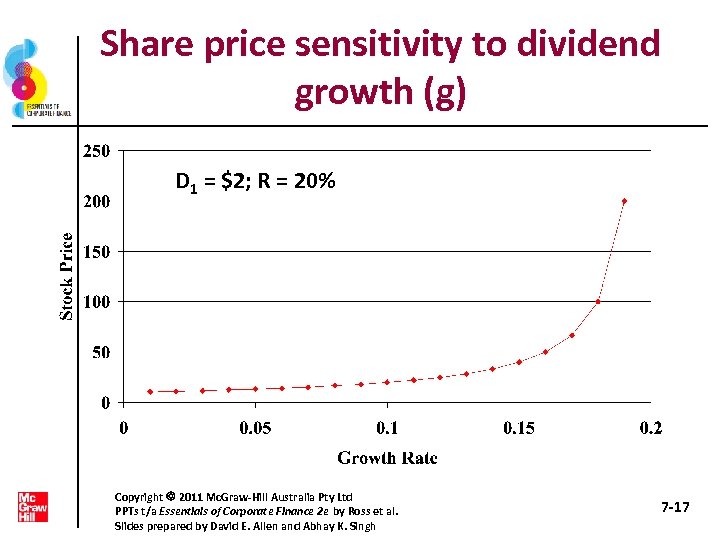 Share price sensitivity to dividend growth (g) D 1 = $2; R = 20% Copyright 2011 Mc. Graw-Hill Australia Pty Ltd PPTs t/a Essentials of Corporate Finance 2 e by Ross et al. Slides prepared by David E. Allen and Abhay K. Singh 7 -17
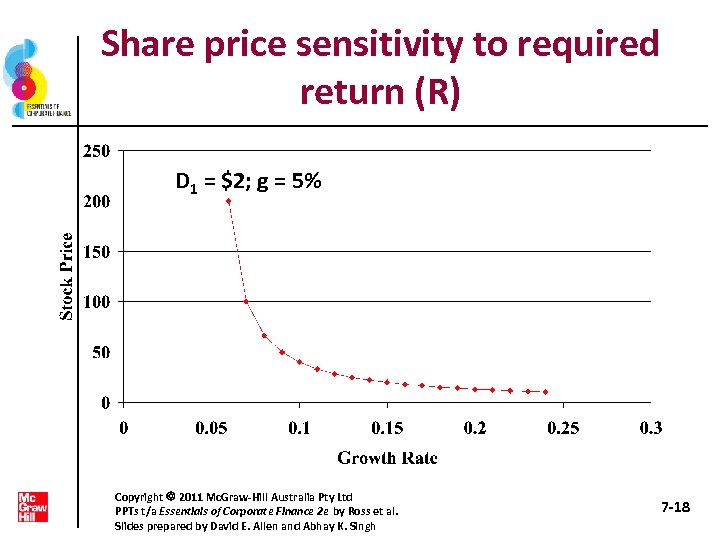 Share price sensitivity to required return (R) D 1 = $2; g = 5% Copyright 2011 Mc. Graw-Hill Australia Pty Ltd PPTs t/a Essentials of Corporate Finance 2 e by Ross et al. Slides prepared by David E. Allen and Abhay K. Singh 7 -18
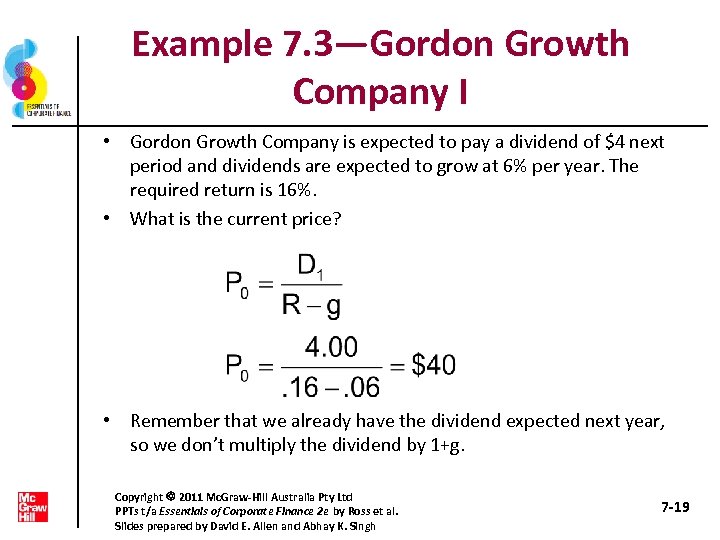 Example 7. 3—Gordon Growth Company I • Gordon Growth Company is expected to pay a dividend of $4 next period and dividends are expected to grow at 6% per year. The required return is 16%. • What is the current price? • Remember that we already have the dividend expected next year, so we don’t multiply the dividend by 1+g. Copyright 2011 Mc. Graw-Hill Australia Pty Ltd PPTs t/a Essentials of Corporate Finance 2 e by Ross et al. Slides prepared by David E. Allen and Abhay K. Singh 7 -19
 Example 7. 3—Gordon Growth Company II • What is the price expected to be in year 4? – P 4 = D 4(1 + g) / (R – g) = D 5 / (R – g) – P 4 = 4(1+. 06)4 / (. 16 -. 06) = 50. 50 • What is the implied return given the change in price during the 4 -year period? – 50. 50 = 40(1+return)4; return = 6% – -40[PV]; 50. 50[FV]; 4[N]; [CPT][I/Y] = 6% • The price grows at the same rate as the dividends. Copyright 2011 Mc. Graw-Hill Australia Pty Ltd PPTs t/a Essentials of Corporate Finance 2 e by Ross et al. Slides prepared by David E. Allen and Abhay K. Singh 7 -20
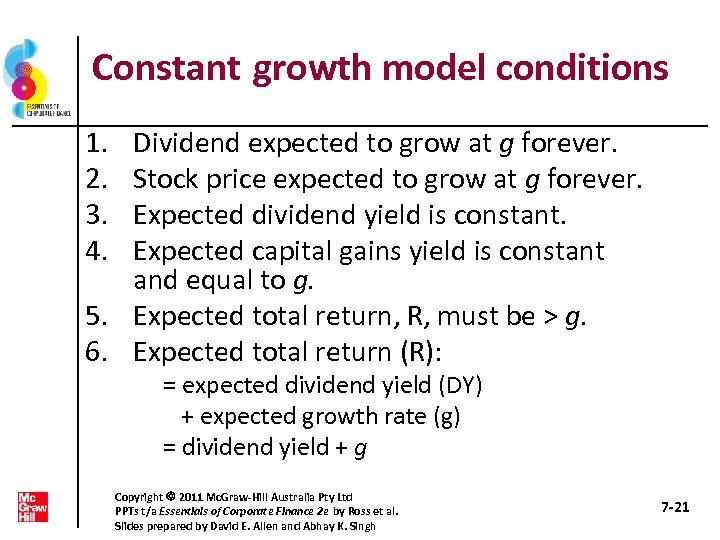 Constant growth model conditions 1. 2. 3. 4. Dividend expected to grow at g forever. Stock price expected to grow at g forever. Expected dividend yield is constant. Expected capital gains yield is constant and equal to g. 5. Expected total return, R, must be > g. 6. Expected total return (R): = expected dividend yield (DY) + expected growth rate (g) = dividend yield + g Copyright 2011 Mc. Graw-Hill Australia Pty Ltd PPTs t/a Essentials of Corporate Finance 2 e by Ross et al. Slides prepared by David E. Allen and Abhay K. Singh 7 -21
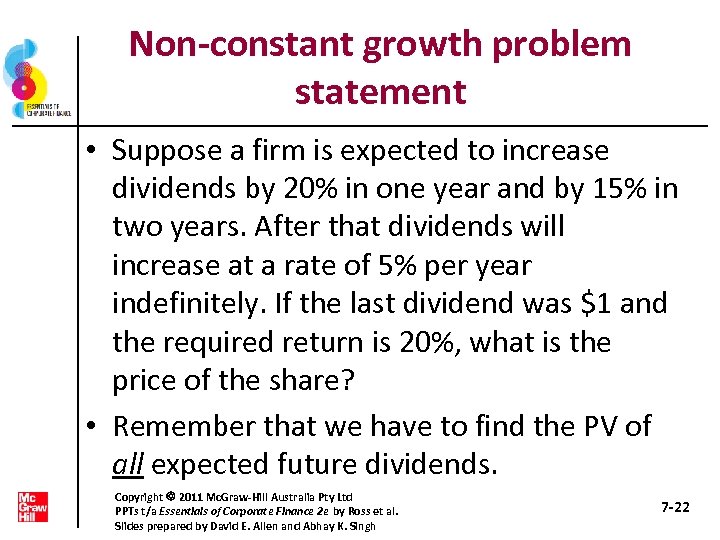 Non-constant growth problem statement • Suppose a firm is expected to increase dividends by 20% in one year and by 15% in two years. After that dividends will increase at a rate of 5% per year indefinitely. If the last dividend was $1 and the required return is 20%, what is the price of the share? • Remember that we have to find the PV of all expected future dividends. Copyright 2011 Mc. Graw-Hill Australia Pty Ltd PPTs t/a Essentials of Corporate Finance 2 e by Ross et al. Slides prepared by David E. Allen and Abhay K. Singh 7 -22
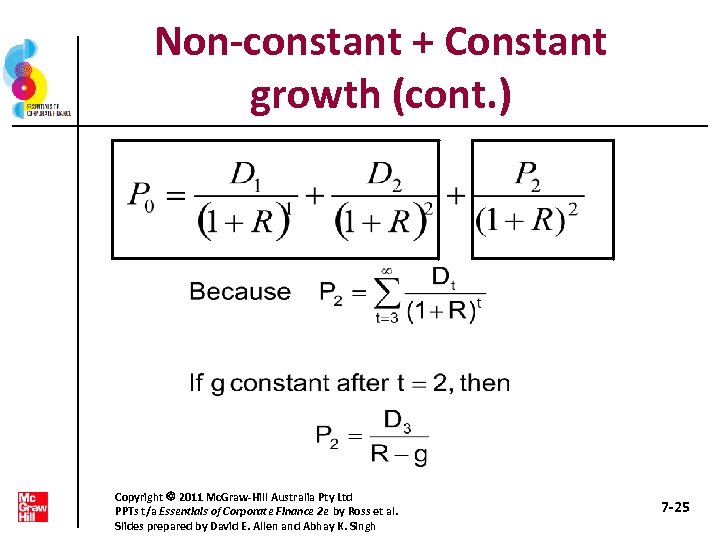
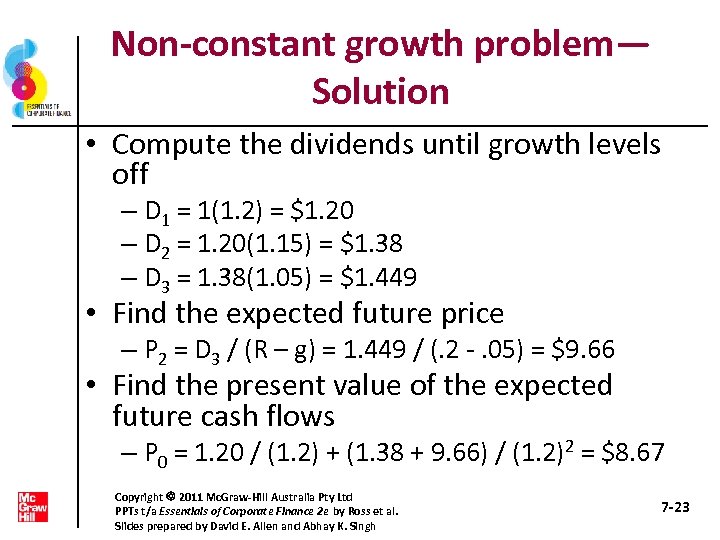 Non-constant growth problem— Solution • Compute the dividends until growth levels off – D 1 = 1(1. 2) = $1. 20 – D 2 = 1. 20(1. 15) = $1. 38 – D 3 = 1. 38(1. 05) = $1. 449 • Find the expected future price – P 2 = D 3 / (R – g) = 1. 449 / (. 2 -. 05) = $9. 66 • Find the present value of the expected future cash flows – P 0 = 1. 20 / (1. 2) + (1. 38 + 9. 66) / (1. 2)2 = $8. 67 Copyright 2011 Mc. Graw-Hill Australia Pty Ltd PPTs t/a Essentials of Corporate Finance 2 e by Ross et al. Slides prepared by David E. Allen and Abhay K. Singh 7 -23
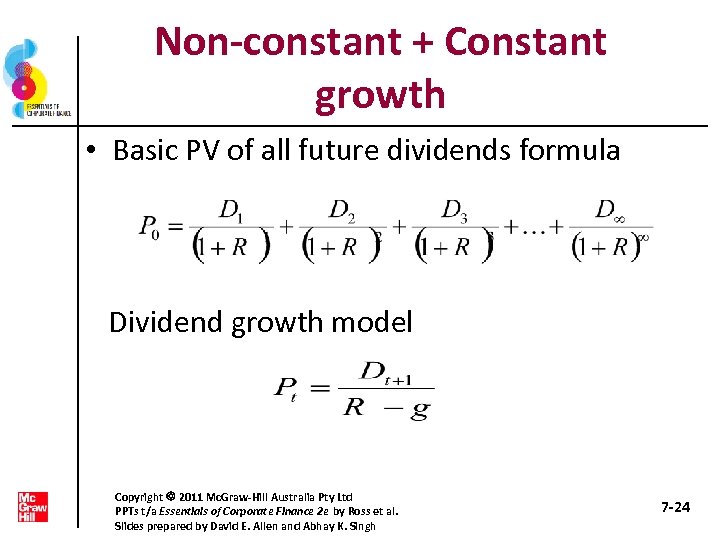 Non-constant + Constant growth • Basic PV of all future dividends formula Dividend growth model Copyright 2011 Mc. Graw-Hill Australia Pty Ltd PPTs t/a Essentials of Corporate Finance 2 e by Ross et al. Slides prepared by David E. Allen and Abhay K. Singh 7 -24
 Non-constant + Constant growth (cont. ) Copyright 2011 Mc. Graw-Hill Australia Pty Ltd PPTs t/a Essentials of Corporate Finance 2 e by Ross et al. Slides prepared by David E. Allen and Abhay K. Singh 7 -25
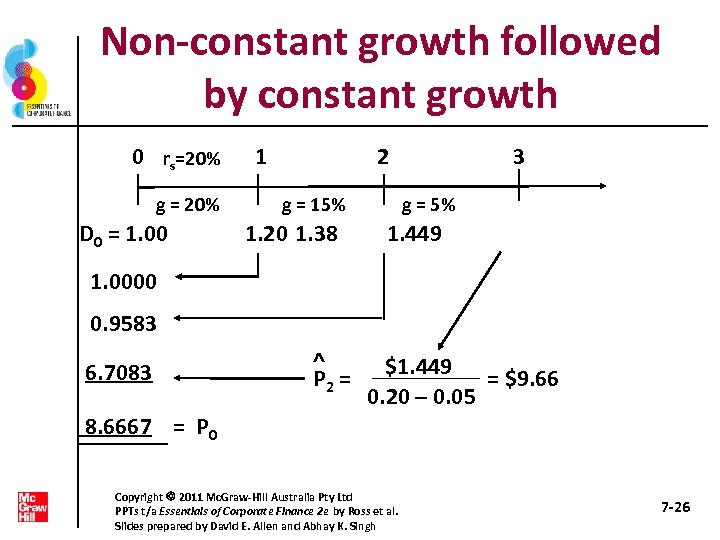 Non-constant growth followed by constant growth 0 rs=20% g = 20% D 0 = 1. 00 1 2 g = 15% 1. 20 1. 38 3 g = 5% 1. 449 1. 0000 0. 9583 6. 7083 ^ P 2 = $1. 449 = $9. 66 0. 20 – 0. 05 8. 6667 = P 0 Copyright 2011 Mc. Graw-Hill Australia Pty Ltd PPTs t/a Essentials of Corporate Finance 2 e by Ross et al. Slides prepared by David E. Allen and Abhay K. Singh 7 -26
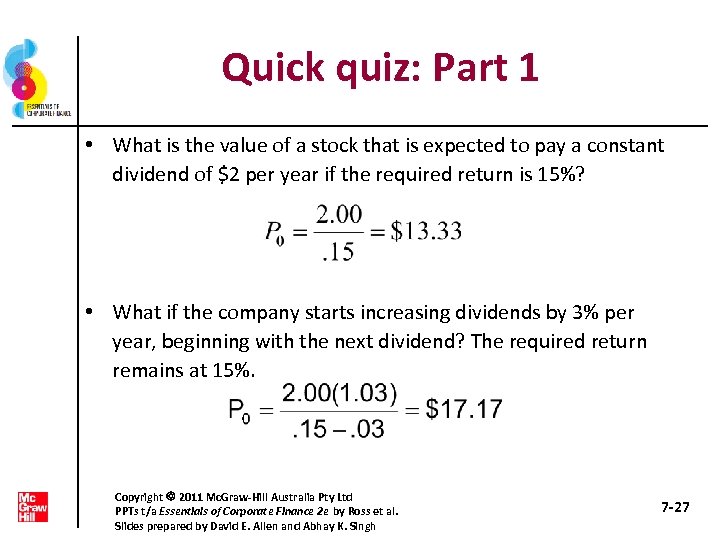 Quick quiz: Part 1 • What is the value of a stock that is expected to pay a constant dividend of $2 per year if the required return is 15%? • What if the company starts increasing dividends by 3% per year, beginning with the next dividend? The required return remains at 15%. Copyright 2011 Mc. Graw-Hill Australia Pty Ltd PPTs t/a Essentials of Corporate Finance 2 e by Ross et al. Slides prepared by David E. Allen and Abhay K. Singh 7 -27
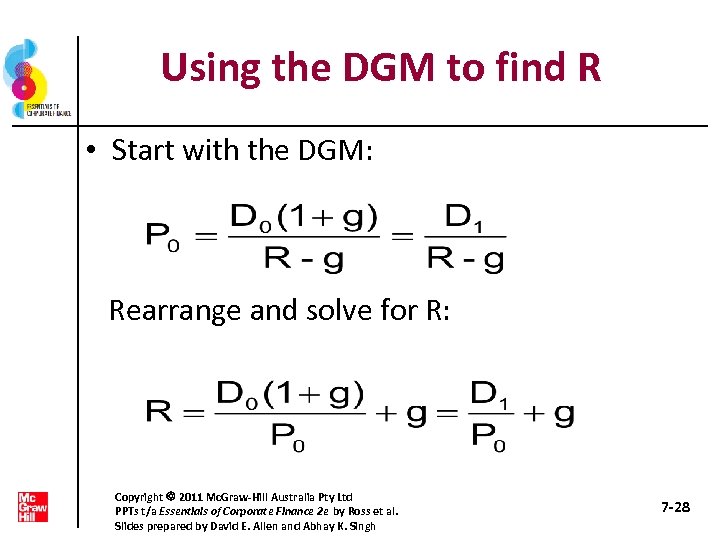 Using the DGM to find R • Start with the DGM: Rearrange and solve for R: Copyright 2011 Mc. Graw-Hill Australia Pty Ltd PPTs t/a Essentials of Corporate Finance 2 e by Ross et al. Slides prepared by David E. Allen and Abhay K. Singh 7 -28
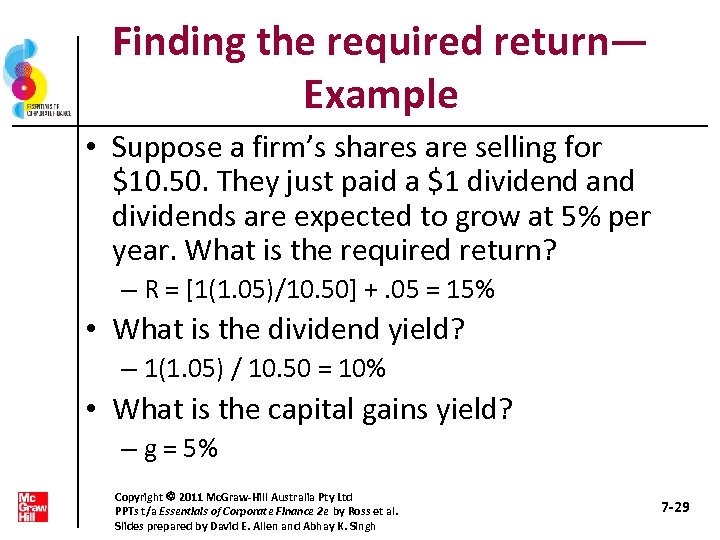 Finding the required return— Example • Suppose a firm’s shares are selling for $10. 50. They just paid a $1 dividend and dividends are expected to grow at 5% per year. What is the required return? – R = [1(1. 05)/10. 50] +. 05 = 15% • What is the dividend yield? – 1(1. 05) / 10. 50 = 10% • What is the capital gains yield? – g = 5% Copyright 2011 Mc. Graw-Hill Australia Pty Ltd PPTs t/a Essentials of Corporate Finance 2 e by Ross et al. Slides prepared by David E. Allen and Abhay K. Singh 7 -29
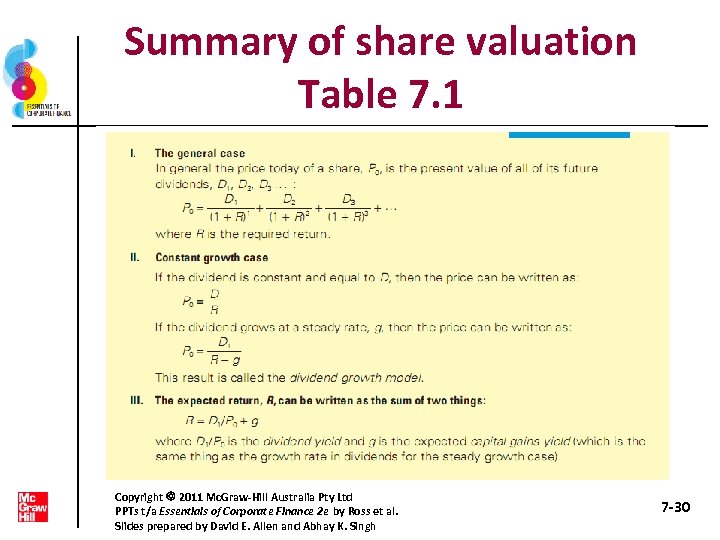 Summary of share valuation Table 7. 1 Copyright 2011 Mc. Graw-Hill Australia Pty Ltd PPTs t/a Essentials of Corporate Finance 2 e by Ross et al. Slides prepared by David E. Allen and Abhay K. Singh 7 -30
 Features of ordinary shares • Voting rights – Stockholders elect directors – Cumulative voting vs straight voting – Proxy voting • Classes of share – ‘One share, one vote’ Copyright 2011 Mc. Graw-Hill Australia Pty Ltd PPTs t/a Essentials of Corporate Finance 2 e by Ross et al. Slides prepared by David E. Allen and Abhay K. Singh 7 -31
 Features of ordinary shares (cont. ) • Other rights – Share proportionally in declared dividends – Share proportionally in remaining assets during liquidation – Pre-emptive right • Right of first refusal to buy new stock issue to maintain proportional ownership if desired Australia Pty Ltd Copyright 2011 Mc. Graw-Hill PPTs t/a Essentials of Corporate Finance 2 e by Ross et al. Slides prepared by David E. Allen and Abhay K. Singh 7 -32
 Dividend characteristics • Dividends are not a liability of the firm until declared by the Board of Directors – A firm cannot go bankrupt for not declaring dividends • Dividends and taxes – Dividends are not tax deductible for a firm – Taxed as ordinary income for individuals – Dividends received by corporations have a minimum 100% exclusion from taxable income Copyright 2011 Mc. Graw-Hill Australia Pty Ltd PPTs t/a Essentials of Corporate Finance 2 e by Ross et al. Slides prepared by David E. Allen and Abhay K. Singh 7 -33
 Features of preference shares • Dividends – Stated dividend must be paid before dividends can be paid to ordinary shareholders – Dividends are not a liability of the firm and preference dividends can be deferred indefinitely – Most preference dividends are cumulative— any missed preference dividends have to be paid before ordinary dividends can be paid • Preference shares generally do not carry voting rights Copyright 2011 Mc. Graw-Hill Australia Pty Ltd PPTs t/a Essentials of Corporate Finance 2 e by Ross et al. Slides prepared by David E. Allen and Abhay K. Singh 7 -34
 The share markets • Primary vs secondary markets – Primary = new-issue market – Secondary = existing shares traded among investors • Dealers vs brokers – Dealer: Maintains an inventory Ready to buy or sell at any time Think ‘Used car dealer’ – Broker: Brings buyers and sellers together Think ‘Real estate broker’ Copyright 2011 Mc. Graw-Hill Australia Pty Ltd PPTs t/a Essentials of Corporate Finance 2 e by Ross et al. Slides prepared by David E. Allen and Abhay K. Singh 7 -35
 Australian Stock Exchange (ASX) • Australian Stock Exchange (ASX)— 1987 – Result of amalgamation of state-based exchanges • 1987—Introduction of Stock Exchange Automated Trading System (SEATS) • 1998—Demutualisation of ASX • 2006—Merger with Sydney Futures Exchange and now called Australian Securities Exchange • New Zealand Stock Exchange – Created in 1974 – 1991—Introduction of Computer Based Trading System – Demutualised in 2002 Copyright 2011 Mc. Graw-Hill Australia Pty Ltd PPTs t/a Essentials of Corporate Finance 2 e by Ross et al. Slides prepared by David E. Allen and Abhay K. Singh 7 -36
 ASX and NZX operations • Operational goal = Attract order flow • Both ASX and NZX are auction markets – Agency trading—Brokers buying and selling for clients – Principal trading—Brokers buying and selling their own accounts • Orders – Limit order—specified sell/buy price – Market order—at best market price • Trading in both ASX and NZX takes place on computer network Copyright 2011 Mc. Graw-Hill Australia Pty Ltd PPTs t/a Essentials of Corporate Finance 2 e by Ross et al. Slides prepared by David E. Allen and Abhay K. Singh 7 -37
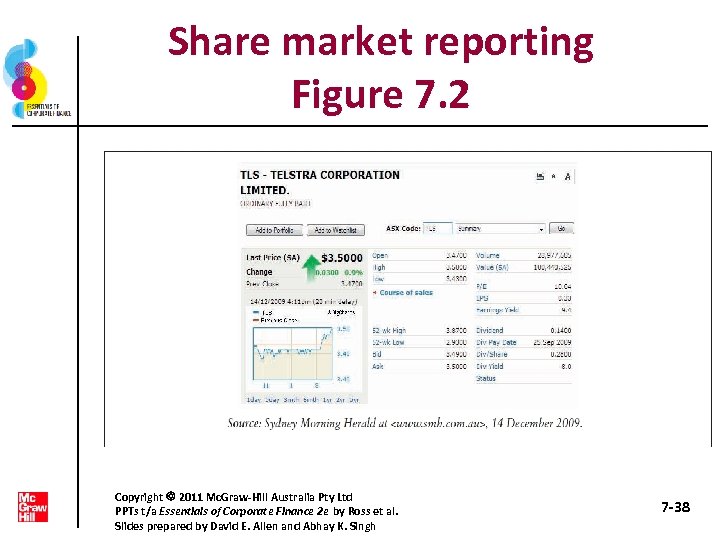 Share market reporting Figure 7. 2 Copyright 2011 Mc. Graw-Hill Australia Pty Ltd PPTs t/a Essentials of Corporate Finance 2 e by Ross et al. Slides prepared by David E. Allen and Abhay K. Singh 7 -38
 Work the Web • Click on the information icon to go to
 Quick quiz: Part 2 • You observe a share price of $18. 75. You expect a dividend growth rate of 5% and the most recent dividend was $1. 50. What is the required return? • What are some of the major characteristics of ordinary shares? • What are some of the major characteristics of preference shares? Copyright 2011 Mc. Graw-Hill Australia Pty Ltd PPTs t/a Essentials of Corporate Finance 2 e by Ross et al Slides prepared by David E. Allen and Abhay K. Singh. 7 -40
 Chapter 7 END 7 -41