 Скачать презентацию Equipment Acquisition Risk Management Mohd Yusof bin
72b8c8de1860a7bf9573498b2ad29c43.ppt
- Количество слайдов: 32



Equipment Acquisition & Risk Management Mohd Yusof bin Baharuddin
EQUIPMENT ACQUISITION § Objective: Improved performance at reduced cost § Typically, medical device systems will emerge from strategic technology planning and technology assessment processes as “required and budgeted” needs.
The following process should be followed: 1. A need analysis should be conducted, reaffirming clinical needs and deviceintended applications. 2. Material management and clinical engineering personnel should ensure this item is a candidate for centralized or coordinated acquisition of similar equipment with other hospital departments.
3. Written pre-purchase evaluation guidelines should be followed. 4. Purchasing takes place, wherein final equipment negotiations are conducted and purchase documents are prepared and a purchase order is made.
Pre-purchase Evaluation 1. Analysis of needs and development of a specification list. 2. Developing a vendor list and requesting proposals. 3. Analyzing proposals, site planning. 4. Evaluating samples. 5. Selecting finalists. 6. Make the award. 7. Delivery and installation. 8. Acceptance testing
Acquisition Process Strategies Cost of Ownership § The cost of ownership encompasses all direct and indirect expenses. § It expresses the cost factors of medical equipment for both the initial price of the equipment (which typically includes the equipment, its installation, and initial training cost) and support over the long-term (ongoing training, equipment service, supplies, connectivity, upgrades, and other costs)
§ The full range of cost of ownership factor includes: § technology assessment and acquisition costs, § operation and maintenance costs § It is estimated that the purchase price represents only 20% of the life-cycle cost ownership.
Utilization Information § When conducting needs analysis (Step 1 as in pre-purchase evaluation), actual utilization information from the organization’s existing similar devices can be very helpful. § One method of measuring equipment utilization is to match product to its intended function and to measure daily (if necessary) the equipment ‘s actual utilization.
Analysis includes the following information: § From the equipment inventory, equipment installation dates and condition codes [1(new) to 5(scrap), as determined by technical service appraisal and service expenses] § From the procedure mix, like procedures are grouped by modality. § Procedure/equipment volumes information is retrieved from the central billing system. § Operational constraints are determined (the total period of time equipment is available during the day). For example , comparing a Radiographic and Fluoroscopic (R and F) x-ray room’s ideal utilization versus a straight radiographic (Rad) room’s ideal utilization.
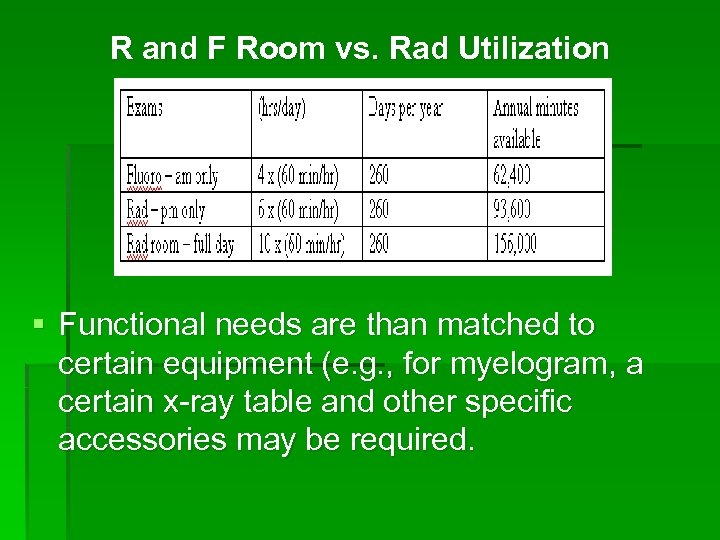
R and F Room vs. Rad Utilization § Functional needs are than matched to certain equipment (e. g. , for myelogram, a certain x-ray table and other specific accessories may be required.
Life-Cycle Cost Analysis § Life-cycle cost analysis is a tool used during technology planning, assessment or acquisition either to compare highcost, alternative means for providing a service, or to determine whether a single project or technology has a positive or negative economic value.
§ The strength of life cycle-cost analysis is that it examines the cash flow impact of an alternative over its entire life, instead of focusing solely on initial capital investments. § Life cycle cost analysis facilitates comparisons between projects or technologies with large initial cash outlays and those level outlays and inflows overtime.

§ The most powerful life cycle cost technique is Net Present Value (NPV) analysis, which explicitly accounts for inflation and foregone investment opportunities by future cash flows in present dollars. PV = Ct (1 + r)t
A hospital might use LCC analysis as a key factor in such important decision as: § To replace/rebuild or buy/lease medical imaging equipment; § To purchase equipment with a greater initial capital outlay and lower operating costs or to choose an alternative § To acquire and install equipment or contract with a mobile equipment vendor to provide the service when beginning a major new service (e. g. , MRI service); § To acquire a costly, specialized clinical laboratory instrument or continue to send tests to a reference lab; § To stay with hard-copy storage of radiology films or move to electronic image archiving; § To continue to lease a complete telephone system or buy a new one.
Steps for LCC/NPV analysis 1. Map out all the factors related to each alternative to gain a complete understanding of each alternative’s impact on the status quo. This first step is perhaps the most crucial. 2. Choose a time frame, or lifecycle, of the decision. 3. Determine the actual incremental cash flows associated with the quantifiable elements of each alternative. 4. Choose a discount factor.
5. Determine the net present value (or cost) for each alternative. 6. Compare the alternatives and use the comparison as input for final choice. 7. Perform sensitivity analysis using alternative assumptions. 8. Assess the likely impact of all identified subjective factors.
Equipment Evaluation § The process provides information that can be used to screen unacceptable performance by either the vendor or the equipment. § The pre-purchase evaluation process consists of technical, clinical, financial, and operational aspects. These aspects are evaluated during TA process. § CE should be familiar with emerging and evolving technologies and can translate the clinical needs of users into comprehensive bids specification document. § The specification document should be clear to facilitate a competitive bidding environment and a valid comparison of vendors.
Conditions of Sale Document § One strategy that strengthens the acquisition process is the Condition of Sale document. This multifaceted document integrates equipment specifications, performance, installation requirements and follow-up services.
Making the Award § Standard purchase orders that include the Conditions of Sale for medical equipment are usually used to initiate order. In addition to current facility conditions are addressed as a minimum: § Installation and approval requirements, responsibilities, and timetable. § Payment, assignment, and cancellation. § Software requirements and updates (e. g. , software availability, licensing fees).
Acceptance Testing § All medical equipment must be inspected and tested before it is placed into service regardless of whether it is purchased, leased, rented, or borrowed by the hospital. Acceptance testing involves the following: § An incoming inspection designed to verify that each medical device received is capable of performing its designed function and is electrically safe. § Baseline measures that may be later used to resolve specified problems. § Compliance with the equipment assets management process.
Clinical Team Requirements § In clinical acquisition process, clinical-decision makers analyze the following criteria concerning proposed technology acquisitions, specifically as they relate to clinical team requirements: § § Ability of staff to assimilate the technology. Medical staff satisfaction (short-term and long-term). Impact on staffing (numbers, functions). Projected utilization.
RISK MANAGEMENT MOHD YUSOF BAHARUDDIN
Introduction § Risk measures the probability and severity of loss or injury, while uncertainty refers to lack of knowledge or lack of certainty. § While it is not simple to quantify the cost-tobenefit ratio in a particular intervention, risk management evolves into responsibility that includes prediction of injury, avoidance of exposure to risks, and minimization of liability exposure.
Reducing Risk § The dynamic risk factor modifies this level and individually identifies each piece of equipment within an equipment category according to the accumulated experiences over the equipment life cycle. § These experiences include: § number of failures, § number of recalls, § hazards, or incidents, and § equipment age.
The RM program requires: § the development of risk criteria, § the identification of problems, and § an action plan to reduce them.
§ The impact of both risk and quality are monitored prior to the purchasing decision, during installation, maintenance and repair, and as indicators for replacement. § Faulty design, poor manufacturing, lack of compatibility with existing technology, and mismatch with user skills and/or needs can be corrected during the equipment selection and acceptance testing. § Incorrect operating procedure, lack of or inadequate maintenance program, or faulty repair work can be corrected by failure evaluation system.
§ § 1. 2. 3. Periodically, a summary report of significant equipment-related performance is prepared. The report’s data is made of elements that show: the ratio of the number of completed-toscheduled inspections, the number and percent of devices failing to pass prescribed inspection, the number and percent of devices for which a user’s complaint was registered (however no problems were found),
4. the number and percent of devices that show physical damage, 5. devices that were involved with an unusual event (incident), and 6. the number of devices for which a user’s complaint was justified.
Quality Improvement (QI) § A quality improvement process is introduced, in order to provide a patient care environment that is continuously safer and provides higher quality patient outcomes. § The process is proactive and consists of: 1. structure – written manual of policies and procedures defining goals and objectives, 2. process – understanding of the operation and the ability to determine opportunities for improvement, and 3. outcome base – an evaluation of the program impact as determined by function reports.
§ One of the QI process methods is based on 10 steps that are the building blocks for an information collection and evaluation system The 10 steps are: 1. Assign Responsibility 2. Delineate Scope of Service 3. Identify Important Aspects of Service 4. Identify Indicators 5. Establish Thresholds for Evaluation 6. Collect and Organize Data 7. Evaluate Service 8. Take Actions to Solve Problems 9. Assess Actions and Document Improvement 10. Communicate Relevant Information
Codes and Standards § Risk analysis, continuous QI, cost/benefit assessment, and compliance with the regulatory mandates are concepts that are vital for manager who is responsible for managing medical technology. § For example, IEC (International Electro-technical Commission), Safe Medical Devices Act (SMDA), American National Standards Institute (ANSI), Medical Information Bus (MIB), Joint Commission on Accreditation of Healthcare Organization (JCAHO), National Institute for Occupational Safety and Health (NIOSH). This is sample of the many that mandates and activities that shape the administration of healthcare services.
Summary 1. Equipment Acquisition § Process of Acquiring Technology § § § Acquisition Process Strategies § § § § 2. Overall Process Pre-purchase Evaluation Cost of Ownership Utilization Information Life-Cycle Cost Analysis Equipment Evaluation The Conditions of Sale Document Making the Award Acceptance Testing Clinical Team Requirements Risk Management § § Introduction Reducing Risk Quality Improvement Codes and Standards
Скачать презентацию Equipment Acquisition Risk Management Mohd Yusof bin
72b8c8de1860a7bf9573498b2ad29c43.ppt