


 Скачать презентацию EQUALITY of CHALLENGE Initiative In-House Assessments and Diagnostic
0a19fcb8ddf6916d51283a4f2ed55926.ppt
- Количество слайдов: 29
 EQUALITY of CHALLENGE Initiative In-House Assessments and Diagnostic Testing Identifying Difficulties and Exceptionalities Jean Johnston 2009 Schull Community College
 Types of Testing p Incoming assessments p On-going assessments p Diagnostic assessments (in-house) p Testing by outside professionals, including the NEPS psychologist 2
 Incoming Assessments What Tests? D. Young Cloze Reading Test 3 Vernon Maths Competency Test (N. France was used up to 2007) AH 2 was used until last year Cognitive Abilities Test 3 (CAT 3) Level E has replaced it 3
 INCOMING ASSESSMENTS Purpose is to: Ø Identify those students who might benefit from learning support Ø To assist in the organisation of well-balanced mixed-ability groupings Ø To identify students who might benefit from further testing Ø To begin to identify students with exceptional ability Ø To assist in identifying students with dual exceptionality Ø To provide information to subject teachers about the range of ability in the new first year 4
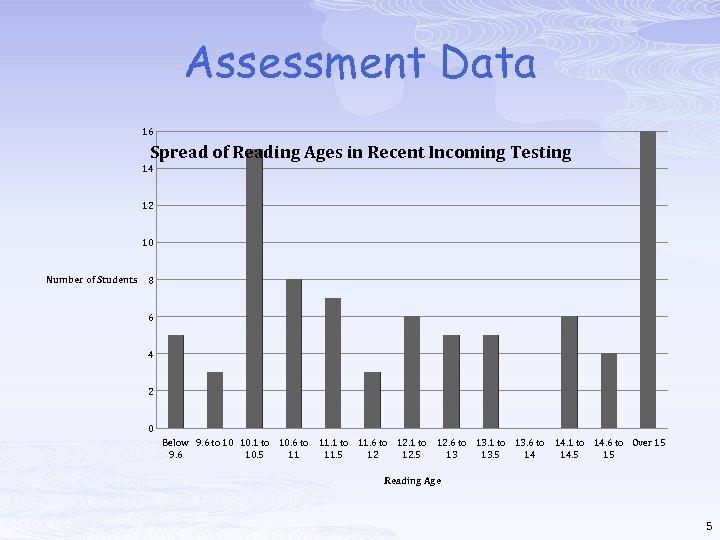 Assessment Data 16 Spread of Reading Ages in Recent Incoming Testing 14 12 10 Number of Students 8 6 4 2 0 Below 9. 6 to 10 10. 1 to 10. 6 to 9. 6 10. 5 11 11. 1 to 11. 6 to 12. 1 to 11. 5 12 12. 5 12. 6 to 13. 1 to 13. 6 to 13 13. 5 14 14. 1 to 14. 6 to Over 15 14. 5 15 Reading Age 5
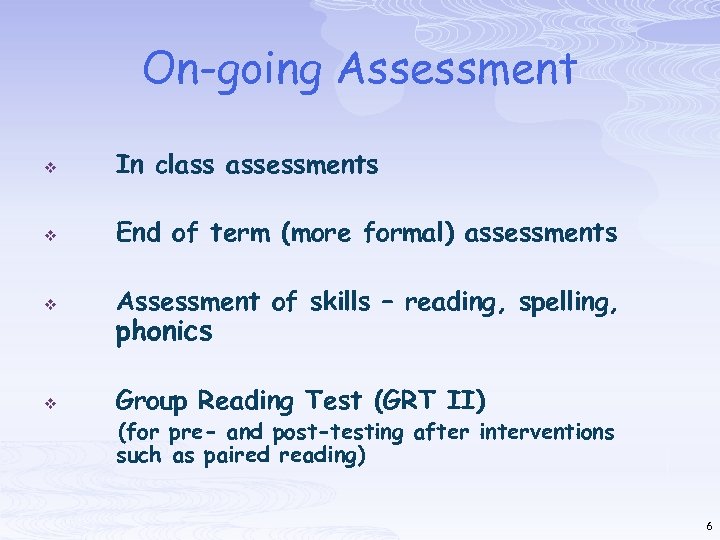 On-going Assessment v In class assessments v End of term (more formal) assessments v Assessment of skills – reading, spelling, v Group Reading Test (GRT II) phonics (for pre- and post-testing after interventions such as paired reading) 6
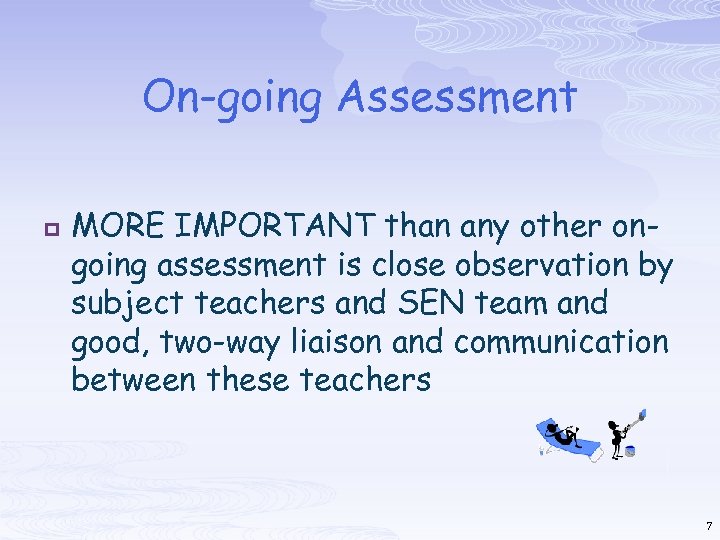 On-going Assessment p MORE IMPORTANT than any other ongoing assessment is close observation by subject teachers and SEN team and good, two-way liaison and communication between these teachers 7
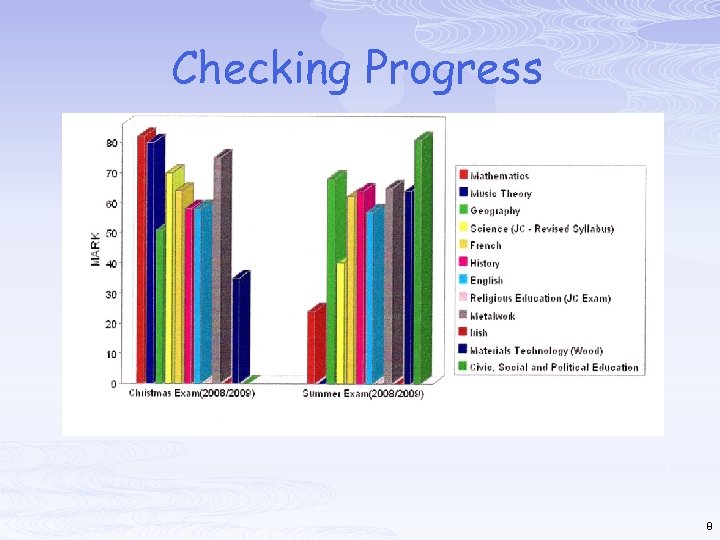 Checking Progress 8
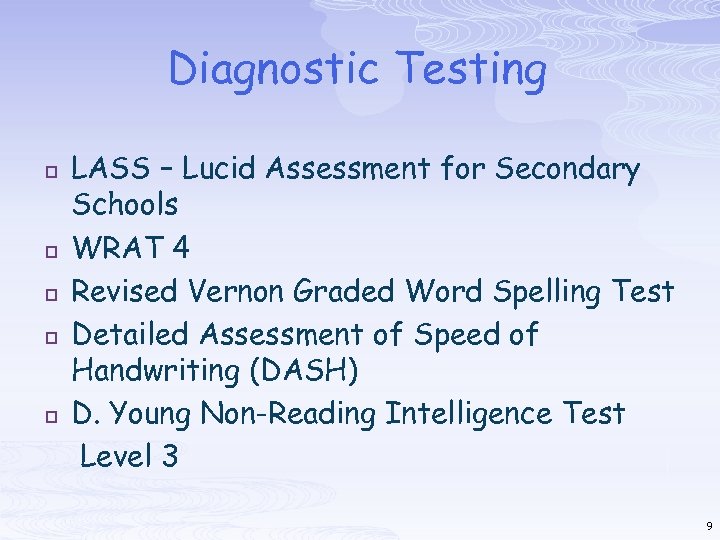 Diagnostic Testing p p p LASS – Lucid Assessment for Secondary Schools WRAT 4 Revised Vernon Graded Word Spelling Test Detailed Assessment of Speed of Handwriting (DASH) D. Young Non-Reading Intelligence Test Level 3 9
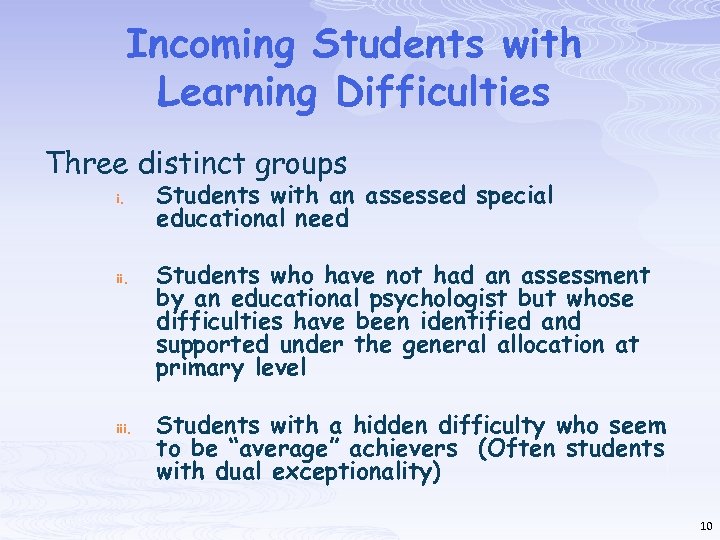 Incoming Students with Learning Difficulties Three distinct groups i. iii. Students with an assessed special educational need Students who have not had an assessment by an educational psychologist but whose difficulties have been identified and supported under the general allocation at primary level Students with a hidden difficulty who seem to be “average” achievers (Often students with dual exceptionality) 10
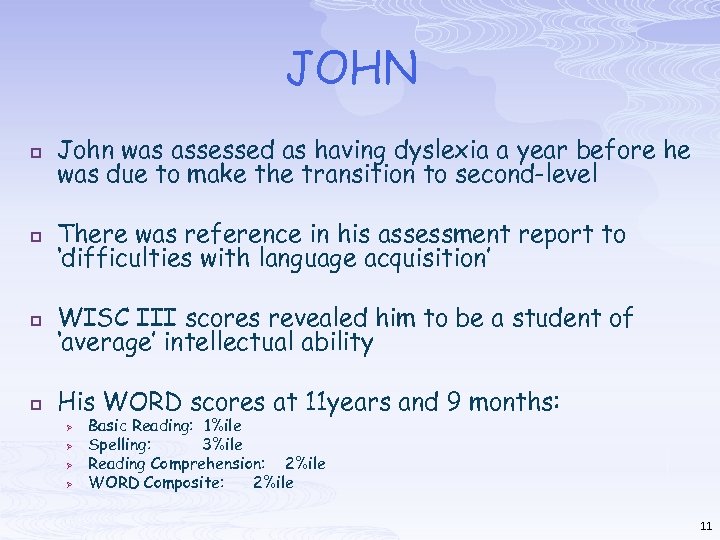 JOHN p John was assessed as having dyslexia a year before he was due to make the transition to second-level p There was reference in his assessment report to ‘difficulties with language acquisition’ p WISC III scores revealed him to be a student of ‘average’ intellectual ability p His WORD scores at 11 years and 9 months: Ø Ø Basic Reading: 1%ile Spelling: 3%ile Reading Comprehension: 2%ile WORD Composite: 2%ile 11
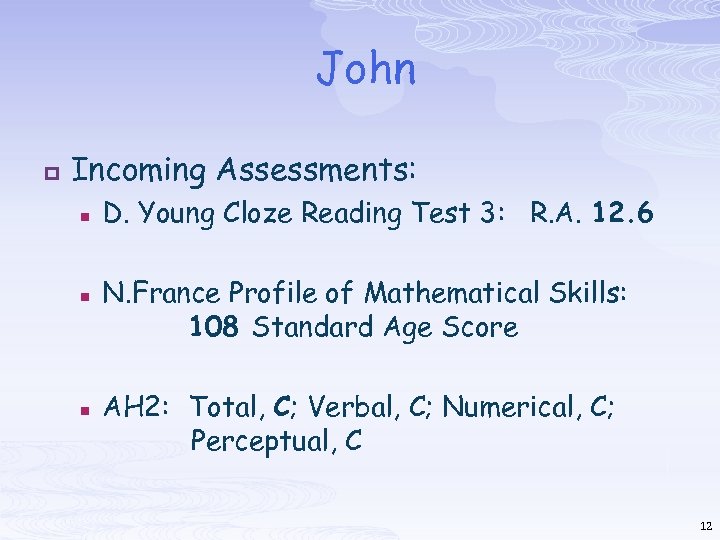 John p Incoming Assessments: n n n D. Young Cloze Reading Test 3: R. A. 12. 6 N. France Profile of Mathematical Skills: 108 Standard Age Score AH 2: Total, C; Verbal, C; Numerical, C; Perceptual, C 12
 JOHN p p p John was allocated 2. 5 hours There was no Laptop Initiative then but John had the use of the computer with assistive software in the SEN Room Despite adequate scores in incoming tests, John experienced great difficulties with all literacy skills 13
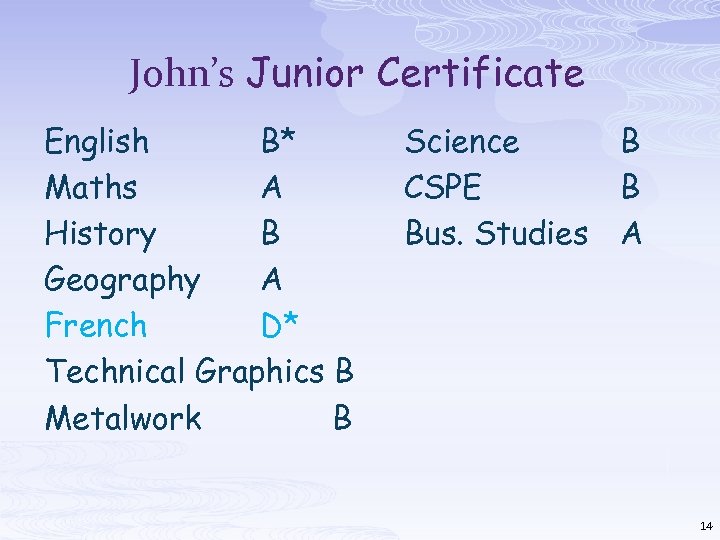 John’s Junior Certificate English B* Maths A History B Geography A French D* Technical Graphics B Metalwork B Science B CSPE B Bus. Studies A 14
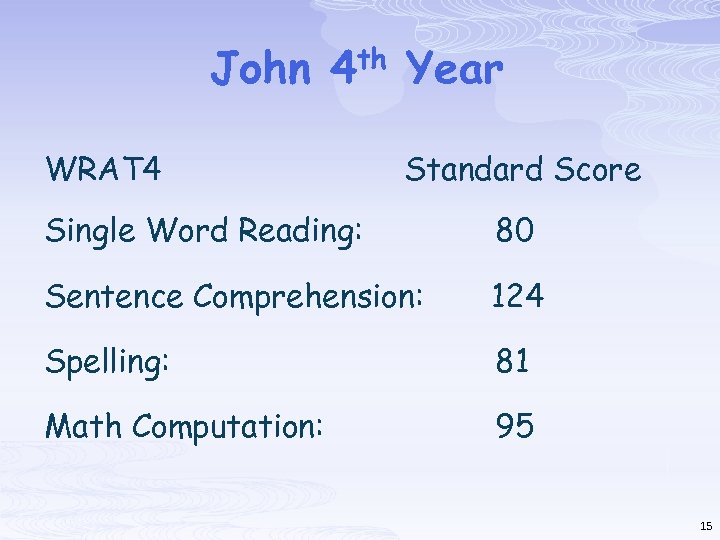 John 4 th Year WRAT 4 Standard Score Single Word Reading: 80 Sentence Comprehension: 124 Spelling: 81 Math Computation: 95 15
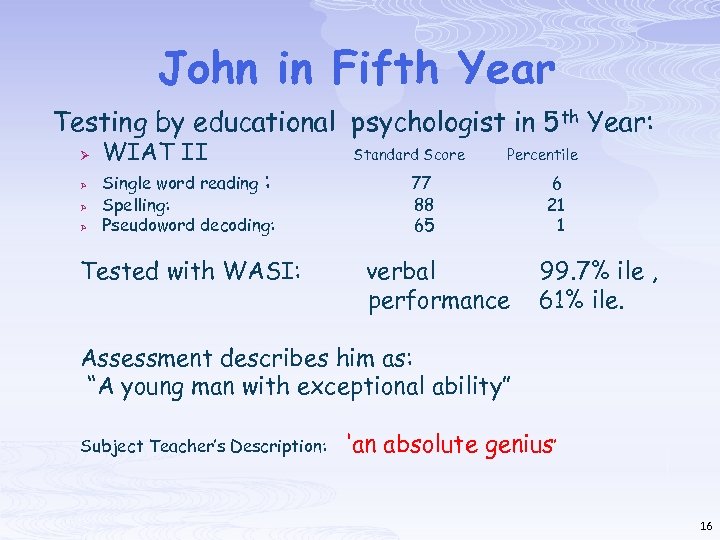 John in Fifth Year Testing by educational psychologist in 5 th Year: Ø Ø WIAT II Single word reading : Spelling: Pseudoword decoding: Tested with WASI: Standard Score Percentile 77 88 65 verbal performance 6 21 1 99. 7% ile , 61% ile. Assessment describes him as: “A young man with exceptional ability” Subject Teacher’s Description: ‘an absolute genius’ 16
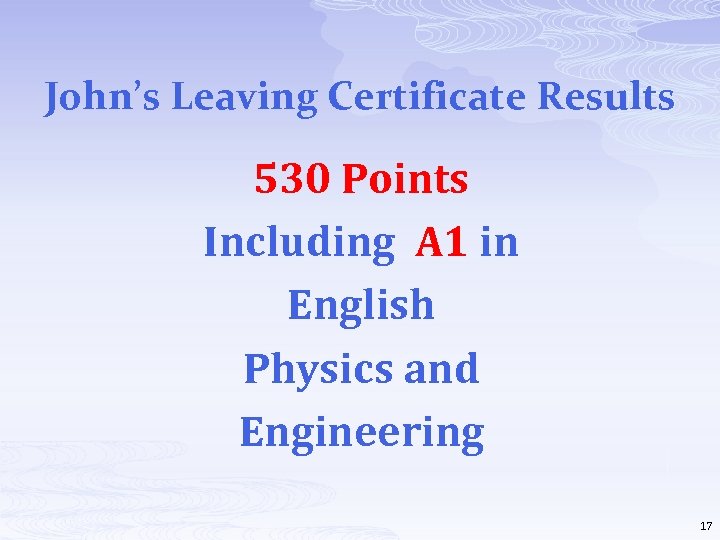 John’s Leaving Certificate Results 530 Points Including A 1 in English Physics and Engineering 17
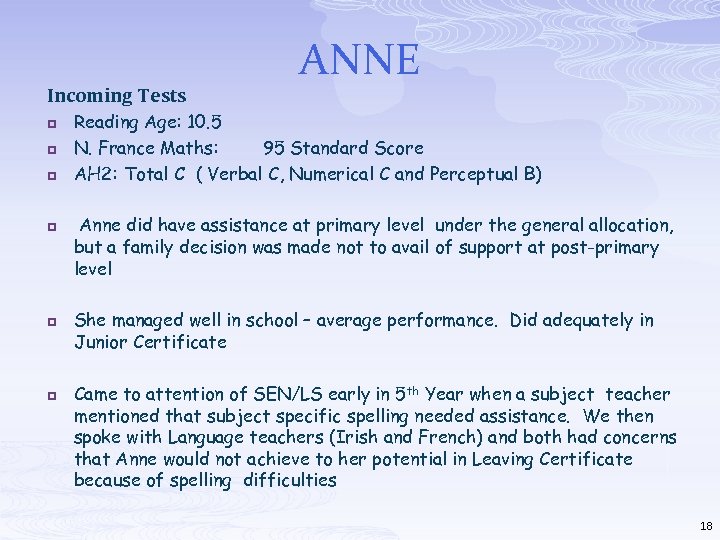 Incoming Tests p p p ANNE Reading Age: 10. 5 N. France Maths: 95 Standard Score AH 2: Total C ( Verbal C, Numerical C and Perceptual B) Anne did have assistance at primary level under the general allocation, but a family decision was made not to avail of support at post-primary level She managed well in school – average performance. Did adequately in Junior Certificate Came to attention of SEN/LS early in 5 th Year when a subject teacher mentioned that subject specific spelling needed assistance. We then spoke with Language teachers (Irish and French) and both had concerns that Anne would not achieve to her potential in Leaving Certificate because of spelling difficulties 18
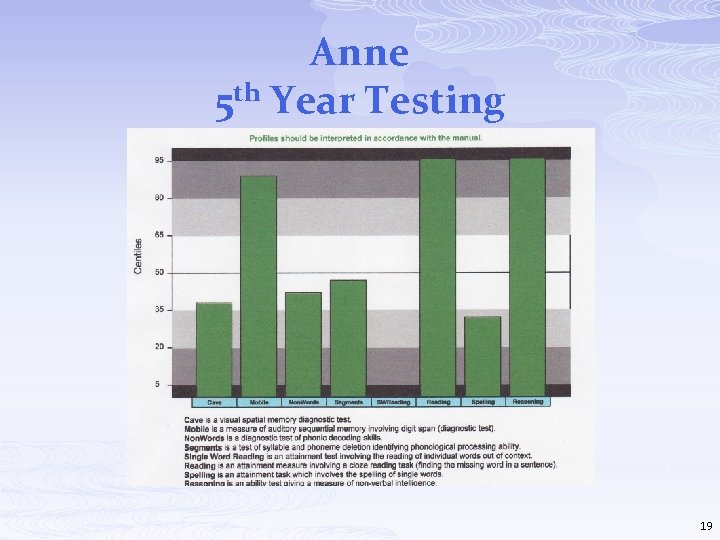 Anne 5 th Year Testing 19
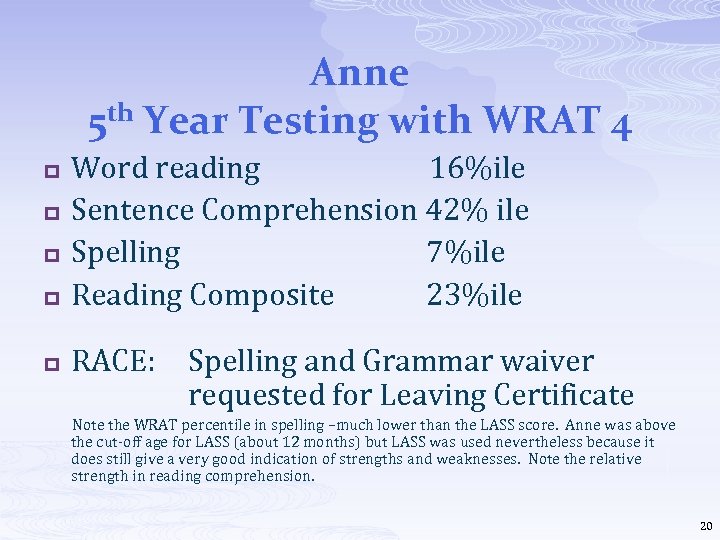 Anne 5 th Year Testing with WRAT 4 p Word reading 16%ile Sentence Comprehension 42% ile Spelling 7%ile Reading Composite 23%ile p RACE: p p p Spelling and Grammar waiver requested for Leaving Certificate Note the WRAT percentile in spelling –much lower than the LASS score. Anne was above the cut-off age for LASS (about 12 months) but LASS was used nevertheless because it does still give a very good indication of strengths and weaknesses. Note the relative strength in reading comprehension. 20
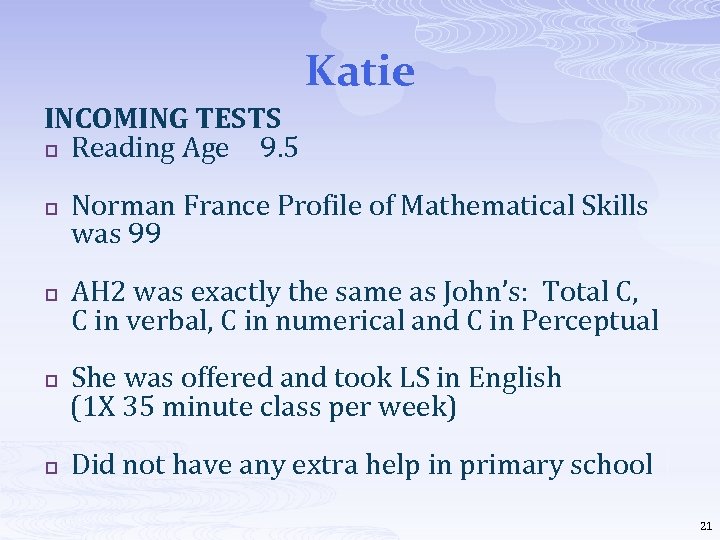 Katie INCOMING TESTS p Reading Age 9. 5 p p Norman France Profile of Mathematical Skills was 99 AH 2 was exactly the same as John’s: Total C, C in verbal, C in numerical and C in Perceptual She was offered and took LS in English (1 X 35 minute class per week) Did not have any extra help in primary school 21
 KATIE p p p Was brought to our attention in third year because there was teacher concern with her spelling in Irish and French Investigation revealed also that she was having trouble with English spelling and grammar – but was doing higher level English Testing was carried out 22
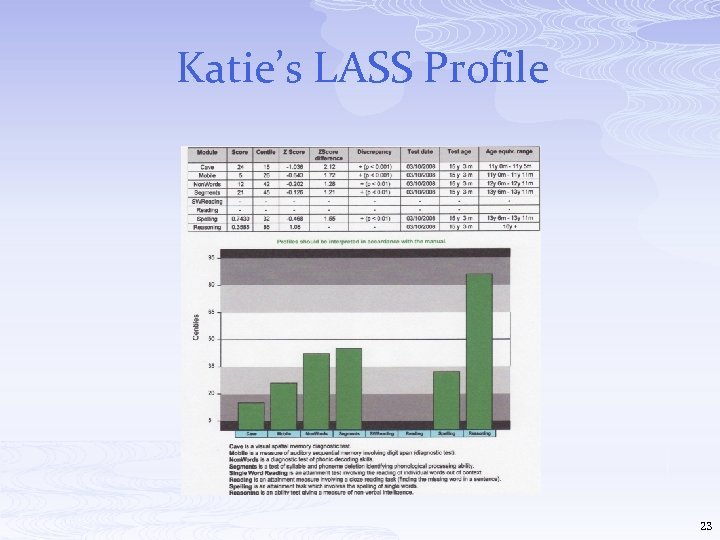 Katie’s LASS Profile 23
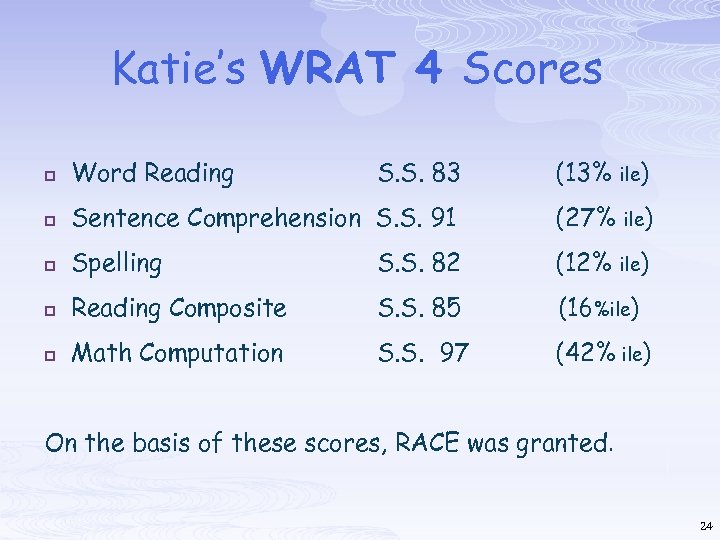 Katie’s WRAT 4 Scores p Word Reading S. S. 83 (13% ile) p Sentence Comprehension S. S. 91 (27% ile) p Spelling S. S. 82 (12% ile) p Reading Composite S. S. 85 (16%ile) p Math Computation S. S. 97 (42% ile) On the basis of these scores, RACE was granted. 24
 Double Exceptionality Ø Ø Ø John, our first student, is an exceptionally able student who has a learning difficulty that has been largely overcome because of his ability The other two students have difficulties but also have the potential to be exceptionally able The incoming profiles of these students were similarly ‘average’, with one exception 25
 Dual Exceptionality Incoming testing did not reveal any learning difficulties in these students, except in Katie’s case where it revealed a reading difficulty – otherwise her scores were also ‘average’ 26
 Double Exceptionality p p The two girls described above are coping well with the curriculum However they are unlikely to achieve their potential without additional supports 27
 CAVEATS q q q Incoming testing is a useful tool, but is only one part of assessment AND it may often be misleading Observation and communication are essential to a fuller understanding of a student’s abilities Academic ability is only one aspect of intellectual ability – many ‘intelligences’ cannot be measured by testing 28
 The ‘Equality of Challenge’ Initiative p Has raised awareness about students with dual exceptionality p Has led to a broader and more effective use of both incoming assessments and of in-house testing p p Has resulted in identification of students with exceptional needs and of those with dual exceptionality Has led to measures being put in place to support both these categories of students 29