


 Скачать презентацию EPSRC Mathematical Sciences Programme David Harman Head
2396764641408f0e34ebfe6ef74b85cb.ppt
- Количество слайдов: 17
 EPSRC Mathematical Sciences Programme David Harman – Head of Programme Katharine Bowes – Pure Mathematics Mark Bambury – Applied Mathematics Janet Edwards – Statistics/Operational Research and Mathematical Physics
 EPSRC GOALS 2008 -11 • Increase focus on the key challenges for society • Encourage even more ambitious and transformative research in a healthy research base • Attract and nurture talented and skilled people • Work with all partners to more effectively translate/understand how research can contribute to solving the challenges facing society • Realign our own internal organisation to deliver our goals most effectively
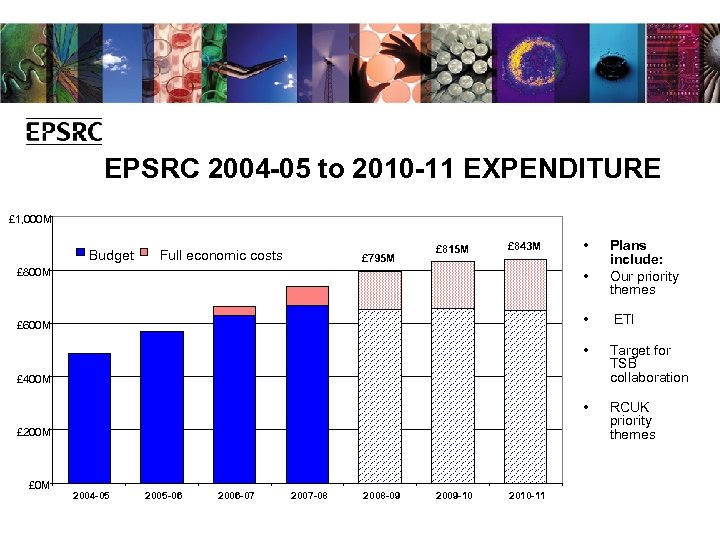 EPSRC 2004 -05 to 2010 -11 EXPENDITURE £ 1, 000 M Budget Full economic costs £ 795 M £ 815 M £ 843 M £ 800 M • • Plans include: Our priority themes • ETI • Target for TSB collaboration • £ 600 M RCUK priority themes £ 400 M £ 200 M £ 0 M 2004 -05 2005 -06 2006 -07 2007 -08 2008 -09 2009 -10 2010 -11
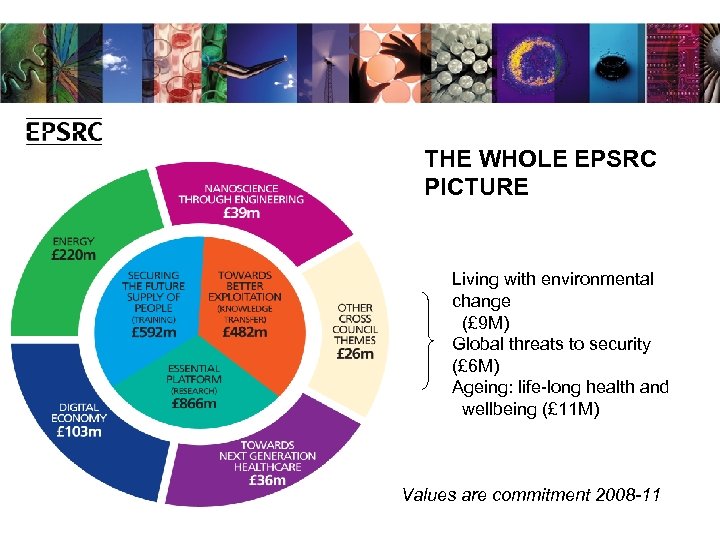 THE WHOLE EPSRC PICTURE Living with environmental change (£ 9 M) Global threats to security (£ 6 M) Ageing: life-long health and wellbeing (£ 11 M) Values are commitment 2008 -11
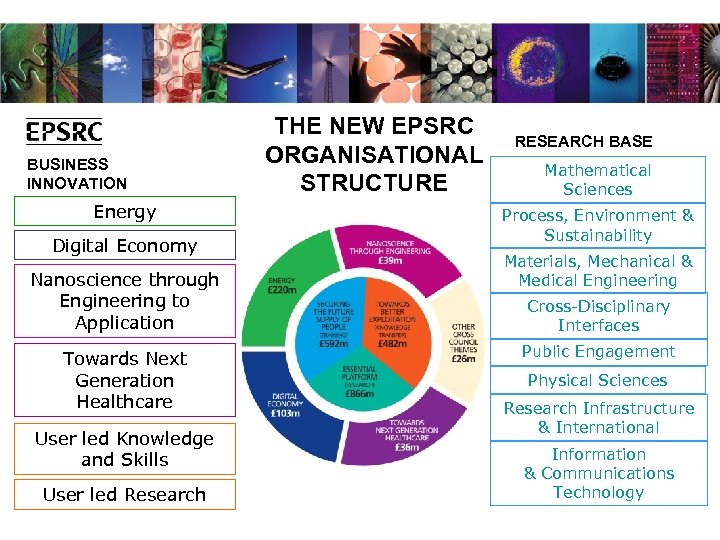 BUSINESS INNOVATION Energy Digital Economy Nanoscience through Engineering to Application Towards Next Generation Healthcare User led Knowledge and Skills User led Research THE NEW EPSRC ORGANISATIONAL STRUCTURE RESEARCH BASE Mathematical Sciences Process, Environment & Sustainability Materials, Mechanical & Medical Engineering Cross-Disciplinary Interfaces Public Engagement Physical Sciences Research Infrastructure & International Information & Communications Technology
 CONCLUSIONS • The major feature of our plans is the identification of key priority themes addressing important societal challenges • All research disciplines have an important role to play in these themes • The largest proportion of our budget is spent on investigator-led research and training • We want to encourage researchers to be even more ambitious • Need for us all to demonstrate the wider impact of science and engineering research on society and the economy
 MATHEMATICAL SCIENCES PROGRAMME 2008/09
 COMMITMENT BUDGET 2008/09 Research £ 16 M Training £ 16 M
 PRIORITIES • Engagement with focused research themes • Supporting young researchers and next generation of research leaders • High quality fundamental research • Pump-priming new research topics or areas in need of rejuvenation
 ENGAGEMENT WITH FOCUSED RESEARCH THEMES • Workshops between mathematicians and practitioners • Discipline-hopping awards • Bridging the gaps initiative A dialogue with the community will be helpful in deciding how to take this forward
 SUPPORTING YOUNG RESEARCHERS AND NEXT GENERATION OF RESEARCH LEADERS • • Doctoral training programme First Grants Postdoctoral Fellowships Career Acceleration and Leadership Fellowships • Workshops for new academics
 HIGH QUALITY FUNDAMENTAL RESEARCH • • • Responsive mode Encouraging more flexibility and adventure Programme grants Platform grants Signposting strategic areas
 PUMP-PRIMING NEW RESEARCH TOPICS OR AREAS IN NEED OF REJUVENATION • Numerical analysis and high performance computing (S&I topic) • New maths for biology • Quantitative risk in the Insurance industry • CRUK Imaging initiative
 SUMMARY OF ACTIONS FROM IRM • • 7 Science & Innovation Awards 6 Taught course centres LMS/RSS specialist short courses Statistics Mobility Fellowships Discipline Hopping Awards Bridging the Gaps Multidisciplinary critical mass centres Total Investment – From council (S&I) = £ 25 M; From Maths Programme = £ 6 M
 SOME FACTS AND FIGURES… • Current grant portfolio: 430 grants for £ 103 M, including • 7 senior fellowships, 39 advanced fellowships and 30 postdoctoral fellowships • 5 Critical Mass centres (about £ 1 M each pre-f. EC) • 3 ‘Programme’ grants (about £ 1. 7 M each) • Renewed investment last year in INI and ICMS; • Support for symposium activities at Warwick and Durham;
 SOME FACTS AND FIGURES. . cont’d • Funding for a range of networks; incoming and outgoing visitor programmes; • Representation Theory network twinned with French community – scope for twinned networks in other areas; • Also 7 S&I awards in Mathematical Sciences, total investment ~£ 25 M; • Funding for ~200 doctoral students a year through DTA and CASE allocations • 6 Taught course centres
 THE FUTURE… • The Programme is in good shape; • There are opportunities ahead to contribute to achieving the EPSRC Delivery Plan; • EPSRC will actively encourage mathematicians to engage with the focused research themes; • By so doing the wider value of mathematics to society will be more easily demonstrated; • Core funding through responsive mode will be maintained.