 Скачать презентацию EPOXY-BASED FIBRE REINFORCED NANOCOMPOSITES Completed Novoselova Yulia Group
Epoxy-Based Fibre Reinforced Nanocomposites.pptx
- Количество слайдов: 11



EPOXY-BASED FIBRE REINFORCED NANOCOMPOSITES Completed: Novoselova Yulia Group: MP-19

Plan 1) Useful phrases and keywords 2) The modification of epoxy resins 3) Introduction 4) Properties of epoxy resins 5) Concluding remarks 6) List of sources used
Useful phrases and keywords Fibre-reinforced epoxy composites – композиты на основе эпоксидной смолы Carbon nanotubes (CNT) – углеродные нанотрубки Nanofibres - нановолокона Nanoclay - наноглины Epoxy resins - эпоксидные смолы Glass transition temperature (Tg) - температура стеклования Thermosetting polymers - термореактивные полимеры
The modification of epoxy resins In the article presented, the modification of epoxy resins with nanoparticles could endow the materials with some superior properties such as broadening of the glass transition temperatures, modest increases in the glassy modulus, low dielectric constant, and significant increases in key mechanical properties. In the last 15 years, some studies have shown the potential improvement in properties and performances of fibre reinforced polymer matrix materials in which nano and micro-scale particles were incorporated.

Introduction Epoxy resins are widely used in fibre-reinforced composites due to their superior thermal, mechanical, and electrical properties. Depending on the chemical compositions and curing kinetics, it is possible to vary their mechanical properties ranging from extreme flexibility to high strength and hardness, and physical properties such as adhesive strength, chemical resistance, heat resistance and electrical resistance. The widespread use of the epoxy thermosets, however, is limited in many high-performance applications because of their inherent brittleness, delamination and fracture toughness limitations.
Properties of epoxy resins The development of improved high performance composites based on thermosetting polymers can only be achieved by simultaneously improving resin, fibre and interface properties. Significant property improvements are currently made possible by using resins, curing agents and co-monomers with new backbone chemistries, which provide networks with reduced moisture absorption, modification of thermoset resins with thermoplastic polymer, and incorporating tough thermoset or thermoplastic films in the form of interpenetrating network systems. The most successful strategies concerning the toughening of epoxy resins involve the incorporation of dispersed elastomeric and thermoplastic phases into the resin matrix, which results in a multiphase polymeric system. Unfortunately, such methods generally do not provide adequate improvements in toughness for highly crosslinked, high glass transition temperature (Tg) epoxies and their composites for e. g. aerospace and automotive applications.
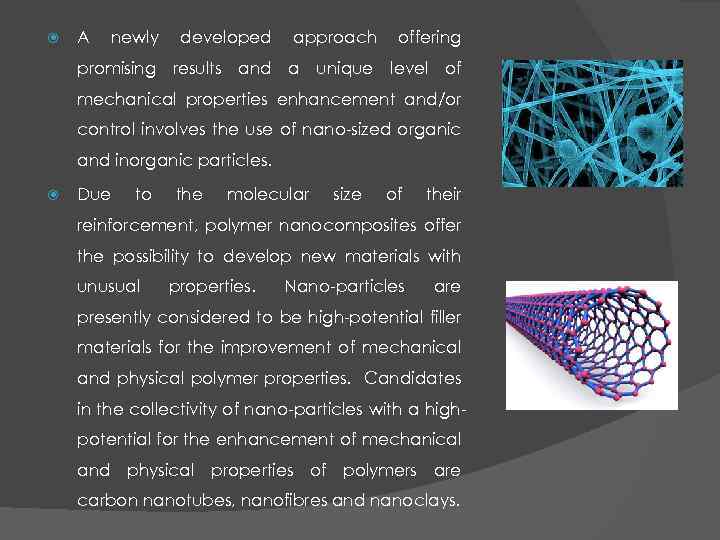
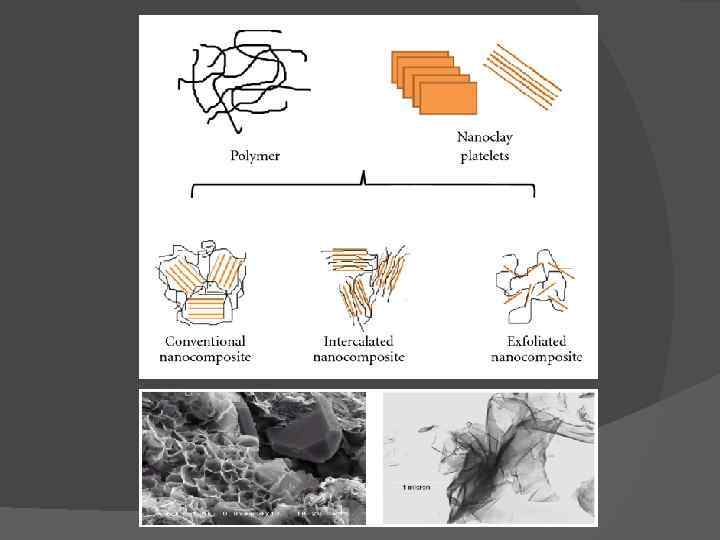
A newly developed approach offering promising results and a unique level of mechanical properties enhancement and/or control involves the use of nano-sized organic and inorganic particles. Due to the molecular size of their reinforcement, polymer nanocomposites offer the possibility to develop new materials with unusual properties. Nano-particles are presently considered to be high-potential filler materials for the improvement of mechanical and physical polymer properties. Candidates in the collectivity of nano-particles with a highpotential for the enhancement of mechanical and physical properties of polymers are carbon nanotubes, nanofibres and nanoclays.
Concluding remarks Fibre-reinforced composites are a type of engineering material that has exhibited high strength–weight and modulus–weight ratios, even compared with some metallic materials. In the last two decade, some studies have shown the potential improvement in properties and performances of fibre reinforced polymer matrix materials in which nano and micro-scale particles were incorporated. To date, nanoparticle reinforcement of fibre reinforced composites has been shown to be a possibility, but much work remains to be performed in order to understand how nanoreinforcement results in major changes in material properties. The understanding of these phenomena will facilitate their extension to the reinforcement of more complicated anisotropic structures and advanced polymeric composite systems. Nanoparticles provide a high potential for the modification of polymers. They are very effective fillers regarding mechanical properties, especially toughness.
![List of sources used [1] J. Kong, R. Ning, Y. Tang, J. Mater. Sci.](https://present5.com/presentation/8174135_456647059/image-10.jpg "List of sources used [1] J. Kong, R. Ning, Y. Tang, J. Mater. Sci.")
List of sources used [1] J. Kong, R. Ning, Y. Tang, J. Mater. Sci. 2006, 41, 1639. [2] Sritima Kar, A. K. Banthia, J. Appl. Polym. Sci. 2005, 96, 2446. [3] A. R. Siebert, in: Rubber-Modified Thermoset Resins. Based on a symposium held at the 186 th Meeting of the American Chemical Society. Washington, DC, 1984, 179. [4] Dodiuk, H. Kenig, S. Blinsky, I. Dotan, A. Buchman, J. Adhesion and Adhes. 2005, 211

THANK YOU FOR ATTENTION !
Скачать презентацию EPOXY-BASED FIBRE REINFORCED NANOCOMPOSITES Completed Novoselova Yulia Group
Epoxy-Based Fibre Reinforced Nanocomposites.pptx