 Скачать презентацию Epitaxial Graphene a New Platform for Carbon Electronics
83d7261b634f0783b7941fc3b8c044e5.ppt
- Количество слайдов: 1



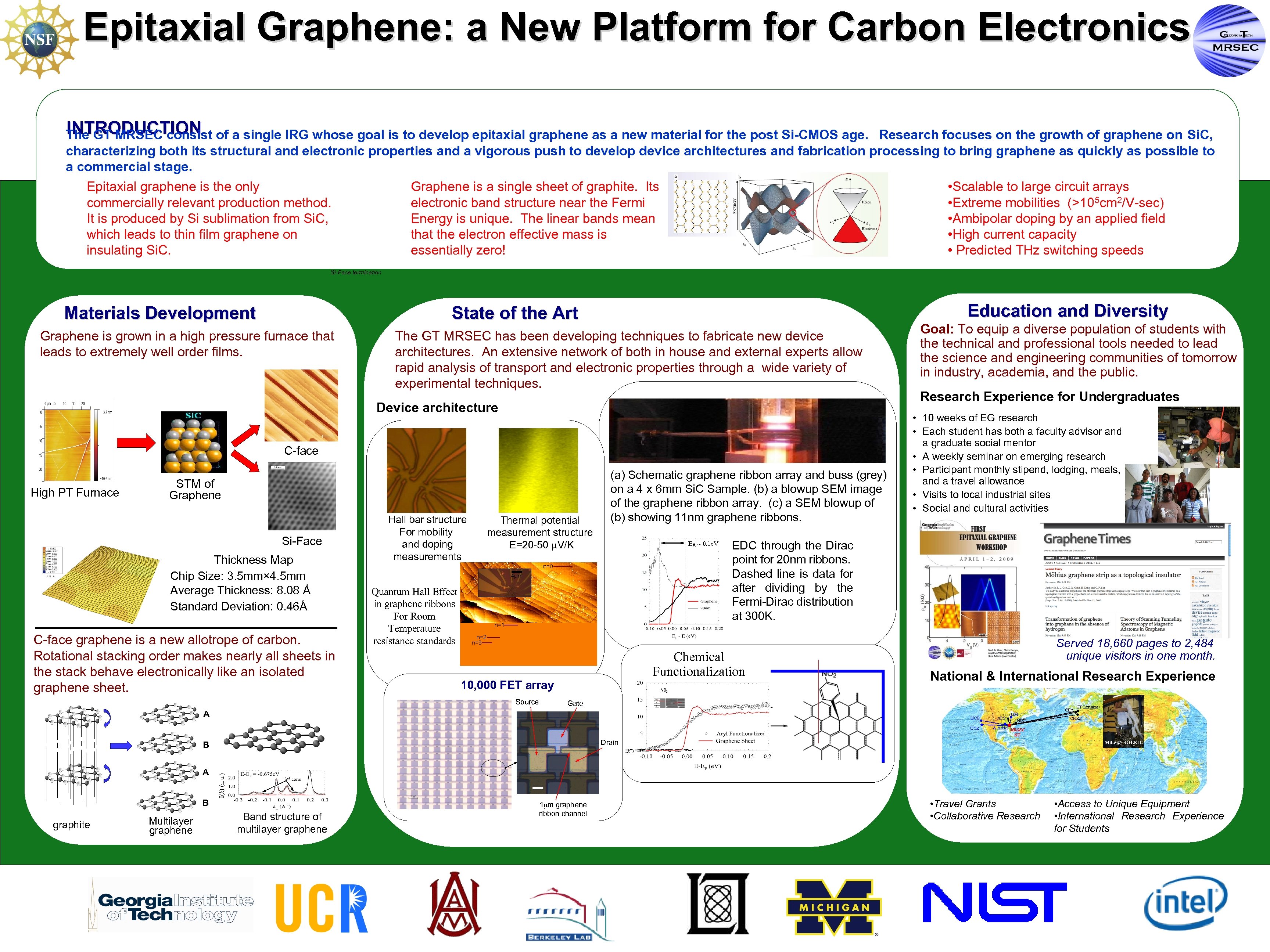
Epitaxial Graphene: a New Platform for Carbon Electronics INTRODUCTION The GT MRSEC consist of a single IRG whose goal is to develop epitaxial graphene as a new material for the post Si-CMOS age. Research focuses on the growth of graphene on Si. C, characterizing both its structural and electronic properties and a vigorous push to develop device architectures and fabrication processing to bring graphene as quickly as possible to a commercial stage. Epitaxial graphene is the only C-Face termination commercially relevant production method. It is produced by Si sublimation from Si. C, Si. C which leads to thin film graphene on insulating Si. C. • Scalable to large circuit arrays • Extreme mobilities (>105 cm 2/V-sec) • Ambipolar doping by an applied field • High current capacity • Predicted THz switching speeds Graphene is a single sheet of graphite. Its electronic band structure near the Fermi Energy is unique. The linear bands mean that the electron effective mass is essentially zero! Si-Face termination Materials Development Education and Diversity State of the Art Graphene is grown in a high pressure furnace that leads to extremely well order films. The GT MRSEC has been developing techniques to fabricate new device architectures. An extensive network of both in house and external experts allow rapid analysis of transport and electronic properties through a wide variety of experimental techniques. Device architecture C-face High PT Furnace STM of Graphene Si-Face Thickness Map Chip Size: 3. 5 mm× 4. 5 mm Average Thickness: 8. 08 Å Standard Deviation: 0. 46Å C-face graphene is a new allotrope of carbon. Rotational stacking order makes nearly all sheets in the stack behave electronically like an isolated graphene sheet. Hall bar structure For mobility and doping measurements Thermal potential measurement structure E=20 -50 m. V/K (a) Schematic graphene ribbon array and buss (grey) on a 4 x 6 mm Si. C Sample. (b) a blowup SEM image of the graphene ribbon array. (c) a SEM blowup of (b) showing 11 nm graphene ribbons. Eg ~ 0. 1 e. V n=0 4µm Quantum Hall Effect in graphene ribbons For Room Temperature resistance standards n=1 Goal: To equip a diverse population of students with the technical and professional tools needed to lead the science and engineering communities of tomorrow in industry, academia, and the public. Research Experience for Undergraduates • 10 weeks of EG research • Each student has both a faculty advisor and a graduate social mentor • A weekly seminar on emerging research • Participant monthly stipend, lodging, meals, and a travel allowance • Visits to local industrial sites • Social and cultural activities EDC through the Dirac point for 20 nm ribbons. Dashed line is data for after dividing by the Fermi-Dirac distribution at 300 K. n=2 n=3 Chemical Functionalization 10, 000 FET array Source Served 18, 660 pages to 2, 484 unique visitors in one month. National & International Research Experience N 02 Gate A UCB UCR graphite Multilayer graphene I(k) (a. u. ) B UM NIST GT Lorraine CNRS A A&M MRSEC GT Drain B A APS CEA Mike @ SOLEIL 3 rd cone Band structure of multilayer graphene 1 mm graphene ribbon channel • Travel Grants • Collaborative Research • Access to Unique Equipment • International Research Experience for Students
Скачать презентацию Epitaxial Graphene a New Platform for Carbon Electronics
83d7261b634f0783b7941fc3b8c044e5.ppt