


 Скачать презентацию Epidemiologic Measures of Association Saeed Akhtar Ph D
434e7487b92e80b01fa824f1a2de02a9.ppt
- Количество слайдов: 21
 Epidemiologic Measures of Association Saeed Akhtar, Ph. D Associate Professor, Epidemiology Division of Epidemiology and Biostatistics Aga Khan University, Karachi, Pakistan Email 1
 Epidemiologic Measures of Association • Session Objectives By the end of session students should be able to: • Compute & Interpret Relative risk (RR) & Odds ratio (OR) as a measure of association between exposure and Disease • Understand when OR approximates RR 2
 Definitions Association • A statistical relationship between two or more variables Risk • Probability conditional or unconditional of the occurrence of some event in time • Probability of an individual developing a disease or change in health status over a fixed time interval, conditional on the individual not dying during the same time period Absolute risk 3
 Association between exposure & Disease • Question: Is there an excess risk associated with a given exposure? • Objective: To determine whether certain exposure is associated with a given disease • Methodology: Use one of the epidemiologic study designs Cohort Case-control 4
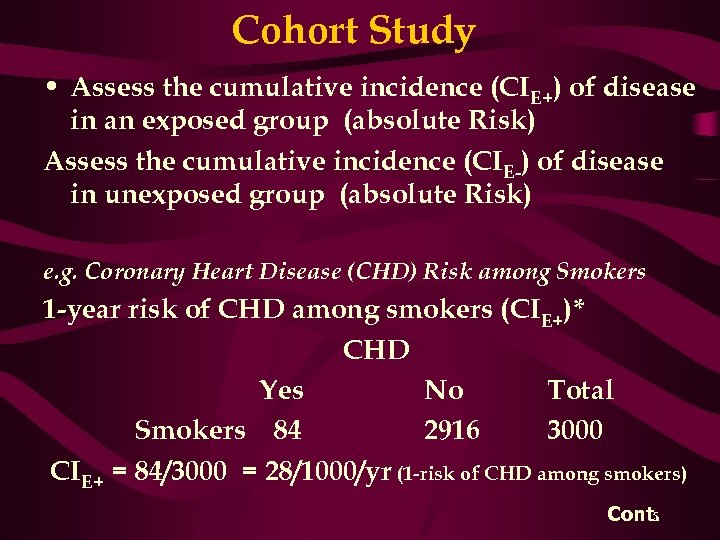 Cohort Study • Assess the cumulative incidence (CIE+) of disease in an exposed group (absolute Risk) Assess the cumulative incidence (CIE-) of disease in unexposed group (absolute Risk) e. g. Coronary Heart Disease (CHD) Risk among Smokers 1 -year risk of CHD among smokers (CIE+)* CHD Yes No Total Smokers 84 2916 3000 CIE+ = 84/3000 = 28/1000/yr (1 -risk of CHD among smokers) Cont. 5
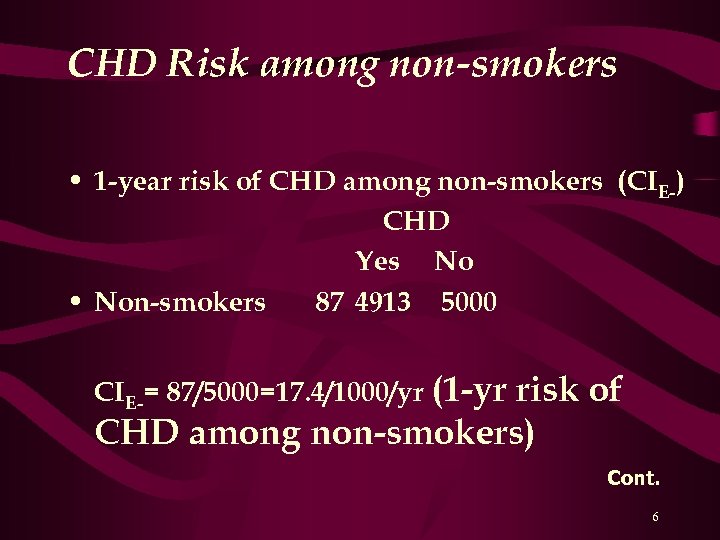 CHD Risk among non-smokers • 1 -year risk of CHD among non-smokers (CIE-) CHD Yes No • Non-smokers 87 4913 5000 CIE-= 87/5000=17. 4/1000/yr (1 -yr risk of CHD among non-smokers) Cont. 6
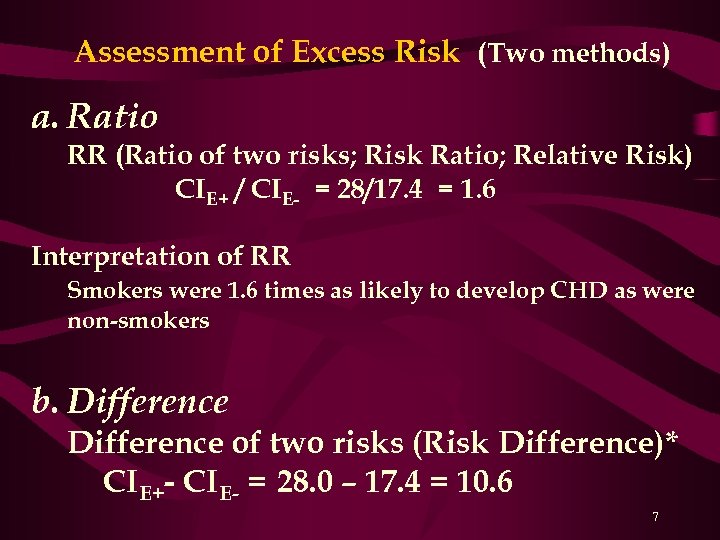 Assessment of Excess Risk (Two methods) a. Ratio RR (Ratio of two risks; Risk Ratio; Relative Risk) CIE+ / CIE- = 28/17. 4 = 1. 6 Interpretation of RR Smokers were 1. 6 times as likely to develop CHD as were non-smokers b. Difference of two risks (Risk Difference)* CIE+- CIE- = 28. 0 – 17. 4 = 10. 6 7
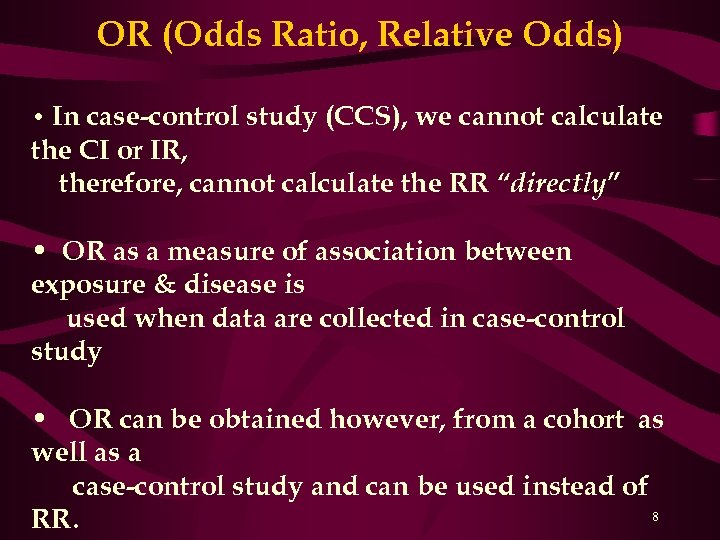 OR (Odds Ratio, Relative Odds) • In case-control study (CCS), we cannot calculate the CI or IR, therefore, cannot calculate the RR “directly” • OR as a measure of association between exposure & disease is used when data are collected in case-control study • OR can be obtained however, from a cohort as well as a case-control study and can be used instead of 8 RR.
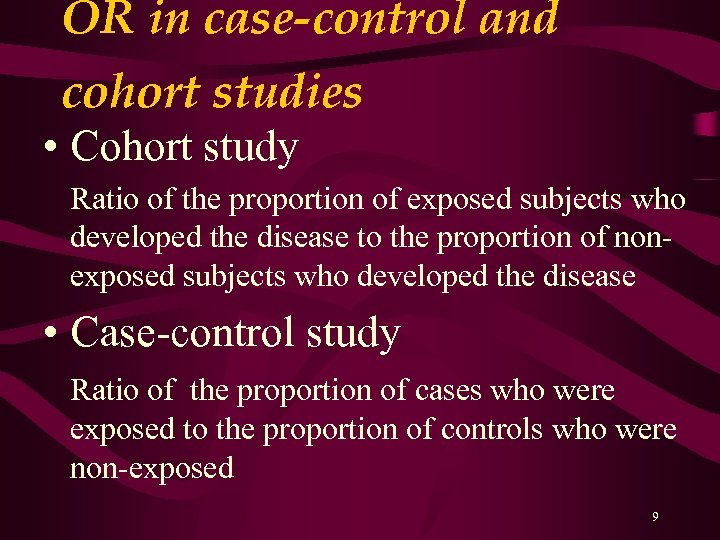 OR in case-control and cohort studies • Cohort study Ratio of the proportion of exposed subjects who developed the disease to the proportion of nonexposed subjects who developed the disease • Case-control study Ratio of the proportion of cases who were exposed to the proportion of controls who were non-exposed 9
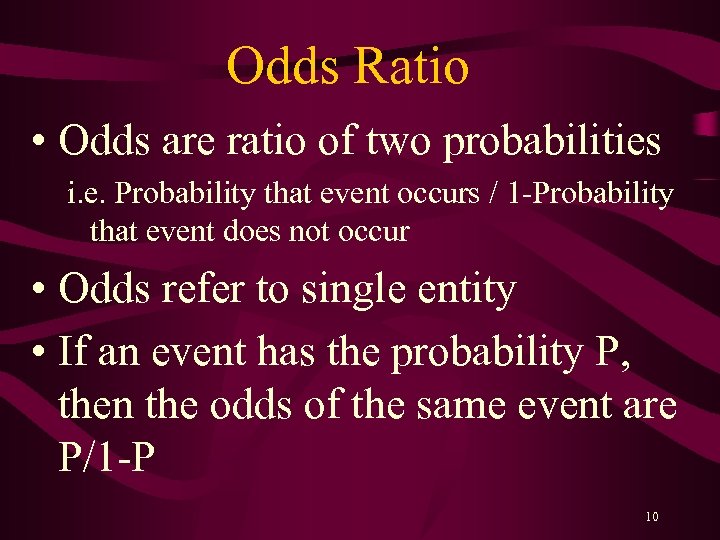 Odds Ratio • Odds are ratio of two probabilities i. e. Probability that event occurs / 1 -Probability that event does not occur • Odds refer to single entity • If an event has the probability P, then the odds of the same event are P/1 -P 10
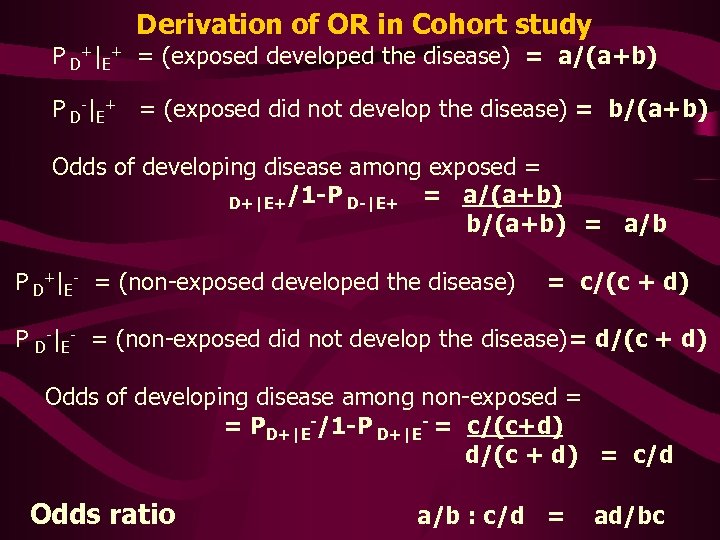 Derivation of OR in Cohort study P D+|E+ = (exposed developed the disease) = a/(a+b) P D-|E+ = (exposed did not develop the disease) = b/(a+b) Odds of developing disease among exposed = D+|E+/1 -P D-|E+ = a/(a+b) b/(a+b) = a/b P D+|E- = (non-exposed developed the disease) P - D |E = c/(c + d) = (non-exposed did not develop the disease)= d/(c + d) Odds of developing disease among non-exposed = = PD+|E-/1 -P D+|E- = c/(c+d) d/(c + d) = c/d Odds ratio a/b : c/d = 11 ad/bc
 OR in case-control study In case-control study RR cannot be calculated directly to determine the association between exposure and disease. n n Don’t know the risk of disease among exposed and un-exposed since we start recruiting cases and controls. n Can use OR as measure of association between exposure and disease in a case control study. 12
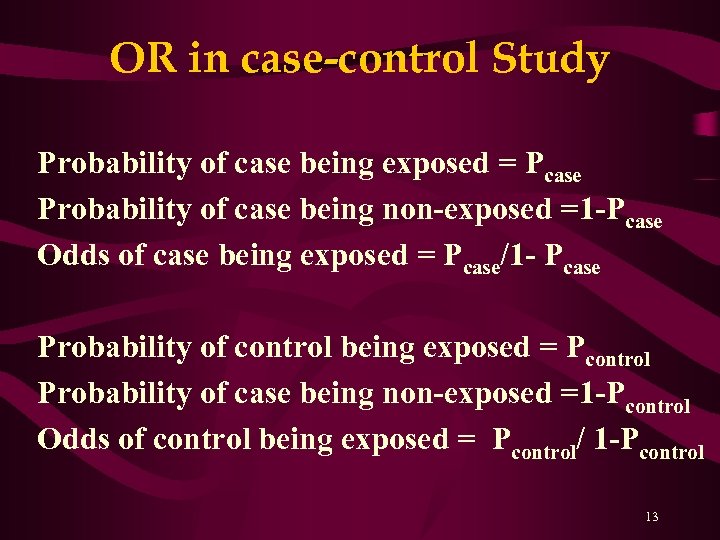 OR in case-control Study Probability of case being exposed = Pcase Probability of case being non-exposed =1 -Pcase Odds of case being exposed = Pcase/1 - Pcase Probability of control being exposed = Pcontrol Probability of case being non-exposed =1 -Pcontrol Odds of control being exposed = Pcontrol/ 1 -Pcontrol 13
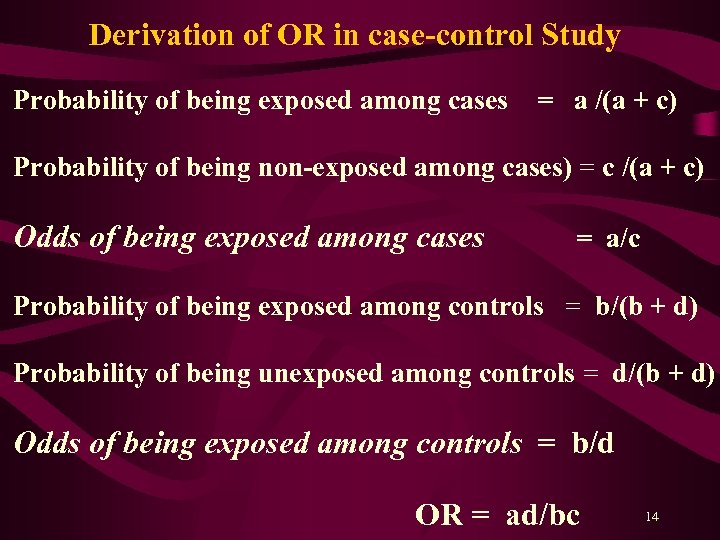 Derivation of OR in case-control Study Probability of being exposed among cases = a /(a + c) Probability of being non-exposed among cases) = c /(a + c) Odds of being exposed among cases = a/c Probability of being exposed among controls = b/(b + d) Probability of being unexposed among controls = d/(b + d) Odds of being exposed among controls = b/d OR = ad/bc 14
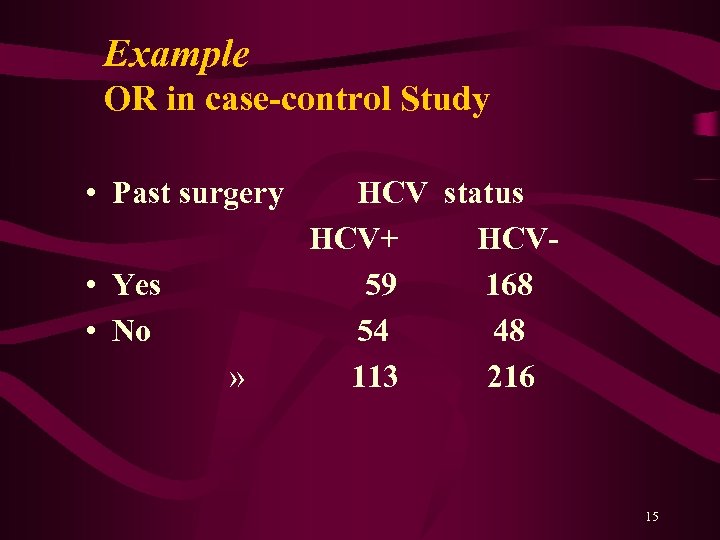 Example OR in case-control Study • Past surgery • Yes • No » HCV status HCV+ HCV 59 168 54 48 113 216 15
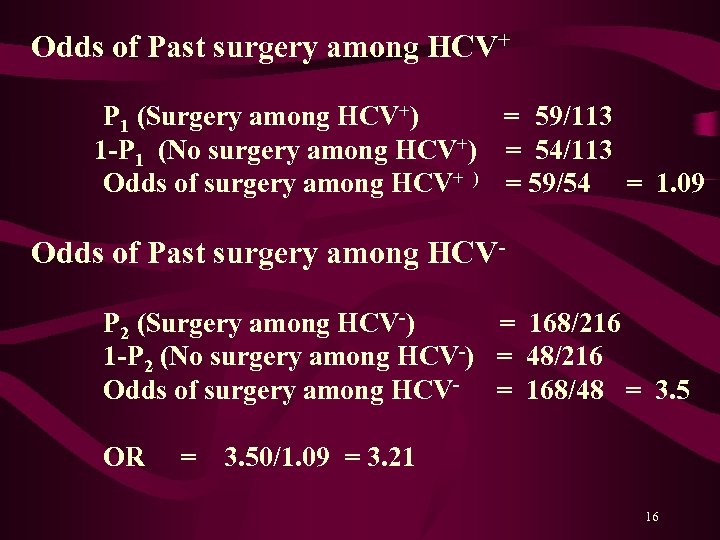 Odds of Past surgery among HCV+ P 1 (Surgery among HCV+) = 59/113 1 -P 1 (No surgery among HCV+) = 54/113 Odds of surgery among HCV+ ) = 59/54 = 1. 09 Odds of Past surgery among HCVP 2 (Surgery among HCV-) = 168/216 1 -P 2 (No surgery among HCV-) = 48/216 Odds of surgery among HCV- = 168/48 = 3. 5 OR = 3. 50/1. 09 = 3. 21 16
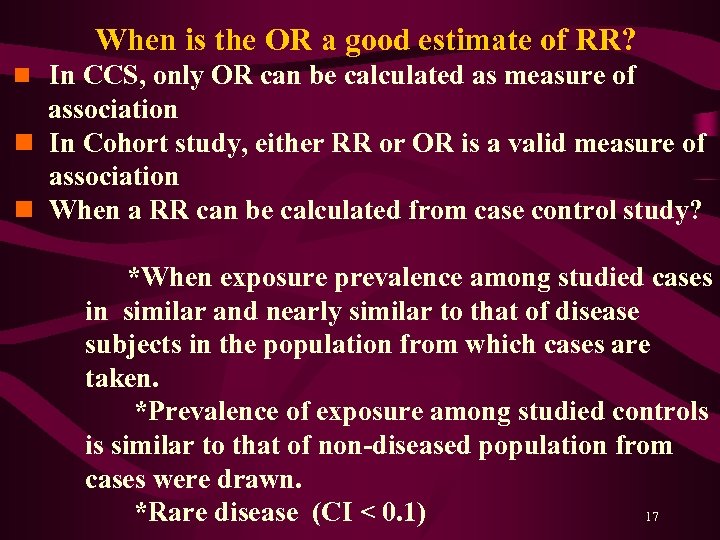 When is the OR a good estimate of RR? n In CCS, only OR can be calculated as measure of association n In Cohort study, either RR or OR is a valid measure of association n When a RR can be calculated from case control study? *When exposure prevalence among studied cases in similar and nearly similar to that of disease subjects in the population from which cases are taken. *Prevalence of exposure among studied controls is similar to that of non-diseased population from cases were drawn. 17 *Rare disease (CI < 0. 1)
 Matched case-control study n Matching: In a matched case-control study each case is matched to a control according to variables that are known to be related to disease risk i. e. age, sex, race n Data are analyzed in terms of casecontrol pairs rather than for individual subjects n Four types of case-control combinations are possible in regard to exposure history. 18
 Concordant pairs are ignored since they don’t contribute in calculation of effect estimate (i. e. OR) n n Disconcordant pairs of cases and controls are used to calculate the matched OR. n Matched OR = Ratio of discordant pairs = b /c i. e. # of pairs in which cases exposed / # of pairs in which controls were exposed 19
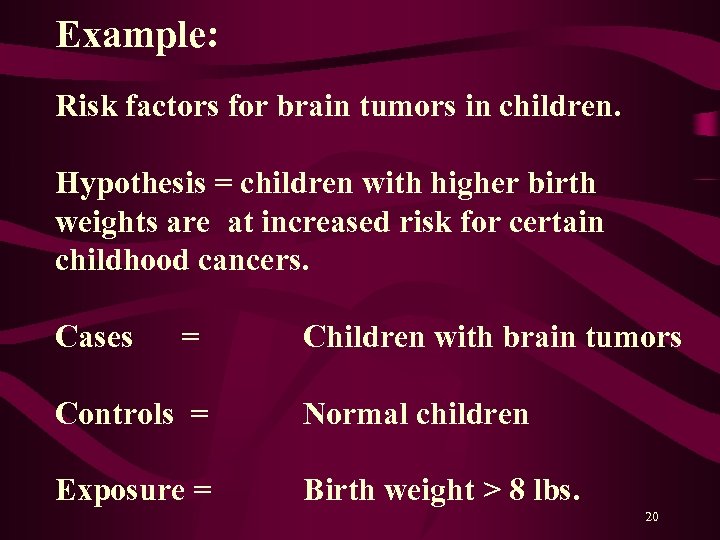 Example: Risk factors for brain tumors in children. Hypothesis = children with higher birth weights are at increased risk for certain childhood cancers. Cases = Children with brain tumors Controls = Normal children Exposure = Birth weight > 8 lbs. 20
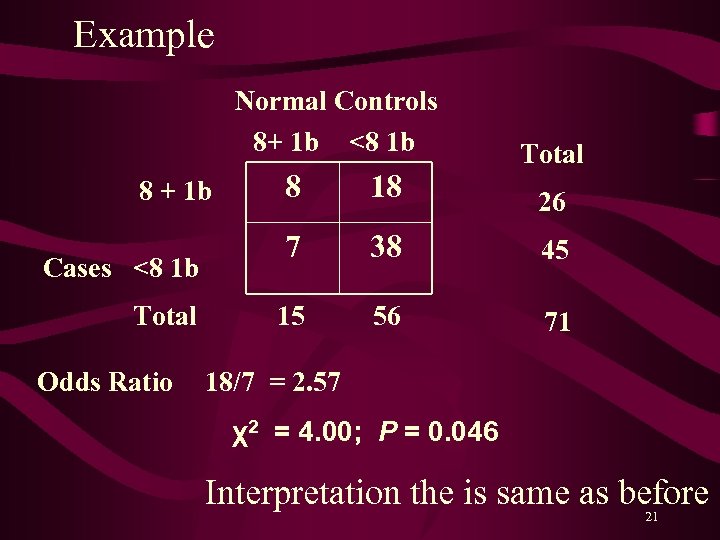 Example Normal Controls 8+ 1 b <8 1 b Total Odds Ratio 8 18 7 38 45 15 8 + 1 b Cases <8 1 b Total 56 71 26 18/7 = 2. 57 χ2 = 4. 00; P = 0. 046 Interpretation the is same as before 21