 Скачать презентацию Epidemic of Care A Call for Safer Better
d7f98a936b8458401ebbf03458cf525b.ppt
- Количество слайдов: 127



Epidemic of Care: A Call for Safer, Better and More Accountable Health Care George C. Halvorson Chairman and CEO, Kaiser Foundation Health Plan, Inc. and Kaiser Foundation Hospitals The Quality Colloquium at Harvard University August 25, 2003
Health care costs are exploding. 2
Health care is the single biggest cost issue for employers – and a major budget issue for the government. 3
Government budget decisions are reducing the scope and eligibility for health care entitlement programs. 4
Employers are looking for fast and effective costreduction alternatives relative to health care premiums. 5
The easiest way of reducing cost for employers is to reduce benefits to employees. 6
Most non-union employers are reducing benefits – adding copayments, increasing co-insurance percentages, and adding deductibles. 7
But cost increases continue at unaffordable levels – buyers are reaching a tipping point. 8
The last time health care cost increases hit double-digit levels for multiple years – in the late 1980 s – employers abandoned traditional insurance and moved to managed care. Very quickly. 9
During the 1990 s, various forms of managed care negotiated provider fees down, negotiated low drug prices, and eliminated outrageous waste in the system (e. g. , Friday admissions for Monday surgery, overnight admissions for X-rays, 76 percent class C drugs). 10
For the 1990 s, health care premium costs stayed fairly low, reflecting the new lower unit prices and the various managed care waste-reduction strategies. 11
These strategies temporarily “rebased” the market for provider services. The cost pendulum is now swinging in the opposite direction. 12
Cost pressures have returned. Providers in a great many markets have consolidated to regain market power and pricing leverage. 13
Negotiated prices have hit rock bottom and are pretty much all going up. 14
Drug companies have concentrated on chronic care treatments and new drugs. The old model: “Take these for the next 10 days. ” The new model: “Take a pill a day forever. ” Also: Prices have gone up for “drugs that work. ” 15
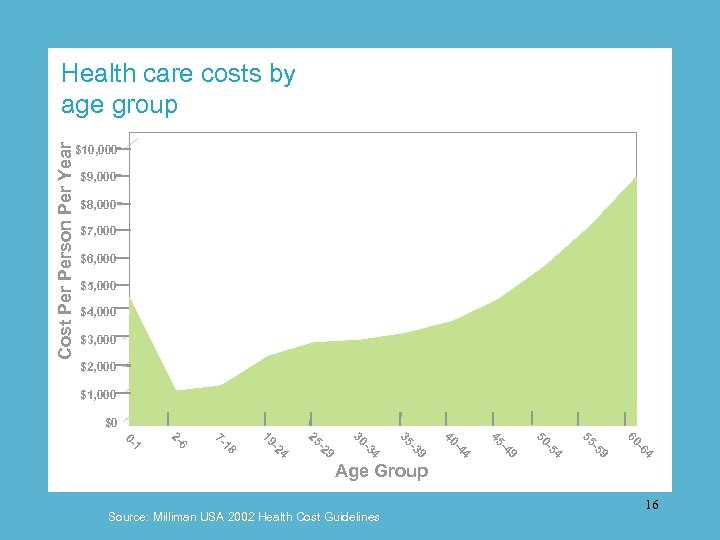
Cost Person Per Year Health care costs by age group $10, 000 $9, 000 $8, 000 $7, 000 $6, 000 $5, 000 $4, 000 $3, 000 $2, 000 $1, 000 $0 4 -6 60 9 -5 55 4 -5 50 9 -4 45 4 -4 40 9 -3 35 4 -3 30 9 -2 25 4 -2 19 18 7 - 6 2 - 1 0 - Age Group Source: Milliman USA 2002 Health Cost Guidelines 16
Chronic care costs are exploding. The number of diabetics is up by 50 percent since 1990. 17
New technologies are expanding the scope and reach of care. 18
Heroic medicine is commonplace … and very expensive. Miracles happen routinely. 19
We are facing health care worker shortages in a number of professions. These shortages will be resolved by: 1) paying more per worker or 2) reengineering care delivery. 20
We will probably just pay more. 21
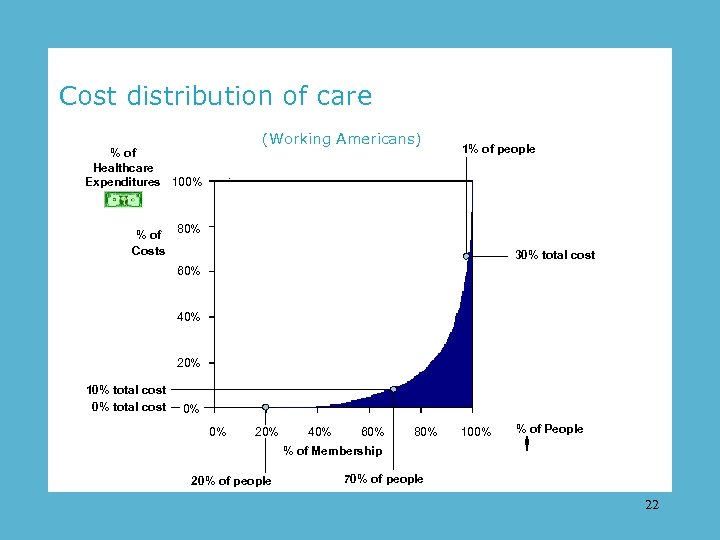
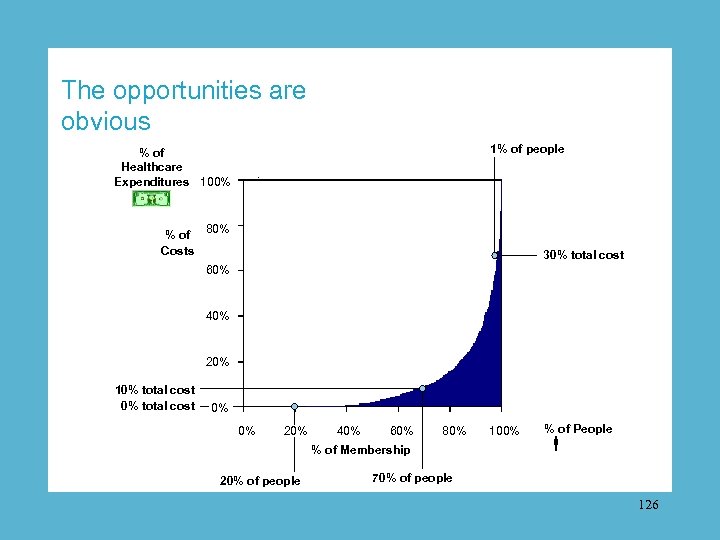
Cost distribution of care (Working Americans) % of Healthcare Expenditures 100% % of Costs 1% of people 80% 30% total cost 60% 40% 20% 10% total cost 0% 0% 20% 40% 60% 80% % of Membership 20% of people 100% % of People 70% of people 22

20 percent = zero expense. 23
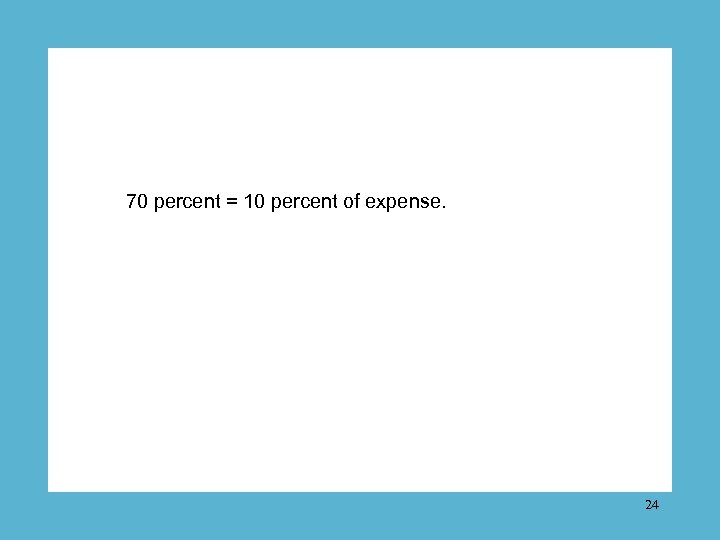
70 percent = 10 percent of expense. 24
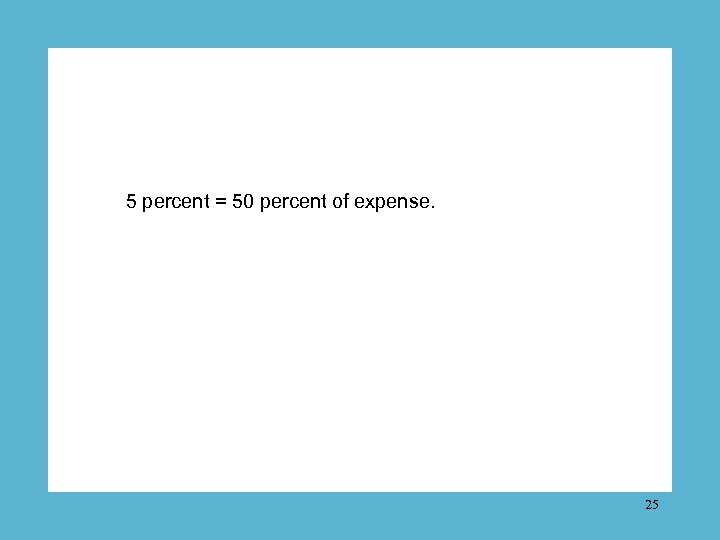
5 percent = 50 percent of expense. 25
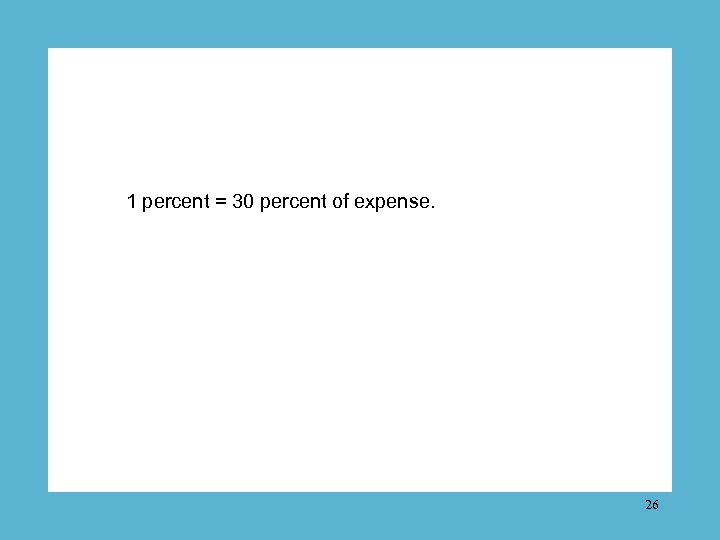
1 percent = 30 percent of expense. 26
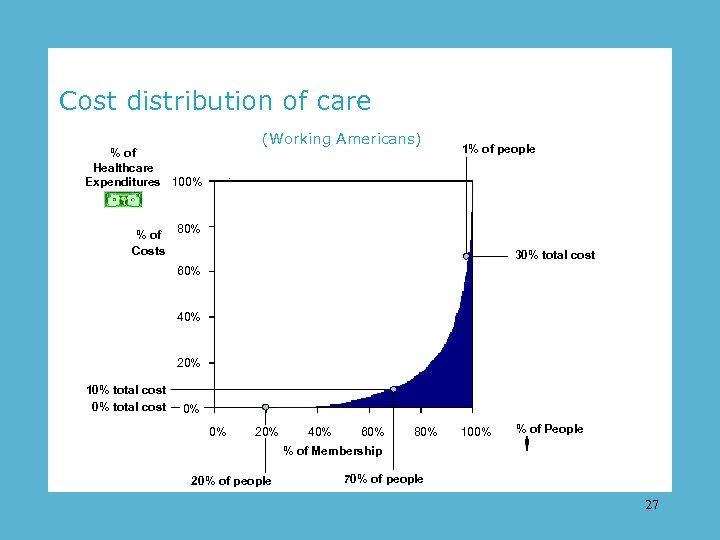
Cost distribution of care (Working Americans) % of Healthcare Expenditures 100% % of Costs 1% of people 80% 30% total cost 60% 40% 20% 10% total cost 0% 0% 20% 40% 60% 80% % of Membership 20% of people 100% % of People 70% of people 27
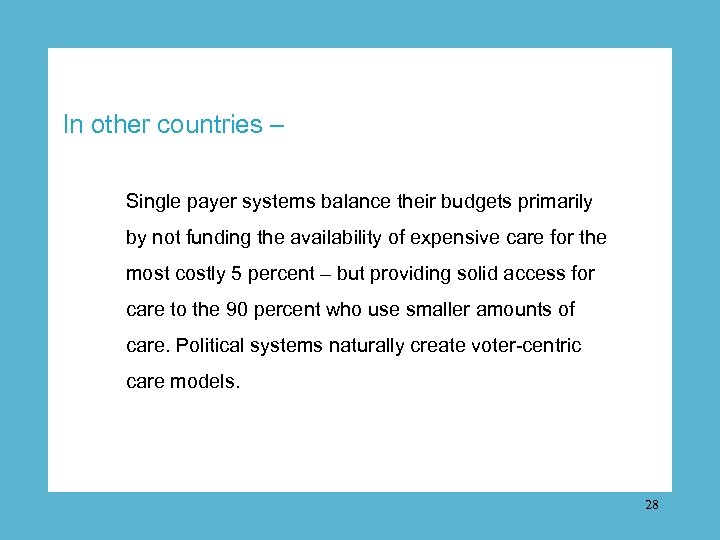
In other countries – Single payer systems balance their budgets primarily by not funding the availability of expensive care for the most costly 5 percent – but providing solid access for care to the 90 percent who use smaller amounts of care. Political systems naturally create voter-centric care models. 28
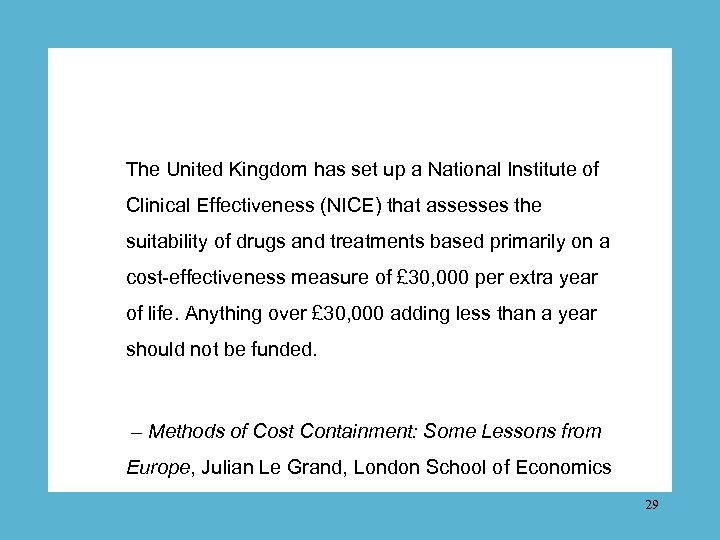
The United Kingdom has set up a National Institute of Clinical Effectiveness (NICE) that assesses the suitability of drugs and treatments based primarily on a cost-effectiveness measure of £ 30, 000 per extra year of life. Anything over £ 30, 000 adding less than a year should not be funded. – Methods of Cost Containment: Some Lessons from Europe, Julian Le Grand, London School of Economics 29
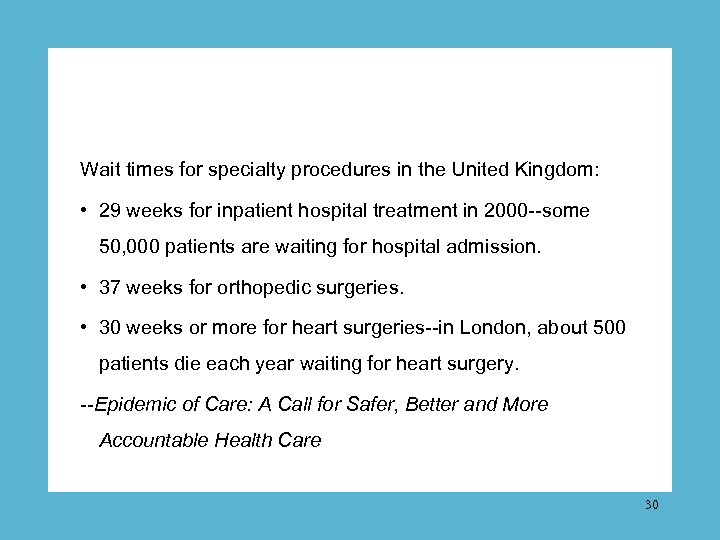
Wait times for specialty procedures in the United Kingdom: • 29 weeks for inpatient hospital treatment in 2000 --some 50, 000 patients are waiting for hospital admission. • 37 weeks for orthopedic surgeries. • 30 weeks or more for heart surgeries--in London, about 500 patients die each year waiting for heart surgery. --Epidemic of Care: A Call for Safer, Better and More Accountable Health Care 30
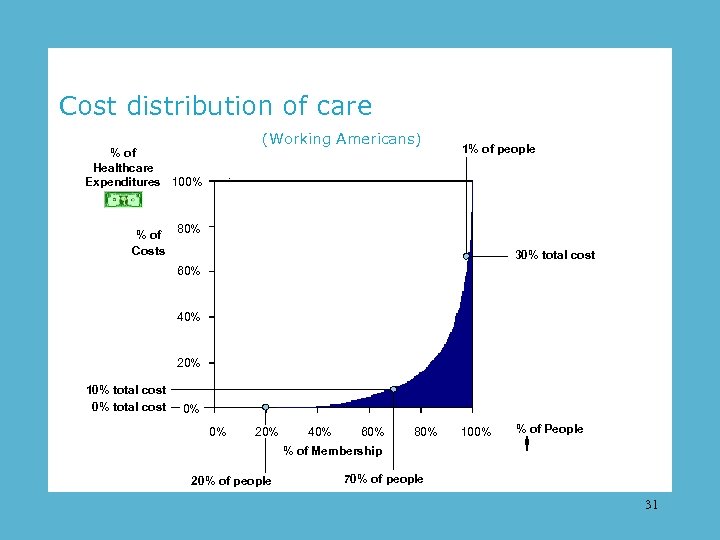
Cost distribution of care (Working Americans) % of Healthcare Expenditures 100% % of Costs 1% of people 80% 30% total cost 60% 40% 20% 10% total cost 0% 0% 20% 40% 60% 80% % of Membership 20% of people 100% % of People 70% of people 31
So how good is the care being practiced in the world’s most expensive care environment? 32
Two Institute of Medicine studies –To Err is Human and Crossing the Quality Chasm – answer that question well. 33
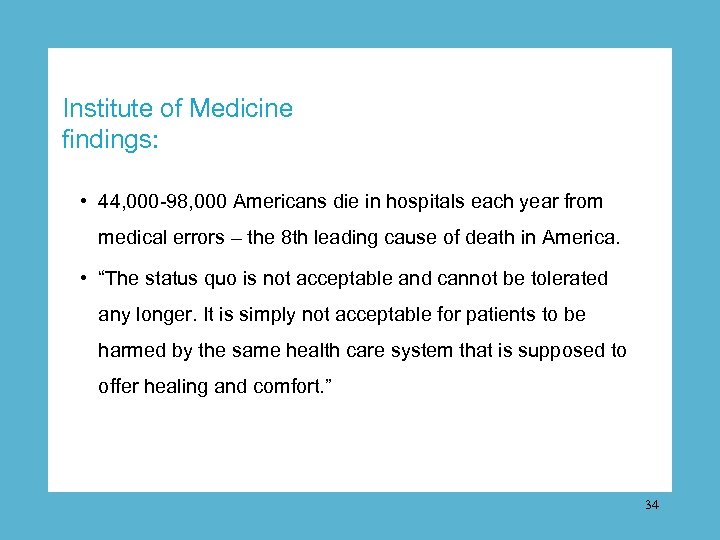
Institute of Medicine findings: • 44, 000 -98, 000 Americans die in hospitals each year from medical errors – the 8 th leading cause of death in America. • “The status quo is not acceptable and cannot be tolerated any longer. It is simply not acceptable for patients to be harmed by the same health care system that is supposed to offer healing and comfort. ” 34
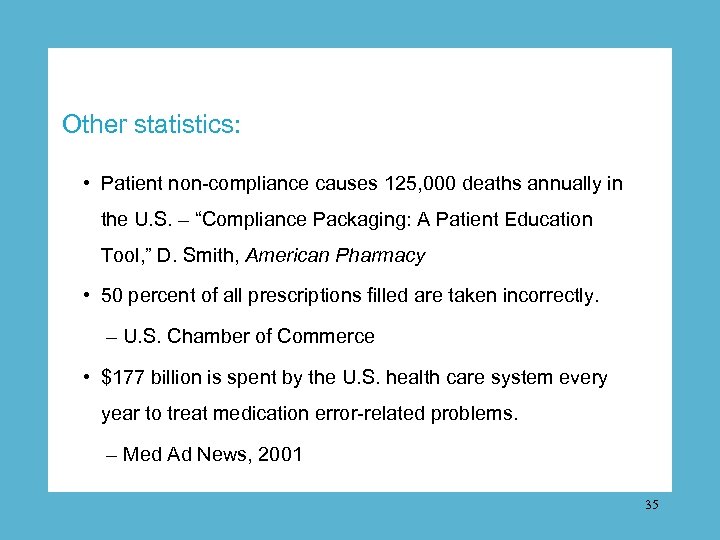
Other statistics: • Patient non-compliance causes 125, 000 deaths annually in the U. S. – “Compliance Packaging: A Patient Education Tool, ” D. Smith, American Pharmacy • 50 percent of all prescriptions filled are taken incorrectly. – U. S. Chamber of Commerce • $177 billion is spent by the U. S. health care system every year to treat medication error-related problems. – Med Ad News, 2001 35
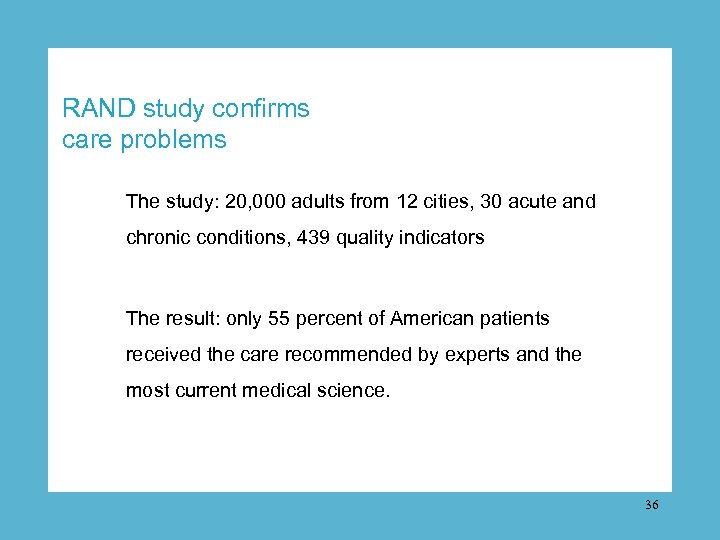
RAND study confirms care problems The study: 20, 000 adults from 12 cities, 30 acute and chronic conditions, 439 quality indicators The result: only 55 percent of American patients received the care recommended by experts and the most current medical science. 36
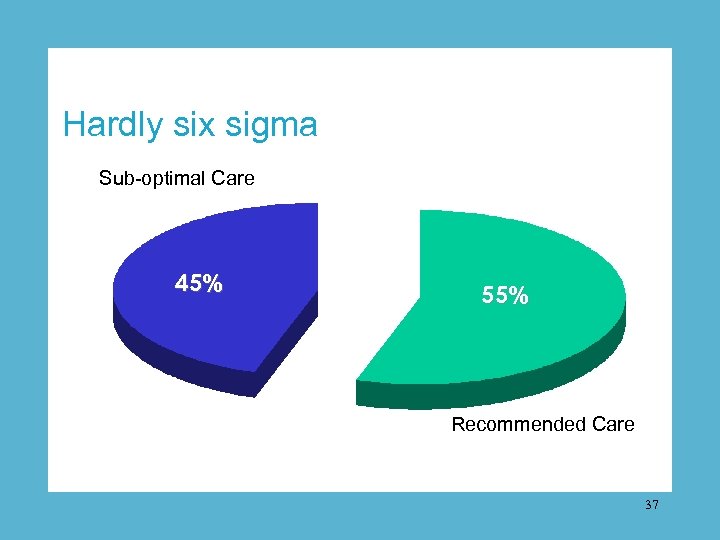
Hardly six sigma Sub-optimal Care 45% 55% Recommended Care 37
Only 55 percent of patients in the world’s most expensive health care environment received appropriate care. 38
RAND (cont’d. ) • Only 45 percent of those presenting with heart attacks received beta-blockers. • Only 24 percent of diabetics received three or more glycosylated hemoglobin tests within a two-year period. • “The deficits we have identified in adherence to recommended processes for basic care pose serious threats to the health of the American public. ” – RAND 39
Diabetes is the number one cause of blindness, kidney failure, amputations, and the highest co-morbidity factor for death from heart disease. 40
Less than half of American diabetics receive appropriate care. 41

America has no peer when it comes to high tech care. 42
But when more than half of all diabetics receive inadequate care, that points to a massive failure of health care policy, health care strategy, and health care delivery. 43
We are experiencing a massive, expensive and entirely unnecessary failure of care delivery. 44
Why does our system fail so many people and waste so much money? 45
The economics are obvious – we pay care providers for incidents of care – not for creating, maintaining or restoring health. 46
The economic incentives are clear: There are more than 8, 000 billing codes for procedures. Not one billing code for a cure. – Strong Medicine 47
Care delivery is organized around its reward system – not around patient health. 48
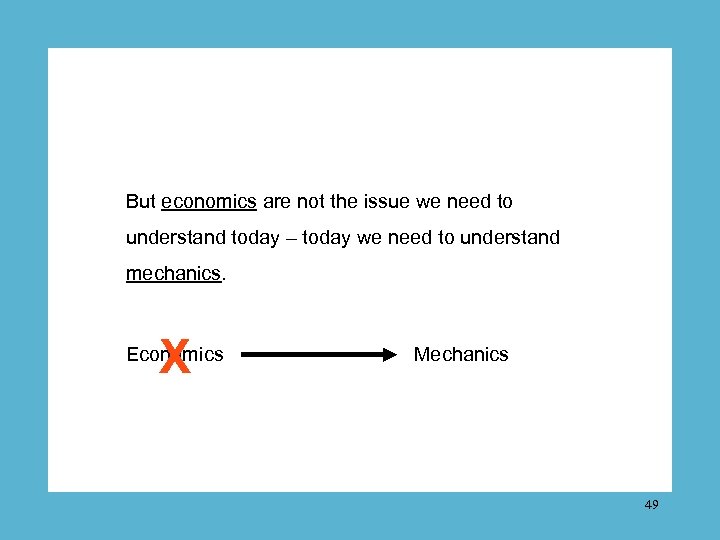
But economics are not the issue we need to understand today – today we need to understand mechanics. X Economics Mechanics 49
In every other area of the economy, the mechanical processes of production are studied and constantly improved with the goal of improving outcomes and reducing cost. 50
Example: Best Buy Four years ago, the company Best Buy sold a $700 basic DVD player. Today, they sell a $40 DVD player (with better features). How did that happen? 51
In industry, outcomes are measured. In the production process, wobbly parts are identified and fixed. 52
In health care, outcomes are seldom measured and hugely wobbly parts are entirely ignored. 53

What are those hugely wobbly parts for health care? 54
Five are glaringly obvious. 55
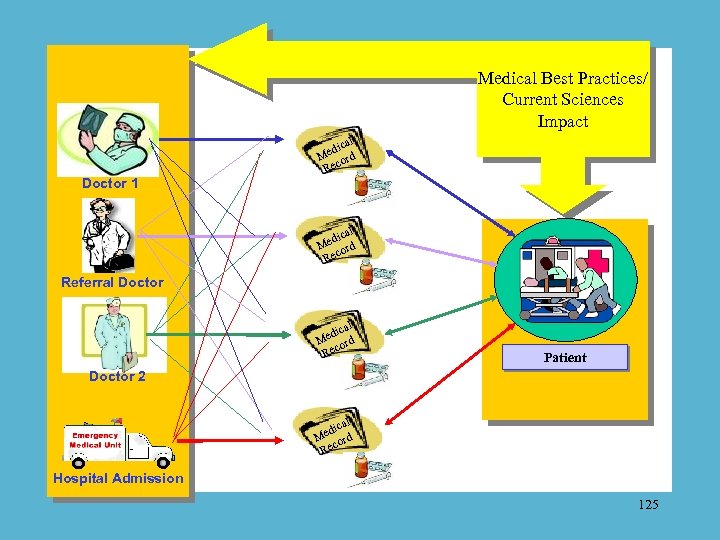
Wobbly part #1: The medical record Paper medical records are: • inadequate • inaccessible • often illegible • sometimes inaccurate • invariably inert 56
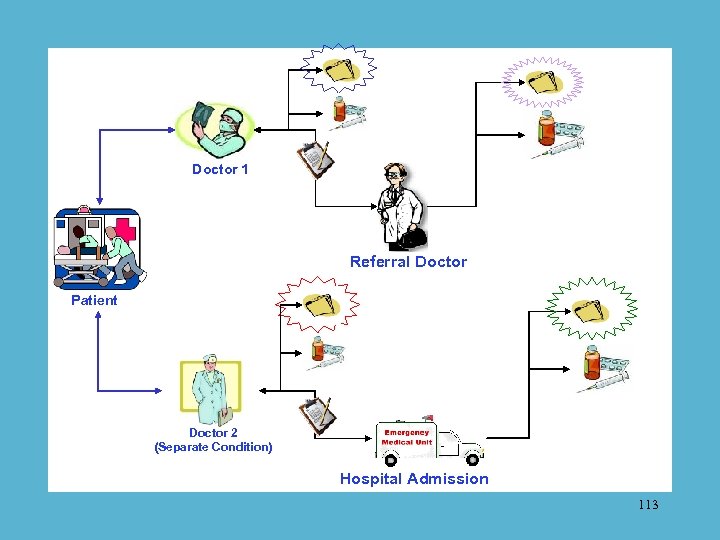
If you have five doctors, you probably have five separate medical records. 57
Health care is an information-dependent profession with crippled access to information. 58
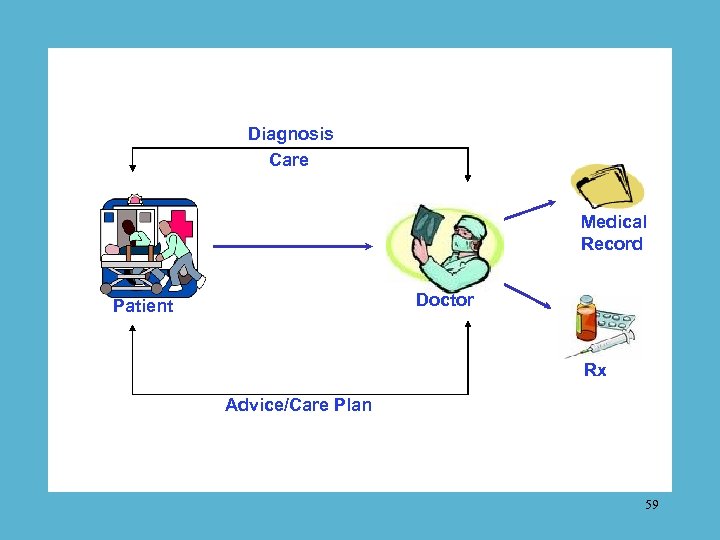
Diagnosis Care Medical Record Doctor Patient Rx Advice/Care Plan 59
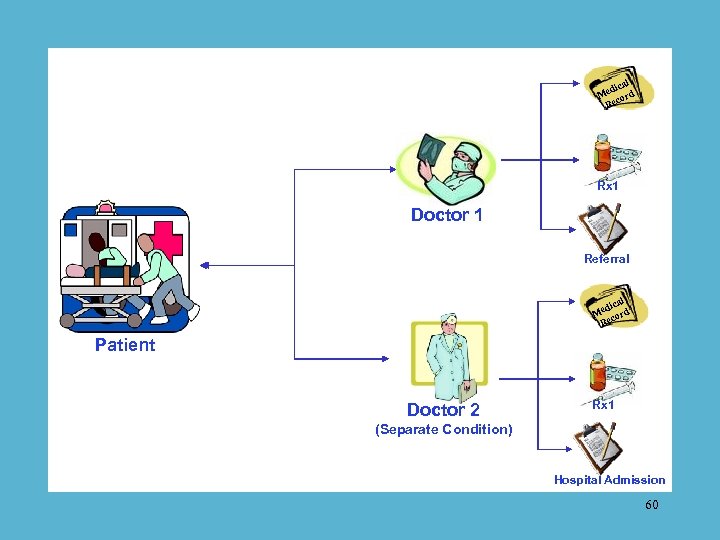
al dic Me cord Re Rx 1 Doctor 1 Referral cal edi rd M co Re Patient Doctor 2 Rx 1 (Separate Condition) Hospital Admission 60
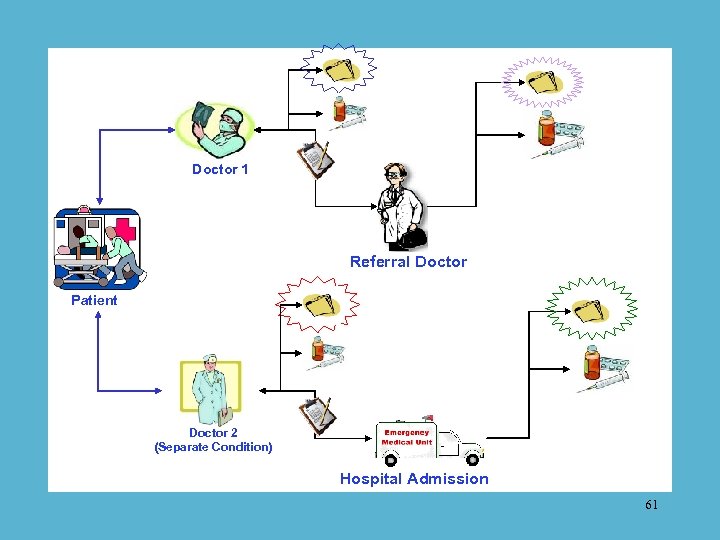
Doctor 1 Referral Doctor Patient Doctor 2 (Separate Condition) Hospital Admission 61
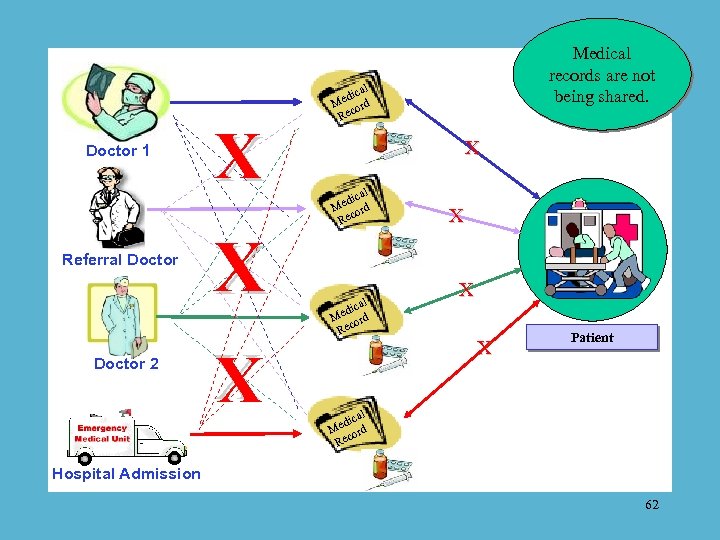
Referral Doctor 2 X X Doctor 1 Medical records are not being shared. al dic Me ord Rec X al dic Me ord Rec cal edi d M or Rec X X X Patient cal edi d M or Rec Hospital Admission 62
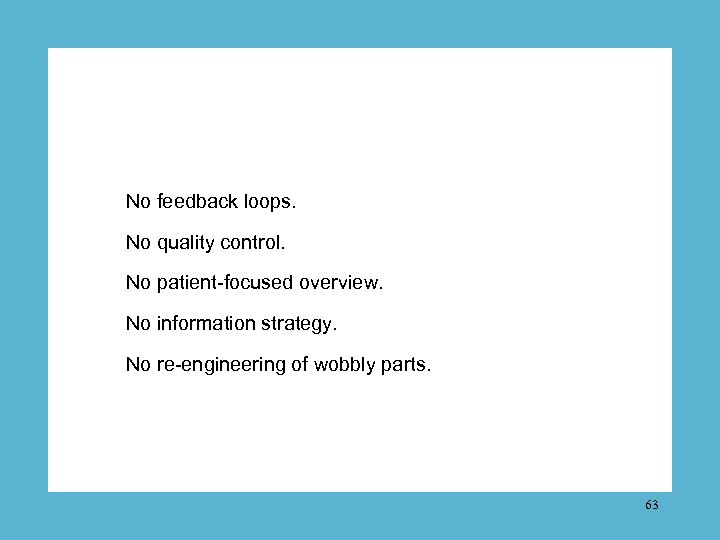
No feedback loops. No quality control. No patient-focused overview. No information strategy. No re-engineering of wobbly parts. 63
Prescriptions and work orders are too often illegible and misread. 64
It’s a miracle (and a testament to a lot of hard-working, dedicated people) that the non-system works as well as it does. 65
Wobbly Part #2: Inconsistent access to current science Current medical science is not consistently available to caregivers. 66
No one can keep up. 67
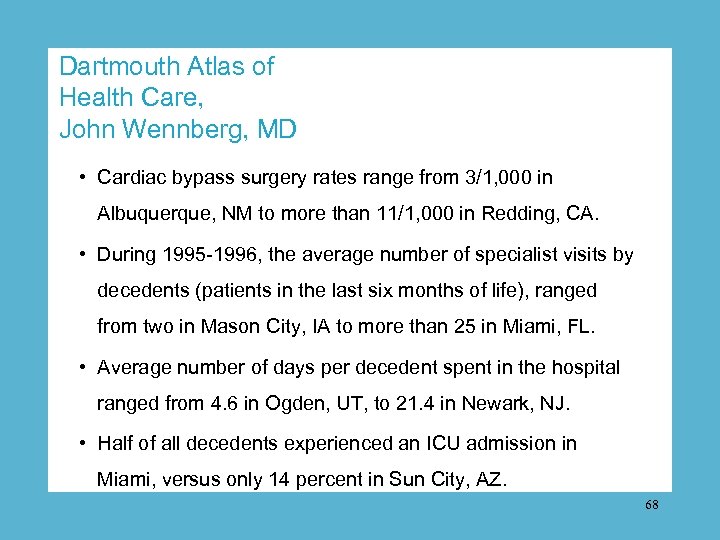
Dartmouth Atlas of Health Care, John Wennberg, MD • Cardiac bypass surgery rates range from 3/1, 000 in Albuquerque, NM to more than 11/1, 000 in Redding, CA. • During 1995 -1996, the average number of specialist visits by decedents (patients in the last six months of life), ranged from two in Mason City, IA to more than 25 in Miami, FL. • Average number of days per decedent spent in the hospital ranged from 4. 6 in Ogden, UT, to 21. 4 in Newark, NJ. • Half of all decedents experienced an ICU admission in Miami, versus only 14 percent in Sun City, AZ. 68
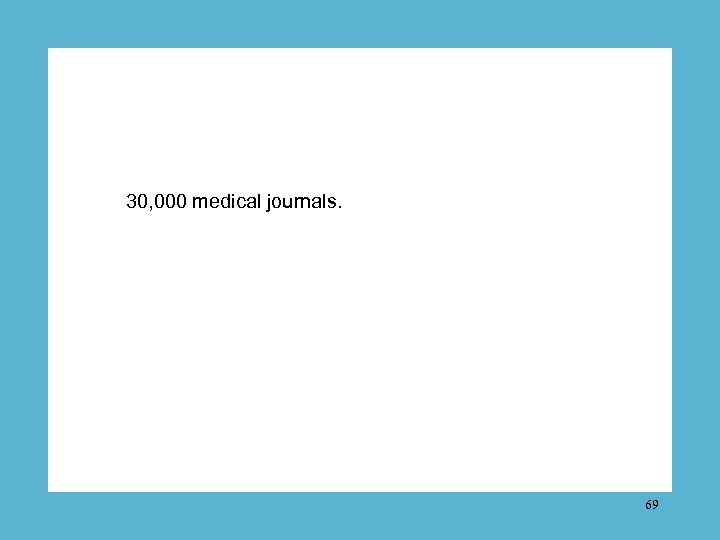
30, 000 medical journals. 69
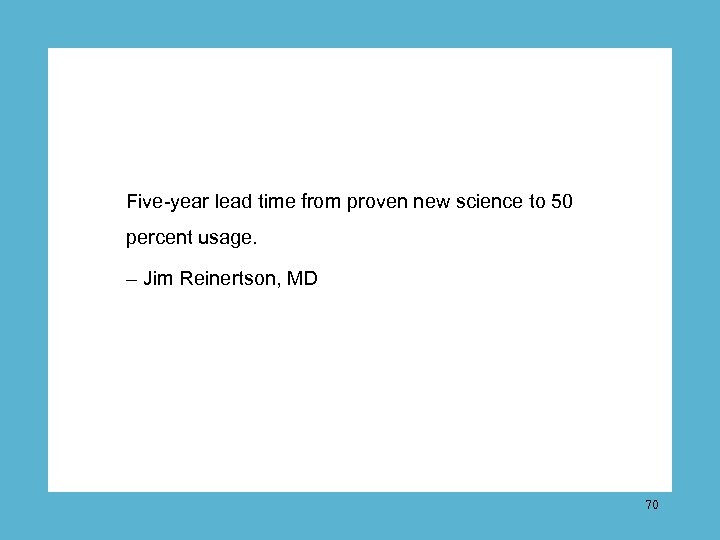
Five-year lead time from proven new science to 50 percent usage. – Jim Reinertson, MD 70
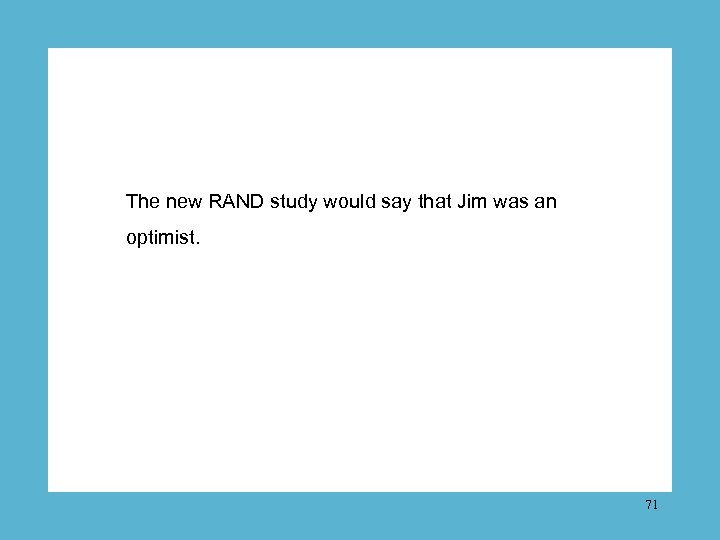
The new RAND study would say that Jim was an optimist. 71
How can doctors stay informed? Patients using the Internet are now a common way of updating the medical libraries of individual physicians. 72
Other than that, providers get updates from occasional seminars, sporadic journal review, non-systemic peer contacts, and vendor sales people. No other industry has so many built-in barriers to the sharing of best practice information and current learning. 73
Wobbly part issue No ill will – simply a very badly undesigned non-system. 74
Doctors need current information about best care in the exam room at the point of care for optimal results. 75
Wobbly part #3: Patient “compliance” High levels of patient misunderstanding, or silent refusal to follow medical advice. 76
Automated prescription refill program Unintended learning. 77
20 percent of prescriptions are not picked up – they’re left in the pharmacy. 78
Patients need to be the key decision-maker regarding their own care. 79
But … it’s hard to figure out what works when we don’t know what the patient actually did. It’s also hard for patients to remember how to do five or six things the doctor told them to do in a two-minute summary discussion of their care. 80
Wobbly part #4: Patient follow-ups There are few, if any, follow-up care reminders or tracking systems for individual patients or providers. 81
Veterinary medicine and dentists do those functions well. Human medicine does them very poorly, if at all. 82
The problem is exacerbated when patients see multiple, unrelated doctors who have no idea of what care regimen a given patient is working on with other doctors. 83
Missed opportunities abound Doctors forget to do chronic care follow-up when seeing patients for acute conditions (no reminder system). 84
Wobbly part #5: Outcome tracking No one tracks outcomes of care – we generally do not have good information about what really works. 85

The $40 DVD wouldn’t exist if no one tracked the quality process that creates each DVD player. 86
In too many cases, popular medicine is merely “bad” medicine – because no one did the outcomes research to validate the procedure. 87
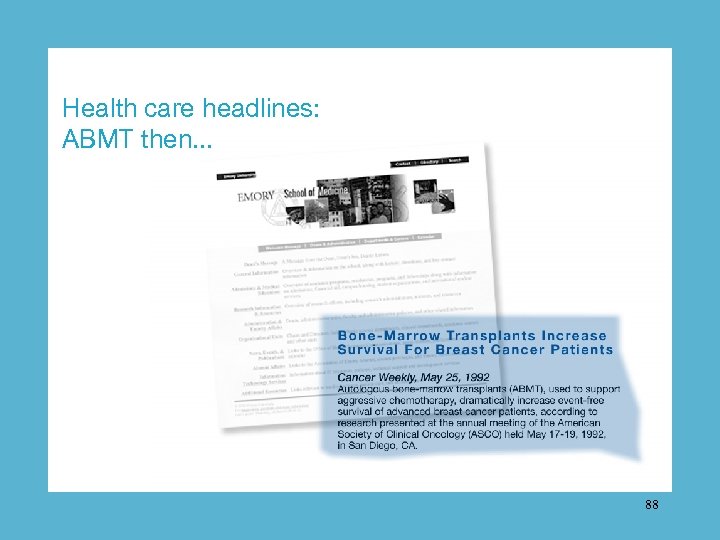
Health care headlines: ABMT then. . . 88
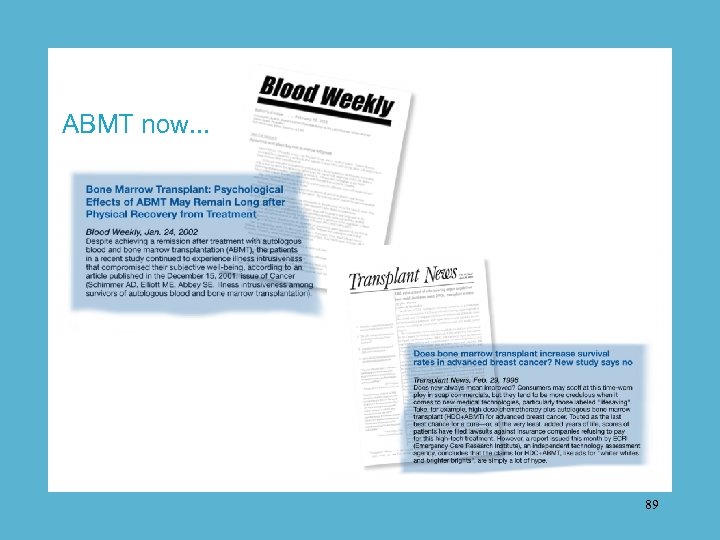
ABMT now. . . 89
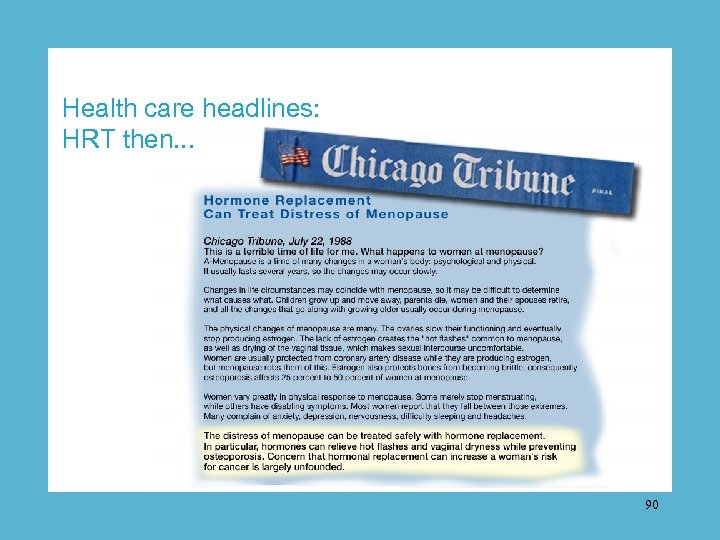
Health care headlines: HRT then. . . 90
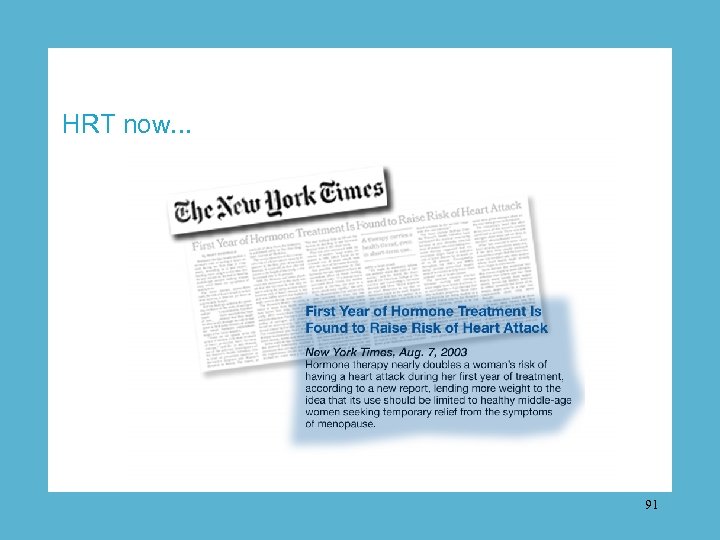
HRT now. . . 91
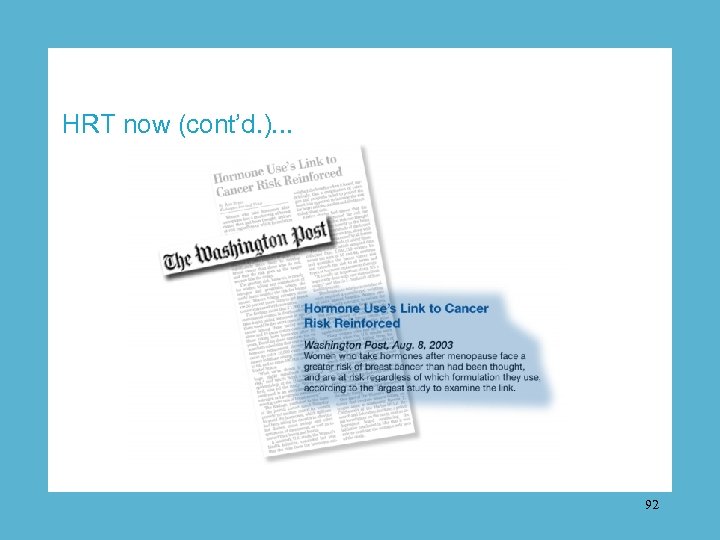
HRT now (cont’d. ). . . 92
The majority of procedures done in some medical specialties do not have a validated database demonstrating their effectiveness and value. 93
In the absence of data, decisions are made based on professional judgment. 94
Professional judgment wouldn’t create a $40 DVD player. 95
So what is the answer? 96
The answer is mechanical An automated, computerized, all-inclusive electronic medical record that includes medical best practice protocols, interactive programming, and patient-friendly explanations, clear communications, and standardized, automatic reminder systems. A system that tracks results. A system that instantly can be changed as science improves. 97
Each of the wobbly parts that damages health care outcomes is fixable – but only with a dedicated system explicitly designed to fix each problem. 98
What happens when computers are used to make care more accessible and consistent? 99
Pilot results (why we believe in computer-assisted care and care re-engineering). 100
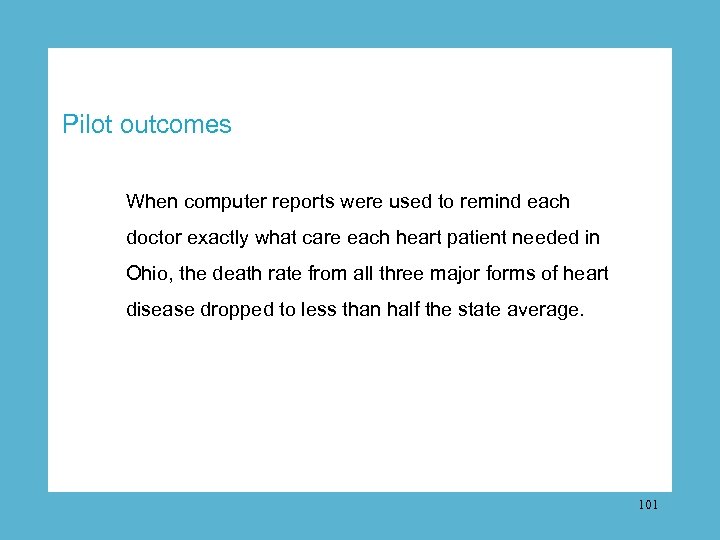
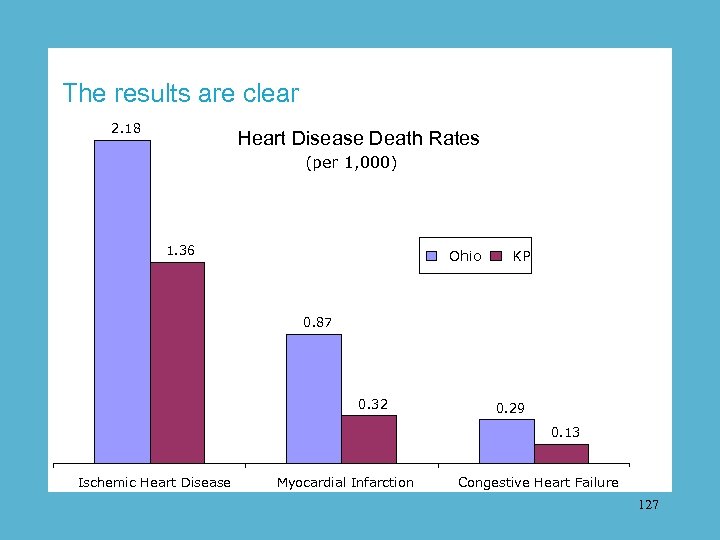
Pilot outcomes When computer reports were used to remind each doctor exactly what care each heart patient needed in Ohio, the death rate from all three major forms of heart disease dropped to less than half the state average. 101
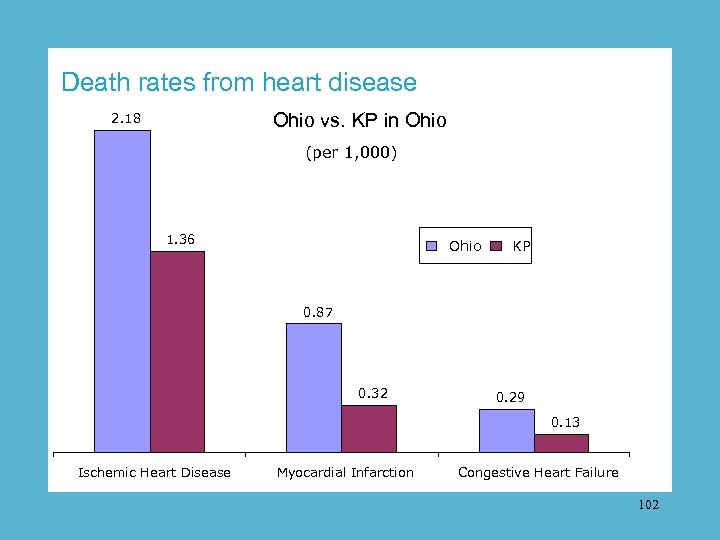
Death rates from heart disease Ohio vs. KP in Ohio 2. 18 (per 1, 000) 1. 36 Ohio KP 0. 87 0. 32 0. 29 0. 13 Ischemic Heart Disease Myocardial Infarction Congestive Heart Failure 102
Other similar results: 103
What happens when an AMR is attached to a pharmacy review program in Colorado to monitor and track patients on anti-coagulation therapy? 104
A 79 percent reduction in bleeding complications. 105
Southern California – Computer tracking of follow-up care for end-stage renal disease patients. 106
Result: a 31 percent reduction in the death rate from end-stage renal disease. – Department of Health and Human Services Medicare Demonstration Project 107
Computer-assisted care has nearly eliminated new cases of blindness in diabetics in Northern California. Diabetes is the number one cause of blindness in the U. S. 108
The results for asthmatics, diabetics, heart disease patients, etc. have been dramatic in every pilot site when the computer is used to assist the physician in delivering consistent, science-based care. 109
For America – It’s time to re-engineer care. 110
It’s time to use the computer to assist caregivers and significantly improve outcomes. 111
No other approach has the potential to achieve remotely similar results. Every other approach hits the “wobbly part” quality barrier. “Patient directed” care certainly does not deal with the issues that cause these problems. But “patient involved” care can make a big difference. It takes a system to support that involvement. 112
Doctor 1 Referral Doctor Patient Doctor 2 (Separate Condition) Hospital Admission 113
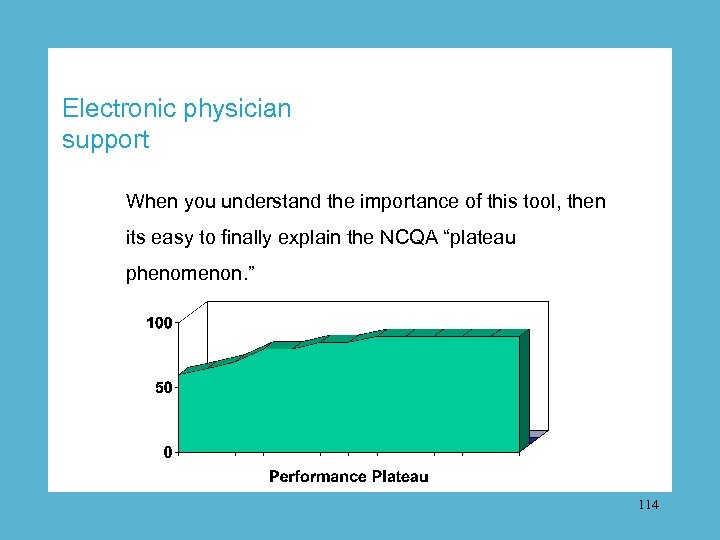
Electronic physician support When you understand the importance of this tool, then its easy to finally explain the NCQA “plateau phenomenon. ” 114
It won’t be cheap or easy to fully automate these key aspects of care. 115
Kaiser Permanente is investing nearly $2 billion to put these systems in place in the next three years. 116
Just about every other world class, multi-specialty group practice in America is heading down a similar path, albeit with “patients, ” not “members, ” as their key database. 117
Market forces will drive quality When the results are all in and improved health is the obvious outcome, the rest of health care will be forced to follow by using computers and physician support tools. 118
How? Some will follow our lead. For most caregivers, “virtual” systems will emerge – anchored by hospitals, hub clinics, health plans, systems vendors, and maybe even government agencies. 119
Health care is on the verge of a whole new level of accountability and performance. 120
Rewards for actual outcomes will finally be possible (because true outcomes will finally be measurable). 121
Practical focus The economics will trail the mechanics – but both will need to be there in order to optimize care, cost and value. 122
Without this tool, the wobbly parts of health care will continue to produce the results documented by Dr. Wennberg, the IOM and RAND. 123
It’s time to re-engineer care, with the computer as the key enabler. 124
Medical Best Practices/ Current Sciences Impact Doctor 1 cal edi d M or Rec Referral Doctor cal edi d M or Rec Patient Doctor 2 cal edi d M or Rec Hospital Admission 125
The opportunities are obvious 1% of people % of Healthcare Expenditures 100% % of Costs 80% 30% total cost 60% 40% 20% 10% total cost 0% 0% 20% 40% 60% 80% % of Membership 20% of people 100% % of People 70% of people 126
The results are clear 2. 18 Heart Disease Death Rates (per 1, 000) 1. 36 Ohio KP 0. 87 0. 32 0. 29 0. 13 Ischemic Heart Disease Myocardial Infarction Congestive Heart Failure 127
Скачать презентацию Epidemic of Care A Call for Safer Better
d7f98a936b8458401ebbf03458cf525b.ppt