


 Скачать презентацию Enzymes The classification and nomenclature Lyases and Transferases
lecture class lyases transf.ppt
- Количество слайдов: 23
 Enzymes The classification and nomenclature. Lyases and Transferases
 The plan of lecture • 1) The classification and nomenclature of enzymes • 2) Transferases, representatives – structure and catalytic role • 3) Lyases, representatives – structure and catalytic role
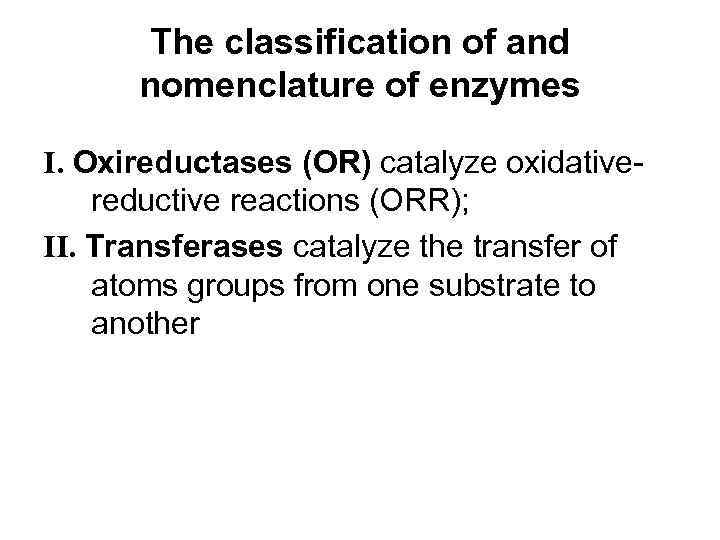 The classification of and nomenclature of enzymes I. Oxireductases (ОR) catalyze oxidativereductive reactions (ОRR); II. Transferases catalyze the transfer of atoms groups from one substrate to another
 III. Hydrolases catalyze the cleavage of complex substances to simple ones with participation of water (this process is called as hydrolysis)
 IV. Lyases catalyze the reactions of cleavage without water or promote the addition of atoms groups in the site of double or triple bonds
 V. Isomerases catalyze the isomerizm ведут реакции изомеризации; VI. Lygases, or synthetases catalyze the synthesis of some substances
 The nomenclature of enzymes Each class is divided into subclasses (from 4 -13), subclass is divided into subsubclasses, each subsubclass contains a representative
 Therefore the cipher of each enzyme consists of 4 numbers: first one shows the number of class; second one indicates number of subclass, third one represents the number of subsubclass, fourth one shows the place of a representative in subsubclass
 For instance, the cipher for pancreatic lipase is 3. 1. 1. 3. , this is means that pancreatic lipase refers to hydrolases (3 -rd class, that is catalyzes the hydrolysis)
 To the 1 -st subclass (esterase, that is catalyzes the hydrolysis of ester bonds), to the 1 -st subsubclass (that is catalyzes the hydrolysis of ester bonds formed by carboxylic acids), the place in subsubclass is third one
 General characteristic and classification of transferases Transferases are enzymes which catalyze the reactions of transfer of groups of atoms from one substrate to another. Almost all transferases are two-component enzymes. They are contained in the cells only. On the depend on character of transported groups there are some subclasses of transferases: amino-, methyl-, acyl- and phosphotransferases
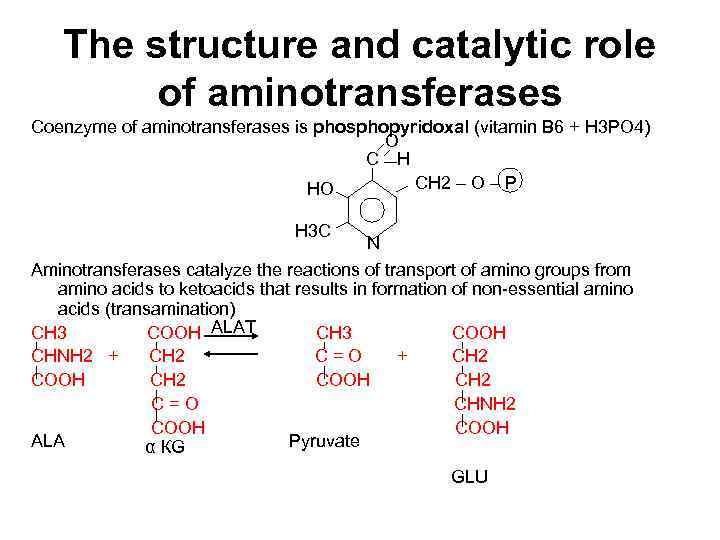 The structure and catalytic role of aminotransferases Coenzyme of aminotransferases is phosphopyridoxal (vitamin B 6 + H 3 PO 4) О С Н СН 2 – О – Р НО Н 3 С N Aminotransferases catalyze the reactions of transport of amino groups from amino acids to ketoacids that results in formation of non-essential amino acids (transamination) СН 3 COOH АLАT CH 3 COOH СНNH 2 + CH 2 C=O + CH 2 COOH CН 2 COOH CH 2 C=O CHNH 2 СООН COOH АLА Pyruvate α КG GLU
 The importance of transamination 1) 2) 3) 4) This is a pathway of synthesis of non-essential amino acids; This is the way of integration of metabolism of carbohydrates and amino acids due to reversibility of transamination This is initial state of amino acids catabolism Aminotransferases are organospecific enzymes, e. g. alanine aminotransferase occurs mainly in liver; aspartate aminotransferase does in liver, myocardium, muscles. This has a diagnostic role, because in lesion of these organs and tissues the activity of these enzymes is increased in blood plasma. It is due to exit of them from corresponding cells into blood
 The structure and catalytic role of methyltransferases Coenzyme is reduced form of Folic Acid (vitamin Bc) – tetrahydrofolic acid (THFA). It is reduced residue of pteridine, para-aminobenzoic and glutamic acids. Methyltransferases catalyze the reactions of intermolecular transport of methyl- and other one -carbon groups (methylation). The source of methyl group is methionine (Met). In these reactions vitamin B 12 is also necessary.
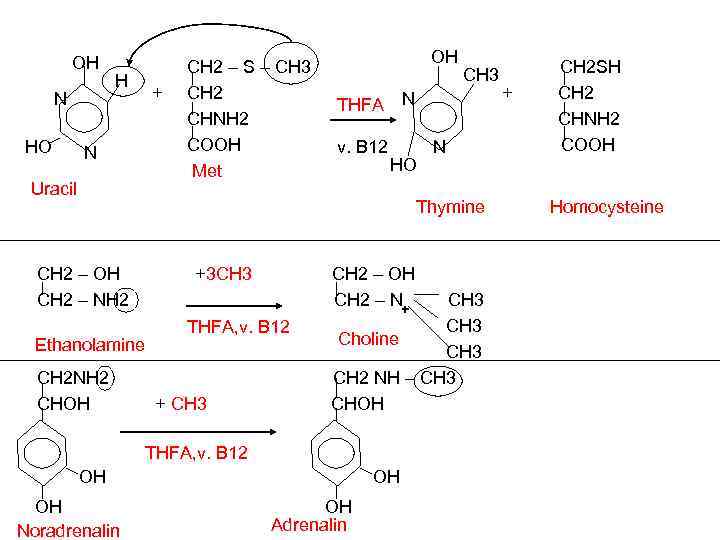 OH N HO H + N Uracil СН 2 – S – CH 3 CH 2 CHNH 2 COOH Met OH N ТHFA v. B 12 CH 3 HO N Thymine СН 2 – ОН СН 2 – NH 2 +3 CH 3 Ethanolamine CH 2 NH 2 CHOH CH 2 – N ТHFA, v. B 12 + CH 3 Choline CH 3 CH 2 NH – CH 3 CHOH ТHFA, v. B 12 OH OH Noradrenalin OH OH Adrenalin + CH 2 SH CH 2 CHNH 2 COOH Homocysteine
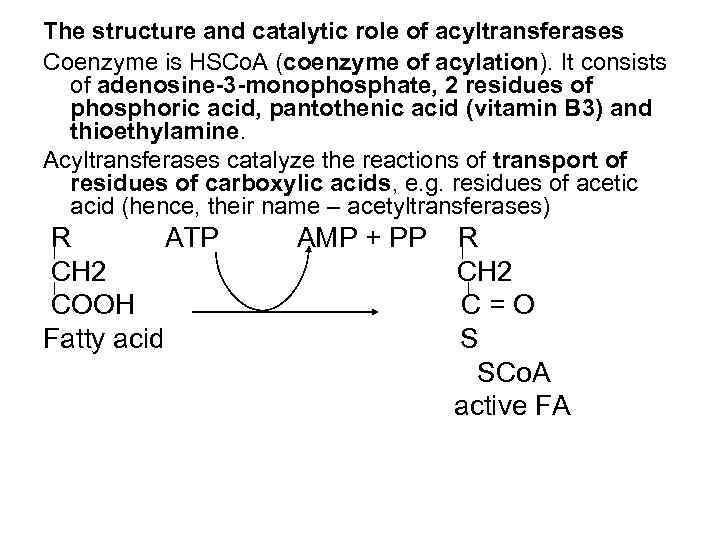 The structure and catalytic role of acyltransferases Coenzyme is HSCo. A (coenzyme of acylation). It consists of adenosine-3 -monophosphate, 2 residues of phosphoric acid, pantothenic acid (vitamin B 3) and thioethylamine. Acyltransferases catalyze the reactions of transport of residues of carboxylic acids, e. g. residues of acetic acid (hence, their name – acetyltransferases) R AТP CH 2 COOH Fatty acid АМP + РР R CH 2 C=O S SCo. A active FA
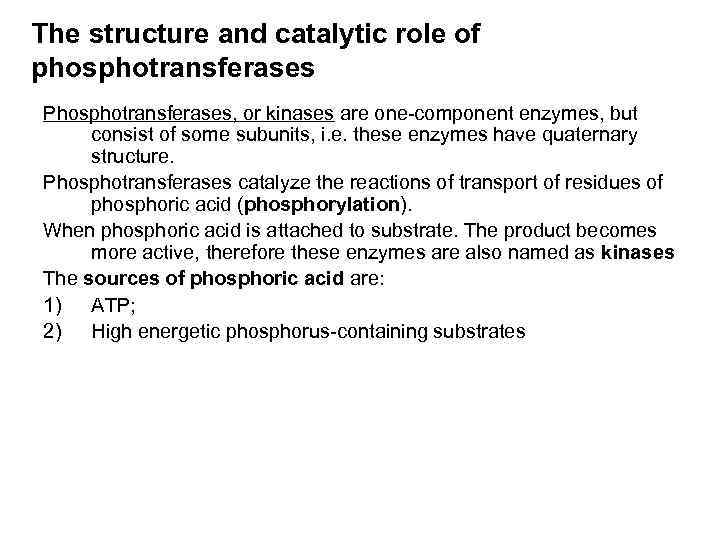 The structure and catalytic role of phosphotransferases Phosphotransferases, or kinases are one-component enzymes, but consist of some subunits, i. e. these enzymes have quaternary structure. Phosphotransferases catalyze the reactions of transport of residues of phosphoric acid (phosphorylation). When phosphoric acid is attached to substrate. The product becomes more active, therefore these enzymes are also named as kinases The sources of phosphoric acid are: 1) ATP; 2) High energetic phosphorus-containing substrates
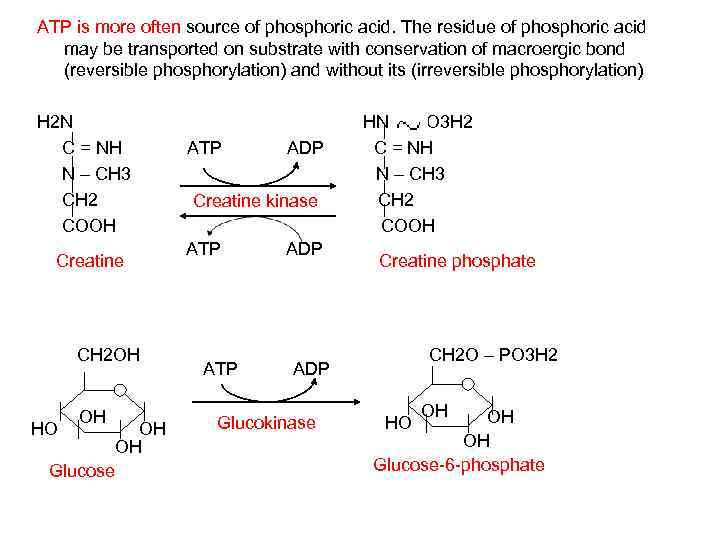 ATP is more often source of phosphoric acid. The residue of phosphoric acid may be transported on substrate with conservation of macroergic bond (reversible phosphorylation) and without its (irreversible phosphorylation) H 2 N C = NH N – CH 3 CH 2 COOH Creatine СН 2 ОН НО ОН ОН ОН Glucose АТP АDP Creatine kinase АТP АDP HN PO 3 H 2 C = NH N – CH 3 CH 2 COOH Creatine phosphate СН 2 О – РО 3 Н 2 АDP Glucokinase ОН ОН ОН Glucose-6 -phosphate НО
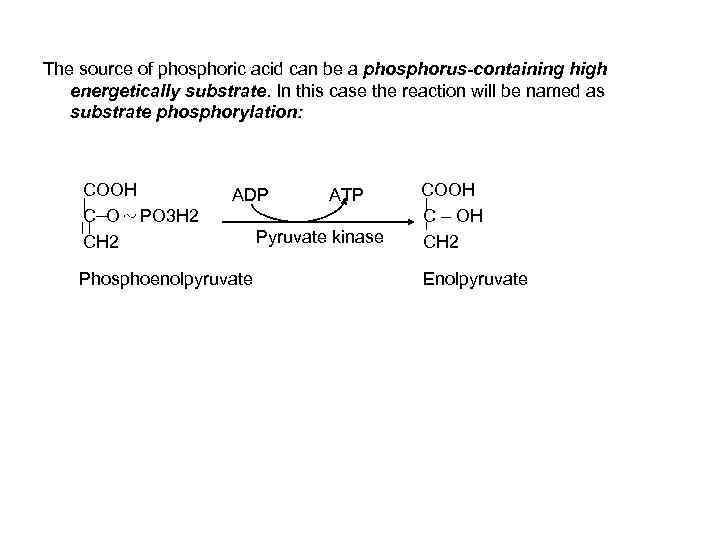 The source of phosphoric acid can be a phosphorus-containing high energetically substrate. In this case the reaction will be named as substrate phosphorylation: СOOH C O PO 3 H 2 CH 2 АDP Phosphoenolpyruvate АTP Pyruvate kinase COOH C – OH CH 2 Enolpyruvate
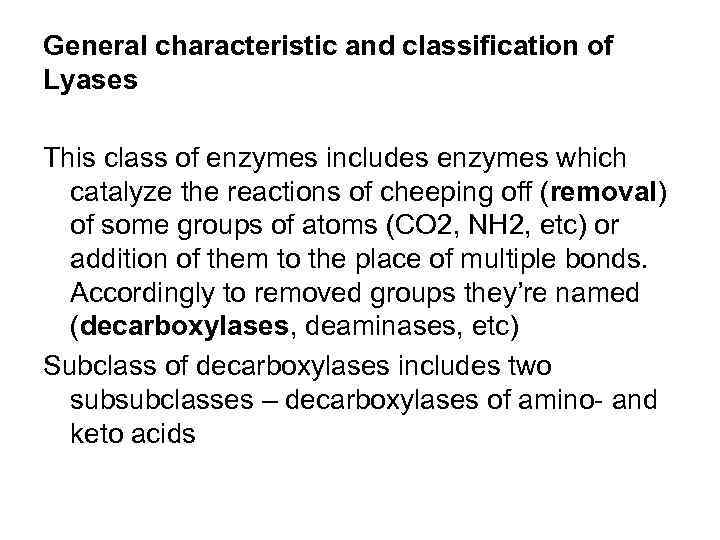 General characteristic and classification of Lyases This class of enzymes includes enzymes which catalyze the reactions of cheeping off (removal) of some groups of atoms (CO 2, NH 2, etc) or addition of them to the place of multiple bonds. Accordingly to removed groups they’re named (decarboxylases, deaminases, etc) Subclass of decarboxylases includes two subsubclasses – decarboxylases of amino- and keto acids
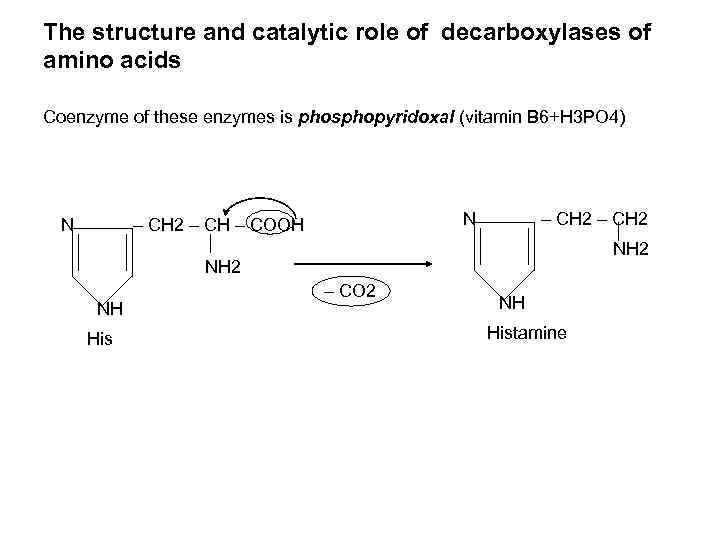 The structure and catalytic role of decarboxylases of amino acids Coenzyme of these enzymes is phosphopyridoxal (vitamin B 6+H 3 PO 4) N N – CH 2 – CH – COOH – CH 2 NH His – СО 2 NH Histamine
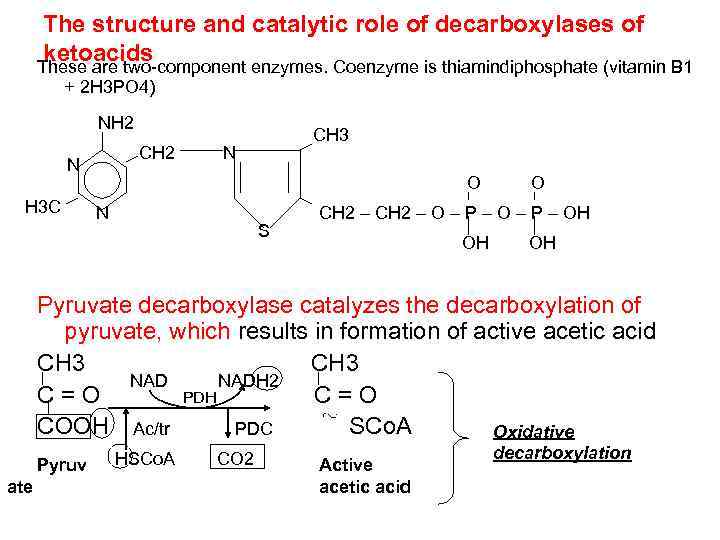 The structure and catalytic role of decarboxylases of ketoacids These are two-component enzymes. Coenzyme is thiamindiphosphate (vitamin B 1 + 2 H 3 PO 4) NH 2 CH 2 N H 3 C CH 3 N O N S O CH 2 – O – P – OH OH OH Pyruvate decarboxylase catalyzes the decarboxylation of pyruvate, which results in formation of active acetic acid СН 3 NАD NADН 2 С=О PDH СООН Аc/tr SCo. A PDC Oxidative Pyruv ate HSCo. A СО 2 Active acetic acid decarboxylation
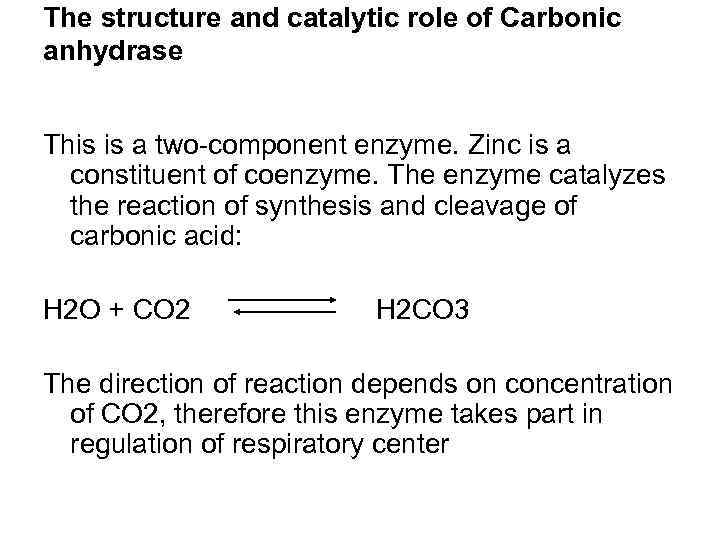 The structure and catalytic role of Carbonic anhydrase This is a two-component enzyme. Zinc is a constituent of coenzyme. The enzyme catalyzes the reaction of synthesis and cleavage of carbonic acid: Н 2 О + СО 2 Н 2 СО 3 The direction of reaction depends on concentration of CO 2, therefore this enzyme takes part in regulation of respiratory center