 Скачать презентацию Enzyme mechanisms Andy Howard Introductory Biochemistry 2 November
489d61fb978e7db118aed28c3c607cff.ppt
- Количество слайдов: 49



Enzyme mechanisms Andy Howard Introductory Biochemistry 2 November 2010 Biochem: Enzyme Mechanisms 11/02/2010
More about mechanisms Many enzymatic mechanisms involve either covalent catalysis or acid-base interactions n We’ll give some examples of several mechanistic approaches n 11/02/2010 Biochem: Enzyme Mechanisms 2
Mechanism Topics n n n Enzyme dynamics Enzyme chemistry Transition-state binding Diffusion-controlled Reactions Binding Modes of Catalysis Redox reactions n n Induced fit Ionic intermediates Active-site amino acids Serine proteases n n Reaction How they illustrate what we’ve learned Specificity Evolution 11/02/2010 Biochem: Enzyme Mechanisms 3
The protein moves as well! n Changes to active-site conformation: n n n Help with substrate binding Position the catalytic groups Induce formation of a near-attack conformation (NAC) Help to break or make bonds Facilitate conversion of S to P Sometimes involve networks of concerted amino acid changes 11/02/2010 Biochem: Enzyme Mechanisms 4
Binding modes: proximity n n We describe enzymatic mechanisms in terms of the binding modes of the substrates (or, more properly, the transition-state species) to the enzyme. One of these involves the proximity effect, in which two (or more) substrates are directed down potential-energy gradients to positions where they are close to one another. Thus the enzyme is able to defeat the entropic difficulty of bringing substrates together. 11/02/2010 Biochem: Enzyme Mechanisms William Jencks 5
Binding modes: efficient transition-state binding n n Transition state fits even better (geometrically and electrostatically) in the active site than the substrate would. This improved fit lowers the energy of the transition-state system relative to the substrate. Best competitive inhibitors of an enzyme are those that resemble the transition state rather than the substrate or product. 11/02/2010 Biochem: Enzyme Mechanisms 6
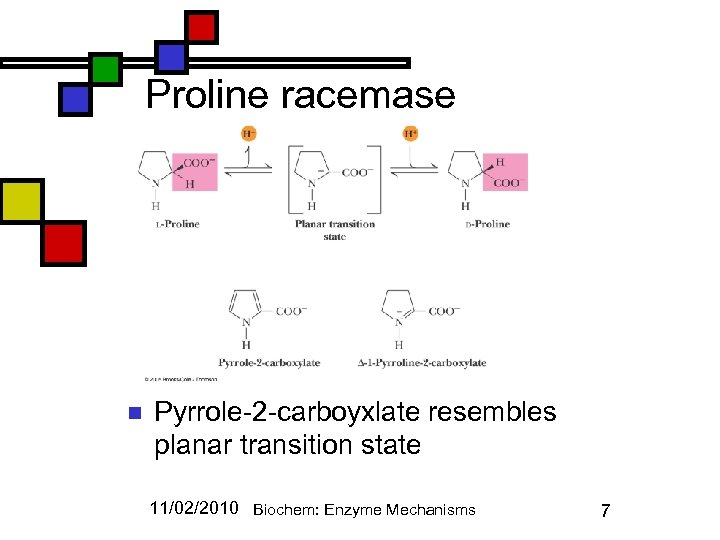
Proline racemase n Pyrrole-2 -carboyxlate resembles planar transition state 11/02/2010 Biochem: Enzyme Mechanisms 7
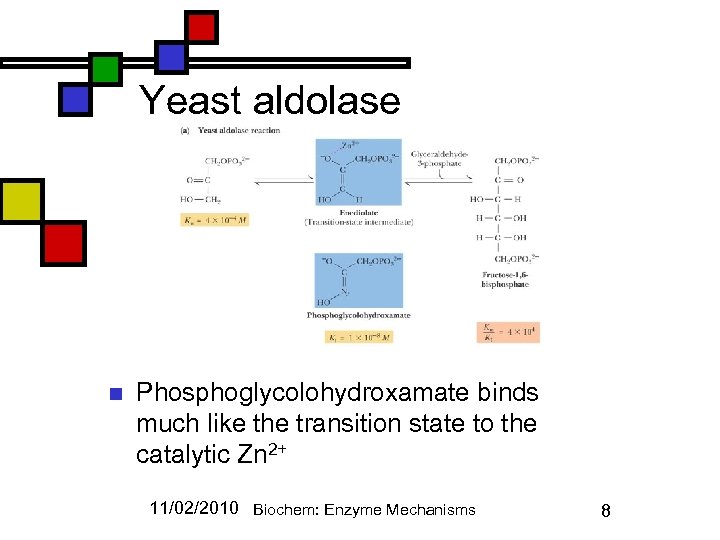
Yeast aldolase n Phosphoglycolohydroxamate binds much like the transition state to the catalytic Zn 2+ 11/02/2010 Biochem: Enzyme Mechanisms 8
Adenosine deaminase with transition-state analog n n Transition-state analog: Ki~10 -8 * substrate Km Wilson et al (1991) Science 252: 1278 11/02/2010 Biochem: Enzyme Mechanisms 9
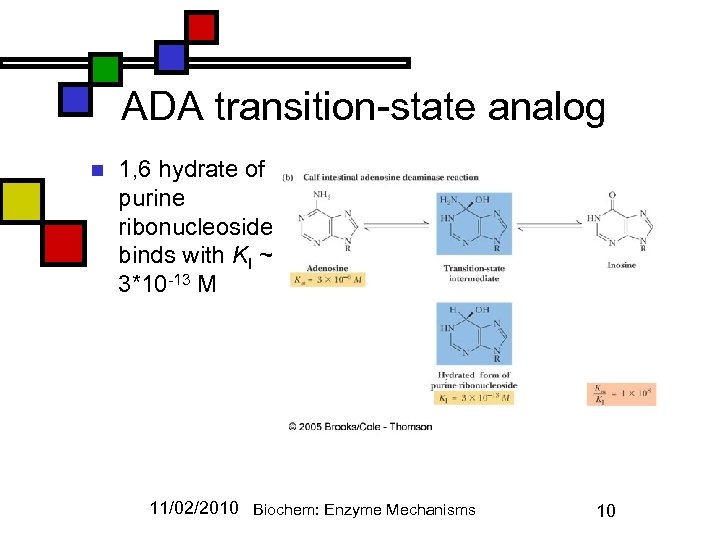
ADA transition-state analog n 1, 6 hydrate of purine ribonucleoside binds with KI ~ 3*10 -13 M 11/02/2010 Biochem: Enzyme Mechanisms 10
Diffusion-controlled reactions n n Some enzymes are so efficient that the limiting factor in completion of the reaction is diffusion of the substrates into the active site: These are diffusion-controlled reactions. Ultra-high turnover rates: kcat ~ 109 s-1. We can describe kcat / Km as catalytic efficiency (or the specificity constant) of an enzyme. A diffusion-controlled reaction will have a catalytic efficiency on the order of 108 M-1 s-1. 11/02/2010 Biochem: Enzyme Mechanisms 11
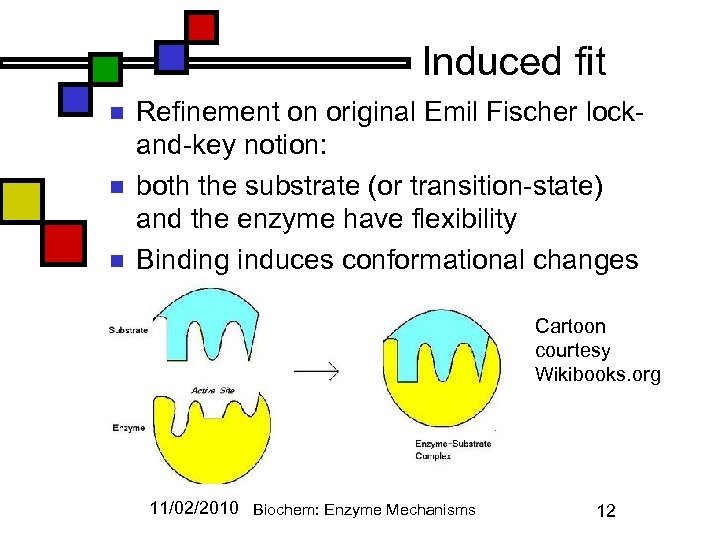
Induced fit n n n Refinement on original Emil Fischer lockand-key notion: both the substrate (or transition-state) and the enzyme have flexibility Binding induces conformational changes Cartoon courtesy Wikibooks. org 11/02/2010 Biochem: Enzyme Mechanisms 12
Ionic reactions n n Define them as reactions that involve charged, or at least polar, intermediates Typically 2 reactants n n Electron rich (nucleophilic) reactant Electron poor (electrophilic) reactant Conventional to describe reaction as attack of nucleophile on electrophile Drawn with nucleophile donating electron(s) to electrophile 11/02/2010 Biochem: Enzyme Mechanisms 13
Attack on Acyl Group n n n Transfer of an acyl group: section 14. 6 Nucleophile Y attacks carbonyl carbon, forming tetrahedral intermediate X- is leaving group 11/02/2010 Biochem: Enzyme Mechanisms 14
Direct Displacement n n n Attacking group adds to face of atom opposite to leaving group Transition state can have five ligands; This is inherently less stable than other attacks, but it can still work 11/02/2010 Biochem: Enzyme Mechanisms 15
Cleavage Reactions n Both electrons stay with one atom n n n Covalent bond produces carbanion: R 3—C—H R 3—C: - + H+ Covalent bond produces carbocation: R 3—C—H R 3—C+ + : H- One electron stays with each product n Both end up as radicals n R 1 O—OR 2 R 1 O • + • OR 2 Radicals are highly reactive— some more than others n 11/02/2010 Biochem: Enzyme Mechanisms 16
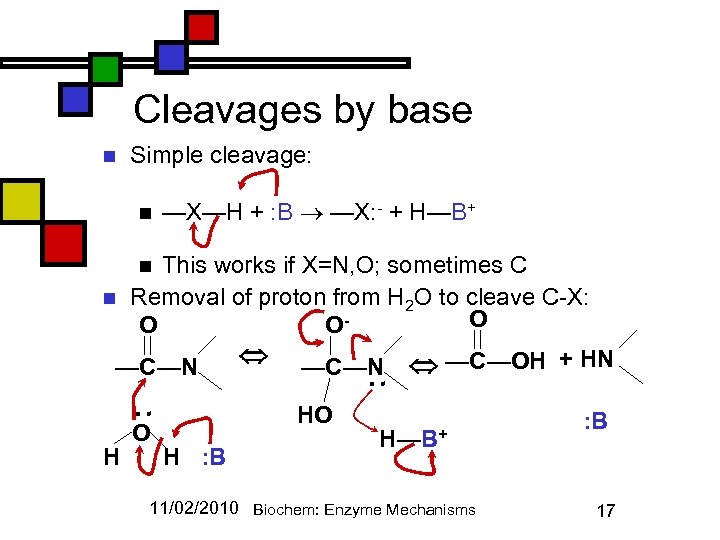
Cleavages by base n Simple cleavage: n —X—H + : B —X: - + H—B+ This works if X=N, O; sometimes C n Removal of proton from H 2 O to cleave C-X: O O O —C—N —C—OH + HN —C—N : n : HO H : B H—B+ 11/02/2010 Biochem: Enzyme Mechanisms : B 17
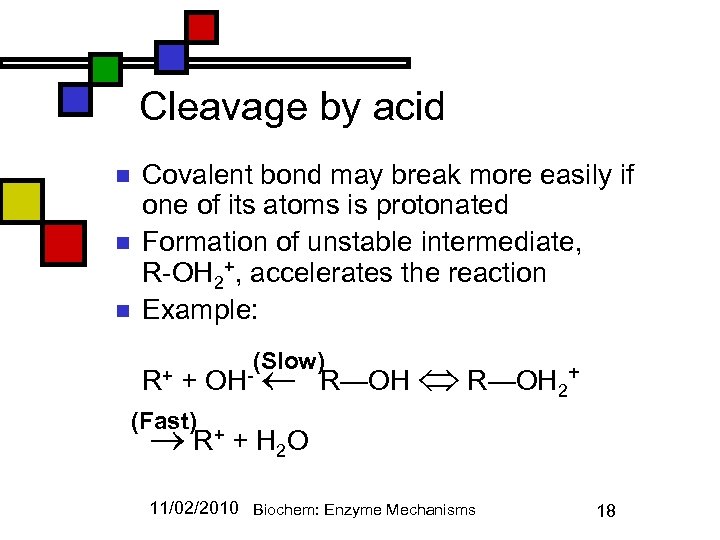
Cleavage by acid n n n Covalent bond may break more easily if one of its atoms is protonated Formation of unstable intermediate, R-OH 2+, accelerates the reaction Example: R+ + (Slow) OH- R—OH 2+ (Fast) R + + H 2 O 11/02/2010 Biochem: Enzyme Mechanisms 18
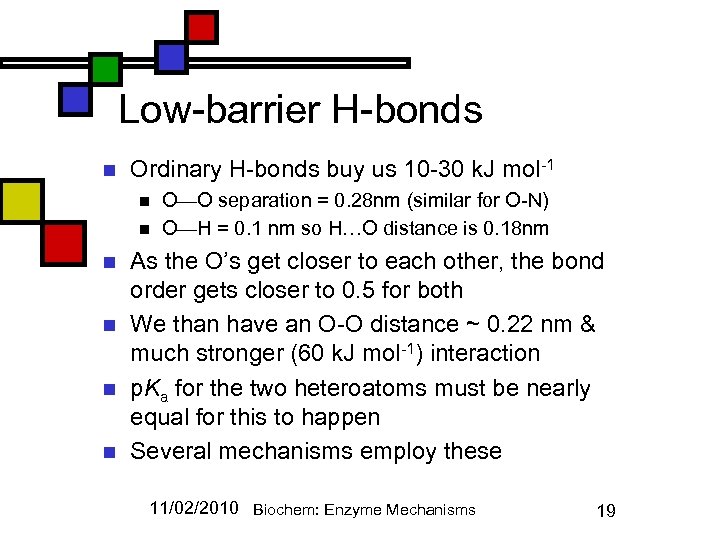
Low-barrier H-bonds n Ordinary H-bonds buy us 10 -30 k. J mol-1 n n n O—O separation = 0. 28 nm (similar for O-N) O—H = 0. 1 nm so H…O distance is 0. 18 nm As the O’s get closer to each other, the bond order gets closer to 0. 5 for both We than have an O-O distance ~ 0. 22 nm & much stronger (60 k. J mol-1) interaction p. Ka for the two heteroatoms must be nearly equal for this to happen Several mechanisms employ these 11/02/2010 Biochem: Enzyme Mechanisms 19
Oxidation-Reduction Reactions n n Commonplace in biochemistry: EC 1 Oxidation is a loss of electrons Reduction is the gain of electrons In practice, often: n n oxidation is decrease in # of C-H bonds; reduction is increase in # of C-H bonds 11/02/2010 Biochem: Enzyme Mechanisms 20
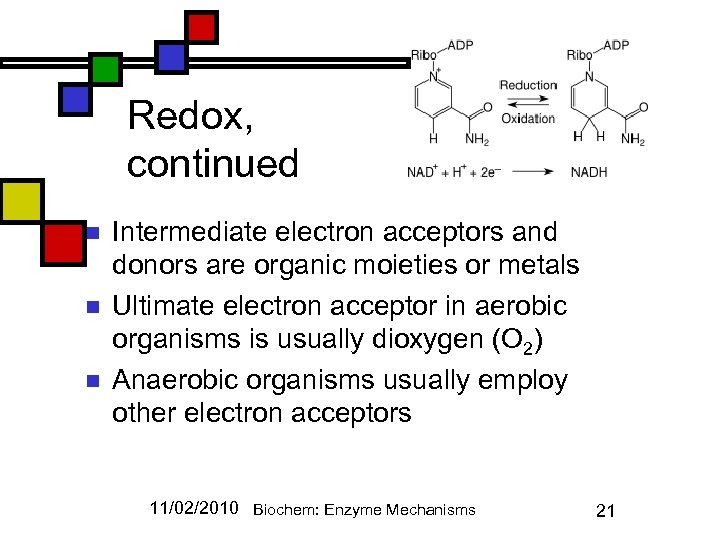
Redox, continued n n n Intermediate electron acceptors and donors are organic moieties or metals Ultimate electron acceptor in aerobic organisms is usually dioxygen (O 2) Anaerobic organisms usually employ other electron acceptors 11/02/2010 Biochem: Enzyme Mechanisms 21
Biological redox reactions n n n n Generally 2 -electron transformations Often involve alcohols, aldehydes, ketones, carboxylic acids, C=C bonds: R 1 R 2 CH-OH + X R 1 R 2 C=O + XH 2 R 1 HC=O + X + OH- R 1 COO- + XH 2 X is usually NAD, NADP, FAD, FMN A few biological redox systems involve metal ions or Fe-S complexes Usually reduced compounds are higher-energy than the corresponding oxidized compounds 11/02/2010 Biochem: Enzyme Mechanisms 22
One-electron redox reactions n n n FMN, FAD, some metal ions can be oxidized or reduced one electron at a time With organic cofactors this generally leaves a free radical in each of two places Subsequent reactions get us back to an even number of electrons 11/02/2010 Biochem: Enzyme Mechanisms 23
Covalent catalysis n n Reactive side-chain can be a nucleophile or an electrophile, but nucleophile is more common n A—X + E X—E + A n X—E + B B—X + E Example: sucrose phosphorylase n n Net reaction: Sucrose + Pi Glucose 1 -P + fructose Fructose=A, Glucose=X, Phosphate=B 11/02/2010 Biochem: Enzyme Mechanisms 24
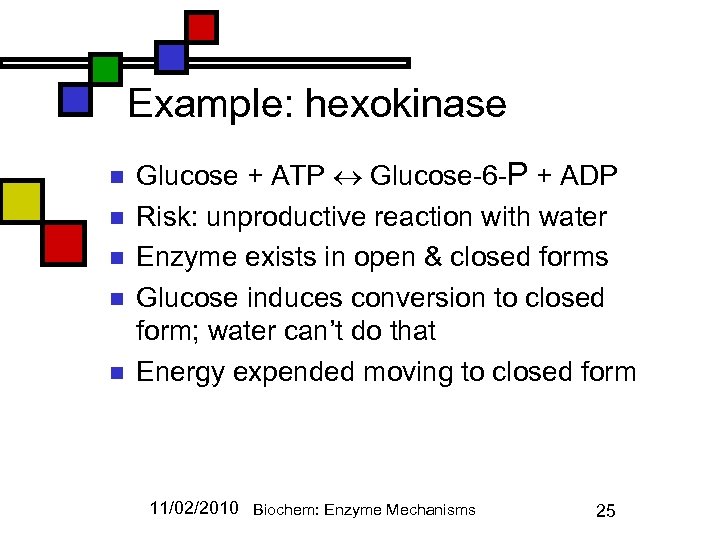
Example: hexokinase n n n Glucose + ATP Glucose-6 -P + ADP Risk: unproductive reaction with water Enzyme exists in open & closed forms Glucose induces conversion to closed form; water can’t do that Energy expended moving to closed form 11/02/2010 Biochem: Enzyme Mechanisms 25
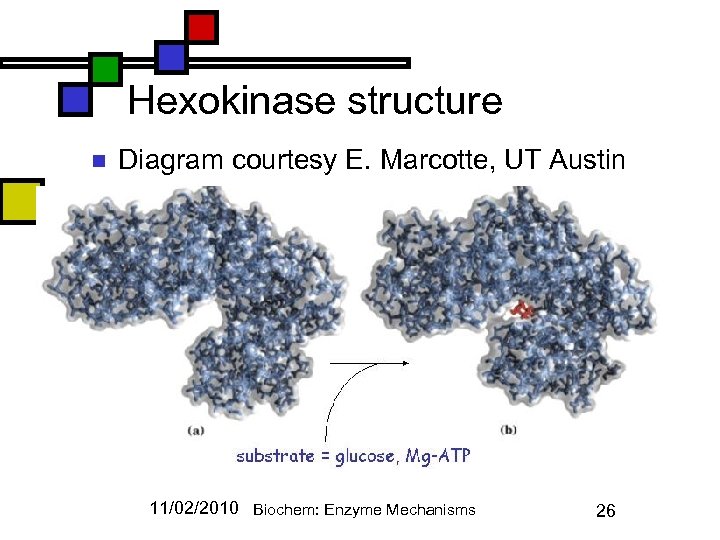
Hexokinase structure n Diagram courtesy E. Marcotte, UT Austin 11/02/2010 Biochem: Enzyme Mechanisms 26
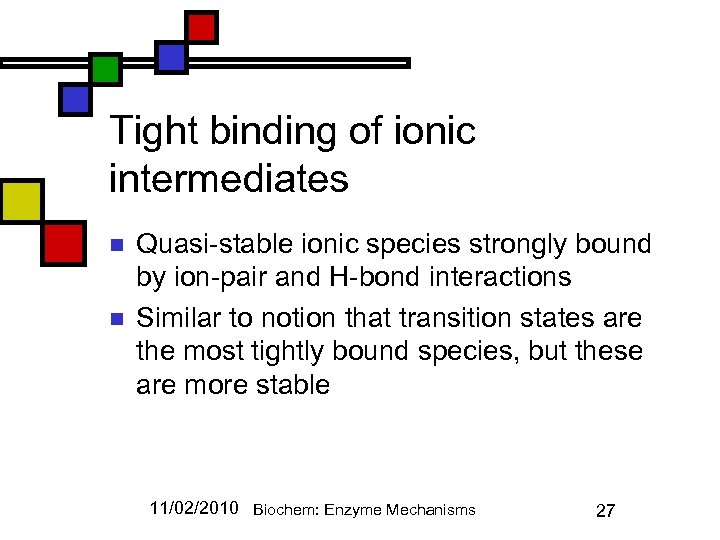
Tight binding of ionic intermediates n n Quasi-stable ionic species strongly bound by ion-pair and H-bond interactions Similar to notion that transition states are the most tightly bound species, but these are more stable 11/02/2010 Biochem: Enzyme Mechanisms 27
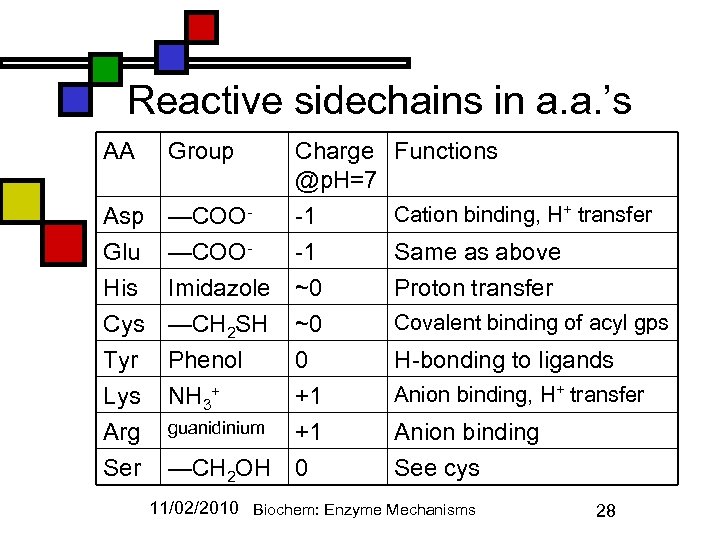
Reactive sidechains in a. a. ’s AA Group Asp Glu His Cys Tyr Lys Arg Ser —COOImidazole —CH 2 SH Phenol NH 3+ Charge Functions @p. H=7 -1 -1 ~0 ~0 0 +1 guanidinium +1 —CH 2 OH 0 Cation binding, H+ transfer Same as above Proton transfer Covalent binding of acyl gps H-bonding to ligands Anion binding, H+ transfer Anion binding See cys 11/02/2010 Biochem: Enzyme Mechanisms 28
Generalizations about activesite amino acids n n n Typical enzyme has 2 -6 key catalytic residues His, asp, arg, glu, lys account for 64% Remember: n n p. Ka values in proteins sometimes different from those of isolated aa’s Frequency overall Frequency in catalysis 11/02/2010 Biochem: Enzyme Mechanisms 29
Rates often depend on p. H n n If an amino acid that is necessary to the mechanism changes protonation state at a particular p. H, then the reaction may be allowed or disallowed depending on p. H Two ionizable residues means there may be a narrow p. H optimum for catalysis 11/02/2010 Biochem: Enzyme Mechanisms 30
Papain as an example 11/02/2010 Biochem: Enzyme Mechanisms 31
i. Clicker quiz, question 1 Why would the nonproductive hexokinase reaction H 2 O + ATP ADP + Pi be considered nonproductive? n (a) Because it needlessly soaks up water n (b) Because the enzyme undergoes a wasteful conformational change n (c) Because the energy in the high-energy phosphate bond is unavailable for other purposes n (d) Because ADP is poisonous n (e) None of the above 11/02/2010 Biochem: Enzyme Mechanisms 32
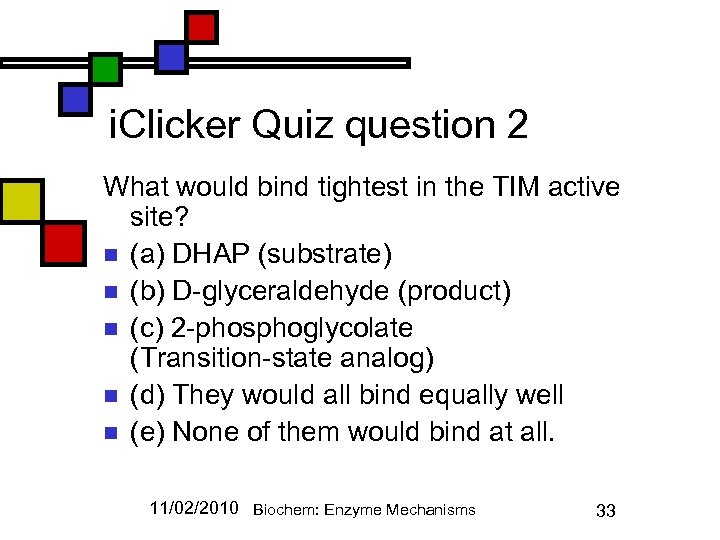
i. Clicker Quiz question 2 What would bind tightest in the TIM active site? n (a) DHAP (substrate) n (b) D-glyceraldehyde (product) n (c) 2 -phosphoglycolate (Transition-state analog) n (d) They would all bind equally well n (e) None of them would bind at all. 11/02/2010 Biochem: Enzyme Mechanisms 33
Serine protease mechanism n n n Only detailed mechanism that we’ll ask you to memorize One of the first to be elucidated Well studied structurally Illustrates many other mechanisms Instance of convergent and divergent evolution 11/02/2010 Biochem: Enzyme Mechanisms 34
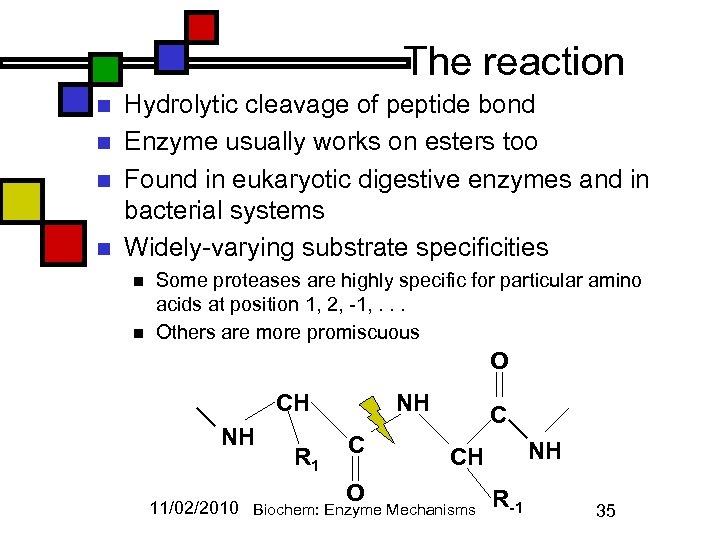
The reaction n n Hydrolytic cleavage of peptide bond Enzyme usually works on esters too Found in eukaryotic digestive enzymes and in bacterial systems Widely-varying substrate specificities n n Some proteases are highly specific for particular amino acids at position 1, 2, -1, . . . Others are more promiscuous O CH NH R 1 NH C O C NH CH 11/02/2010 Biochem: Enzyme Mechanisms R-1 35
Mechanism n n Active-site serine —OH … Without neighboring amino acids, it’s fairly unreactive becomes powerful nucleophile because OH proton lies near unprotonated N of His This N can abstract the hydrogen at nearneutral p. H Resulting + charge on His is stabilized by its proximity to a nearby carboxylate group on an aspartate side-chain. 11/02/2010 Biochem: Enzyme Mechanisms 36
Catalytic triad n The catalytic triad of asp, his, and ser is found in an approximately linear arrangement in all the serine proteases, all the way from non-specific, secreted bacterial proteases to highly regulated and highly specific mammalian proteases. 11/02/2010 Biochem: Enzyme Mechanisms 37
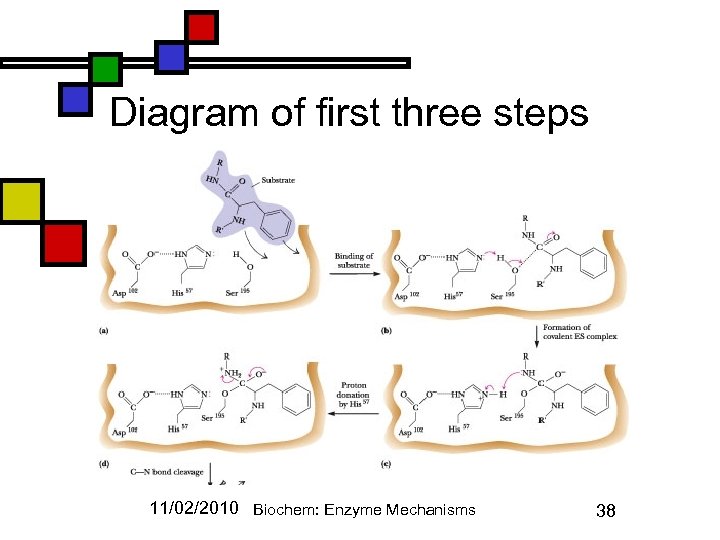
Diagram of first three steps 11/02/2010 Biochem: Enzyme Mechanisms 38
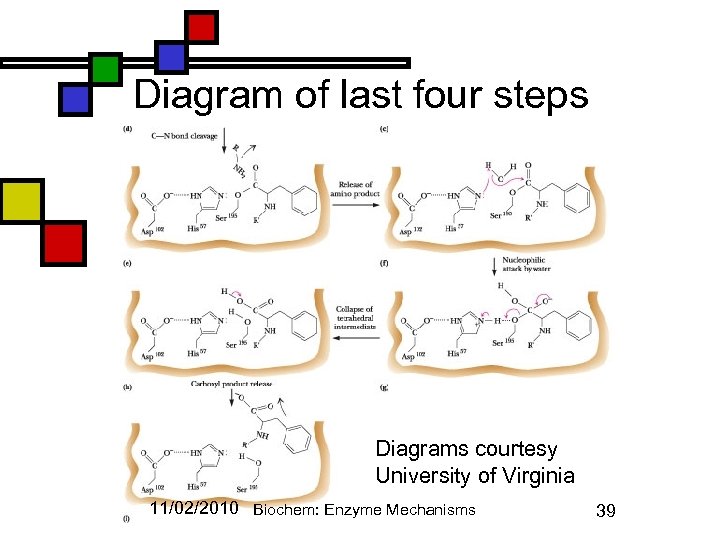
Diagram of last four steps Diagrams courtesy University of Virginia 11/02/2010 Biochem: Enzyme Mechanisms 39
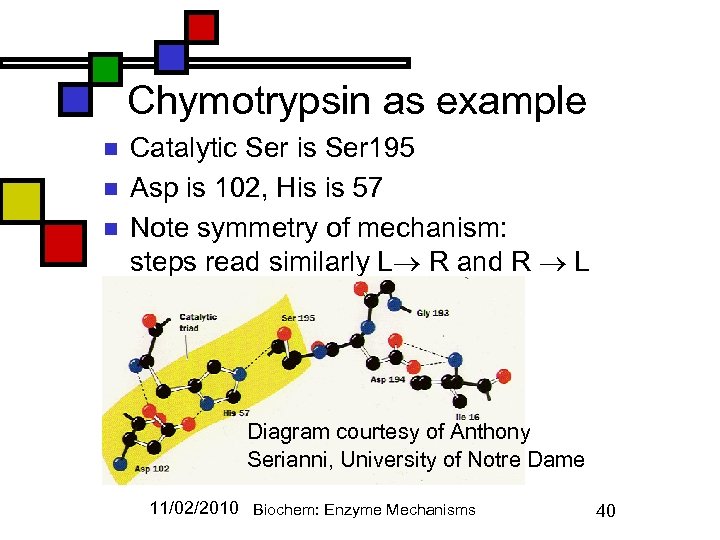
Chymotrypsin as example n n n Catalytic Ser is Ser 195 Asp is 102, His is 57 Note symmetry of mechanism: steps read similarly L R and R L Diagram courtesy of Anthony Serianni, University of Notre Dame 11/02/2010 Biochem: Enzyme Mechanisms 40
Oxyanion hole n n When his-57 accepts proton from Ser-195: it creates an R—O- ion on Ser sidechain In reality the Ser O immediately becomes covalently bonded to substrate carbonyl carbon, moving negative charge to the carbonyl O. Oxyanion is on the substrate's oxygen Oxyanion stabilized by additional interaction in addition to the protonated his 57: main-chain NH group from gly 193 H-bonds to oxygen atom (or ion) from the substrate, further stabilizing the ion. 11/02/2010 Biochem: Enzyme Mechanisms 41
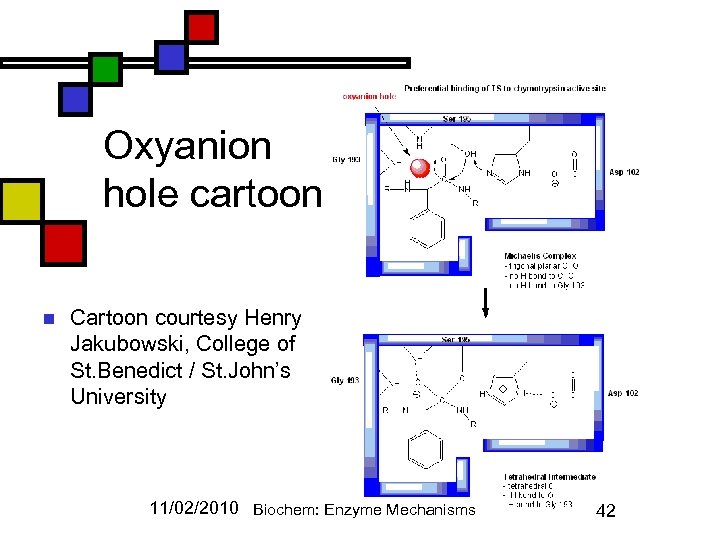
Oxyanion hole cartoon n Cartoon courtesy Henry Jakubowski, College of St. Benedict / St. John’s University 11/02/2010 Biochem: Enzyme Mechanisms 42
Modes of catalysis in serine proteases n n Proximity effect: gathering of reactants in steps 1 and 4 Acid-base catalysis at histidine in steps 2 and 4 Covalent catalysis on serine hydroxymethyl group in steps 2 -5 So both chemical (acid-base & covalent) and binding modes (proximity & transition-state) are used in this mechanism 11/02/2010 Biochem: Enzyme Mechanisms 43
Specificity n n n Active site catalytic triad is nearly invariant for eukaryotic serine proteases Remainder of cavity where reaction occurs varies significantly from protease to protease. In chymotrypsin hydrophobic pocket just upstream of the position where scissile bond sits This accommodates large hydrophobic side chain like that of phe, and doesn’t comfortably accommodate hydrophilic or small side chain. Thus specificity is conferred by the shape and electrostatic character of the site. 11/02/2010 Biochem: Enzyme Mechanisms 44
Chymotrypsin active site n n Comfortably accommodates aromatics at S 1 site Differs from other mammalian serine proteases in specificity Diagram courtesy School of Crystallography, Birkbeck College 11/02/2010 Biochem: Enzyme Mechanisms 45
Divergent evolution n Ancestral eukaryotic serine proteases presumably have differentiated into forms with different side-chain specificities Chymotrypsin is substantially conserved within eukaryotes, but is distinctly different from elastase Primary differences are in P 1 side chain pocket, but that isn’t inevitable 11/02/2010 Biochem: Enzyme Mechanisms 46
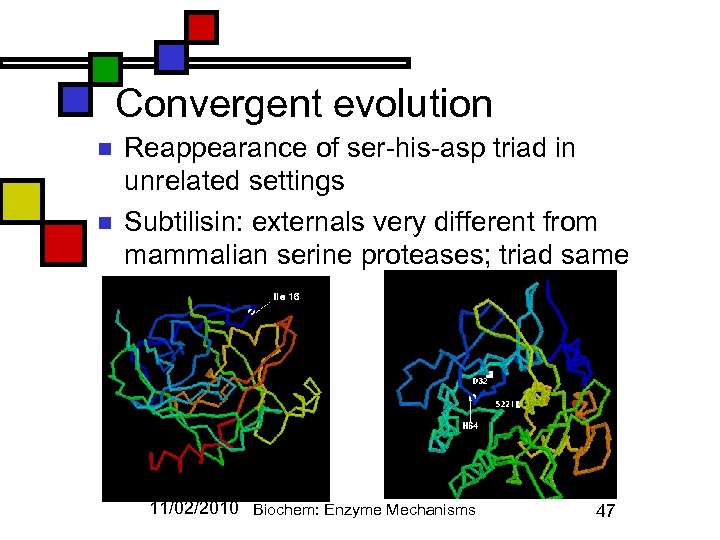
Convergent evolution n n Reappearance of ser-his-asp triad in unrelated settings Subtilisin: externals very different from mammalian serine proteases; triad same 11/02/2010 Biochem: Enzyme Mechanisms 47
Subtilisin mutagenesis n n n Substitutions for any of the amino acids in the catalytic triad has disastrous effects on the catalytic activity, as measured by kcat. Km affected only slightly, since the structure of the binding pocket is not altered very much by conservative mutations. An interesting (and somewhat non-intuitive) result is that even these "broken" enzymes still catalyze the hydrolysis of some test substrates at much higher rates than buffer alone would provide. I would encourage you to think about why that might be true. 11/02/2010 Biochem: Enzyme Mechanisms 48
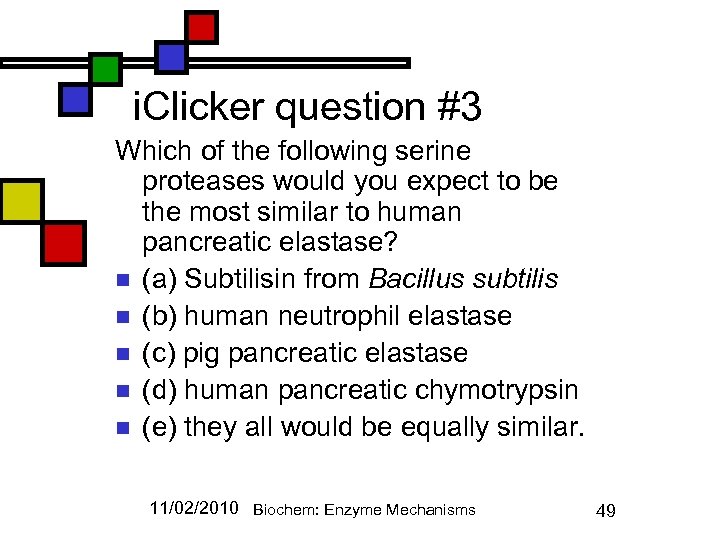
i. Clicker question #3 Which of the following serine proteases would you expect to be the most similar to human pancreatic elastase? n (a) Subtilisin from Bacillus subtilis n (b) human neutrophil elastase n (c) pig pancreatic elastase n (d) human pancreatic chymotrypsin n (e) they all would be equally similar. 11/02/2010 Biochem: Enzyme Mechanisms 49
Скачать презентацию Enzyme mechanisms Andy Howard Introductory Biochemistry 2 November
489d61fb978e7db118aed28c3c607cff.ppt