 Скачать презентацию ENVR 421 Food Safety and Foodborne Disease Mark
27c5aa671e68baf56a36ff83c809a2e5.ppt
- Количество слайдов: 39



ENVR 421 Food Safety and Foodborne Disease Mark D. Sobsey
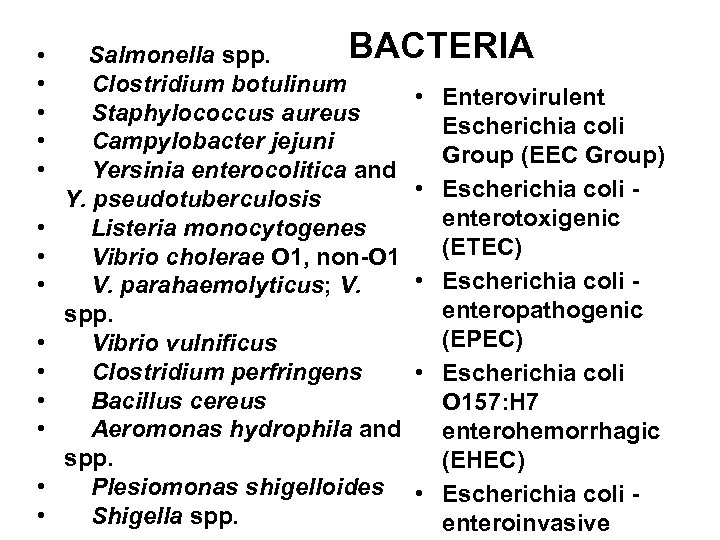
• • • • BACTERIA Salmonella spp. Clostridium botulinum • Enterovirulent Staphylococcus aureus Escherichia coli Campylobacter jejuni Group (EEC Group) Yersinia enterocolitica and • Escherichia coli Y. pseudotuberculosis enterotoxigenic Listeria monocytogenes (ETEC) Vibrio cholerae O 1, non-O 1 • Escherichia coli V. parahaemolyticus; V. enteropathogenic spp. (EPEC) Vibrio vulnificus Clostridium perfringens • Escherichia coli Bacillus cereus O 157: H 7 Aeromonas hydrophila and enterohemorrhagic spp. (EHEC) Plesiomonas shigelloides • Escherichia coli Shigella spp. enteroinvasive
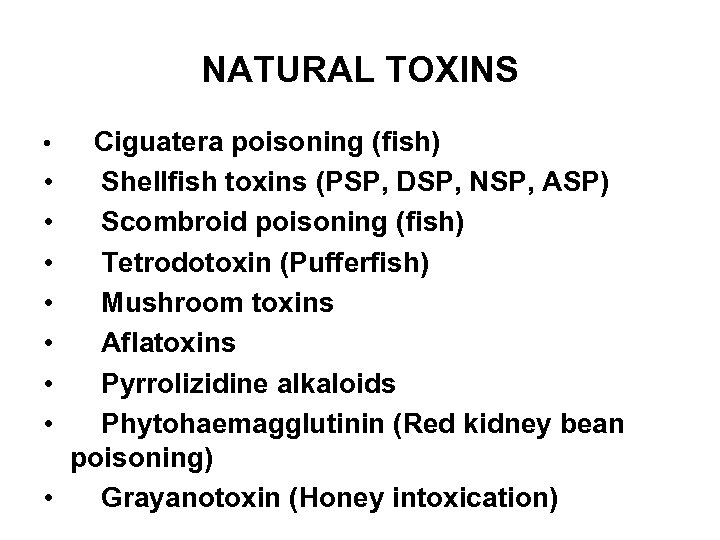
NATURAL TOXINS • • • Ciguatera poisoning (fish) Shellfish toxins (PSP, DSP, NSP, ASP) Scombroid poisoning (fish) Tetrodotoxin (Pufferfish) Mushroom toxins Aflatoxins Pyrrolizidine alkaloids Phytohaemagglutinin (Red kidney bean poisoning) Grayanotoxin (Honey intoxication)
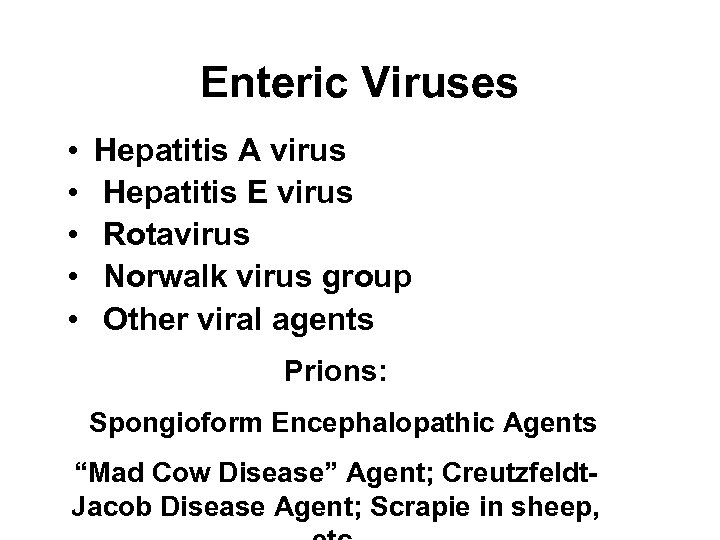
Enteric Viruses • • • Hepatitis A virus Hepatitis E virus Rotavirus Norwalk virus group Other viral agents Prions: Spongioform Encephalopathic Agents “Mad Cow Disease” Agent; Creutzfeldt. Jacob Disease Agent; Scrapie in sheep,
Parasitic Protozoa and Worms • • • Giardia lamblia Entamoeba histolytica Cryptosporidium parvum Cyclospora cayetanensis Anisakis sp. and related worms Diphyllobothrium spp. Nanophyetus spp. Eustrongylides sp. Acanthamoeba and other free-living amoebae Ascaris lumbricoides and Trichuris
Sources of Foodborne Enteric Microbial Contamination • Food handler‑associated contamination – Inadequate personal hygiene fecal contamination of foods (e. g. , hands) • Food processing – Equipment, packaging and personnel contaminate foods during processing • Food Storage: time and temperature abuse bacterial growth • Fecal contamination prior to harvest or collection – Animal foods contaminated naturally by infection (e. g. , salmonella) – Surface contamination (e. g. , feces on fur, feathers, hooves, etc. ) – Shellfish and other fish contaminated in their environment • Fecal (sewage) contamination of water pathogen uptake by filter‑feeding on waterborne particles
Foods Implicated in Foodborne Illness: Meats • Red Meats – High contamination in comminuted and processed meats (e. g. , ground beef, sausage) – High surface area, increased contact with processing equipment; increased handling; variety of sources from the animal (organs, trimmings, etc. ). » Ex. , E. coli O 157: H 7 outbreaks due to undercooked hamburger • Poultry – High contamination levels in cut‑up poultry • Increased handling, processing and contact with common equipment • Salmonella and campylobacters are prevalent in some poultry flocks – can contaminate an entire processing plant via equipment and process baths (e. g. , chiller tank) – Eggs
Foods Implicated in Foodborne Illness: Fish • Contamination depends on type of seafood, quality of harvest water and amount of processing, handling and storage. • Bivalve mollusks (oysters, clams, mussels, etc. ); filter feeders – Accumulate enteric pathogens from fecally contaminated waters – Acquire high levels of vibrios from their environmental waters • Crustaceans (e. g. , crabs) – Acquire some pathogens by feeding on mollusks – Acquire high levels of vibrios from their water environment • Vibrio levels can increase during handling, processing and storage, especially if temperatures are too high.
Other Foods Implicated in Foodborne Illness • Produce (fruits and vegetables) – fecal contamination in irrigation water and other fecal sources (animal droppings, birds, etc. ) – inadequate or unsanitary picking, washing or processing. • Dairy Products – In developed countries milk and related dairy products are usually made from pasteurized milk. • Raw milk and products (e. g. , cheeses) made from unpasteurized milk are high risk of bacteria contamination – salmonella, campylobacter, brucella, yersinia, listeria, ). • Unpasteurized fruit juices and other beverages – fecal contamination from animal and human sources • Deli, "Fast" and Restaurant Foods
Methods to Control Fecal Contamination of Foods - I • Prevent exposure to fecal contamination in the environment, after harvest or during processing, preparation and handling • Maintain sanitation in the environment: – harvest shellfish only from waters that are not fecally contaminated; – irrigate fruits and vegetables with non‑fecally contaminated water. – fertilize fruits and vegetables with uncontaminated fertilizers. • Maintain uninfected herds and flocks of animals – Immunize animals against infectious diseases: • Brucella abortus: brucellosis from cattle; raw milk/dairy products – Colonize animals with harmless microflora: • Colonize baby chicks with harmless bacteria competitive
Methods to Control Fecal Contamination of Foods - II • Maintain adequate hygiene and sanitation during harvest, processing, storage and distribution. • Source control: use of non‑fecally contaminated foods and ingredients; • Use clean water for washing, processing, cleaning and worker hygiene; • Adequate human and food waste treatment and disposal facilities • Plant and equipment sanitation: clean, sanitize, etc. • Personal hygiene, food handling practices and employee health (education, training and policies). • Criteria and standards and guidelines for fecal contamination (pathogens and microbial indicators). • Inspection, monitoring and surveillance (product
Hazard Analysis/Critical Control Points (HACCP) A program of process control to (1) identify microbial hazards, (2) identify the most vulnerable (critical) sites or steps in the process and (3) implement an in‑house monitoring system for quality assurance and hygiene. Incorporates elements of: (i) education and training, (ii) ingredient or commodity control, (iii) process control, (iv) inspection, and (v) microbiological and related surveys Design and implement on a commodity-specific and
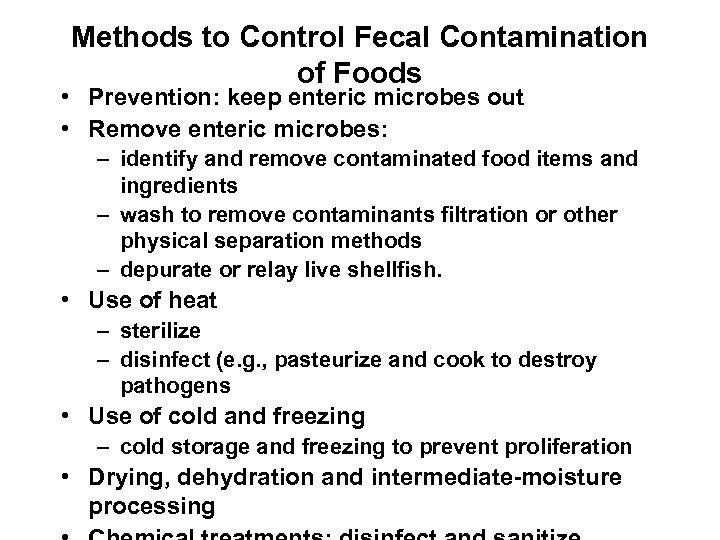
Methods to Control Fecal Contamination of Foods • Prevention: keep enteric microbes out • Remove enteric microbes: – identify and remove contaminated food items and ingredients – wash to remove contaminants filtration or other physical separation methods – depurate or relay live shellfish. • Use of heat – sterilize – disinfect (e. g. , pasteurize and cook to destroy pathogens • Use of cold and freezing – cold storage and freezing to prevent proliferation • Drying, dehydration and intermediate-moisture processing
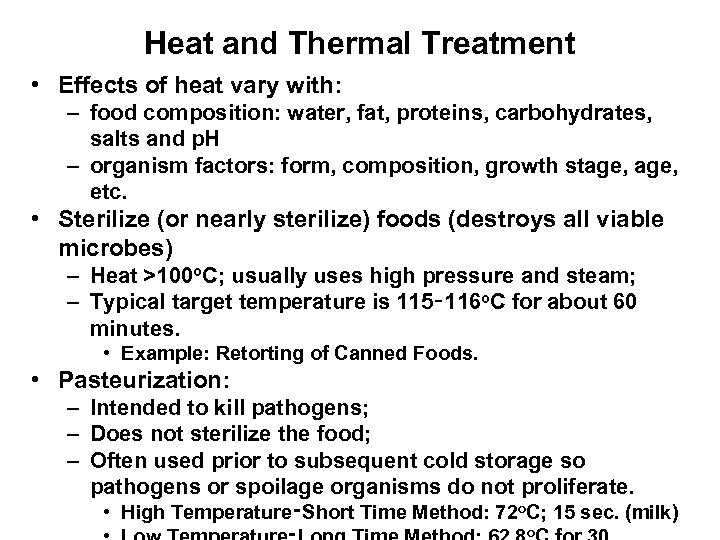
Heat and Thermal Treatment • Effects of heat vary with: – food composition: water, fat, proteins, carbohydrates, salts and p. H – organism factors: form, composition, growth stage, etc. • Sterilize (or nearly sterilize) foods (destroys all viable microbes) – Heat >100 o. C; usually uses high pressure and steam; – Typical target temperature is 115‑ 116 o. C for about 60 minutes. • Example: Retorting of Canned Foods. • Pasteurization: – Intended to kill pathogens; – Does not sterilize the food; – Often used prior to subsequent cold storage so pathogens or spoilage organisms do not proliferate. • High Temperature‑Short Time Method: 72 o. C; 15 sec. (milk) o
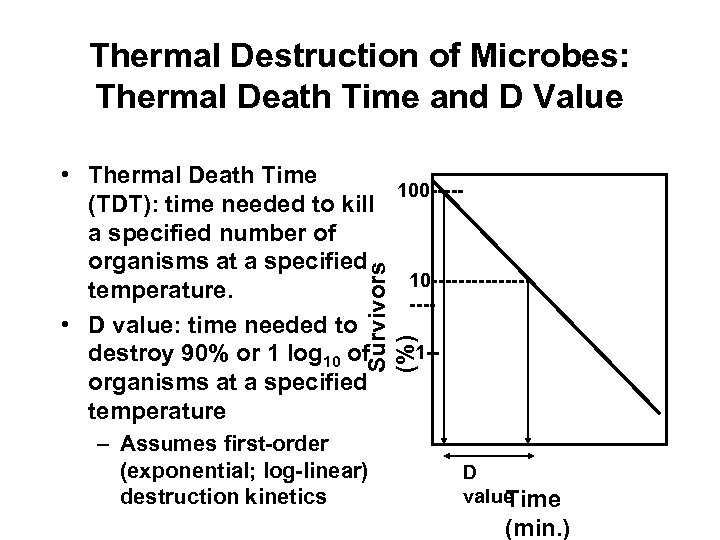
Thermal Destruction of Microbes: Thermal Death Time and D Value Survivors (%) • Thermal Death Time 100 ----(TDT): time needed to kill a specified number of organisms at a specified 10 -------temperature. --- • D value: time needed to 1 -destroy 90% or 1 log 10 of organisms at a specified temperature – Assumes first-order (exponential; log-linear) destruction kinetics D value Time (min. )
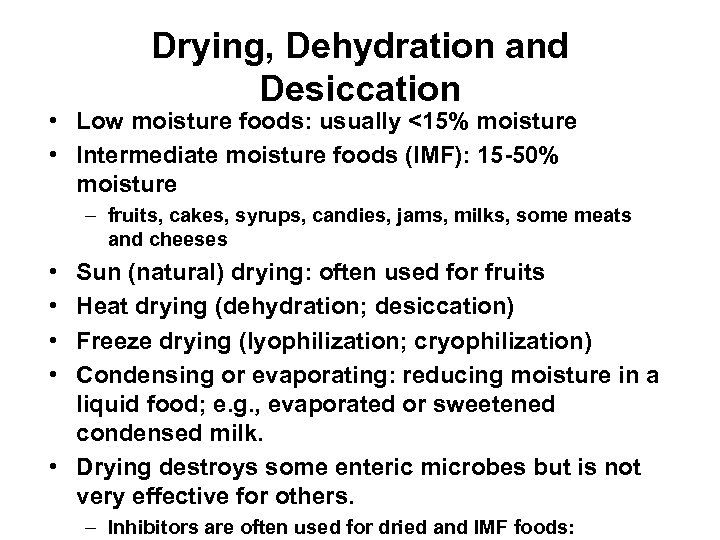
Drying, Dehydration and Desiccation • Low moisture foods: usually <15% moisture • Intermediate moisture foods (IMF): 15 -50% moisture – fruits, cakes, syrups, candies, jams, milks, some meats and cheeses • • Sun (natural) drying: often used for fruits Heat drying (dehydration; desiccation) Freeze drying (lyophilization; cryophilization) Condensing or evaporating: reducing moisture in a liquid food; e. g. , evaporated or sweetened condensed milk. • Drying destroys some enteric microbes but is not very effective for others. – Inhibitors are often used for dried and IMF foods:
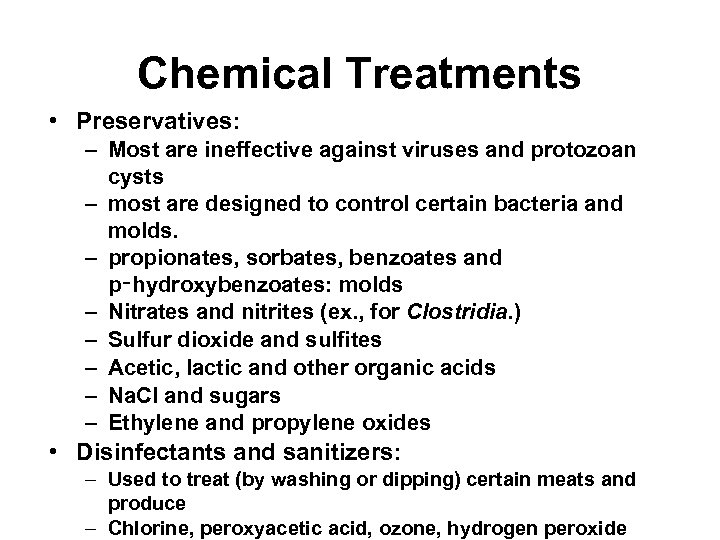
Chemical Treatments • Preservatives: – Most are ineffective against viruses and protozoan cysts – most are designed to control certain bacteria and molds. – propionates, sorbates, benzoates and p‑hydroxybenzoates: molds – Nitrates and nitrites (ex. , for Clostridia. ) – Sulfur dioxide and sulfites – Acetic, lactic and other organic acids – Na. Cl and sugars – Ethylene and propylene oxides • Disinfectants and sanitizers: – Used to treat (by washing or dipping) certain meats and produce – Chlorine, peroxyacetic acid, ozone, hydrogen peroxide
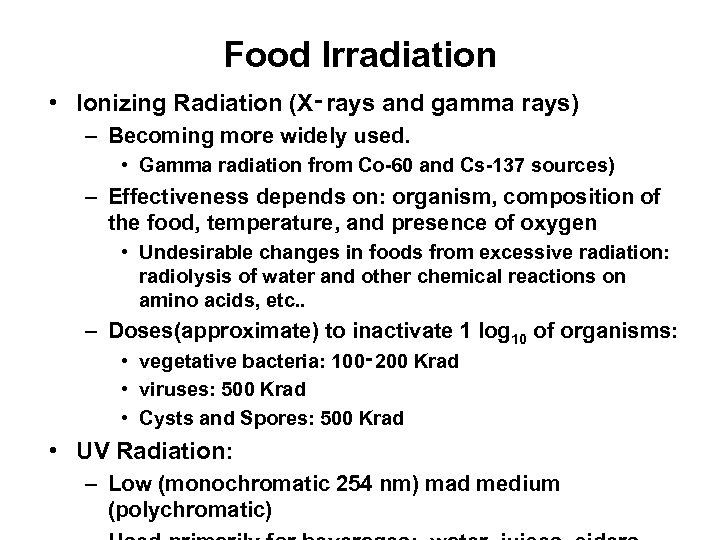
Food Irradiation • Ionizing Radiation (X‑rays and gamma rays) – Becoming more widely used. • Gamma radiation from Co-60 and Cs-137 sources) – Effectiveness depends on: organism, composition of the food, temperature, and presence of oxygen • Undesirable changes in foods from excessive radiation: radiolysis of water and other chemical reactions on amino acids, etc. . – Doses(approximate) to inactivate 1 log 10 of organisms: • vegetative bacteria: 100‑ 200 Krad • viruses: 500 Krad • Cysts and Spores: 500 Krad • UV Radiation: – Low (monochromatic 254 nm) mad medium (polychromatic)
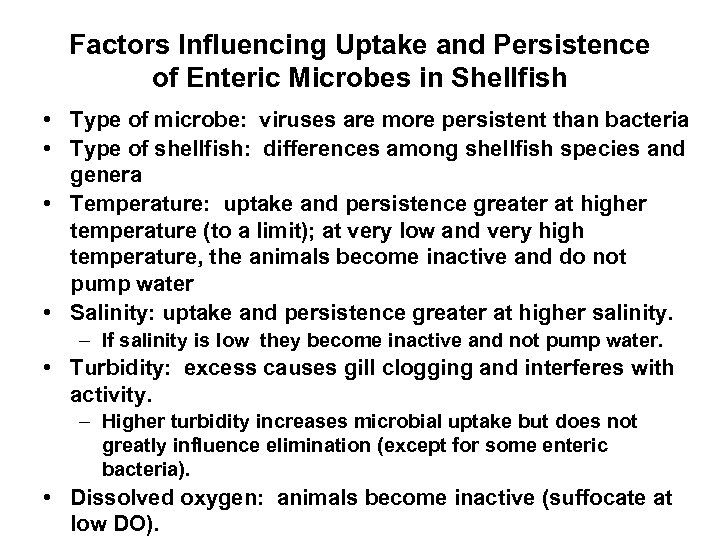
Factors Influencing Uptake and Persistence of Enteric Microbes in Shellfish • Type of microbe: viruses are more persistent than bacteria • Type of shellfish: differences among shellfish species and genera • Temperature: uptake and persistence greater at higher temperature (to a limit); at very low and very high temperature, the animals become inactive and do not pump water • Salinity: uptake and persistence greater at higher salinity. – If salinity is low they become inactive and not pump water. • Turbidity: excess causes gill clogging and interferes with activity. – Higher turbidity increases microbial uptake but does not greatly influence elimination (except for some enteric bacteria). • Dissolved oxygen: animals become inactive (suffocate at low DO).
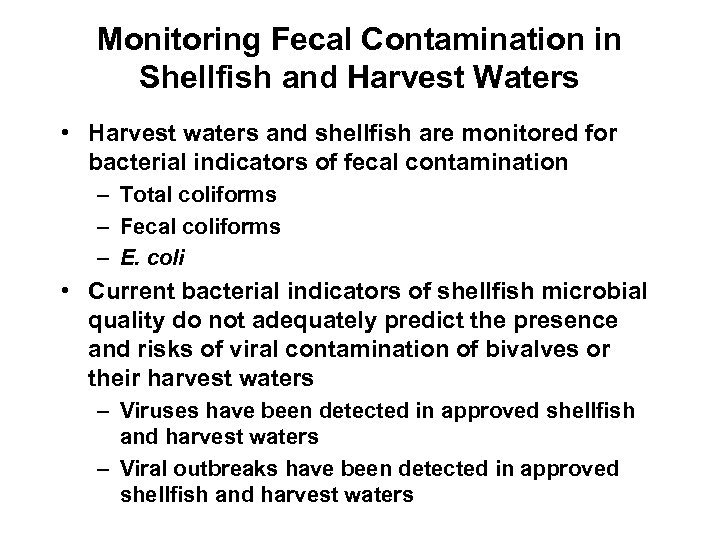
Monitoring Fecal Contamination in Shellfish and Harvest Waters • Harvest waters and shellfish are monitored for bacterial indicators of fecal contamination – Total coliforms – Fecal coliforms – E. coli • Current bacterial indicators of shellfish microbial quality do not adequately predict the presence and risks of viral contamination of bivalves or their harvest waters – Viruses have been detected in approved shellfish and harvest waters – Viral outbreaks have been detected in approved shellfish and harvest waters
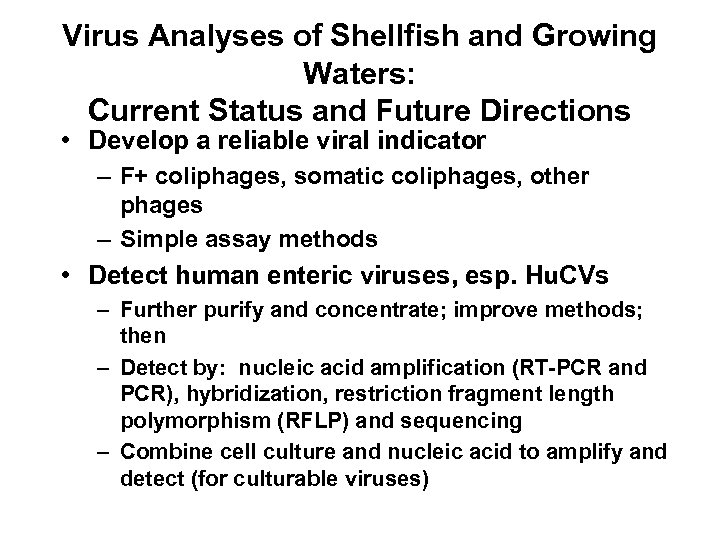
Virus Analyses of Shellfish and Growing Waters: Current Status and Future Directions • Develop a reliable viral indicator – F+ coliphages, somatic coliphages, other phages – Simple assay methods • Detect human enteric viruses, esp. Hu. CVs – Further purify and concentrate; improve methods; then – Detect by: nucleic acid amplification (RT-PCR and PCR), hybridization, restriction fragment length polymorphism (RFLP) and sequencing – Combine cell culture and nucleic acid to amplify and detect (for culturable viruses)
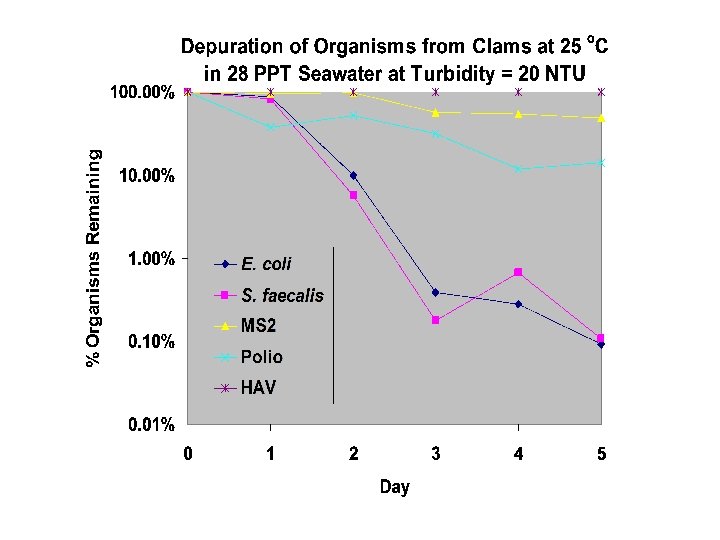
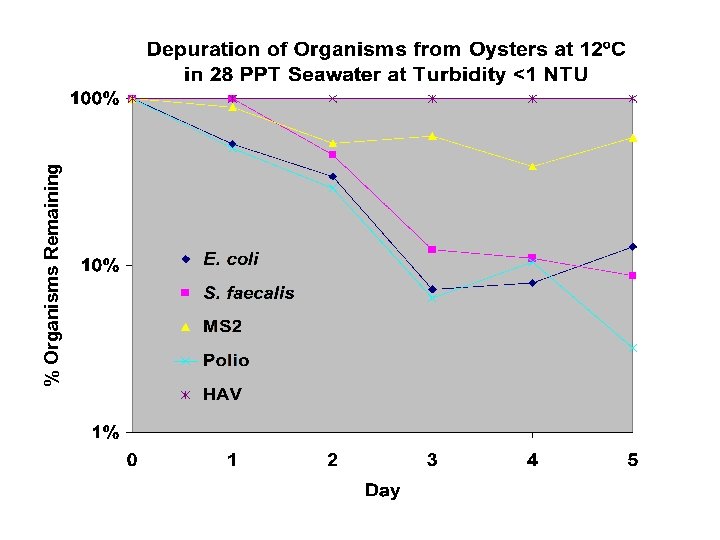
% Organisms Remaining
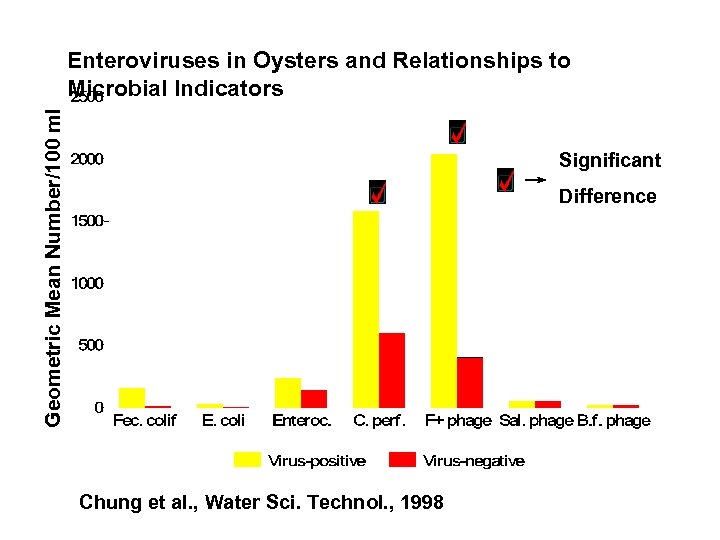
Geometric Mean Number/100 ml Enteroviruses in Oysters and Relationships to Microbial Indicators Significant Difference Chung et al. , Water Sci. Technol. , 1998
Shellfish Depuration and Relaying • Place live bivalve mollusks shellfish in clean flowing seawater – Normal pumping, feeding and related activity rids accumulated microbes • Relaying: – transfer shellfish from contaminated (restricted) waters to uncontaminated natural estuarine waters. – Typical holding times in the clean water are two weeks or longer. • Depuration: – Place restricted shellfish in shore‑based tanks of clean, flowing seawater under controlled conditions for periods of several days – Factors influencing deputation efficiency: • tank geometry and loading (quantity of shellfish per
Foodborne Disease in the Home • About half of all Salmonella cases result from unsafe handling of food in the home. • Foodborne illness costs the United States $23 billion annually. • Foodborne illness is often mistaken for “the flu, as many of the symptoms are similar: – stomach pain, diarrhea, nausea, chills, fever, and headache. • Many experts believe the kitchen is home to more potentially dangerous
Regularly Clean the Kitchen and Other Food Preparation Areas to Reduce Risks of Crosscontamination and Foodborne illness • ? Use antibacterial products for added protection in the kitchen to prevent foodborne illness? • Wash hands thoroughly • Clean and sanitize all surfaces frequently
• • • Hands Spread Foodborne Pathogens from the Food to Other Places refrigerator door handles hot and cold sink faucets, dishcloths, counter-tops, stove knobs high chairs appliances etc.
Sponges Versus Paper Towels • Foodborne bacteria can multiply quickly in kitchen towels, sponges and cloths. • Wash sponges and cloth items in the washing machine or dishwasher frequently to reduce bacteria levels. – For quick treatment, microwave them till very hot to reduce bacteria levels • Paper towels reduce crosscontamination risks – they are disposable, so they less
Cutting Boards: Plastic or Wood • Plastic cutting boards: – less porous – absorb and retain less bacteria than porous wood • Wood cutting boards – more porous – absorb more bacteria, but may actually be antibacterial • After meal preparation, wash cutting board with soap and water and then clean with an antibacterial cleaner or bleach and water mixture. – Always follow the product label's directions.
Reducing Foodborne Illness Risks in Food Shopping • Shop only at reputable stores. • Check expiration dates of meats, dairy products, etc. • Select canned foods free of dents and cracks – (bulging lids and cans indicate a food poisoning threat). • Avoid cross-contamination in your shopping cart – do not allow raw meat, poultry or seafood juice to drip on to your other groceries. • Buy perishables last and keep them in the coolest part of your car.
Keeping Foods Clean • Work with clean hands, hair, fingernails, and clothing. • Wash hands with soap and water after using the toilet • Wash hands after smoking or blowing your nose • Wash hands after touching raw meats, poultry & seafoods Avoid using hands to mix foods; use clean utensils • Keep hands away from mouth, nose, and hair. • Cover coughs and sneezes with disposable tissues and wash hands thoroughly afterward. • Avoid using the same spoon more than once for tasting food while preparing, cooking, or serving. • Clean all dishes, utensils, and work surfaces with soap and water after each use esp. if used for raw food
Salmonella Infection • Causes an estimated 1. 4 million foodborne illnesses/year • From 1993 -1997, only 189, 304 Salmonella infections (~38, 00/year) reported through the National Salmonella Surveillance System – a passive, laboratory-based system. • In the same period, 357 recognized outbreaks of Salmonella infection resulting in 32, 610 illnesses were reported through the Foodborne-Disease Outbreak Surveillance System. • These system greatly underestimate the
4 Steps to Preventing Foodborne Illness • • Clean: Wash hands and surfaces often Separate: Don't cross-contaminate Cook: Cook to proper temperatures Chill: Refrigerate promptly
Cool Refrigerate/Freeze • • • Refrigerate uncooked foods Stored cooked foods in refrigerator Defrost frozen foods in refrigerator Set refrigerator for 40 -41 o. F (18 o. C) Use uncooked or cooked foods in 1 -4 days Use frozen foods in 1 -4 months, depending on food
Wash • Wash hands before preparing food and after handling raw meat, poultry and fish • Wash hands after using toilet • Wash cutting boards, utensils and other items in contact with raw meat and poultry – use hot, soapy water • Prevent meat, poultry or its juices from touching other foods or other objects • Wash fresh produce with water or with dilute bleach in water. • Keep inside of refrigerator clean
Cook • Cook meat and poultry until no longer ping and juices are clear • Cook fish until flaky, not rubbery when cutting • Cook evenly: turn, rotate and/or stir • Cook to safe internal temperatures – Meat and poultry: 165 o. F • Refrigerate cooked leftovers immediately • Reheat all leftovers covered at 165 o. F or more • Cook eggs until white and yolk are solid, not runny
Protect Against Foodborne Illness by Following these Food Safety Rules : • Buy pasteurized dairy products (see label) & hard cheeses marked "aged 60 days" (or longer) if made from unpasteurized milk • After handling or cutting raw meat, poultry or seafood, wash your hands, the cutting board, counter, knives, and any other utensils you've used with hot soapy water before using again. • Thoroughly cook meat, poultry and seafood, esp. shellfish. • Cover and store leftover cooked food in refrigerator ASAP. • Reheat all leftovers until steaming hot. • Thoroughly wash raw fruits and vegetables with tap
Consumer Education and Outreach Programs in Food Safety • Government: – US Department of Agriculture – US Food and Drug Administration – UC Centers for Disease Control and Prevention • Private Sector • Consumer and Public Interest Groups • Partnerships and Consortia – The Partnership for Food Safety
Скачать презентацию ENVR 421 Food Safety and Foodborne Disease Mark
27c5aa671e68baf56a36ff83c809a2e5.ppt