 Скачать презентацию ENVISIONING THE FUTURE scenario based design methods
4812757f9fdea8c6aa191c658088d640.ppt
- Количество слайдов: 52



ENVISIONING THE FUTURE ? scenario based design methods for design in context Gerrit C. van der Veer Vrije Universiteit, Amsterdam Faculty of Sciences; Dept of Computer Sciences; Section Human-Computer Interaction, Multimedia and Culture
new interaction technology just another toy? Look back for a second: • how would you communicate without mobile phone • how would your department organize activities without fax and email? What came first - the mobile phone or mobility? How quickly did your (grand) parents learn, how quickly will your children learn?
New I. T. changes the world Design involves more than “the user”: • the organization of people - their communications, their relations, and their work; • the context of use and the culture
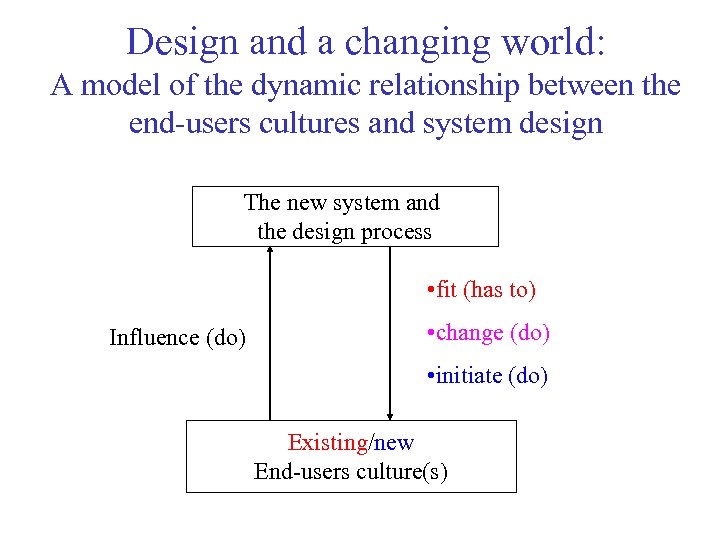
Design and a changing world: A model of the dynamic relationship between the end-users cultures and system design The new system and the design process • fit (has to) Influence (do) • change (do) • initiate (do) Existing/new End-users culture(s)
Fit (has to) cultures in short run are “stable” the need for fit • task analysis to know the organization, the context of use, and the culture When fit condition is not fulfilled design for the future world: • Holtzblatt & Beyer (1998) - contextual design or the design will fail • the early fax (early 20 th century) • IBM’s first in-house text processing system (‘ 70 s) • Pliskin (1993) - management information systems case study: failure of implementing an EES (Employee Evaluation System)
Change (do) culture is socially constructed and, consequently, it is subject to continuous change need for envisioning the changes that lead to the “new culture of use” “envisioning design”
Initiate (do) create a new culture the need to envision “the (totally) new culture of use” initiate culture case: Apple Advanced Technologies is an example of a design company that on purpose not only tried to change but to initiate new cultures of use, e. g. , for future education. Ways to support such a culture included stimulating the development of journals like “Mac. User” intended to create an “elite” user culture with its own journals, discussion forums, etc.
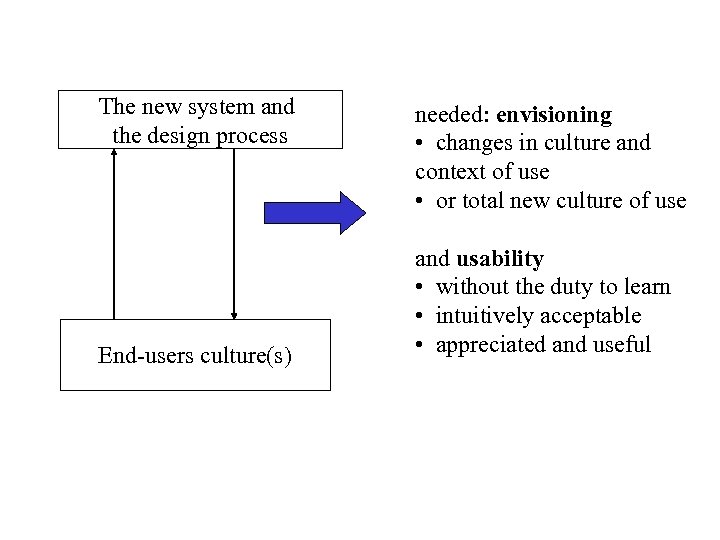
The new system and the design process End-users culture(s) needed: envisioning • changes in culture and context of use • or total new culture of use and usability • without the duty to learn • intuitively acceptable • appreciated and useful
Tools for envisioning: scenarios Scenarios are “informal narrative descriptions” of the user’s activities when performing a specific task (Carroll, 2000) A well specified and sufficiently detailed description of individual instances of events, artefacts, procedures, situations • described in full context of use • from the point of view of actors (users, not the client of design) • proposed as envisioning, not as finished design document
types of scenarios Formatted as: • written story • story board • performed by actors (e. g. , video “Star fire”, SUN; ‘ 95, HP) • script to be acted, if needed with mock-ups of potential technology Main role is the user with motives, goals, knowledge, …. . • prospective user can imagine themselves - “suppose you …” • other stakeholders may imagine somebody else - a “persona”
levels of scenarios High level scenarios • the overall motives that prospective users might have when they come to the system and the general kind of interaction they might experience • In this type of scenarios detailed specification of dialogue or of look and feel is lacking Low level scenarios • specify precisely the system’s functionality and the interactions between user and system”
Scenarios and culture 1. high level scenarios – are suitable for situations where the main problem is the difference in cultures between the “current” situation and the envisioned context of use. – cultural aspects can be represented in: • goals, values and needs of users in the future situation • norms, habits, “fashion” 2. low level scenarios – will be applied in later iterations of the design process – cultural aspects mostly represented in: • cultural symbols in the interface • details of the context
methodology to design for new cultures of use Step 1: build, from initial requirements, a conceptual model of the new technology • which problems / requirements does the design approach • which (types of ) tasks may be delegated to technology or performed with the help of technology • the cultural context (especially in high level scenarios): how will these tasks affect the culture of use (other roles, other value systems, other business processes)
Step 2: develop one or more scenarios two points of view (foci): actor (user): the “audience”, or “personas” (Cooper, 2000) • goals and values in relation to use of the system (meanings assigned to the technology) • meanings of the system’s representations and dialogue (low-level scenarios) situation • needs and motives to use the proposed functionality • allow the prospective user to imagine the actual situation
Step 3: confront the prospective users and other stakeholders with the scenarios and analyze the reactions mental models of prospective users as initiated by the scenario (in users’ mental models cultural aspects are reflected Mantovani, 1996) claim analysis • what is different from the current system & situation? • what was the goal for this feature - is this goal reached? • what are side effects and their valence (+ / -)? claims analysis participants: designers of relevant disciplines, client, prospective users, sceptical users and stakeholders
Step 4: feedback the results to the conceptual model Corrective feedback: • the conceptual model is not understood as intended. • would the design be needed, acceptable, in the envisioned culture of use. • discovered in a very early state where not too much design effort is spend on dead ends. Creative feedback: • end users and stakeholders interpret (project) their imagination and develop new ideas about the conceptual model • an early and rich source for refinement and re-design.
Example of high-level scenario with multiple personas SUN Starfire • Claims of envisioning: task level: co-ordination; communication; efficiency; organisational simplicity functionality: representation of information; speed and availability interaction: dialogue styles; flexibility technology: efficiency of available technology • In search of opinions of prospective users on usability: learnability, ease of use, affect
Example of high-level scenario low budget student scripted and acted video A communication-device for regular guests of hotel chains original requirements: • guest should feel “special” • speed • flexibility • ease of use
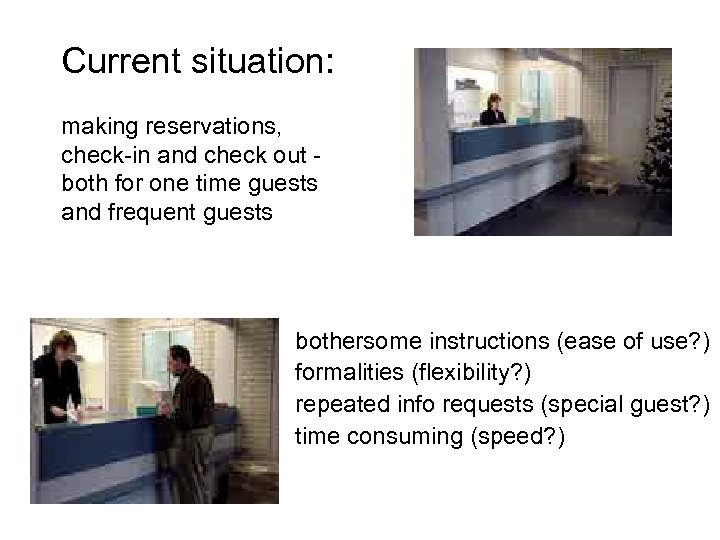
Current situation: making reservations, check-in and check out both for one time guests and frequent guests bothersome instructions (ease of use? ) formalities (flexibility? ) repeated info requests (special guest? ) time consuming (speed? )
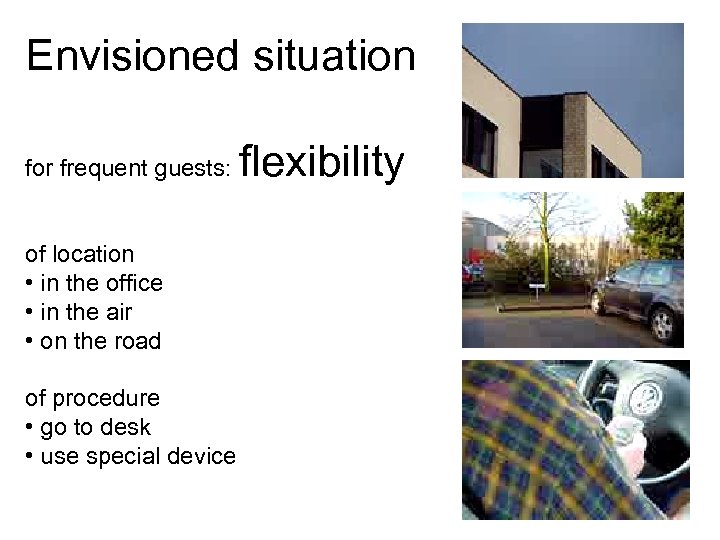
Envisioned situation for frequent guests: of location • in the office • in the air • on the road of procedure • go to desk • use special device flexibility
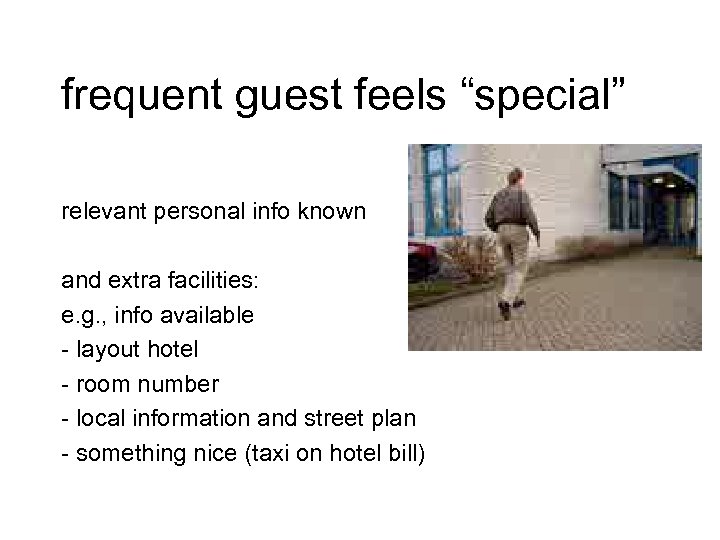
frequent guest feels “special” relevant personal info known and extra facilities: e. g. , info available - layout hotel - room number - local information and street plan - something nice (taxi on hotel bill)
speed no need to be in the queue, no need to find passport or credit card
ease of use no key, device is key
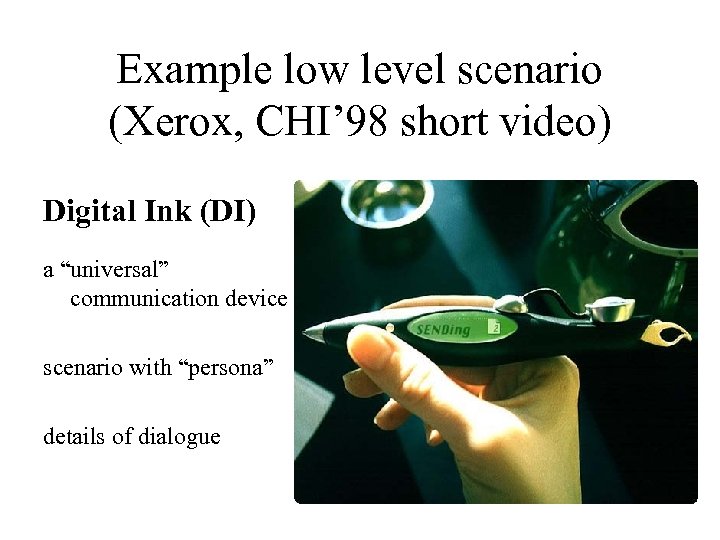
Example low level scenario (Xerox, CHI’ 98 short video) Digital Ink (DI) a “universal” communication device scenario with “persona” details of dialogue
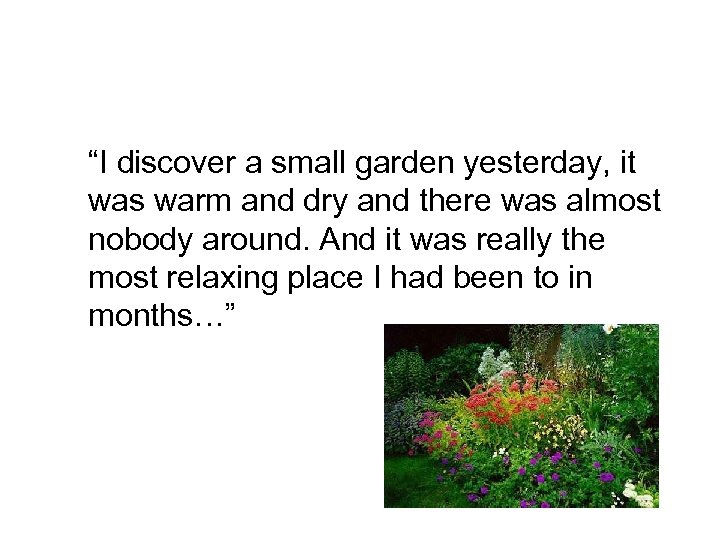
“I discover a small garden yesterday, it was warm and dry and there was almost nobody around. And it was really the most relaxing place I had been to in months…”
Mental models analysis See previous lecture on models in HCI
Claims analysis For each new feature in the design Identify the feature - what is the actual novelty • Ask what is the aim - and will this be successful? • Ask for side effects that could be considered bad / dangerous / intrusive - in what context?
Exploring an envisioning scenario a “quick and dirty (? )” analysis Domain: Department of international association of Musicologists, a world wide society of professionals and music libraries • department: libraries of original manuscripts and old prints • entrance on appointment, • for registered members Requirements for new system: • safety • ease of use • multi-lingual (international membership)
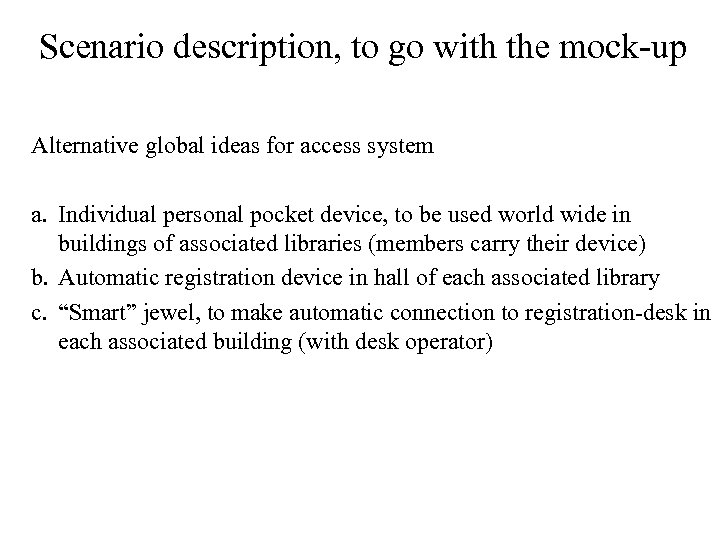
Scenario description, to go with the mock-up Alternative global ideas for access system a. Individual personal pocket device, to be used world wide in buildings of associated libraries (members carry their device) b. Automatic registration device in hall of each associated library c. “Smart” jewel, to make automatic connection to registration-desk in each associated building (with desk operator)
Scenario description, to go with the mock-up General story: • Musicologist (M) has made reservations to study old print • M is at the entrance of the build, and has not registered yet • M has not been here before “Suppose You are M”
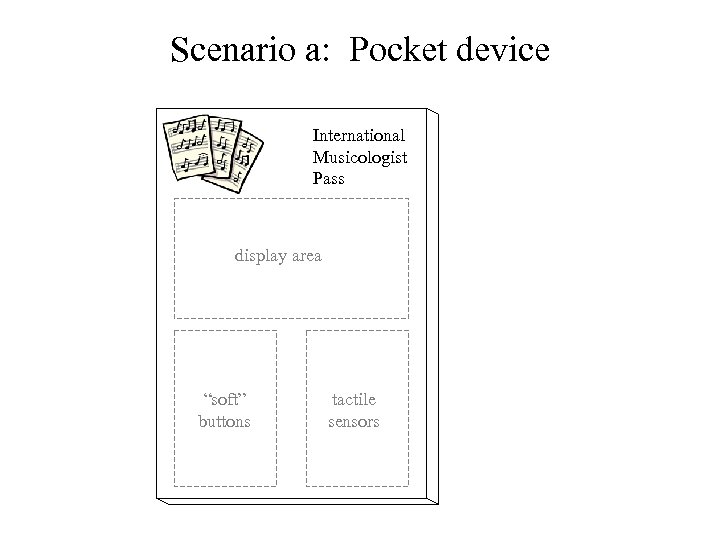
Scenario a: Pocket device International Musicologist Pass display area “soft” buttons tactile sensors
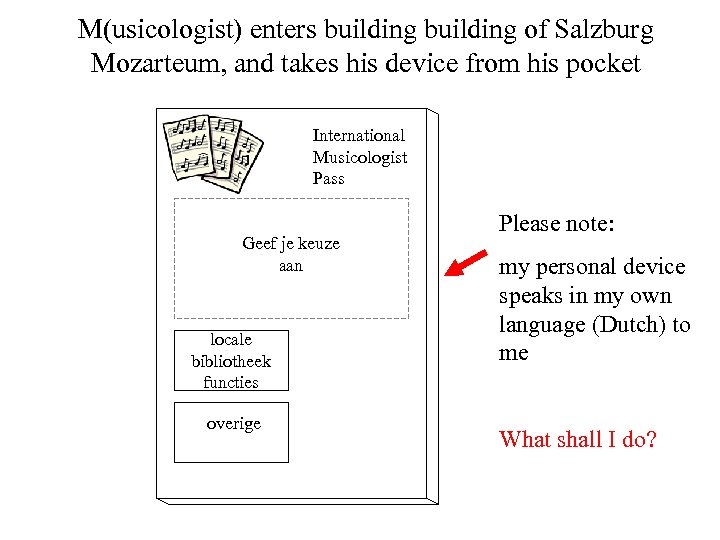
M(usicologist) enters building of Salzburg Mozarteum, and takes his device from his pocket International Musicologist Pass Geef je keuze aan locale bibliotheek functies overige Please note: my personal device speaks in my own language (Dutch) to me What shall I do?
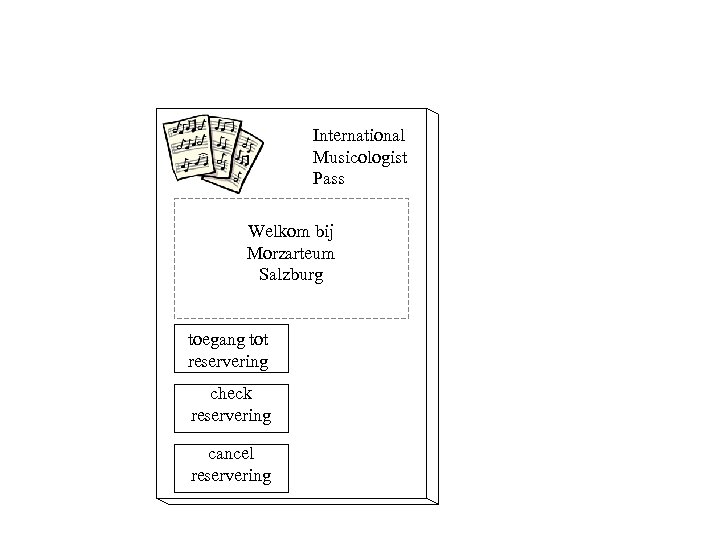
International Musicologist Pass Welkom bij Morzarteum Salzburg toegang tot reservering check reservering cancel reservering
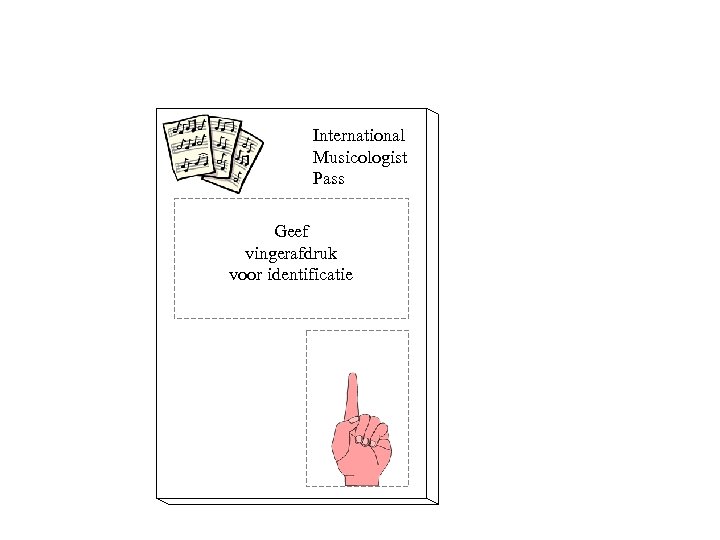
International Musicologist Pass Geef vingerafdruk voor identificatie
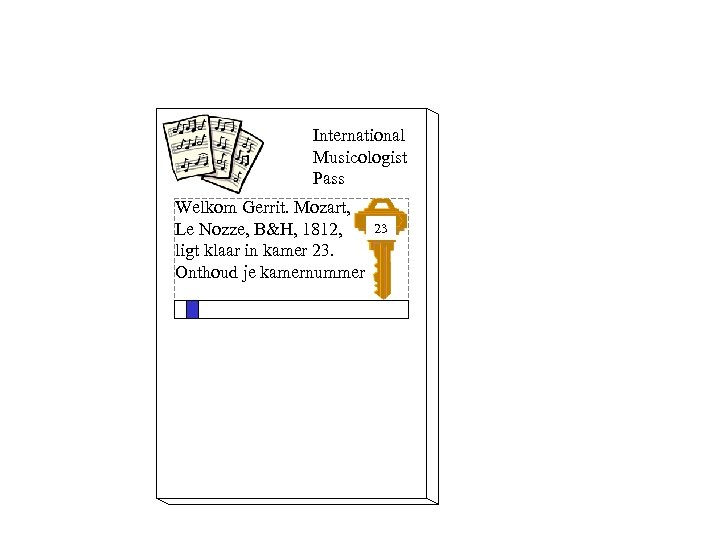
International Musicologist Pass Welkom Gerrit. Mozart, Le Nozze, B&H, 1812, ligt klaar in kamer 23. Onthoud je kamernummer 23
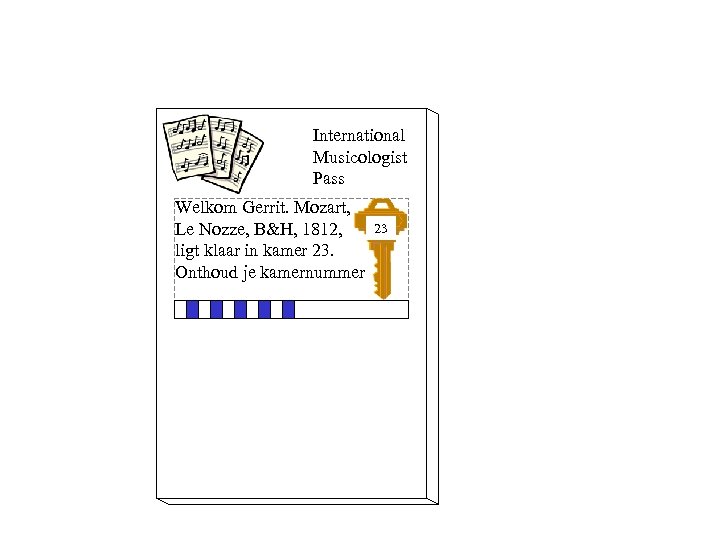
International Musicologist Pass Welkom Gerrit. Mozart, Le Nozze, B&H, 1812, ligt klaar in kamer 23. Onthoud je kamernummer 23
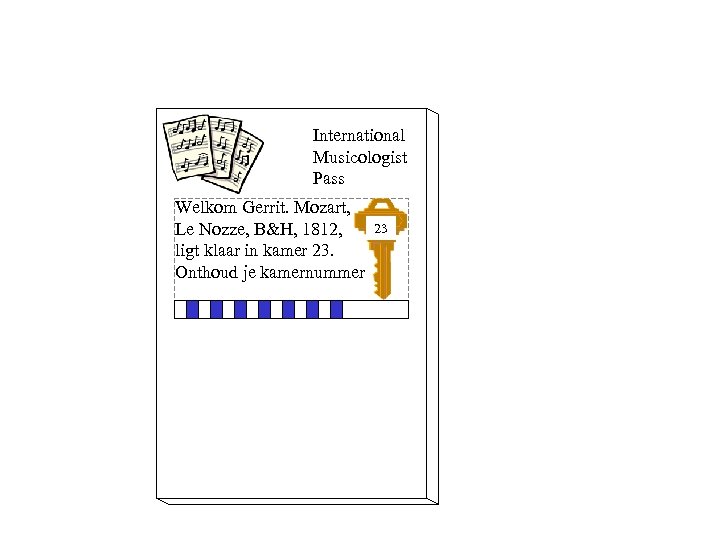
International Musicologist Pass Welkom Gerrit. Mozart, Le Nozze, B&H, 1812, ligt klaar in kamer 23. Onthoud je kamernummer 23
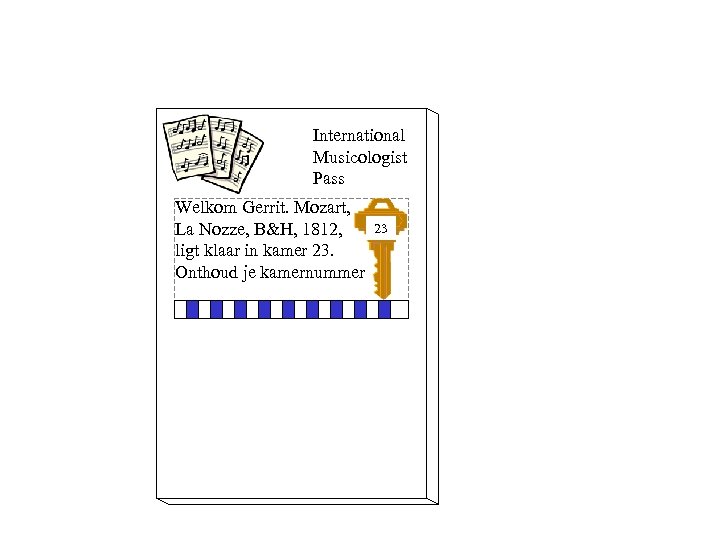
International Musicologist Pass Welkom Gerrit. Mozart, La Nozze, B&H, 1812, ligt klaar in kamer 23. Onthoud je kamernummer 23
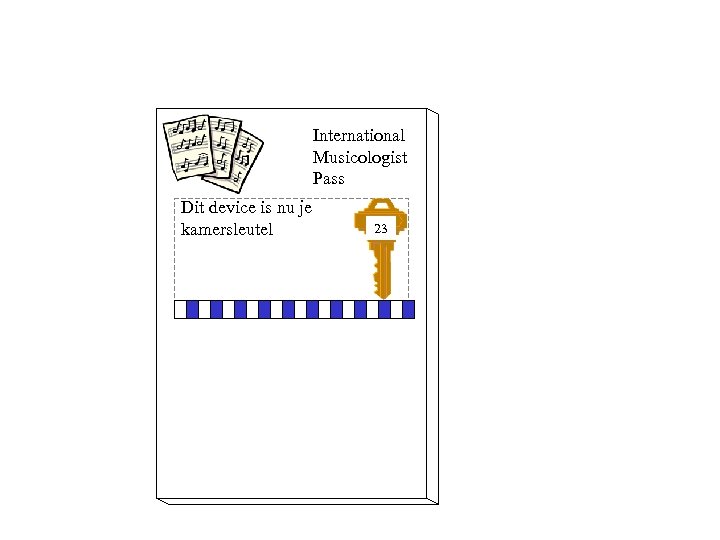
International Musicologist Pass Dit device is nu je kamersleutel 23
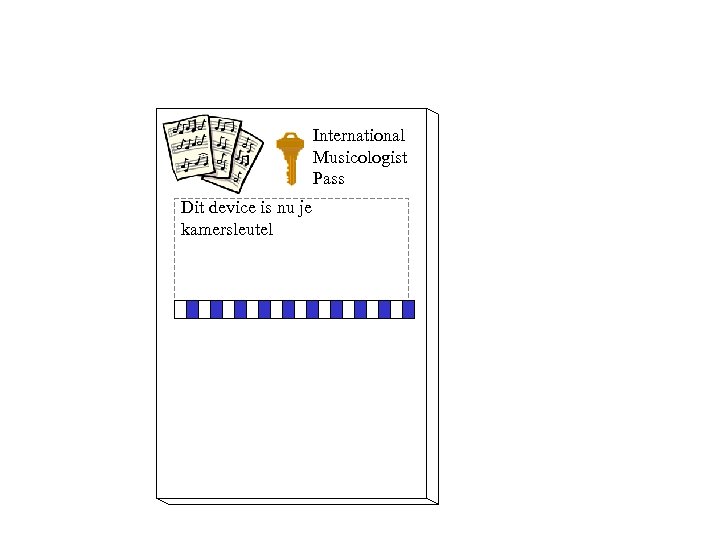
International Musicologist Pass Dit device is nu je kamersleutel
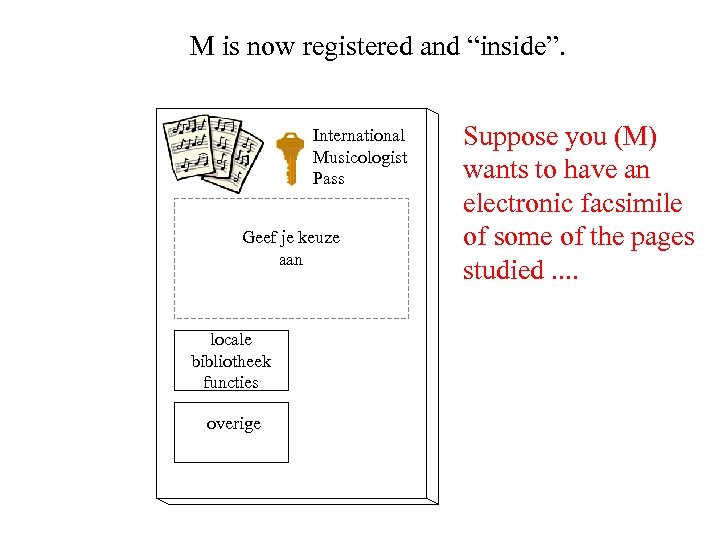
M is now registered and “inside”. International Musicologist Pass Geef je keuze aan locale bibliotheek functies overige Suppose you (M) wants to have an electronic facsimile of some of the pages studied. .
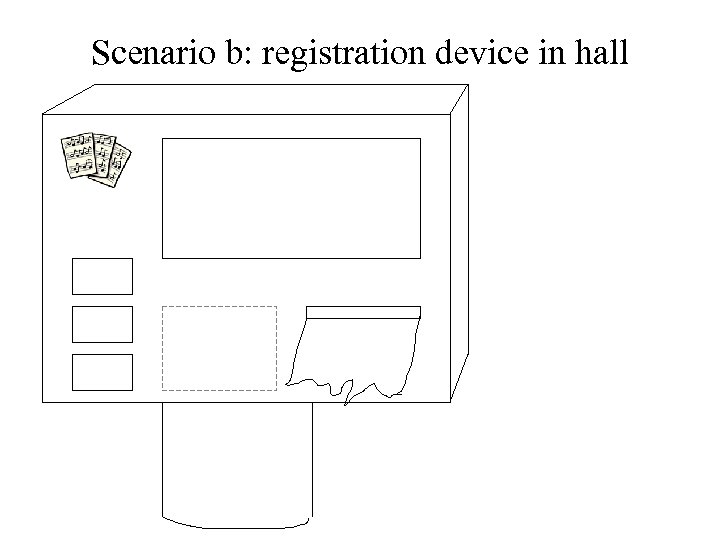
Scenario b: registration device in hall
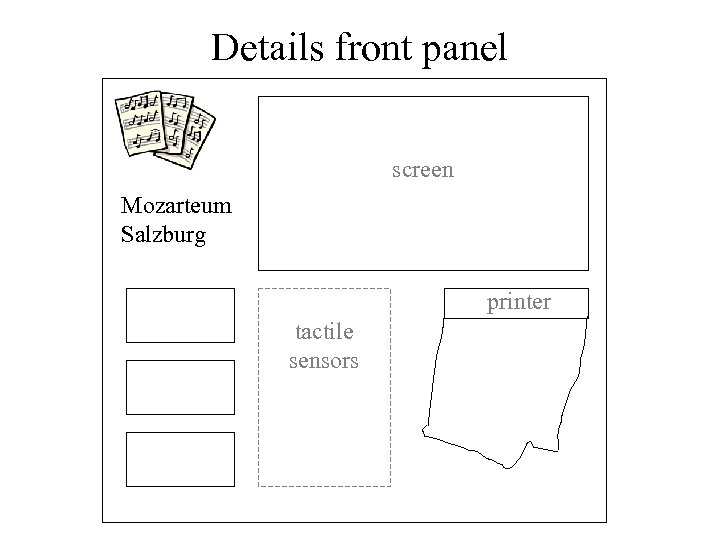
Details front panel screen Mozarteum Salzburg printer tactile sensors
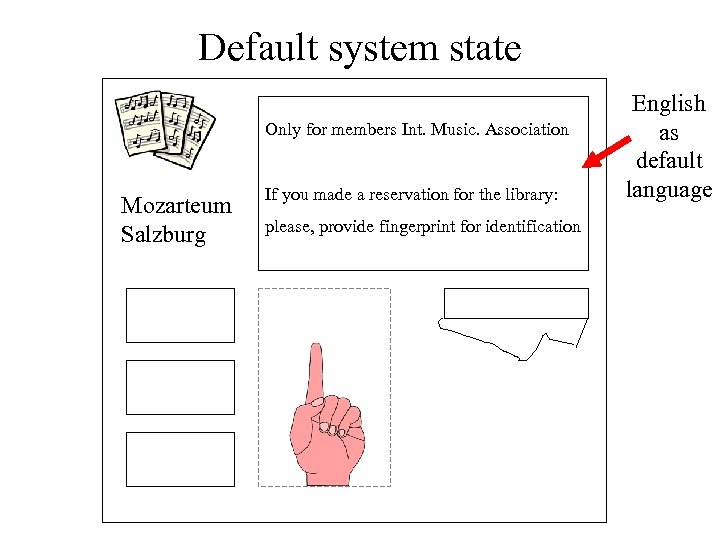
Default system state Only for members Int. Music. Association Mozarteum Salzburg If you made a reservation for the library: please, provide fingerprint for identification English as default language
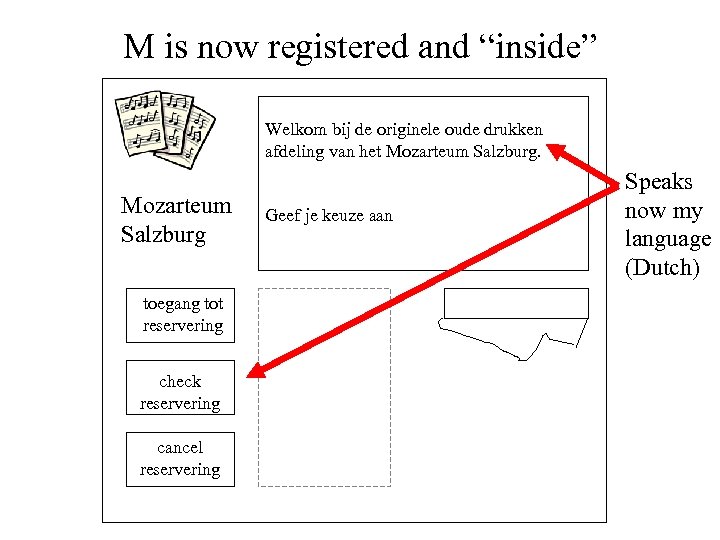
M is now registered and “inside” Welkom bij de originele oude drukken afdeling van het Mozarteum Salzburg toegang tot reservering check reservering cancel reservering Geef je keuze aan Speaks now my language (Dutch)
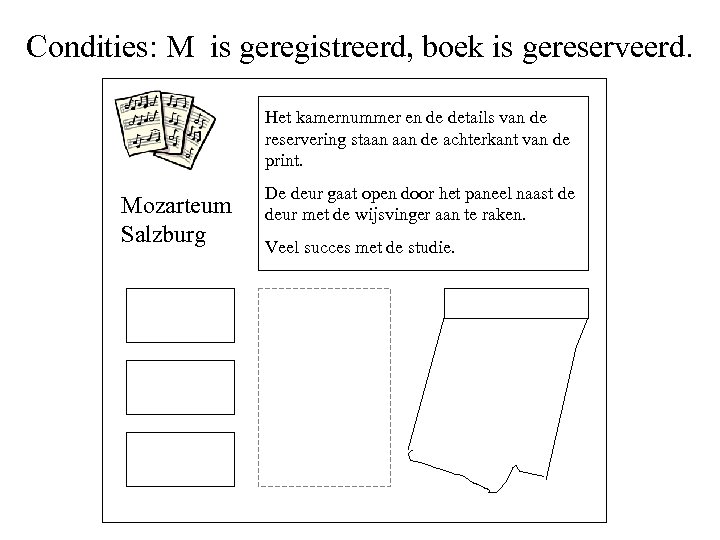
Condities: M is geregistreerd, boek is gereserveerd. Het kamernummer en de details van de reservering staan de achterkant van de print. Mozarteum Salzburg De deur gaat open door het paneel naast de deur met de wijsvinger aan te raken. Veel succes met de studie.
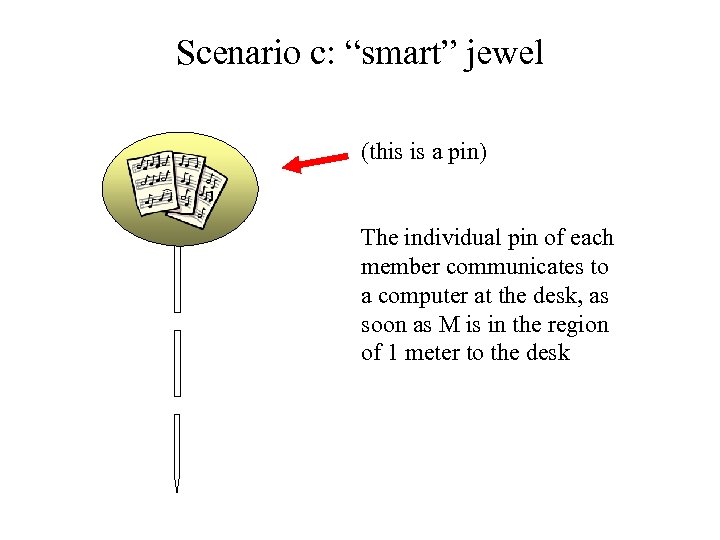
Scenario c: “smart” jewel (this is a pin) The individual pin of each member communicates to a computer at the desk, as soon as M is in the region of 1 meter to the desk
Screen at the desk, visible to the desk operator D who is another type of IT user with another specific role for this system
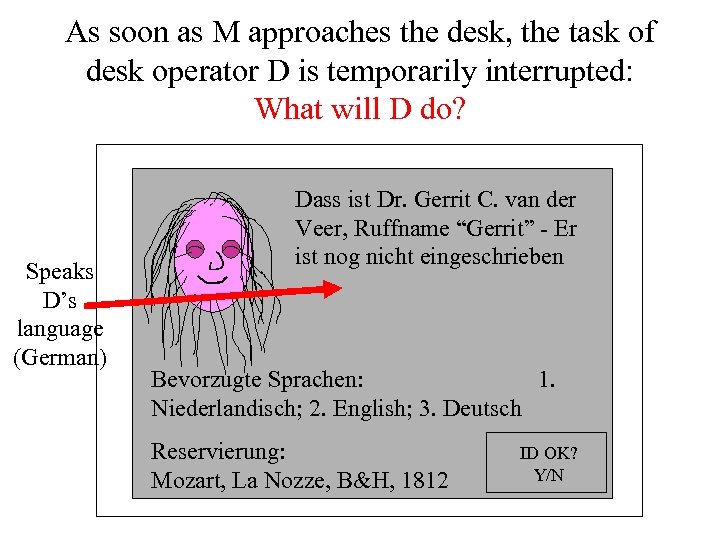
As soon as M approaches the desk, the task of desk operator D is temporarily interrupted: What will D do? Speaks D’s language (German) Dass ist Dr. Gerrit C. van der Veer, Ruffname “Gerrit” - Er ist nog nicht eingeschrieben Bevorzugte Sprachen: 1. Niederlandisch; 2. English; 3. Deutsch Reservierung: Mozart, La Nozze, B&H, 1812 ID OK? Y/N
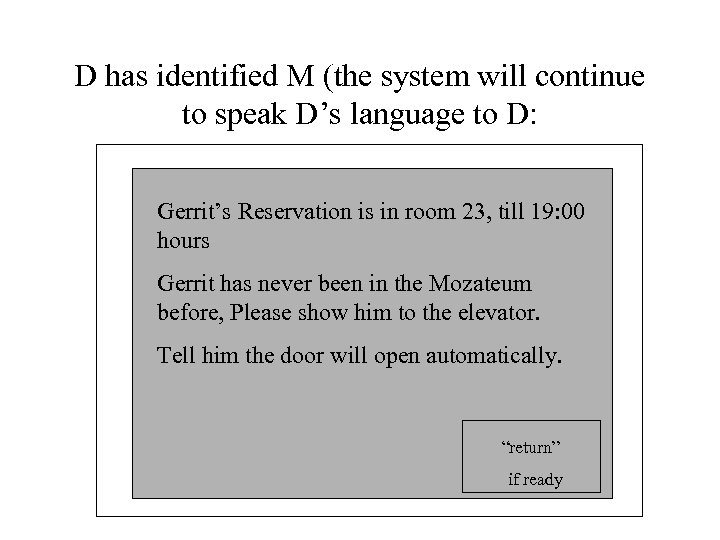
D has identified M (the system will continue to speak D’s language to D: Gerrit’s Reservation is in room 23, till 19: 00 hours Gerrit has never been in the Mozateum before, Please show him to the elevator. Tell him the door will open automatically. “return” if ready
opgave In groepen van 3(4): • werk uit een scenario voor de situatie dat M klaar is met de studie, wil vertrekken en electronische copie bestellen van pag. 3 -10 en 12 van de bestudeerde bron (naar email adres) • voor scenario 1, 2, resp 3
conclusion • Envisioning design of future technology, organisation, and procedures needs to be based on insight in mental models as well as culture and context of use • Scenarios provide an early way to represent envisioning and allow “cheap” assessment of stakeholder understanding and acceptance • Claims analysis and mental models techniques are relevant, simple, and easy to use
Скачать презентацию ENVISIONING THE FUTURE scenario based design methods
4812757f9fdea8c6aa191c658088d640.ppt