


 Скачать презентацию Environmental Sensor Networks Вонр проф д-р Александар Маркоски
ac044bc55d00bb4a729ebd052720497d.ppt
- Количество слайдов: 43
 Environmental Sensor Networks Вонр. проф. д-р Александар Маркоски Технички факултет – Битола 2008 год. Enviromatics 2008 - Environmental Sensor Networks 1
 Introduction • Environmental monitoring has a long history, including analogue loggers such as early paper plotters measuring barometric pressure and the recording of specific environmental parameters. Loggers record data at specific intervals and require manual downloading by a maintenance team. • A sensor network is designed to transmit the data from an array of sensors to a data repository on a server. They do not necessarily use a simple one-way data stream over a communications network. Elements of the system will make decisions about what data to pass on, such as local area summaries and filtering in order to minimise power use while maximising information content. Enviromatics 2008 - Environmental Sensor Networks 2
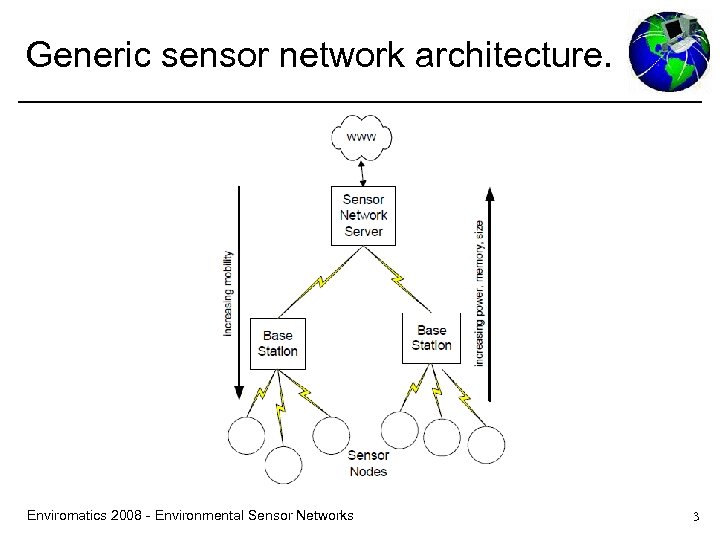 Generic sensor network architecture. Enviromatics 2008 - Environmental Sensor Networks 3
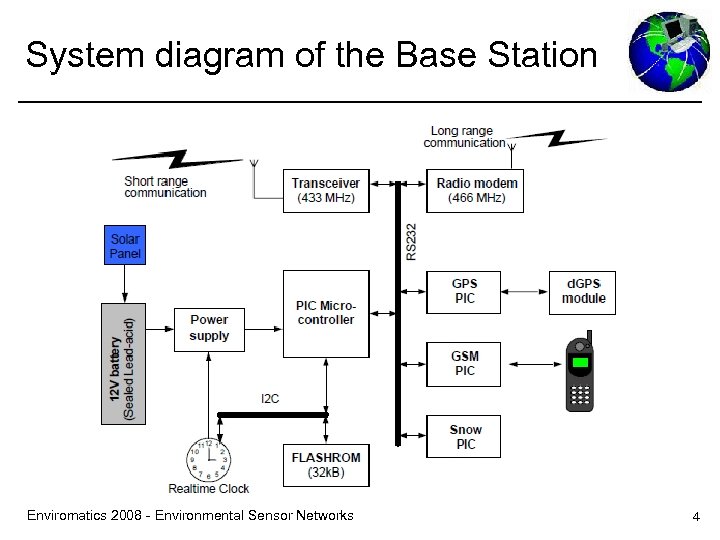 System diagram of the Base Station Enviromatics 2008 - Environmental Sensor Networks 4
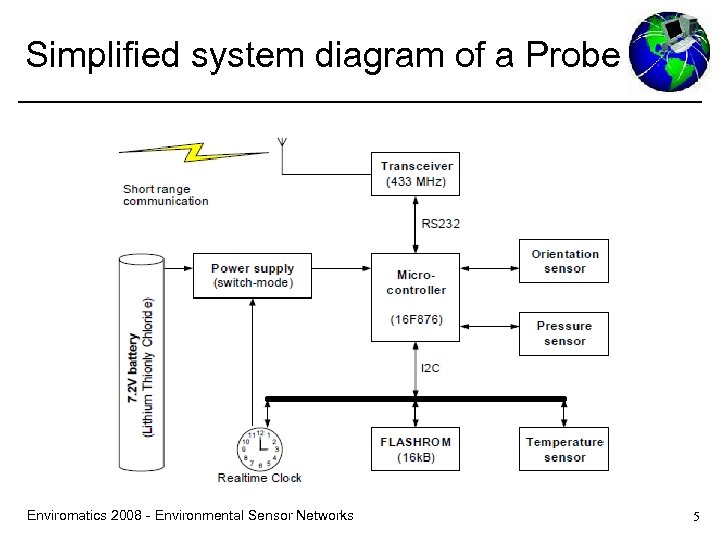 Simplified system diagram of a Probe Enviromatics 2008 - Environmental Sensor Networks 5
 Sensor Nodes Sensor nodes have the following requirements: • • • Low-cost – so many units can be produced. Low power – for long-term operation. Automated – maintenance free Robust – withstand errors and failures. Non-intrusive – low environmental disturbance. Low pollution Enviromatics 2008 - Environmental Sensor Networks 6
 Communications The nature of the environment meant the communications must meet the following requirements: • • • High-power omnidirectional for probes long-range for base to reference Low data-rate Error-detection and correction Backup channels are needed Enviromatics 2008 - Environmental Sensor Networks 7
 Computing A range of different computer systems and software required to build a sensor network: • • • Microcontrollers – for sensor nodes Small OS – for nodes Low-power systems – for base stations Routing and message-passing Server – for the sensor network server Publishing software – visualisation and services Enviromatics 2008 - Environmental Sensor Networks 8
 Challenges for environmental sensor networks • • Miniaturisation Power Management Radio Communication Scalability Remote Management Usability Standardisation Security Enviromatics 2008 - Environmental Sensor Networks 9
 HARDWARE Low Power Wireless Sensor Network Devices Enviromatics 2008 - Environmental Sensor Networks 10
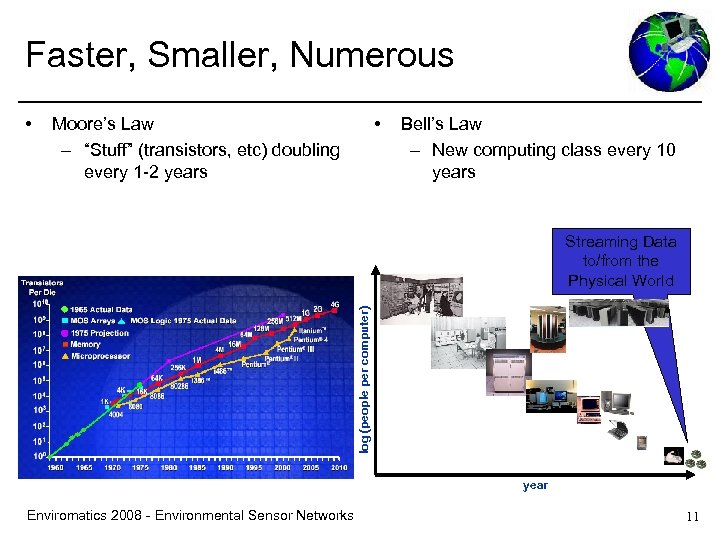 Faster, Smaller, Numerous • • Moore’s Law – “Stuff” (transistors, etc) doubling every 1 -2 years Bell’s Law – New computing class every 10 years log (people per computer) Streaming Data to/from the Physical World year Enviromatics 2008 - Environmental Sensor Networks 11
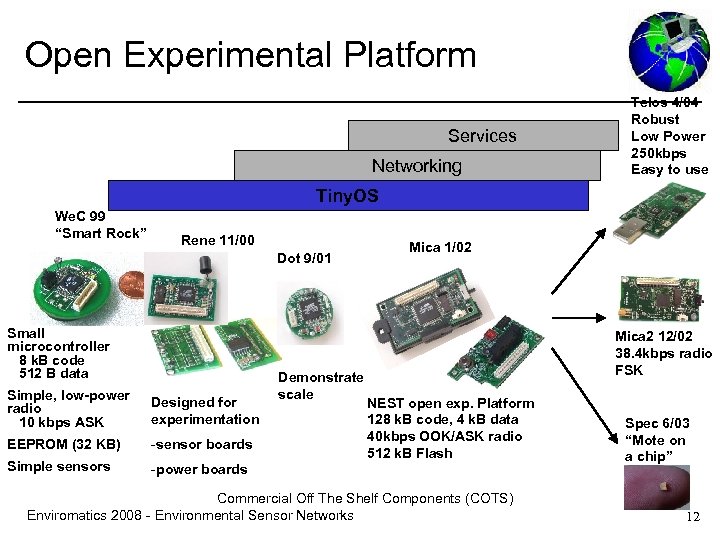 Open Experimental Platform Services Networking Telos 4/04 Robust Low Power 250 kbps Easy to use Tiny. OS We. C 99 “Smart Rock” Rene 11/00 Dot 9/01 Small microcontroller 8 k. B code 512 B data Simple, low-power radio 10 kbps ASK Designed for experimentation EEPROM (32 KB) -sensor boards Simple sensors Demonstrate scale Mica 1/02 Mica 2 12/02 38. 4 kbps radio FSK -power boards NEST open exp. Platform 128 k. B code, 4 k. B data 40 kbps OOK/ASK radio 512 k. B Flash Commercial Off The Shelf Components (COTS) Enviromatics 2008 - Environmental Sensor Networks Spec 6/03 “Mote on a chip” 12
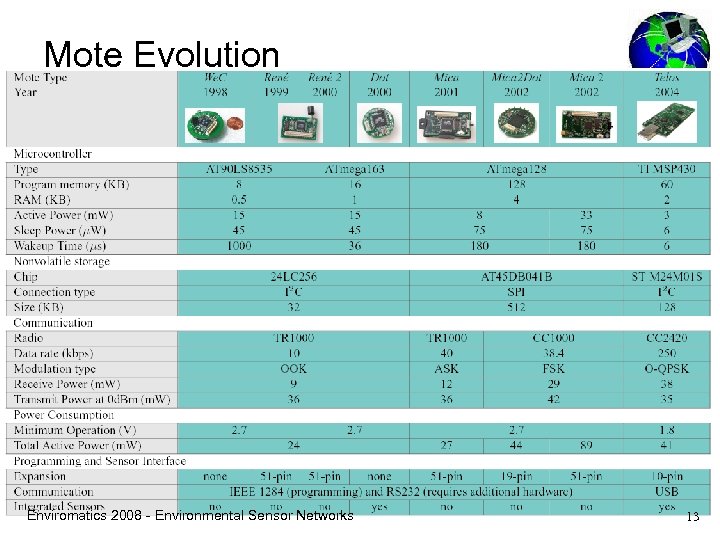 Mote Evolution Enviromatics 2008 - Environmental Sensor Networks 13
 Design Principles • Key to Low Duty Cycle Operation: – Sleep – majority of the time – Wakeup – quickly start processing – Active – minimize work & return to sleep Enviromatics 2008 - Environmental Sensor Networks 14
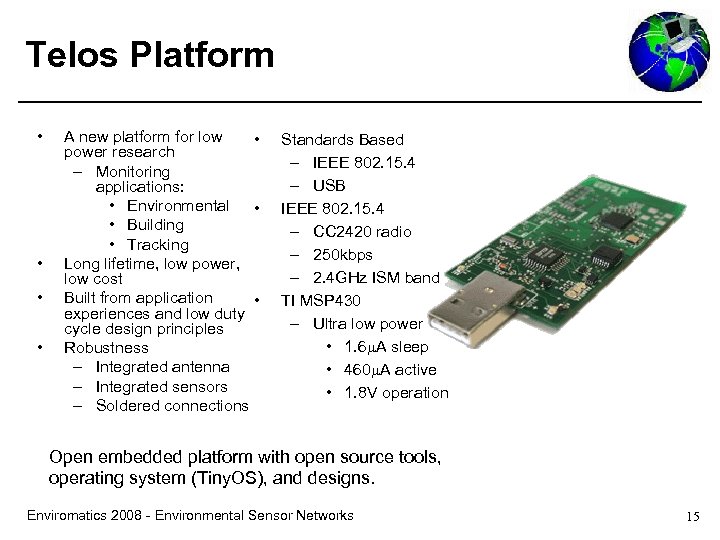 Telos Platform • • A new platform for low • power research – Monitoring applications: • Environmental • • Building • Tracking Long lifetime, low power, low cost Built from application • experiences and low duty cycle design principles Robustness – Integrated antenna – Integrated sensors – Soldered connections Standards Based – IEEE 802. 15. 4 – USB IEEE 802. 15. 4 – CC 2420 radio – 250 kbps – 2. 4 GHz ISM band TI MSP 430 – Ultra low power • 1. 6 m. A sleep • 460 m. A active • 1. 8 V operation Open embedded platform with open source tools, operating system (Tiny. OS), and designs. Enviromatics 2008 - Environmental Sensor Networks 15
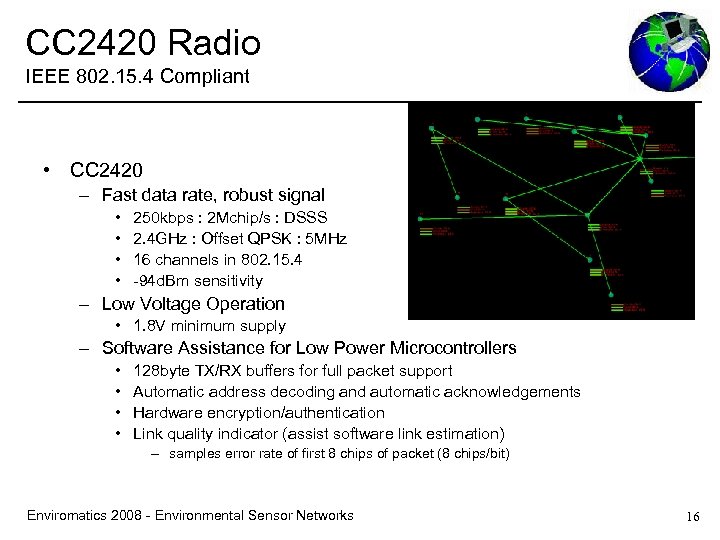 CC 2420 Radio IEEE 802. 15. 4 Compliant • CC 2420 – Fast data rate, robust signal • • 250 kbps : 2 Mchip/s : DSSS 2. 4 GHz : Offset QPSK : 5 MHz 16 channels in 802. 15. 4 -94 d. Bm sensitivity – Low Voltage Operation • 1. 8 V minimum supply – Software Assistance for Low Power Microcontrollers • • 128 byte TX/RX buffers for full packet support Automatic address decoding and automatic acknowledgements Hardware encryption/authentication Link quality indicator (assist software link estimation) – samples error rate of first 8 chips of packet (8 chips/bit) Enviromatics 2008 - Environmental Sensor Networks 16
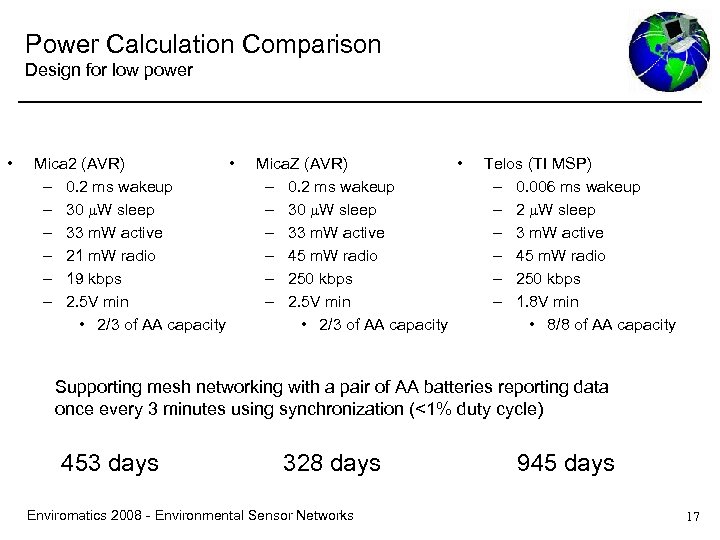 Power Calculation Comparison Design for low power • Mica 2 (AVR) • – 0. 2 ms wakeup – 30 m. W sleep – 33 m. W active – 21 m. W radio – 19 kbps – 2. 5 V min • 2/3 of AA capacity Mica. Z (AVR) • – 0. 2 ms wakeup – 30 m. W sleep – 33 m. W active – 45 m. W radio – 250 kbps – 2. 5 V min • 2/3 of AA capacity Telos (TI MSP) – 0. 006 ms wakeup – 2 m. W sleep – 3 m. W active – 45 m. W radio – 250 kbps – 1. 8 V min • 8/8 of AA capacity Supporting mesh networking with a pair of AA batteries reporting data once every 3 minutes using synchronization (<1% duty cycle) 453 days 328 days Enviromatics 2008 - Environmental Sensor Networks 945 days 17
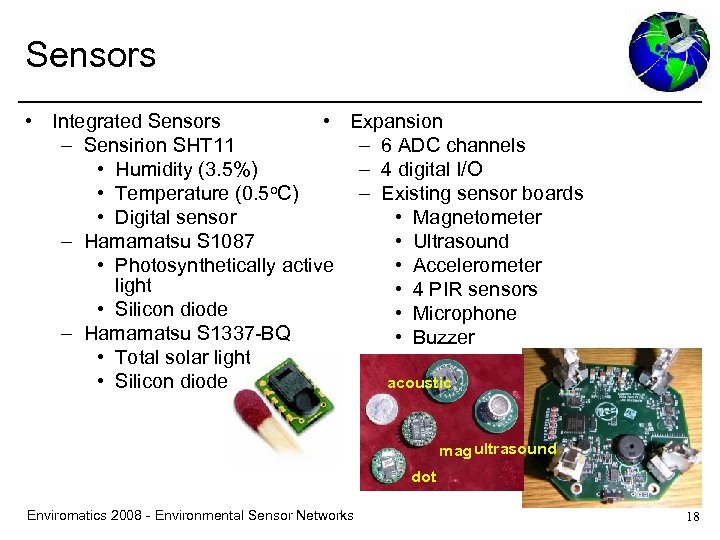 Sensors • Expansion • Integrated Sensors – 6 ADC channels – Sensirion SHT 11 – 4 digital I/O • Humidity (3. 5%) – Existing sensor boards • Temperature (0. 5 o. C) • Magnetometer • Digital sensor • Ultrasound – Hamamatsu S 1087 • Accelerometer • Photosynthetically active light • 4 PIR sensors • Silicon diode • Microphone – Hamamatsu S 1337 -BQ • Buzzer • Total solar light • Silicon diode acoustic mag ultrasound dot Enviromatics 2008 - Environmental Sensor Networks 18
 Examples Enviromatics 2008 - Environmental Sensor Networks 19
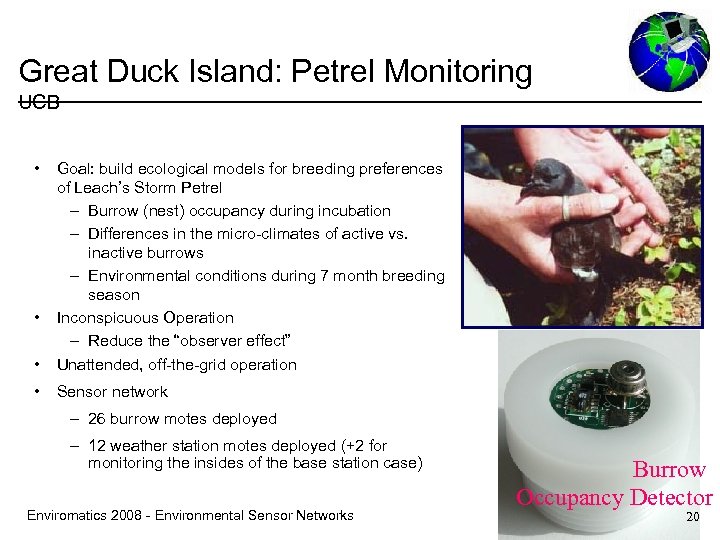 Great Duck Island: Petrel Monitoring UCB • • Goal: build ecological models for breeding preferences of Leach’s Storm Petrel – Burrow (nest) occupancy during incubation – Differences in the micro-climates of active vs. inactive burrows – Environmental conditions during 7 month breeding season Inconspicuous Operation – Reduce the “observer effect” Unattended, off-the-grid operation • Sensor network • – 26 burrow motes deployed – 12 weather station motes deployed (+2 for monitoring the insides of the base station case) Enviromatics 2008 - Environmental Sensor Networks Burrow Occupancy Detector 20
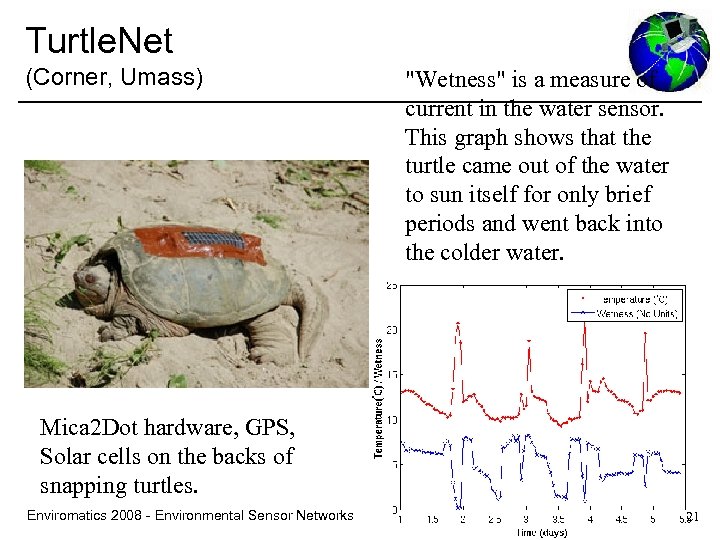 Turtle. Net (Corner, Umass) "Wetness" is a measure of current in the water sensor. This graph shows that the turtle came out of the water to sun itself for only brief periods and went back into the colder water. Mica 2 Dot hardware, GPS, Solar cells on the backs of snapping turtles. Enviromatics 2008 - Environmental Sensor Networks 21
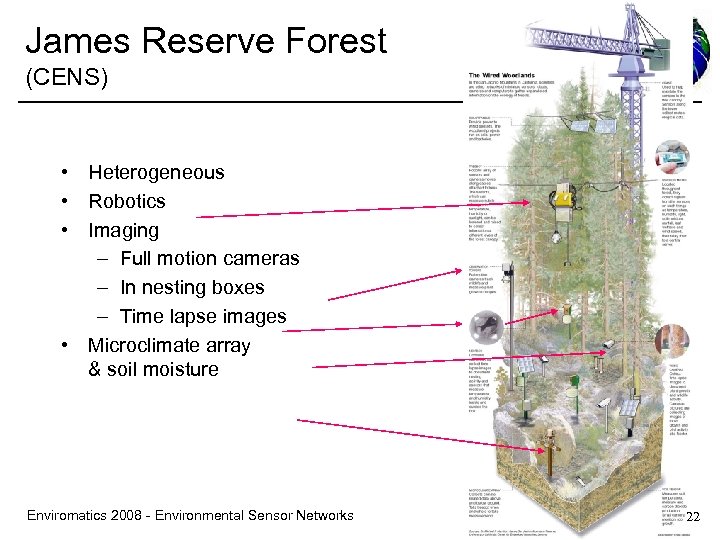 James Reserve Forest (CENS) • Heterogeneous • Robotics • Imaging – Full motion cameras – In nesting boxes – Time lapse images • Microclimate array & soil moisture Enviromatics 2008 - Environmental Sensor Networks 22
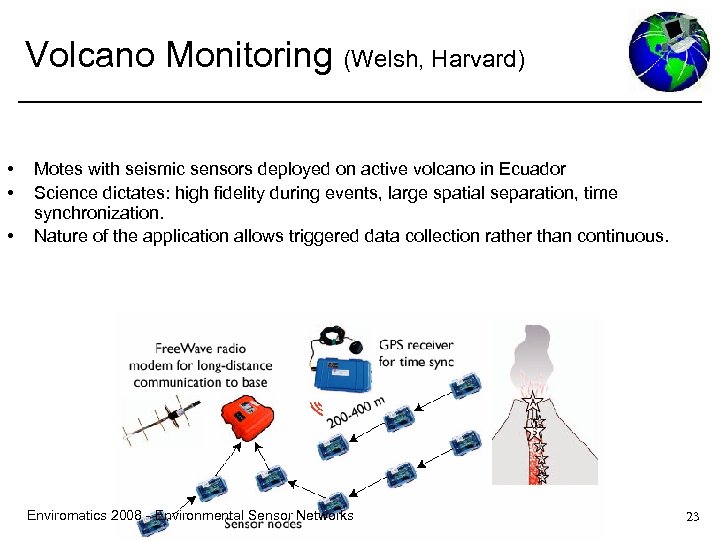 Volcano Monitoring (Welsh, Harvard) • • • Motes with seismic sensors deployed on active volcano in Ecuador Science dictates: high fidelity during events, large spatial separation, time synchronization. Nature of the application allows triggered data collection rather than continuous. Enviromatics 2008 - Environmental Sensor Networks 23
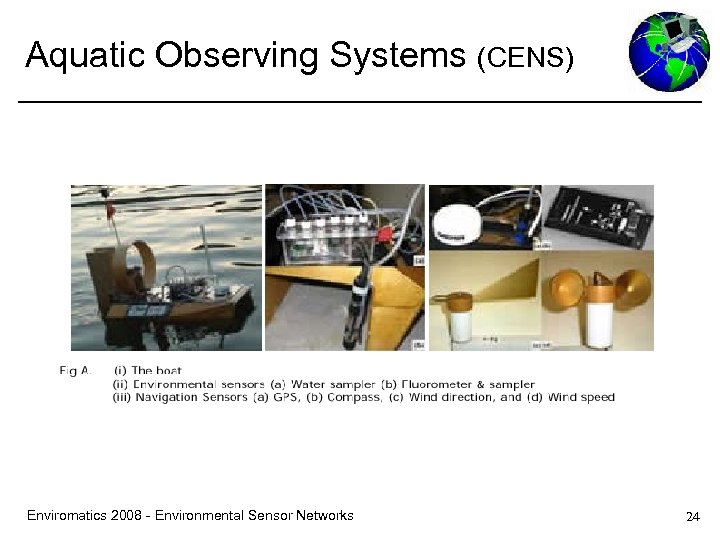 Aquatic Observing Systems (CENS) Enviromatics 2008 - Environmental Sensor Networks 24
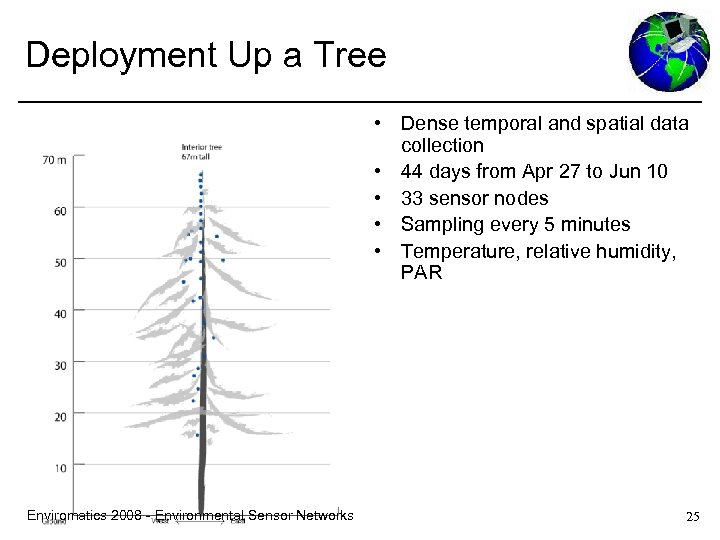 Deployment Up a Tree • Dense temporal and spatial data collection • 44 days from Apr 27 to Jun 10 • 33 sensor nodes • Sampling every 5 minutes • Temperature, relative humidity, PAR Enviromatics 2008 - Environmental Sensor Networks 25
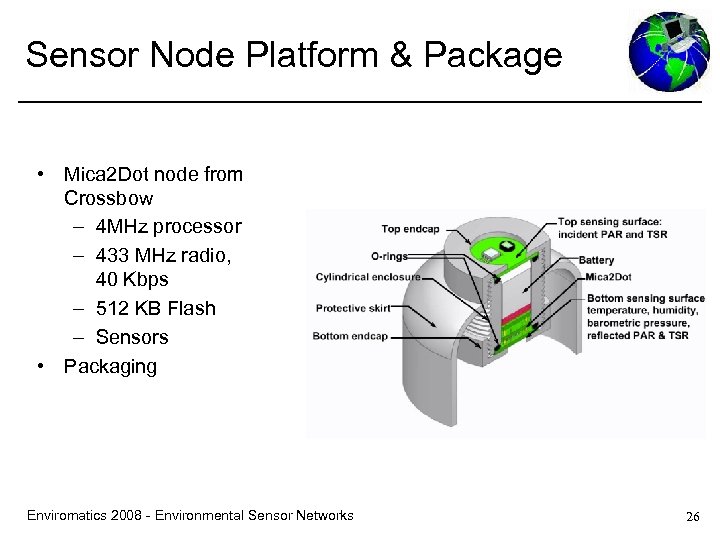 Sensor Node Platform & Package • Mica 2 Dot node from Crossbow – 4 MHz processor – 433 MHz radio, 40 Kbps – 512 KB Flash – Sensors • Packaging Enviromatics 2008 - Environmental Sensor Networks 26
 TASK Software • • • Duty cycling – node on 4 sec every 5 min Time synchronization Tree route discovery between gateway and nodes Tiny. DB data collection and querying Data logging in Flash as backup Enviromatics 2008 - Environmental Sensor Networks 27
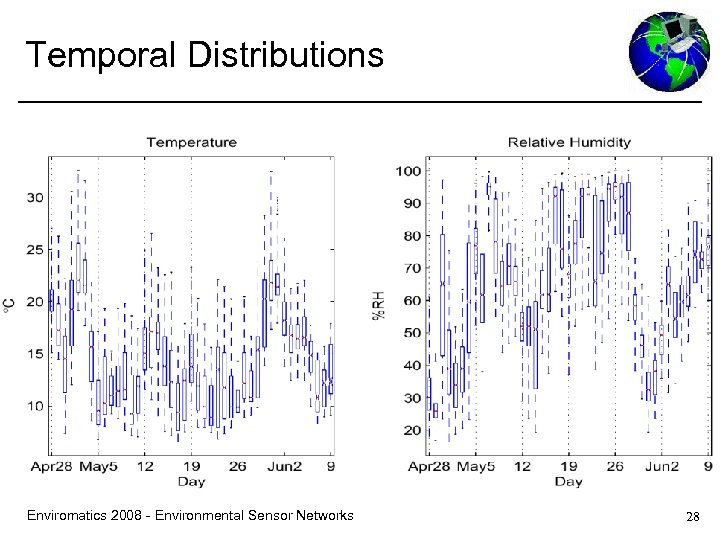 Temporal Distributions Enviromatics 2008 - Environmental Sensor Networks 28
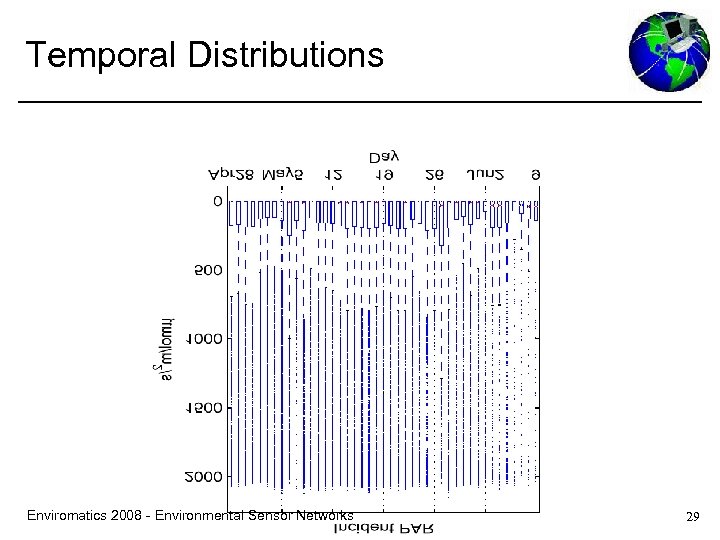 Temporal Distributions Enviromatics 2008 - Environmental Sensor Networks 29
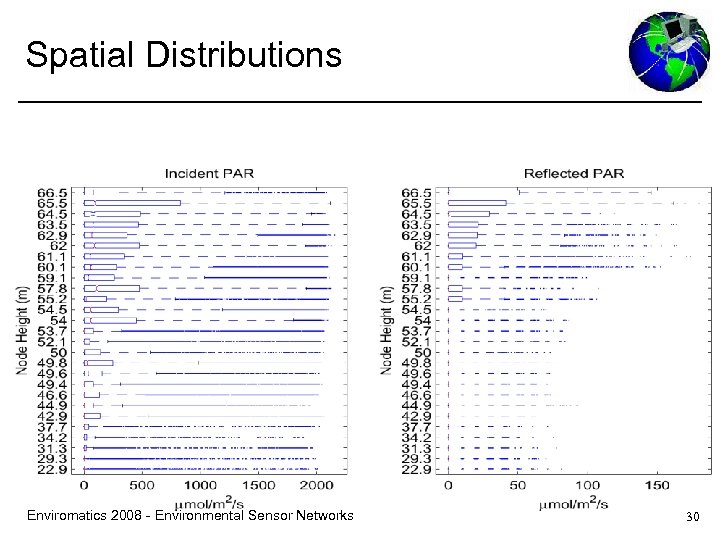 Spatial Distributions Enviromatics 2008 - Environmental Sensor Networks 30
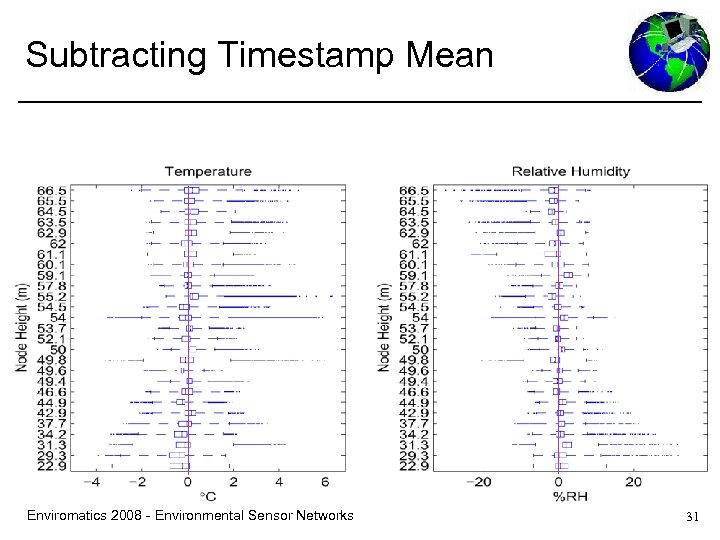 Subtracting Timestamp Mean Enviromatics 2008 - Environmental Sensor Networks 31
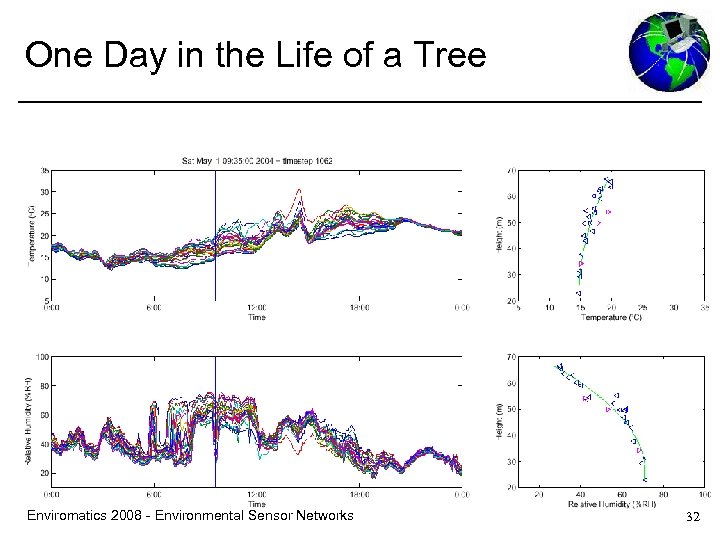 One Day in the Life of a Tree Enviromatics 2008 - Environmental Sensor Networks 32
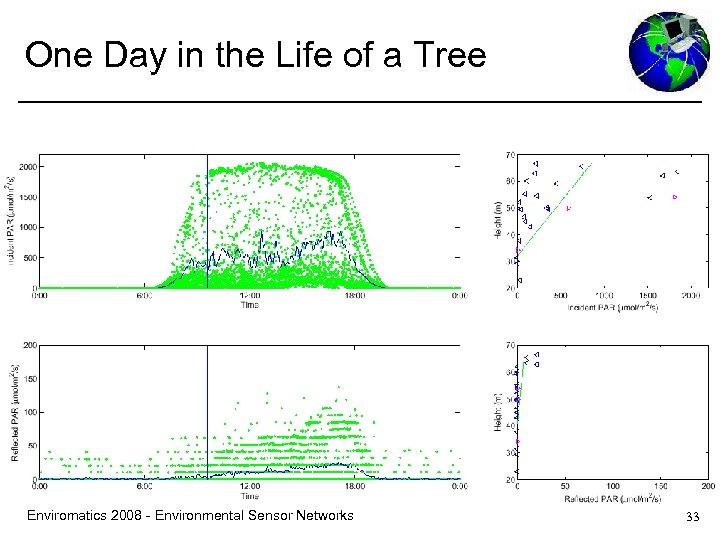 One Day in the Life of a Tree Enviromatics 2008 - Environmental Sensor Networks 33
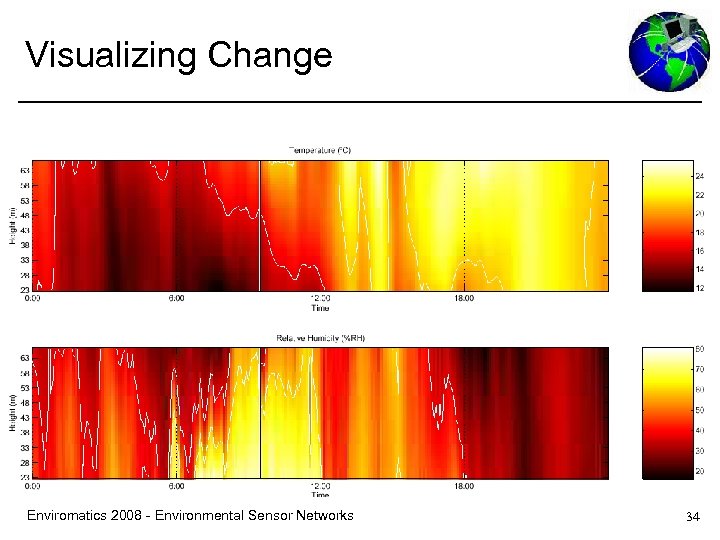 Visualizing Change Enviromatics 2008 - Environmental Sensor Networks 34
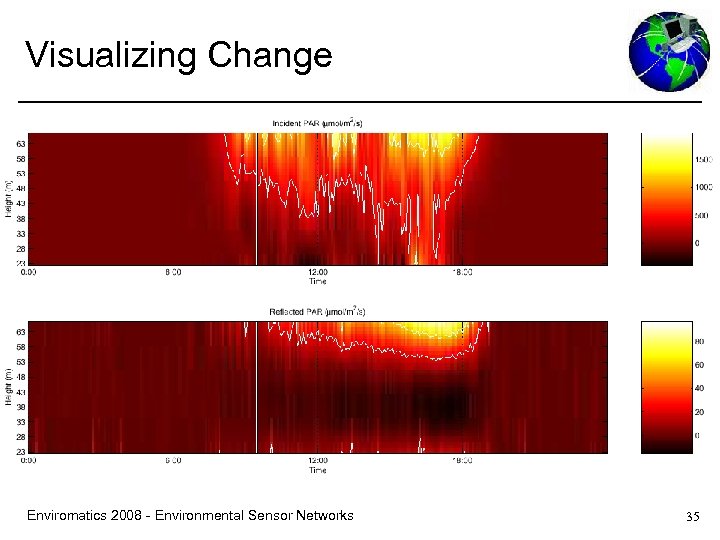 Visualizing Change Enviromatics 2008 - Environmental Sensor Networks 35
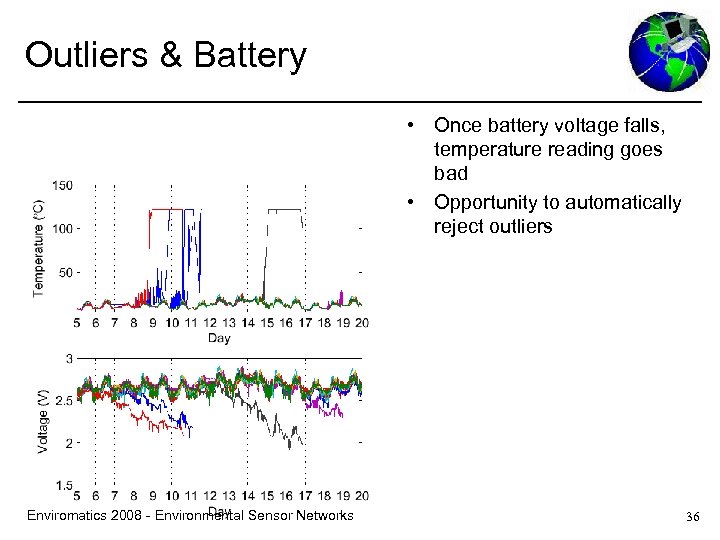 Outliers & Battery • Once battery voltage falls, temperature reading goes bad • Opportunity to automatically reject outliers Enviromatics 2008 - Environmental Sensor Networks 36
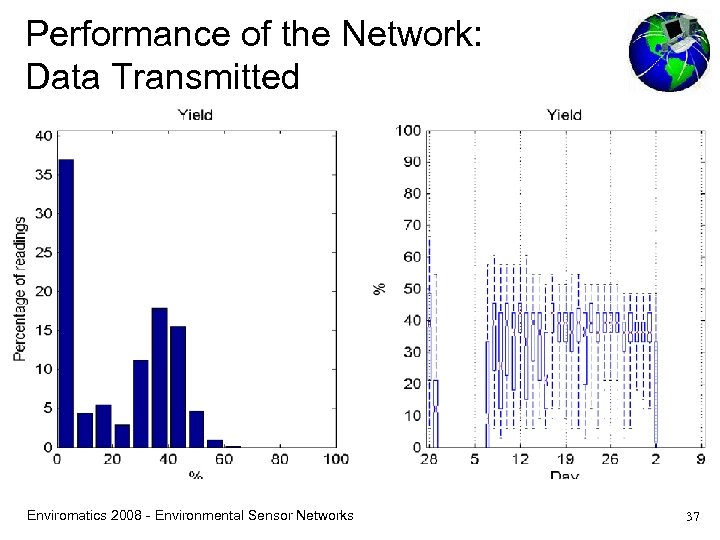 Performance of the Network: Data Transmitted Enviromatics 2008 - Environmental Sensor Networks 37
 Next step. . . Web-based Wireless Environmental Sensing Network (WWESN) Enviromatics 2008 - Environmental Sensor Networks 38
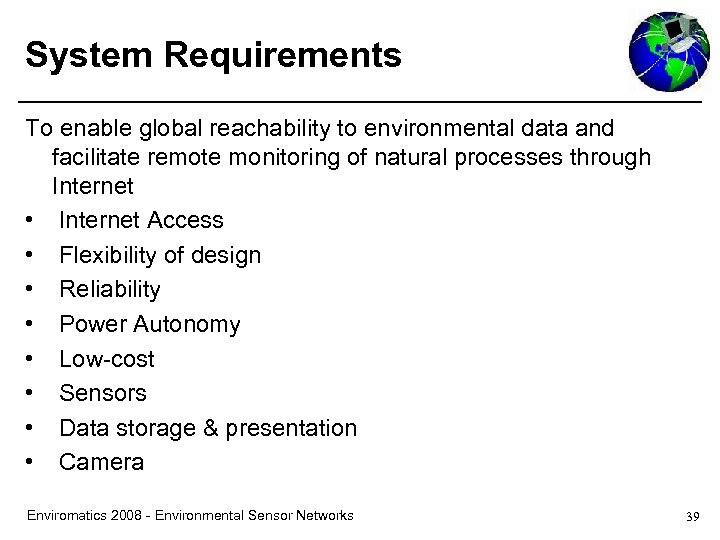 System Requirements To enable global reachability to environmental data and facilitate remote monitoring of natural processes through Internet • Internet Access • Flexibility of design • Reliability • Power Autonomy • Low-cost • Sensors • Data storage & presentation • Camera Enviromatics 2008 - Environmental Sensor Networks 39
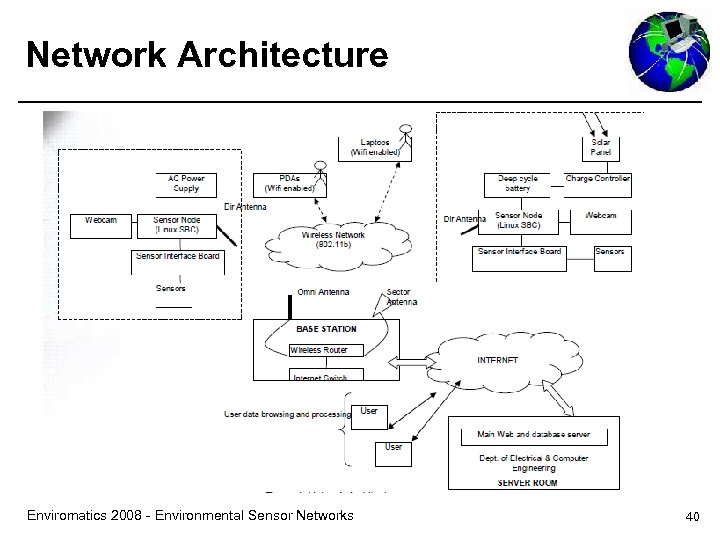 Network Architecture Enviromatics 2008 - Environmental Sensor Networks 40
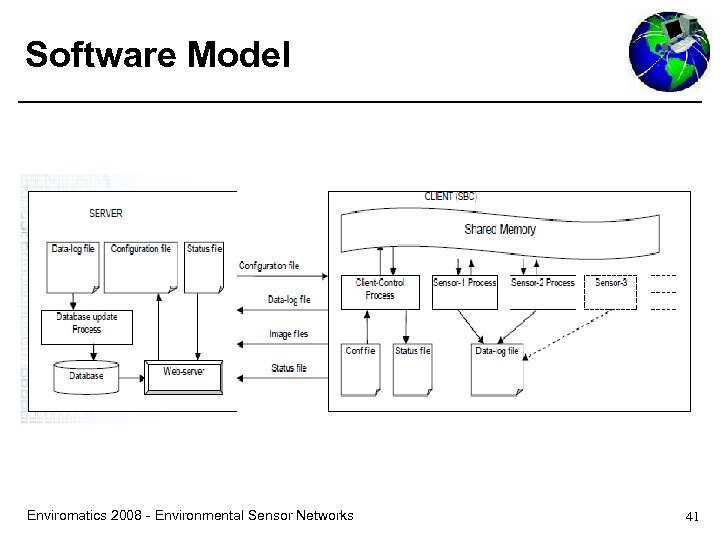 Software Model Enviromatics 2008 - Environmental Sensor Networks 41
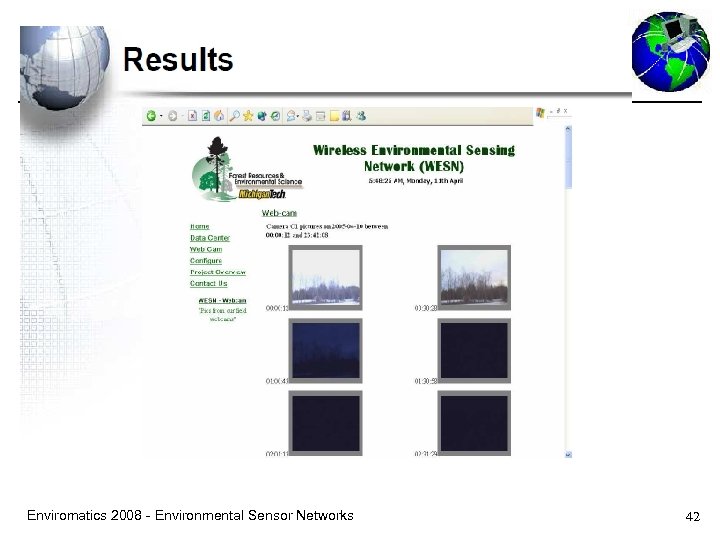 Enviromatics 2008 - Environmental Sensor Networks 42
 Questions? Enviromatics 2008 - Environmental Sensor Networks 43