 Скачать презентацию Environmental Problems Their Causes and Sustainability Chapter 1
3e45b5299faaf18c61fd0e2abc1099b0.ppt
- Количество слайдов: 53



Environmental Problems, Their Causes, and Sustainability Chapter 1
Core Case Study: Living in an Exponential Age Impact of human exponential growth on • Loss of animal and plant species • Loss of resources
Exponential Growth 1. When you put $100 in an account that earns 8% interest, at the end of the year you will have $108. During that year the $100 is called capital and the $8 in interest is the income.

2. If you keep the money in the same account, after the 2 nd year you will have $116. 64. After the 3 rd year, $125. 97. Then $136. 05.
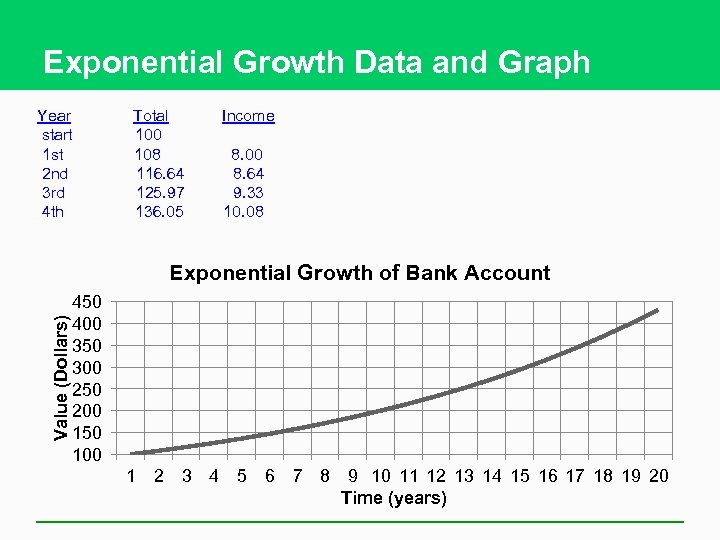
Exponential Growth Data and Graph Year Total Income start 100 1 st 108 8. 00 2 nd 116. 64 8. 64 3 rd 125. 97 9. 33 4 th 136. 05 10. 08 Value (Dollars) Exponential Growth of Bank Account 450 400 350 300 250 200 150 100 1 2 3 4 5 6 7 8 9 10 11 12 13 14 15 16 17 18 19 20 Time (years)
Exponential Growth - Notice that even though the interest rate (8%) stays the same, the yearly income of money in the account increases. - Even if the interest rate was. 1% the same effect would occur, eventually. -This increase of income is called exponential growth.
Exponential Growth Examples Exponential growth happens whenever any quantity increases by a fixed percentage each year. Examples of quantities that are or have grown exponentially are the world’s use of oil, cod harvest in New England, world population, and sales of ipads.
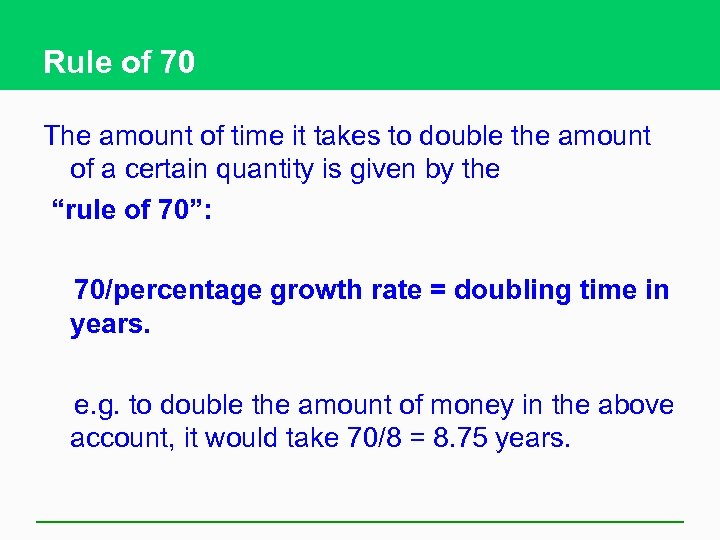
Rule of 70 The amount of time it takes to double the amount of a certain quantity is given by the “rule of 70”: 70/percentage growth rate = doubling time in years. e. g. to double the amount of money in the above account, it would take 70/8 = 8. 75 years.
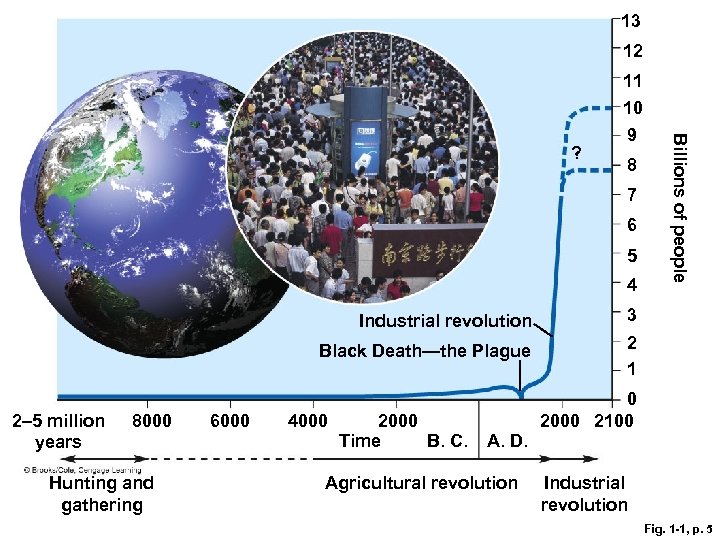
13 12 11 8 7 6 5 4 Industrial revolution 2– 5 million years 8000 Hunting and gathering 6000 3 Black Death—the Plague Billions of people ? 10 9 2 1 4000 2000 Time B. C. 0 2000 2100 A. D. Agricultural revolution Industrial revolution Fig. 1 -1, p. 5
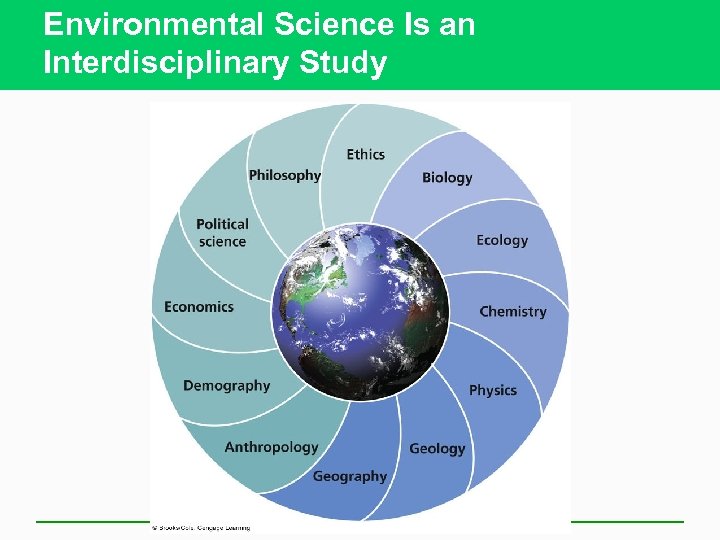
Environmental Science Is an Interdisciplinary Study
Natural Capital § People (and all living things) on earth depend on solar capital and natural capital for life. § Solar capital is energy from the sun. Natural capital is both natural resources and natural services provided by earth.
Natural (Earth) Capital § Natural capital is supported by solar capital 1) Natural resources • oil, uranium, fertile soil 2) Natural services • nutrient cycling
Sustainability § A sustainable society is one where the community can flourish without hurting future generations by using up too much earth capital.
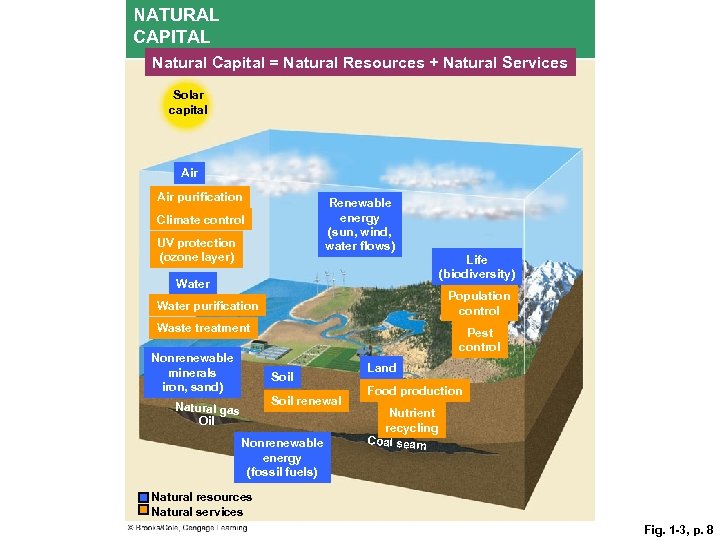
NATURAL CAPITAL Natural Capital = Natural Resources + Natural Services Solar capital Air purification Renewable energy (sun, wind, water flows) Climate control UV protection (ozone layer) Water Population control Water purification Waste treatment Nonrenewable minerals iron, sand) Pest control Soil renewal Natural gas Oil Life (biodiversity) Nonrenewable energy (fossil fuels) Land Food production Nutrient recycling Coal seam Natural resources Natural services Fig. 1 -3, p. 8
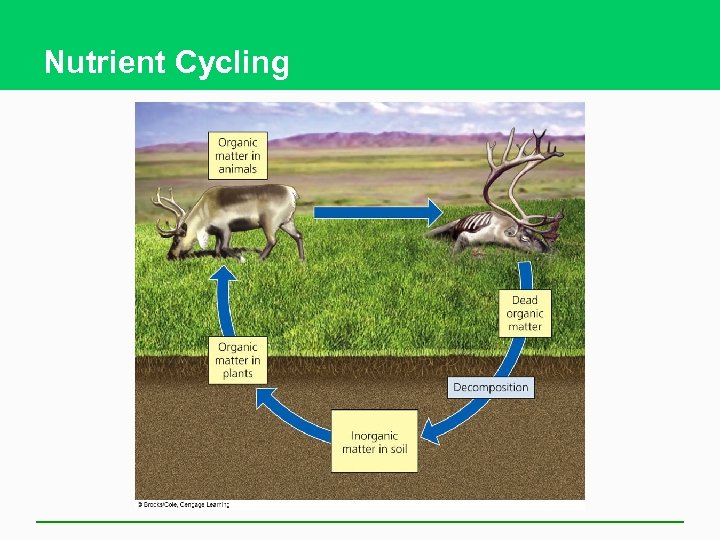
Nutrient Cycling
Economic Growth In order to increase a country’s income, a country must increase the amount of goods and services that it provides.
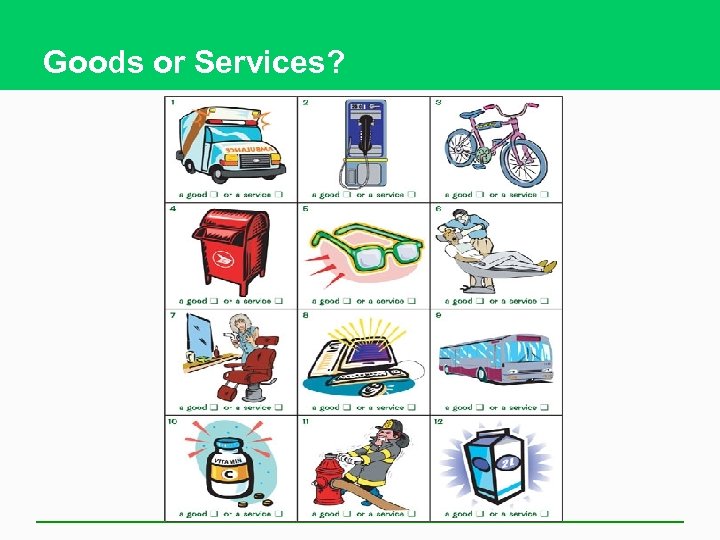
Goods or Services?
Throughput To increase the amount of goods and services a country must increase the amount of matter and energy it consumes. The flow of matter and energy that is consumed in producing goods and services is called throughput.
GDP vs GNP Gross domestic product is the market value of the goods and services produced by a country only within it’s borders. The rise and fall of the GDP is a good indicator of economic growth. .
GNP Gross national product is the market value of the goods and services produced by a country inside and outside of it’s borders.
per capita GNP is the GNP divided by the population. It’s a good indicator of the distribution of wealth of a country and in most cases it is also a measure of the amount of resources consumed and waste produced.
PPP, per capita GDP PPP Purchasing Power Parity (PPP) a) the cost of a bag of groceries in a country per capita GDP PPP a) how many groceries an average person could buy in their own country with US dollars
India § Traditional GDP : 10 th largest economy § GDP PPP: 4 th largest
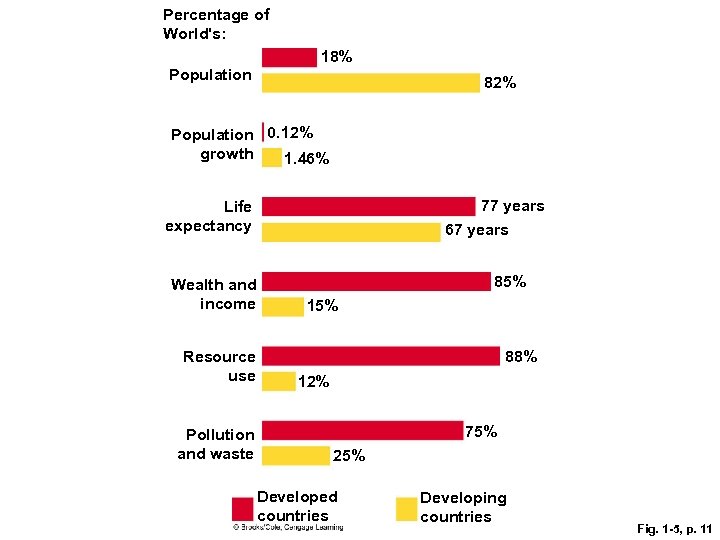
Percentage of World's: 18% Population 82% Population 0. 12% growth 1. 46% 77 years 67 years Life expectancy Wealth and income Resource use Pollution and waste 85% 15% 88% 12% 75% 25% Developed countries Developing countries Fig. 1 -5, p. 11
Ecological Footprint Ecological footprint is the amount of land water required to provide resources for a country • Per capita ecological footprint leads to a different ranking (compare EU and India)
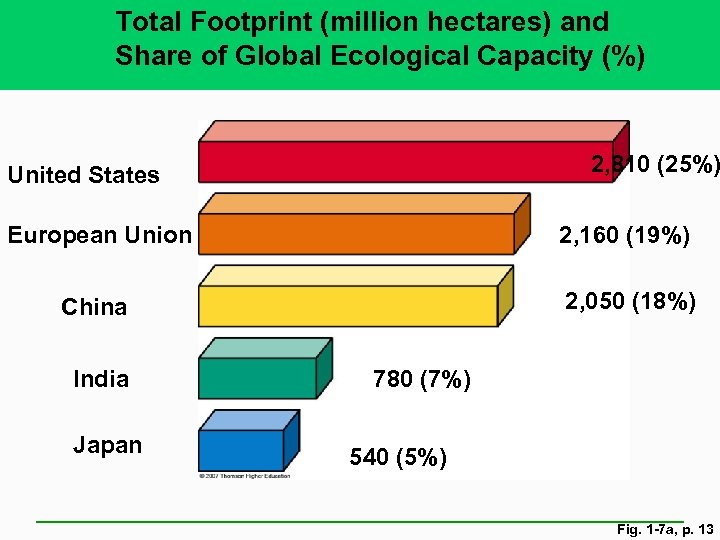
Total Footprint (million hectares) and Share of Global Ecological Capacity (%) 2, 810 (25%) United States European Union 2, 160 (19%) China 2, 050 (18%) India Japan 780 (7%) 540 (5%) Fig. 1 -7 a, p. 13
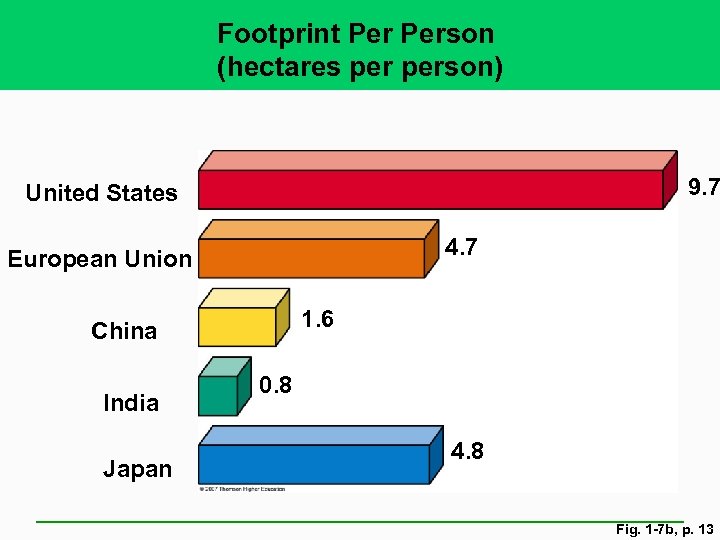
Footprint Person (hectares person) 9. 7 United States 4. 7 European Union 1. 6 China India Japan 0. 8 4. 8 Fig. 1 -7 b, p. 13
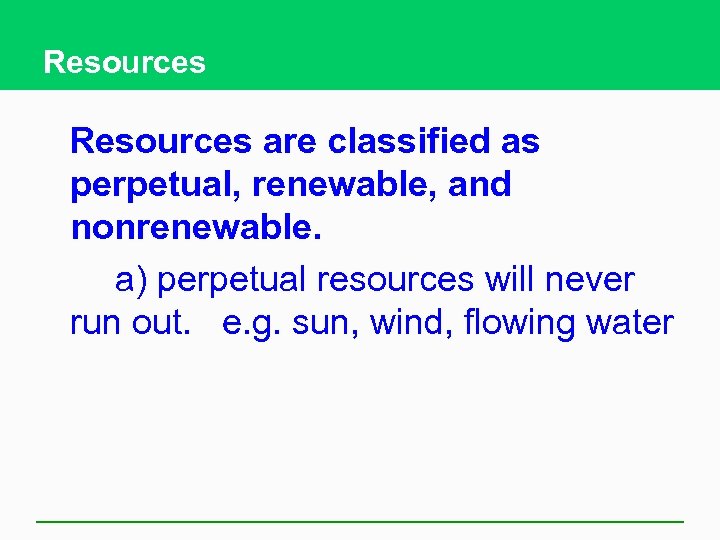
Resources are classified as perpetual, renewable, and nonrenewable. a) perpetual resources will never run out. e. g. sun, wind, flowing water
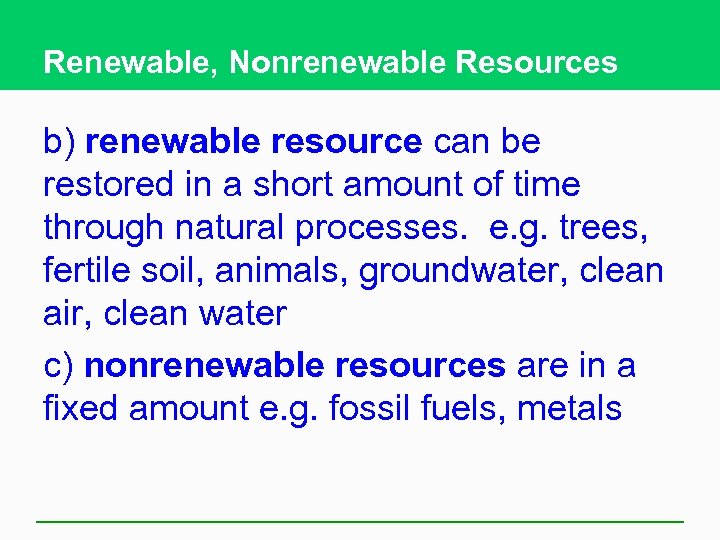
Renewable, Nonrenewable Resources b) renewable resource can be restored in a short amount of time through natural processes. e. g. trees, fertile soil, animals, groundwater, clean air, clean water c) nonrenewable resources are in a fixed amount e. g. fossil fuels, metals
Renewable Resources § Sustainable yield is the maximum amount of a resource that can be extracted without reducing the supply of that resource. § Environmental degradation occurs if extraction is greater that a resource’s ability to replace itself.
Tragedy of the Commons § Common property resources are either owned by no one or by a group. e. g. grazing land, ocean fish, clean water and clean air, m + m’s
Tragedy of the Commons § The Tragedy of the Commons can occur to a common property resource. § If many people share a resource then no one is definitely responsible for its care. If someone lessens their use of it chances are someone else will increase their use.
Tragedy of the Commons § The tragedy is that there is no payoff in limiting ones use, so most people tend to overuse and the resource is degraded.
Tragedy of the Commons Boston Commons Federal grazing land ranchers Solutions
Hegel § Hegel said, 200 years ago, that tragedy is not the conflict between right and wrong, it is the conflict between right and right.
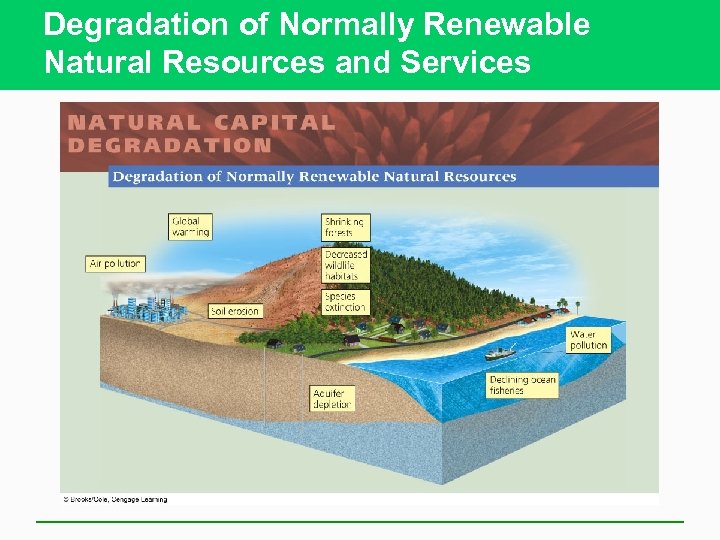
Degradation of Normally Renewable Natural Resources and Services
Some Resources Are Not Renewable § Nonrenewable resources • Energy resources • Metallic mineral resources • Nonmetallic mineral resources § Reuse § Recycle
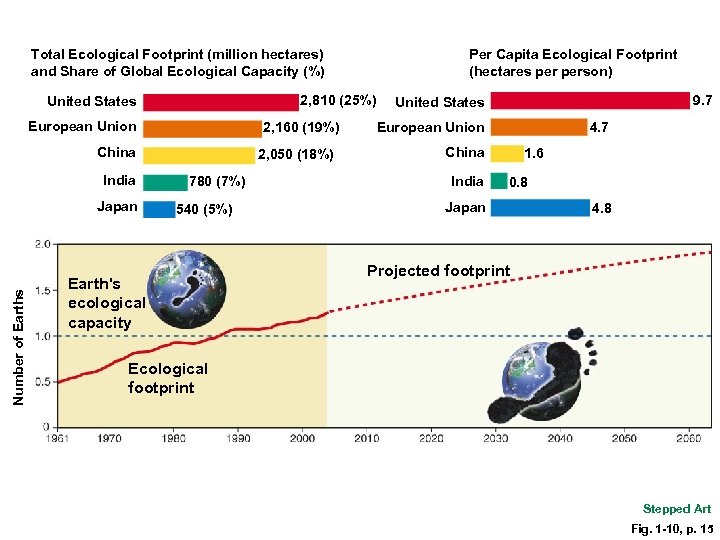
Total Ecological Footprint (million hectares) and Share of Global Ecological Capacity (%) 2, 810 (25%) United States European Union 2, 160 (19%) China India Number of Earths Japan Per Capita Ecological Footprint (hectares person) 2, 050 (18%) 780 (7%) 540 (5%) Earth's ecological capacity 9. 7 United States European Union 4. 7 China India 1. 6 0. 8 Japan 4. 8 Projected footprint Ecological footprint Stepped Art Fig. 1 -10, p. 15
Case Study: China’s New Affluent Consumers (1) § Leading consumer of various foods and goods • Wheat, rice, and meat • Coal, fertilizers, steel, and cement § Second largest consumer of oil
Case Study: China’s New Affluent Consumers (2) § Two-thirds of the most polluted cities are in China § Projections, by 2020 • Largest consumer and producer of cars • World’s leading economy in terms of GDP PPP
Cultural Changes Have Increased Our Ecological Footprints § 12, 000 years ago: hunters and gatherers § Three major cultural events since • Agricultural revolution • Industrial-medical revolution • Information-globalization revolution
Pollution Comes from a Number of Sources § Sources of pollution • Point • E. g. , smokestack • Nonpoint • E. g. , pesticides blown into the air, fertilizer runoff
Types of Pollutants § Main type of pollutants • Biodegradable • Nondegradable
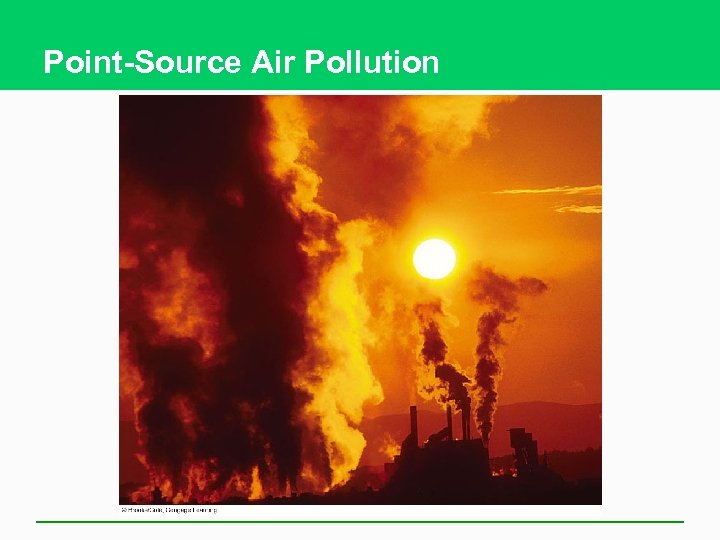
Point-Source Air Pollution
We Can Clean Up Pollution or Prevent It § Preventing pollution is more effective and less costly than cleaning up pollution. § Pollution cleanup (output pollution control) § Pollution prevention (input pollution control)
Causes of Environmental Problems Population growth Unsustainable resource use Poverty Excluding environmental costs from market prices Trying to manage nature without knowing enough about it Stepped Art Fig. 1 -12, p. 18
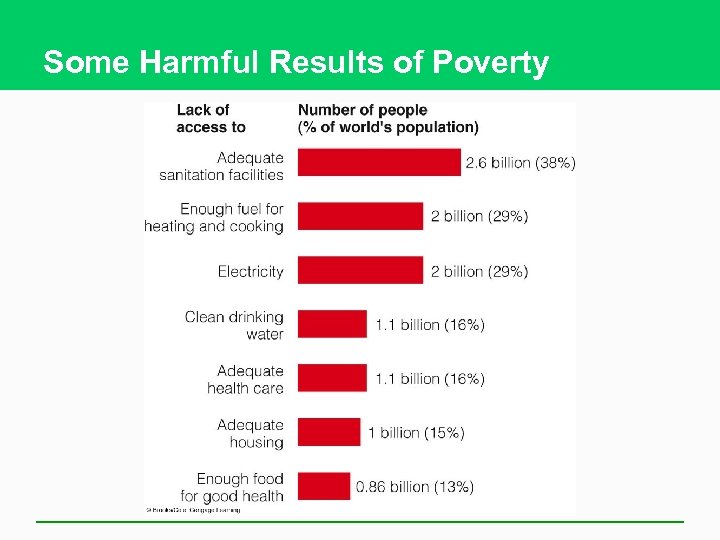
Some Harmful Results of Poverty
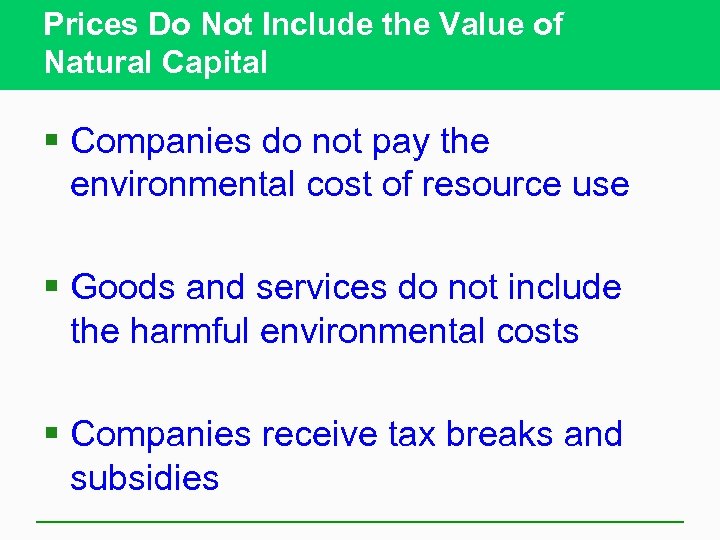
Prices Do Not Include the Value of Natural Capital § Companies do not pay the environmental cost of resource use § Goods and services do not include the harmful environmental costs § Companies receive tax breaks and subsidies
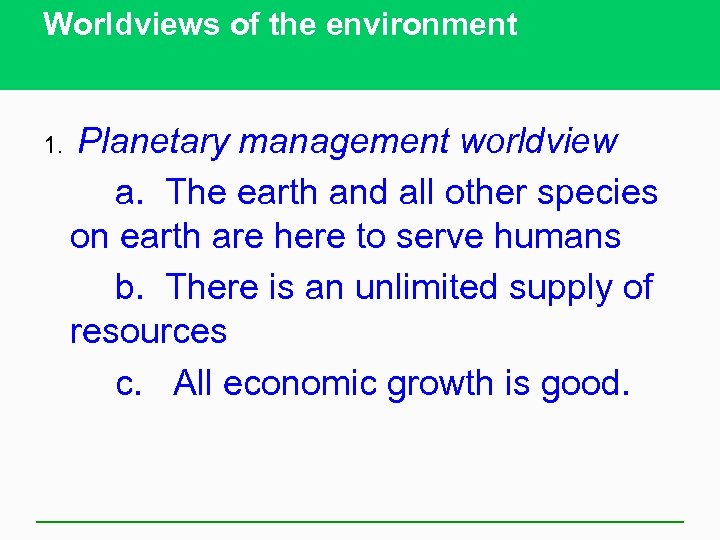
Worldviews of the environment 1. Planetary management worldview a. The earth and all other species on earth are here to serve humans b. There is an unlimited supply of resources c. All economic growth is good.
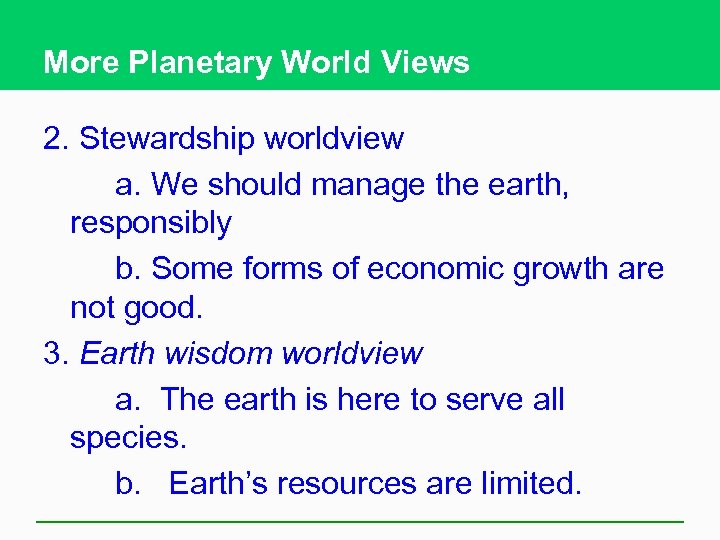
More Planetary World Views 2. Stewardship worldview a. We should manage the earth, responsibly b. Some forms of economic growth are not good. 3. Earth wisdom worldview a. The earth is here to serve all species. b. Earth’s resources are limited.
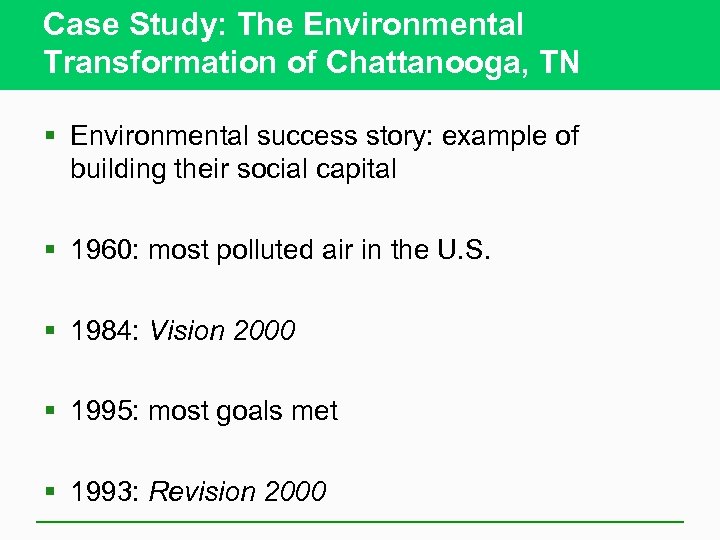
Case Study: The Environmental Transformation of Chattanooga, TN § Environmental success story: example of building their social capital § 1960: most polluted air in the U. S. § 1984: Vision 2000 § 1995: most goals met § 1993: Revision 2000
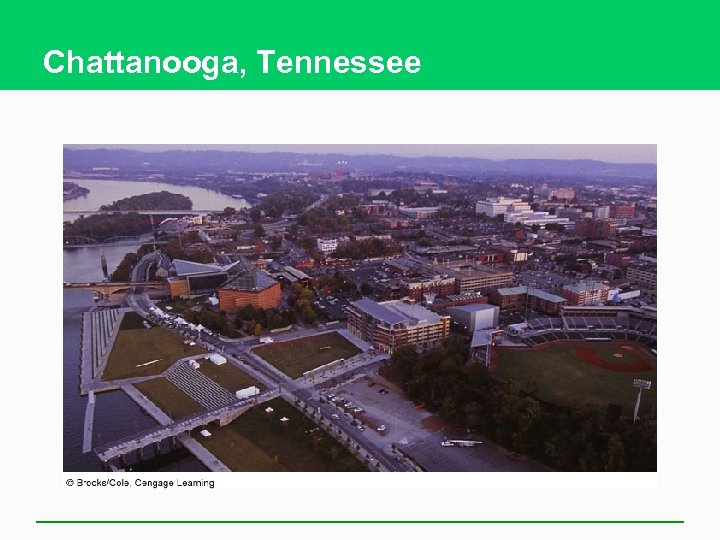
Chattanooga, Tennessee
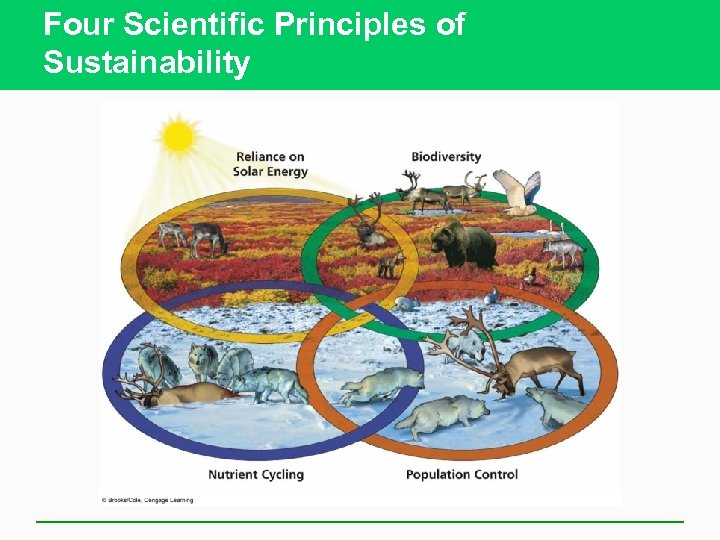
Four Scientific Principles of Sustainability
Скачать презентацию Environmental Problems Their Causes and Sustainability Chapter 1
3e45b5299faaf18c61fd0e2abc1099b0.ppt