


 Скачать презентацию ENVIRONMENTAL PERFORMANCE ASSESSMENT OF ALCOHOL INDUSTRY IN UTTAR
b6eca8451b0d08411071a513628a8f7b.ppt
- Количество слайдов: 63
 ENVIRONMENTAL PERFORMANCE ASSESSMENT OF ALCOHOL INDUSTRY IN UTTAR PRADESH DR. YASHPAL SINGH CHIEF ENVIRONMENT OFFICER U. P. Pollution Control Board Lucknow, India
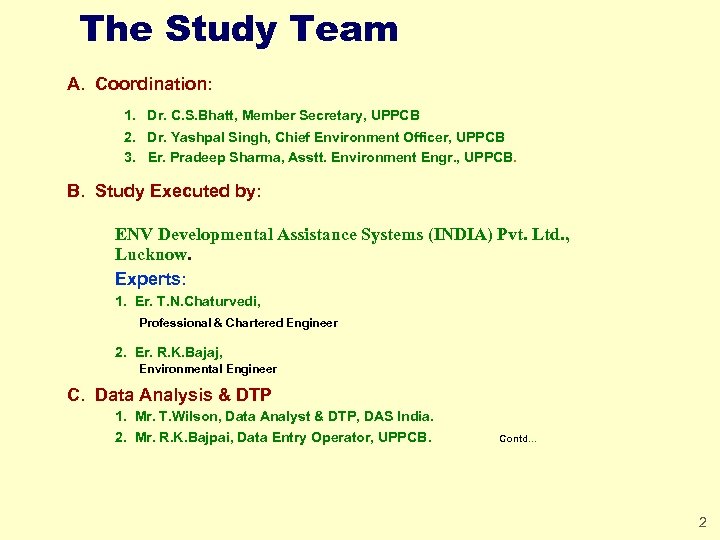 The Study Team A. Coordination: 1. Dr. C. S. Bhatt, Member Secretary, UPPCB 2. Dr. Yashpal Singh, Chief Environment Officer, UPPCB 3. Er. Pradeep Sharma, Asstt. Environment Engr. , UPPCB. B. Study Executed by: ENV Developmental Assistance Systems (INDIA) Pvt. Ltd. , Lucknow. Experts: 1. Er. T. N. Chaturvedi, Professional & Chartered Engineer 2. Er. R. K. Bajaj, Environmental Engineer C. Data Analysis & DTP 1. Mr. T. Wilson, Data Analyst & DTP, DAS India. 2. Mr. R. K. Bajpai, Data Entry Operator, UPPCB. Contd. . . 2
 The Study Team (… contd. ) Our gratitude to: Sri Pradeep Kumar The then Principal Secretary Environment and Chairman UP Pollution Control Board For conceiving and designing the study and for his inspiring leadership and guidance. Excise Department Govt. of Uttar Pradesh. For providing valuable data Senior Officers of the U. P. Pollution Control Board For their valuable inputs. 3
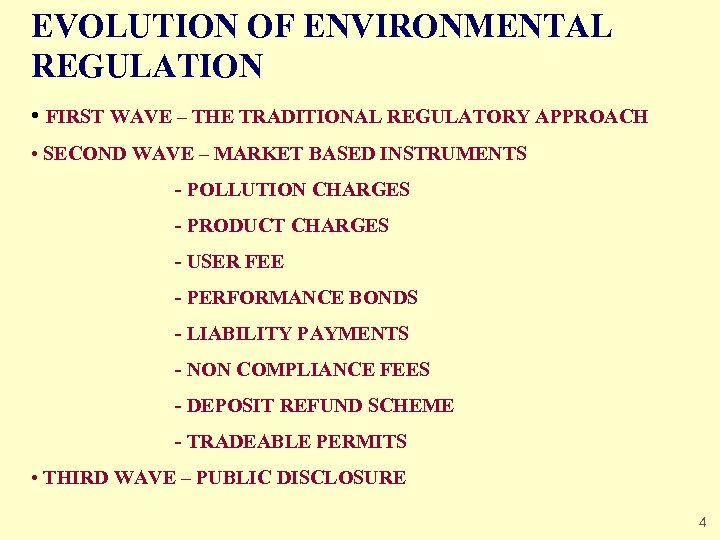 EVOLUTION OF ENVIRONMENTAL REGULATION • FIRST WAVE – THE TRADITIONAL REGULATORY APPROACH • SECOND WAVE – MARKET BASED INSTRUMENTS - POLLUTION CHARGES - PRODUCT CHARGES - USER FEE - PERFORMANCE BONDS - LIABILITY PAYMENTS - NON COMPLIANCE FEES - DEPOSIT REFUND SCHEME - TRADEABLE PERMITS • THIRD WAVE – PUBLIC DISCLOSURE 4
 BENEFITS OF PUBLIC DISCLOSURE • CREATION OF MARKET OPPORTUNITIES • IMPROVEMENTS IN ENVIRONMENTAL PERFORMANCE • INCREASED CONFIDENCE OF INVESTORS, INSURERS AND FINANCIAL INSTITUTIONS • IMPROVED RELATIONSHIP WITH LOCAL COMMUNITIES, REGULATORS AND NON GOVERNMENT ORGANISATIIONS • GREATER CONTROL OF ENVIRONMENTAL DISCLOSURE • INCREASED STAFF COMMITTMENT 5
 PRACTICED AS • Involuntary – Media Exposures, Notices, PIL Etc. • Mandatory – The Regulatory Mechanism like consents • Voluntary – Press Release, Public Reports Etc. DRIVERS • Transparency - Society Wants To Be Told What Is Going On • Accountability - Fear Of Losing Significant Economic Value Of Good Corporate Reputation • Synergy Between Economic And Environmental Performance 6
 ENVIRONMENTAL LEGISLATION • THE WATER (PREVENTION AND CONTROL OF POLLUTION ) ACT, 1974 AS AMENDED IN 1988. • THE WATER ( PREVENTION AND CONTROL OF POLLUTION) CESS ACT, 1977 AS AMENDED IN 1991. • THE AIR (PREVENTION AND CONTROL OF POLLUTION) ACT, 1981 AS AMENDED IN 1987. • THE ENVIRONMENT (PROTECTION) ACT, 1986 • THE PUBLIC LIABILITY INSURANCE ACT, 1991 • THE NATIONAL ENVIRONMENTAL TRIBUNAL ACT, 1995 • THE NATIONAL ENVIRONMENT APPELLATE AUTHORITY ACT, 1997 • NATIONAL BIODIVERSITY ACT, 2002 7
 • INSTITUTIONAL MECHANISM - CENTRAL POLLUTION CONTROL BOARD - STATE POLLUTION CONTROL BOARDS • INCENTIVES / DISINCENTIVES - FINES - BANK GUARANTEES - CESS REBATE - CONSENT VALIDITY - LOCATION - CLOSURES - PROSECUTION 8
 Environmental Performance Rating A Pioneering Initiative l l l U. P. Pollution Control Board, in a pioneering initiative is making efforts to change the paradigm of the way Pollution Control is commonly understood. Dispel the notion that, Pollution Control is an end of process, cost-intensive, loss-making effort. Rather, environmental management and pollution control means harmonizing resources, process and outputs. 9
 Objectives of this Study l l To place a Mirror before the industry in the form of Environmental Performance Rating to make them aware about their strengths and weaknesses as also the opportunities & threats, so as to enable self-correction and continual improvement in their environmental performance. To encourage pro-active role by the Industry to improve its Environmental Performance through benchmarking. 10
 Significance of Alcohol Industry l l Downstream unit of Sugar Industry- Synergy with Sugar & Paper Utilising wastes (Molasses) to produce Alcohol, an essential input of the Chemical & Pharmaceutical Industry and a product for human consumption. Alcohol – great potential for use as Fuel for automobiles – GASOHOL. But, also known for discharging highly polluted effluents and is included in ‘Schedule-1’ of Water Cess Act. An EIA is a pre-requisite before setting up of any unit or expansion thereof. (Contd……. ) 11
 Significance of Alcohol Industry (…. Contd. ) l Significance in U. P. w w Alongwith sugar, the largest value enhancer to agricultural produce. Contributes a significant part of State GDP – next only to Trade Tax. Major catalyst of Employment in the Primary & Secondary Sectors. Unfortunately, also amongst the most polluting industries. u Over 10 MT of BOD load per day into the river systems of the State. 12
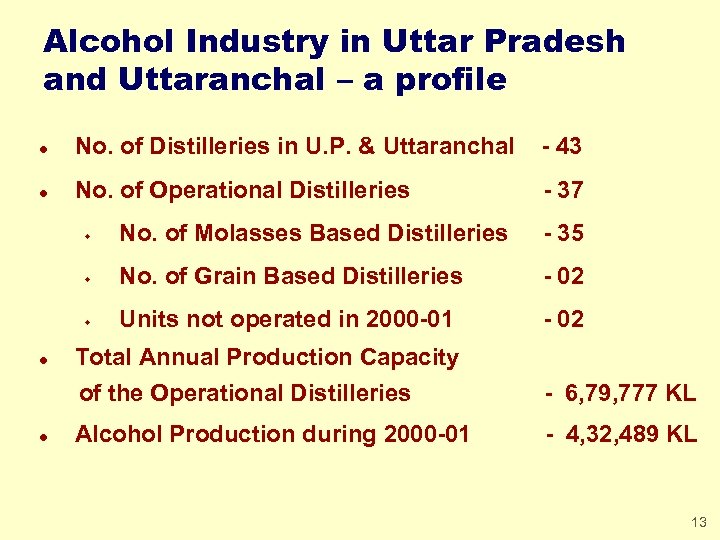 Alcohol Industry in Uttar Pradesh and Uttaranchal – a profile l No. of Distilleries in U. P. & Uttaranchal - 43 l No. of Operational Distilleries - 37 w No. of Grain Based Distilleries - 02 w l - 35 w l No. of Molasses Based Distilleries Units not operated in 2000 -01 - 02 Total Annual Production Capacity of the Operational Distilleries - 6, 79, 777 KL Alcohol Production during 2000 -01 - 4, 32, 489 KL 13
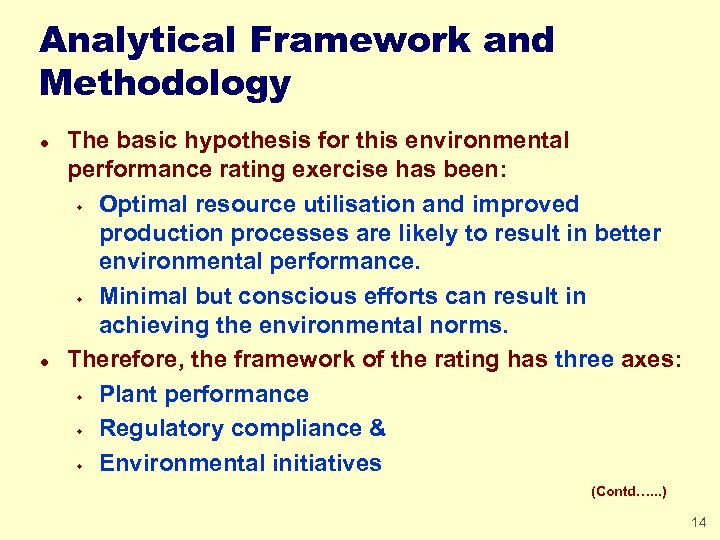 Analytical Framework and Methodology l l The basic hypothesis for this environmental performance rating exercise has been: w Optimal resource utilisation and improved production processes are likely to result in better environmental performance. w Minimal but conscious efforts can result in achieving the environmental norms. Therefore, the framework of the rating has three axes: w Plant performance w Regulatory compliance & w Environmental initiatives (Contd…. . . ) 14
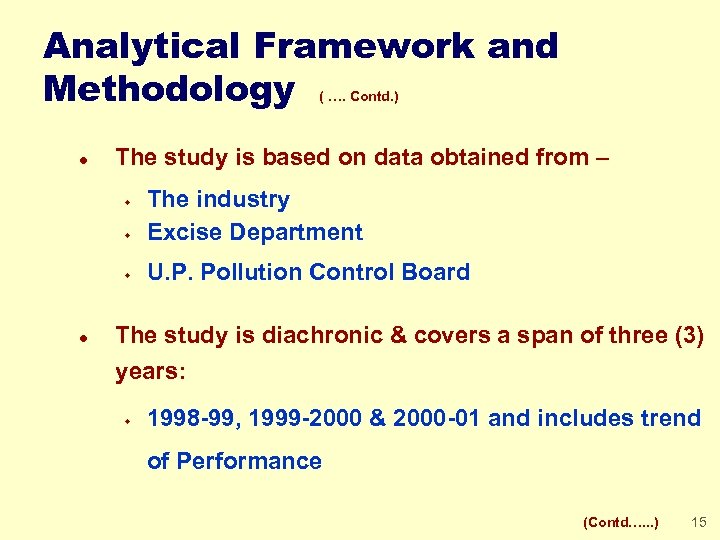 Analytical Framework and Methodology ( …. Contd. ) l The study is based on data obtained from – w The industry Excise Department w U. P. Pollution Control Board w l The study is diachronic & covers a span of three (3) years: w 1998 -99, 1999 -2000 & 2000 -01 and includes trend of Performance (Contd…. . . ) 15
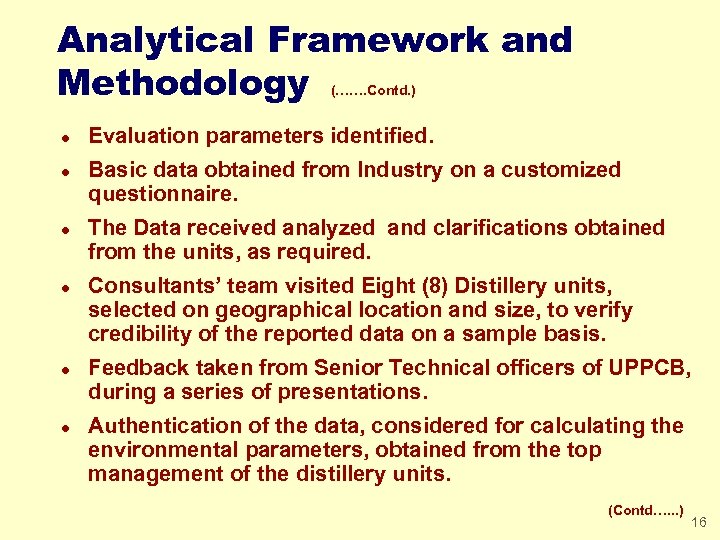 Analytical Framework and Methodology (……. Contd. ) l l l Evaluation parameters identified. Basic data obtained from Industry on a customized questionnaire. The Data received analyzed and clarifications obtained from the units, as required. Consultants’ team visited Eight (8) Distillery units, selected on geographical location and size, to verify credibility of the reported data on a sample basis. Feedback taken from Senior Technical officers of UPPCB, during a series of presentations. Authentication of the data, considered for calculating the environmental parameters, obtained from the top management of the distillery units. (Contd…. . . ) 16
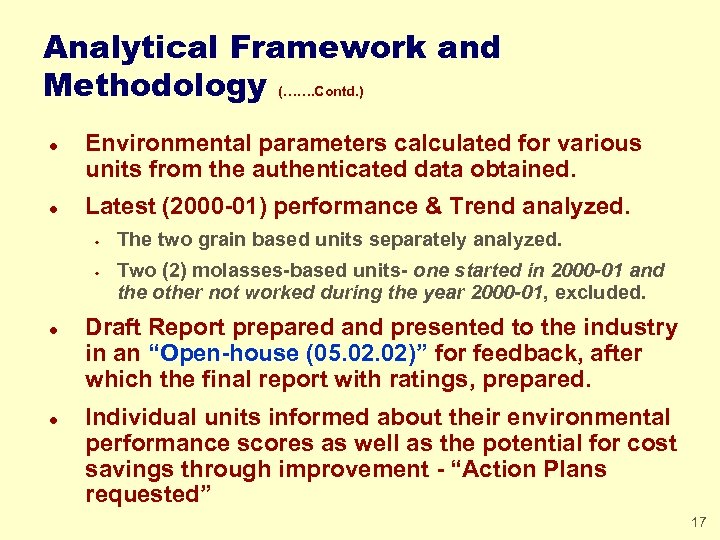 Analytical Framework and Methodology (……. Contd. ) l l Environmental parameters calculated for various units from the authenticated data obtained. Latest (2000 -01) performance & Trend analyzed. w w l l The two grain based units separately analyzed. Two (2) molasses-based units- one started in 2000 -01 and the other not worked during the year 2000 -01, excluded. Draft Report prepared and presented to the industry in an “Open-house (05. 02)” for feedback, after which the final report with ratings, prepared. Individual units informed about their environmental performance scores as well as the potential for cost savings through improvement - “Action Plans requested” 17
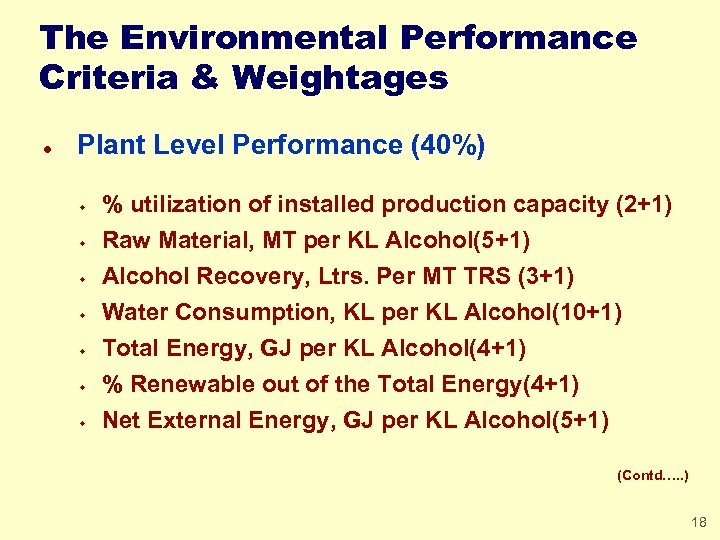 The Environmental Performance Criteria & Weightages l Plant Level Performance (40%) w w w w % utilization of installed production capacity (2+1) Raw Material, MT per KL Alcohol(5+1) Alcohol Recovery, Ltrs. Per MT TRS (3+1) Water Consumption, KL per KL Alcohol(10+1) Total Energy, GJ per KL Alcohol(4+1) % Renewable out of the Total Energy(4+1) Net External Energy, GJ per KL Alcohol(5+1) (Contd…. . ) 18
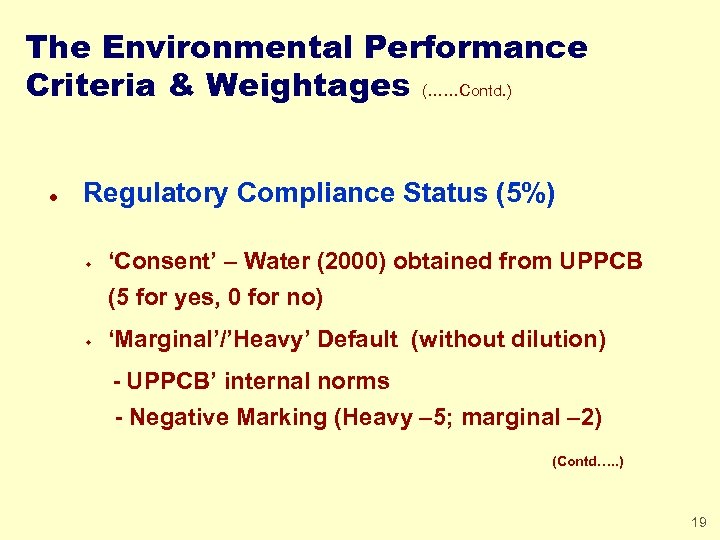 The Environmental Performance Criteria & Weightages (……Contd. ) l Regulatory Compliance Status (5%) w w ‘Consent’ – Water (2000) obtained from UPPCB (5 for yes, 0 for no) ‘Marginal’/’Heavy’ Default (without dilution) - UPPCB’ internal norms - Negative Marking (Heavy – 5; marginal – 2) (Contd…. . ) 19
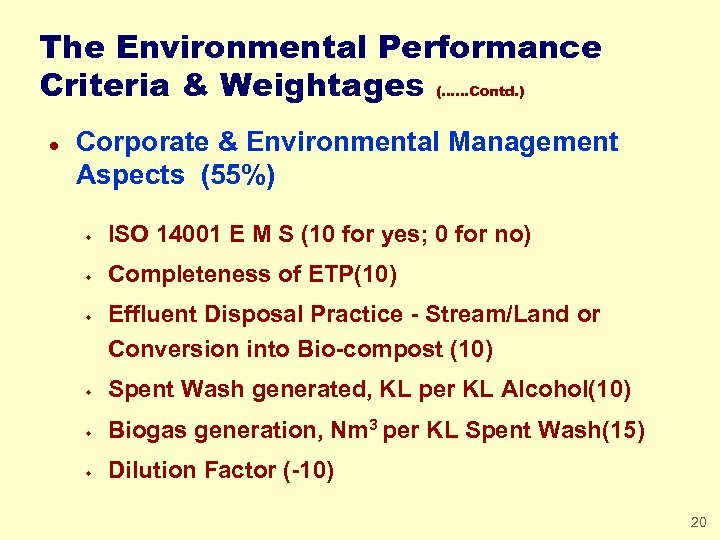 The Environmental Performance Criteria & Weightages (……Contd. ) l Corporate & Environmental Management Aspects (55%) w ISO 14001 E M S (10 for yes; 0 for no) w Completeness of ETP(10) w Effluent Disposal Practice - Stream/Land or Conversion into Bio-compost (10) w Spent Wash generated, KL per KL Alcohol(10) w Biogas generation, Nm 3 per KL Spent Wash(15) w Dilution Factor (-10) 20
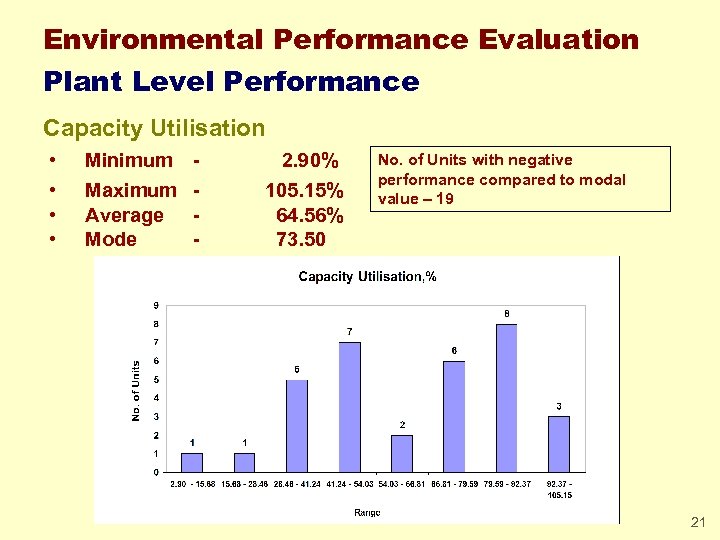 Environmental Performance Evaluation Plant Level Performance Capacity Utilisation • • Minimum Maximum Average Mode - 2. 90% 105. 15% 64. 56% 73. 50 No. of Units with negative performance compared to modal value – 19 21
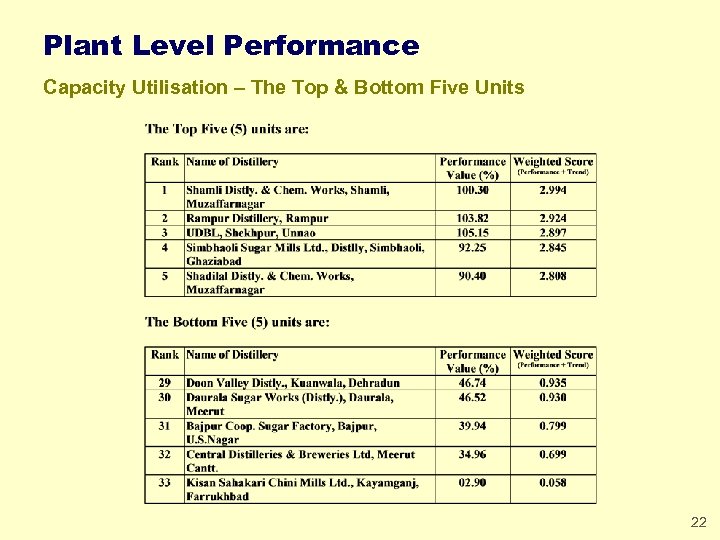 Plant Level Performance Capacity Utilisation – The Top & Bottom Five Units 22
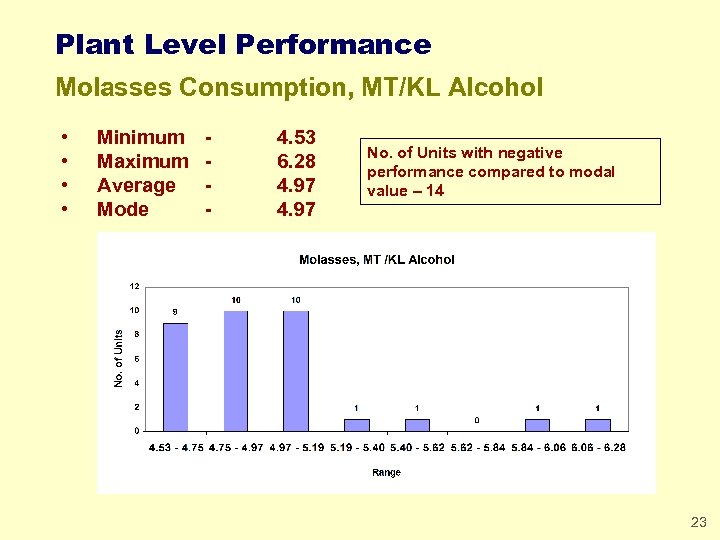 Plant Level Performance Molasses Consumption, MT/KL Alcohol • • Minimum Maximum Average Mode - 4. 53 6. 28 4. 97 No. of Units with negative performance compared to modal value – 14 23
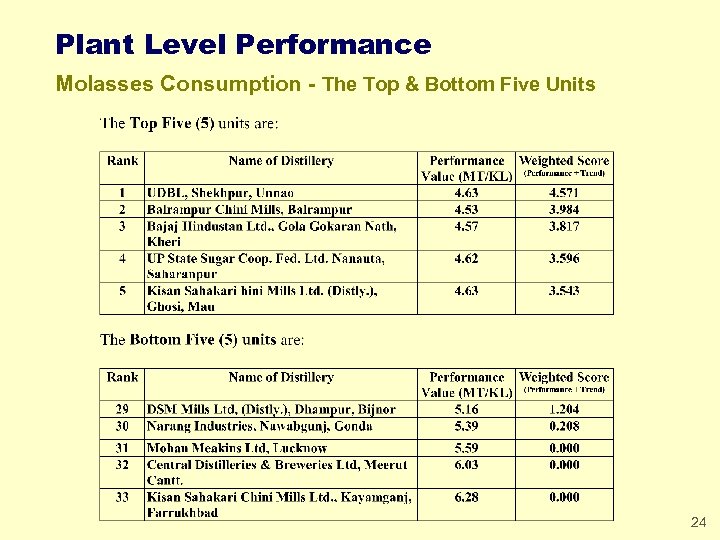 Plant Level Performance Molasses Consumption - The Top & Bottom Five Units 24
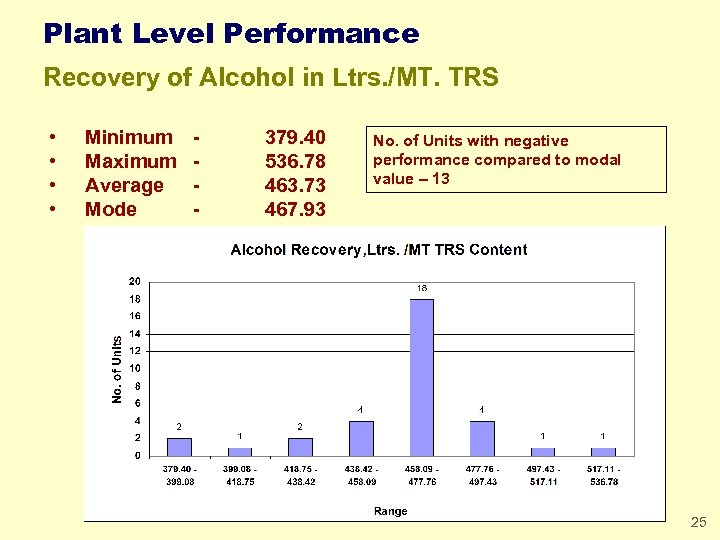 Plant Level Performance Recovery of Alcohol in Ltrs. /MT. TRS • • Minimum Maximum Average Mode - 379. 40 536. 78 463. 73 467. 93 No. of Units with negative performance compared to modal value – 13 25
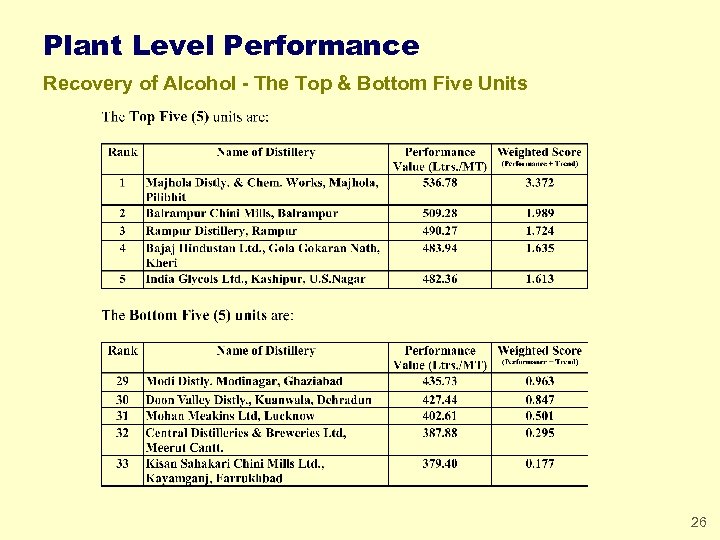 Plant Level Performance Recovery of Alcohol - The Top & Bottom Five Units 26
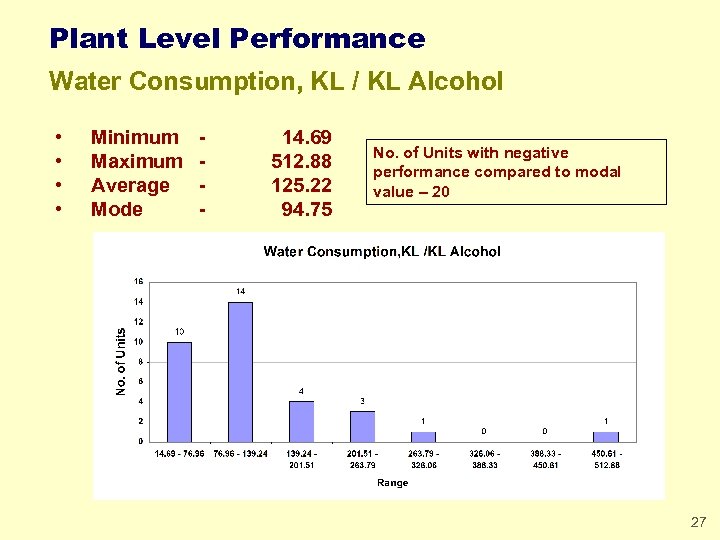 Plant Level Performance Water Consumption, KL / KL Alcohol • • Minimum Maximum Average Mode - 14. 69 512. 88 125. 22 94. 75 No. of Units with negative performance compared to modal value – 20 27
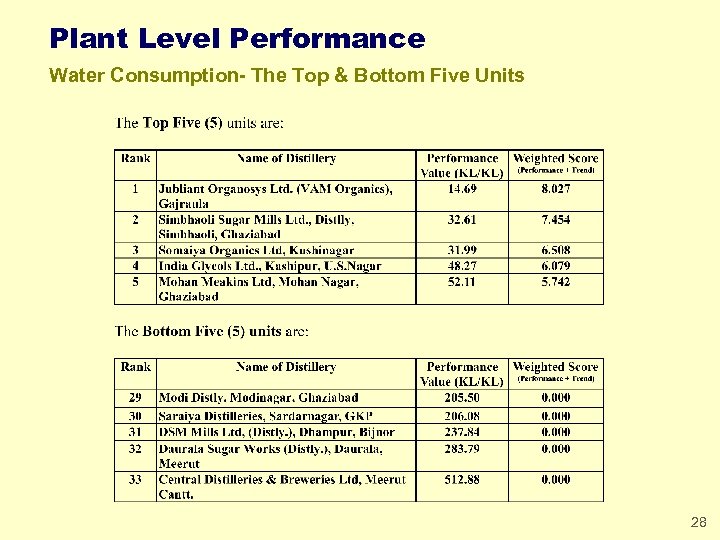 Plant Level Performance Water Consumption- The Top & Bottom Five Units 28
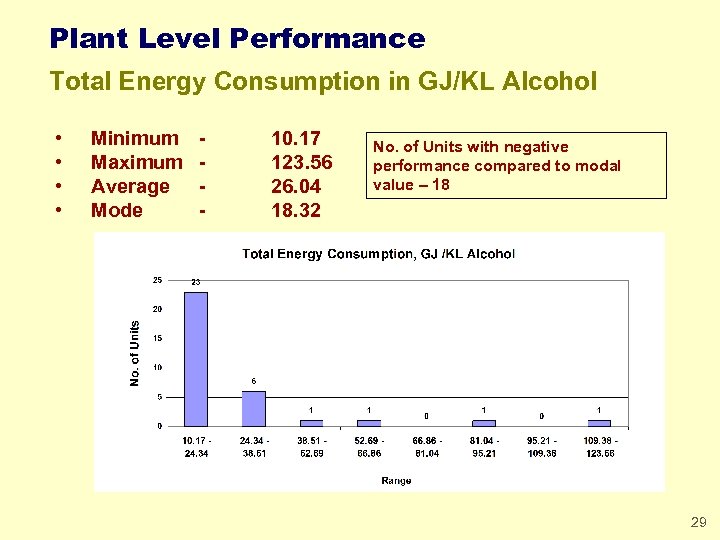 Plant Level Performance Total Energy Consumption in GJ/KL Alcohol • • Minimum Maximum Average Mode - 10. 17 123. 56 26. 04 18. 32 No. of Units with negative performance compared to modal value – 18 29
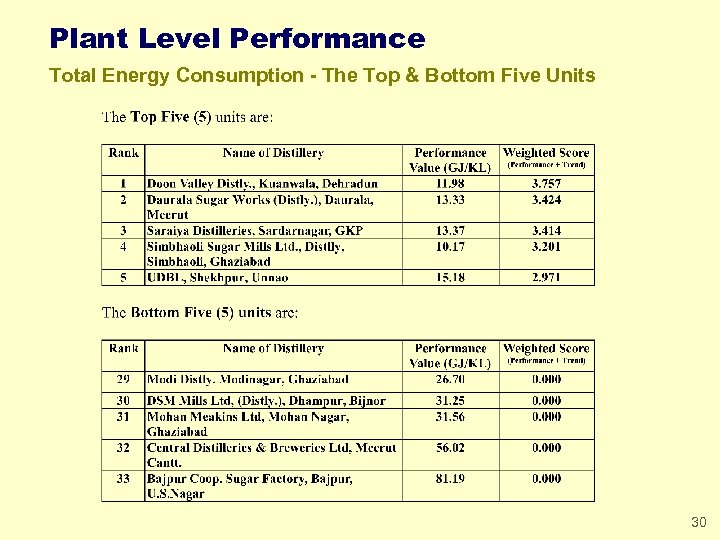 Plant Level Performance Total Energy Consumption - The Top & Bottom Five Units 30
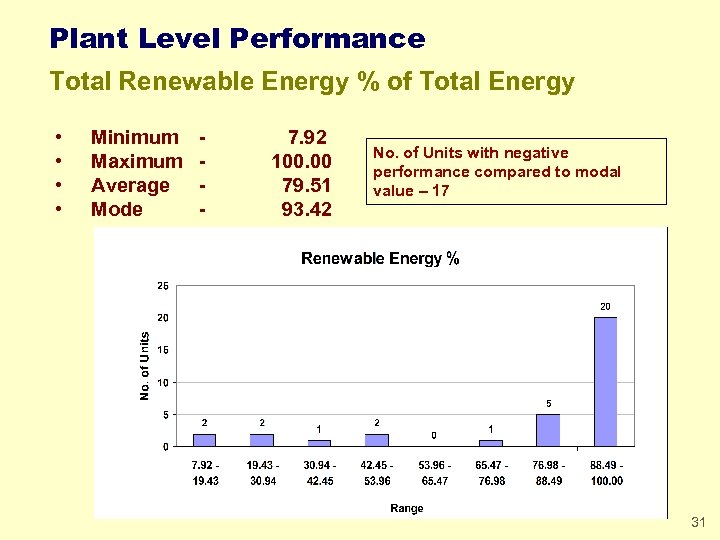 Plant Level Performance Total Renewable Energy % of Total Energy • • Minimum Maximum Average Mode - 7. 92 100. 00 79. 51 93. 42 No. of Units with negative performance compared to modal value – 17 31
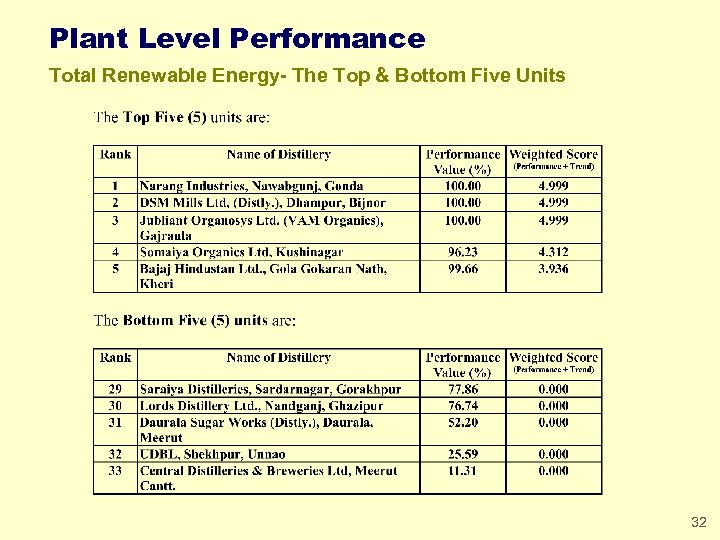 Plant Level Performance Total Renewable Energy- The Top & Bottom Five Units 32
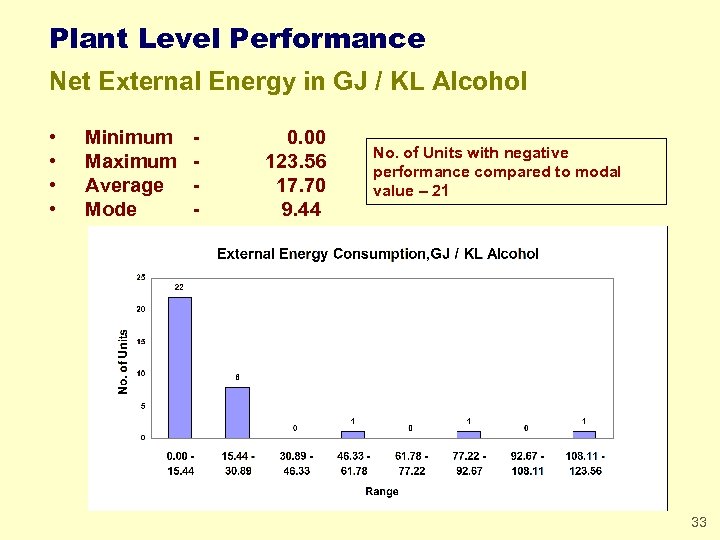 Plant Level Performance Net External Energy in GJ / KL Alcohol • • Minimum Maximum Average Mode - 0. 00 123. 56 17. 70 9. 44 No. of Units with negative performance compared to modal value – 21 33
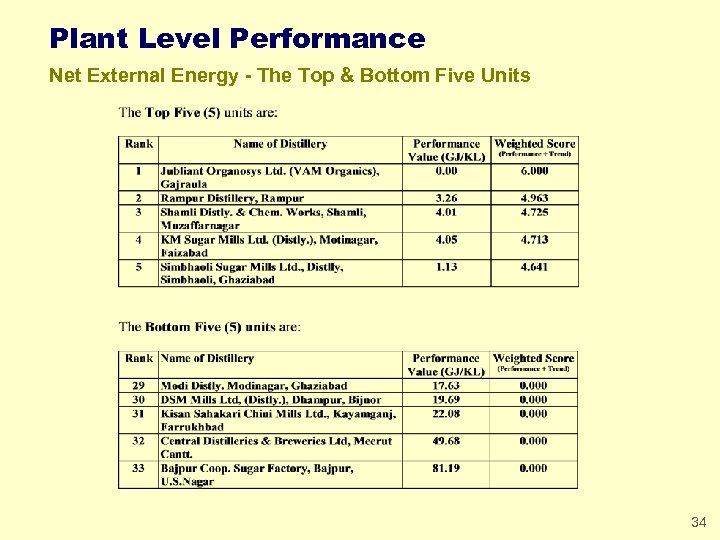 Plant Level Performance Net External Energy - The Top & Bottom Five Units 34
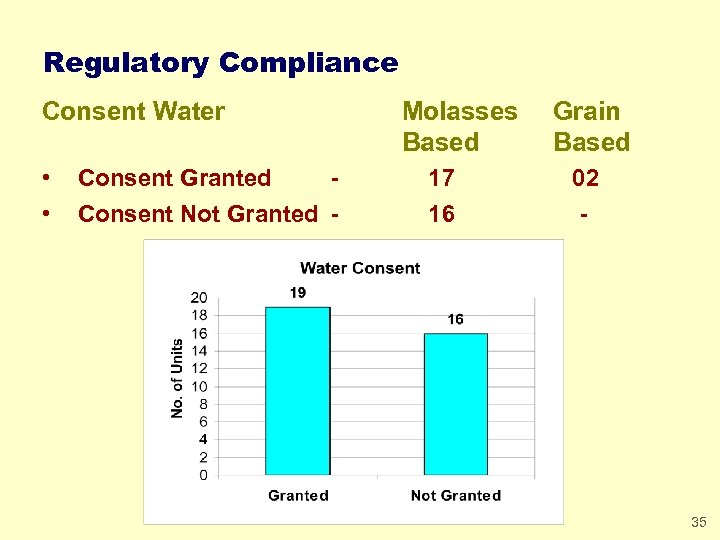 Regulatory Compliance Consent Water • • Consent Granted Consent Not Granted - Molasses Based 17 16 Grain Based 02 - 35
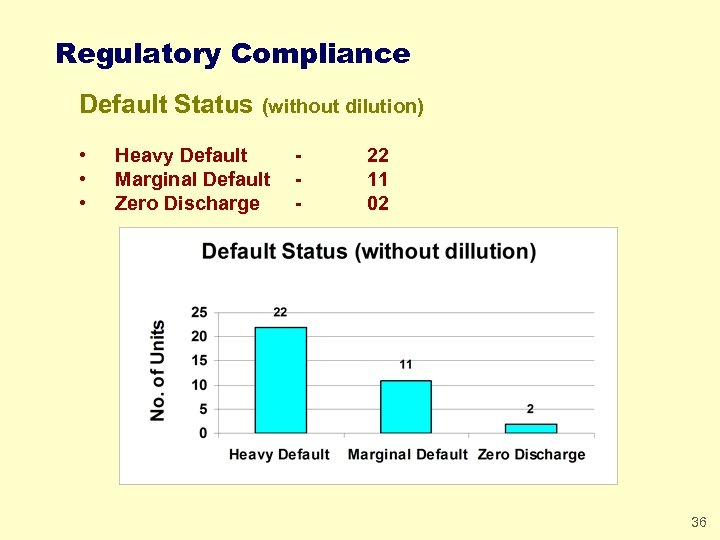 Regulatory Compliance Default Status • • • (without dilution) Heavy Default Marginal Default Zero Discharge - 22 11 02 36
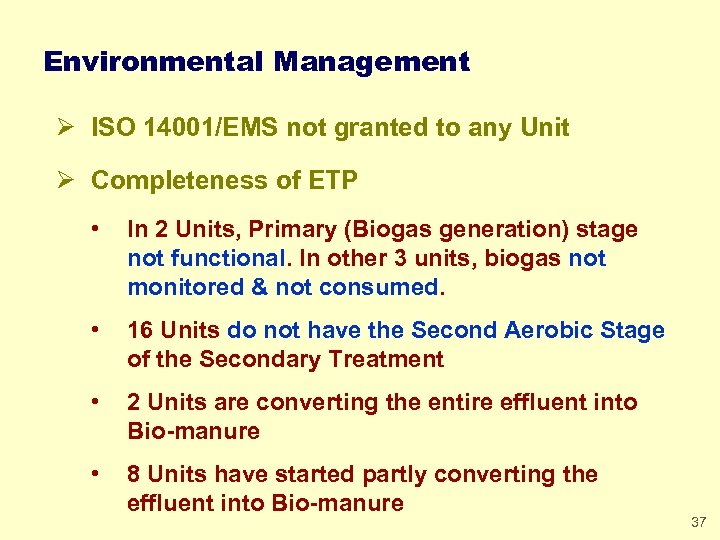 Environmental Management Ø ISO 14001/EMS not granted to any Unit Ø Completeness of ETP • In 2 Units, Primary (Biogas generation) stage not functional. In other 3 units, biogas not monitored & not consumed. • 16 Units do not have the Second Aerobic Stage of the Secondary Treatment • 2 Units are converting the entire effluent into Bio-manure • 8 Units have started partly converting the effluent into Bio-manure 37
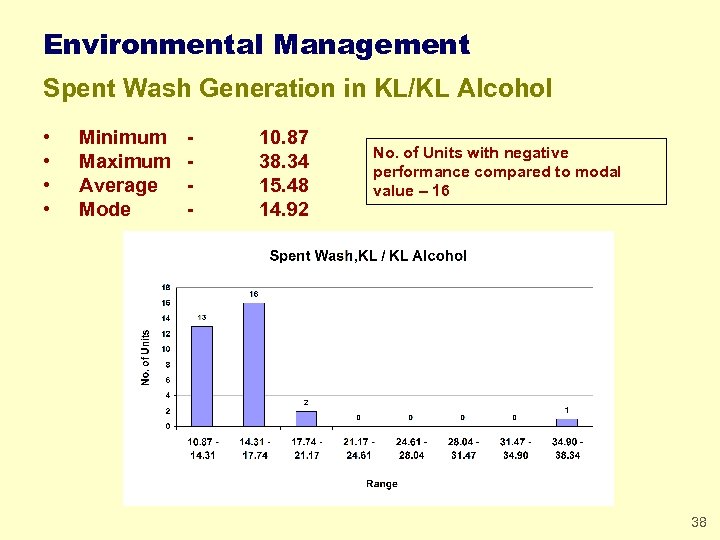 Environmental Management Spent Wash Generation in KL/KL Alcohol • • Minimum Maximum Average Mode - 10. 87 38. 34 15. 48 14. 92 No. of Units with negative performance compared to modal value – 16 38
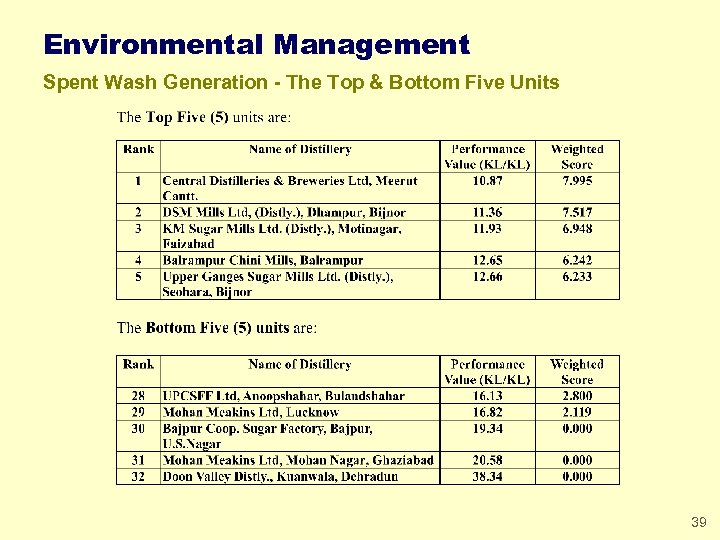 Environmental Management Spent Wash Generation - The Top & Bottom Five Units 39
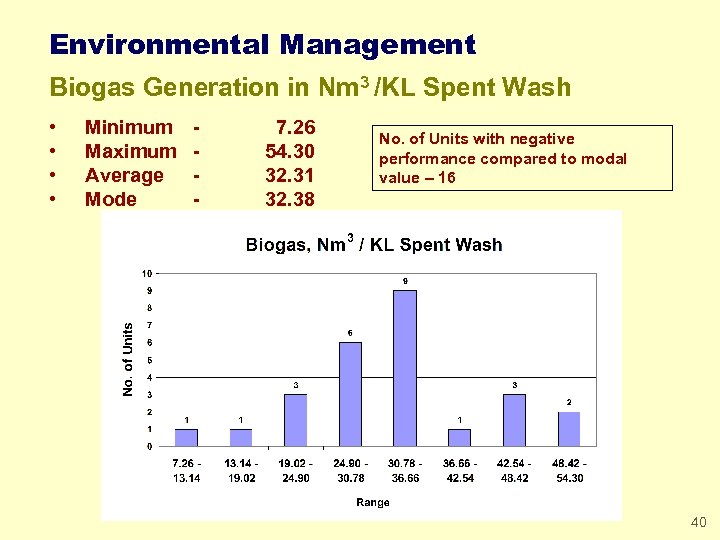 Environmental Management Biogas Generation in Nm 3 /KL Spent Wash • • Minimum Maximum Average Mode - 7. 26 54. 30 32. 31 32. 38 No. of Units with negative performance compared to modal value – 16 40
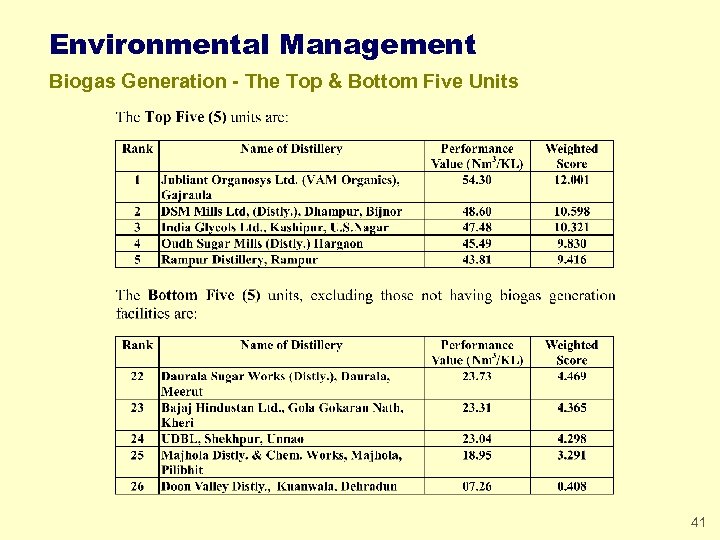 Environmental Management Biogas Generation - The Top & Bottom Five Units 41
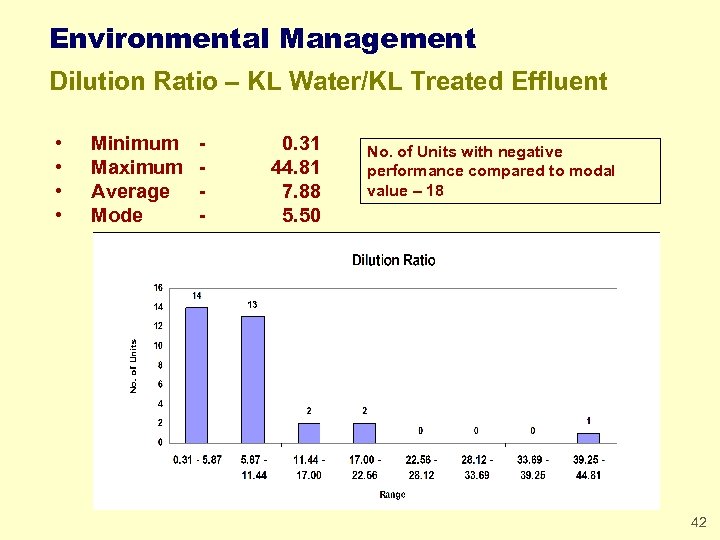 Environmental Management Dilution Ratio – KL Water/KL Treated Effluent • • Minimum Maximum Average Mode - 0. 31 44. 81 7. 88 5. 50 No. of Units with negative performance compared to modal value – 18 42
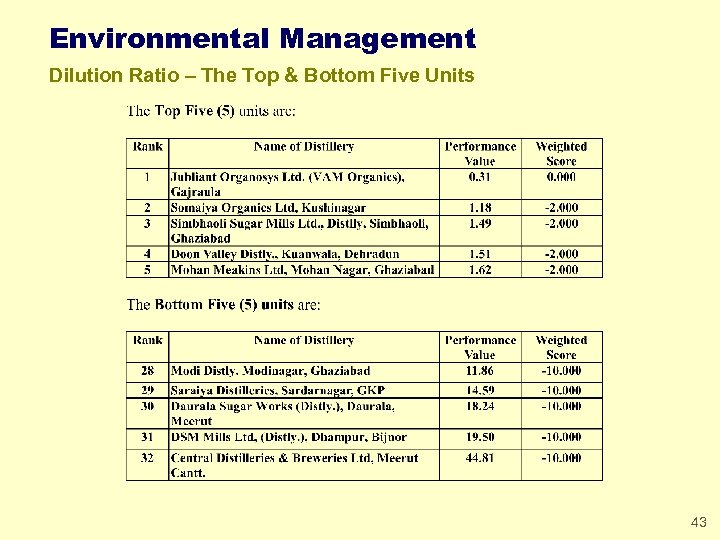 Environmental Management Dilution Ratio – The Top & Bottom Five Units 43
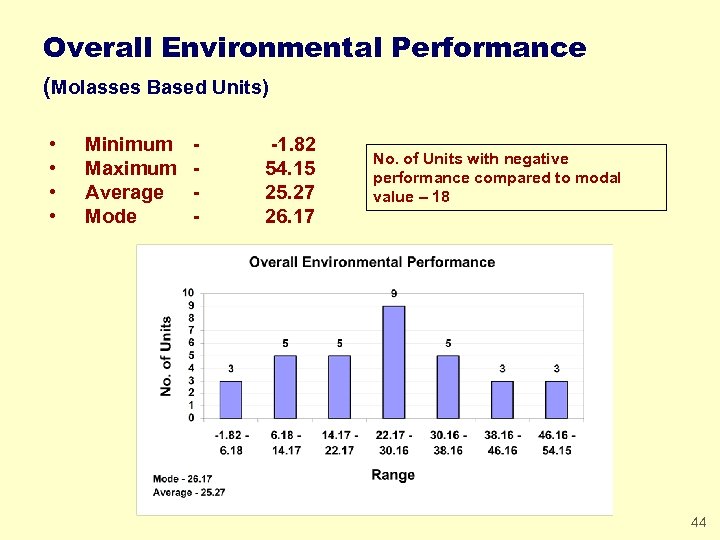 Overall Environmental Performance (Molasses Based Units) • • Minimum Maximum Average Mode - -1. 82 54. 15 25. 27 26. 17 No. of Units with negative performance compared to modal value – 18 44
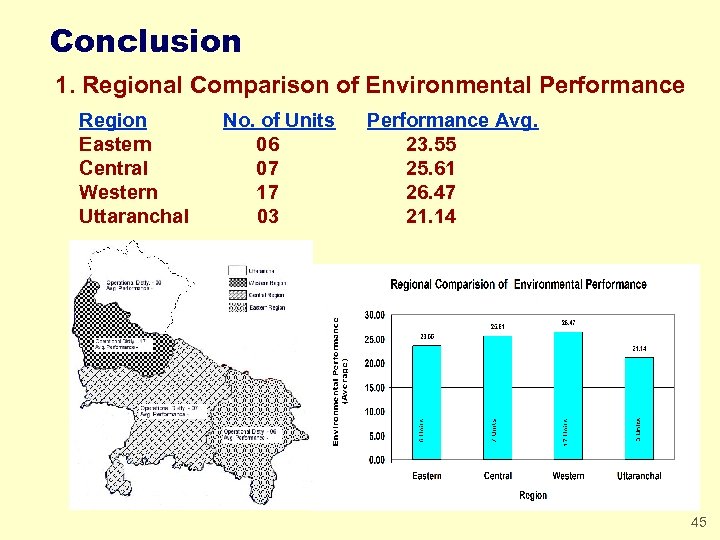 Conclusion 1. Regional Comparison of Environmental Performance Region Eastern Central Western Uttaranchal No. of Units 06 07 17 03 Performance Avg. 23. 55 25. 61 26. 47 21. 14 45
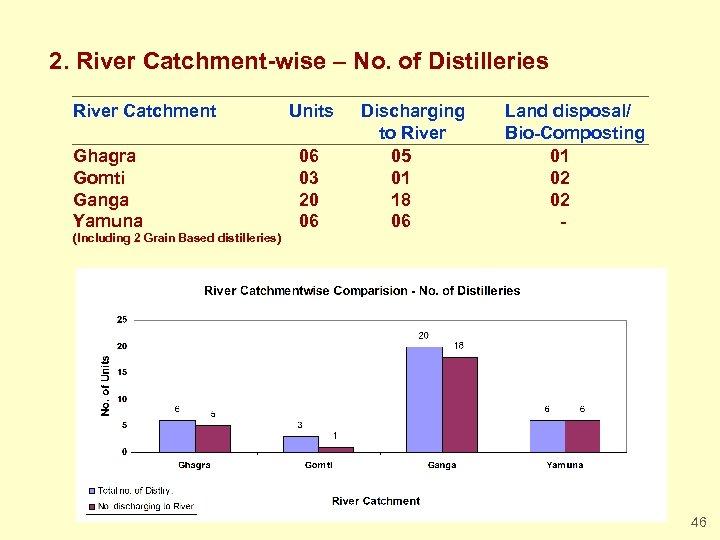 2. River Catchment-wise – No. of Distilleries River Catchment Ghagra Gomti Ganga Yamuna Units 06 03 20 06 Discharging to River 05 01 18 06 Land disposal/ Bio-Composting 01 02 02 - (Including 2 Grain Based distilleries) 46
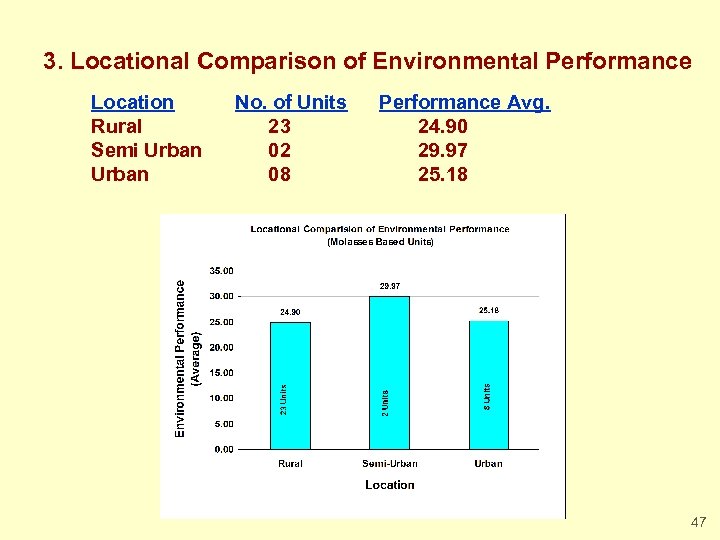 3. Locational Comparison of Environmental Performance Location Rural Semi Urban No. of Units 23 02 08 Performance Avg. 24. 90 29. 97 25. 18 47
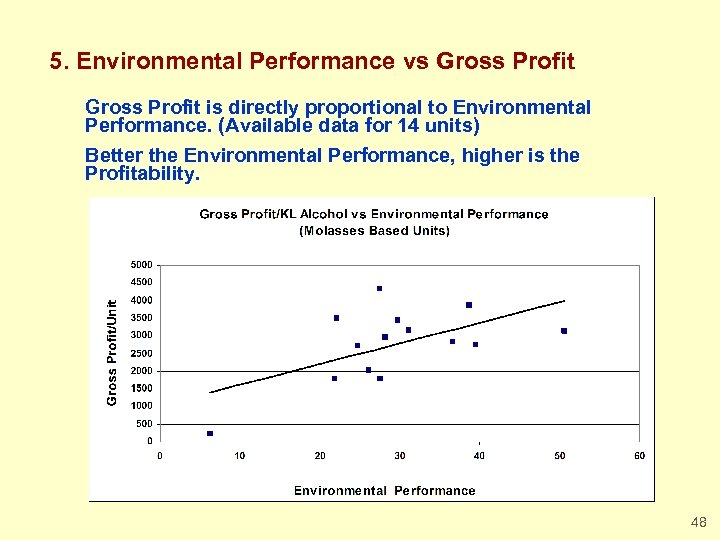 5. Environmental Performance vs Gross Profit is directly proportional to Environmental Performance. (Available data for 14 units) Better the Environmental Performance, higher is the Profitability. 48
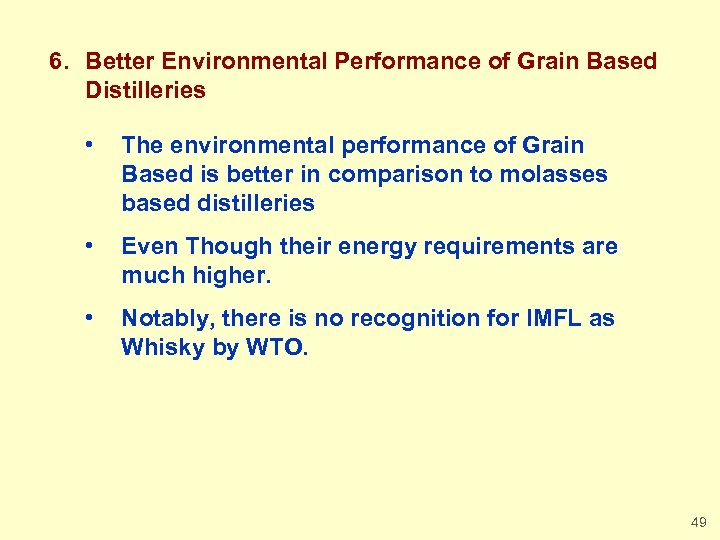 6. Better Environmental Performance of Grain Based Distilleries • The environmental performance of Grain Based is better in comparison to molasses based distilleries • Even Though their energy requirements are much higher. • Notably, there is no recognition for IMFL as Whisky by WTO. 49
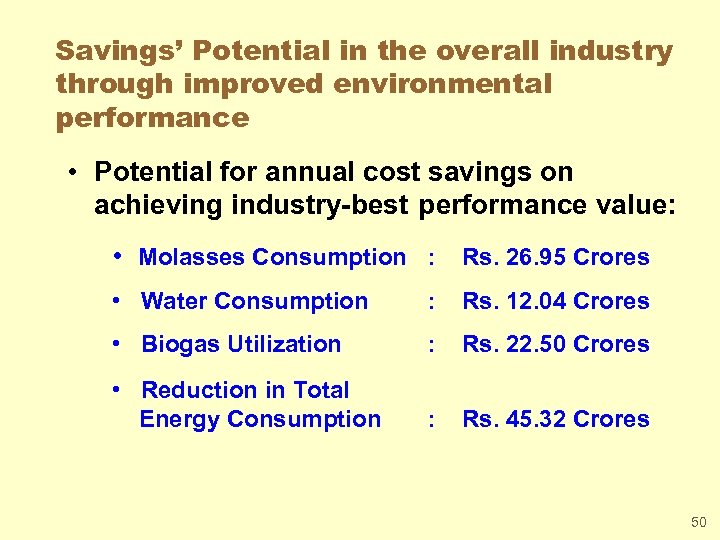 Savings’ Potential in the overall industry through improved environmental performance • Potential for annual cost savings on achieving industry-best performance value: • Molasses Consumption : Rs. 26. 95 Crores • Water Consumption : Rs. 12. 04 Crores • Biogas Utilization : Rs. 22. 50 Crores • Reduction in Total Energy Consumption : Rs. 45. 32 Crores 50
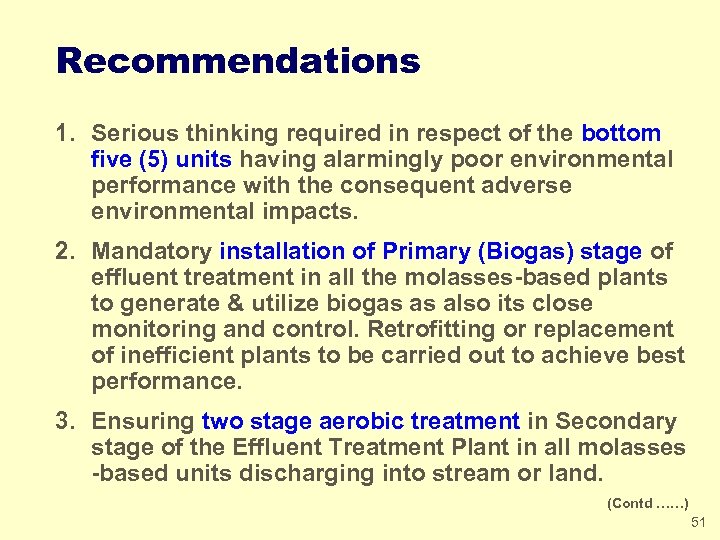 Recommendations 1. Serious thinking required in respect of the bottom five (5) units having alarmingly poor environmental performance with the consequent adverse environmental impacts. 2. Mandatory installation of Primary (Biogas) stage of effluent treatment in all the molasses-based plants to generate & utilize biogas as also its close monitoring and control. Retrofitting or replacement of inefficient plants to be carried out to achieve best performance. 3. Ensuring two stage aerobic treatment in Secondary stage of the Effluent Treatment Plant in all molasses -based units discharging into stream or land. (Contd ……) 51
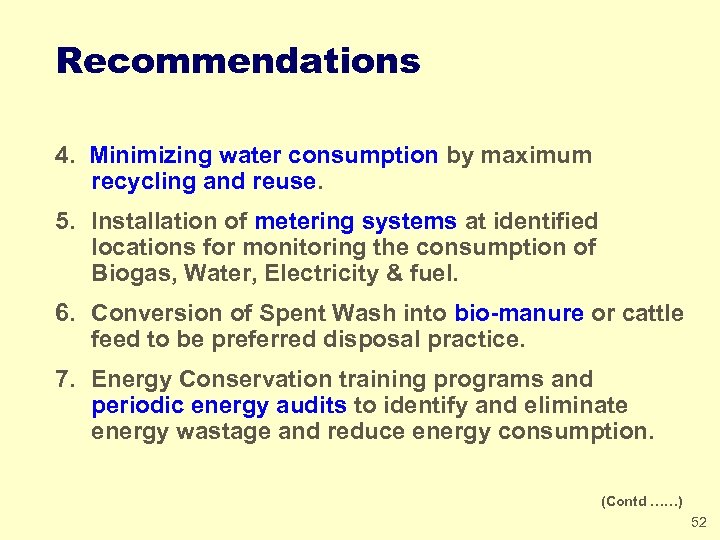 Recommendations 4. Minimizing water consumption by maximum recycling and reuse. 5. Installation of metering systems at identified locations for monitoring the consumption of Biogas, Water, Electricity & fuel. 6. Conversion of Spent Wash into bio-manure or cattle feed to be preferred disposal practice. 7. Energy Conservation training programs and periodic energy audits to identify and eliminate energy wastage and reduce energy consumption. (Contd ……) 52
 Recommendation (……. Contd. ) 8. Maximum utilization of the treated effluent for irrigation, where bio-composting is not feasible. 9. Adoption of the best available technologies in the following areas, • Fermentation • Distillation • Co-generation of steam/power • Effluent Treatment 10. Upgradation of the Management through the implementation of : • • ISO 14001 Environmental Management System ISO 9001 Quality Management System 53
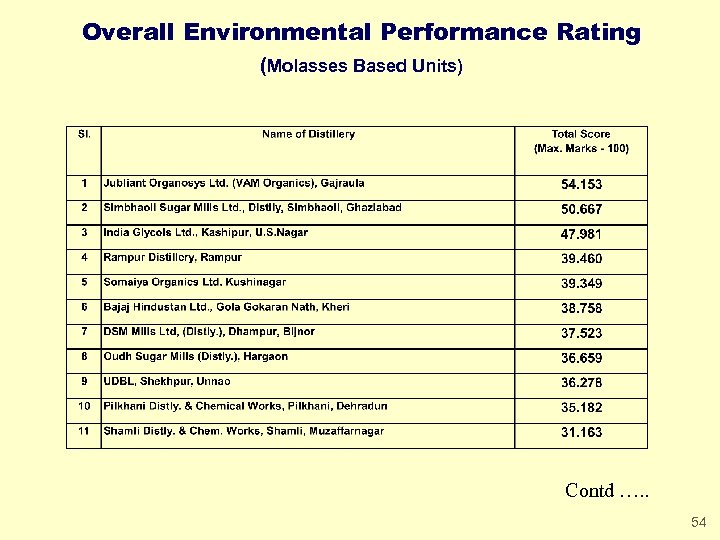 Overall Environmental Performance Rating (Molasses Based Units) Contd …. . 54
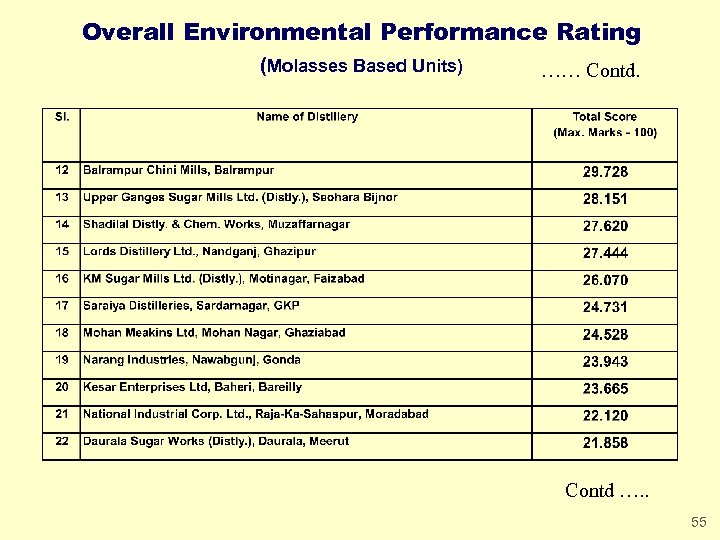 Overall Environmental Performance Rating (Molasses Based Units) …… Contd …. . 55
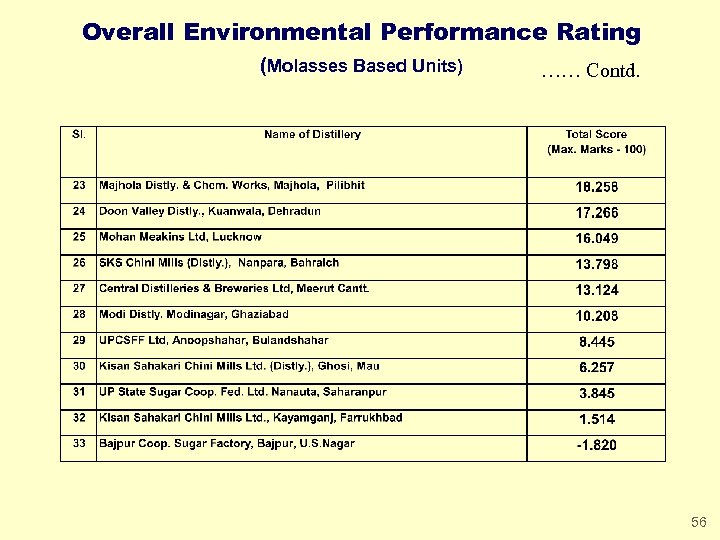 Overall Environmental Performance Rating (Molasses Based Units) …… Contd. 56
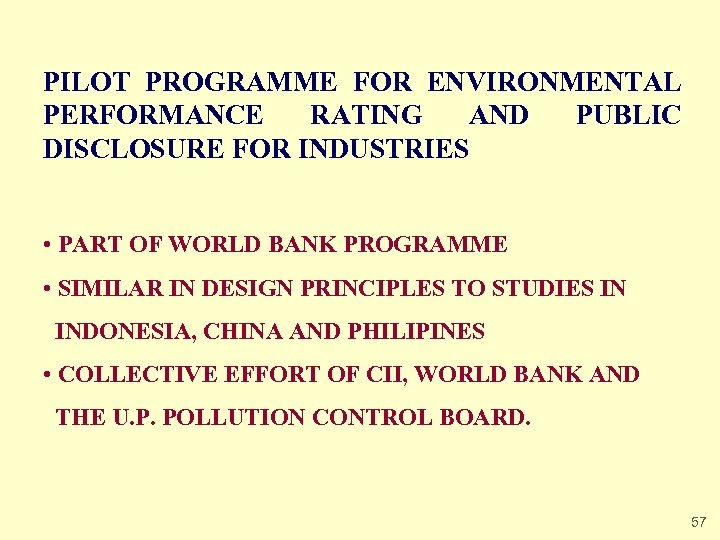 PILOT PROGRAMME FOR ENVIRONMENTAL PERFORMANCE RATING AND PUBLIC DISCLOSURE FOR INDUSTRIES • PART OF WORLD BANK PROGRAMME • SIMILAR IN DESIGN PRINCIPLES TO STUDIES IN INDONESIA, CHINA AND PHILIPINES • COLLECTIVE EFFORT OF CII, WORLD BANK AND THE U. P. POLLUTION CONTROL BOARD. 57
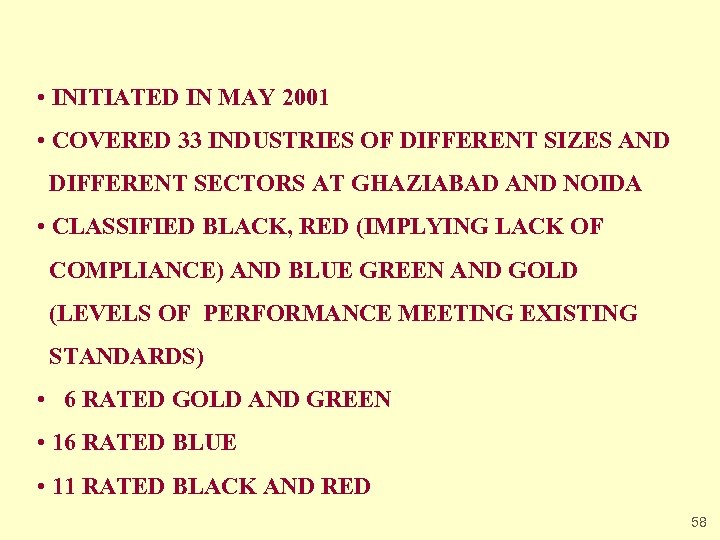 • INITIATED IN MAY 2001 • COVERED 33 INDUSTRIES OF DIFFERENT SIZES AND DIFFERENT SECTORS AT GHAZIABAD AND NOIDA • CLASSIFIED BLACK, RED (IMPLYING LACK OF COMPLIANCE) AND BLUE GREEN AND GOLD (LEVELS OF PERFORMANCE MEETING EXISTING STANDARDS) • 6 RATED GOLD AND GREEN • 16 RATED BLUE • 11 RATED BLACK AND RED 58
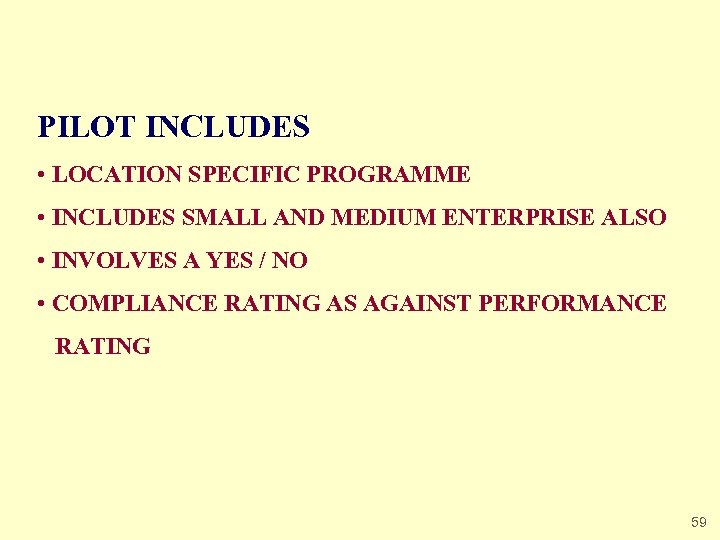 PILOT INCLUDES • LOCATION SPECIFIC PROGRAMME • INCLUDES SMALL AND MEDIUM ENTERPRISE ALSO • INVOLVES A YES / NO • COMPLIANCE RATING AS AGAINST PERFORMANCE RATING 59
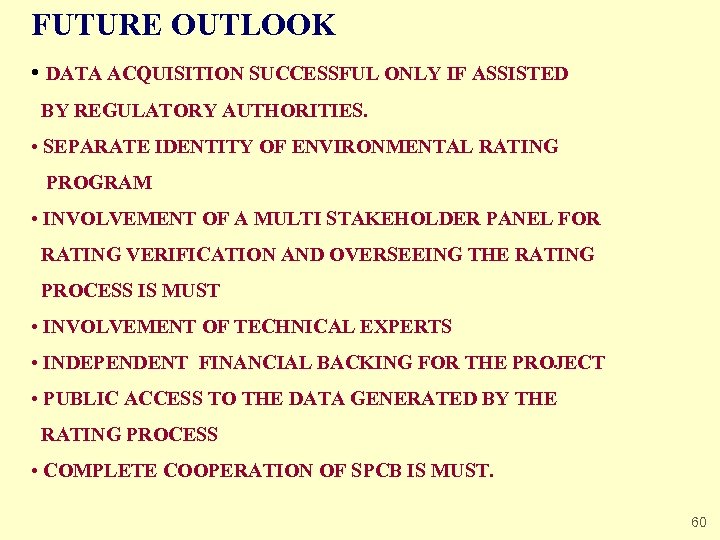 FUTURE OUTLOOK • DATA ACQUISITION SUCCESSFUL ONLY IF ASSISTED BY REGULATORY AUTHORITIES. • SEPARATE IDENTITY OF ENVIRONMENTAL RATING PROGRAM • INVOLVEMENT OF A MULTI STAKEHOLDER PANEL FOR RATING VERIFICATION AND OVERSEEING THE RATING PROCESS IS MUST • INVOLVEMENT OF TECHNICAL EXPERTS • INDEPENDENT FINANCIAL BACKING FOR THE PROJECT • PUBLIC ACCESS TO THE DATA GENERATED BY THE RATING PROCESS • COMPLETE COOPERATION OF SPCB IS MUST. 60
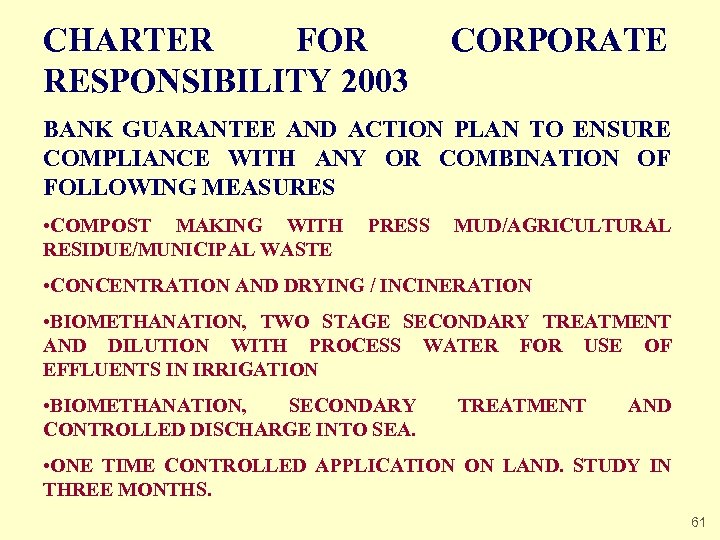 CHARTER FOR RESPONSIBILITY 2003 CORPORATE BANK GUARANTEE AND ACTION PLAN TO ENSURE COMPLIANCE WITH ANY OR COMBINATION OF FOLLOWING MEASURES • COMPOST MAKING WITH RESIDUE/MUNICIPAL WASTE PRESS MUD/AGRICULTURAL • CONCENTRATION AND DRYING / INCINERATION • BIOMETHANATION, TWO STAGE SECONDARY TREATMENT AND DILUTION WITH PROCESS WATER FOR USE OF EFFLUENTS IN IRRIGATION • BIOMETHANATION, SECONDARY CONTROLLED DISCHARGE INTO SEA. TREATMENT AND • ONE TIME CONTROLLED APPLICATION ON LAND. STUDY IN THREE MONTHS. 61
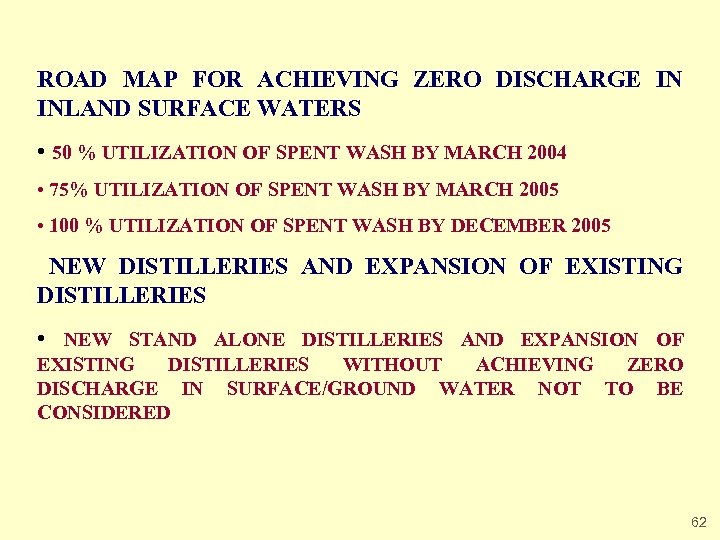 ROAD MAP FOR ACHIEVING ZERO DISCHARGE IN INLAND SURFACE WATERS • 50 % UTILIZATION OF SPENT WASH BY MARCH 2004 • 75% UTILIZATION OF SPENT WASH BY MARCH 2005 • 100 % UTILIZATION OF SPENT WASH BY DECEMBER 2005 NEW DISTILLERIES AND EXPANSION OF EXISTING DISTILLERIES • NEW STAND ALONE DISTILLERIES AND EXPANSION OF EXISTING DISTILLERIES WITHOUT ACHIEVING ZERO DISCHARGE IN SURFACE/GROUND WATER NOT TO BE CONSIDERED 62
 THANK YOU 63