


 Скачать презентацию Environmental Monitoring моніторинг довкілля Environmental Control
Презентация1 mon.pptx
- Количество слайдов: 12
 Environmental Monitoring – моніторинг довкілля Environmental Control – контроль за навколишнім середовищем Measurements - вимірювання Observations – спостереження State of the environment – стан навколишнього середовища Changes of the environment – зміни навколишнього середовища Evaluation – оцінка Analysis – аналіз Environmental data – дані щодо стану навколишнього середовища Warning system – система попередження
 Forecast (or prediction) of the environmental consequences – прогноз екологічних наслідків Management decisions – управлінські рішення Sampling – відбір проб Environmental regulations - екологічні норми Anthropogenic influence - антропогенний вплив Reliable information – надійна інформація Verifiable information – достовірна інформація Set of criteria – система показників Permissible environmental loads – допустимі навантаження на навколишнє середовище
 A total system for environmental control includes three basic types of activity. The first involves measurements and observations directed towards a description of the state of the environment and its changes. The second activity is the evaluation and analysis of environmental data to determine possible trends and to develop a warning system related to pre-set criteria. This specifically includes functions such as predictions of the environmental consequences of planned actions, descriptions of the budget of contaminants and the analysis of ecosystems, determination of environmental criteria for specific pollutants, and the formulation of recommendations for actions.
 The third and final activity in the total system is that of action, designed to avoid environmental deterioration but in the overall context of achieving environmental management in the most beneficial way. Global environmental monitoring or ''monitoring'' describes as activities of the first type listed above. Accordingly, monitoring is defined as, "a scientifically designed system of continuing measurements and observations. "
 Environmental monitoring can be defined as the systematic sampling of air, water, soil, and biota in order to observe and study the environment, as well as to derive knowledge from this process (Artiola et al. , 2004; Wiersma, 2004). Monitoring can be conducted for a number of purposes, including to establish environmental “baselines, trends, and cumulative effects”, to test environmental modeling processes, to educate the public about environmental conditions, to inform policy design and decision-making, to ensure compliance with environmental regulations, to assess the effects of anthropogenic influences, or to conduct an inventory of natural resources (Mitchell, 2002).
 Environmental monitoring is defined as "an activity undertaken to provide specific information on the characteristics and functions of environmental and social variables in space and time“. The British Standard EN ISO 14031: 1999 defines Environmental Performance Evaluation (EPE) as an internal management process and tool designed to provide environmental management with reliable and verifiable information on an ongoing basis to determine whether an organization’s environmental performance is meeting the criteria set by the management of the organisation.
 Environmental monitoring may be defined according to DWAF’s Integrated Environmental Management Framework (IEMF) as “the repetitive and continued observation, measurement and evaluation of environmental data to follow changes over a period of time to assess the efficiency of control measures”.
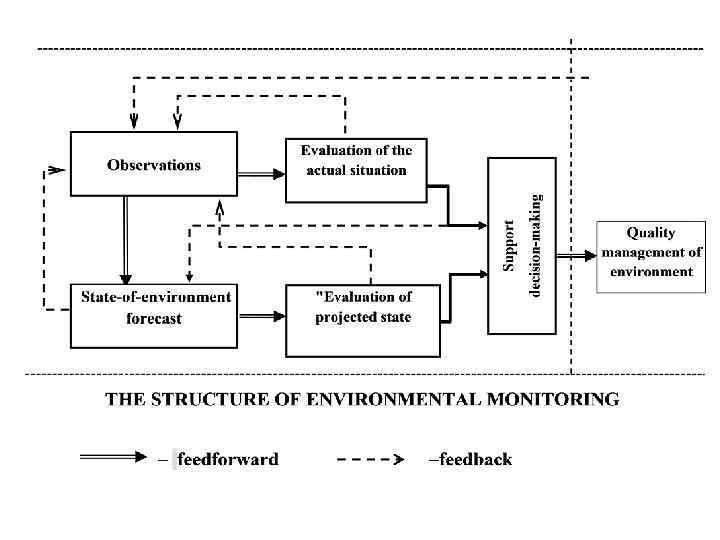
 Environmental monitoring is analytical information system that covers the following main areas: 1) observation of the environment and the factors that affect the separate elements of the environment; 2) evaluation and analysis of the actual state of all components of the environment; 3) forecast of the state of environment and evaluation of the environmental condition; 4) providing scientific information to support for management decision making.
 Universal approach for determining the structure of the monitoring system of anthropogenic changes in the environment is its division into basic blocks: "Observations", "Evaluation of the actual situation (current state)", "State-of-environment forecast", "Evaluation of projected state" "Support for decision-making".
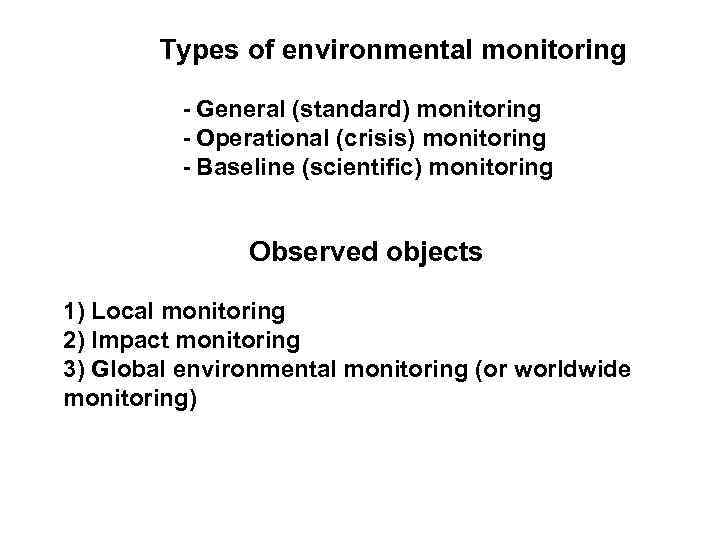 Types of environmental monitoring - General (standard) monitoring - Operational (crisis) monitoring - Baseline (scientific) monitoring Observed objects 1) Local monitoring 2) Impact monitoring 3) Global environmental monitoring (or worldwide monitoring)
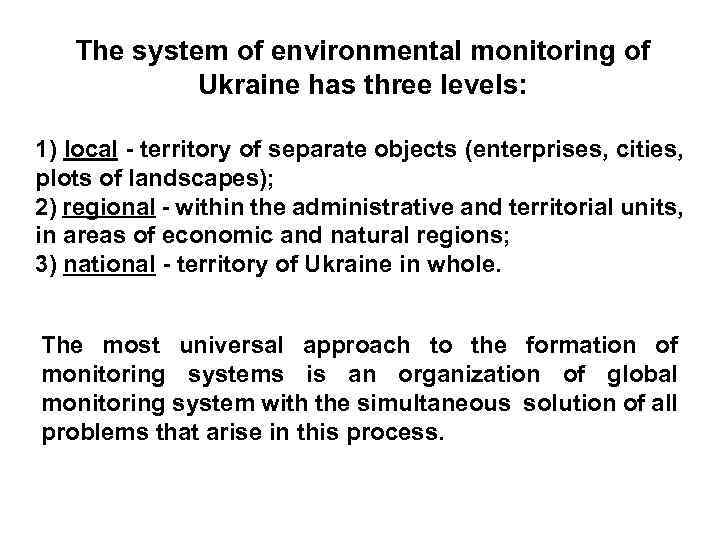 The system of environmental monitoring of Ukraine has three levels: 1) local - territory of separate objects (enterprises, cities, plots of landscapes); 2) regional - within the administrative and territorial units, in areas of economic and natural regions; 3) national - territory of Ukraine in whole. The most universal approach to the formation of monitoring systems is an organization of global monitoring system with the simultaneous solution of all problems that arise in this process.