 Скачать презентацию Environmental Fund for Lebanon Legal and Technical Frameworks
740166d8941461bd572ec584a9c68892.ppt
- Количество слайдов: 36



Environmental Fund for Lebanon Legal and Technical Frameworks for Environmental Compliance in Lebanon 17 June 2011 Monroe Hotel - Beirut
Industries in Lebanon Most industries are small or medium sized More than 90% employ <10 people (Mo. I, 2000) Workforce of 114, 000 people Until April 2001, 3 classes of industrial establishments depending on degree of environmental threat (decree 4917) At present amended to 5 industrial classes (class 1 serious, 2 significant, 3 limited, 4 insignificant, 5 no risk) (decree 5243) Large number of not permitted but existing facilities
Environmental Problems and Challenges Uncontrolled dumping of industrial solid waste Lack of industrial effluent treatment facilities Uncontrolled emissions into the atmosphere Heavy consumption of water Occupational health related problems High production costs
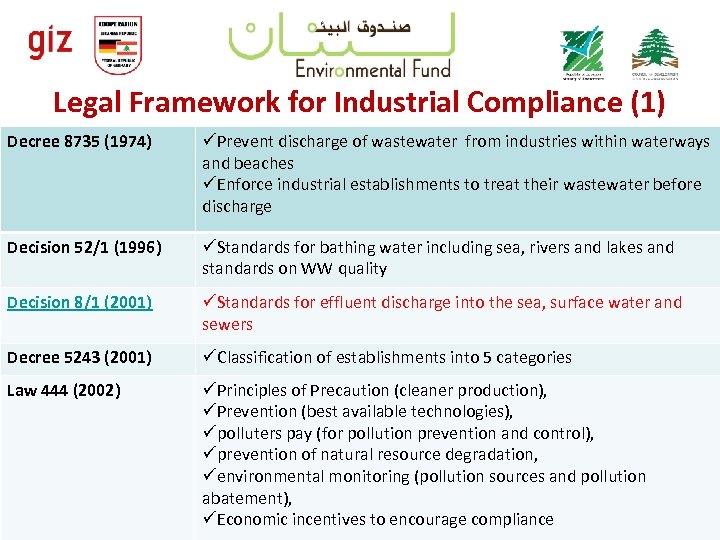
Legal Framework for Industrial Compliance (1) Decree 8735 (1974) üPrevent discharge of wastewater from industries within waterways and beaches üEnforce industrial establishments to treat their wastewater before discharge Decision 52/1 (1996) üStandards for bathing water including sea, rivers and lakes and standards on WW quality Decision 8/1 (2001) üStandards for effluent discharge into the sea, surface water and sewers Decree 5243 (2001) üClassification of establishments into 5 categories Law 444 (2002) üPrinciples of Precaution (cleaner production), üPrevention (best available technologies), üpolluters pay (for pollution prevention and control), üprevention of natural resource degradation, üenvironmental monitoring (pollution sources and pollution abatement), üEconomic incentives to encourage compliance
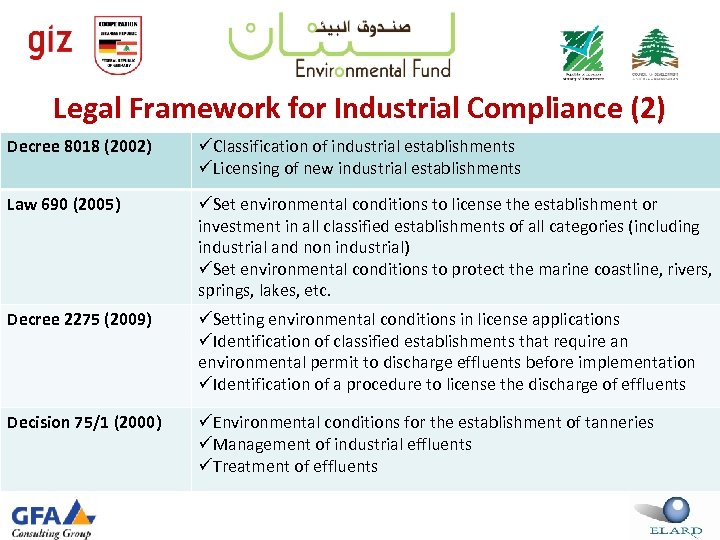
Legal Framework for Industrial Compliance (2) Decree 8018 (2002) üClassification of industrial establishments üLicensing of new industrial establishments Law 690 (2005) üSet environmental conditions to license the establishment or investment in all classified establishments of all categories (including industrial and non industrial) üSet environmental conditions to protect the marine coastline, rivers, springs, lakes, etc. Decree 2275 (2009) üSetting environmental conditions in license applications üIdentification of classified establishments that require an environmental permit to discharge effluents before implementation üIdentification of a procedure to license the discharge of effluents Decision 75/1 (2000) üEnvironmental conditions for the establishment of tanneries üManagement of industrial effluents üTreatment of effluents
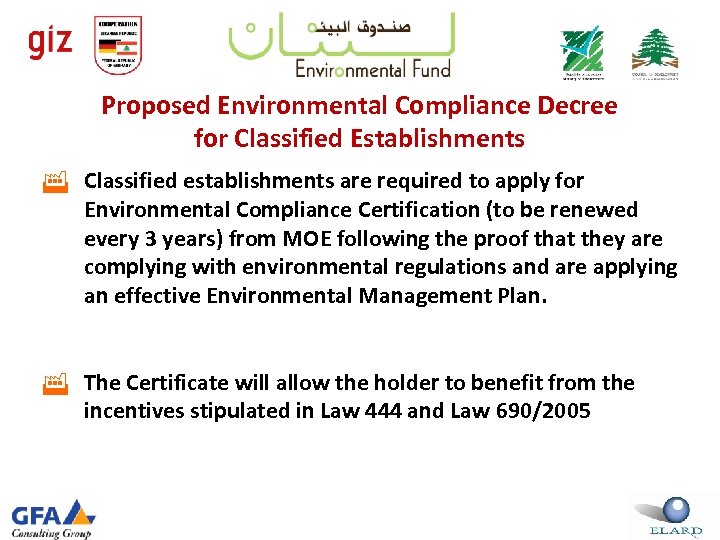
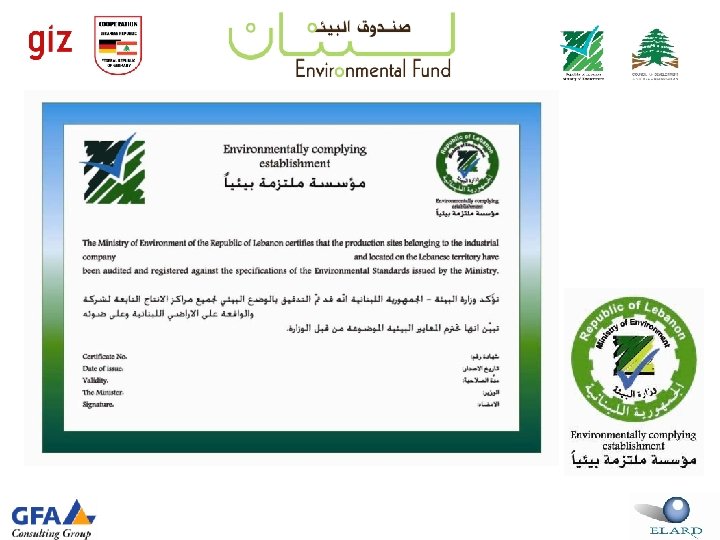
Proposed Environmental Compliance Decree for Classified Establishments Classified establishments are required to apply for Environmental Compliance Certification (to be renewed every 3 years) from MOE following the proof that they are complying with environmental regulations and are applying an effective Environmental Management Plan. The Certificate will allow the holder to benefit from the incentives stipulated in Law 444 and Law 690/2005
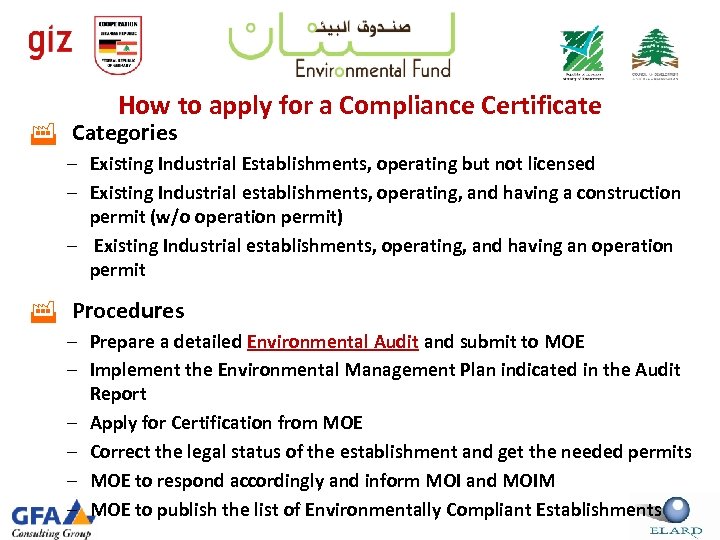
How to apply for a Compliance Certificate Categories – Existing Industrial Establishments, operating but not licensed – Existing Industrial establishments, operating, and having a construction permit (w/o operation permit) – Existing Industrial establishments, operating, and having an operation permit Procedures – Prepare a detailed Environmental Audit and submit to MOE – Implement the Environmental Management Plan indicated in the Audit Report – Apply for Certification from MOE – Correct the legal status of the establishment and get the needed permits – MOE to respond accordingly and inform MOI and MOIM – MOE to publish the list of Environmentally Compliant Establishments
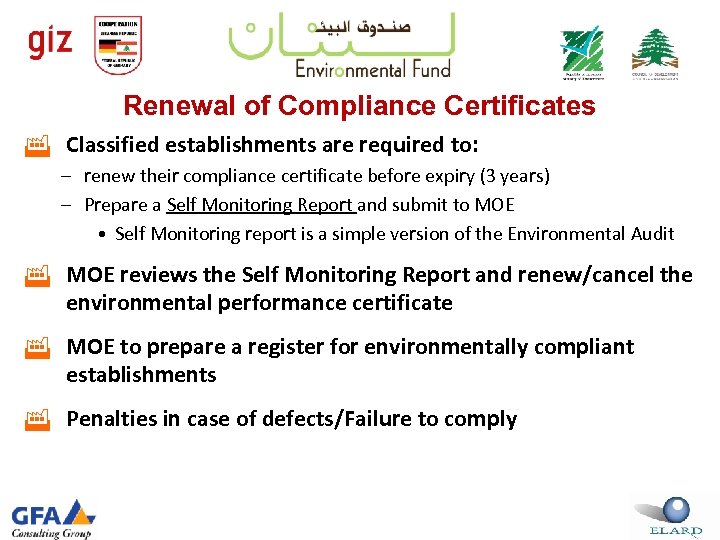
Renewal of Compliance Certificates Classified establishments are required to: – renew their compliance certificate before expiry (3 years) – Prepare a Self Monitoring Report and submit to MOE • Self Monitoring report is a simple version of the Environmental Audit MOE reviews the Self Monitoring Report and renew/cancel the environmental performance certificate MOE to prepare a register for environmentally compliant establishments Penalties in case of defects/Failure to comply
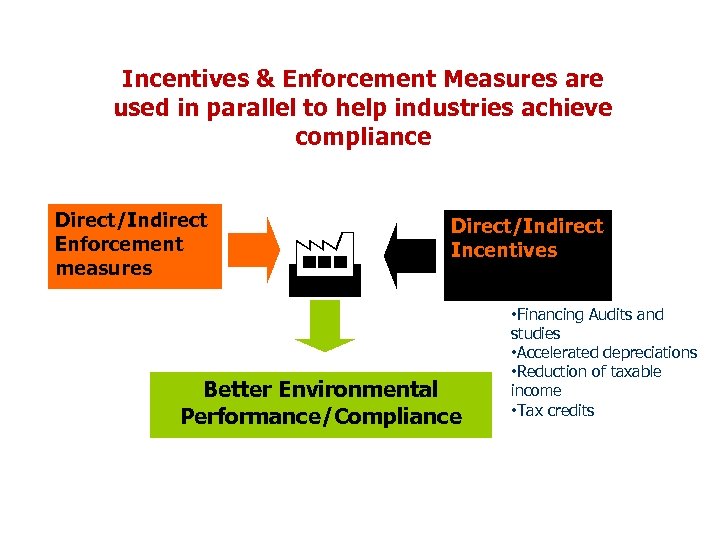
Incentives & Enforcement Measures are used in parallel to help industries achieve compliance Direct/Indirect Enforcement measures Direct/Indirect Incentives Better Environmental Performance/Compliance • Financing Audits and studies • Accelerated depreciations • Reduction of taxable income • Tax credits
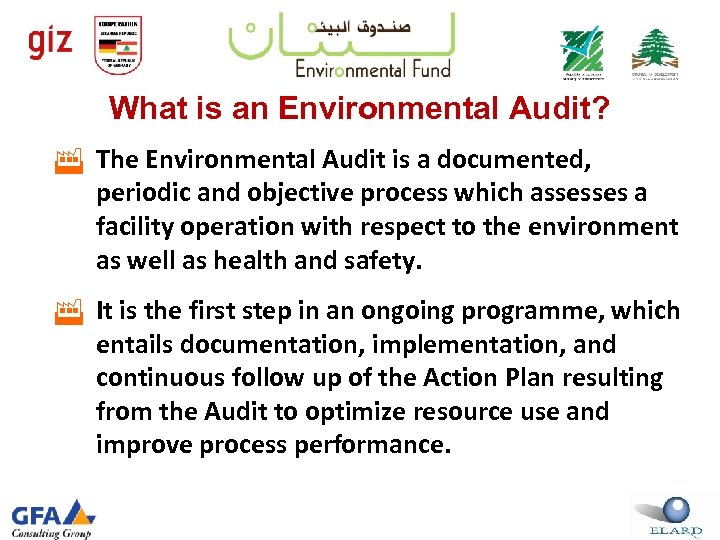
What is an Environmental Audit? The Environmental Audit is a documented, periodic and objective process which assesses a facility operation with respect to the environment as well as health and safety. It is the first step in an ongoing programme, which entails documentation, implementation, and continuous follow up of the Action Plan resulting from the Audit to optimize resource use and improve process performance.
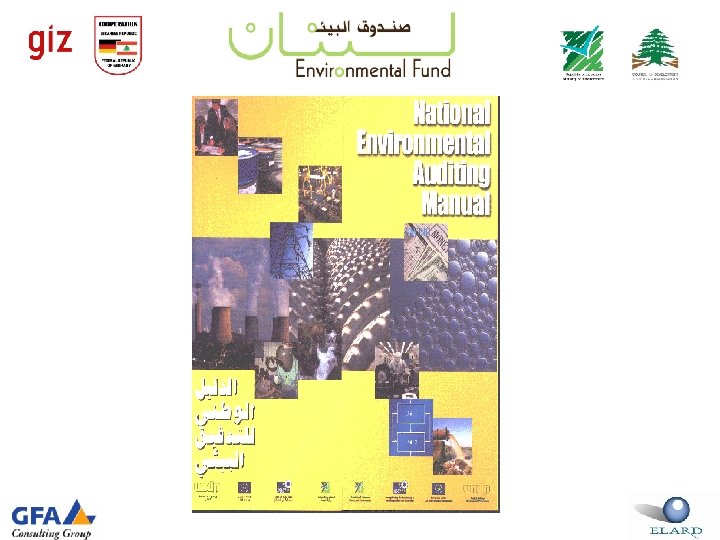
Environmental Auditing Manual The Audit Manual covers the following issues entirely through a series of checklists: – – – – – Environmental management practices Production processes used Water consumption Wastewater management Air quality and gaseous emissions Solid waste management Noise pollution Energy consumption Occupational health and safety
Objectives of the Environmental Audit Assessment of compliance with government legislation, regulations, and permit conditions Assessment to adherence to internal policy and procedures Assessment of the status of current practice Identification of efficiency potentials and areas for improvement to minimize the impact on the environment
Benefits of Environmental Auditing Promoting good environmental management Ensuring cost effective compliance with laws, regulations, standards and company policy Improving employee productivity, awareness and safety at work Reducing operating costs Incorporating the environmental dimension in a facility’s operation Triggering new priorities in policies and practices Improving the image of the facility and enhancing competitiveness
Environmental Audit Procedure 1: Pre Audit • To make the necessary preparations and arrangements for the on site audit 2: On Site Audit • To assess compliance with government legislation, regulations and permit conditions • To assess adherence to internal policy and procedures • To identify areas of improvement to minimize the impact on the environment 3: Post Audit • To produce an audit report that includes the findings and recommendations • To promote the development of an Action plan for the continual improvement of operations • To develop/adjust the environmental management system
Step 1: Pre-Audit/Audit Planning and Preparation Setting objectives and scope Forming and organizing the audit team Overview of the type of the facility Visiting the top management Conducting detailed background research Tailoring the pre-audit questionnaire Tailoring for checklists Assigning tasks, responsibilities and timetable
Step 2: On Site Audit Introductory meeting with staff Assessing the legal status and environmental management Detailed on site inspection – – – – Production Process Water Supply Wastewater Management Air Emissions Solid Waste Management Noise pollution Energy consumption Occupational Health and Safety Data Analysis Concluding meeting
Step 3: Post Audit Focuses on final stages of the audit and covers the following issues: Audit Report • Introduction • Site description • Results / findings and recommendations Action Plan • • Compliance strategy Areas for further investigation Blueprints for environmental auditing program Blueprints for an environmental awareness and training program Development of indicators Blueprints for progress monitoring program Time frame for implementation
Self Monitoring report Annual consumption of fuel, types and associated costs Air pollutants: Is there any abatement measures for air pollution, precise it, Are all air pollutants compliant with decision 8/1, send reports of air pollution analysis Water consumption: Quantity consumed, surface water consumption, groundwater consumption, what are the measures to limit water consumption? Wastewater treatment: Quantity treated, what are the method of final disposal of industrial waste, other wastewater (in sewers, on soil, underground, surface water, evaporation ponds, other). Are industrial effluents compliant with national standards? Provide analysis results. Solid and Hazardous waste: Provide data regarding hazardous waste, solid waste, packaging waste, other (source of production, quantity generated, storage location, mode of transport to storage, final disposal site) Other: are all criteria indicated in the operation permit followed?
Technical Measures for Treatment of Industrial Pollution in Specific Industrial Sectors
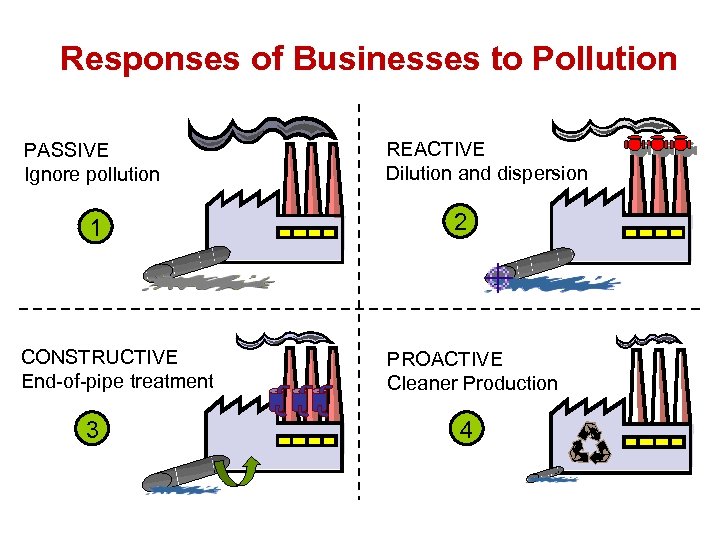
Responses of Businesses to Pollution PASSIVE Ignore pollution 1 CONSTRUCTIVE End-of-pipe treatment 3 REACTIVE Dilution and dispersion 2 PROACTIVE Cleaner Production 4
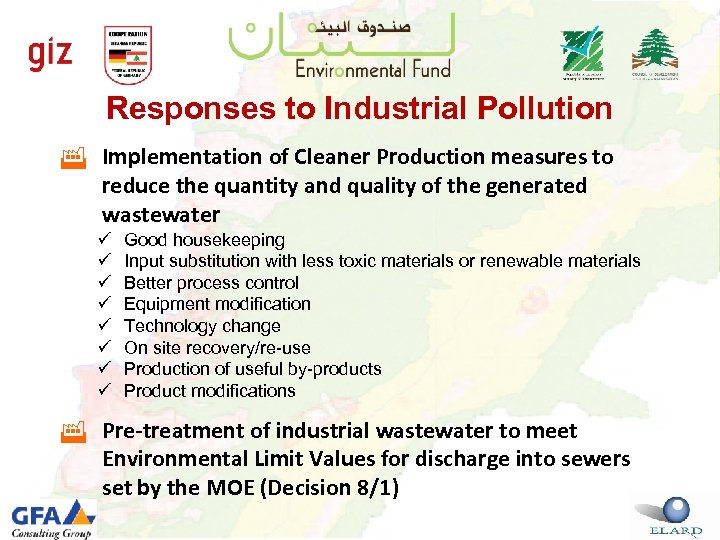
Responses to Industrial Pollution Implementation of Cleaner Production measures to reduce the quantity and quality of the generated wastewater ü ü ü ü Good housekeeping Input substitution with less toxic materials or renewable materials Better process control Equipment modification Technology change On site recovery/re-use Production of useful by-products Product modifications Pre-treatment of industrial wastewater to meet Environmental Limit Values for discharge into sewers set by the MOE (Decision 8/1) 1
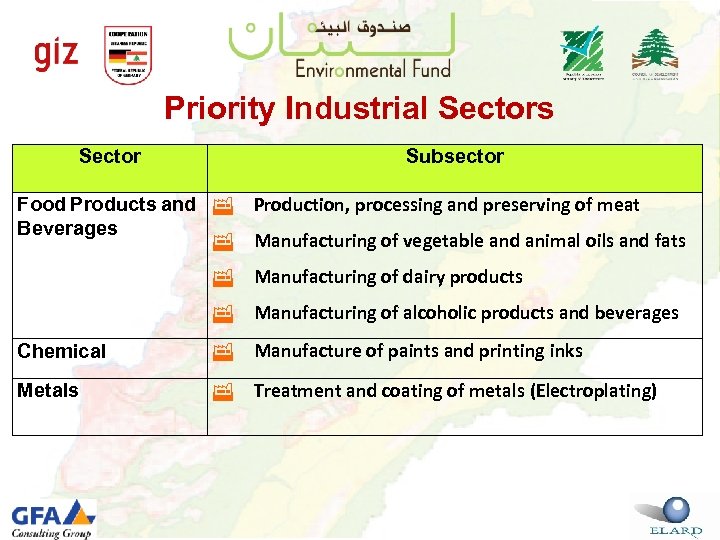
Priority Industrial Sectors Sector Subsector Food Products and Beverages Production, processing and preserving of meat Manufacturing of vegetable and animal oils and fats Manufacturing of dairy products Manufacturing of alcoholic products and beverages Chemical Manufacture of paints and printing inks Metals Treatment and coating of metals (Electroplating) 1
WILCO: Poultry and Meat Processing Annual quantity of meat products is 7, 900 tons The wastewater generated is 300 m 3/d (mainly from washing and cleaning operations) Discharged directly into surface waters Wastewater characterized by high COD (3500 mg/l), BOD (1500 mg/l) and oil and grease (500 mg/l) Got three offers from three suppliers (Aqua, Redox and Metito) to treat wastewater to levels that can be used for irrigation Estimated treatment cost = 505, 550 euro
Proposed Effluent Treatment at WILCO Step 1: – Proper sieving: to remove suspended solids greater than 1, 5 mm - 2, 5 mm – Sand traps: to prevent any clogging in the process – Equalization tank for p. H adjustment. Step 2: – Precipitation and / or flocculation followed by flotation: For removal of suspended solids, fat, and grease Step 3: – Aerobic Biological treatment for the removal of BOD, COD, Ammonia and nitrogen followed by sedimentation and sludge dewatering
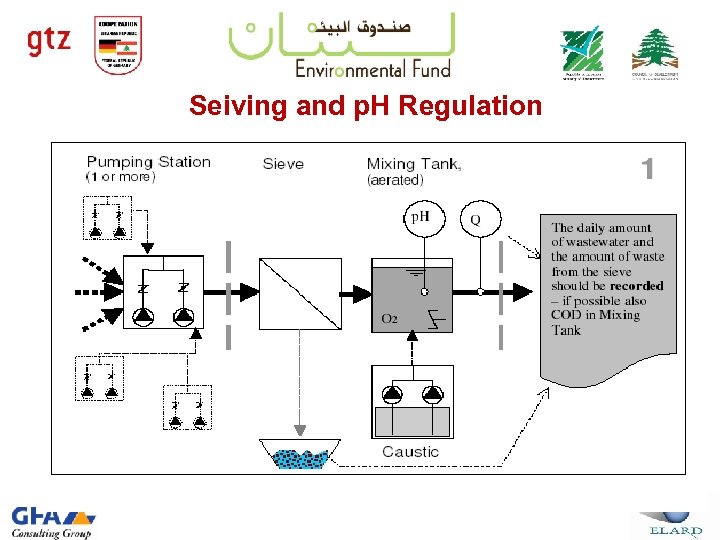
Seiving and p. H Regulation
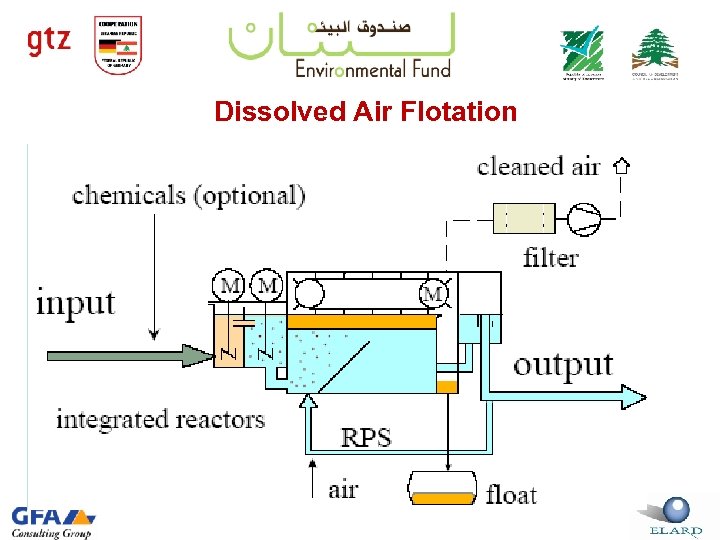
Dissolved Air Flotation 1
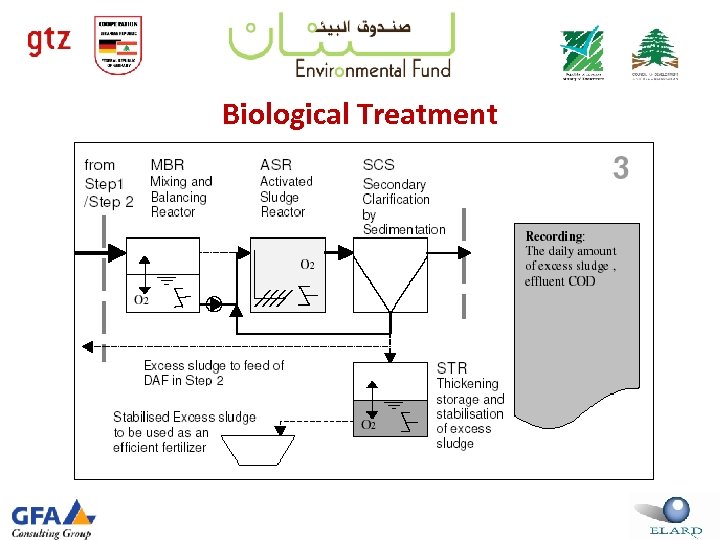
Biological Treatment
Societe pour l’Industrie des Metaux (SIDEM) Located in Zouk Mosbeh Annual production of 12, 000 to 13, 000 t of mill finish, anodized and powder coated aluminum profiles Two main effluent streams: 1 - Wastewater from the electroplating process ü is being treated on site to reduce Cr. VI to Cr. III in a chemical physical treatment unit present on site ü Sludge is being disposed of in coordination with Holcim 1
Anodizing Effluents 2 - Wastewater from the anodizing line (around 1000 m 3/d) ü Wastewater from the anodizing of Al profiles (degreasing, etching, electrolytic anodization using H 2 SO 4 and Na. OH, and DC current) is highly acidic and is disposed of in the sewerage network of Zouk Mosbeh industrial zone ü Wastewater is characterized by low p. H (p. H=4. 47), High TSS (TSS=1, 749 mg/l) and high Sulphates (1, 040 mg/l) ü Cooperation with Veolia to propose an offer for effluent treatment from the anodizing line to reach MOE standards
Proposed Pre-treatment at SIDEM Build, equip and install a new chemical physical treatment unit consisting of: q Equalization and storage tanks: to dilute and homogenize acidic and basic solutions and for proper mixing q Neutralization, flocculation and decantation to remove the acidity and reduce TSS, sulphates and precipitate the metals q Sludge dewatering by means of a filter press to facilitate co -processing at the cement factories The cost for this pre-treatment unit is 754, 000 euros. 1
PULPER (Slim Oil) Located in Nahr Ibrahim Process involves mechanical pressing, extracting and refining of crude sunflower oil Annual production of 8, 000 tons of sunflower vegetable oil Discharge 150 m 3/d of wastewater into the surrounding environment Wastewater is characterized by very high levels of COD (125, 000 mg/l), oil and grease (331, 000 mg/l) and can be separated from the other effluents from the deodorizer 1
Cleaner Production in PULPER Harburg, the company who installed and commissioned the plant was consulted to propose a solution Recommendations: q Either treating the wastewater through a chemical physical treatment followed by flotation to remove the oil & grease q Or doing some process modifications to reduce the pollution in the area (complete reduction of water consumption and minimization of odors) by improving the production and implementing a close water cooling circuit system. 1
Proposed Process Modifications in PULPER Closed water circuit cooling (mainly through heat exchanger) at the vacuum system Production efficiency improvement (mainly through a horizontal filter) at the Combined Degumming and Winterization Plant Installation of a self cleaning chemical system for the deodorizer to control odors in the water Refinery control extension and upgrade The cost of this intervention is around 446, 500 euros
THANK YOU FOR YOUR INTEREST IN THE ENVIRONMENTAL FUND FOR LEBANON
Скачать презентацию Environmental Fund for Lebanon Legal and Technical Frameworks
740166d8941461bd572ec584a9c68892.ppt