 Скачать презентацию ENVIRONMENTAL ASPECTS OF REAL ESTATE IN MASSACHUSETTS By
6a6d5fff1ec2b7741c91b76e6a33ee83.ppt
- Количество слайдов: 55




ENVIRONMENTAL ASPECTS OF REAL ESTATE IN MASSACHUSETTS By Gregor I. Mc. Gregor, Esq. Mc. Gregor & Associates/Boston © 2011

www. mcgregorlaw. com The author is grateful to his law clerks Kristin Spriano (2004), Kyle Lewis (2007), associate Luke Legere (2007), law clerks Colleen Walsh (2009), Brian Confrey (2011) and Erin Odell (2011)
OUTLINE v Environmental Aspects A to Z v Real Estate Due Diligence v The Four W’s Waste Wetlands Water Wildlife v Practical Tips
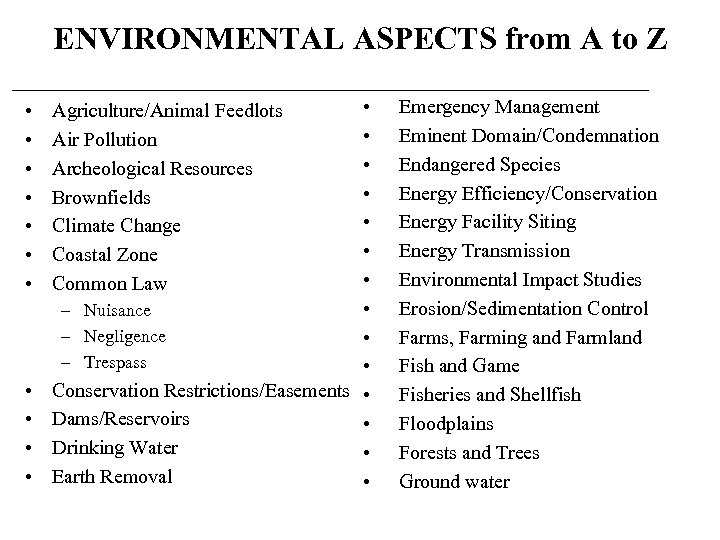
ENVIRONMENTAL ASPECTS from A to Z • • – Nuisance – Negligence • – Trespass • • Conservation Restrictions/Easements • • Dams/Reservoirs • • Drinking Water • • Earth Removal • • Agriculture/Animal Feedlots Air Pollution Archeological Resources Brownfields Climate Change Coastal Zone Common Law Emergency Management Eminent Domain/Condemnation Endangered Species Energy Efficiency/Conservation Energy Facility Siting Energy Transmission Environmental Impact Studies Erosion/Sedimentation Control Farms, Farming and Farmland Fish and Game Fisheries and Shellfish Floodplains Forests and Trees Ground water
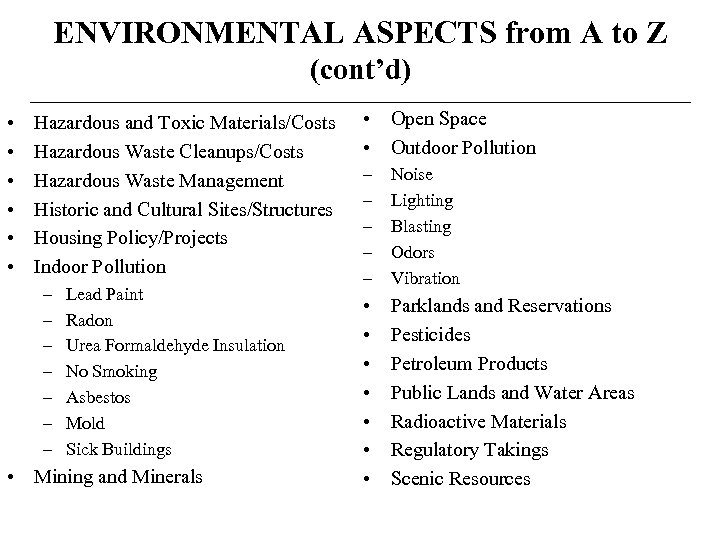
ENVIRONMENTAL ASPECTS from A to Z (cont’d) • • • Hazardous and Toxic Materials/Costs Hazardous Waste Cleanups/Costs Hazardous Waste Management Historic and Cultural Sites/Structures Housing Policy/Projects Indoor Pollution – – – – Lead Paint Radon Urea Formaldehyde Insulation No Smoking Asbestos Mold Sick Buildings • Mining and Minerals • Open Space • Outdoor Pollution – – – Noise Lighting Blasting Odors Vibration • • Parklands and Reservations Pesticides Petroleum Products Public Lands and Water Areas Radioactive Materials Regulatory Takings Scenic Resources
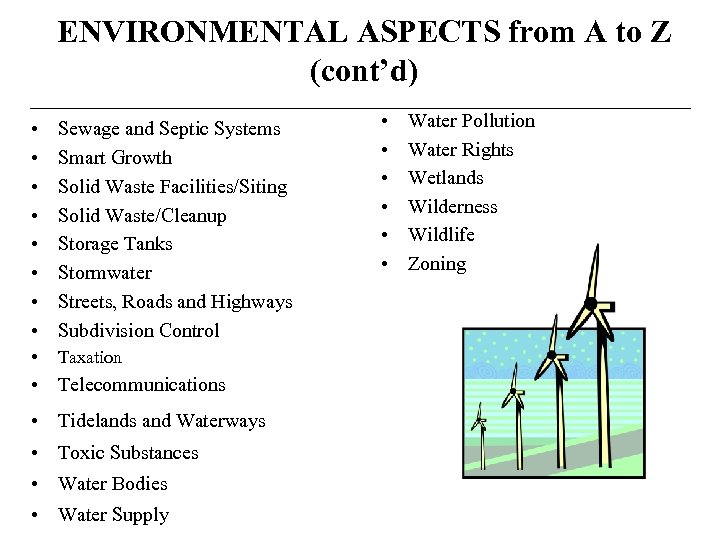
ENVIRONMENTAL ASPECTS from A to Z (cont’d) • • Sewage and Septic Systems Smart Growth Solid Waste Facilities/Siting Solid Waste/Cleanup Storage Tanks Stormwater Streets, Roads and Highways Subdivision Control • Taxation • Telecommunications • Tidelands and Waterways • Toxic Substances • Water Bodies • Water Supply • • • Water Pollution Water Rights Wetlands Wilderness Wildlife Zoning
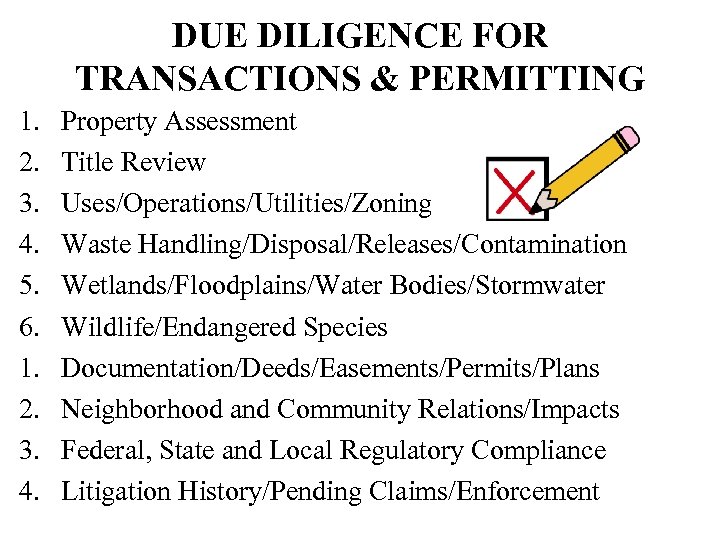
DUE DILIGENCE FOR TRANSACTIONS & PERMITTING 1. 2. 3. 4. 5. 6. 1. 2. 3. 4. Property Assessment Title Review Uses/Operations/Utilities/Zoning Waste Handling/Disposal/Releases/Contamination Wetlands/Floodplains/Water Bodies/Stormwater Wildlife/Endangered Species Documentation/Deeds/Easements/Permits/Plans Neighborhood and Community Relations/Impacts Federal, State and Local Regulatory Compliance Litigation History/Pending Claims/Enforcement
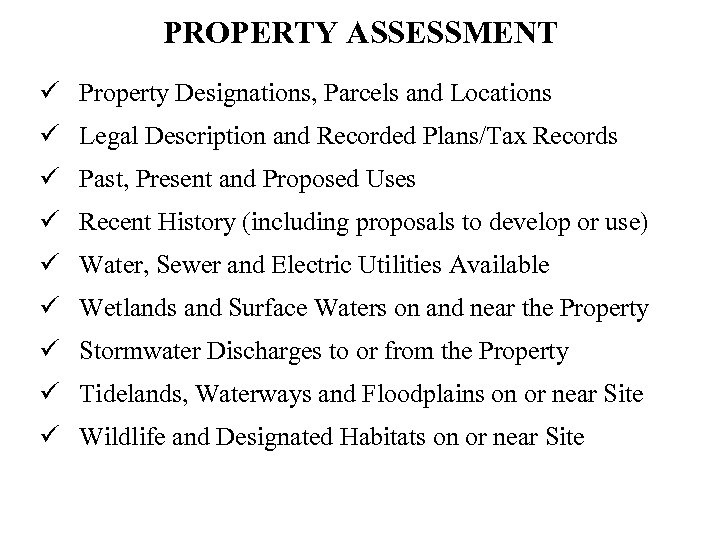
PROPERTY ASSESSMENT ü Property Designations, Parcels and Locations ü Legal Description and Recorded Plans/Tax Records ü Past, Present and Proposed Uses ü Recent History (including proposals to develop or use) ü Water, Sewer and Electric Utilities Available ü Wetlands and Surface Waters on and near the Property ü Stormwater Discharges to or from the Property ü Tidelands, Waterways and Floodplains on or near Site ü Wildlife and Designated Habitats on or near Site
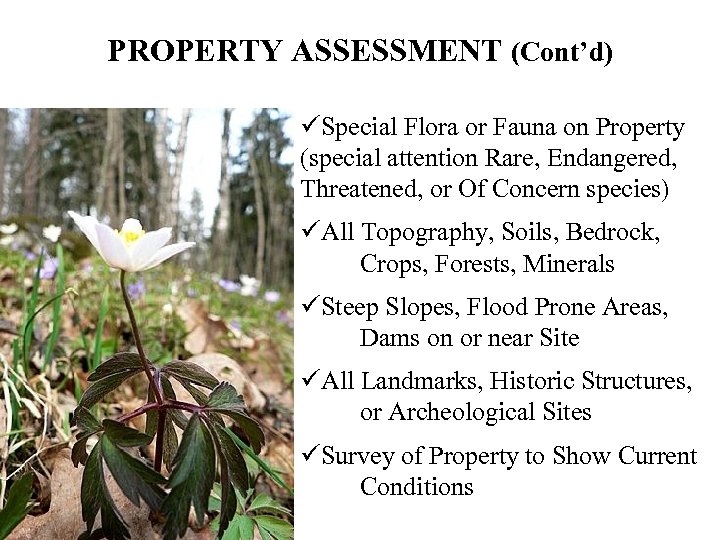
PROPERTY ASSESSMENT (Cont’d) üSpecial Flora or Fauna on Property (special attention Rare, Endangered, Threatened, or Of Concern species) üAll Topography, Soils, Bedrock, Crops, Forests, Minerals üSteep Slopes, Flood Prone Areas, Dams on or near Site üAll Landmarks, Historic Structures, or Archeological Sites üSurvey of Property to Show Current Conditions
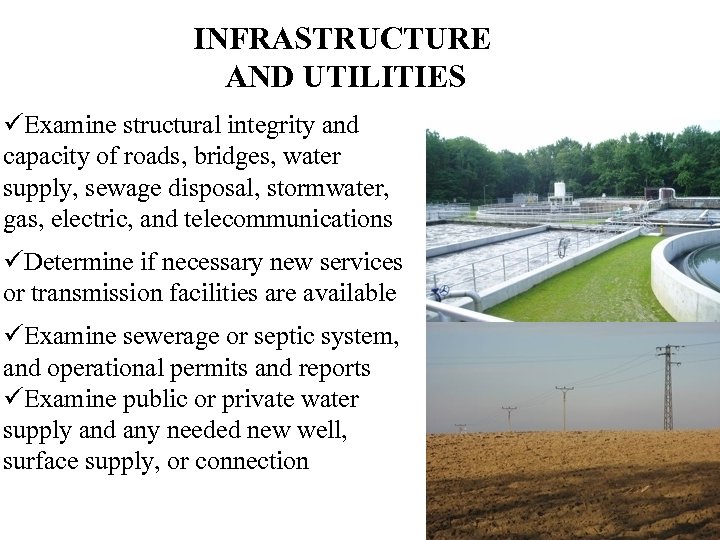
INFRASTRUCTURE AND UTILITIES üExamine structural integrity and capacity of roads, bridges, water supply, sewage disposal, stormwater, gas, electric, and telecommunications üDetermine if necessary new services or transmission facilities are available üExamine sewerage or septic system, and operational permits and reports üExamine public or private water supply and any needed new well, surface supply, or connection
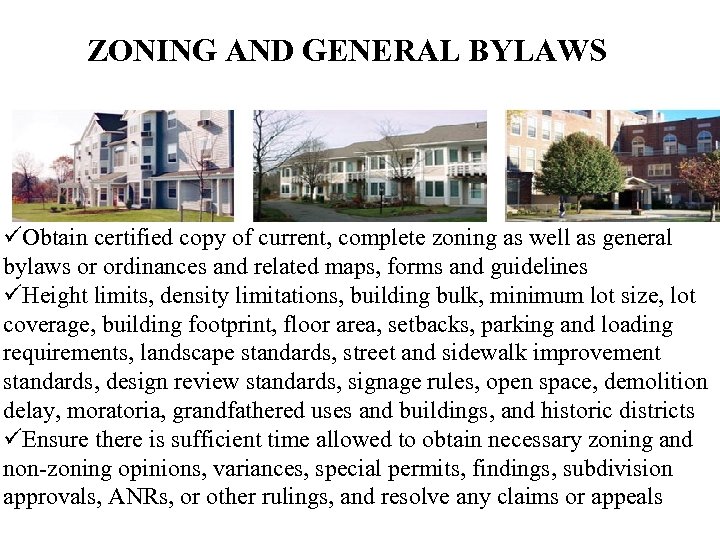
ZONING AND GENERAL BYLAWS üObtain certified copy of current, complete zoning as well as general bylaws or ordinances and related maps, forms and guidelines üHeight limits, density limitations, building bulk, minimum lot size, lot coverage, building footprint, floor area, setbacks, parking and loading requirements, landscape standards, street and sidewalk improvement standards, design review standards, signage rules, open space, demolition delay, moratoria, grandfathered uses and buildings, and historic districts üEnsure there is sufficient time allowed to obtain necessary zoning and non-zoning opinions, variances, special permits, findings, subdivision approvals, ANRs, or other rulings, and resolve any claims or appeals
REGULATORY COMPLIANCE ü Identify applicable federal, state and local laws, rules and regulations as well as guidelines and other requirements ü Copies of all current and pending permits, plans, certificates, registrations and approvals regarding environmental matters ü Copies of all correspondence and inquiries to and from any governmental agencies during the past three years ü Material reports filed with government agencies pursuant to environmental laws ü Any legal opinions or recommendations concerning compliance with environmental laws or potential liabilities
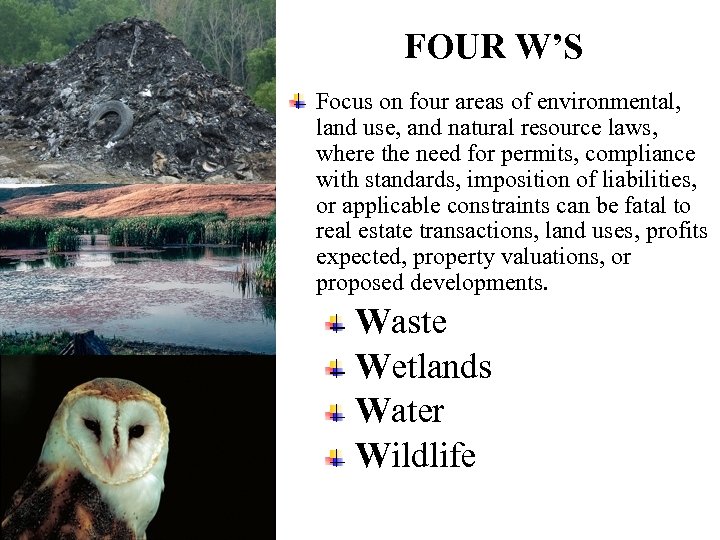
FOUR W’S Focus on four areas of environmental, land use, and natural resource laws, where the need for permits, compliance with standards, imposition of liabilities, or applicable constraints can be fatal to real estate transactions, land uses, profits expected, property valuations, or proposed developments. Waste Wetlands Water Wildlife
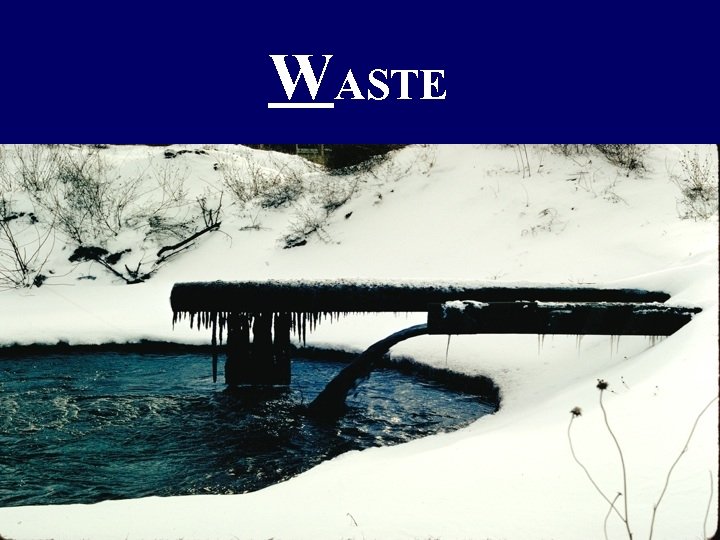
WASTE
PROPERTY CONTAMINATION • These words can spook buyers, sellers, banks, investors, landlords, tenants, and brokers • Developers disappear from the landscape when they see signs of hazardous waste • Business expansions are cancelled for the fear of discovering or disturbing past contamination • Government agencies which acquire property by purchase, eminent domain, condemnation, tax title, gift or otherwise, get cold feet • This fear of liability is natural, considering that innocent landowners can be liable for acquiring contaminated land even if they were not aware of the contamination at the time of acquisition and even if the contamination was legal
CONTAMINATION IS MANAGEABLE The presence of contamination need not render property unusable or unsellable • Someone needs to take charge and manage the problems • Contaminated real estate can be bought and sold without unreasonable fear of liability • Parties to a transaction can find many ways to “hold the deal together” • It is very possible to make money buying and selling dirty property
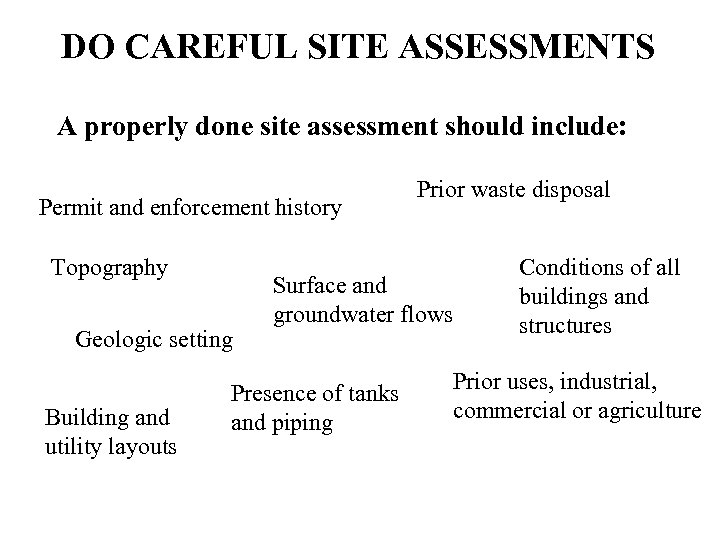
DO CAREFUL SITE ASSESSMENTS A properly done site assessment should include: Permit and enforcement history Topography Geologic setting Building and utility layouts Prior waste disposal Surface and groundwater flows Presence of tanks and piping Conditions of all buildings and structures Prior uses, industrial, commercial or agriculture
STRUCTURE TRANSACTIONS TO REDUCE RISK Decisions to purchase or develop land should be based on the nature and scope of contamination, anticipated cleanup costs, activity and use limitations, and potential future liability • Control liability by timing and structuring the transaction – Delay the closing or acquisition until cleanup is complete – Deposit purchase money in escrow until the property or operation is clean – Personally do the cleanup, deducting costs from the purchase price – Contract cleanup duties between buyer and seller, using a formula – Agree that clauses survive the closing • Postpone, limit or avoid liability by carving off the contaminated areas – Do not own or operate the dirty site, buy only the clean portion – Purchase or lease less than fee interest in property, such as an easement, the air rights, or the upper floors – Lease the clean parts of the site or building – Loan operating funds, taking back principal and interest
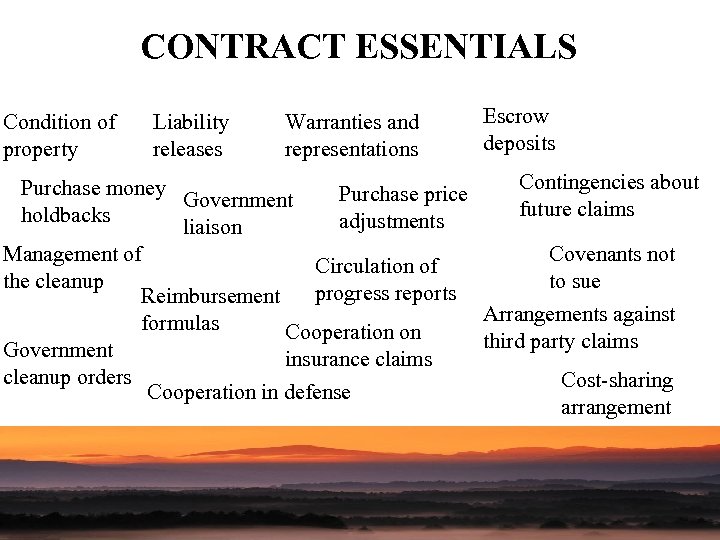
CONTRACT ESSENTIALS Condition of property Liability releases Warranties and representations Escrow deposits Contingencies about Purchase money Purchase price Government future claims holdbacks adjustments liaison Management of Covenants not Circulation of the cleanup to sue progress reports Reimbursement Arrangements against formulas Cooperation on third party claims Government insurance claims cleanup orders Cost-sharing Cooperation in defense arrangement
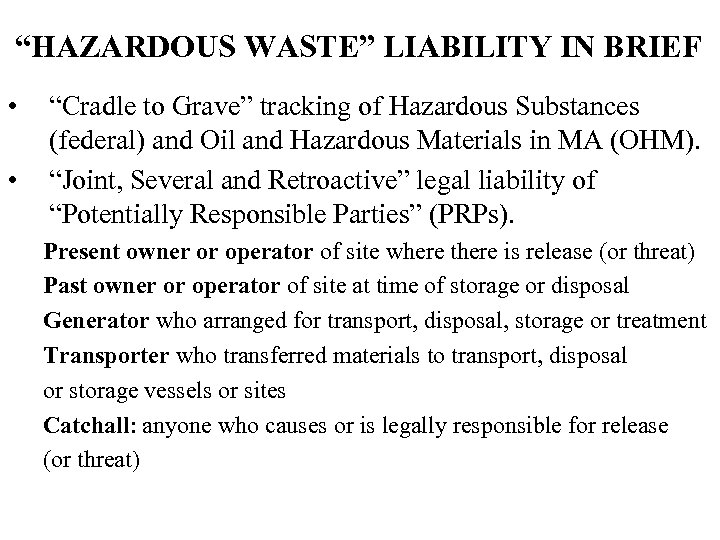
“HAZARDOUS WASTE” LIABILITY IN BRIEF • • “Cradle to Grave” tracking of Hazardous Substances (federal) and Oil and Hazardous Materials in MA (OHM). “Joint, Several and Retroactive” legal liability of “Potentially Responsible Parties” (PRPs). Present owner or operator of site where there is release (or threat) Past owner or operator of site at time of storage or disposal Generator who arranged for transport, disposal, storage or treatment Transporter who transferred materials to transport, disposal or storage vessels or sites Catchall: anyone who causes or is legally responsible for release (or threat)
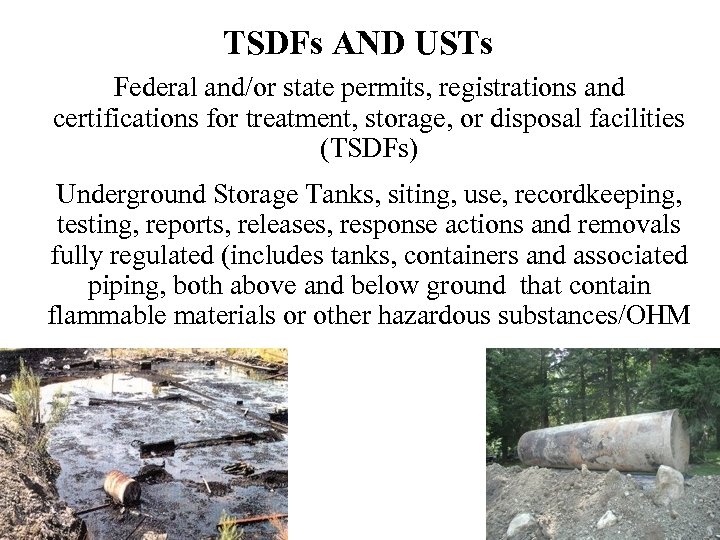
TSDFs AND USTs Federal and/or state permits, registrations and certifications for treatment, storage, or disposal facilities (TSDFs) Underground Storage Tanks, siting, use, recordkeeping, testing, reports, releases, response actions and removals fully regulated (includes tanks, containers and associated piping, both above and below ground that contain flammable materials or other hazardous substances/OHM
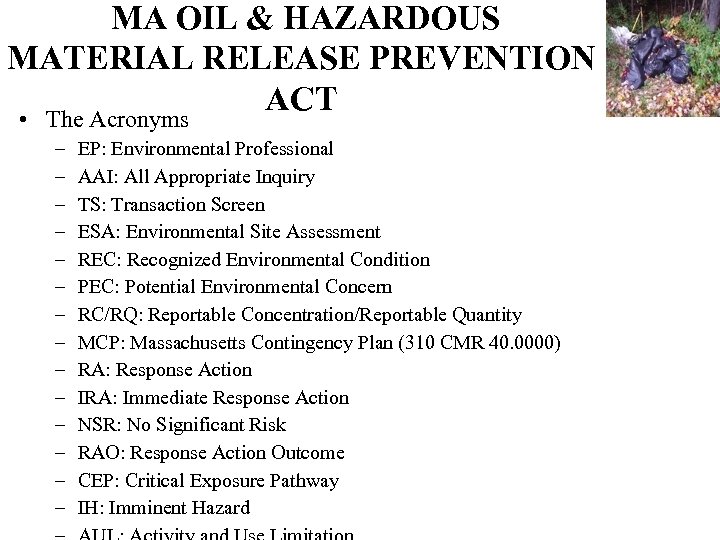
MA OIL & HAZARDOUS MATERIAL RELEASE PREVENTION ACT • The Acronyms – – – – EP: Environmental Professional AAI: All Appropriate Inquiry TS: Transaction Screen ESA: Environmental Site Assessment REC: Recognized Environmental Condition PEC: Potential Environmental Concern RC/RQ: Reportable Concentration/Reportable Quantity MCP: Massachusetts Contingency Plan (310 CMR 40. 0000) RA: Response Action IRA: Immediate Response Action NSR: No Significant Risk RAO: Response Action Outcome CEP: Critical Exposure Pathway IH: Imminent Hazard
MA OIL & HAZARDOUS MATERIAL RELEASE PREVENTION ACT (Cont’d) • The Process Distilled – TS only can identify PECs: your EP conducts site visit, database review, review of historic maps. Not a full ESA. – ASTM Phase I is preferred as your ESA so as to identify RECs: your EP visits site, reviews databases, consults maps and plans, conducts interviews with owners, operators and occupants, and does environmental lien search – MA 21 E MCP Phase II is used to determine the nature and the extent of contamination, identify receptors and pathways, determine risk posed – Ideally results in finding of NSR. May find Significant Risk requiring a long term RA. Sometimes reveals IH requiring IRA. Goal becomes RAO of NSR. – Phase III: feasibility evaluation to evaluate and select cleanup plan – Phase IV: perform cleanup and submit documents showing final inspection performed; negotiate and execute AUL if required – RAO – DEP Audit of RAO, AUL or both.
WETLANDS AND FLOODPLAIN LAW
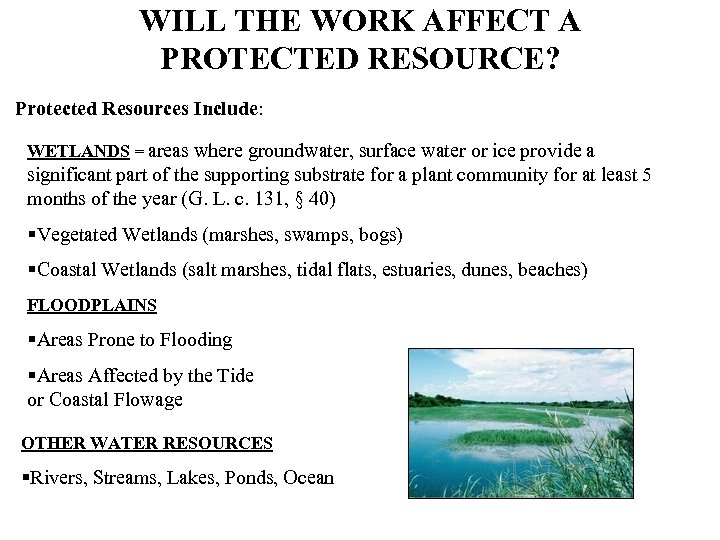
WILL THE WORK AFFECT A PROTECTED RESOURCE? Protected Resources Include: WETLANDS = areas where groundwater, surface water or ice provide a significant part of the supporting substrate for a plant community for at least 5 months of the year (G. L. c. 131, § 40) §Vegetated Wetlands (marshes, swamps, bogs) §Coastal Wetlands (salt marshes, tidal flats, estuaries, dunes, beaches) FLOODPLAINS §Areas Prone to Flooding §Areas Affected by the Tide or Coastal Flowage OTHER WATER RESOURCES §Rivers, Streams, Lakes, Ponds, Ocean
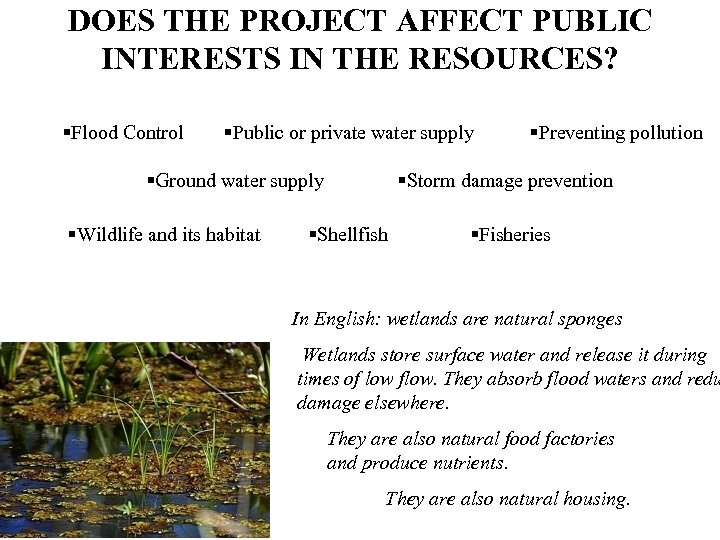
DOES THE PROJECT AFFECT PUBLIC INTERESTS IN THE RESOURCES? §Flood Control §Public or private water supply §Ground water supply §Wildlife and its habitat §Preventing pollution §Storm damage prevention §Shellfish §Fisheries In English: wetlands are natural sponges Wetlands store surface water and release it during times of low flow. They absorb flood waters and redu damage elsewhere. They are also natural food factories and produce nutrients. They are also natural housing.
WETLANDS PROTECTION ACT • Triggered by projects involving: – – Dredging Filling Removing Altering • Procedure: – File notice of intent (NOI) with conservation commission – Granted permit: order of conditions (OOC) • Appealable to DEP • Recorded in registry or Land Court
HOME RULE WETLANDS BYLAWS • • • Overview – Local permit program administered by the Conservation Commission – Uses general bylaw and ordinance authority in G. L. c. 40, § 21 and Home Rule Amendment to the Massachusetts Constitution, Articles II and LXXXIX – For local bylaws and regulations: http: //maccweb. org/resources_bylaws. html Typical Local Bylaw – Jurisdiction and procedure similar to Wetlands Protection Act. Clarifies and expands jurisdiction and requirements beyond Act to be stricter than DEP – Fewer exemptions than in Wetlands Protection Act with explicit authority to disapprove projects or impose setbacks and mitigation – Most bylaws allow public hearing on an application to be combined with Wetlands Protection Act hearing, but appeals are to both DEP and court Enforcement – Typical site inspections, violation notices and enforcement orders as well as traditional remedies for injunctions and civil forfeitures in Superior Court, and criminal prosecution with criminal fines and incarceration – Bylaws following the MACC model include the “ticketing” approach outlined in G. L. c. 40, § 21 D for so-called non-criminal dispositions
HOME RULE WETLANDS BYLAWS (Cont’d) • Conservation Commission – Entertains applications for projects and rulings under its bylaw and regulations – Holds quasi-judicial public hearings like a planning board or zoning board – Schedules and continues hearings at Commission’s discretion – Mistakes implicate Home Rule Power • If the Commission fails to issue its decision within the timeframe specified by municipal bylaw, a denial issued later is a nullity and the DEP Superseding Order of Conditions governs the project. SJC noted Commission’s failure to timely act did not constitute constructive approval Oyster Creek Preservation, Inc. v. Conservation Comm’n of Harwich, 449 Mass. 859 (2007). • See also Regan v. Conservation Comm’n of Falmouth, 77 Mass. App. Ct. 485 (2010), holding that DEP Superseding Order of Conditions trumped bylaw denial issued one day after expiration of statutory deadline for decision. – Implements both the local wetland bylaws and State Wetland Protection Act – Issues decisions separately reviewable in DEP (under Act) and court (bylaw) – Commission promulgates own regulations typically tougher than DEP
HOME RULE WETLANDS BYLAWS (Cont’d) • Conservation Commission – Variances and Permits • When applying for variance under bylaw, burden is on property owner to show why other options that complied with bylaw were not economically feasible; merely because variance desirable to the landowner does not mean denial has risen to level of substantial hardship. Brown v. ZBA of Norfolk, 74 Mass. App. Ct. 1111 (2009) • Conservation Commission cannot use higher standard of burden of proof when deciding to issue or deny permits than what is contained in the local bylaw, and tougher standard in regulation is not valid. Conroy v. Conservation Comm’n of Lexington, 73 Mass. App. Ct. 552 (2009) • DEP may issue a Superseding Order of Conditions where the decisionmaking authority has not its decision based exclusively on the specific terms of a bylaw more stringent than the Act. Healer v. DEP, 73 Mass. App. Ct. 714 (2009)
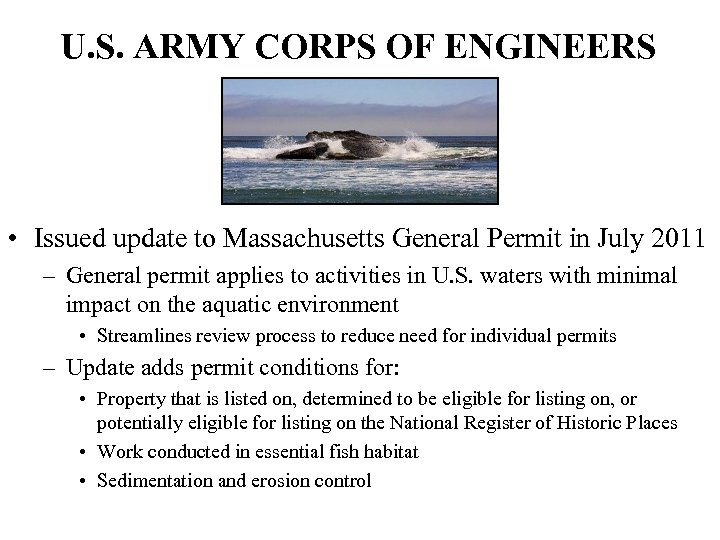
U. S. ARMY CORPS OF ENGINEERS • Issued update to Massachusetts General Permit in July 2011 – General permit applies to activities in U. S. waters with minimal impact on the aquatic environment • Streamlines review process to reduce need for individual permits – Update adds permit conditions for: • Property that is listed on, determined to be eligible for listing on, or potentially eligible for listing on the National Register of Historic Places • Work conducted in essential fish habitat • Sedimentation and erosion control
WATER
WATER POLLUTION • DEP’s Division of Water Pollution Control and the Bureau of Waste Prevention regulate industrial and other discharges to groundwater, large and small septic systems, and industrial sites. G. L. c. 21, §§ 26 -53. • The Division may enter, inspect, and sample sources, issue enforcement orders, suspend or revoke permits, levy administrative penalties, and seek criminal penalties, civil fines or injunctive relief. • A permit may be needed for activities that may foreseeably result, directly or indirectly, in discharge of pollutants into surface or groundwaters, including stormwater drainage from industrial sites.
WATER POLLUTION (Cont’d) • The Massachusetts Clean Water Act goes beyond the federal regulatory scheme by covering a wider range of pollutants, regulating ground water discharges, and regulating non-point sources. DEP also regulates sewers beyond the sewer use standards prescribed by EPA. • Massachusetts regulations virtually prohibit discharges to designated “outstanding resource waters” and specify antidegradation provisions for waters whose quality already exceeds minimum levels. • NPDES permitting is conducted by EPA and DEP: therefore, a NPDES discharge permit application should be simultaneously submitted on the same form to both agencies. Permits typically combine conditions set by either agency and are issued under both state and federal law.
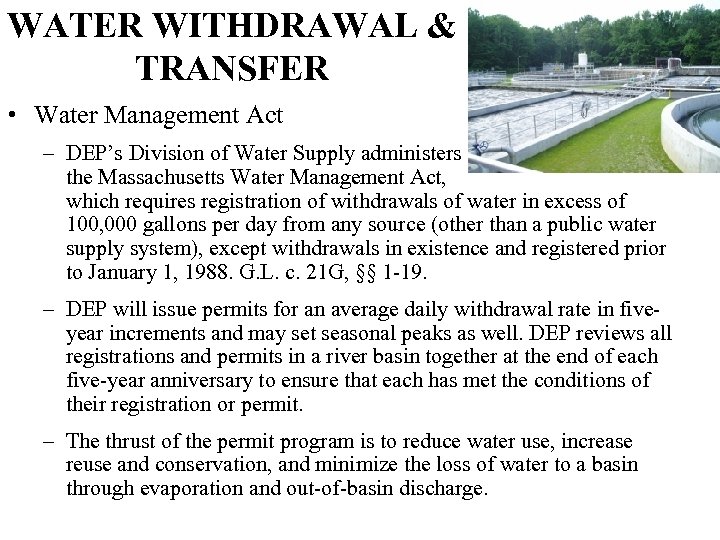
WATER WITHDRAWAL & TRANSFER • Water Management Act – DEP’s Division of Water Supply administers the Massachusetts Water Management Act, which requires registration of withdrawals of water in excess of 100, 000 gallons per day from any source (other than a public water supply system), except withdrawals in existence and registered prior to January 1, 1988. G. L. c. 21 G, §§ 1 -19. – DEP will issue permits for an average daily withdrawal rate in fiveyear increments and may set seasonal peaks as well. DEP reviews all registrations and permits in a river basin together at the end of each five-year anniversary to ensure that each has met the conditions of their registration or permit. – The thrust of the permit program is to reduce water use, increase reuse and conservation, and minimize the loss of water to a basin through evaporation and out-of-basin discharge.
WATER WITHDRAWAL & TRANSFER • Interbasin Transfer Act – Massachusetts Water Resources Commission (WRC) administers Interbasin Transfer Act requiring certain environmental and water supply management standards be met prior to approving an increase in capacity of a transfer system when the transfer crosses a town line and a basin line (roughly the watershed) and the water transferred will not be returned to its basin of origin for discharge – Applies to transfers of water supply, wastewater, and wastewater triggered by the development of a water supply source – Exemptions for existing systems, intratown transfers, replacing an existing source with one of the same capacity, reactivating a source that has not been used but not decommissioned, adding individual connections when system’s capacity is not increased, DEPauthorized emergency connections, sources that only provide redundancy, and increases in a Water Management Act permit that will not increase the source’s capacity
WELLS • Need permit from local Board of Health for a new well that will supply potable drinking water – Some Boards of Health have their own regulations setting forth standards for these permits, required testing and records, and limits on use. Some towns adopt limits for irrigation (especially lawn watering) and other non-potable wells. • To build a facility expected to exceed 100, 000 gallons per day need permit under Water Management Act • Federal law applies to public systems (used by 25 or more persons or having 15 or more service connections)
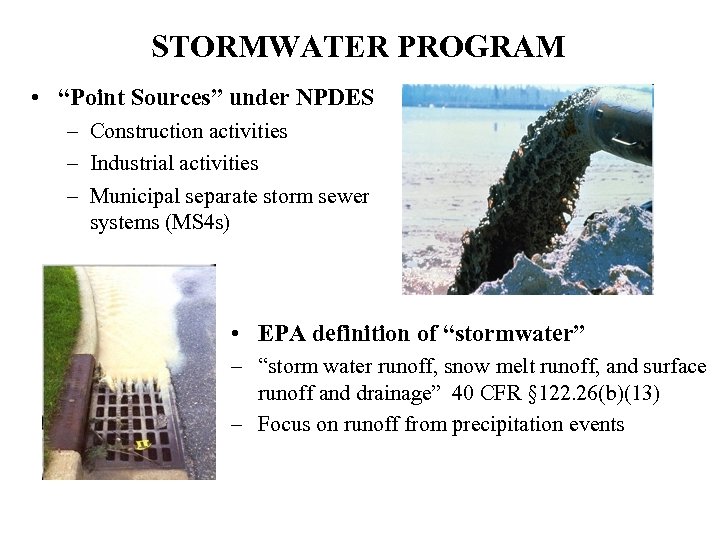
STORMWATER PROGRAM • “Point Sources” under NPDES – Construction activities – Industrial activities – Municipal separate storm sewer systems (MS 4 s) • EPA definition of “stormwater” – “storm water runoff, snow melt runoff, and surface runoff and drainage” 40 CFR § 122. 26(b)(13) – Focus on runoff from precipitation events
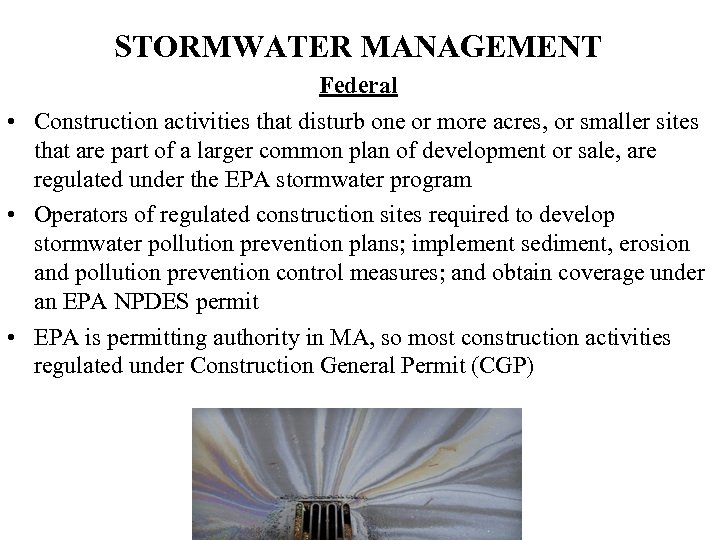
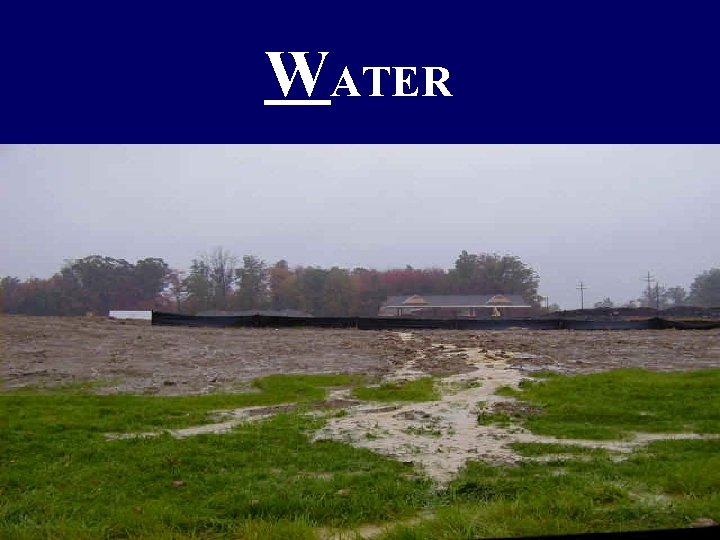
STORMWATER MANAGEMENT Federal • Construction activities that disturb one or more acres, or smaller sites that are part of a larger common plan of development or sale, are regulated under the EPA stormwater program • Operators of regulated construction sites required to develop stormwater pollution prevention plans; implement sediment, erosion and pollution prevention control measures; and obtain coverage under an EPA NPDES permit • EPA is permitting authority in MA, so most construction activities regulated under Construction General Permit (CGP)
STORMWATER MANAGEMENT Highlights of Mass. DEP’s Stormwater Management Standards • • • Outfalls may not discharge untreated stormwater directly to or cause erosion in wetlands or Commonwealth waters Stormwater management systems must be designed so that postdevelopment peak discharge rates do not exceed pre-development peak discharge rates Loss of annual recharge to groundwater must be eliminated or minimized through use of infiltration measures (environmentally sensitive site design, low impact development techniques, best management practices, good operation and maintenance) Stormwater management systems must designed to remove 80% of average annual post-construction load of Total Suspended Solids Must develop and implement plan to control construction-related impacts during construction and land-disturbance activities

WILDLIFE and ENDANGERED SPECIES
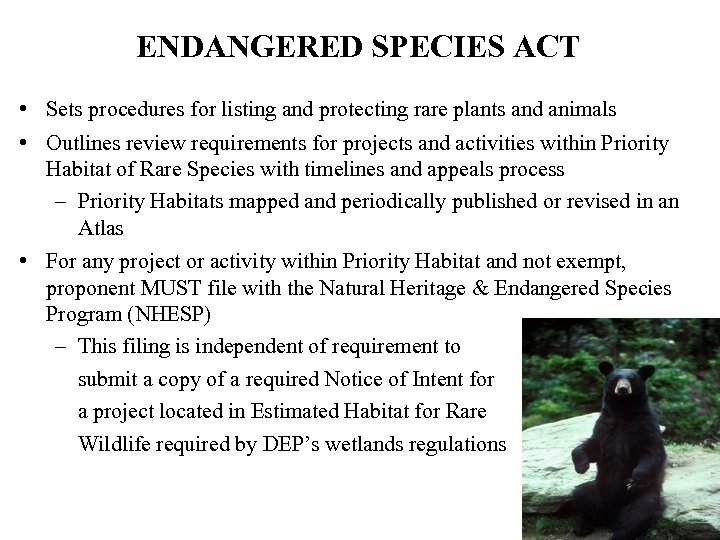
ENDANGERED SPECIES ACT • Sets procedures for listing and protecting rare plants and animals • Outlines review requirements for projects and activities within Priority Habitat of Rare Species with timelines and appeals process – Priority Habitats mapped and periodically published or revised in an Atlas • For any project or activity within Priority Habitat and not exempt, proponent MUST file with the Natural Heritage & Endangered Species Program (NHESP) – This filing is independent of requirement to submit a copy of a required Notice of Intent for a project located in Estimated Habitat for Rare Wildlife required by DEP’s wetlands regulations
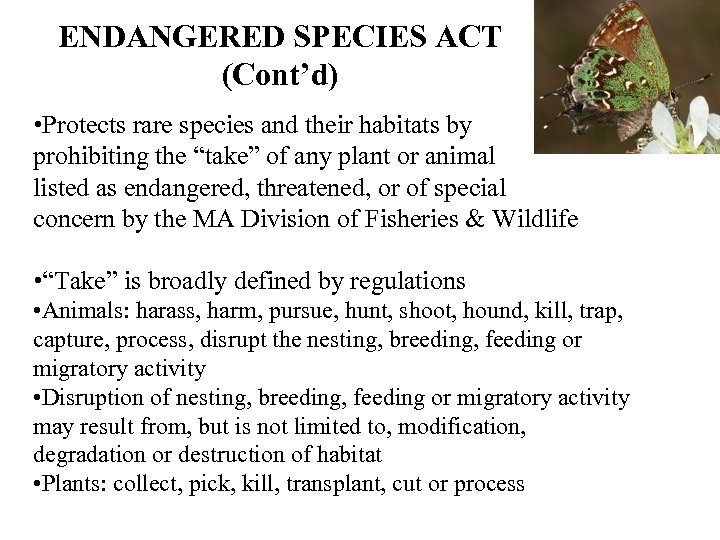
ENDANGERED SPECIES ACT (Cont’d) • Protects rare species and their habitats by prohibiting the “take” of any plant or animal listed as endangered, threatened, or of special concern by the MA Division of Fisheries & Wildlife • “Take” is broadly defined by regulations • Animals: harass, harm, pursue, hunt, shoot, hound, kill, trap, capture, process, disrupt the nesting, breeding, feeding or migratory activity • Disruption of nesting, breeding, feeding or migratory activity may result from, but is not limited to, modification, degradation or destruction of habitat • Plants: collect, pick, kill, transplant, cut or process
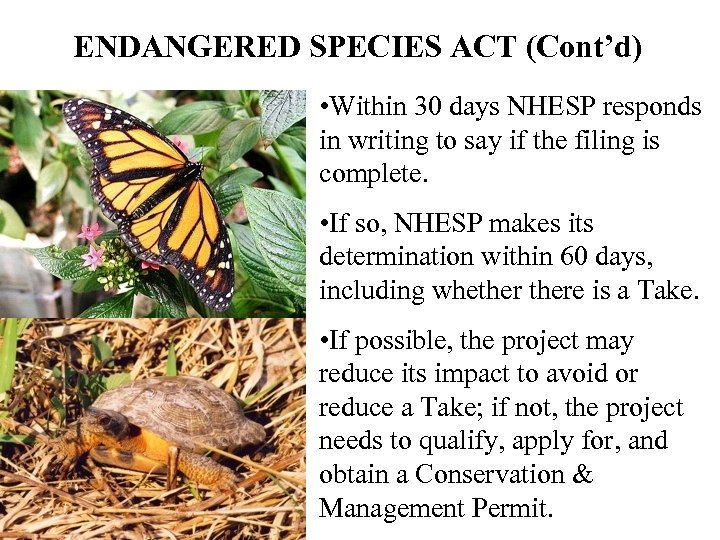
ENDANGERED SPECIES ACT (Cont’d) • Within 30 days NHESP responds in writing to say if the filing is complete. • If so, NHESP makes its determination within 60 days, including whethere is a Take. • If possible, the project may reduce its impact to avoid or reduce a Take; if not, the project needs to qualify, apply for, and obtain a Conservation & Management Permit.
RECENT DEVELOPMENTS • Pepin v. Division of Fisheries and Wildlife, Docket No. HDCV 2009 -00838 A (March 21, 2011) – Challenge to validity of DFW’s Priority Habitat regulations and failure to offer protection for property owners impacted by Priority Habitat designation similar to the protection offered to property owners affected by Significant Habitat designations – Superior Court: • MESA does not explicitly prohibit or permit the demarcation and regulation of Priority Habitat, but the Priority Habitat regulations do not exceed DFW’s statutory authority under MESA - they are consistent with MESA’s prohibition on the take of listed species and MESA’s broad purpose of protecting and conserving wildlife and their habitat • Protections provided to those potentially impacted by Significant Habitat designations are necessary due to severe statutory limits on issuance of permit to alter Significant Habitat
RECENT DEVELOPMENTS Ten Persons of the Commonwealth v. Fellsway Development LLC, 460 Mass. 366 (2011) – Background: Secretary of the EOEEA initially required complete environmental review of proposed project; developer and DOCR later entered into memorandum of understanding and developer agreed to pay for traffic improvements; Secretary issued opinion stating that project was no longer within MEPA because state was no longer required to pay for traffic improvements – SJC held that G. L. c. 214, § 7 A confers subject jurisdiction on state court to hear claims of MEPA violations when private project proponent and permitting authority, but not the Secretary of EOEEA, are joined as defendants – Court did not overrule Cummings v. Sec’y of the EOEEA, which held that project opponents cannot directly challenge a MEPA decision by naming the Secretary of the EOEEA as a defendant
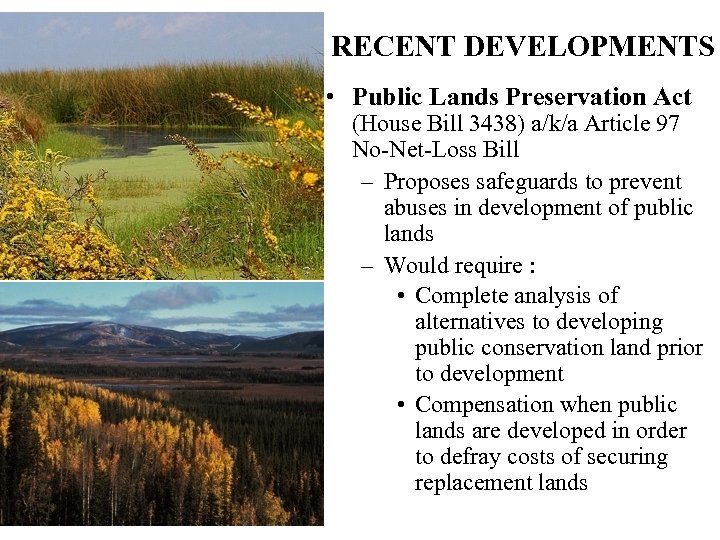
RECENT DEVELOPMENTS • Public Lands Preservation Act (House Bill 3438) a/k/a Article 97 No-Net-Loss Bill – Proposes safeguards to prevent abuses in development of public lands – Would require : • Complete analysis of alternatives to developing public conservation land prior to development • Compensation when public lands are developed in order to defray costs of securing replacement lands
RECENT DEVELOPMENTS • Doherty v. Admiral’s Flagship Condominium Trust, 80 Mass. App. Ct. 104 (2011) – Leaks in roof or just below roof above plaintiff’s unit caused toxic mold infiltration – First leak occurred in 2004, plaintiff filed complaint in 2009 – Discovery rule was applied to plaintiff’s claim, resulting in claim accruing, for purposes of the statute of limitations, when testing revealed the existence of toxic mold (in 2006)
RECENT DEVELOPMENTS Commonwealth v. Springfield Terminal Railway Company, 80 Mass. App. Ct. 22 (2011) – After substantial release of diesel fuel from freight locomotive, jury convicted co-defendant corporations of failing to notify DEP immediately as required by G. L. c. 21 E, §§ 7, 11 – Appeals Court: • With a statutorily-created crime, the Commonwealth can meet its burden to prove a mens rea of knowledge by showing either collective corporate knowledge or respondeat superior • Judge can impose standard probation conditions on a corporation and require an officer of the corporation to sign the conditions of probation in his capacity as a corporate officer • The word “day” as used in G. L. c. 21 E, § 11 means a calendar day
PRACTICAL TIPS • Learn about environmental agency organization and “who’s who. ” This means headquarters and regional office authority. Identify the roles of division chiefs and directors. Find out who are the real decision makers. Meet their needs. • Master the substantive and procedural requirements of the agency. These include notice requirements, timing of filing documents, submittal requirements, appeal deadlines, performance standards, design specifications, and any qualifications of persons filing information with the agency. • Collect applicable laws and regulations. Obtain previous permits and typical permit conditions. Get any guidelines.
PRACTICAL TIPS • Make informal contact with low-level agency officials to get tentative reactions to any proposals and submittals. • Solicit agency ideas and incorporate their ideas in projects. Let the agency personnel feel they have a role in shaping any proposal before it is cast in stone and formally submitted. • Make informational filings with appropriate agencies. This allows all to see the “larger plan” and avoid the “pinball effect” that sends applicants bouncing from one agency to another. Consider arranging joint filings and hearings. • Invite the municipality to adopt the Streamlined Permitting approach allowed by state law for priority development areas
PRACTICAL TIPS • Communicate with the agencies openly and anticipate likely reactions and concerns. Work with the lower level of agency personnel as senior staff rely on them. Understand utilize agency precedents and traditional practices. Argue what is established law, fair procedure, and sensible policy. • Plan ahead for agency meetings and hearings. Avoid pointless, premature sessions with high level agency officials who will spot issues, ask for more data, and then rely on staff reviews anyway. • Work up the agency ladder so that a “yes”is final at any level but a “no” can go higher. Never accept a “no” answer.
PRACTICAL TIPS • Use the persuasive approach, relying on the strength of your information. Master your project to show it meets all standards. • Lobby around the agency’s back only rarely, but utilize political clout when necessary. More often than not, political clout is most useful by “holding it back. ” Let the agency know you are ready, willing and able to go “all the way” for an approvable project. • Enlist the support of neighbors, organizations and the public. • Document meetings and telephone contacts. Maintain careful records. Keep track of your commitments and meet them. Memorialize agency promises in writing.
PRACTICAL TIPS • Answer questions fully and accurately but do not acquiesce in unending requests for more information. Solidify requests. • Make clear what you seek and why, and that you provided to the agency what is legally required and reasonable. Label anything else a voluntary or courtesy submittal. • Stay calm: Lawyers can be most effective by leading others to common ground through careful listening, rather than by aggressively staking out legal arguments. Outspokenness will be more effective if you stay measured. • Thank the agency personnel in writing for their time and consideration.

The environmental aspects of real estate can be anticipated and managed professionally and successfully.
Скачать презентацию ENVIRONMENTAL ASPECTS OF REAL ESTATE IN MASSACHUSETTS By
6a6d5fff1ec2b7741c91b76e6a33ee83.ppt