 Скачать презентацию Environment Bay of Plenty -Bus Satisfaction Survey 2010
aae89de09ce735be6b65cac9266a02c3.ppt
- Количество слайдов: 72



Environment Bay of Plenty: -Bus Satisfaction Survey 2010 June 2010 Damien Cullinan, Sara Laugesen Copyright © 2010 Key Research. Confidential and proprietary.
Introduction • Environment Bay of Plenty (EBOP) is responsible for planning and contracting for public transport services within the Bay of Plenty region. It contracts for bus services in Tauranga, Rotorua, Eastern and Western Bay of Plenty. • To enable delivery of these service, Environment Bay of Plenty receives financial assistance from the New Zealand Transport Agency. In receiving that assistance, there a number of requirements that the Council has to meet. • One of those is to conduct an annual passenger survey of its contracted bus services. The purpose of the survey is to establish passenger’s perceptions on the quality of these services. • To this end, Key Research were commissioned in 2006, 2007, 2008, 2009 and 2010 to undertake a study involving users of the bus service as well as non-bus users to assess perceptions of the EBOP bus service. • This report outlines the methodology and outcomes of this research process. Copyright © 2010 Key Research. Confidential and proprietary.
Objectives The primary research objectives were to: • Conduct a socio-economic profile of respondents (such as, gender, age, and income). Specific to bus users: • • • Establish the levels of satisfaction with the bus services in Rotorua and Tauranga; • • • Analyse frequency and timing of bus use; Identify the most important factor that could be improved in the service; Identify use of the total mobility (TM) scheme and whether public transport has replaced what previously were total mobility trips; Identify motivations for public transport use over private transport; Establish methods of finding information on bus services; Specific to non-bus users • Identify likelihood of using buses in the future; • Identify changes that they need for non-bus users to consider using public transport; • Determine the reasons for non-use of the bus services Copyright © 2010 Key Research. Confidential and proprietary.
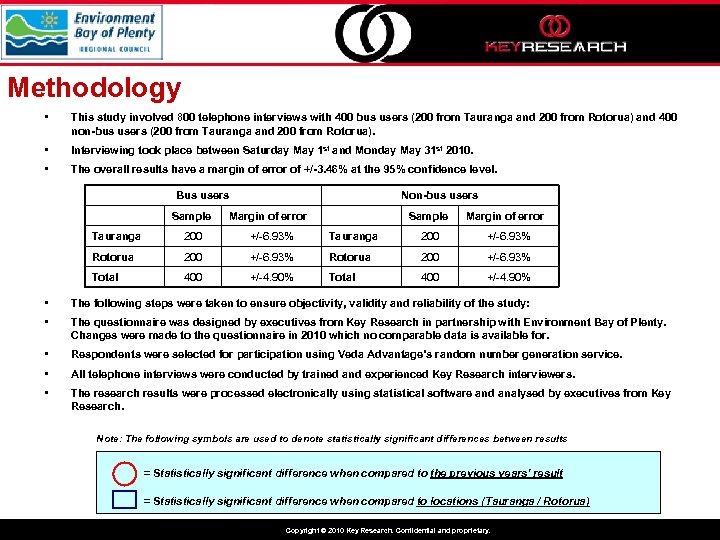
Methodology • This study involved 800 telephone interviews with 400 bus users (200 from Tauranga and 200 from Rotorua) and 400 non-bus users (200 from Tauranga and 200 from Rotorua). • Interviewing took place between Saturday May 1 st and Monday May 31 st 2010. • The overall results have a margin of error of +/-3. 46% at the 95% confidence level. Bus users Sample Non-bus users Margin of error Sample Margin of error Tauranga 200 +/-6. 93% Rotorua 200 +/-6. 93% Total 400 +/-4. 90% • The following steps were taken to ensure objectivity, validity and reliability of the study: • The questionnaire was designed by executives from Key Research in partnership with Environment Bay of Plenty. Changes were made to the questionnaire in 2010 which no comparable data is available for. • Respondents were selected for participation using Veda Advantage’s random number generation service. • All telephone interviews were conducted by trained and experienced Key Research interviewers. • The research results were processed electronically using statistical software and analysed by executives from Key Research. Note: The following symbols are used to denote statistically significant differences between results = Statistically significant difference when compared to the previous years’ result = Statistically significant difference when compared to locations (Tauranga / Rotorua) Copyright © 2010 Key Research. Confidential and proprietary.
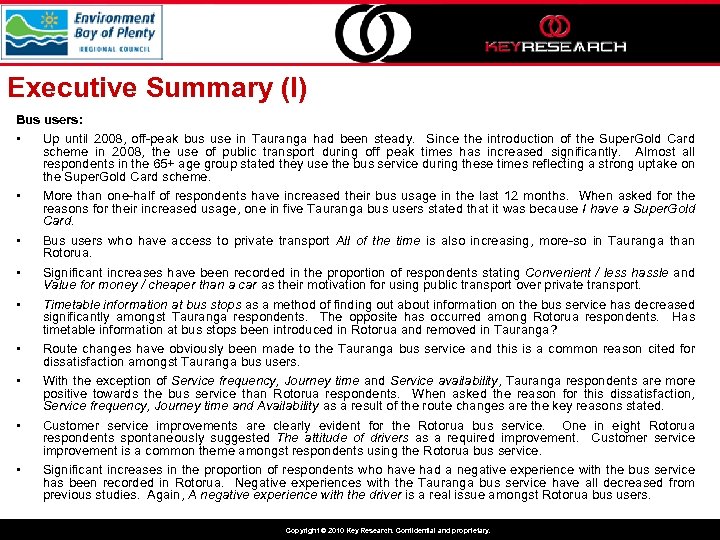
Executive Summary (I) Bus users: • • • Up until 2008, off-peak bus use in Tauranga had been steady. Since the introduction of the Super. Gold Card scheme in 2008, the use of public transport during off peak times has increased significantly. Almost all respondents in the 65+ age group stated they use the bus service during these times reflecting a strong uptake on the Super. Gold Card scheme. More than one-half of respondents have increased their bus usage in the last 12 months. When asked for the reasons for their increased usage, one in five Tauranga bus users stated that it was because I have a Super. Gold Card. Bus users who have access to private transport All of the time is also increasing, more-so in Tauranga than Rotorua. • Significant increases have been recorded in the proportion of respondents stating Convenient / less hassle and Value for money / cheaper than a car as their motivation for using public transport over private transport. • Timetable information at bus stops as a method of finding out about information on the bus service has decreased significantly amongst Tauranga respondents. The opposite has occurred among Rotorua respondents. Has timetable information at bus stops been introduced in Rotorua and removed in Tauranga? • Route changes have obviously been made to the Tauranga bus service and this is a common reason cited for dissatisfaction amongst Tauranga bus users. With the exception of Service frequency, Journey time and Service availability, Tauranga respondents are more positive towards the bus service than Rotorua respondents. When asked the reason for this dissatisfaction, Service frequency, Journey time and Availability as a result of the route changes are the key reasons stated. Customer service improvements are clearly evident for the Rotorua bus service. One in eight Rotorua respondents spontaneously suggested The attitude of drivers as a required improvement. Customer service improvement is a common theme amongst respondents using the Rotorua bus service. Significant increases in the proportion of respondents who have had a negative experience with the bus service has been recorded in Rotorua. Negative experiences with the Tauranga bus service have all decreased from previous studies. Again, A negative experience with the driver is a real issue amongst Rotorua bus users. • • • Copyright © 2010 Key Research. Confidential and proprietary.
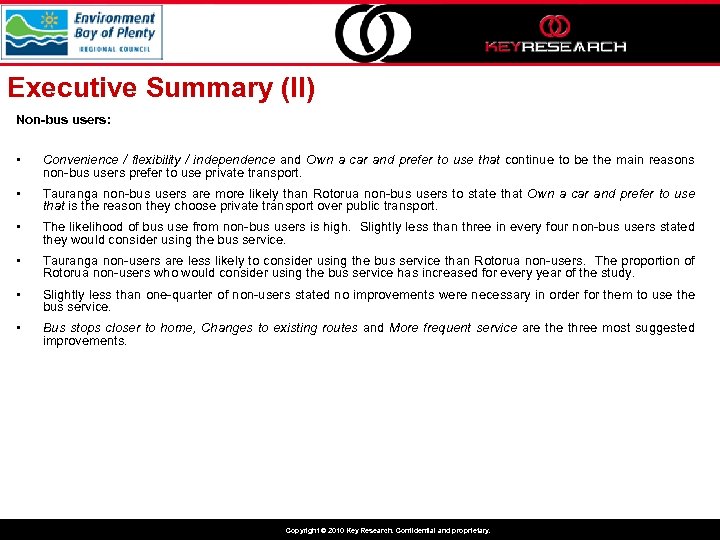
Executive Summary (II) Non-bus users: • Convenience / flexibility / independence and Own a car and prefer to use that continue to be the main reasons non-bus users prefer to use private transport. • Tauranga non-bus users are more likely than Rotorua non-bus users to state that Own a car and prefer to use that is the reason they choose private transport over public transport. • The likelihood of bus use from non-bus users is high. Slightly less than three in every four non-bus users stated they would consider using the bus service. • Tauranga non-users are less likely to consider using the bus service than Rotorua non-users. The proportion of Rotorua non-users who would consider using the bus service has increased for every year of the study. • Slightly less than one-quarter of non-users stated no improvements were necessary in order for them to use the bus service. • Bus stops closer to home, Changes to existing routes and More frequent service are three most suggested improvements. Copyright © 2010 Key Research. Confidential and proprietary.
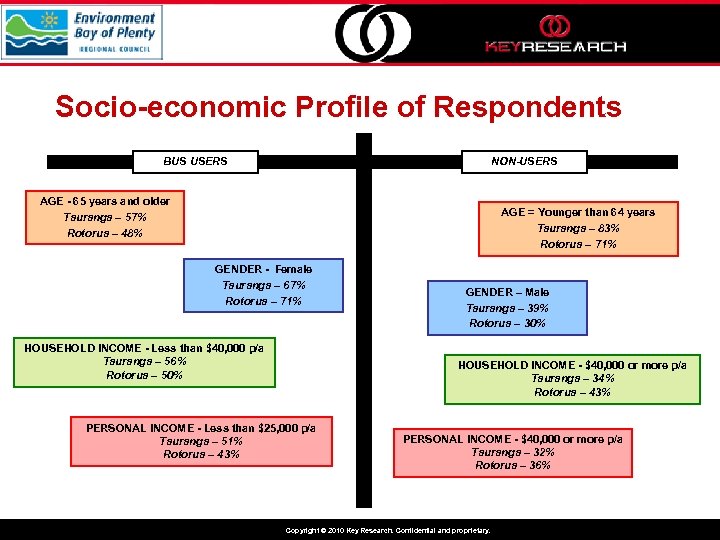
Socio-economic Profile of Respondents BUS USERS NON-USERS AGE - 65 years and older Tauranga – 57% Rotorua – 48% AGE = Younger than 64 years Tauranga – 83% Rotorua – 71% GENDER - Female Tauranga – 67% Rotorua – 71% HOUSEHOLD INCOME - Less than $40, 000 p/a Tauranga – 56% Rotorua – 50% GENDER – Male Tauranga – 39% Rotorua – 30% HOUSEHOLD INCOME - $40, 000 or more p/a Tauranga – 34% Rotorua – 43% PERSONAL INCOME - Less than $25, 000 p/a Tauranga – 51% Rotorua – 43% PERSONAL INCOME - $40, 000 or more p/a Tauranga – 32% Rotorua – 36% Copyright © 2010 Key Research. Confidential and proprietary.
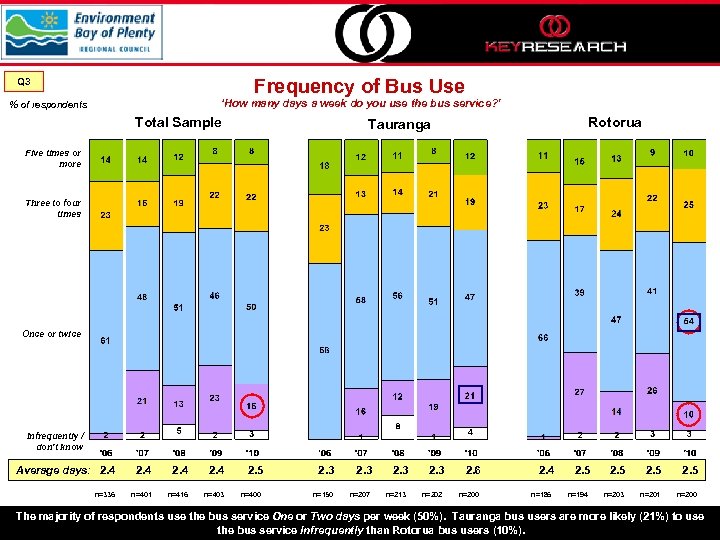
Frequency of Bus Use Q 3 ‘How many days a week do you use the bus service? ’ % of respondents Total Sample Rotorua Tauranga Five times or more Three to four times Once or twice Infrequently / don’t know Average days: 2. 4 n=336 n=401 n=416 n=403 2. 5 n=400 2. 3 n=150 2. 3 n=207 2. 3 n=213 n=202 2. 6 n=200 2. 4 n=186 2. 5 n=194 2. 5 n=203 n=201 n=200 The majority of respondents use the bus service One or Two days per week (50%). Tauranga bus users are more likely (21%) to use Copyright © 2010 Key Research. Confidential and proprietary. the bus service Infrequently than Rotorua bus users (10%).
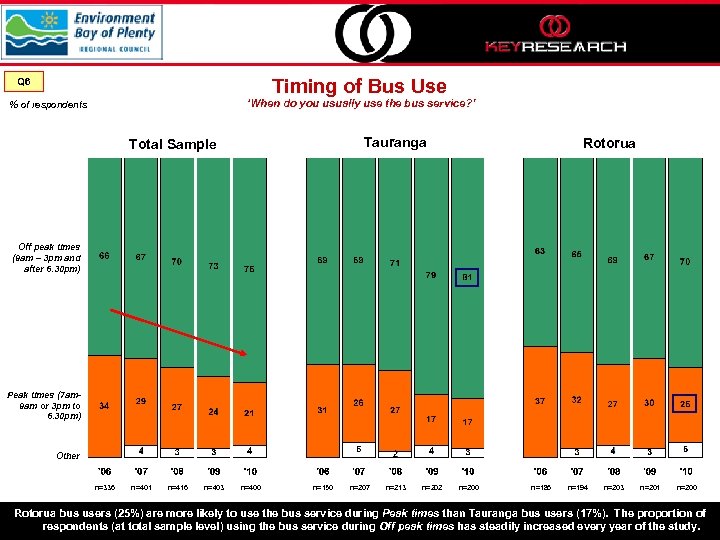
Timing of Bus Use Q 6 ‘When do you usually use the bus service? ’ % of respondents Tauranga Total Sample Rotorua Off peak times (9 am – 3 pm and after 6. 30 pm) Peak times (7 am 9 am or 3 pm to 6. 30 pm) Other n=336 n=401 n=416 n=403 n=400 n=150 n=207 n=213 n=202 n=200 n=186 n=194 n=203 n=201 n=200 Rotorua bus users (25%) are more likely to use the bus service during Peak times than Tauranga bus users (17%). The proportion of respondents (at total sample level) using the bus service during Off Confidential and proprietary. Copyright © 2010 Key Research. peak times has steadily increased every year of the study.
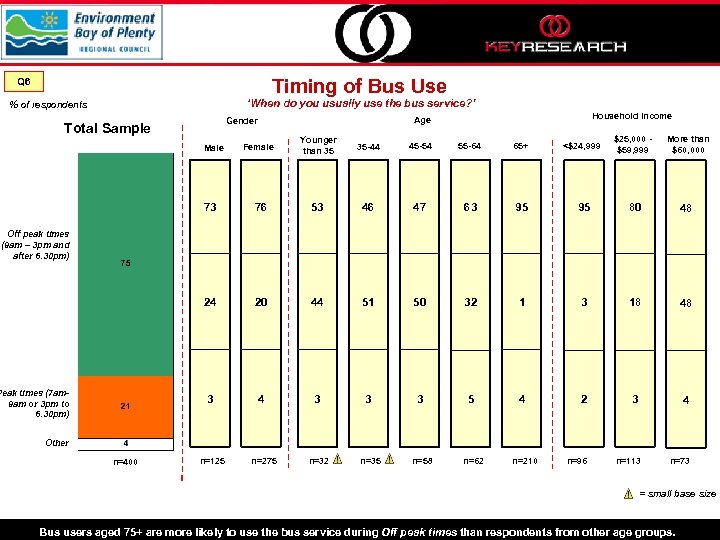
Timing of Bus Use Q 6 ‘When do you usually use the bus service? ’ % of respondents Total Sample Household income Age Gender Female Younger than 35 35 -44 45 -54 55 -64 65+ <$24, 999 $25, 000 $59, 999 More than $60, 000 73 76 53 46 47 63 95 95 80 48 24 20 44 51 50 32 1 3 18 48 3 4 3 3 3 5 4 2 3 4 n=32 n=35 n=58 Male Off peak times (9 am – 3 pm and after 6. 30 pm) Peak times (7 am 9 am or 3 pm to 6. 30 pm) Other n=400 n=125 n=275 n=62 n=210 n=96 n=113 n=73 = small base size Copyright © 2010 Key Research. peak times than respondents from other age groups. Bus users aged 75+ are more likely to use the bus service during Off. Confidential and proprietary.
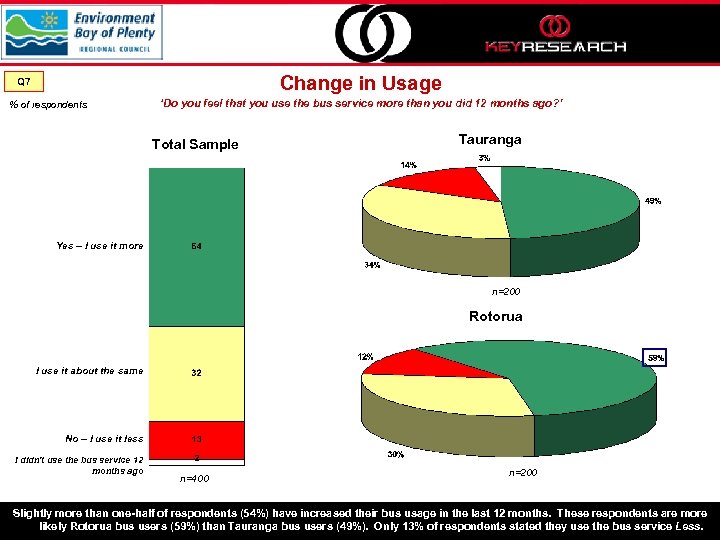
Change in Usage Q 7 % of respondents ‘Do you feel that you use the bus service more than you did 12 months ago? ’ Total Sample Tauranga Yes – I use it more n=200 Rotorua I use it about the same No – I use it less I didn’t use the bus service 12 months ago n=400 n=200 Slightly more than one-half of respondents (54%) have increased their bus usage in the last 12 months. These respondents are more likely Rotorua bus users (59%) than Tauranga bus users (49%). Only 13% of and proprietary. Copyright © 2010 Key Research. Confidential respondents stated they use the bus service Less.
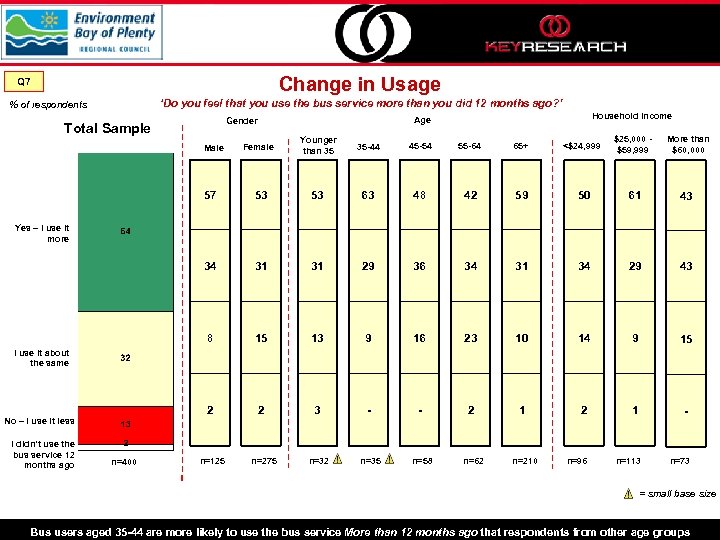
Change in Usage Q 7 ‘Do you feel that you use the bus service more than you did 12 months ago? ’ % of respondents Total Sample Household income Age Gender Female Younger than 35 35 -44 45 -54 55 -64 65+ <$24, 999 $25, 000 $59, 999 More than $60, 000 57 53 53 63 48 42 59 50 61 43 34 31 31 29 36 34 31 34 29 43 8 15 13 9 16 23 10 14 9 15 2 2 3 - - 2 1 - n=32 n=35 n=58 Male Yes – I use it more I use it about the same No – I use it less I didn’t use the bus service 12 months ago n=400 n=125 n=275 n=62 n=210 n=96 n=113 n=73 = small base size Copyright © 2010 Key Research. 12 months ago that Bus users aged 35 -44 are more likely to use the bus service More than. Confidential and proprietary. respondents from other age groups
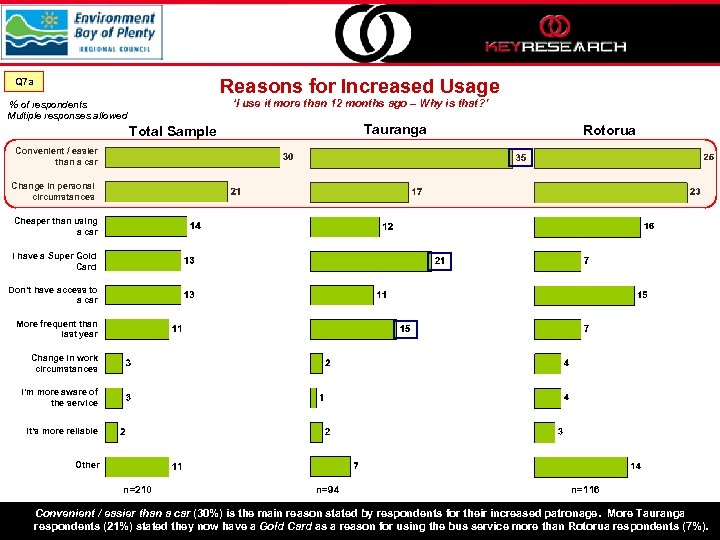
Reasons for Increased Usage Q 7 a ‘I use it more than 12 months ago – Why is that? ’ % of respondents Multiple responses allowed Tauranga Total Sample Rotorua Convenient / easier than a car Change in personal circumstances Cheaper than using a car I have a Super Gold Card Don’t have access to a car More frequent than last year Change in work circumstances I’m more aware of the service It’s more reliable Other n=210 n=94 n=116 Convenient / easier than a car (30%) is the main reason stated by respondents for their increased patronage. More Tauranga respondents (21%) stated they now have a Gold Copyright © 2010 Key Research. Confidential and proprietary. Card as a reason for using the bus service more than Rotorua respondents (7%).
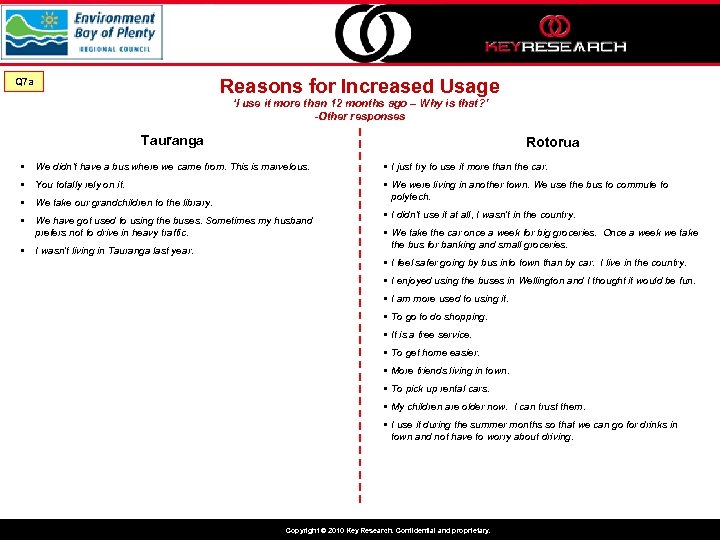
Reasons for Increased Usage Q 7 a ‘I use it more than 12 months ago – Why is that? ’ -Other responses Tauranga Rotorua • We didn’t have a bus where we came from. This is marvelous. • I just try to use it more than the car. • You totally rely on it. • We were living in another town. We use the bus to commute to polytech. • We take our grandchildren to the library. • We have got used to using the buses. Sometimes my husband prefers not to drive in heavy traffic. • I wasn't living in Tauranga last year. • I didn't use it at all, I wasn't in the country. • We take the car once a week for big groceries. Once a week we take the bus for banking and small groceries. • I feel safer going by bus into town than by car. I live in the country. • I enjoyed using the buses in Wellington and I thought it would be fun. • I am more used to using it. • To go to do shopping. • It is a free service. • To get home easier. • More friends living in town. • To pick up rental cars. • My children are older now. I can trust them. • I use it during the summer months so that we can go for drinks in town and not have to worry about driving. Copyright © 2010 Key Research. Confidential and proprietary.
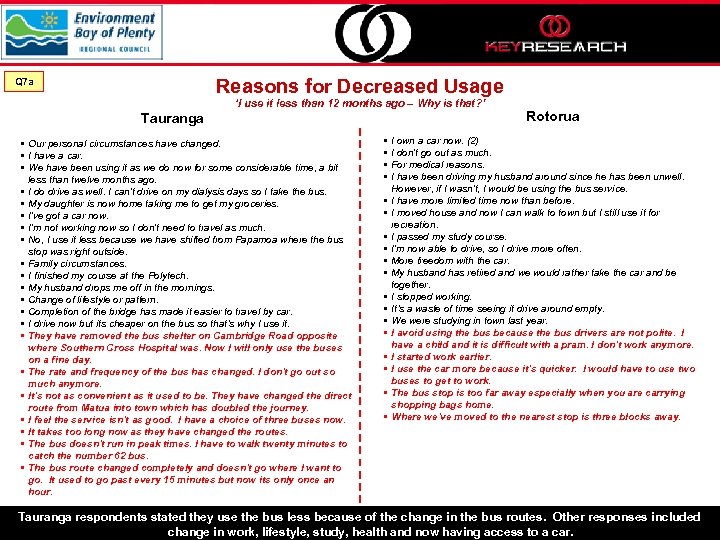
Reasons for Decreased Usage Q 7 a ‘I use it less than 12 months ago – Why is that? ’ Tauranga • Our personal circumstances have changed. • I have a car. • We have been using it as we do now for some considerable time, a bit less than twelve months ago. • I do drive as well. I can't drive on my dialysis days so I take the bus. • My daughter is now home taking me to get my groceries. • I've got a car now. • I'm not working now so I don't need to travel as much. • No, I use it less because we have shifted from Papamoa where the bus stop was right outside. • Family circumstances. • I finished my course at the Polytech. • My husband drops me off in the mornings. • Change of lifestyle or pattern. • Completion of the bridge has made it easier to travel by car. • I drive now but its cheaper on the bus so that’s why I use it. • They have removed the bus shelter on Cambridge Road opposite where Southern Cross Hospital was. Now I will only use the buses on a fine day. • The rate and frequency of the bus has changed. I don't go out so much anymore. • It's not as convenient as it used to be. They have changed the direct route from Matua into town which has doubled the journey. • I feel the service isn't as good. I have a choice of three buses now. • It takes too long now as they have changed the routes. • The bus doesn't run in peak times. I have to walk twenty minutes to catch the number 62 bus. • The bus route changed completely and doesn't go where I want to go. It used to go past every 15 minutes but now its only once an hour. • • • • • Rotorua I own a car now. (2) I don't go out as much. For medical reasons. I have been driving my husband around since he has been unwell. However, if I wasn't, I would be using the bus service. I have more limited time now than before. I moved house and now I can walk to town but I still use it for recreation. I passed my study course. I'm now able to drive, so I drive more often. More freedom with the car. My husband has retired and we would rather take the car and be together. I stopped working. It’s a waste of time seeing it drive around empty. We were studying in town last year. I avoid using the bus because the bus drivers are not polite. I have a child and it is difficult with a pram. I don't work anymore. I started work earlier. I use the car more because it's quicker. I would have to use two buses to get to work. The bus stop is too far away especially when you are carrying shopping bags home. Where we've moved to the nearest stop is three blocks away. Tauranga respondents stated they use the bus less because of the change in the bus routes. Other responses included Copyright © 2010 Key Research. Confidential having access to a car. change in work, lifestyle, study, health and nowand proprietary.
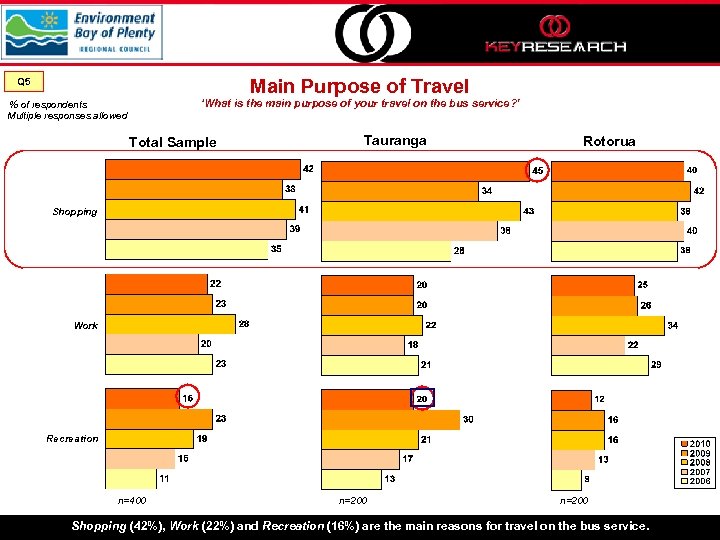
Main Purpose of Travel Q 5 ‘What is the main purpose of your travel on the bus service? ’ % of respondents Multiple responses allowed Total Sample Tauranga Rotorua Shopping Work Recreation n=400 n=200 Shopping (42%), Work (22%) and Recreation (16%) Research. Confidentialreasons for travel on the bus service. Copyright © 2010 Key are the main and proprietary.
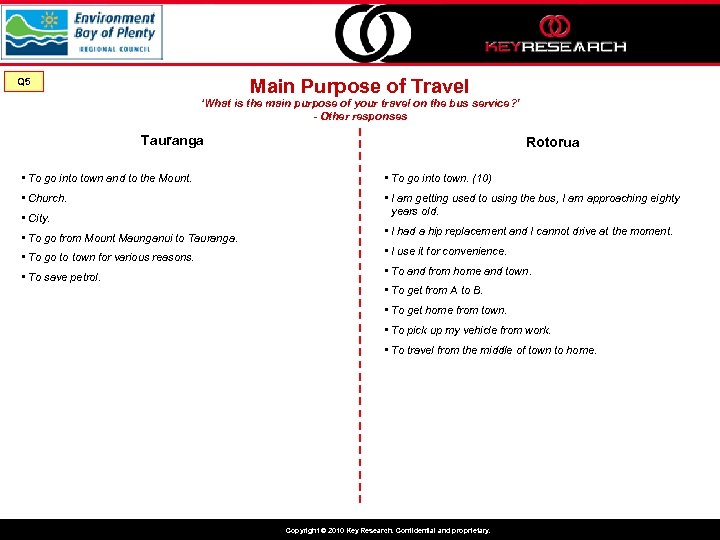
Main Purpose of Travel Q 5 ‘What is the main purpose of your travel on the bus service? ’ - Other responses Tauranga Rotorua • To go into town and to the Mount. • To go into town. (10) • Church. • I am getting used to using the bus, I am approaching eighty years old. • City. • To go from Mount Maunganui to Tauranga. • To go to town for various reasons. • To save petrol. • I had a hip replacement and I cannot drive at the moment. • I use it for convenience. • To and from home and town. • To get from A to B. • To get home from town. • To pick up my vehicle from work. • To travel from the middle of town to home. Copyright © 2010 Key Research. Confidential and proprietary.
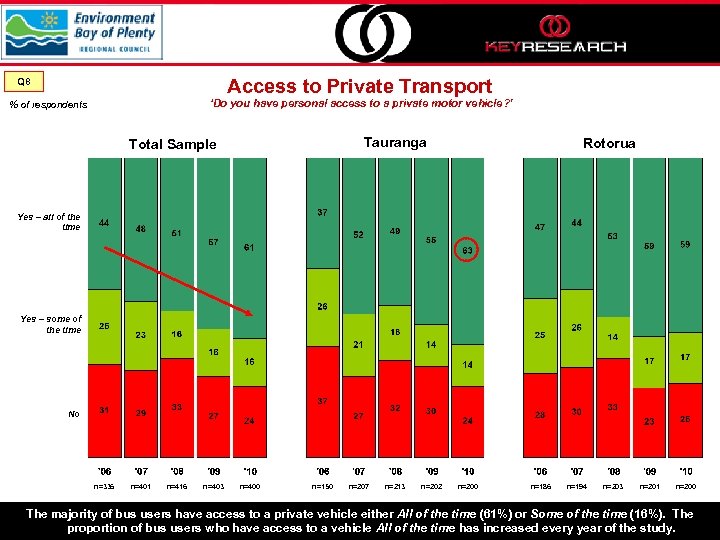
Access to Private Transport Q 8 ‘Do you have personal access to a private motor vehicle? ’ % of respondents Tauranga Total Sample Rotorua Yes – all of the time Yes – some of the time No n=336 n=401 n=416 n=403 n=400 n=150 n=207 n=213 n=202 n=200 n=186 n=194 n=203 n=201 n=200 The majority of bus users have access to a private vehicle either All of the time (61%) or Some of the time (16%). The proportion of bus users who have access to © 2010 Key Research. of the time has increased every year of the study. Copyright a vehicle All Confidential and proprietary.
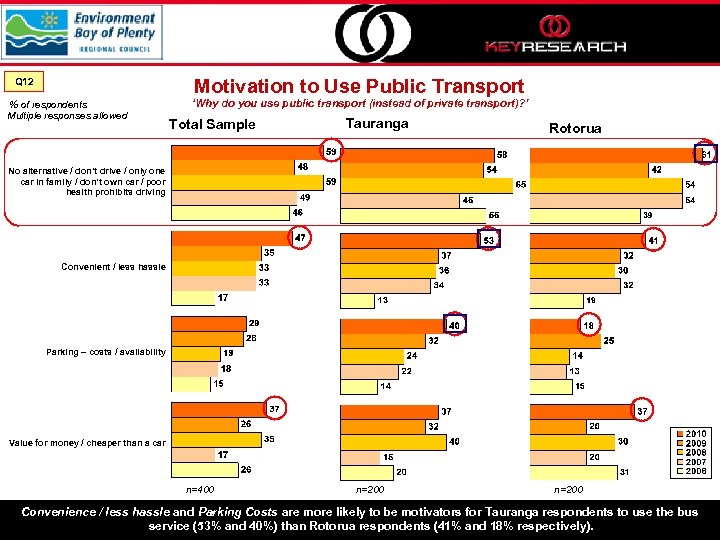
Motivation to Use Public Transport Q 12 % of respondents Multiple responses allowed ‘Why do you use public transport (instead of private transport)? ’ Total Sample Tauranga Rotorua No alternative / don’t drive / only one car in family / don’t own car / poor health prohibits driving Convenient / less hassle Parking – costs / availability Value for money / cheaper than a car n=400 n=200 Convenience / less hassle and Parking Costs are more likely to be motivators for Tauranga respondents to use the bus service (53% and 40%) than Rotorua respondents (41% and 18% respectively). Copyright © 2010 Key Research. Confidential and proprietary.
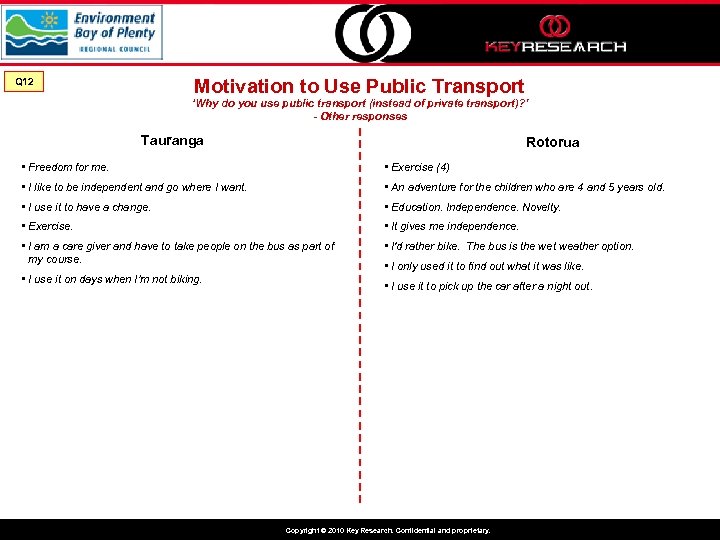
Motivation to Use Public Transport Q 12 ‘Why do you use public transport (instead of private transport)? ’ - Other responses Tauranga Rotorua • Freedom for me. • Exercise (4) • I like to be independent and go where I want. • An adventure for the children who are 4 and 5 years old. • I use it to have a change. • Education. Independence. Novelty. • Exercise. • It gives me independence. • I am a care giver and have to take people on the bus as part of my course. • I'd rather bike. The bus is the wet weather option. • I use it on days when I’m not biking. • I only used it to find out what it was like. • I use it to pick up the car after a night out. Copyright © 2010 Key Research. Confidential and proprietary.
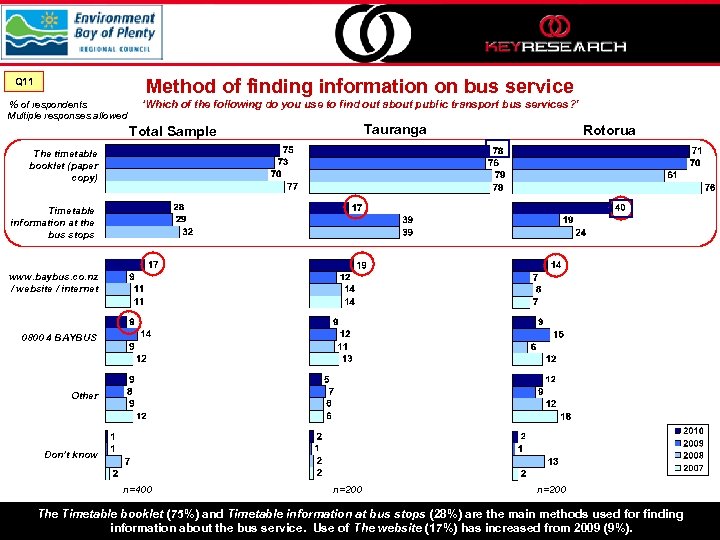
Method of finding information on bus service Q 11 % of respondents Multiple responses allowed ‘Which of the following do you use to find out about public transport bus services? ’ Tauranga Total Sample Rotorua The timetable booklet (paper copy) Timetable information at the bus stops www. baybus. co. nz / website / internet 0800 4 BAYBUS Other Don’t know n=400 n=200 The Timetable booklet (75%) and Timetable information at bus stops (28%) are the main methods used for finding information about the bus service. Use of The website (17%) has increased from 2009 (9%). Copyright © 2010 Key Research. Confidential and proprietary.
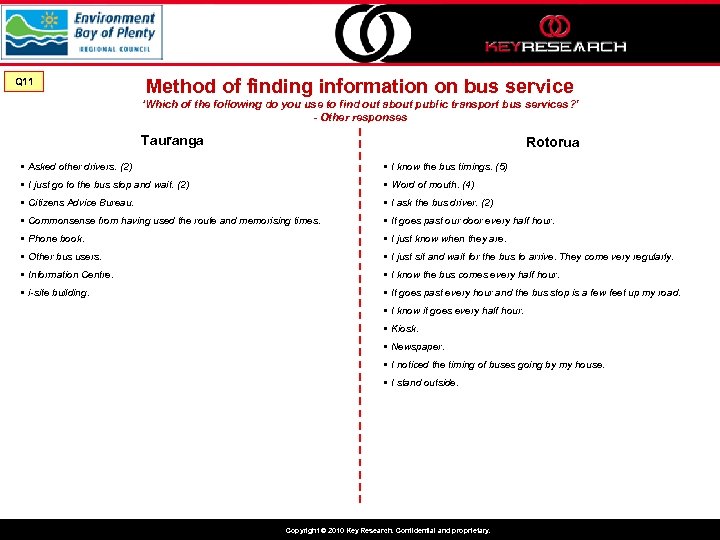
Q 11 Method of finding information on bus service ‘Which of the following do you use to find out about public transport bus services? ’ - Other responses Tauranga Rotorua • Asked other drivers. (2) • I know the bus timings. (5) • I just go to the bus stop and wait. (2) • Word of mouth. (4) • Citizens Advice Bureau. • I ask the bus driver. (2) • Commonsense from having used the route and memorising times. • It goes past our door every half hour. • Phone book. • I just know when they are. • Other bus users. • I just sit and wait for the bus to arrive. They come very regularly. • Information Centre. • I know the bus comes every half hour. • i-site building. • It goes past every hour and the bus stop is a few feet up my road. • I know it goes every half hour. • Kiosk. • Newspaper. • I noticed the timing of buses going by my house. • I stand outside. Copyright © 2010 Key Research. Confidential and proprietary.
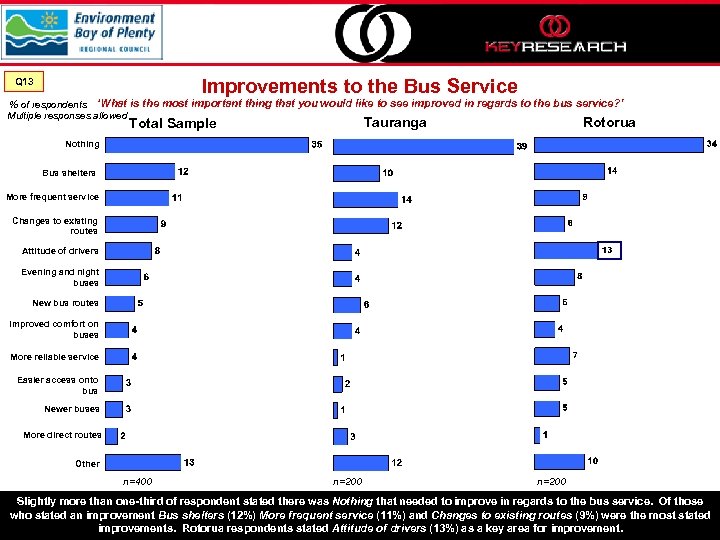
Improvements to the Bus Service Q 13 % of respondents ‘What is the most important thing that you would like to see improved in regards to the bus service? ’ Multiple responses allowed Tauranga Total Sample Rotorua Nothing Bus shelters More frequent service Changes to existing routes Attitude of drivers Evening and night buses New bus routes Improved comfort on buses More reliable service Easier access onto bus Newer buses More direct routes Other n=400 n=200 Slightly more than one-third of respondent stated there was Nothing that needed to improve in regards to the bus service. Of those who stated an improvement Bus shelters (12%) More frequent service (11%) and Changes to existing routes (9%) were the most stated improvements. Rotorua respondents stated 2010 Key Research. Confidential and proprietary. area for improvement. Copyright © Attitude of drivers (13%) as a key
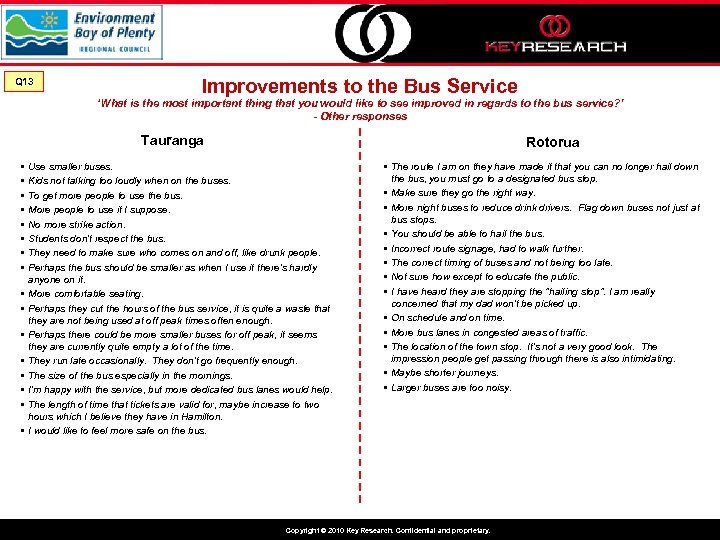
Q 13 Improvements to the Bus Service ‘What is the most important thing that you would like to see improved in regards to the bus service? ’ - Other responses Tauranga • • • • Rotorua Use smaller buses. Kids not talking too loudly when on the buses. To get more people to use the bus. More people to use it I suppose. No more strike action. Students don't respect the bus. They need to make sure who comes on and off, like drunk people. Perhaps the bus should be smaller as when I use it there's hardly anyone on it. More comfortable seating. Perhaps they cut the hours of the bus service, it is quite a waste that they are not being used at off peak times often enough. Perhaps there could be more smaller buses for off peak, it seems they are currently quite empty a lot of the time. They run late occasionally. They don't go frequently enough. The size of the bus especially in the mornings. I'm happy with the service, but more dedicated bus lanes would help. The length of time that tickets are valid for, maybe increase to two hours which I believe they have in Hamilton. I would like to feel more safe on the bus. • The route I am on they have made it that you can no longer hail down the bus, you must go to a designated bus stop. • Make sure they go the right way. • More night buses to reduce drink drivers. Flag down buses not just at bus stops. • You should be able to hail the bus. • Incorrect route signage, had to walk further. • The correct timing of buses and not being too late. • Not sure how except to educate the public. • I have heard they are stopping the "hailing stop". I am really concerned that my dad won't be picked up. • On schedule and on time. • More bus lanes in congested areas of traffic. • The location of the town stop. It's not a very good look. The impression people get passing through there is also intimidating. • Maybe shorter journeys. • Larger buses are too noisy. Copyright © 2010 Key Research. Confidential and proprietary.
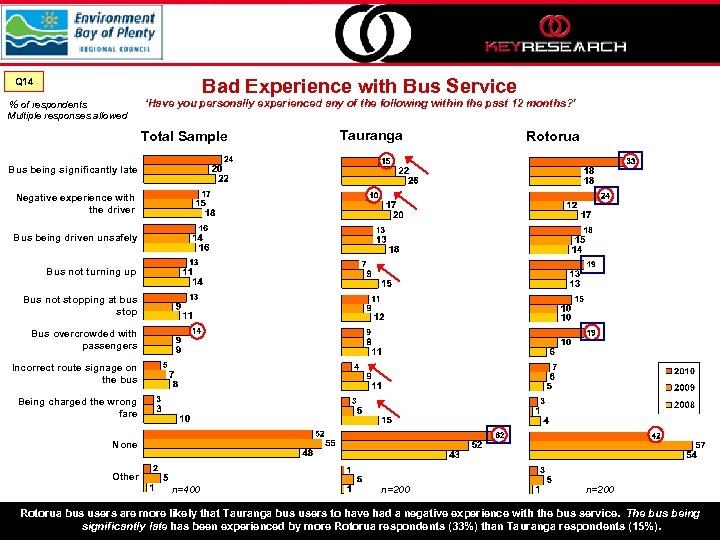
Bad Experience with Bus Service Q 14 % of respondents Multiple responses allowed ‘Have you personally experienced any of the following within the past 12 months? ’ Total Sample Tauranga Rotorua Bus being significantly late Negative experience with the driver Bus being driven unsafely Bus not turning up Bus not stopping at bus stop Bus overcrowded with passengers Incorrect route signage on the bus Being charged the wrong fare None Other n=400 n=200 Rotorua bus users are more likely that Tauranga bus users to have had a negative experience with the bus service. The bus being significantly late has been experienced Copyright © 2010 Key Research. Confidential and proprietary. Tauranga respondents (15%). by more Rotorua respondents (33%) than
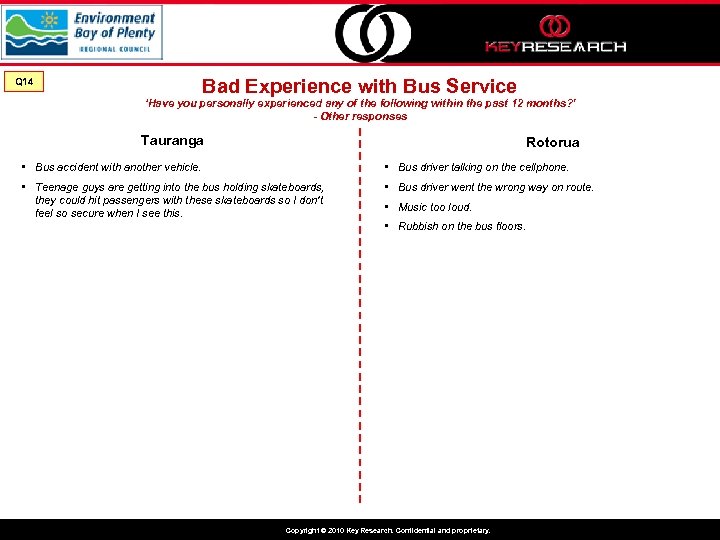
Bad Experience with Bus Service Q 14 ‘Have you personally experienced any of the following within the past 12 months? ’ - Other responses Tauranga Rotorua • Bus accident with another vehicle. • Bus driver talking on the cellphone. • Teenage guys are getting into the bus holding skateboards, they could hit passengers with these skateboards so I don't feel so secure when I see this. • Bus driver went the wrong way on route. • Music too loud. • Rubbish on the bus floors. Copyright © 2010 Key Research. Confidential and proprietary.
Total Mobility Copyright © 2010 Key Research. Confidential and proprietary.
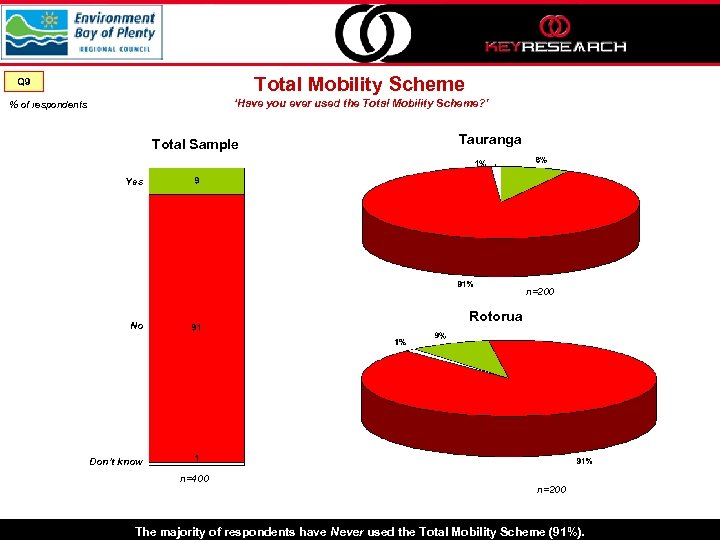
Total Mobility Scheme Q 9 ‘Have you ever used the Total Mobility Scheme? ’ % of respondents Total Sample Tauranga Yes n=200 Rotorua No Don’t know n=400 n=200 Copyright © Never used the Total proprietary. The majority of respondents have 2010 Key Research. Confidential and Mobility Scheme (91%).
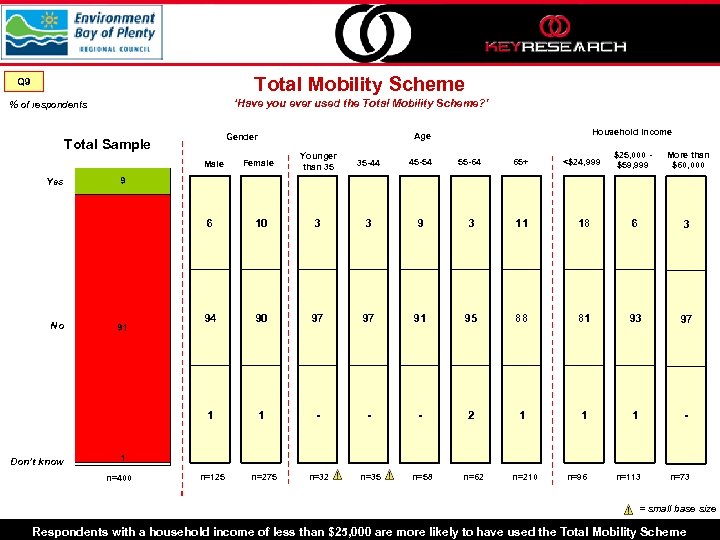
Total Mobility Scheme Q 9 ‘Have you ever used the Total Mobility Scheme? ’ % of respondents Total Sample Household income Age Gender Female Younger than 35 35 -44 45 -54 55 -64 65+ <$24, 999 $25, 000 $59, 999 More than $60, 000 6 10 3 3 9 3 11 18 6 3 94 90 97 97 91 95 88 81 93 97 1 1 - - - 2 1 1 1 - n=32 n=35 n=58 Male Yes No Don’t know n=400 n=125 n=275 n=62 n=210 n=96 n=113 n=73 = small base size Copyright © 2010 Key Research. more likely to have Respondents with a household income of less than $25, 000 are Confidential and proprietary. used the Total Mobility Scheme
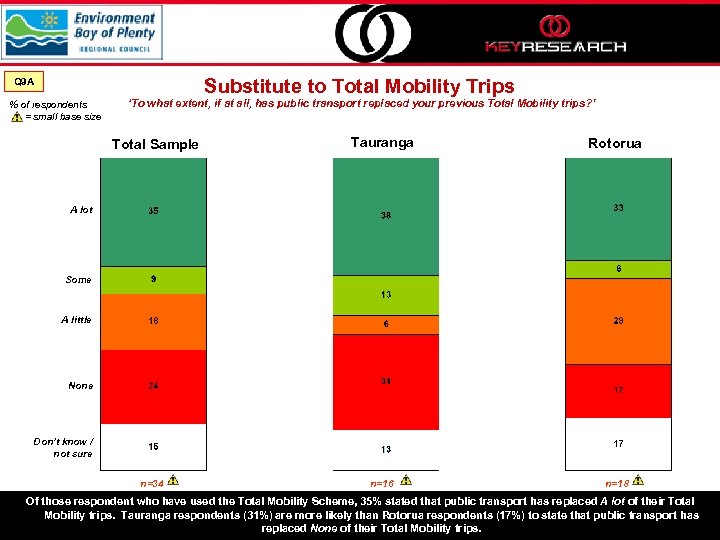
Substitute to Total Mobility Trips Q 9 A % of respondents = small base size ‘To what extent, if at all, has public transport replaced your previous Total Mobility trips? ’ Total Sample Tauranga Rotorua n=16 n=18 A lot Some A little None Don’t know / not sure n=34 Of those respondent who have used the Total Mobility Scheme, 35% stated that public transport has replaced A lot of their Total Mobility trips. Tauranga respondents (31%) are more likely than Rotorua respondents (17%) to state that public transport has replaced None of their Total Mobility proprietary. Copyright © 2010 Key Research. Confidential and trips.
Satisfaction with Bus Service Copyright © 2010 Key Research. Confidential and proprietary.
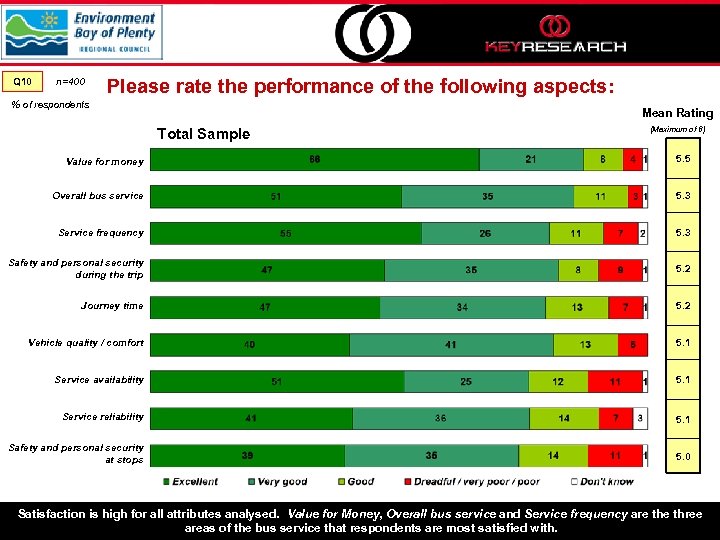
Q 10 n=400 Please rate the performance of the following aspects: % of respondents Mean Rating Total Sample (Maximum of 6) Value for money 5. 5 Overall bus service 5. 3 Service frequency 5. 3 Safety and personal security during the trip 5. 2 Journey time 5. 2 Vehicle quality / comfort 5. 1 Service availability 5. 1 Service reliability 5. 1 Safety and personal security at stops 5. 0 Satisfaction is high for all attributes analysed. Value for Money, Overall bus service and Service frequency are three areas of the bus service©that. Key Research. Confidential and proprietary. Copyright 2010 respondents are most satisfied with.
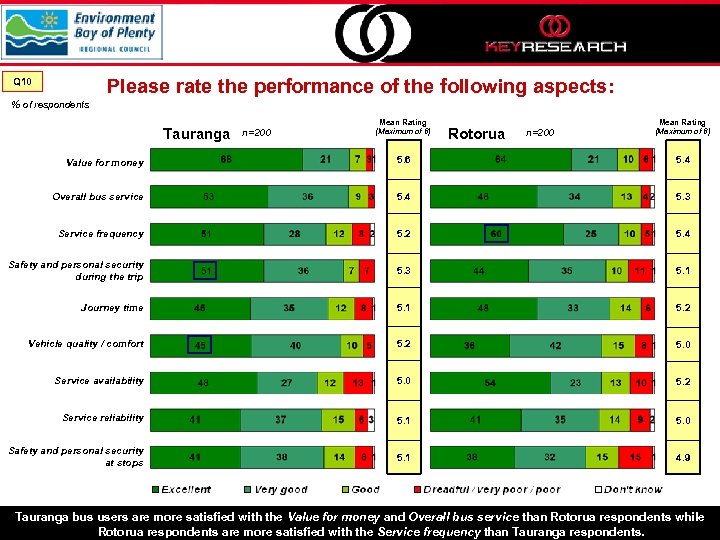
Please rate the performance of the following aspects: Q 10 % of respondents Tauranga n=200 Mean Rating (Maximum of 6) Rotorua n=200 Mean Rating (Maximum of 6) Value for money 5. 6 5. 4 Overall bus service 5. 4 5. 3 Service frequency 5. 2 5. 4 Safety and personal security during the trip 5. 3 5. 1 Journey time 5. 1 5. 2 Vehicle quality / comfort 5. 2 5. 0 Service availability 5. 0 5. 2 Service reliability 5. 1 5. 0 Safety and personal security at stops 5. 1 4. 9 Tauranga bus users are more satisfied with the Value for money and Overall bus service than Rotorua respondents while Copyright © 2010 Key Research. Confidential and proprietary. Rotorua respondents are more satisfied with the Service frequency than Tauranga respondents.
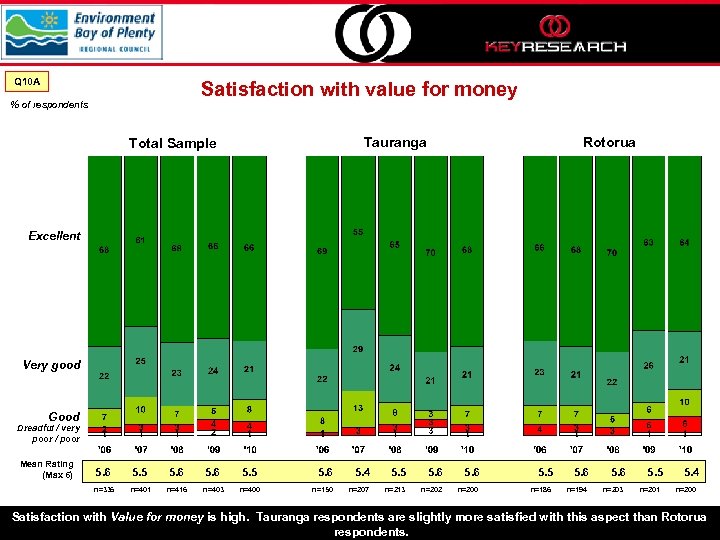
Q 10 A Satisfaction with value for money % of respondents Tauranga Total Sample Rotorua Excellent Very good Good Dreadful / very poor / poor Mean Rating (Max 6) 5. 6 5. 5 n=336 n=401 n=416 n=403 n=400 5. 6 5. 4 5. 5 5. 6 n=150 n=207 n=213 n=202 n=200 5. 5 n=186 5. 6 n=194 5. 6 n=203 5. 5 n=201 5. 4 n=200 Satisfaction with Value for money is high. Tauranga respondents are slightly more satisfied with this aspect than Rotorua Copyright © 2010 Key Research. Confidential and proprietary. respondents.
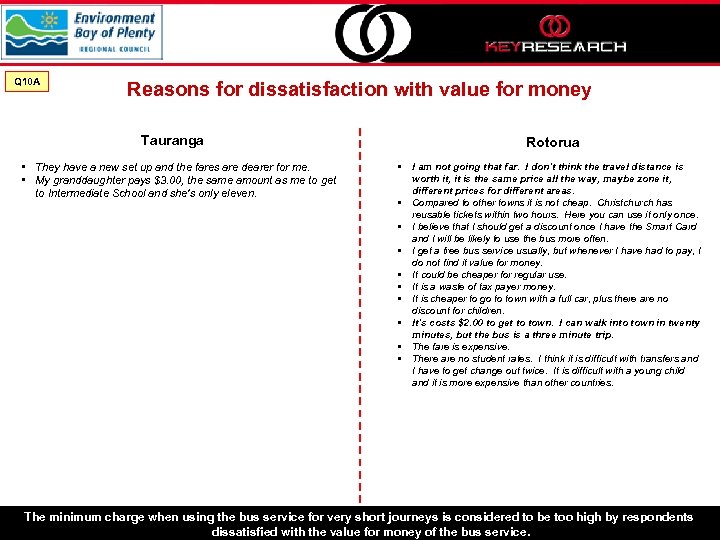
Q 10 A Reasons for dissatisfaction with value for money Tauranga • They have a new set up and the fares are dearer for me. • My granddaughter pays $3. 00, the same amount as me to get to Intermediate School and she's only eleven. Rotorua • I am not going that far. I don't think the travel distance is worth it, it is the same price all the way, maybe zone it, different prices for different areas. • Compared to other towns it is not cheap. Christchurch has reusable tickets within two hours. Here you can use it only once. • I believe that I should get a discount once I have the Smart Card and I will be likely to use the bus more often. • I get a free bus service usually, but whenever I have had to pay, I do not find it value for money. • It could be cheaper for regular use. • It is a waste of tax payer money. • It is cheaper to go to town with a full car, plus there are no discount for children. • It's costs $2. 00 to get to town. I can walk into town in twenty minutes, but the bus is a three minute trip. • The fare is expensive. • There are no student rates. I think it is difficult with transfers and I have to get change out twice. It is difficult with a young child and it is more expensive than other countries. The minimum charge when using the bus service for very short journeys is considered to be too high by respondents Copyright © value for money of the bus service. dissatisfied with the 2010 Key Research. Confidential and proprietary.
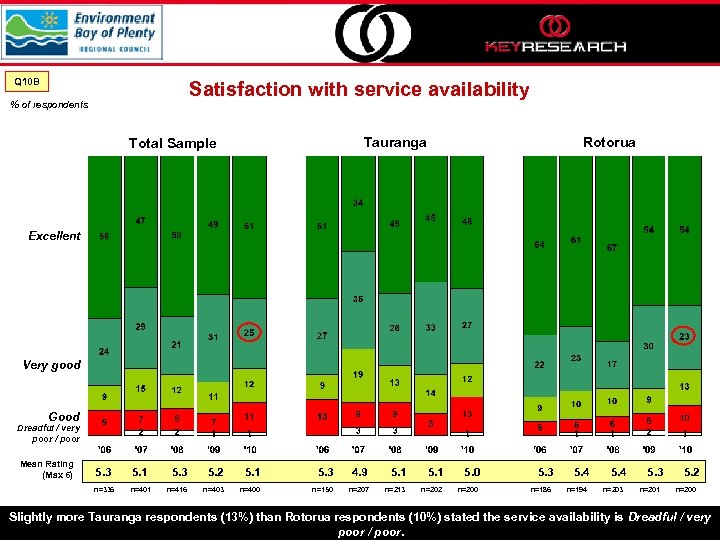
Q 10 B Satisfaction with service availability % of respondents Tauranga Total Sample Rotorua Excellent Very good Good Dreadful / very poor / poor Mean Rating (Max 6) 5. 3 5. 1 n=336 n=401 5. 3 5. 2 5. 1 5. 3 4. 9 5. 1 5. 0 n=416 n=403 n=400 n=150 n=207 n=213 n=202 n=200 5. 3 n=186 5. 4 n=194 5. 4 n=203 5. 3 n=201 5. 2 n=200 Slightly more Tauranga respondents (13%) than Rotorua respondents (10%) stated the service availability is Dreadful / very Copyright © 2010 Key Research. Confidential and proprietary. poor / poor.
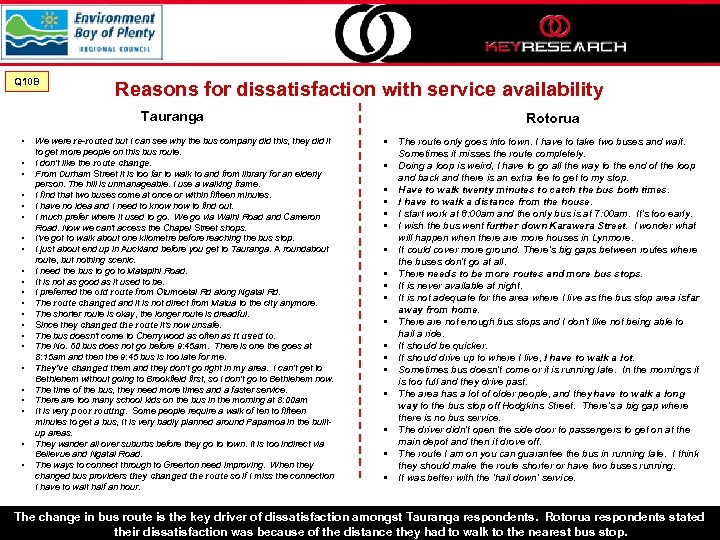
Q 10 B Reasons for dissatisfaction with service availability Tauranga • • • • • • We were re-routed but I can see why the bus company did this, they did it to get more people on this bus route. I don't like the route change. From Durham Street it is too far to walk to and from library for an elderly person. The hill is unmanageable. I use a walking frame. I find that two buses come at once or within fifteen minutes. I have no idea and I need to know how to find out. I much prefer where it used to go. We go via Waihi Road and Cameron Road. Now we can't access the Chapel Street shops. I've got to walk about one kilometre before reaching the bus stop. I just about end up in Auckland before you get to Tauranga. A roundabout route, but nothing scenic. I need the bus to go to Matapihi Road. It is not as good as it used to be. I preferred the old route from Otumoetai Rd along Ngatai Rd. The route changed and it is not direct from Matua to the city anymore. The shorter route is okay, the longer route is dreadful. Since they changed the route it's now unsafe. The bus doesn't come to Cherrywood as often as it used to. The No. 60 bus does not go before 9: 45 am. There is one the goes at 8: 15 am and then the 9: 45 bus is too late for me. They've changed them and they don't go right in my area. I can't get to Bethlehem without going to Brookfield first, so I don't go to Bethlehem now. The time of the bus, they need more times and a faster service. There are too many school kids on the bus in the morning at 8: 00 am It is very poor routing. Some people require a walk of ten to fifteen minutes to get a bus, It is very badly planned around Papamoa in the builtup areas. They wander all over suburbs before they go to town. It is too indirect via Bellevue and Ngatai Road. The ways to connect through to Greerton need improving. When they changed bus providers they changed the route so if I miss the connection I have to wait half an hour. Rotorua • • • • • The route only goes into town. I have to take two buses and wait. Sometimes it misses the route completely. Doing a loop is weird, I have to go all the way to the end of the loop and back and there is an extra fee to get to my stop. Have to walk twenty minutes to catch the bus both times. I have to walk a distance from the house. I start work at 8: 00 am and the only bus is at 7: 00 am. It's too early. I wish the bus went further down Karawera Street. I wonder what will happen when there are more houses in Lynmore. It could cover more ground. There's big gaps between routes where the buses don't go at all. There needs to be more routes and more bus stops. It is never available at night. It is not adequate for the area where I live as the bus stop area is far away from home. There are not enough bus stops and I don't like not being able to hail a ride. It should be quicker. It should drive up to where I live, I have to walk a lot. Sometimes bus doesn't come or it is running late. In the mornings it is too full and they drive past. The area has a lot of older people, and they have to walk a long way to the bus stop off Hodgkins Street. There's a big gap where there is no bus service. The driver didn't open the side door to passengers to get on at the main depot and then it drove off. The route I am on you can guarantee the bus in running late. I think they should make the route shorter or have two buses running. It was better with the 'hail down' service. The change in bus route is the key driver of dissatisfaction amongst Tauranga respondents. Rotorua respondents stated Copyright the Key Research. they had proprietary. their dissatisfaction was because of © 2010 distance Confidential andto walk to the nearest bus stop.
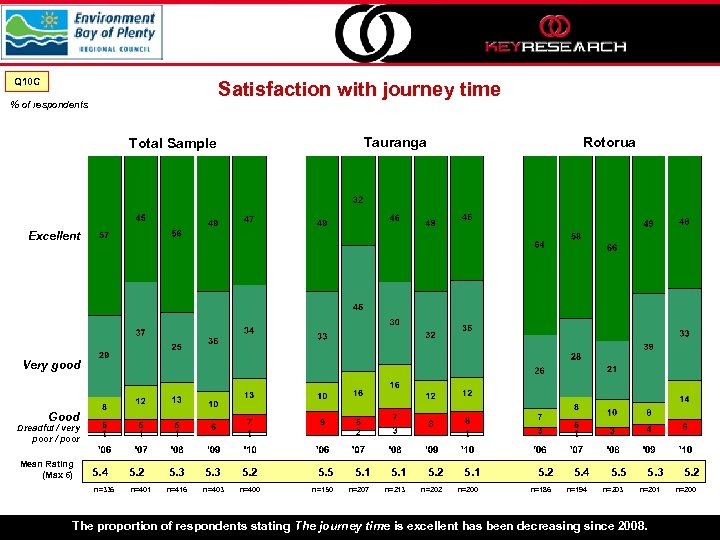
Q 10 C Satisfaction with journey time % of respondents Tauranga Total Sample Rotorua Excellent Very good Good Dreadful / very poor / poor Mean Rating (Max 6) 5. 4 5. 2 5. 3 5. 2 n=336 n=401 n=416 n=403 n=400 5. 5 5. 1 5. 2 5. 1 n=150 n=207 n=213 n=202 n=200 5. 2 n=186 5. 4 n=194 5. 5 n=203 5. 3 n=201 The proportion of respondents stating The journey. Research. is excellent has been decreasing since 2008. Copyright © 2010 Key time Confidential and proprietary. 5. 2 n=200
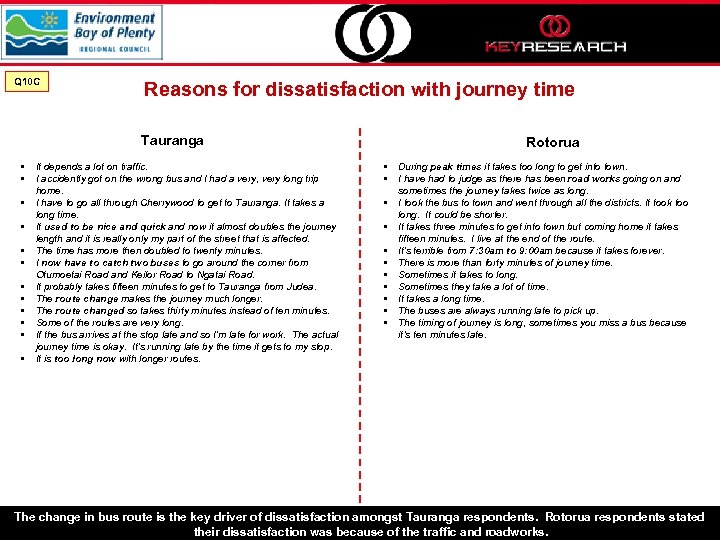
Q 10 C Reasons for dissatisfaction with journey time Tauranga • • • It depends a lot on traffic. I accidently got on the wrong bus and I had a very, very long trip home. I have to go all through Cherrywood to get to Tauranga. It takes a long time. It used to be nice and quick and now it almost doubles the journey length and it is really only my part of the street that is affected. The time has more then doubled to twenty minutes. I now have to catch two buses to go around the corner from Otumoetai Road and Keilor Road to Ngatai Road. It probably takes fifteen minutes to get to Tauranga from Judea. The route change makes the journey much longer. The route changed so takes thirty minutes instead of ten minutes. Some of the routes are very long. If the bus arrives at the stop late and so I'm late for work. The actual journey time is okay. It's running late by the time it gets to my stop. It is too long now with longer routes. Rotorua • During peak times it takes too long to get into town. • I have had to judge as there has been road works going on and sometimes the journey takes twice as long. • I took the bus to town and went through all the districts. It took too long. It could be shorter. • It takes three minutes to get into town but coming home it takes fifteen minutes. I live at the end of the route. • It's terrible from 7: 30 am to 9: 00 am because it takes forever. • There is more than forty minutes of journey time. • Sometimes it takes to long. • Sometimes they take a lot of time. • It takes a long time. • The buses are always running late to pick up. • The timing of journey is long, sometimes you miss a bus because it’s ten minutes late. The change in bus route is the key driver of dissatisfaction amongst Tauranga respondents. Rotorua respondents stated Copyright © 2010 Key Research. Confidential and proprietary. their dissatisfaction was because of the traffic and roadworks.
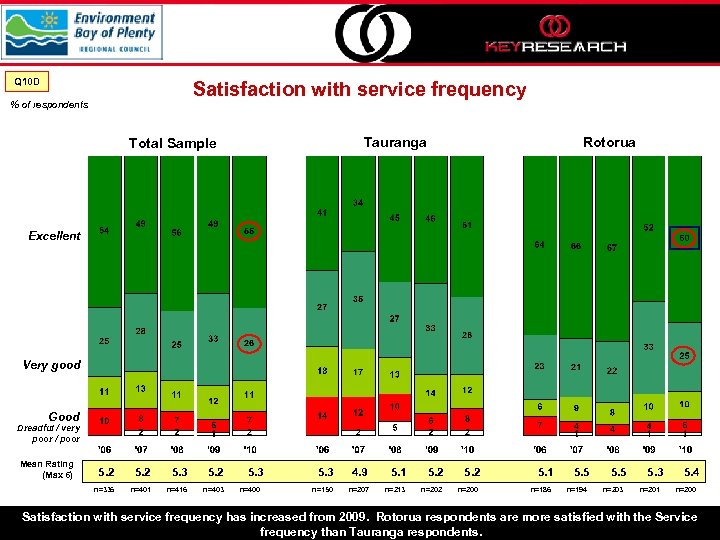
Q 10 D Satisfaction with service frequency % of respondents Tauranga Total Sample Rotorua Excellent Very good Good Dreadful / very poor / poor Mean Rating (Max 6) 5. 2 5. 3 5. 2 n=336 n=401 n=416 n=403 5. 3 n=400 5. 3 4. 9 5. 1 5. 2 n=150 n=207 n=213 n=202 n=200 5. 1 n=186 5. 5 n=194 5. 5 n=203 5. 3 n=201 5. 4 n=200 Satisfaction with service frequency has increased from 2009. Rotorua respondents are more satisfied with the Service Copyright © 2010 Tauranga respondents. frequency than. Key Research. Confidential and proprietary.
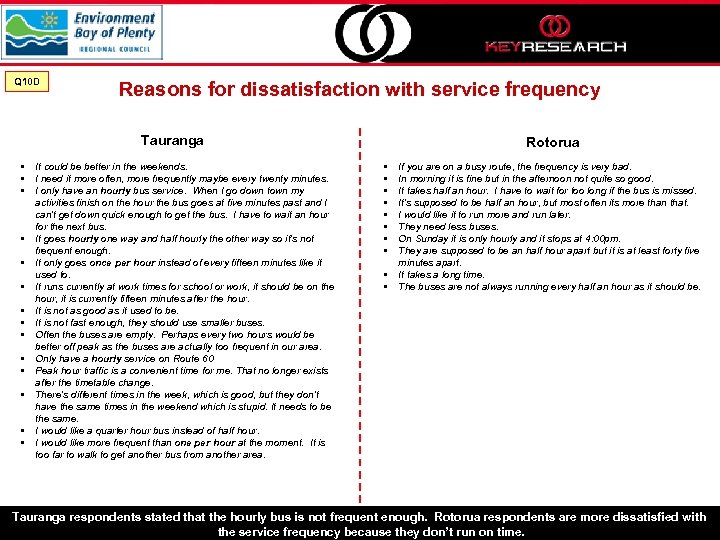
Q 10 D Reasons for dissatisfaction with service frequency Tauranga • It could be better in the weekends. • I need it more often, more frequently maybe every twenty minutes. • I only have an hourly bus service. When I go down town my activities finish on the hour the bus goes at five minutes past and I can't get down quick enough to get the bus. I have to wait an hour for the next bus. • It goes hourly one way and half hourly the other way so it's not frequent enough. • It only goes once per hour instead of every fifteen minutes like it used to. • It runs currently at work times for school or work, it should be on the hour, it is currently fifteen minutes after the hour. • It is not as good as it used to be. • It is not fast enough, they should use smaller buses. • Often the buses are empty. Perhaps every two hours would be better off peak as the buses are actually too frequent in our area. • Only have a hourly service on Route 60 • Peak hour traffic is a convenient time for me. That no longer exists after the timetable change. • There's different times in the week, which is good, but they don't have the same times in the weekend which is stupid. It needs to be the same. • I would like a quarter hour bus instead of half hour. • I would like more frequent than one per hour at the moment. It is too far to walk to get another bus from another area. Rotorua • • • If you are on a busy route, the frequency is very bad. In morning it is fine but in the afternoon not quite so good. It takes half an hour. I have to wait for too long if the bus is missed. It's supposed to be half an hour, but most often its more than that. I would like it to run more and run later. They need less buses. On Sunday it is only hourly and it stops at 4: 00 pm. They are supposed to be an half hour apart but it is at least forty five minutes apart. It takes a long time. The buses are not always running every half an hour as it should be. Tauranga respondents stated that the hourly bus is not frequent enough. Rotorua respondents are more dissatisfied with Copyright © 2010 Key Research. Confidential and run on the service frequency because they don’tproprietary. time.
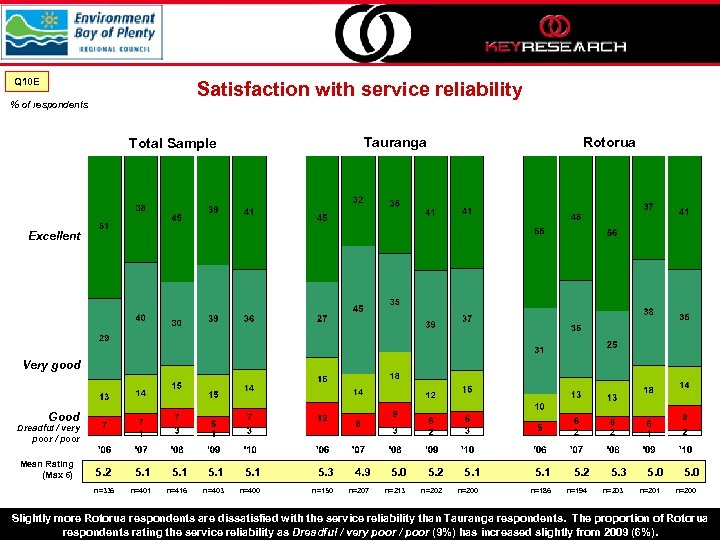
Q 10 E Satisfaction with service reliability % of respondents Tauranga Total Sample Rotorua Excellent Very good Good Dreadful / very poor / poor Mean Rating (Max 6) 5. 2 5. 1 5. 3 4. 9 5. 0 5. 2 5. 1 n=336 n=401 n=416 n=403 n=400 n=150 n=207 n=213 n=202 n=200 n=186 5. 2 n=194 5. 3 n=203 5. 0 n=201 5. 0 n=200 Slightly more Rotorua respondents are dissatisfied with the service reliability than Tauranga respondents. The proportion of Rotorua Copyright © 2010 very poor / poor (9%) has increased slightly from 2009 (6%). respondents rating the service reliability as Dreadful / Key Research. Confidential and proprietary.
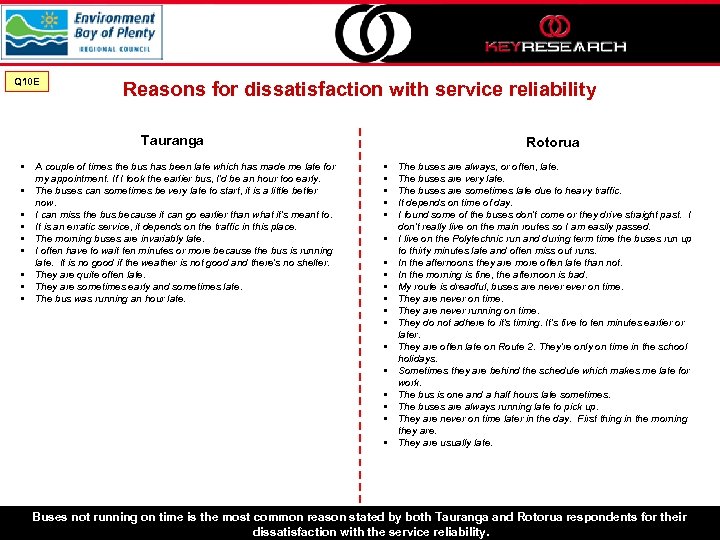
Q 10 E Reasons for dissatisfaction with service reliability Tauranga • A couple of times the bus has been late which has made me late for my appointment. If I took the earlier bus, I'd be an hour too early. • The buses can sometimes be very late to start, it is a little better now. • I can miss the bus because it can go earlier than what it's meant to. • It is an erratic service, it depends on the traffic in this place. • The morning buses are invariably late. • I often have to wait ten minutes or more because the bus is running late. It is no good if the weather is not good and there's no shelter. • They are quite often late. • They are sometimes early and sometimes late. • The bus was running an hour late. Rotorua • • • • • The buses are always, or often, late. The buses are very late. The buses are sometimes late due to heavy traffic. It depends on time of day. I found some of the buses don't come or they drive straight past. I don't really live on the main routes so I am easily passed. I live on the Polytechnic run and during term time the buses run up to thirty minutes late and often miss out runs. In the afternoons they are more often late than not. In the morning is fine, the afternoon is bad. My route is dreadful, buses are never on time. They are never running on time. They do not adhere to it's timing. It's five to ten minutes earlier or later. They are often late on Route 2. They're only on time in the school holidays. Sometimes they are behind the schedule which makes me late for work. The bus is one and a half hours late sometimes. The buses are always running late to pick up. They are never on time later in the day. First thing in the morning they are. They are usually late. Buses not running on time is the most common reason stated by both Tauranga and Rotorua respondents for their Copyright © 2010 Key Research. Confidential and proprietary. dissatisfaction with the service reliability.
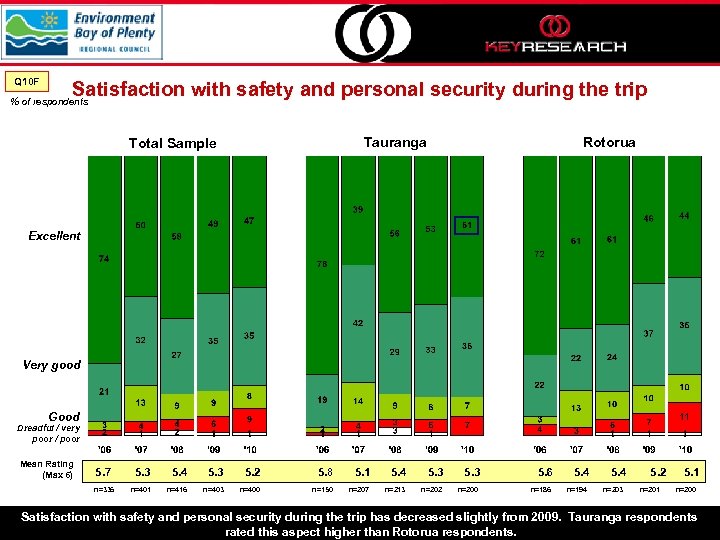
Q 10 F Satisfaction with safety and personal security during the trip % of respondents Tauranga Total Sample Rotorua Excellent Very good Good Dreadful / very poor / poor Mean Rating (Max 6) 5. 7 5. 3 5. 4 5. 3 5. 2 5. 8 5. 1 5. 4 5. 3 n=336 n=401 n=416 n=403 n=400 n=150 n=207 n=213 n=202 n=200 5. 6 n=186 5. 4 n=194 5. 4 n=203 5. 2 n=201 5. 1 n=200 Satisfaction with safety and personal security during the trip has decreased slightly from 2009. Tauranga respondents Copyright higher than Confidential respondents. rated this aspect © 2010 Key Research. Rotoruaand proprietary.
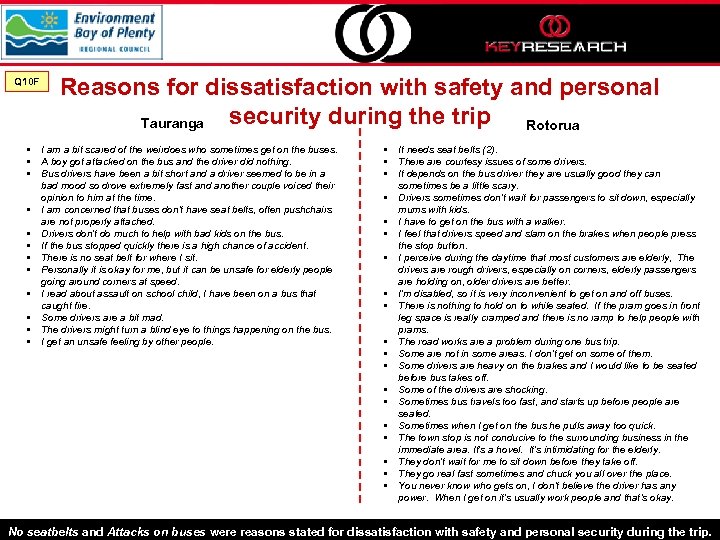
Q 10 F • • • Reasons for dissatisfaction with safety and personal security during the trip Rotorua Tauranga I am a bit scared of the weirdoes who sometimes get on the buses. A boy got attacked on the bus and the driver did nothing. Bus drivers have been a bit short and a driver seemed to be in a bad mood so drove extremely fast and another couple voiced their opinion to him at the time. I am concerned that buses don't have seat belts, often pushchairs are not properly attached. Drivers don't do much to help with bad kids on the bus. If the bus stopped quickly there is a high chance of accident. There is no seat belt for where I sit. Personally it is okay for me, but it can be unsafe for elderly people going around corners at speed. I read about assault on school child, I have been on a bus that caught fire. Some drivers are a bit mad. The drivers might turn a blind eye to things happening on the bus. I get an unsafe feeling by other people. • • • • • It needs seat belts (2). There are courtesy issues of some drivers. It depends on the bus driver they are usually good they can sometimes be a little scary. Drivers sometimes don't wait for passengers to sit down, especially mums with kids. I have to get on the bus with a walker. I feel that drivers speed and slam on the brakes when people press the stop button. I perceive during the daytime that most customers are elderly, The drivers are rough drivers, especially on corners, elderly passengers are holding on, older drivers are better. I'm disabled, so it is very inconvenient to get on and off buses. There is nothing to hold on to while seated. If the pram goes in front leg space is really cramped and there is no ramp to help people with prams. The road works are a problem during one bus trip. Some are not in some areas. I don't get on some of them. Some drivers are heavy on the brakes and I would like to be seated before bus takes off. Some of the drivers are shocking. Sometimes bus travels too fast, and starts up before people are seated. Sometimes when I get on the bus he pulls away too quick. The town stop is not conducive to the surrounding business in the immediate area. It's a hovel. It's intimidating for the elderly. They don't wait for me to sit down before they take off. They go real fast sometimes and chuck you all over the place. You never know who gets on, I don't believe the driver has any power. When I get on it's usually work people and that’s okay. No seatbelts and Attacks on buses were reasons. Copyright © 2010 Key Research. Confidentialwith safety and personal security during the trip. stated for dissatisfaction and proprietary.
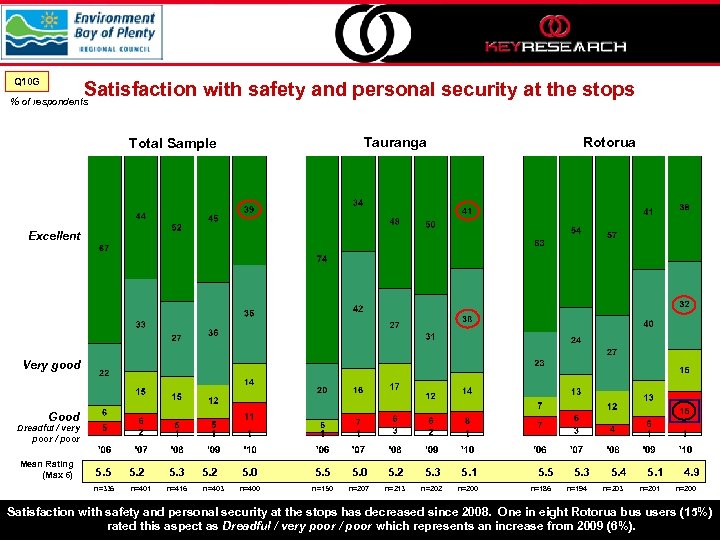
Q 10 G Satisfaction with safety and personal security at the stops % of respondents Tauranga Total Sample Rotorua Excellent Very good Good Dreadful / very poor / poor Mean Rating (Max 6) 5. 5 5. 2 5. 3 5. 2 5. 0 5. 5 5. 0 5. 2 5. 3 5. 1 n=336 n=401 n=416 n=403 n=400 n=150 n=207 n=213 n=202 n=200 5. 5 n=186 5. 3 n=194 5. 4 n=203 5. 1 n=201 4. 9 n=200 Satisfaction with safety and personal security at the stops has decreased since 2008. One in eight Rotorua bus users (15%) rated this aspect as Dreadful / very poor / poor which represents an increase from 2009 (6%). Copyright © 2010 Key Research. Confidential and proprietary.
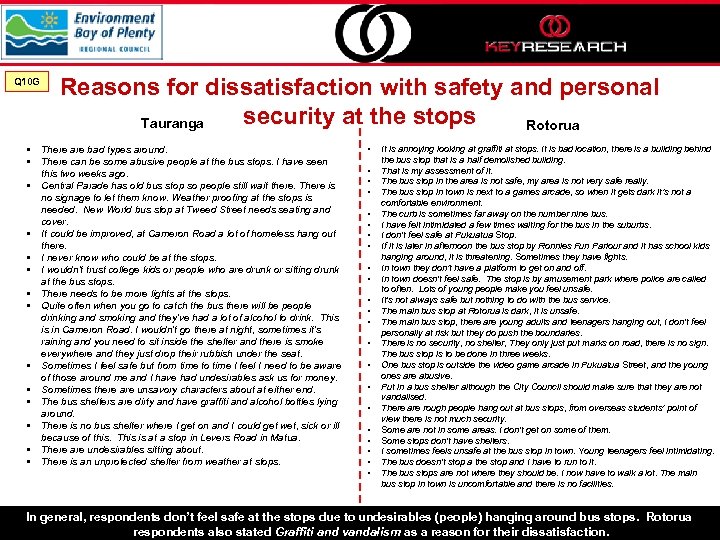
Q 10 G • • • • Reasons for dissatisfaction with safety and personal security at the stops Tauranga Rotorua There are bad types around. There can be some abusive people at the bus stops. I have seen this two weeks ago. Central Parade has old bus stop so people still wait there. There is no signage to let them know. Weather proofing at the stops is needed. New World bus stop at Tweed Street needs seating and cover. It could be improved, at Cameron Road a lot of homeless hang out there. I never know who could be at the stops. I wouldn't trust college kids or people who are drunk or sitting drunk at the bus stops. There needs to be more lights at the stops. Quite often when you go to catch the bus there will be people drinking and smoking and they've had a lot of alcohol to drink. This is in Cameron Road. I wouldn't go there at night, sometimes it's raining and you need to sit inside the shelter and there is smoke everywhere and they just drop their rubbish under the seat. Sometimes I feel safe but from time to time I feel I need to be aware of those around me and I have had undesirables ask us for money. Sometimes there are unsavory characters about at either end. The bus shelters are dirty and have graffiti and alcohol bottles lying around. There is no bus shelter where I get on and I could get wet, sick or ill because of this. This is at a stop in Levers Road in Matua. There are undesirables sitting about. There is an unprotected shelter from weather at stops. • • • • • • It is annoying looking at graffiti at stops. It is bad location, there is a building behind the bus stop that is a half demolished building. That is my assessment of it. The bus stop in the area is not safe, my area is not very safe really. The bus stop in town is next to a games arcade, so when it gets dark it’s not a comfortable environment. The curb is sometimes far away on the number nine bus. I have felt intimidated a few times waiting for the bus in the suburbs. I don't feel safe at Pukuatua Stop. If it is later in afternoon the bus stop by Ronnies Fun Parlour and it has school kids hanging around, it is threatening. Sometimes they have fights. In town they don’t have a platform to get on and off. In town doesn't feel safe. The stop is by amusement park where police are called to often. Lots of young people make you feel unsafe. It's not always safe but nothing to do with the bus service. The main bus stop at Rotorua is dark, it is unsafe. The main bus stop, there are young adults and teenagers hanging out, I don't feel personally at risk but they do push the boundaries. There is no security, no shelter, They only just put marks on road, there is no sign. The bus stop is to be done in three weeks. One bus stop is outside the video game arcade in Pukuatua Street, and the young ones are abusive. Put in a bus shelter although the City Council should make sure that they are not vandalised. There are rough people hang out at bus stops, from overseas students’ point of view there is not much security. Some are not in some areas. I don't get on some of them. Some stops don't have shelters. I sometimes feels unsafe at the bus stop in town. Young teenagers feel intimidating. The bus doesn't stop a the stop and I have to run to it. The bus stops are not where they should be. I now have to walk a lot. The main bus stop in town is uncomfortable and there is no facilities. In general, respondents don’t feel safe at the stops due to undesirables (people) hanging around bus stops. Rotorua Copyright © 2010 Key Research. Confidential and proprietary. respondents also stated Graffiti and vandalism as a reason for their dissatisfaction.
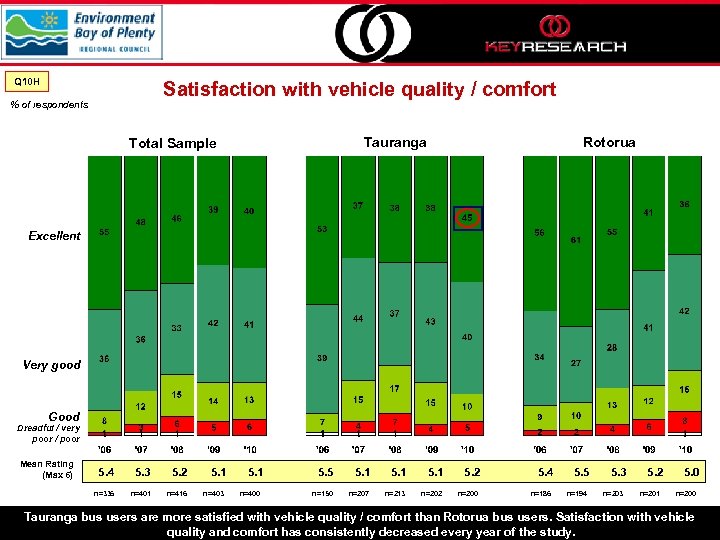
Q 10 H Satisfaction with vehicle quality / comfort % of respondents Tauranga Total Sample Rotorua Excellent Very good Good Dreadful / very poor / poor Mean Rating (Max 6) 5. 4 5. 3 5. 2 n=336 n=401 n=416 5. 1 n=403 5. 1 n=400 5. 5 5. 1 5. 2 n=150 n=207 n=213 n=202 n=200 5. 4 n=186 5. 5 n=194 5. 3 n=203 5. 2 n=201 5. 0 n=200 Tauranga bus users are more satisfied with vehicle quality / comfort than Rotorua bus users. Satisfaction with vehicle Copyright © 2010 Key Research. Confidential every year quality and comfort has consistently decreasedand proprietary. of the study.
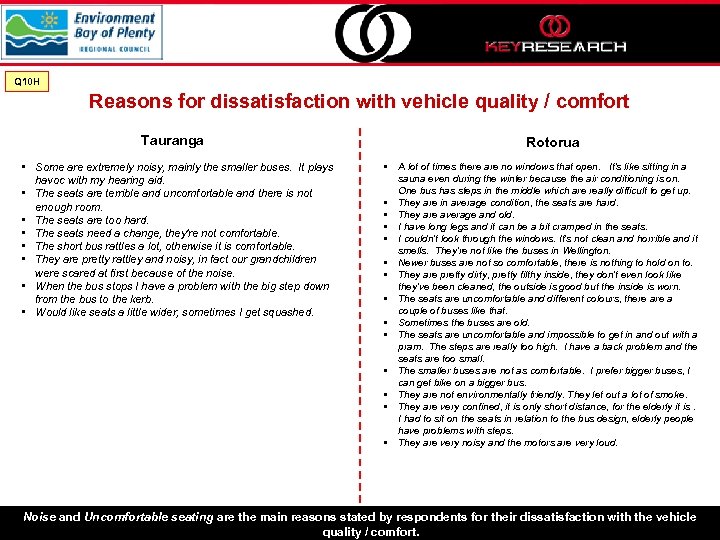
Q 10 H Reasons for dissatisfaction with vehicle quality / comfort Tauranga • Some are extremely noisy, mainly the smaller buses. It plays havoc with my hearing aid. • The seats are terrible and uncomfortable and there is not enough room. • The seats are too hard. • The seats need a change, they're not comfortable. • The short bus rattles a lot, otherwise it is comfortable. • They are pretty rattley and noisy, in fact our grandchildren were scared at first because of the noise. • When the bus stops I have a problem with the big step down from the bus to the kerb. • Would like seats a little wider, sometimes I get squashed. Rotorua • A lot of times there are no windows that open. It's like sitting in a sauna even during the winter because the air conditioning is on. One bus has steps in the middle which are really difficult to get up. • They are in average condition, the seats are hard. • They are average and old. • I have long legs and it can be a bit cramped in the seats. • I couldn't look through the windows. It's not clean and horrible and it smells. They're not like the buses in Wellington. • Newer buses are not so comfortable, there is nothing to hold on to. • They are pretty dirty, pretty filthy inside, they don't even look like they've been cleaned, the outside is good but the inside is worn. • The seats are uncomfortable and different colours, there a couple of buses like that. • Sometimes the buses are old. • The seats are uncomfortable and impossible to get in and out with a pram. The steps are really too high. I have a back problem and the seats are too small. • The smaller buses are not as comfortable. I prefer bigger buses, I can get bike on a bigger bus. • They are not environmentally friendly. They let out a lot of smoke. • They are very confined, it is only short distance, for the elderly it is. I had to sit on the seats in relation to the bus design, elderly people have problems with steps. • They are very noisy and the motors are very loud. Noise and Uncomfortable seating are the main reasons stated by respondents for their dissatisfaction with the vehicle Copyright © 2010 Key Research. Confidential and proprietary. quality / comfort.
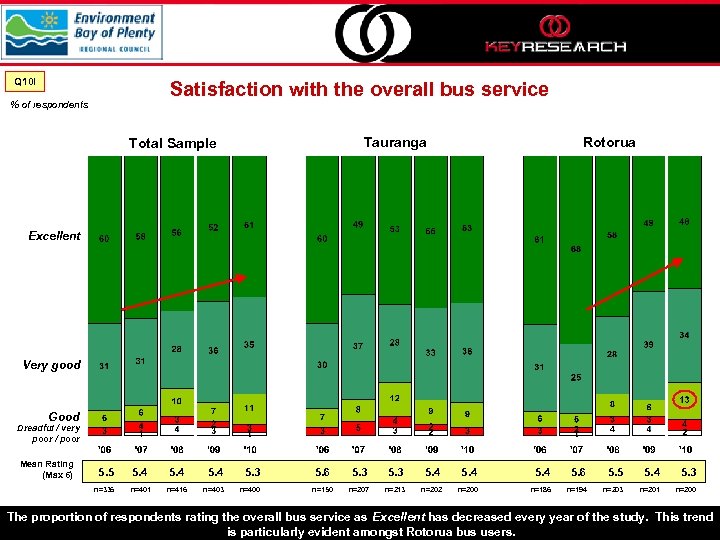
Q 10 I Satisfaction with the overall bus service % of respondents Tauranga Total Sample Rotorua Excellent Very good Good Dreadful / very poor / poor Mean Rating (Max 6) 5. 5 5. 4 n=336 n=401 n=416 5. 4 5. 3 n=400 5. 6 5. 3 5. 4 5. 6 5. 5 5. 4 5. 3 n=150 n=207 n=213 n=202 n=200 n=186 n=194 n=203 n=201 n=200 The proportion of respondents rating the overall bus service as Excellent has decreased every year of the study. This trend Copyright © 2010 Key Research. Confidential and bus users. is particularly evident amongst Rotoruaproprietary.
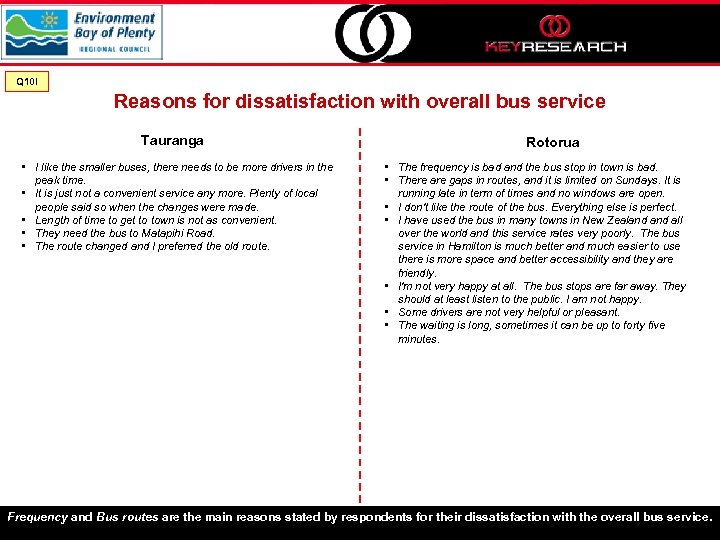
Q 10 I Reasons for dissatisfaction with overall bus service Tauranga Rotorua • I like the smaller buses, there needs to be more drivers in the peak time. • It is just not a convenient service any more. Plenty of local people said so when the changes were made. • Length of time to get to town is not as convenient. • They need the bus to Matapihi Road. • The route changed and I preferred the old route. • The frequency is bad and the bus stop in town is bad. • There are gaps in routes, and it is limited on Sundays. It is running late in term of times and no windows are open. • I don't like the route of the bus. Everything else is perfect. • I have used the bus in many towns in New Zealand all over the world and this service rates very poorly. The bus service in Hamilton is much better and much easier to use there is more space and better accessibility and they are friendly. • I'm not very happy at all. The bus stops are far away. They should at least listen to the public. I am not happy. • Some drivers are not very helpful or pleasant. • The waiting is long, sometimes it can be up to forty five minutes. Frequency and Bus routes are the main reasons stated by respondents for their dissatisfaction with the overall bus service. Copyright © 2010 Key Research. Confidential and proprietary.

Net Promoter Score (NPS) Copyright © 2010 Key Research. Confidential and proprietary.
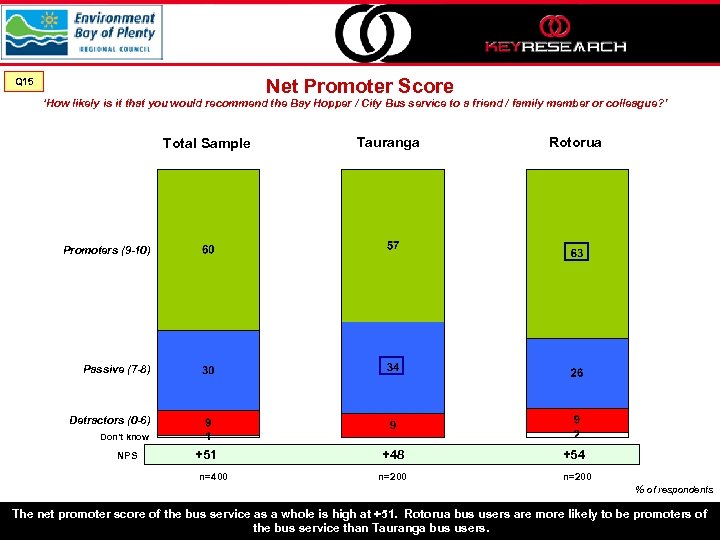
Net Promoter Score Q 15 ‘How likely is it that you would recommend the Bay Hopper / City Bus service to a friend / family member or colleague? ’ Total Sample Tauranga Rotorua Promoters (9 -10) Passive (7 -8) Detractors (0 -6) Don’t know NPS +51 n=400 +48 n=200 +54 n=200 % of respondents The net promoter score of the bus service as a whole is high at +51. Rotorua bus users are more likely to be promoters of the bus service than Tauranga bus proprietary. Copyright © 2010 Key Research. Confidential and users.
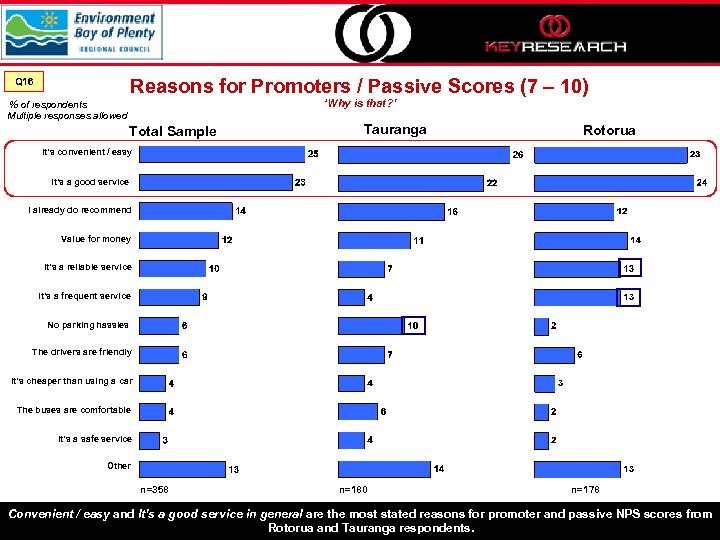
Reasons for Promoters / Passive Scores (7 – 10) Q 16 ‘Why is that? ’ % of respondents Multiple responses allowed Total Sample Tauranga Rotorua It’s convenient / easy It’s a good service I already do recommend Value for money It’s a reliable service It’s a frequent service No parking hassles The drivers are friendly It’s cheaper than using a car The buses are comfortable It’s a safe service Other n=358 n=180 n=178 Convenient / easy and It’s a good service in general are the most stated reasons for promoter and passive NPS scores from Rotorua and Tauranga. Confidential and proprietary. Copyright © 2010 Key Research. respondents.
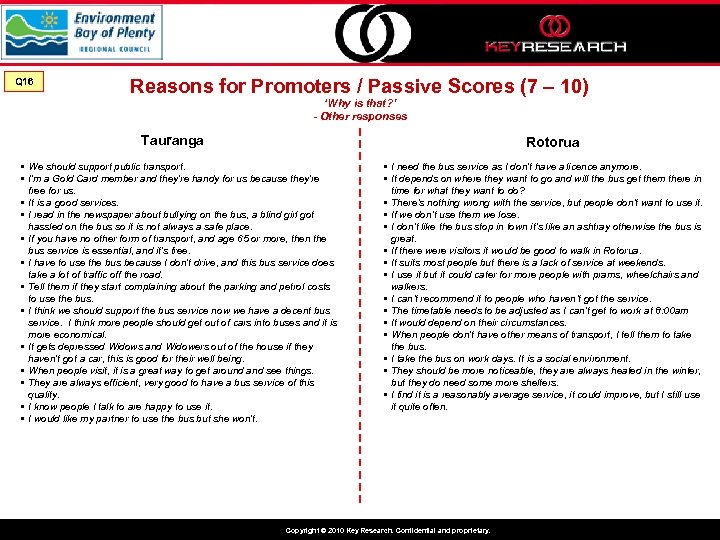
Q 16 Reasons for Promoters / Passive Scores (7 – 10) ‘Why is that? ’ - Other responses Tauranga Rotorua • We should support public transport. • I'm a Gold Card member and they're handy for us because they're free for us. • It is a good services. • I read in the newspaper about bullying on the bus, a blind girl got hassled on the bus so it is not always a safe place. • If you have no other form of transport, and age 65 or more, then the bus service is essential, and it's free. • I have to use the bus because I don't drive, and this bus service does take a lot of traffic off the road. • Tell them if they start complaining about the parking and petrol costs to use the bus. • I think we should support the bus service now we have a decent bus service. I think more people should get out of cars into buses and it is more economical. • It gets depressed Widows and Widowers out of the house if they haven't got a car, this is good for their well being. • When people visit, it is a great way to get around and see things. • They are always efficient, very good to have a bus service of this quality. • I know people I talk to are happy to use it. • I would like my partner to use the bus but she won't. • I need the bus service as I don't have a licence anymore. • It depends on where they want to go and will the bus get them there in time for what they want to do? • There’s nothing wrong with the service, but people don’t want to use it. • If we don't use them we lose. • I don’t like the bus stop in town it’s like an ashtray otherwise the bus is great. • If there were visitors it would be good to walk in Rotorua. • It suits most people but there is a lack of service at weekends. • I use it but it could cater for more people with prams, wheelchairs and walkers. • I can’t recommend it to people who haven’t got the service. • The timetable needs to be adjusted as I can't get to work at 8: 00 am • It would depend on their circumstances. • When people don't have other means of transport, I tell them to take the bus. • I take the bus on work days. It is a social environment. • They should be more noticeable, they are always heated in the winter, but they do need some more shelters. • I find it is a reasonably average service, it could improve, but I still use it quite often. Copyright © 2010 Key Research. Confidential and proprietary.
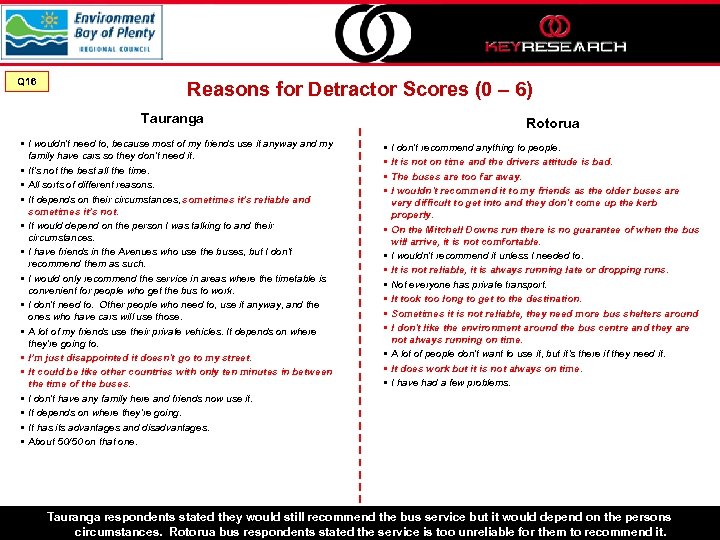
Q 16 Reasons for Detractor Scores (0 – 6) Tauranga • I wouldn't need to, because most of my friends use it anyway and my family have cars so they don't need it. • It's not the best all the time. • All sorts of different reasons. • It depends on their circumstances, sometimes it’s reliable and sometimes it’s not. • It would depend on the person I was talking to and their circumstances. • I have friends in the Avenues who use the buses, but I don't recommend them as such. • I would only recommend the service in areas where the timetable is convenient for people who get the bus to work. • I don't need to. Other people who need to, use it anyway, and the ones who have cars will use those. • A lot of my friends use their private vehicles. It depends on where they're going to. • I’m just disappointed it doesn't go to my street. • It could be like other countries with only ten minutes in between the time of the buses. • I don't have any family here and friends now use it. • It depends on where they’re going. • It has its advantages and disadvantages. • About 50/50 on that one. Rotorua • • • • I don't recommend anything to people. It is not on time and the drivers attitude is bad. The buses are too far away. I wouldn't recommend it to my friends as the older buses are very difficult to get into and they don't come up the kerb properly. On the Mitchell Downs run there is no guarantee of when the bus will arrive, it is not comfortable. I wouldn't recommend it unless I needed to. It is not reliable, it is always running late or dropping runs. Not everyone has private transport. It took too long to get to the destination. Sometimes it is not reliable, they need more bus shelters around I don't like the environment around the bus centre and they are not always running on time. A lot of people don't want to use it, but it’s there if they need it. It does work but it is not always on time. I have had a few problems. Tauranga respondents stated they would still recommend the bus service but it would depend on the persons Copyright © 2010 Key Research. Confidential and proprietary. circumstances. Rotorua bus respondents stated the service is too unreliable for them to recommend it.
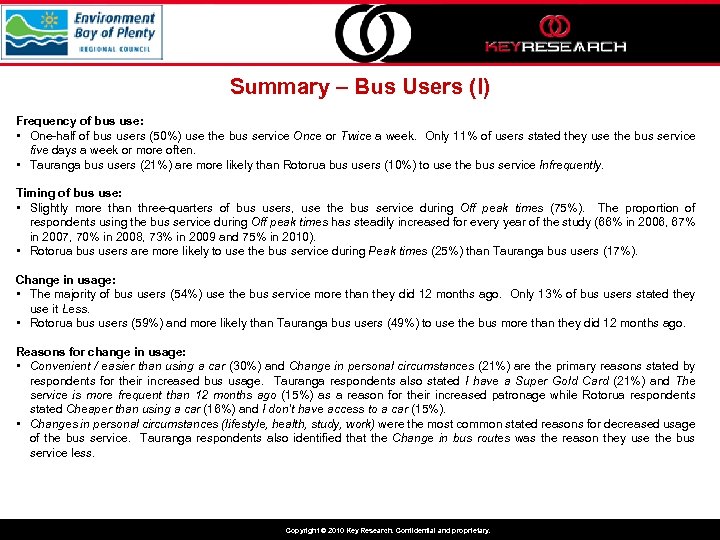
Summary – Bus Users (I) Frequency of bus use: • One-half of bus users (50%) use the bus service Once or Twice a week. Only 11% of users stated they use the bus service five days a week or more often. • Tauranga bus users (21%) are more likely than Rotorua bus users (10%) to use the bus service Infrequently. Timing of bus use: • Slightly more than three-quarters of bus users, use the bus service during Off peak times (75%). The proportion of respondents using the bus service during Off peak times has steadily increased for every year of the study (66% in 2006, 67% in 2007, 70% in 2008, 73% in 2009 and 75% in 2010). • Rotorua bus users are more likely to use the bus service during Peak times (25%) than Tauranga bus users (17%). Change in usage: • The majority of bus users (54%) use the bus service more than they did 12 months ago. Only 13% of bus users stated they use it Less. • Rotorua bus users (59%) and more likely than Tauranga bus users (49%) to use the bus more than they did 12 months ago. Reasons for change in usage: • Convenient / easier than using a car (30%) and Change in personal circumstances (21%) are the primary reasons stated by respondents for their increased bus usage. Tauranga respondents also stated I have a Super Gold Card (21%) and The service is more frequent than 12 months ago (15%) as a reason for their increased patronage while Rotorua respondents stated Cheaper than using a car (16%) and I don’t have access to a car (15%). • Changes in personal circumstances (lifestyle, health, study, work) were the most common stated reasons for decreased usage of the bus service. Tauranga respondents also identified that the Change in bus routes was the reason they use the bus service less. Copyright © 2010 Key Research. Confidential and proprietary.
Summary – Bus Users (II) Main purpose of travel: • Shopping (42%), Work (22%) and Recreation (16%) remain the three main purposes respondents use the bus service. Access to private transport: • The majority of bus users (77%) have access to private transport either All of the time (61%) or Some of the time (16%). • The proportion of bus users who have access to private transport All of the time has increased every year of the study. Total Mobility Scheme: • Slightly less than one in ten bus users (9%) have used the Total Mobility Scheme. • Of those respondents who have used the Total Mobility Scheme, 35% stated that public transport has replaced A lot of their Total Mobility trips. • Tauranga respondents (31%) are more likely than Rotorua respondents (17%) to stated that public transport has replaced None of their Total Mobility Trips. Motivation to use public transport: • No alternative / don’t drive / only one car in family / poor health (59%), Convenient / less hassle (47%) and Parking – costs availability (29%) are three most stated motivators for bus usage. • Convenience / less hassle and Parking costs / availability are more likely to be motivators for Tauranga bus users (53% and 40%) than Rotorua bus users (41% and 18%). Copyright © 2010 Key Research. Confidential and proprietary.
Summary – Bus Users (III) Method of finding information on the bus service: • The Timetable booklet (75%) and Timetable information at bus stops (28%) are the main methods used for finding information about the bus service. • Bus users from Rotorua are significantly more likely to state they use Timetable information at bus stops (40%) than Tauranga respondents (17%). • The website / internet (17%) has increased significantly as a method of finding out about the bus service from 2009 (9%). Improvements to the bus service: • Slightly more than one-third of bus users (35%) stated there was Nothing that needed to improve in regards to the bus service. • Of those who stated improvements Bus shelters (12%), More frequent service (11%) and Changes to existing routes (9%) were the most stated improvements. Bad experiences with the bus service: • Rotorua bus users (13%) are significantly more likely that Tauranga bus users (4%) to state that the Attitude of bus drivers needs to improve. • Tauranga bus users are less likely that Rotorua bus users to have had a negative experience with the bus service. • More Rotorua respondents have experienced each of the negative aspects of service anslysed than Tauranga respondents, more so for having experienced The bus being significantly late (33%) (15% Tauranga respondents). Net promoter score (NPS) • The net promoter score of the bus service as a whole is high at +51. Rotorua bus users are more likely to be promoters of the bus service (63%) than Tauranga bus users (57%). • Convenient / easy (27%) and It’s a good service in general (26%) are the most stated reasons for promoter and passive NPS scores. • Tauranga respondents rating detractor scores stated they would still recommend the bus service however it would depend on the person’s circumstances while Rotorua respondents stated that the bus service was too unreliable for them to recommend it. Copyright © 2010 Key Research. Confidential and proprietary.
Summary – Bus Users (IV) Satisfaction with the bus service: • Satisfaction is high for all attributes analysed. Value for Money, Overall bus service and Service frequency are three areas of the bus service that respondents are most satisfied with. Value for money: • Satisfaction with Value for money is high. Tauranga respondents are slightly more satisfied with this aspect than Rotorua respondents. • The minimum charge when using the bus service for very short journeys is considered to be too high by respondents dissatisfied with the value for money of the bus service. Service availability: • Slightly more Tauranga respondents (13%) than Rotorua respondents (10%) stated the service availability is Dreadful / very poor / poor. • The change in bus route is the key driver of dissatisfaction amongst Tauranga respondents. Rotorua respondents stated their dissatisfaction was because of the distance they had to walk to the nearest bus stop. Journey time: • The proportion of respondents stating The journey time is excellent has been decreasing since 2008. • The change in bus route is the key driver of dissatisfaction amongst Tauranga respondents. Rotorua respondents stated their dissatisfaction was because of the traffic and roadworks. Copyright © 2010 Key Research. Confidential and proprietary.
Summary – Bus Users (V) Service frequency: • Satisfaction with service frequency has increased from 2009. Rotorua respondents are more satisfied with the Service frequency than Tauranga respondents. • Tauranga respondents stated that the hourly bus is not frequent enough. Rotorua respondents are more dissatisfied with the service frequency because they don’t run on time. Service reliability: • Slightly more Rotorua respondents are dissatisfied with the service reliability than Tauranga respondents. The proportion of Rotorua respondents rating the service reliability as Dreadful / very poor / poor (9%) has increased slightly from 2009 (6%). • Buses not running on time is the most common reason stated by both Tauranga and Rotorua respondents for their dissatisfaction with the service reliability. Safety and personal security during the trip: • Satisfaction with safety and personal security during the trip has decreased slightly from 2009. Tauranga respondents rated this aspect higher than Rotorua respondents. • No seatbelts and Attacks on buses were reasons stated for dissatisfaction with safety and personal security during the trip. Safety and personal security at the stops: • Satisfaction with safety and personal security at the stops has decreased since 2008. One in eight Rotorua bus users (15%) rated this aspect as Dreadful / very poor / poor which represents an increase from 2009 (6%). • In general, respondents don’t feel safe at the stops due to undesirables (people) hanging around bus stops. Rotorua respondents also stated Graffiti and vandalism as a reason for their dissatisfaction. Copyright © 2010 Key Research. Confidential and proprietary.
Summary – Bus Users (VI) Vehicle quality / comfort: • Tauranga bus users are more satisfied with vehicle quality / comfort than Rotorua bus users. Satisfaction with vehicle quality and comfort has consistently decreased every year of the study. • Noise and Uncomfortable seating are the main reasons stated by respondents for their dissatisfaction with the vehicle quality / comfort. Overall bus service: • The proportion of respondents rating the overall bus service as Excellent has decreased every year of the study. This trend is particularly evident amongst Rotorua bus users. • Frequency and Bus routes are the main reasons stated by respondents for their dissatisfaction with the overall bus service. Copyright © 2010 Key Research. Confidential and proprietary.
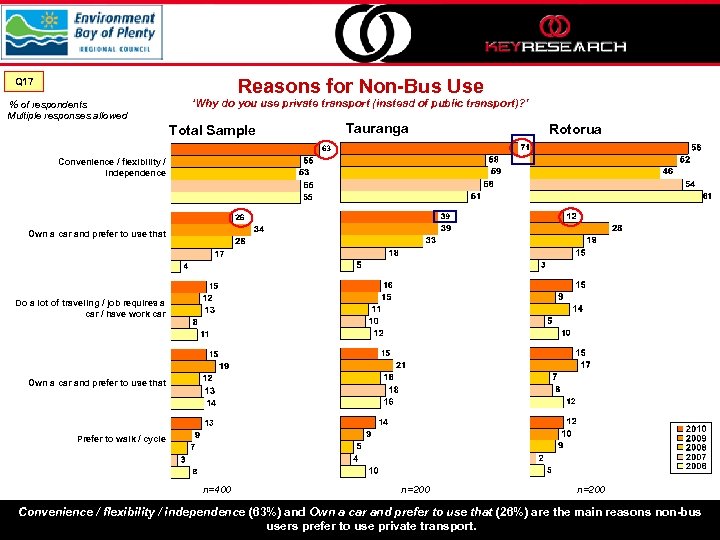
Reasons for Non-Bus Use Q 17 % of respondents Multiple responses allowed ‘Why do you use private transport (instead of public transport)? ’ Total Sample Tauranga Rotorua Convenience / flexibility / independence Own a car and prefer to use that Do a lot of traveling / job requires a car / have work car Own a car and prefer to use that Prefer to walk / cycle n=400 n=200 Convenience / flexibility / independence (63%) and Own a car and prefer to use that (26%) are the main reasons non-bus users prefer to use private transport. Copyright © 2010 Key Research. Confidential and proprietary.
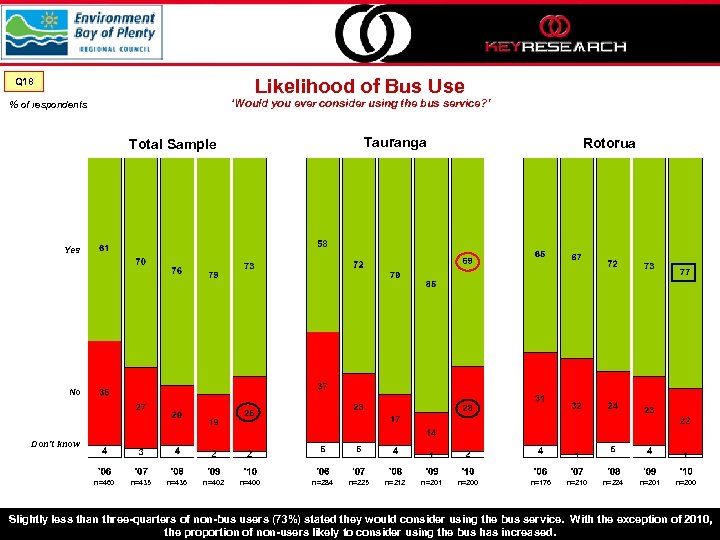
Likelihood of Bus Use Q 18 ‘Would you ever consider using the bus service? ’ % of respondents Tauranga Total Sample Rotorua Yes No Don’t know n=460 n=435 n=436 n=402 n=400 n=284 n=225 n=212 n=201 n=200 n=176 n=210 n=224 n=201 n=200 Slightly less than three-quarters of non-bus users (73%) stated they would consider using the bus service. With the exception of 2010, Copyright © 2010 Key Research. Confidential and bus has the proportion of non-users likely to consider using theproprietary. increased.
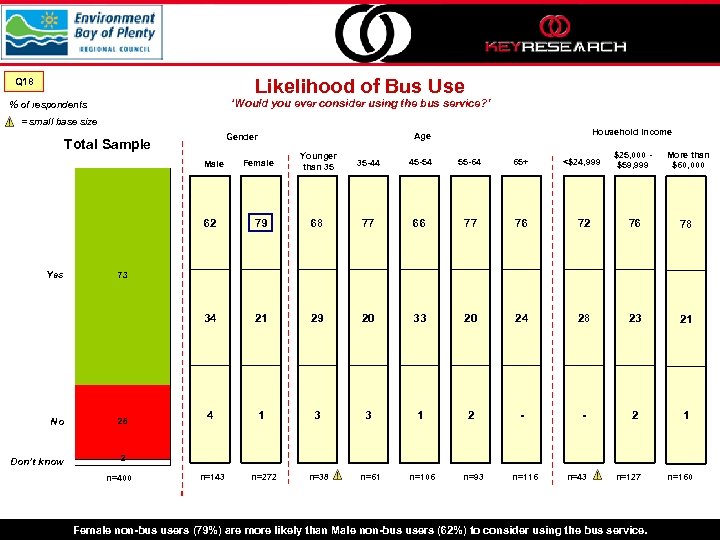
Likelihood of Bus Use Q 18 ‘Would you ever consider using the bus service? ’ % of respondents = small base size Total Sample Household income Age Gender Female Younger than 35 35 -44 45 -54 55 -64 65+ <$24, 999 $25, 000 $59, 999 More than $60, 000 62 79 68 77 66 77 76 72 76 78 34 21 29 20 33 20 24 28 23 21 4 1 3 3 1 2 - - 2 1 n=38 n=61 n=106 Male Yes No Don’t know n=400 n=143 n=272 n=93 n=116 n=43 n=127 Copyright © Male Research. Confidential and proprietary. Female non-bus users (79%) are more likely than 2010 Keynon-bus users (62%) to consider using the bus service. n=160
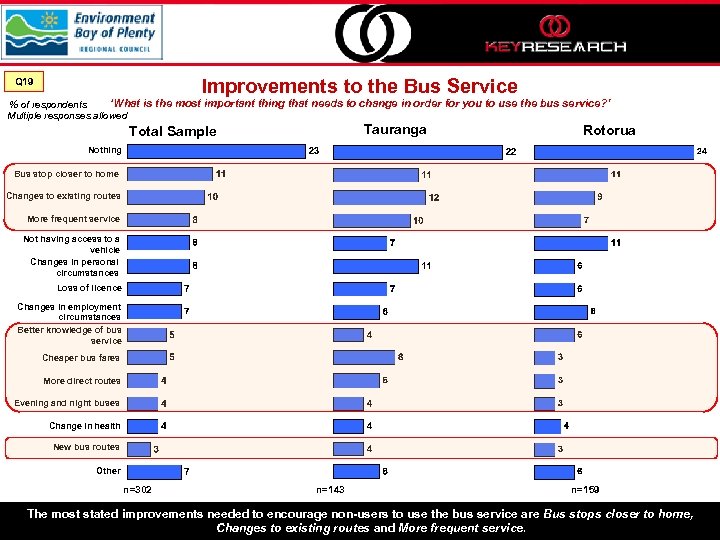
Improvements to the Bus Service Q 19 ‘What is the most important thing that needs to change in order for you to use the bus service? ’ % of respondents Multiple responses allowed Tauranga Total Sample Rotorua Nothing Bus stop closer to home Changes to existing routes More frequent service Not having access to a vehicle Changes in personal circumstances Loss of licence Changes in employment circumstances Better knowledge of bus service Cheaper bus fares More direct routes Evening and night buses Change in health New bus routes Other n=302 n=143 n=159 The most stated improvements needed to encourage non-users to use the bus service are Bus stops closer to home, Changes to existing 2010 Key Research. Confidential and proprietary. Copyright © routes and More frequent service.
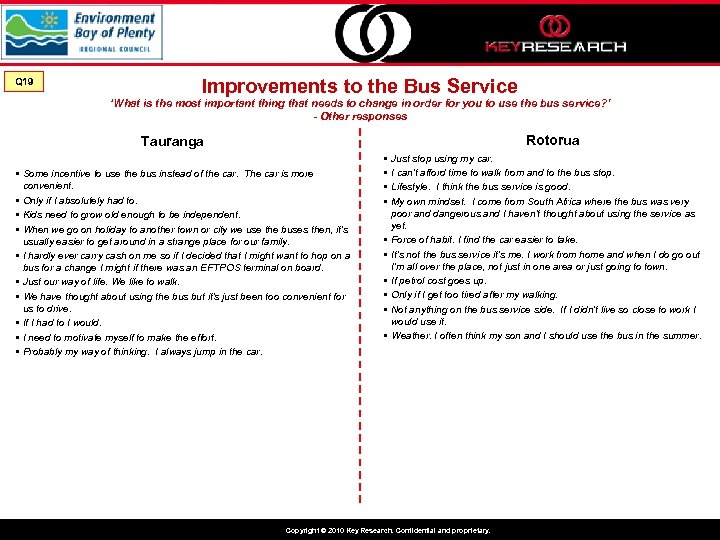
Q 19 Improvements to the Bus Service ‘What is the most important thing that needs to change in order for you to use the bus service? ’ - Other responses Rotorua Tauranga • Some incentive to use the bus instead of the car. The car is more convenient. • Only if I absolutely had to. • Kids need to grow old enough to be independent. • When we go on holiday to another town or city we use the buses then, it's usually easier to get around in a strange place for our family. • I hardly ever carry cash on me so if I decided that I might want to hop on a bus for a change I might if there was an EFTPOS terminal on board. • Just our way of life. We like to walk. • We have thought about using the bus but it's just been too convenient for us to drive. • If I had to I would. • I need to motivate myself to make the effort. • Probably my way of thinking. I always jump in the car. • • • Just stop using my car. I can't afford time to walk from and to the bus stop. Lifestyle. I think the bus service is good. My own mindset. I come from South Africa where the bus was very poor and dangerous and I haven't thought about using the service as yet. Force of habit. I find the car easier to take. It's not the bus service it's me. I work from home and when I do go out I'm all over the place, not just in one area or just going to town. If petrol cost goes up. Only if I get too tired after my walking. Not anything on the bus service side. If I didn't live so close to work I would use it. Weather. I often think my son and I should use the bus in the summer. Copyright © 2010 Key Research. Confidential and proprietary.
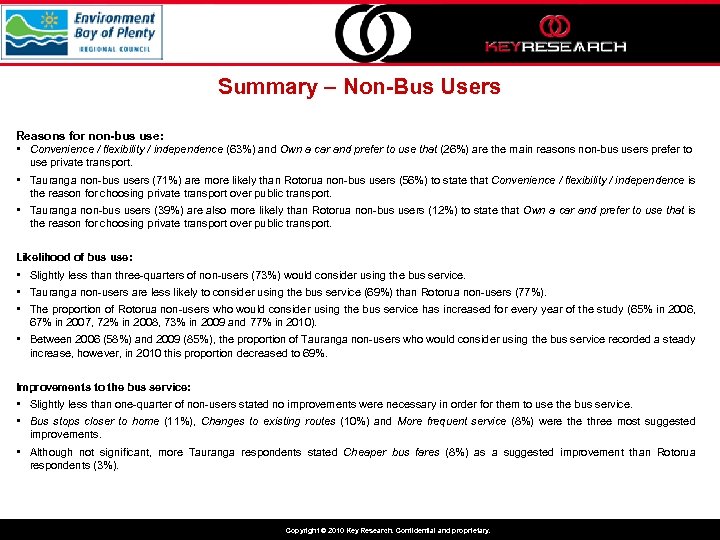
Summary – Non-Bus Users Reasons for non-bus use: • Convenience / flexibility / independence (63%) and Own a car and prefer to use that (26%) are the main reasons non-bus users prefer to use private transport. • Tauranga non-bus users (71%) are more likely than Rotorua non-bus users (56%) to state that Convenience / flexibility / independence is the reason for choosing private transport over public transport. • Tauranga non-bus users (39%) are also more likely than Rotorua non-bus users (12%) to state that Own a car and prefer to use that is the reason for choosing private transport over public transport. Likelihood of bus use: • Slightly less than three-quarters of non-users (73%) would consider using the bus service. • Tauranga non-users are less likely to consider using the bus service (69%) than Rotorua non-users (77%). • The proportion of Rotorua non-users who would consider using the bus service has increased for every year of the study (65% in 2006, 67% in 2007, 72% in 2008, 73% in 2009 and 77% in 2010). • Between 2006 (58%) and 2009 (85%), the proportion of Tauranga non-users who would consider using the bus service recorded a steady increase, however, in 2010 this proportion decreased to 69%. Improvements to the bus service: • Slightly less than one-quarter of non-users stated no improvements were necessary in order for them to use the bus service. • Bus stops closer to home (11%), Changes to existing routes (10%) and More frequent service (8%) were three most suggested improvements. • Although not significant, more Tauranga respondents stated Cheaper bus fares (8%) as a suggested improvement than Rotorua respondents (3%). Copyright © 2010 Key Research. Confidential and proprietary.
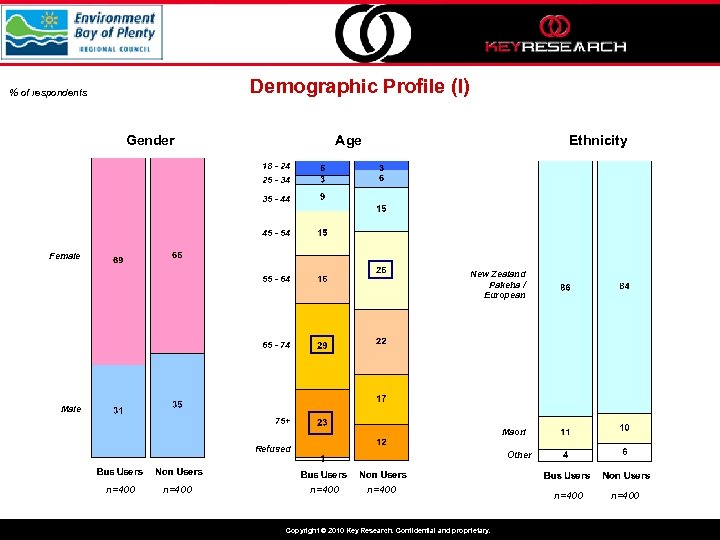
Demographic Profile (I) % of respondents Gender Age Ethnicity 18 - 24 25 - 34 35 - 44 45 - 54 Female New Zealand Pakeha / European 55 - 64 65 - 74 Male 75+ Maori Refused n=400 Other n=400 Copyright © 2010 Key Research. Confidential and proprietary. n=400
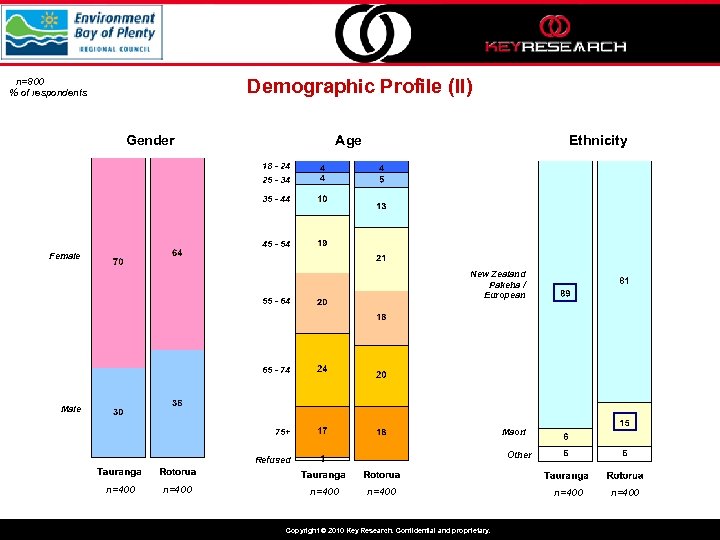
Demographic Profile (II) n=800 % of respondents Gender Age Ethnicity 18 - 24 25 - 34 35 - 44 45 - 54 Female New Zealand Pakeha / European 55 - 64 65 - 74 Male 75+ Maori Other Refused n=400 Copyright © 2010 Key Research. Confidential and proprietary. n=400
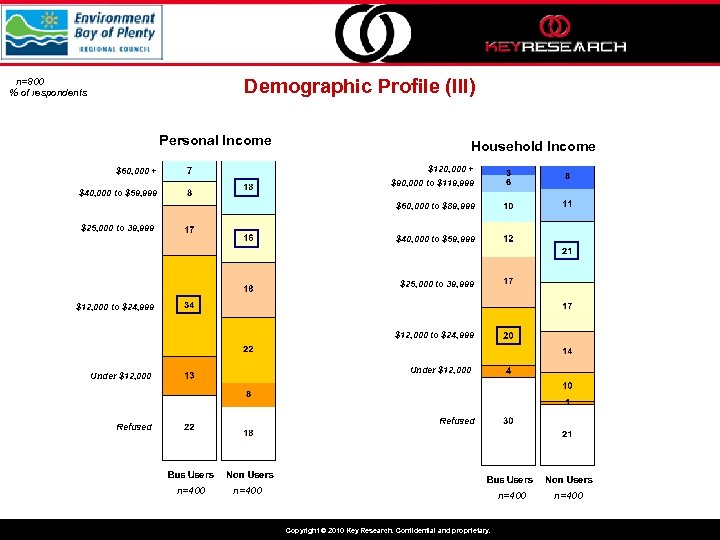
Demographic Profile (III) n=800 % of respondents Personal Income Household Income $120, 000 + $60, 000 + $90, 000 to $119, 999 $40, 000 to $59, 999 $60, 000 to $89, 999 $25, 000 to 39, 999 $40, 000 to $59, 999 $25, 000 to 39, 999 $12, 000 to $24, 999 Under $12, 000 Refused n=400 Copyright © 2010 Key Research. Confidential and proprietary. n=400
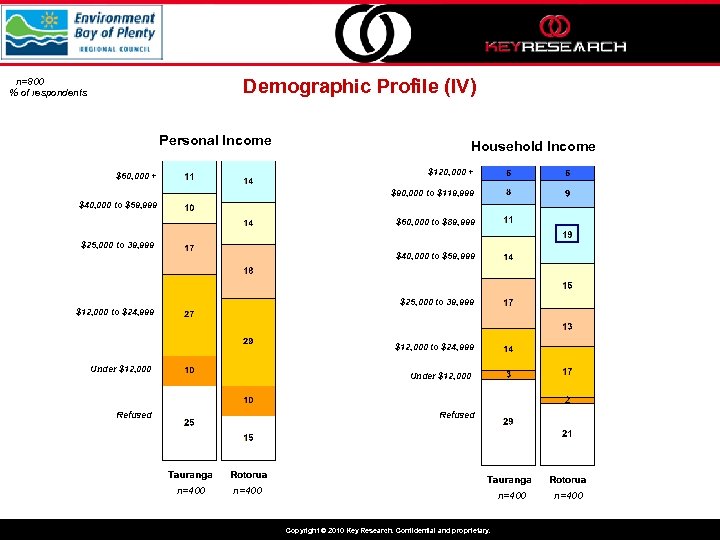
Demographic Profile (IV) n=800 % of respondents Personal Income Household Income $120, 000 + $60, 000 + $90, 000 to $119, 999 $40, 000 to $59, 999 $60, 000 to $89, 999 $25, 000 to 39, 999 $40, 000 to $59, 999 $25, 000 to 39, 999 $12, 000 to $24, 999 Under $12, 000 Refused n=400 Copyright © 2010 Key Research. Confidential and proprietary. n=400
Скачать презентацию Environment Bay of Plenty -Bus Satisfaction Survey 2010
aae89de09ce735be6b65cac9266a02c3.ppt