


 Скачать презентацию Enterprise Systems Architectures EGN 5620 Enterprise Systems Configuration
51db0e7dc842e53f1ed35b5974b1695e.ppt
- Количество слайдов: 38
 Enterprise Systems Architectures EGN 5620 Enterprise Systems Configuration Spring, 2012
 Enterprise Systems Architectures Theories & Concepts
 System architecture, Def. ◦ A scheme by which the functional elements of the system are arranged into physical/logical blocks and by which the blocks interact.
 Three major enterprise (information reference) architectures Generalized enterprise reference architecture (GERA) Purdue enterprise reference architecture (PERA) Enterprise architecture framework ◦ By John Zachman
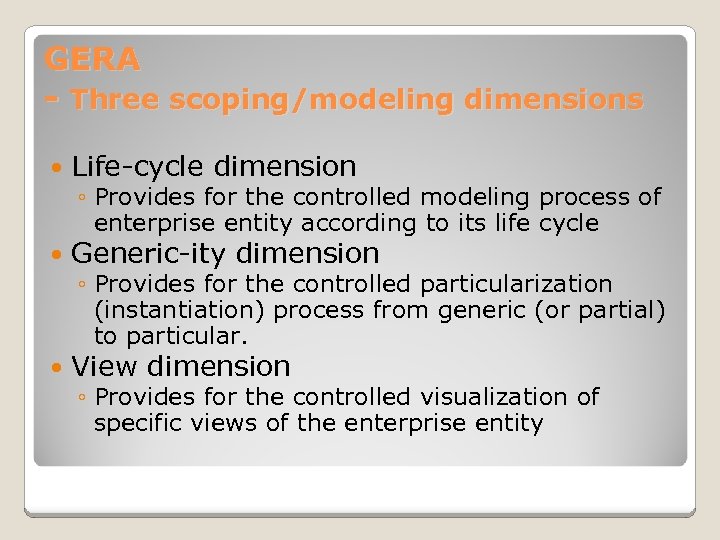 GERA - Three scoping/modeling dimensions Life-cycle dimension Generic-ity dimension View dimension ◦ Provides for the controlled modeling process of enterprise entity according to its life cycle ◦ Provides for the controlled particularization (instantiation) process from generic (or partial) to particular. ◦ Provides for the controlled visualization of specific views of the enterprise entity
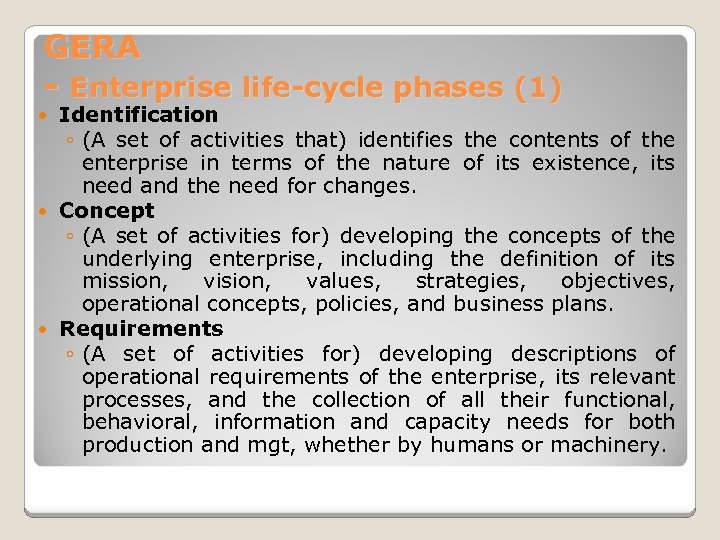 GERA - Enterprise life-cycle phases (1) Identification ◦ (A set of activities that) identifies the contents of the enterprise in terms of the nature of its existence, its need and the need for changes. Concept ◦ (A set of activities for) developing the concepts of the underlying enterprise, including the definition of its mission, vision, values, strategies, objectives, operational concepts, policies, and business plans. Requirements ◦ (A set of activities for) developing descriptions of operational requirements of the enterprise, its relevant processes, and the collection of all their functional, behavioral, information and capacity needs for both production and mgt, whether by humans or machinery.
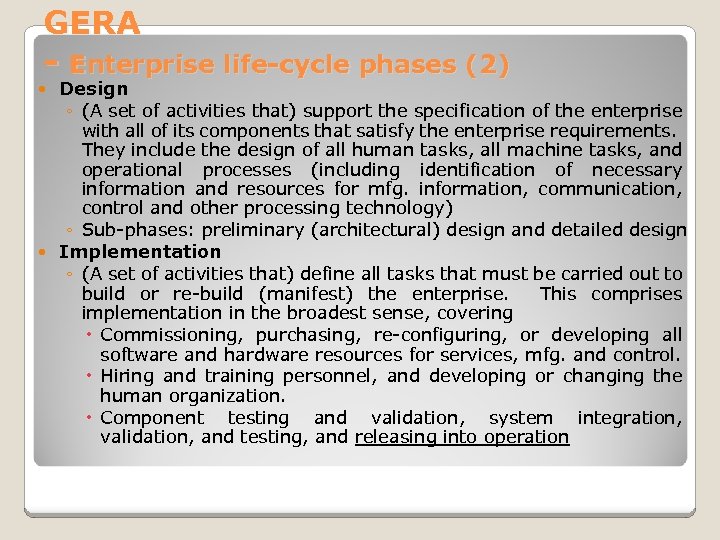 GERA - Enterprise life-cycle phases (2) Design ◦ (A set of activities that) support the specification of the enterprise with all of its components that satisfy the enterprise requirements. They include the design of all human tasks, all machine tasks, and operational processes (including identification of necessary information and resources for mfg. information, communication, control and other processing technology) ◦ Sub-phases: preliminary (architectural) design and detailed design Implementation ◦ (A set of activities that) define all tasks that must be carried out to build or re-build (manifest) the enterprise. This comprises implementation in the broadest sense, covering Commissioning, purchasing, re-configuring, or developing all software and hardware resources for services, mfg. and control. Hiring and training personnel, and developing or changing the human organization. Component testing and validation, system integration, validation, and testing, and releasing into operation
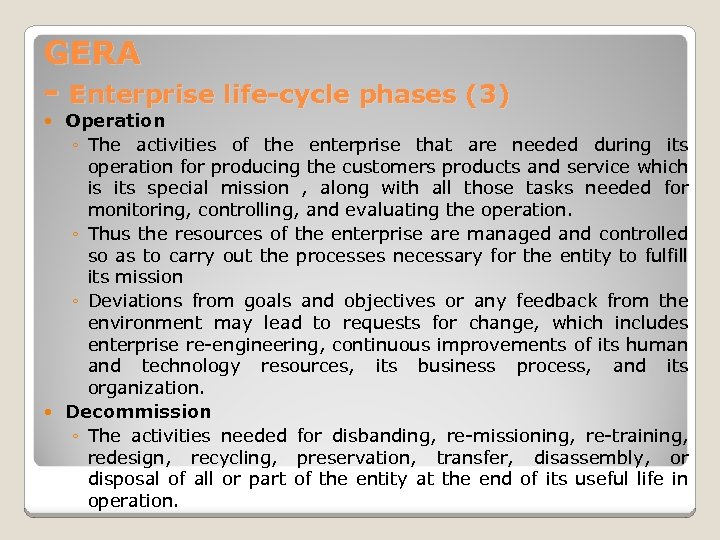 GERA - Enterprise life-cycle phases (3) Operation ◦ The activities of the enterprise that are needed during its operation for producing the customers products and service which is its special mission , along with all those tasks needed for monitoring, controlling, and evaluating the operation. ◦ Thus the resources of the enterprise are managed and controlled so as to carry out the processes necessary for the entity to fulfill its mission ◦ Deviations from goals and objectives or any feedback from the environment may lead to requests for change, which includes enterprise re-engineering, continuous improvements of its human and technology resources, its business process, and its organization. Decommission ◦ The activities needed for disbanding, re-missioning, re-training, redesign, recycling, preservation, transfer, disassembly, or disposal of all or part of the entity at the end of its useful life in operation.
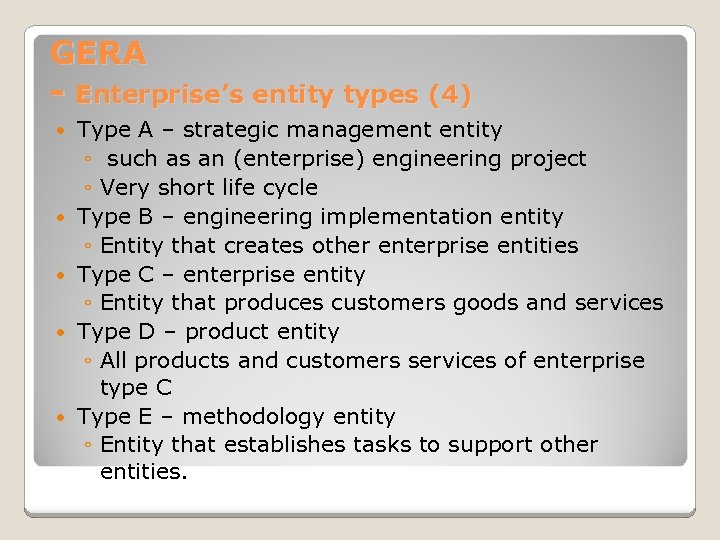 GERA - Enterprise’s entity types (4) Type A – strategic management entity ◦ such as an (enterprise) engineering project ◦ Very short life cycle Type B – engineering implementation entity ◦ Entity that creates other enterprise entities Type C – enterprise entity ◦ Entity that produces customers goods and services Type D – product entity ◦ All products and customers services of enterprise type C Type E – methodology entity ◦ Entity that establishes tasks to support other entities.
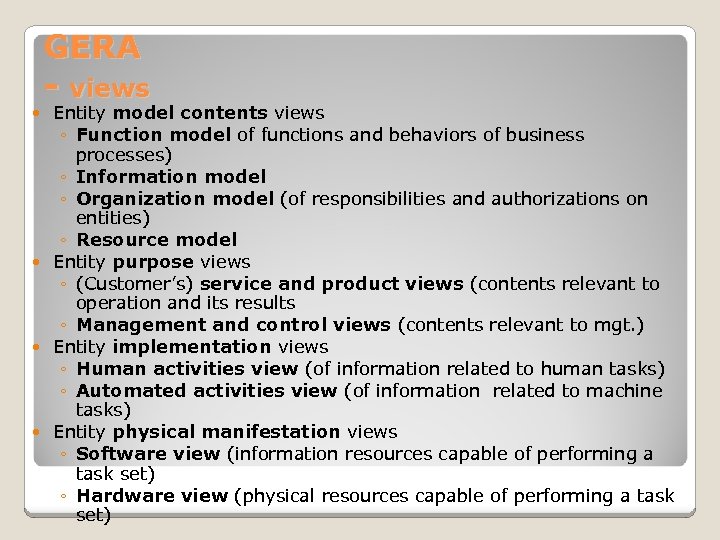 GERA - views Entity model contents views ◦ Function model of functions and behaviors of business processes) ◦ Information model ◦ Organization model (of responsibilities and authorizations on entities) ◦ Resource model Entity purpose views ◦ (Customer’s) service and product views (contents relevant to operation and its results ◦ Management and control views (contents relevant to mgt. ) Entity implementation views ◦ Human activities view (of information related to human tasks) ◦ Automated activities view (of information related to machine tasks) Entity physical manifestation views ◦ Software view (information resources capable of performing a task set) ◦ Hardware view (physical resources capable of performing a task set)
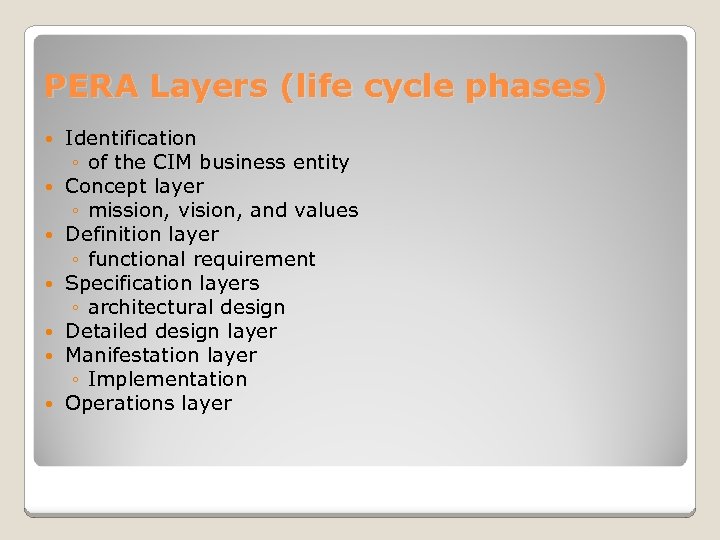 PERA Layers (life cycle phases) Identification ◦ of the CIM business entity Concept layer ◦ mission, vision, and values Definition layer ◦ functional requirement Specification layers ◦ architectural design Detailed design layer Manifestation layer ◦ Implementation Operations layer
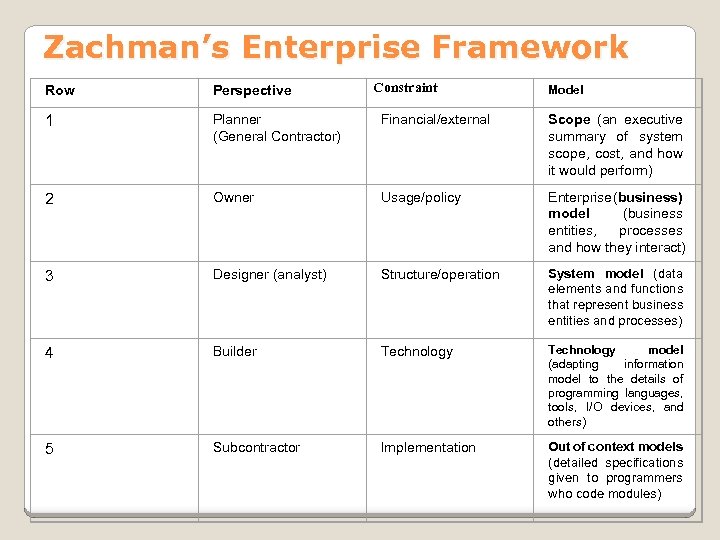 Zachman’s Enterprise Framework Constraint Model Row Perspective 1 Planner (General Contractor) Financial/external Scope (an executive summary of system scope, cost, and how it would perform) 2 Owner Usage/policy Enterprise business) ( model (business entities, processes and how they interact) 3 Designer (analyst) Structure/operation System model (data elements and functions that represent business entities and processes) 4 Builder Technology model (adapting information model to the details of programming languages, tools, I/O devices, and others) 5 Subcontractor Implementation Out of context models (detailed specifications given to programmers who code modules)
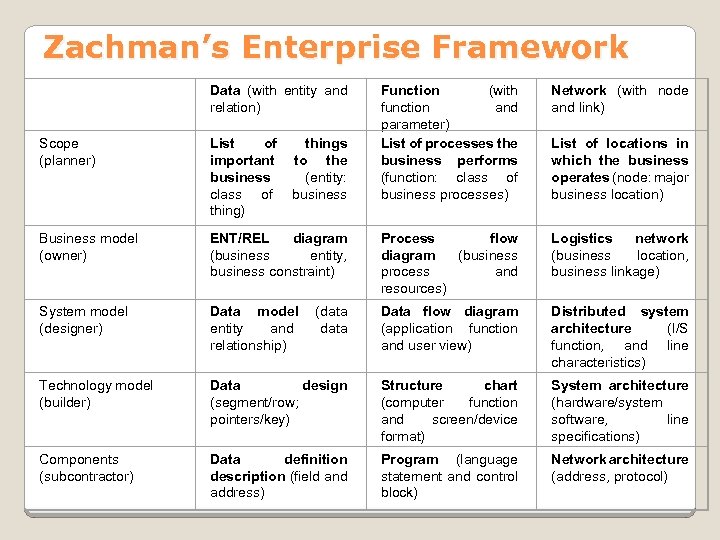 Zachman’s Enterprise Framework Data (with entity and relation) Scope (planner) List of important business class of thing) Business model (owner) Function (with function and parameter) List of processes the business performs (function: class of business processes) Network (with node and link) ENT/REL diagram (business entity, business constraint) Process flow diagram (business process and resources) Logistics network (business location, business linkage) System model (designer) Data model (data entity and data relationship) Data flow diagram (application function and user view) Distributed system architecture (I/S function, and line characteristics) Technology model (builder) Data design (segment/row; pointers/key) Structure chart (computer function and screen/device format) System architecture (hardware/system software, line specifications) Components (subcontractor) Data definition description (field and address) Program (language statement and control block) Network architecture (address, protocol) things to the (entity: business List of locations in which the business operates (node: major business location)
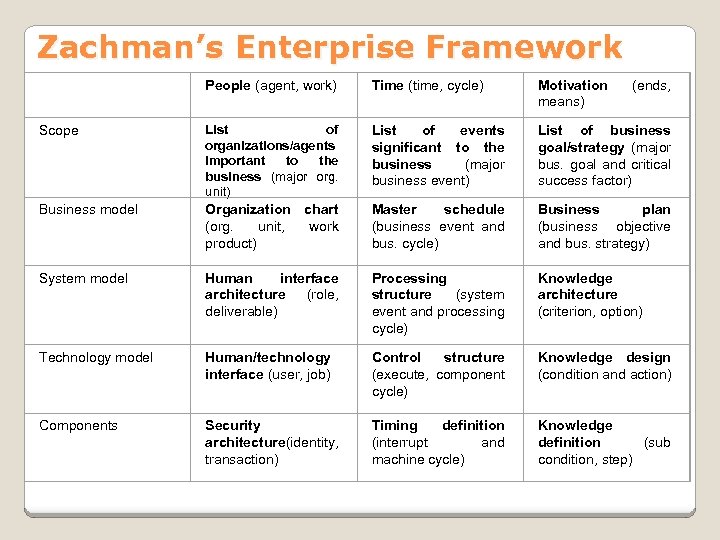 Zachman’s Enterprise Framework People (agent, work) Time (time, cycle) Motivation means) Scope List of organizations/agents important to the business (major org. unit) List of events significant to the business (major business event) List of business goal/strategy (major bus. goal and critical success factor) Business model Organization chart (org. unit, work product) Master schedule (business event and bus. cycle) Business plan (business objective and bus. strategy) System model Human interface architecture (role, deliverable) Processing structure (system event and processing cycle) Knowledge architecture (criterion, option) Technology model Human/technology interface (user, job) Control structure (execute, component cycle) Knowledge design (condition and action) Components Security architecture identity, ( transaction) Timing definition (interrupt and machine cycle) Knowledge definition (sub condition, step) (ends,
 SAP Architecture Design
 SAP Architecture Design Requirements Required data types: 1. Organizational levels (data, elements) 2. Master data 3. Transaction data
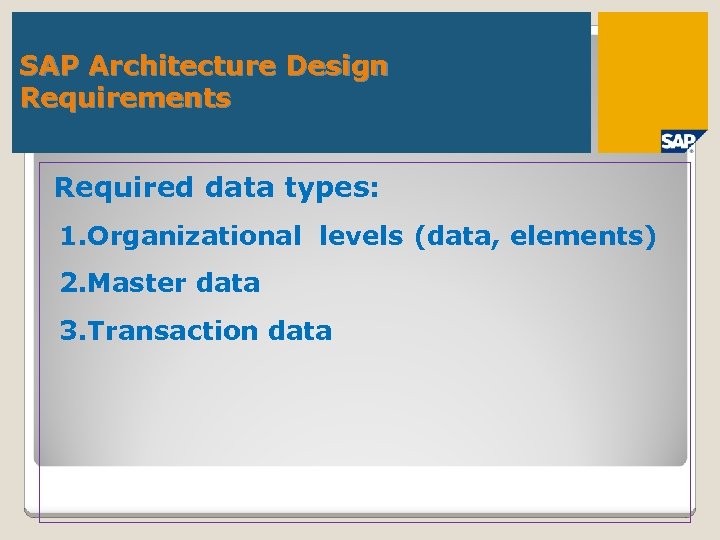
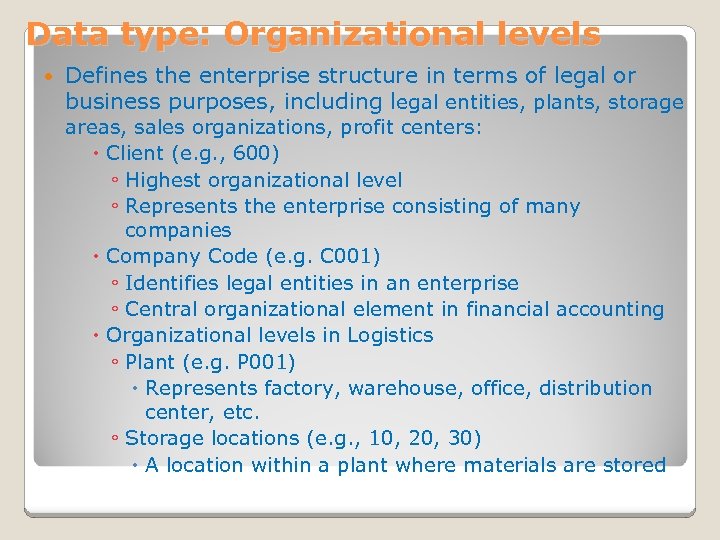 Data type: Organizational levels Defines the enterprise structure in terms of legal or business purposes, including legal entities, plants, storage areas, sales organizations, profit centers: Client (e. g. , 600) ◦ Highest organizational level ◦ Represents the enterprise consisting of many companies Company Code (e. g. C 001) ◦ Identifies legal entities in an enterprise ◦ Central organizational element in financial accounting Organizational levels in Logistics ◦ Plant (e. g. P 001) Represents factory, warehouse, office, distribution center, etc. ◦ Storage locations (e. g. , 10, 20, 30) A location within a plant where materials are stored
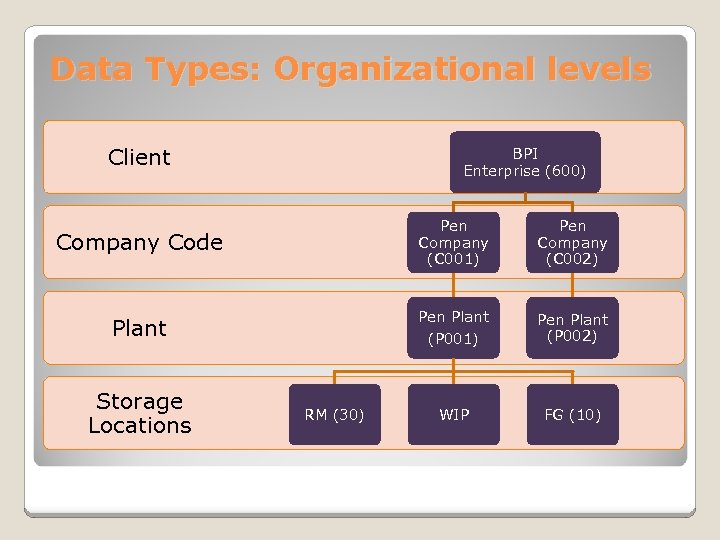 Data Types: Organizational levels Client BPI Enterprise (600) Company Code Pen Company (C 001) Pen Company (C 002) Plant Pen Plant (P 001) Pen Plant (P 002) WIP FG (10) Storage Locations RM (30)
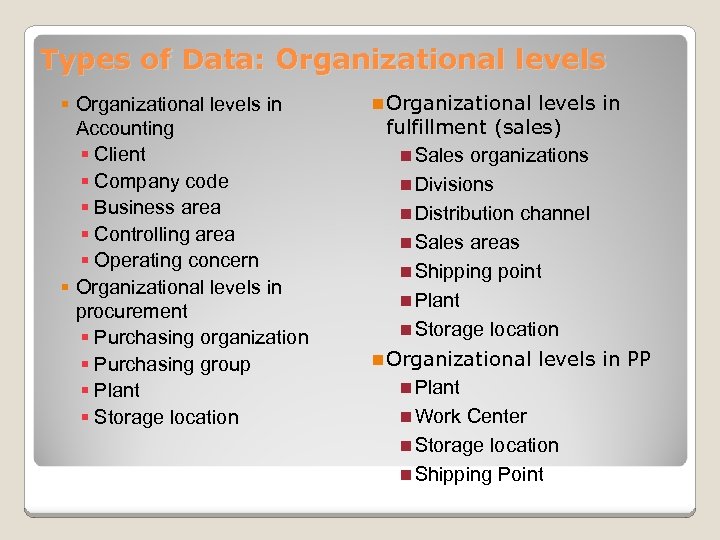 Types of Data: Organizational levels § Organizational levels in Accounting § Client § Company code § Business area § Controlling area § Operating concern § Organizational levels in procurement § Purchasing organization § Purchasing group § Plant § Storage location n Organizational levels in fulfillment (sales) n Sales organizations n Divisions n Distribution channel n Sales areas n Shipping point n Plant n Storage location n Organizational levels in PP n Plant n Work Center n Storage location n Shipping Point
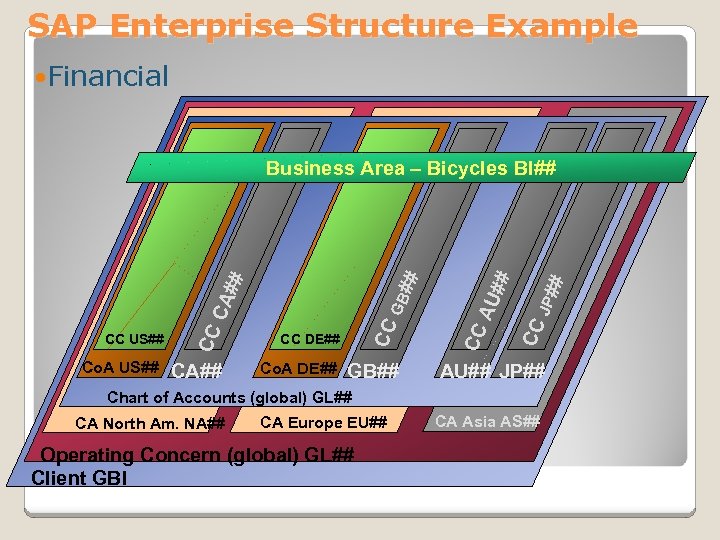 SAP Enterprise Structure Example Financial Co. A US## Co. A DE## GB## # JP # ## AU CC CA## CC CC DE## CC CC US## CC CA GB ## ## Business Area – Bicycles BI## AU## JP## Chart of Accounts (global) GL## CA North Am. NA## CA Europe EU## Operating Concern (global) GL## Client GBI CA Asia AS##
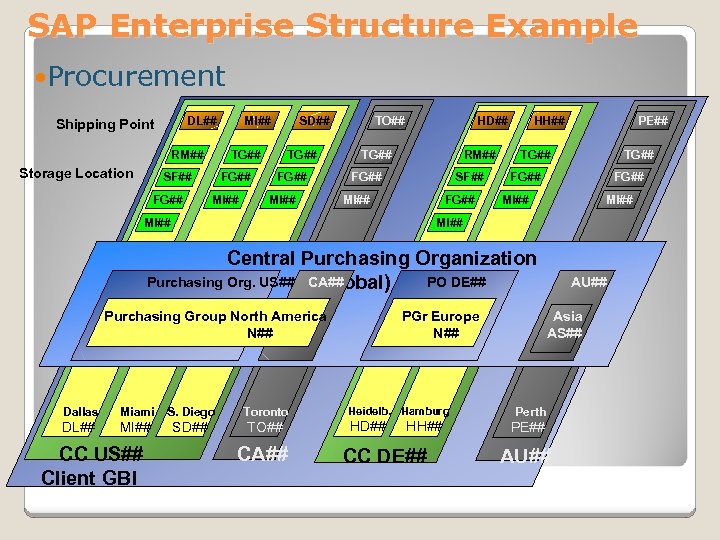 SAP Enterprise Structure Example Procurement DL## Shipping Point RM## Storage Location SD## TG## SF## FG## MI## TO## HD## RM## TG## FG## SF## MI## FG## HH## TG## FG## MI## Central Purchasing Organization Purchasing Org. US## CA## PO (global) GL## DE## Purchasing Group North America N## DL## Miami MI## CC US## Client GBI TG## MI## Dallas PE## S. Diego Toronto SD## TO## CA## PGr Europe N## Heidelb. Hamburg HD## HH## CC DE## AU## Asia AS## Perth PE## AU##
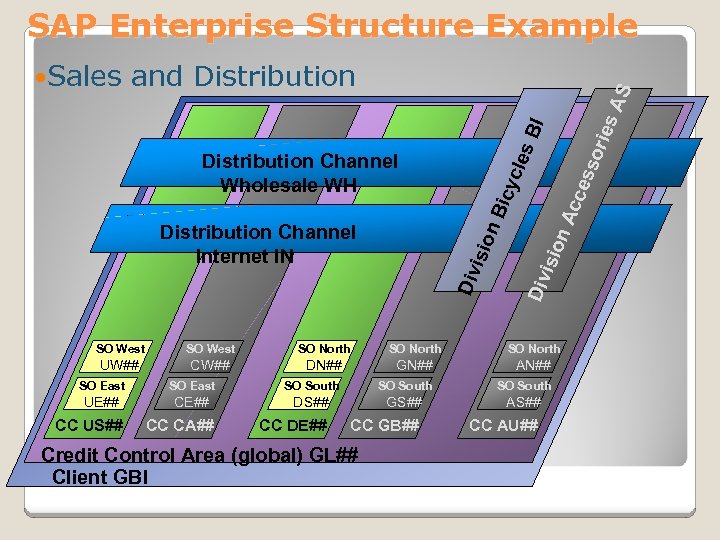 SAP Enterprise Structure Example cce sso ries AS and Distribution les BI Sales isio Div isio Distribution Channel Internet IN n. A n. B icy c Distribution Channel Wholesale WH SO West SO North UW## CW## DN## GN## AN## SO East SO South UE## CE## DS## GS## AS## CC DE## CC GB## CC AU## CC US## CC CA## Credit Control Area (global) GL## Client GBI
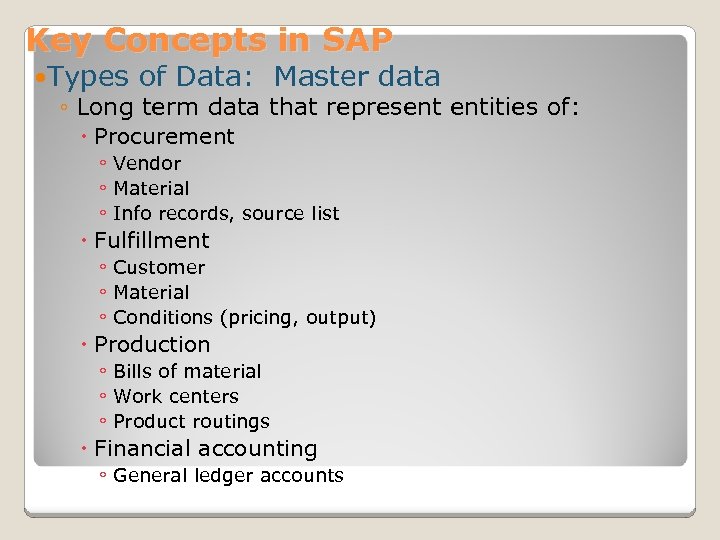 Key Concepts in SAP Types of Data: Master data ◦ Long term data that represent entities of: Procurement ◦ Vendor ◦ Material ◦ Info records, source list Fulfillment ◦ Customer ◦ Material ◦ Conditions (pricing, output) Production ◦ Bills of material ◦ Work centers ◦ Product routings Financial accounting ◦ General ledger accounts
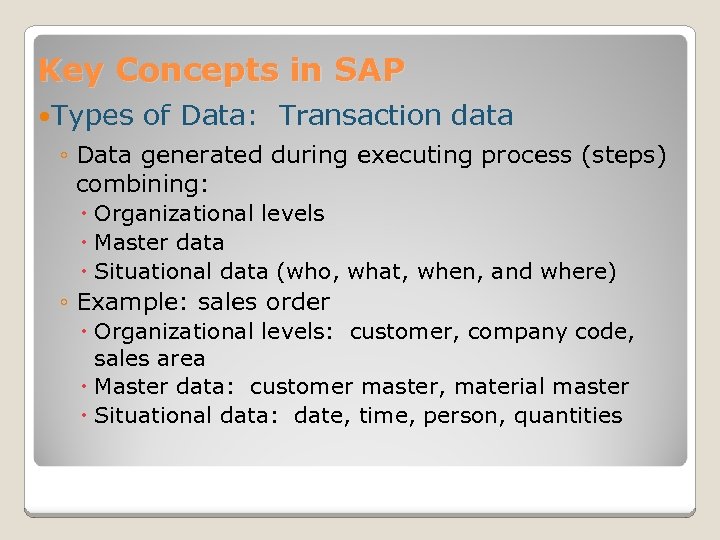 Key Concepts in SAP Types of Data: Transaction data ◦ Data generated during executing process (steps) combining: Organizational levels Master data Situational data (who, what, when, and where) ◦ Example: sales order Organizational levels: customer, company code, sales area Master data: customer master, material master Situational data: date, time, person, quantities
 Key Concepts in SAP • The Document concept ◦ An electronic record of transactions ◦ Each transaction creates document(s) • Document types ◦ ◦ Financial accounting documents (FI) Management accounting documents (CO) Material documents (goods movement) Others
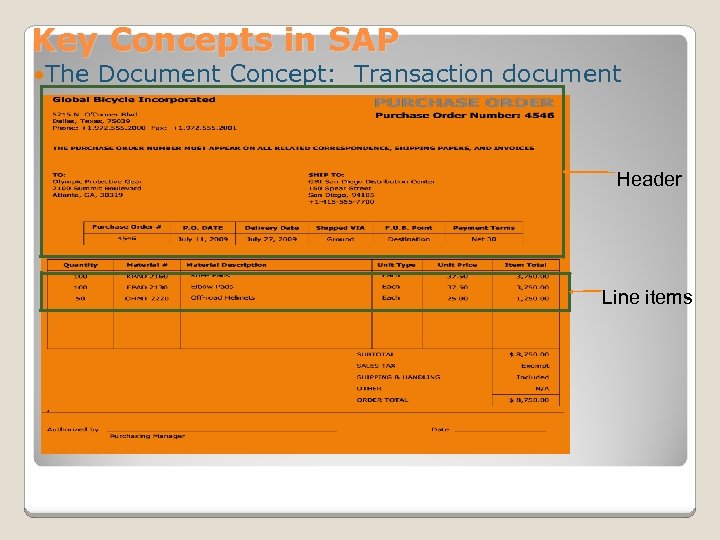 Key Concepts in SAP The Document Concept: Transaction document Header Line items
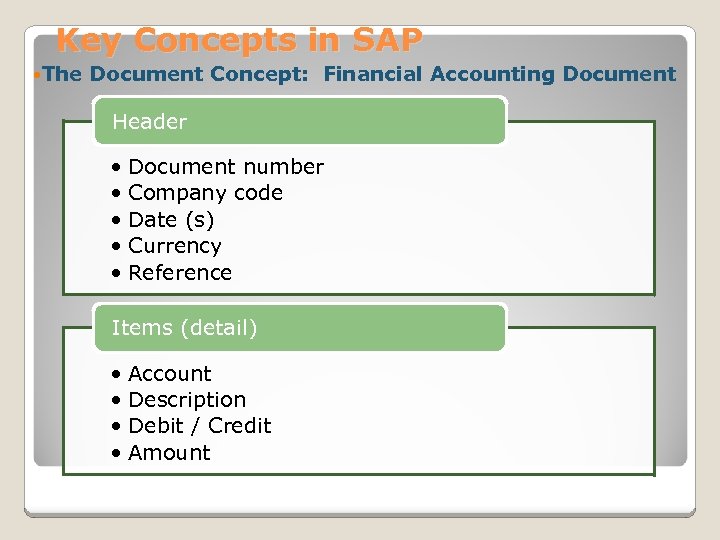 Key Concepts in SAP The Document Concept: Financial Accounting Document Header • Document number • Company code • Date (s) • Currency • Reference Items (detail) • Account • Description • Debit / Credit • Amount
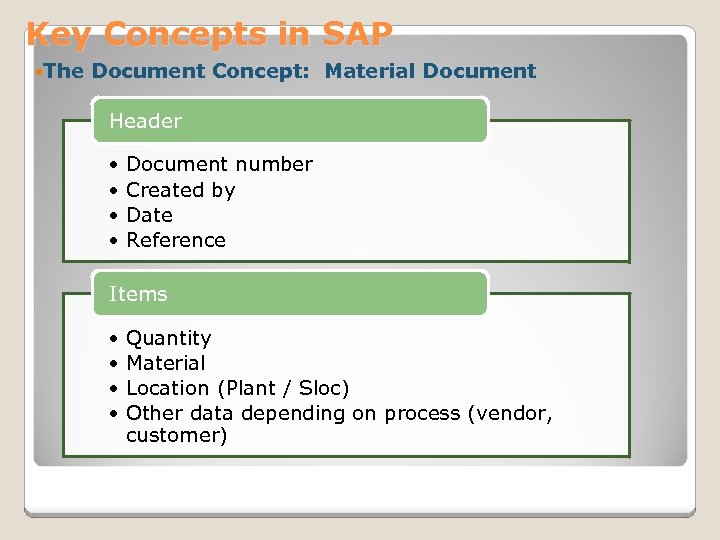 Key Concepts in SAP The Document Concept: Material Document Header • • Document number Created by Date Reference Items • • Quantity Material Location (Plant / Sloc) Other data depending on process (vendor, customer)
 PEN, Inc. System Architecture Design
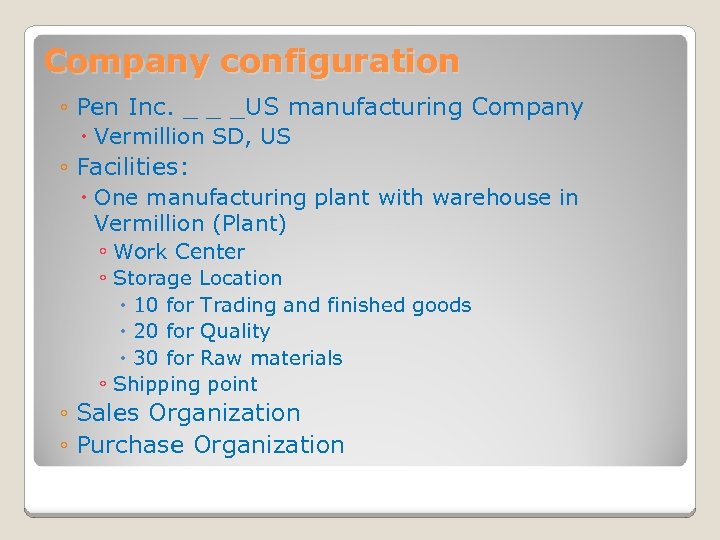 Company configuration ◦ Pen Inc. _ _ _US manufacturing Company Vermillion SD, US ◦ Facilities: One manufacturing plant with warehouse in Vermillion (Plant) ◦ Work Center ◦ Storage Location 10 for Trading and finished goods 20 for Quality 30 for Raw materials ◦ Shipping point ◦ Sales Organization ◦ Purchase Organization
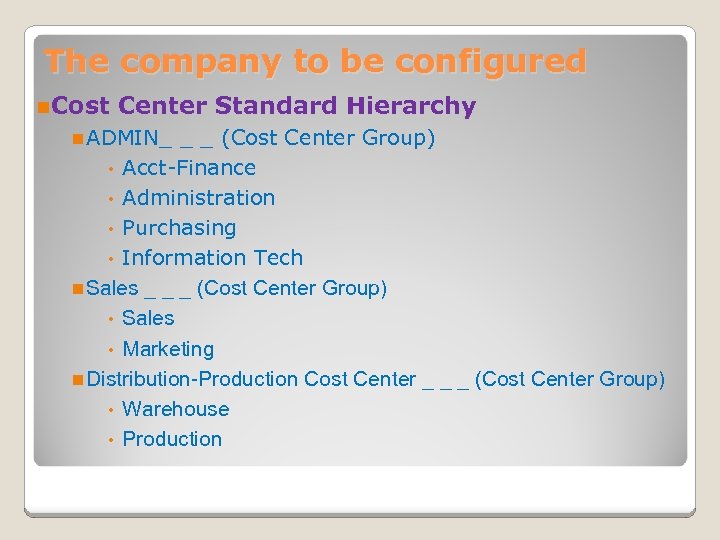 The company to be configured n. Cost Center Standard Hierarchy n ADMIN_ _ _ (Cost Center Group) • Acct-Finance • Administration • Purchasing • Information Tech n Sales _ _ _ (Cost Center Group) • Sales • Marketing n Distribution-Production Cost Center _ _ _ (Cost Center Group) • Warehouse • Production
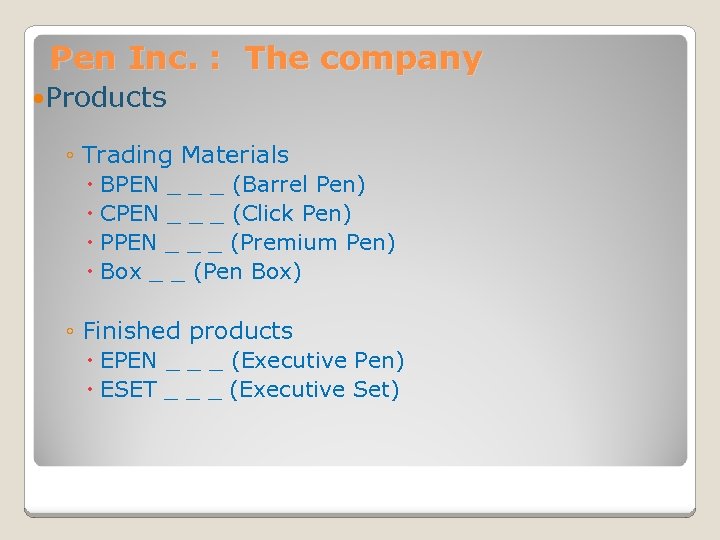 Pen Inc. : The company Products ◦ Trading Materials BPEN _ _ _ (Barrel Pen) CPEN _ _ _ (Click Pen) PPEN _ _ _ (Premium Pen) Box _ _ (Pen Box) ◦ Finished products EPEN _ _ _ (Executive Pen) ESET _ _ _ (Executive Set)
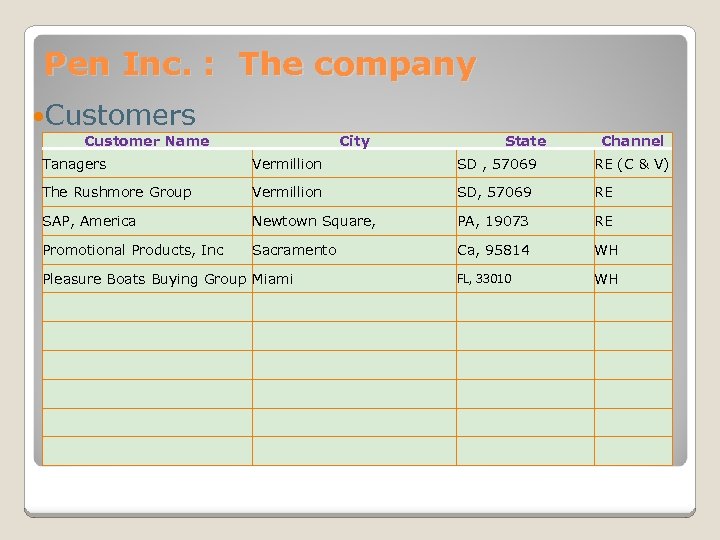 Pen Inc. : The company Customers Customer Name City State Channel Tanagers Vermillion SD , 57069 RE (C & V) The Rushmore Group Vermillion SD, 57069 RE SAP, America Newtown Square, PA, 19073 RE Promotional Products, Inc Sacramento Ca, 95814 WH FL, 33010 WH Pleasure Boats Buying Group Miami
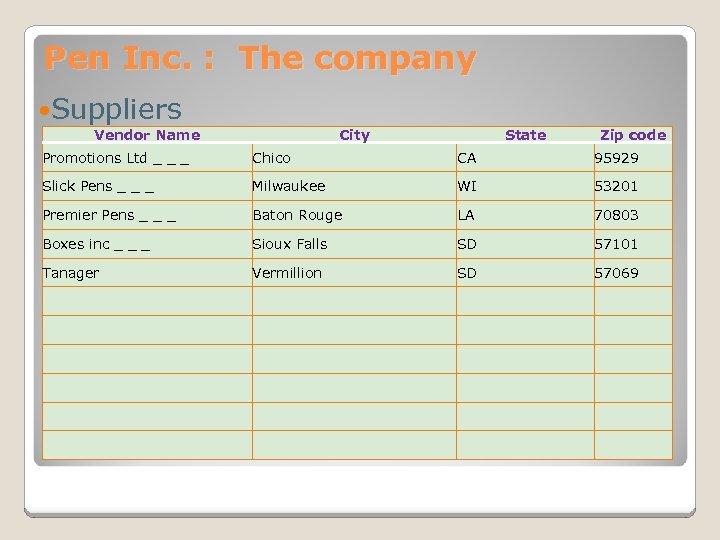 Pen Inc. : The company Suppliers Vendor Name City State Zip code Promotions Ltd _ _ _ Chico CA 95929 Slick Pens _ _ _ Milwaukee WI 53201 Premier Pens _ _ _ Baton Rouge LA 70803 Boxes inc _ _ _ Sioux Falls SD 57101 Tanager Vermillion SD 57069
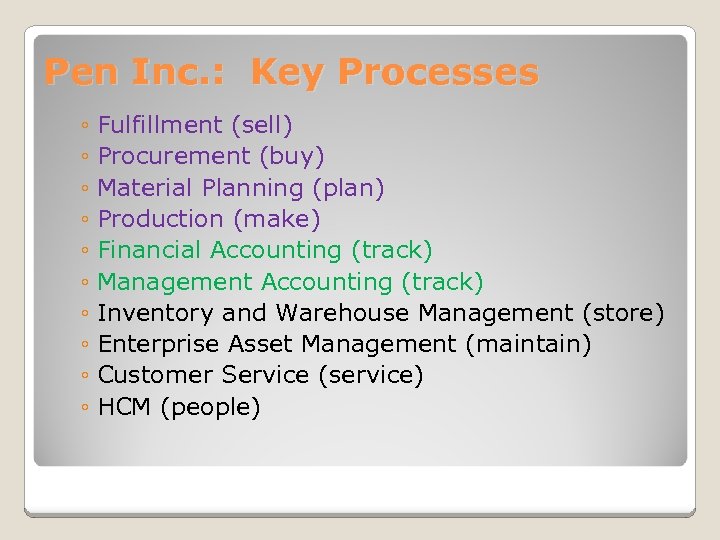 Pen Inc. : Key Processes ◦ Fulfillment (sell) ◦ Procurement (buy) ◦ Material Planning (plan) ◦ Production (make) ◦ Financial Accounting (track) ◦ Management Accounting (track) ◦ Inventory and Warehouse Management (store) ◦ Enterprise Asset Management (maintain) ◦ Customer Service (service) ◦ HCM (people)
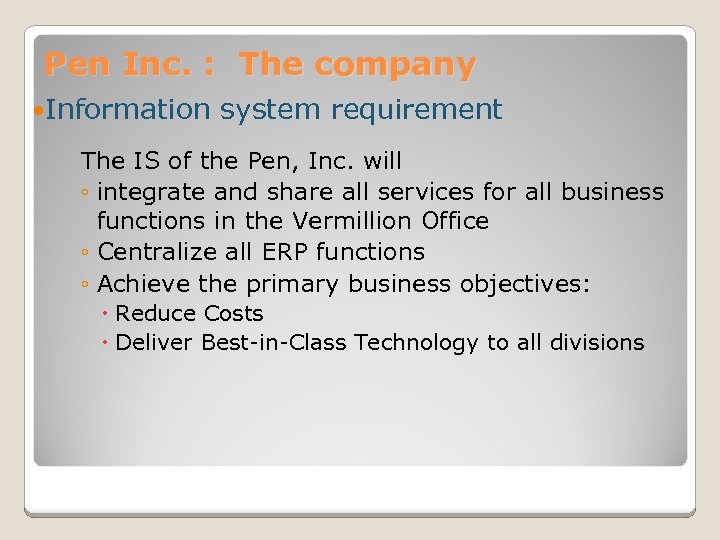 Pen Inc. : The company Information system requirement The IS of the Pen, Inc. will ◦ integrate and share all services for all business functions in the Vermillion Office ◦ Centralize all ERP functions ◦ Achieve the primary business objectives: Reduce Costs Deliver Best-in-Class Technology to all divisions
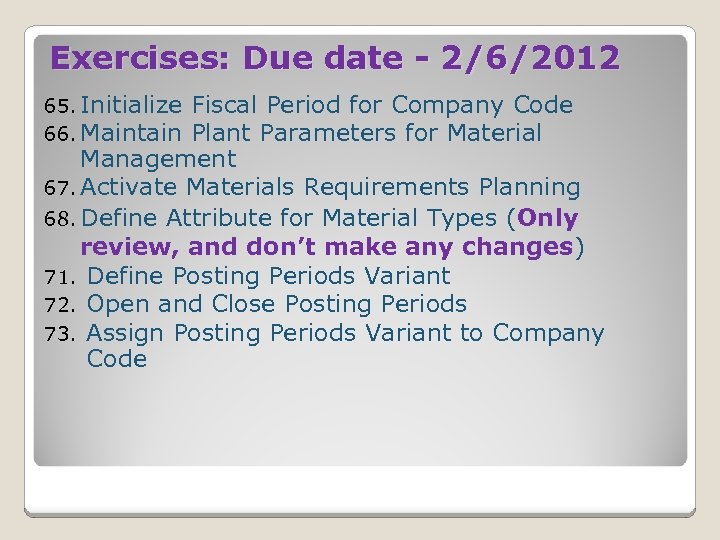 Exercises: Due date - 2/6/2012 65. Initialize 66. Maintain Fiscal Period for Company Code Plant Parameters for Material Management 67. Activate Materials Requirements Planning 68. Define Attribute for Material Types (Only review, and don’t make any changes) 71. Define Posting Periods Variant 72. Open and Close Posting Periods 73. Assign Posting Periods Variant to Company Code
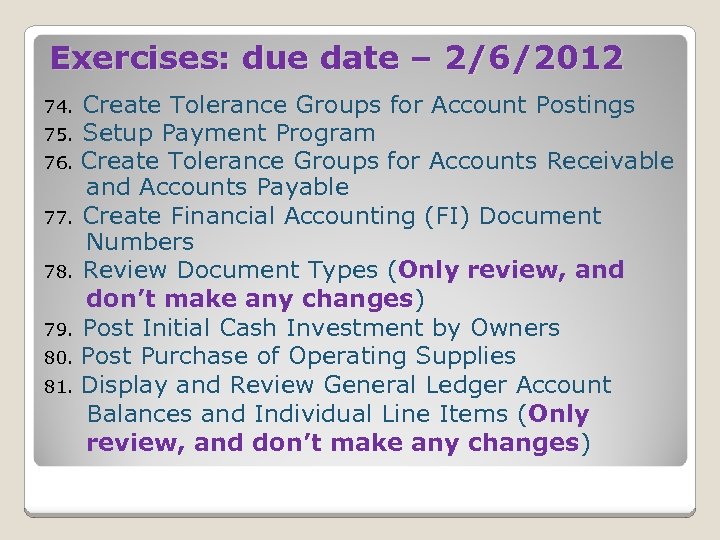 Exercises: due date – 2/6/2012 Create Tolerance Groups for Account Postings 75. Setup Payment Program 76. Create Tolerance Groups for Accounts Receivable and Accounts Payable 77. Create Financial Accounting (FI) Document Numbers 78. Review Document Types (Only review, and don’t make any changes) 79. Post Initial Cash Investment by Owners 80. Post Purchase of Operating Supplies 81. Display and Review General Ledger Account Balances and Individual Line Items (Only review, and don’t make any changes) 74.