


 Скачать презентацию Enterprise Risk Management For Insurers and Financial Institutions
417f5860166c80da1f3f7163d81229a0.ppt
- Количество слайдов: 136
 Enterprise Risk Management For Insurers and Financial Institutions David Ingram CERA, FRM, PRM From the International Actuarial Association 1
 Course Outline 1. INTRODUCTION - Why ERM? 2. RISK MANAGEMENT FUNDAMENTALS – FIRST STAGE OF CREATING AN ERM PROGRAM 3. RISK ASSESSMENT AND RISK TREATMENT ACTUARIAL ROLES 4. ADVANCED ERM TOPICS 2
 Risk Assessment & Risk Treatment Actuarial Roles 3. 1 Types of Risks 3. 2 Risk Models 3. 3 Risk Treatment Options – ALM 3. 4 Risk Treatment Options – Hedging 3. 5 Risk Treatment Options – Reinsurance 3. 6 Risk Treatment Options – Capital Markets 3. 7 Risk Treatment Options – Risk Design 3. 8 Risk Treatment Options – Diversification 3. 9 Risk Treatment Options – Avoid/Retain 3. 10 Choosing a Primary Risk Metric 3. 11 Uses of multiple Risk Models 3. 12 Using Economic Capital for ERM 3. 13 Capital Management & Allocation 3
 3. 1 Types of Risks Systematic v. Specific Traded v. Non-Traded Paid to Take v. Not Paid to Take Market, Credit, Insurance, Operational 4
 Systematic Risk vs. Specific Risk • Flood – Systematic Risk -everyone gets wet • Bucket of water thrown by your brother – Specific risk – only you get wet • Insuring one House – Systematic or Specific? • Insuring thousands of houses – Systematic or Specific? 5
 What are risk management Techniques for Specific Risk? 1) _______ 2) _______ 3) _______ 6
 What are Risk Management Techniques for Systematic Risk? 1) _______ 2) _______ 3) _______ 7
 What happens with a group of specific risks? 8
 3. 2 Risk Models Cause / Effect - Outcome – Frequency/Severity Closed Form v. Single Scenario v. Monte Carlo Stress v. Scenario Sensitivity 9
 Cause Effect - Outcome Typical Life Insurance Actuarial Model follows the steps taken over the life of an insurance contract following a tree branching logic Policy Issue, continue to next year (1 – q - w) Death & Claim in first year (q) Lapse or surrender the contract (w) 10 Repeat – year after year Outcome = PV of three paths for each year
 Outcome – Frequency/Severity • Model commonly used for non-life insurance and for financial market instruments • Past observations of frequency and severity of outcomes used to parameterize statistical models of future outcomes 11
 Closed Form v. Single Scenario v. Monte Carlo • Close Form models – – usually depend upon assumption of distribution of outcomes (normal or log normal) that have formulaic outcomes – • one step calculations Black Sholes Single Scenario – – • Also one step (the one scenario) Using either CEO or OFS Monte Carlo (stochastic) model – – 12 Multi scenario Often do not presume to know distribution of outcomes
 Stress v. Scenario • Stress Test • – Redo calculation changing one parameter Scenario Test – – 13 Adjust all parameters to reflect a fictional total world Includes interactions of factors and dependencies in the assumed situation
 3. 3. 0 Risk Treatment Process • May vary significantly with each major risk category • Depending on Nature of Risk – – – 14 Assessment Capabilities Relationship with Risk Takers Knowledge & Experience of Staff
 Components of Risk Treatment Process Risk Identification Measuring & Monitoring System Risk Assessment & Communication Establishment of Risk Limits & Standards – Risk Treatments – Enforcement of Limits & Standards – Risk Learning – – 15
 Risk Identification • • Within a broad category Need to know which sub categories of the risk can be treated together – And which need to be treated separately 16
 Measuring & Monitoring System • • 17 Measures of risk v. Key Risk Indicators Existing v. Future Manual v. Automated Quantitative v. Qualitative
 Risk Assessment & Communication • Need to establish regular schedule of assessment • Assessments must be communicated at several levels in the organization • 18 – Operational Levels – Management levels Management MUST have discussions with subordinates about the risk positions
 Establishment of Risk Limits & Standards • • 19 Limits = How large, How much, How many, Authorities – Limits must be quantitative – Also may use Checkpoints Standards – For how things are to be done – Treatments permitted/ required
 Risk Treatments • • • 20 Avoid Reduce Offset Transfer Retain & Provision
 To set Standards • Ask the best person in a function what needs to be done to “get it right” • Ask supervisors what information that they need to be able to tell that things are being done “right” • Standards also apply to documentation and recordkeeping 21
 Enforcement of Limits & Standards • • Assessment & Communication systems need to include comparison of risk positions to limits – And adherence to standards Must clearly establish what will happen if limit or standard is violated – Might depend on seriousness of breach – Hard limits v. Soft Limits 22
 Risk Learning • About Losses, Risk Assessment, Risk Treatment Processes – – 23 Internal External Backwards Forward
 Credit Risk Treatment Traditional Credit Risk Treatment • Standards for – Underwriting – Authorities – Collateral, Coverage • Limits & Enforcement – Limits by credit quality, Size of Position – Authority Limits • 24 Active Workout with Risk Learning
 “Modern” Credit Risk Treatment • Credit Va. R risk model & Aggregate limits – Gives aggregate portfolio view of Credit Risk – Allows trade-offs within aggregate limits • Use of credit derivatives to offset excessive specific or aggregate risk levels 25
 Insurance Underwriting Traditional Risk Control Mechanism for Insurance Standards for • Underwriting • Authorities • Insurable Interest Limits & Enforcement • Limits by quality, Amount of Coverage • Authority Limits Active Claims management with Risk Learning 26
 3. 3 Risk Treatment Options – ALM Interest Rate Risk Treatment • Crediting Rate Matching • Cashflow Matching • Duration Matching • Advanced ALM • Economic Capital Limits & Reporting 27
 Crediting Rate Matching Portfolio Rate New Money Rate Investment Year Rates Mismatched crediting rates can lead to large harmful cashflows 28
 Cashflow Matching 1) Project out expected cashflows from liabilities 2) Project out expected cashflows from assets 3) Identify major gaps where there is a large difference between the projected cash outflow and inflow in a future year 4) Make plans to fill those gaps (usually on asset side for insurers) 29 Targeting future asset purchases Targeting asset sales & repurchases
 Duration Matching Duration is sensitivity of value to a change in interest rate Also equal to PV of time weighted cashflows Sum of PV(t x Cft) Focus on D v. D A L Set Limit for abs(DA – DL) – 30 Usually ½ to 1 year
 Duration Matching • Most Insurers adjust assets to match duration of liabilities • First step is to assess expected DL for a new product – • 31 Set DA target for new cashflow Second step is to set schedule for assessment of portfolio DA & DL
 Duration Matching If assessment reveals excessive abs(DA – DL) gap then will plan to: • – Adjust DA target for future cashflows – Sell some assets and purchase others to change DA – Purchase derivatives • 32 Macro or Micro Hedge
 ALM – Advanced • Duration matching only works well if interest rate moves are – – • Similar for all durations Advanced methods take care of: – – 33 Small Larger movements (Convexity) Non-parallel shifts (Key Rate Durations)
 Convexity • Change in Duration with change in interest rates – • Duration measures slope of the value plot – 34 Second derivative of value with respect to a change in interest If Value Plot is a curve, then slope is only accurate measure for very small moves
 Key Rate Durations • Change in value with change in rate at a specific duration – • 35 For example, 5 year rate only Matching Key Rate Durations allows protection against yield curve twists
 3. 4 Risk Treatment Options – Hedging Financial Market Risk Treatment • Derivative Instruments used for Hedging – – Put & Call Options – • Futures Swaps Derivatives are often low cash outlay – 36 Usually means that derivatives involve significant leverage
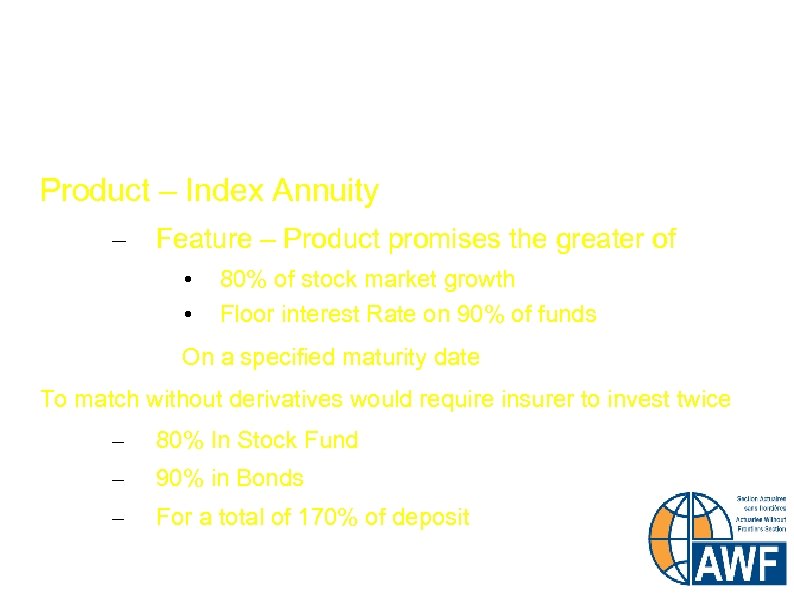 Example of Financial Market Risk Product – Index Annuity – Feature – Product promises the greater of • • 80% of stock market growth Floor interest Rate on 90% of funds On a specified maturity date To match without derivatives would require insurer to invest twice – – 90% in Bonds – 37 80% In Stock Fund For a total of 170% of deposit
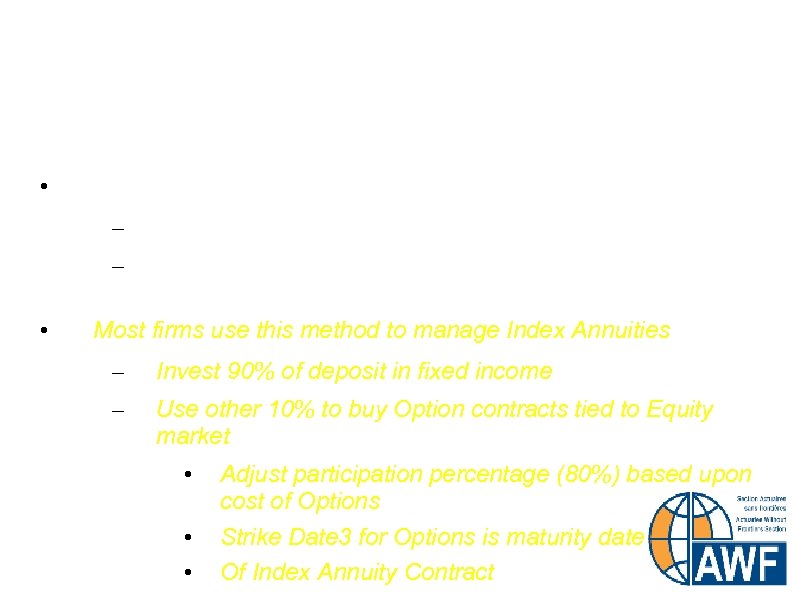 Hedging Methods • Cashflow Hedging – – • Works like Cashflow matching in ALM Purchase derivatives that have strike dates where there are potential cash mismatches Most firms use this method to manage Index Annuities – Invest 90% of deposit in fixed income – Use other 10% to buy Option contracts tied to Equity market • 38 • • Adjust participation percentage (80%) based upon cost of Options Strike Date 3 for Options is maturity date Of Index Annuity Contract
 Hedging Methods • Delta Hedging – Is fundamentally the same idea as Duration Matching – Delta is change in price (value) per change in an underlying (usually a market index) – Delta hedging often uses derivatives with extremely different term to hedge obligations • • 39 Delta hedges are only good for a very short time period (usually a day) Delta Hedges must be rebalanced every day
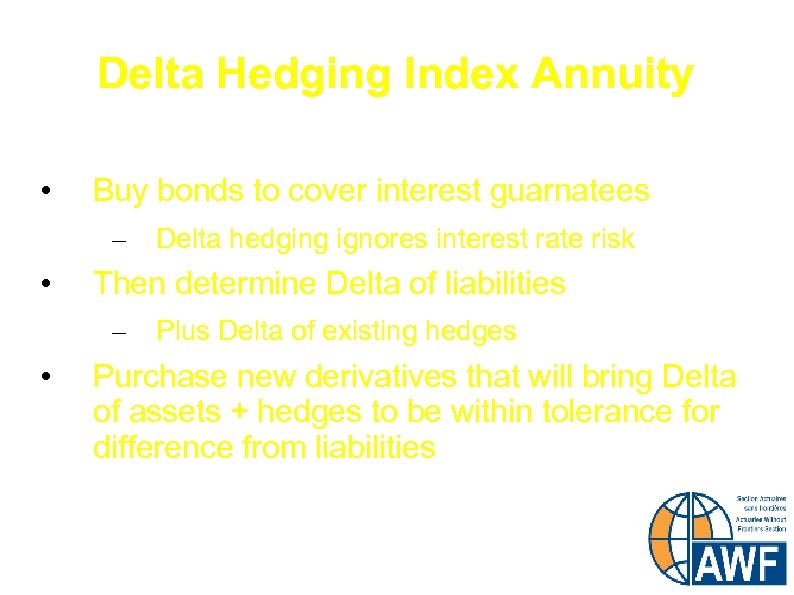 Delta Hedging Index Annuity • Buy bonds to cover interest guarnatees – • Then determine Delta of liabilities – • 40 Delta hedging ignores interest rate risk Plus Delta of existing hedges Purchase new derivatives that will bring Delta of assets + hedges to be within tolerance for difference from liabilities
 Hedging Methods • Greeks – Greeks are partial derivatives of Prices with change in various factors • • • Gamma Vega Tau Get Definitions 41
 Hedging Index Annuity with Greeks • Investments can be any mixture of bonds and stocks • Greeks will determine adjustments needed with derivatives to match all of the risk characteristics 42
 Custom Hedging • Can purchase custom hedge contracts from a bank that have terms tailored to your specific need • If using custom hedges, would expect very low amount of rebalancing needed • Hedges are tied to market indices – not to actual liabilities 43
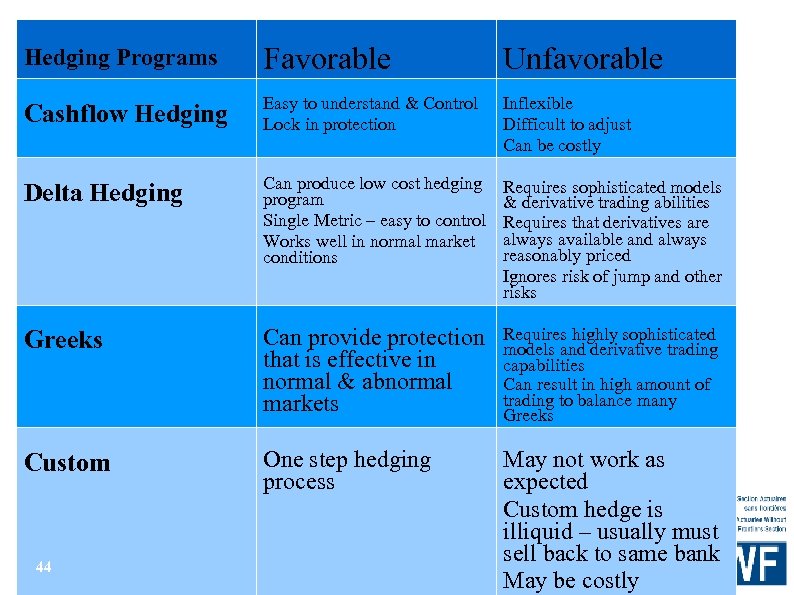 Hedging Programs Favorable Unfavorable Cashflow Hedging Easy to understand & Control Lock in protection Inflexible Difficult to adjust Can be costly Delta Hedging Can produce low cost hedging program Single Metric – easy to control Works well in normal market conditions Requires sophisticated models & derivative trading abilities Requires that derivatives are always available and always reasonably priced Ignores risk of jump and other risks Greeks Can provide protection that is effective in normal & abnormal markets Requires highly sophisticated models and derivative trading capabilities Can result in high amount of trading to balance many Greeks Custom One step hedging process May not work as expected Custom hedge is illiquid – usually must sell back to same bank May be costly 44
 3. 5 Risk Treatment Options – Reinsurance Insurance & Financial Market Risk Treatment Reinsurance is broadly similar to Custom hedges just described Usually much more customized than Custom hedges Reinsurers will usually promise to offset some portion of an insurers exact claims experience 45
 Types of Reinsurance • Facultative v. Treaty • Proportional v. Non-Proportional • Per Risk v. Per Occurrence v. Aggregate
 Facultative v. Treaty • “Facultative” reinsurance applies to a single insurance contract • “Treaty” reinsurance applies to all contracts in a defined block
 Proportional v. Non-Proportional § Proportional reinsurance: the reinsurer takes a defined percentage of all losses § Non-proportional reinsurance: the reinsurer only takes losses that exceed some threshold § Almost always subject to a maximum limit § Threshold may be on per risk, per occurrence, or aggregate basis
 Per Risk v. Per Occurrence v. Aggregate § Types of loss threshold for non-proportional reinsurance § Per Risk: threshold applies to losses from each insurance policy § Per Occurrence: threshold applies to total loss from each specific event (for example, each hurricane or earthquake) § Aggregate: threshold applies to total loss from a specific time period
 Reinsurance • Advantages: – Customized to take exact aspect of risk that insurer wants to lay off – Available through a market of 50 -100 firms globally • Disadvantages – Cost and availability of specific covers varies widely – Need to be concerned about credit quality of reinsurer • Sometimes for many, many years
 Actuarial Analysis of Reinsurance Decision § Quantify frequency & severity of insurance losses § Apply terms of various reinsurance options § Compare cost / benefit and Risk/Reward tradeoffs § Evaluate options in light of company goals in order to determine best strategy 51
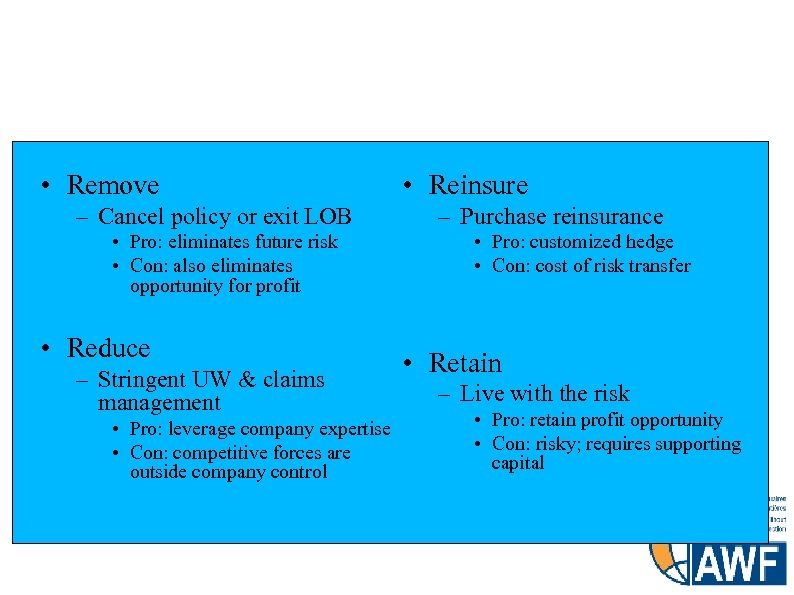 Strategies for Managing Underwriting Risk • Remove – Cancel policy or exit LOB • Pro: eliminates future risk • Con: also eliminates opportunity for profit • Reduce – Stringent UW & claims management • Pro: leverage company expertise • Con: competitive forces are outside company control 52 • Reinsure – Purchase reinsurance • Pro: customized hedge • Con: cost of risk transfer • Retain – Live with the risk • Pro: retain profit opportunity • Con: risky; requires supporting capital
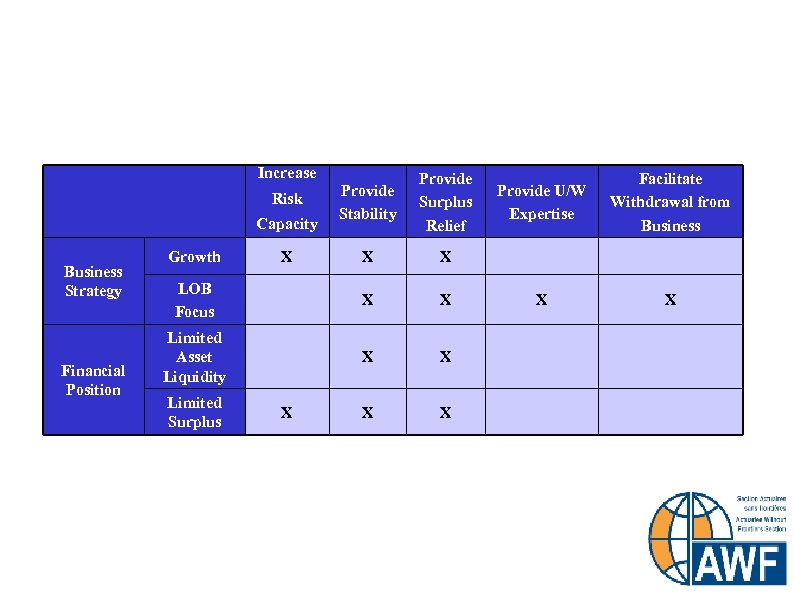 Determining Reinsurance Needs Increase Provide Stability Provide Surplus Relief X X LOB Focus X X Limited Asset Liquidity X X Risk Capacity Business Strategy Financial Position 53 Growth Limited Surplus X X Provide U/W Expertise Facilitate Withdrawal from Business X X
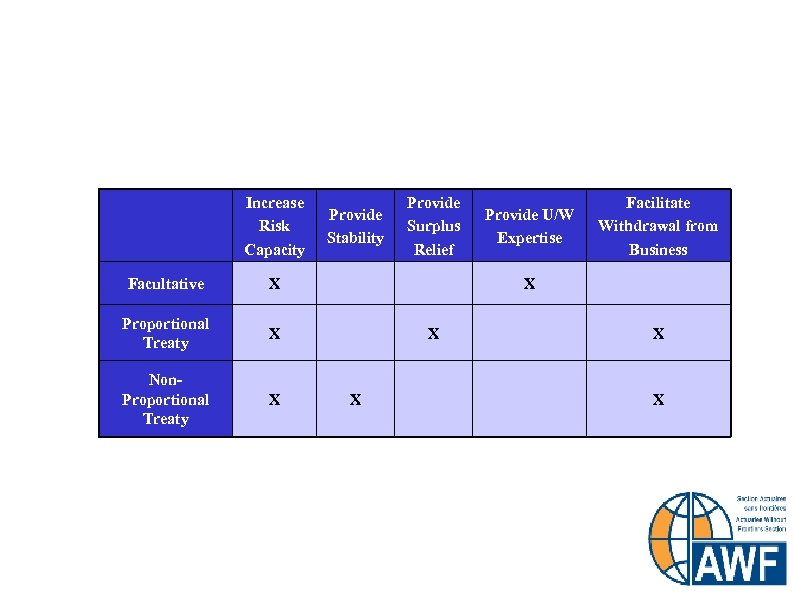 Functions Served by Different Types of Reinsurance Increase Risk Capacity Facultative Non. Proportional Treaty 54 X X Provide Surplus Relief X Proportional Treaty Provide Stability Provide U/W Expertise Facilitate Withdrawal from Business X X X
 Reinsurance • Advantages: – – • Customized to take exact aspect of risk that insurer wants to lay off Available through a market of 50 to 100 firms globally Disadvantages – Cost and availability of specific covers varies widely – Need to be concerned about credit quality of reinsurer • Sometimes for many, many years
 3. 6 Risk Treatment Options – Capital Markets Securutization of Firm Risks Use of General Capital Markets products (ILW) 56
 Capital Markets Options for Insurance Risks • Two broad Capital Markets Solutions to Risk – – 57 Securitize & Sell your own risk on the Capital Markets Buy Capital Markets Instruments that offset a risk that you have
 Securitize your Risk Advantages: • Covers your exact risk • Pricing may be better than reinsurance • Capacity can be higher than reinsurers Disadvantages • Market might balk at any non-standard aspects of your risk • Large fixed cost of securitization • Market appetite varies widely for insurance 58
 Buy Capital Markets instruments to offset your risk • There are some instruments – usually related to insurance cats that have been created by banks or (re)insurers – – Mortality Cat Bonds Industry Loss Warrents • Usually, these are bonds where principle is not repaid if trigger event occurs • Trigger event is usually very large catastrophe 59
 3. 7 Risk Treatment Options – Risk Design Life Insurance Annuities Health Insurance Property Insurance Casualty Insurance 60
 Risk Design – Life Insurance • Increasing Insurance Amount – • High Premium Levels – – • To limit underwriting anti-selection For Guaranteed Options Assumed high degree of anti-selection Offsetting Insurance & Investment Risks – – 61 If investments perform poorly, must buy more insurance Explicit in UL product
 Risk Design - Annuities • Deferred Annuities – – – • Market Value Adjustments (fixed) Investment restrictions (variable) Immediate Annuities – 62 Surrender Charges Limited or no Withdrawal options
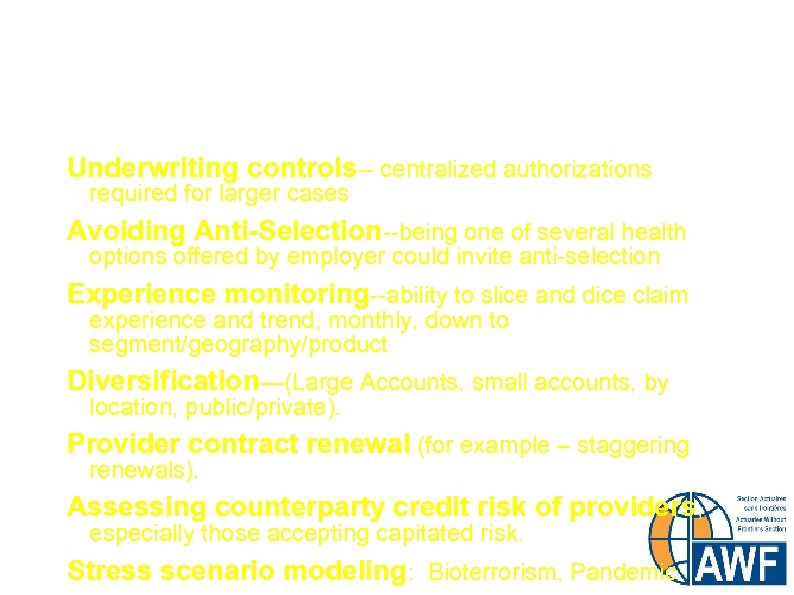 Health Specific ERM Concerns Underwriting controls-- centralized authorizations required for larger cases Avoiding Anti-Selection--being one of several health options offered by employer could invite anti-selection Experience monitoring--ability to slice and dice claim experience and trend, monthly, down to segment/geography/product Diversification—(Large Accounts, small accounts, by location, public/private). Provider contract renewal (for example – staggering renewals). Assessing counterparty credit risk of providers, especially those accepting capitated risk. 63 Stress scenario modeling: Bioterrorism, Pandemic
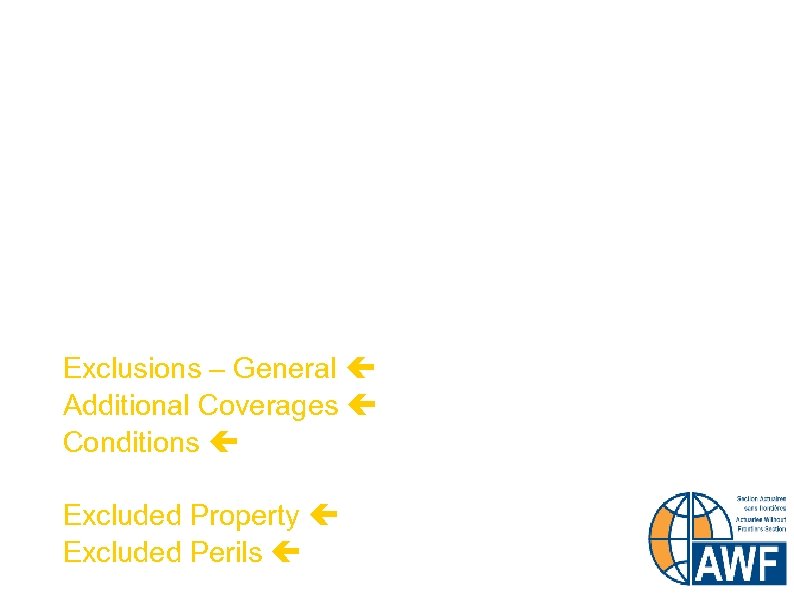 POLICY CONTRACTS As Risk Treatment Tool ELEMENTS OF AN INSURANCE POLICY – 64 Declarations Page(s) Coverage Part(s) Definitions General Provisions Exclusions – General Additional Coverages Conditions Duties After an Accident or Loss Excluded Property Excluded Perils
 POLICY CONTRACTS … OCCURRENCE & CLAIMS-MADE Policies written to cover losses two ways: Occurrence Basis – Pays for losses that occur during the policy period. Claims Made – Pays for losses reported during the policy period Due to nature of Claims Made policies, they are written with either: 65 Extended Reporting Provision, or Retroactive Date Provision Both extend the “period” during which losses may be reported and covered
 BASIC Reinsurance CONTRACT TYPES Facultative or Treaty Individual Risk Entire Book of Business Excess or Pro Rata Limit and Retention Proportional Sharing of Loss 66 66
 “BUSINESS” PROVISIONS Business Covered Line(s) of business In force, new and renewal Exclusions What isn’t covered Territory Where can the risks be located or policies written 67 67
 COVERAGE PROVISION “Coverage” Article establishes the Reinsurer’s liability to the Company for the subject business: Excess – Retention and Limit Quota Share or other Pro Rata – Percentage of Cession The Basis of Coverage is defined. For example, on an XOL contract the Basis of Coverage is “each loss occurrence” or “each risk, ” etc. 68 68
 COVERAGE PROVISIONS Commencement and Termination Definitions – Excess vs. Pro Rata ECO/XPL LAE/DJ UNL – excess only Loss Occurrence – Property vs Casualty 69 69
 COVERAGE PROVISIONS Other Reinsurance – Inuring vs Underlying Reinstatement Warranties Notice Of Loss and Loss Settlements 70 70
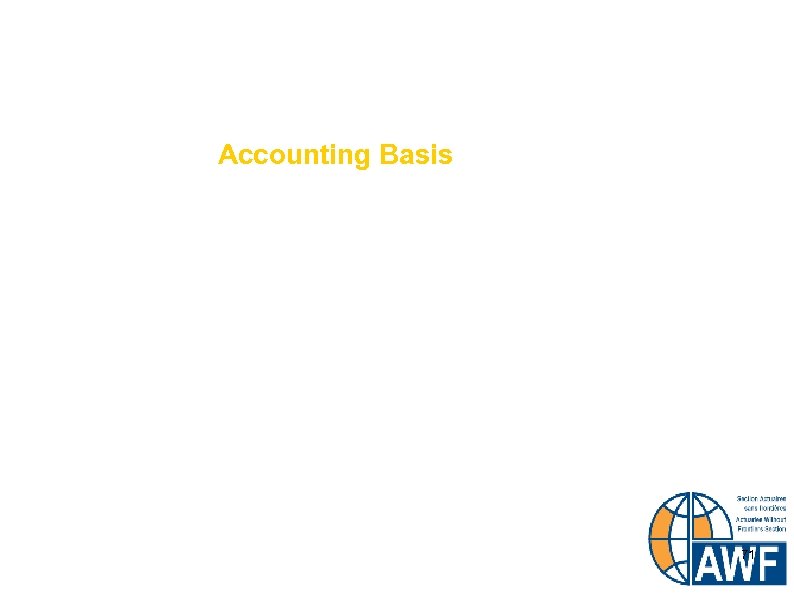 “MONEY” PROVISIONS Three Types of Accounting Basis 1. Accident Year 2. Calendar Year 3. Underwriting Year 71 71
 3. 8 Risk Treatment Options – Diversification among risks Diversification between risks Correlations v. Dependencies 72
 Diversification of Like Independent risks • If rate of claim is q, amount of claim is C, number of insured is N • Expected claims = Nq. C • Standard Deviation of Claims amount is – 73 Square Root {Nq(1 -q)}C
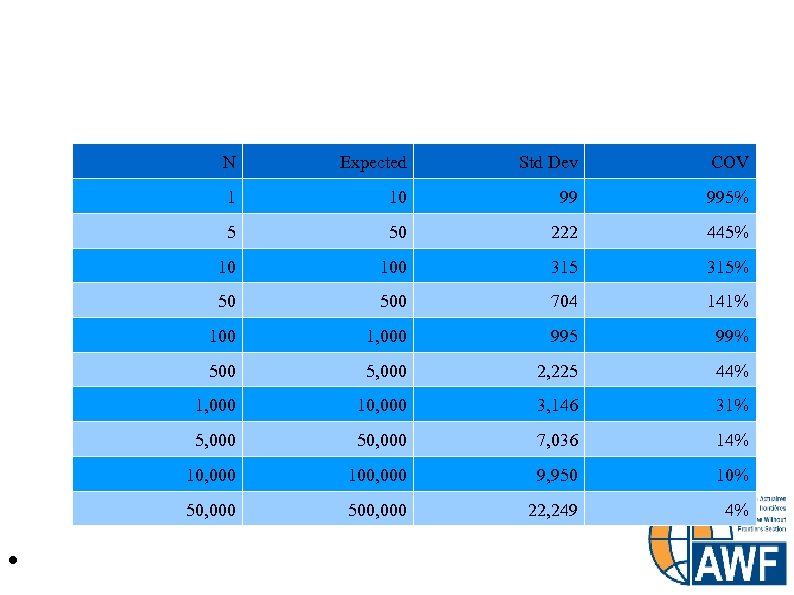 Independent Like Risks N COV 10 99 995% 5 50 222 445% 10 100 315% 50 500 704 141% 100 1, 000 995 99% 500 5, 000 2, 225 44% 1, 000 10, 000 3, 146 31% 5, 000 50, 000 7, 036 14% 10, 000 100, 000 9, 950 10% 50, 000 74 Std Dev 1 • Expected 500, 000 22, 249 4% q=. 01 C=1000
 Combining Unlike Risks • Dependent = Add Ranked Values • Fully independent = Square Root(A 2 + B 2) if both are Normally distributed 75
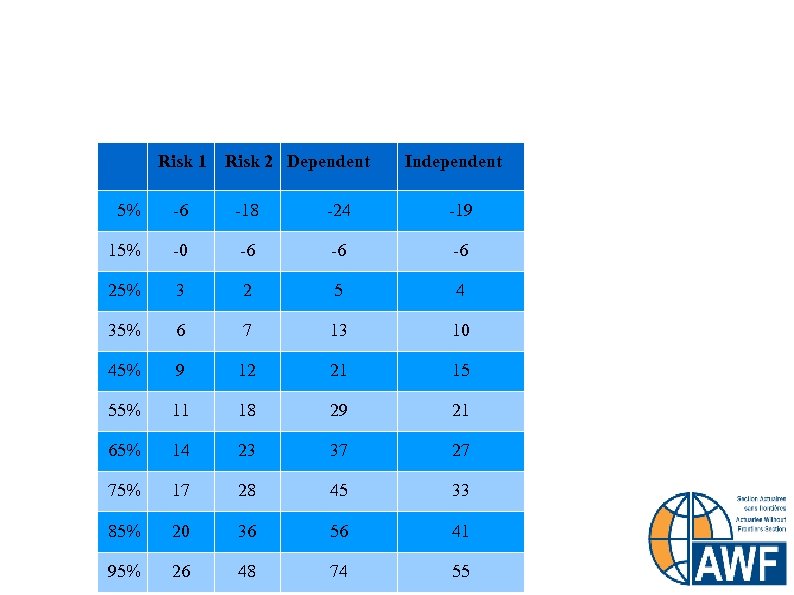 Unlike Risks Risk 1 Risk 2 Dependent Independent 5% -18 -24 -19 15% -0 -6 -6 -6 25% 3 2 5 4 35% 6 7 13 10 45% 9 12 21 15 55% 11 18 29 21 65% 14 23 37 27 75% 17 28 45 33 85% 76 -6 20 36 56 41 95% 26 48 74 55
 Correlation v. Dependencies • Correlation is a mathematical term – • Dependency is a statement about the fundamental relationship between things – • 77 Can calculate correlation between finger length and car ownership Net Wealth and Car ownership Correlations can be found for things with no conceivable dependency
 Copulas General Mathematical technique for combining two random variables that are partially dependent • Gaussian Copula • Non-Gaussian Copula – Some non-Gaussian Copulas will allow higher dependence in the tails of the distribution – Which is popular to more closely fit with reality 78
 3. 9 Risk Treatment Options – Avoid/Retain Operational Risks Holding Capital for Retained Risks 79
 Operational Risks • Usually a firm is not paid to take Operational Risks • So most firms will choose to avoid Operational Risks – – 80 If unavoidable, to minimize them Using cost benefit to choose how to lminimize
 Operational Risk Definition Identifying Risks Assessing Risks Risk Control Risk Transfer & Reduction Case Studies 81
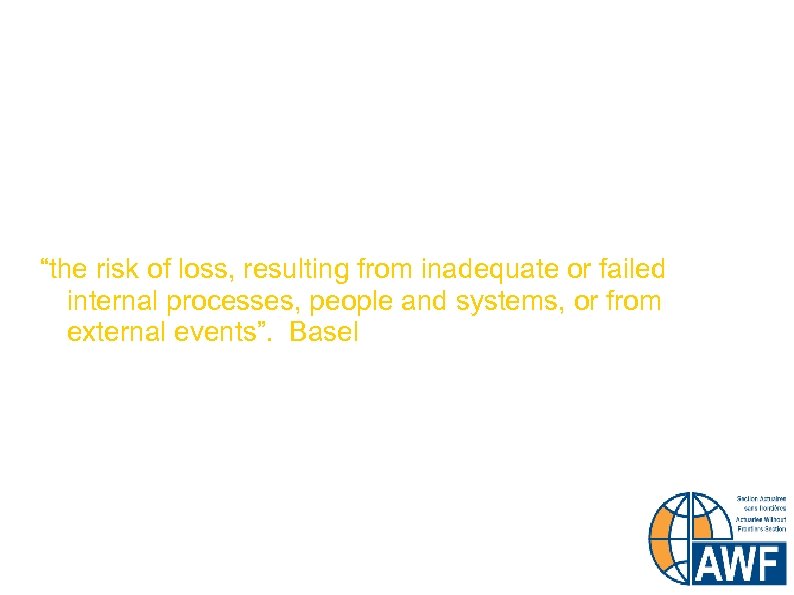 Operational Risk “the risk of loss, resulting from inadequate or failed internal processes, people and systems, or from external events”. Basel 82
 Operational Risks (a partial listing) • • • 83 Regulatory Changes Tax Changes Governance Problems Industry reputation Company reputation Information systems risks Legal risks Financial Reporting Risk Outsourcing • • • Inadequate Controls Process inefficiencies Business strategy risks Political risk Terrorism Natural Catastrophe Misselling Fraud Insourcing
 Operational Risk Measurement is not the most important aspect of operational risk management Operational Risk Management Process: Identify Risks Classify risks by frequency and severity Develop plans and strategies for controlling high frequency and high severity risks 84
 Risk Management Continuum (Harvard University) Proactive Management Anticipate Risks • Central Oversight / Assurance Active Management Timely Response • Governance / Compliance Standards • Understanding and Evaluation of Risks Reactive Crisis Management • Protection of Reputation • Decreased Crisis Response • Improved Services • Improved Work Place 85
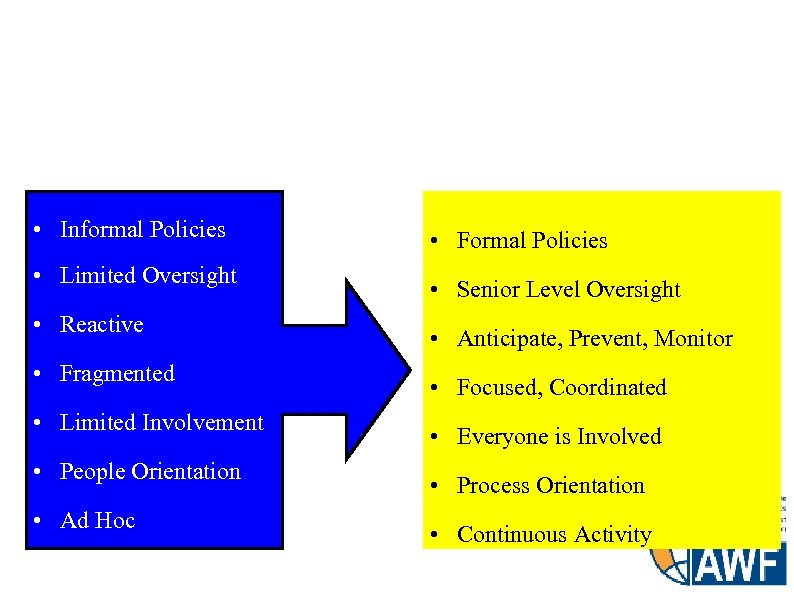 Compliance Paradigm Shift (Harvard University) From • Informal Policies • Limited Oversight • Reactive • Fragmented • Limited Involvement • People Orientation • Ad Hoc 86 To • Formal Policies • Senior Level Oversight • Anticipate, Prevent, Monitor • Focused, Coordinated • Everyone is Involved • Process Orientation • Continuous Activity
 Basel Prescribed Methodology Banks should implement a sound process to identify in a consistent manner over time the events used to set up a loss database and to be able to identify which historical loss experiences are appropriate for the institution and represent the current and future business activities. Banks should develop rigorous conditions under which internal data would be supplemented with external data, as well as the process of ensuring relevance of this data for their business environment. 87
 Operational Risk Tracking Need Standard List of Risks Need to Track Losses Exposures Process should be similar to mortality studies for Life Insurers 88
 Operational Risk Management Control Systems Internal audit Back-up and Redundancy Insurance Compliance monitoring Process improvement 89
 Categories of Operational Risk 1. Clients, Products & Business Practices 2. Fraud, Theft, Unauthorized Activity 3. Execution & Processing Errors 4. Employment & Safety 5. Physical Asset 90 à Suitability, breach of fiduciary duties, sales practices à Natural Disasters and human-instigated acts of damage à Unauthorized transactions, money laundering, fraud à Execution errors & systems failures à Wrongful dismissal, harassment, workers comp & related legal liability
 Case Study Misselling Risk Description Occurs during Sales Process Improper Illustrations Misrepresentation of Policy Provisions Misrepresentation of Company intentions regarding non-guaranteed elements Loss occurs when Incorrect expectations are not met by company policyholder obtains redress via regulator or courts 91
 Misselling Risk Assessment Isolated cases Frequency – Low to Medium Severity – Low to Very Low Systematic Misselling Frequency – based on economic & competitive conditions Severity – Very High 92
 Misselling Risk Management Options Transfer – Insurance Coverage? Offset – Not Applicable Manage - Controls Avoid – Improve Procedures 93
 Misselling Controls & Improved Procedures Culture Training Clear Marketing Materials, Illustrations & Contracts Supervision Monitoring In Depth Review Random Triggered Complaints 94 Turnover Spot Checking
 Case Study Equity Linked Product Execution Risk Description Occurs with client directed transactions processing lags corrected with backdating of transactions company has gain or loss with each backdated transaction Original thinking – gains & losses would cancel Actual findings – direction of client fund movement tends to create more losses than gains with extreme market movements volumes increase, delays increase and losses increase 95
 Equity Linked Product Execution Risk Assessment Frequency – Very High Severity – Low 96
 Equity Linked Product Execution Risk Management Options Transfer – Insurance, Hedging Offset – Possibly Manage – Controls Avoid – Improve Procedures 97
 Equity Linked Product Execution Insurance Option Insurer will require improvement in procedures & controls Hedging Option buy hedge contracts to offset losses from late processing may want to use if cost of improved processing & controls is very high 98
 Equity Linked Product Execution Controls & Improved Procedures Monitoring processing lag Set targets for max daily lag Review cases with longest lags Monitoring losses Review losses with supervisors Review Processes look for avoidable delays in processing enhance technology & training Special attention to larger transactions Develop standards for overtime vs. delays empower management to make decisions 99
 Risks to Avoid • Most firms will have certain risks that they will always AVOID • Important to explicitly document these – 100 Either in Standards or Limits
 Retained RIsks • Insurers and Banks are usually in the business of retaining some risks as their primary business • Important for each to appropriately provision for the risks that are retained • Reserves + Capital 101
 Total Asset Requirement (TAR) approach to provisioning • Risk area calculated the Total amount of assets needed to pay off risks with desired confidence interval (for example 99. 5% under Solvency 2) – This is TAR • Reserves are held for expected losses plus prudent margin (as required) • Capital requirement is then TAR - Reserves 102
 3. 10 Choosing a Primary Risk Metric Ruin v. Volatility Short Term v. Long Term Other Risk Aspects 103
 Ruin v. Volatility • Ruin = Large and usually unlikely loss potential – • 99. 5%tile loss – Solvency 2 Volatility = Fluctuations in earnings – – 104 Standard Deviation of distribution of probable earnings or 90%tile loss
 Ruin v. Volatility Reasons to Choose Ruin 105 Reasons to Choose Volatility
 Short Term v. Long Term • Short Term – • Long Term – – 106 1 year – Solvency 2 Multi Year Until finall run-off of liabilities - US
 Short Termv. Long Term Reasons to Choose ST 107 Reasons to Choose LT
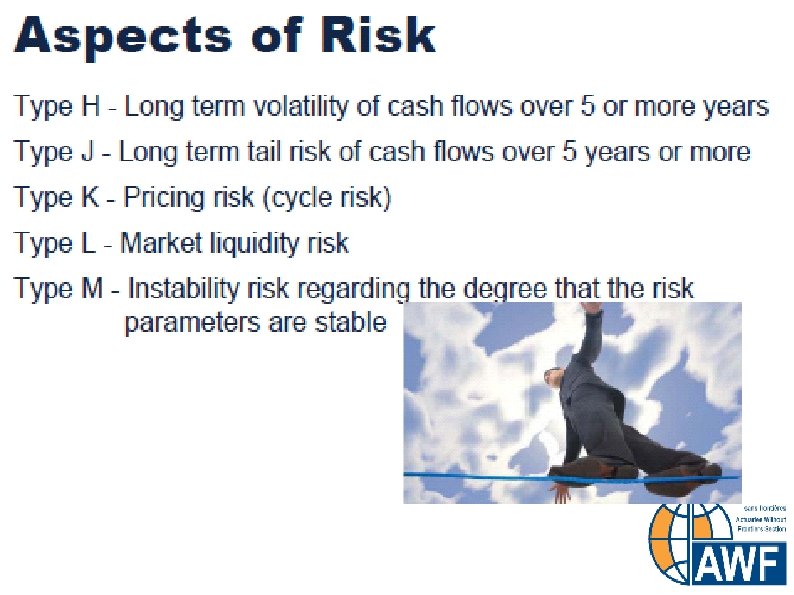
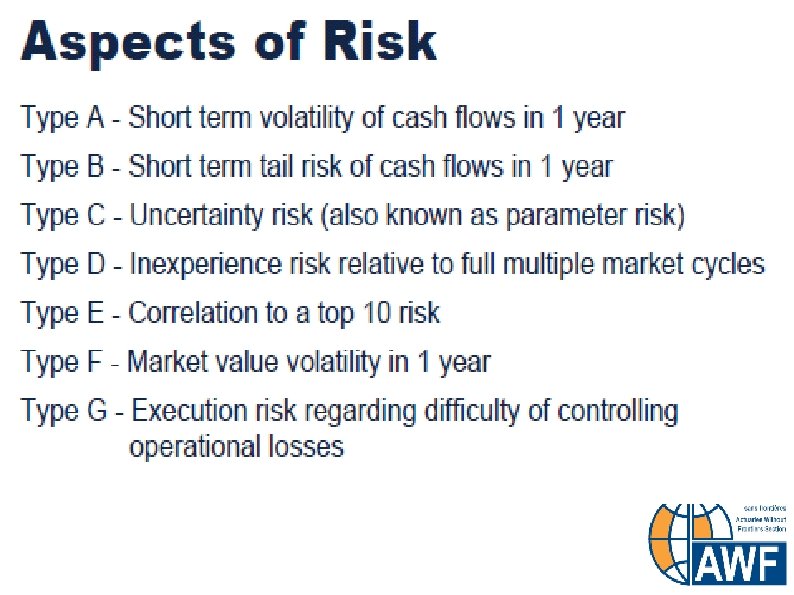 Other Aspects of Risk 108
 109
109
 3. 11 Uses of multiple Risk Models Risk & Light Full Risk Profile 110
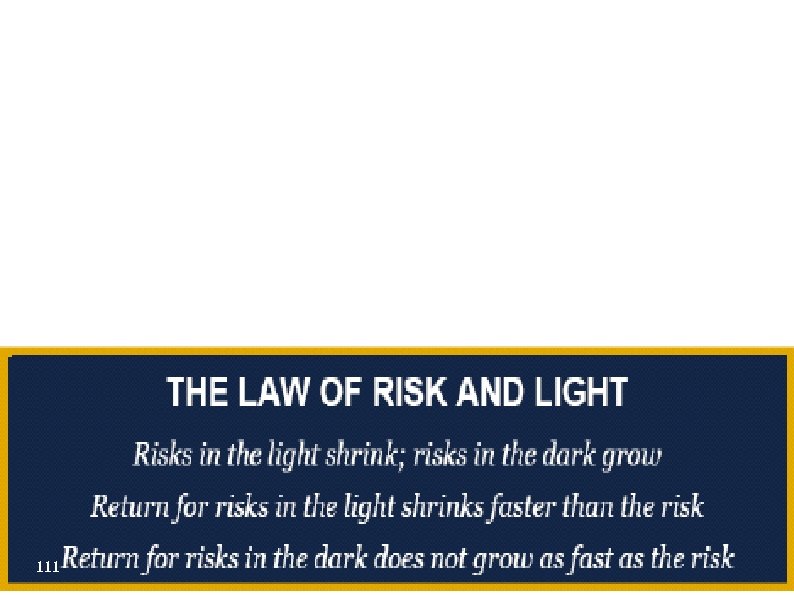 Law of Risk & Light There is a danger that whatever risks you ignore will accumulate in your firm. 111
 Full Risk Profile is your distribution of Risks A) By Risk Type B) By Business Area C) By Region D) With Other important risk aspects 112
 Other Risk Aspects • Can determine Risk Profile by Measurement • Or by Queary – Ask Underwriter to note whether each case has • 113 High, Medium, Low data integrity risk
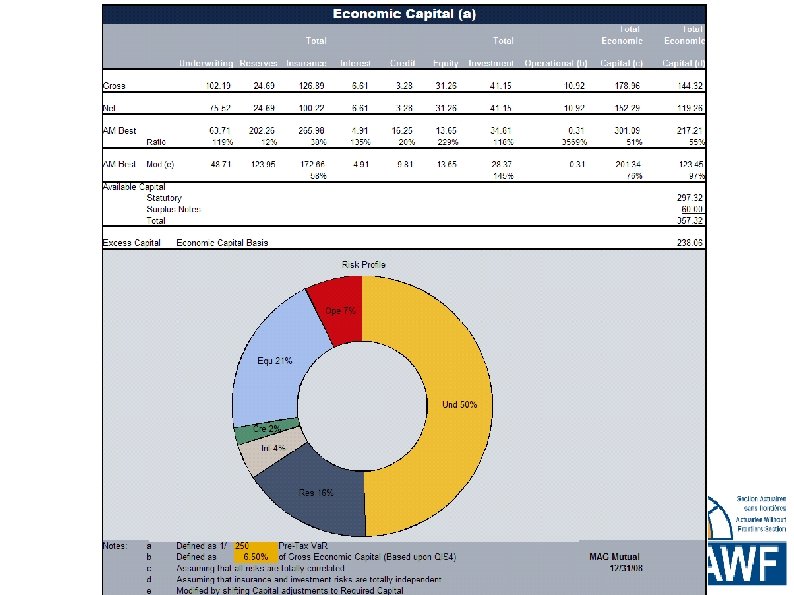
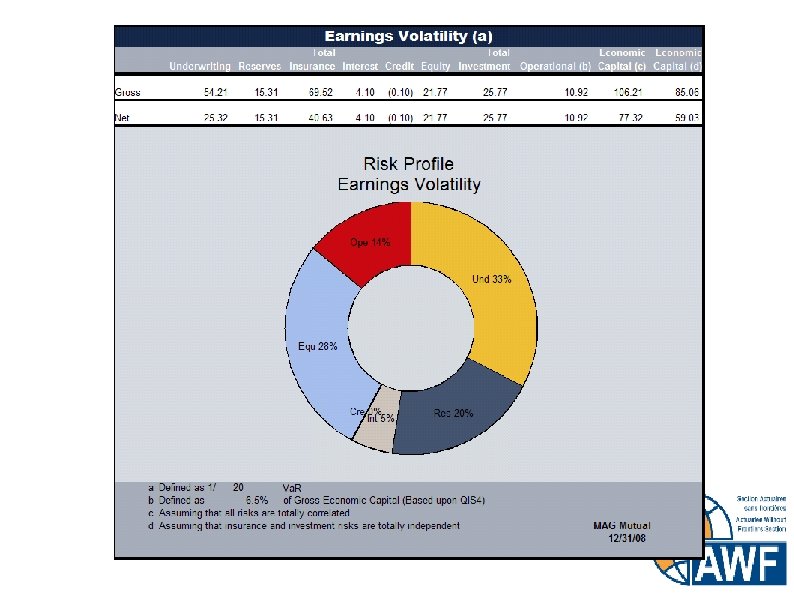
 3. 12 Using Economic Capital for ERM Loss Controlling • EC Provides common metric for exposures & Limits Risk Trading • EC Provides common standard for risk margins Risk Steering • 114 EC provides common metric for macro risk reward
 115
115
 116
116
 3. 13 Capital Management & Allocation Risk Steering • Overall Capital Target • Capital Allocation (retrospective) • Capital Budgeting Process (prospective) 117
 Capital Target Base Target plus Security 118
 Base Target DIRECT REFERENCE TO RATING AGENCY Target the level of capital that supports the desired rating according to the exact rating agency capital model. Advantages • Rating agency model widely used / thoroughly vetted • Offers greater certainty on capital portion of the rating Disadvantages • Uses broad industry average risk factors • Inaccurate unless firm replicates industry average risk per exposure • Actual capital held by similar firms with target rating may vary from Rating Agency guidelines; adjustments reduce this to a modified peer comparison method 119
 Base Target INDIRECT REFERENCE TO RATING AGENCY Using an internal company risk model, target Economic Capital level at an exceedence probability consistent with default rate for desired rating. Advantages • Reflects management knowledge of the risks of the firm • At least one rating agency (S&P) has stated that it will eventually incorporate internal capital models into ratings decisions Disadvantages • Effort of developing a full internal risk model • Work required to validate the model to the satisfaction of both internal and external users • Probabilities related to A and AA rating levels are extremely low (0. 02% and 0. 008% per one Moody's study); in almost no case is there enough data to reliably calibrate a model to those probability levels 120
 BUFFER CAPITAL There are often dire circumstances associated with failure to maintain minimum rating agency capital; therefore, most firms establish a safety buffer. At one extreme is a firm that plans to maintain its rating through a 1 -in-500 -year catastrophe loss scenario (99. 8 th percentile). In contrast, another firm believes it will be possible to access the capital markets about once every five years to replenish capital after moderate losses, and therefore sets a buffer at the 80 th percentile loss. Most firms, whether they directly calculate a buffer or not, fall somewhere in the 1 -in-10 to 1 -in-20 range (90 th to 95 th percentile). 121
 Capital Economic Risk Capital Amount needed to support particular probability of loss event over a time period i. e. 95% probability of maintaining solvency over 5 years Face Capital Additional amount needed to satisfy regulators, rating agencies, board and stock analysts Free Capital Actual capital in excess of above 122
 Reasons for Allocating Capital Pricing Reflecting cost of capital in premiums, expense charges and interest rates Financial Reporting Determining ROE (RAROC) Capital Budgeting Determining who gets the scarce resource 123
 Allocating Risk Capital Total Firm Risk Capital is usually less than total risk capital for each unit Diversification Benefit Correlation Benefit How can the overlap be allocated? 124
 Allocating Risk Capital First, calculate Risk Capital for each unit separately Three general methods for allocating overlap: Proportionate Marginal Corporate 125
 Proportionate Allocation Multiply each unit’s separate Risk Capital Calculation by ratio of overlap to sum of separate risk capital calculations 126
 Marginal Allocation Order of calculation is key “Base” Unit gets overlap “Other” Units get overlap Marginal Factors by risk category 127
 Corporate Each unit holds full separate Risk Capital Corporate unit “holds” the overlap (Could be coordinated with Face Capital and Free Capital) 128
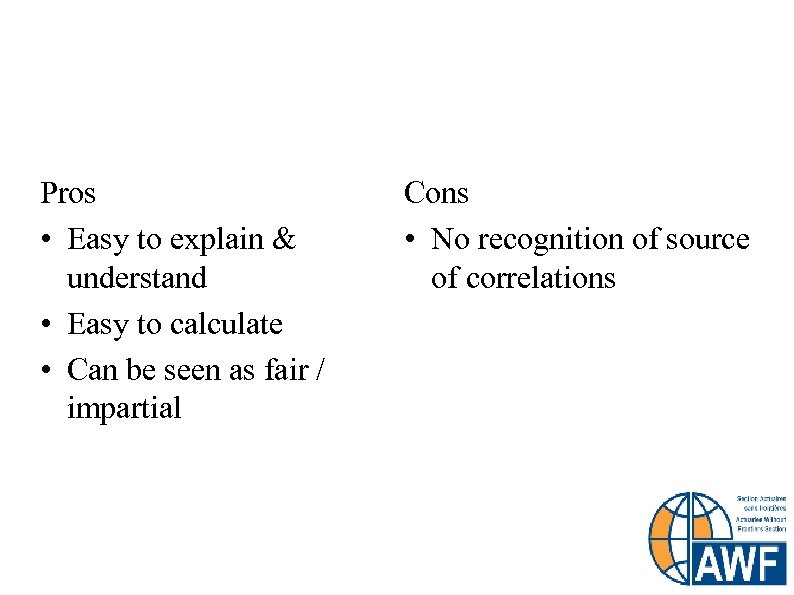 Proportionate Allocation Pros • Easy to explain & understand • Easy to calculate • Can be seen as fair / impartial 129 Cons • No recognition of source of correlations
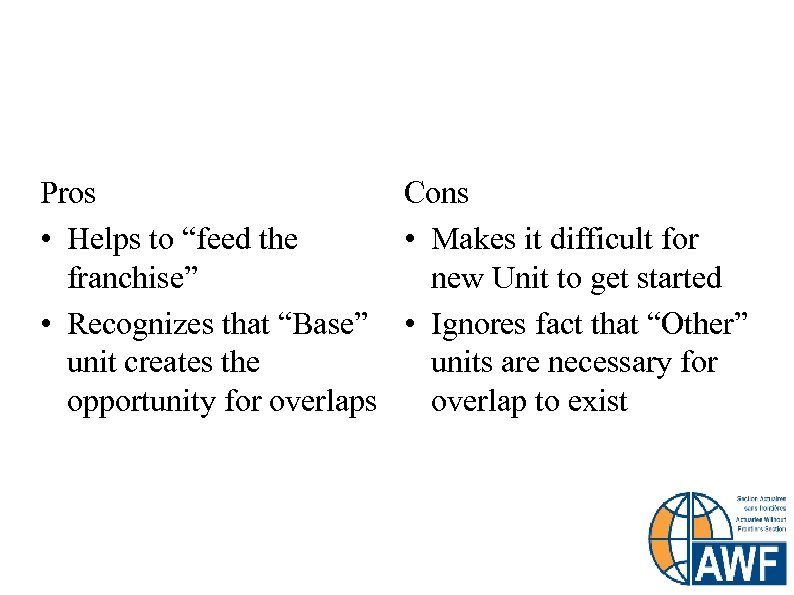 Marginal Allocation “Base” Unit gets overlap Pros Cons • Helps to “feed the • Makes it difficult for franchise” new Unit to get started • Recognizes that “Base” • Ignores fact that “Other” unit creates the units are necessary for opportunity for overlaps overlap to exist 130
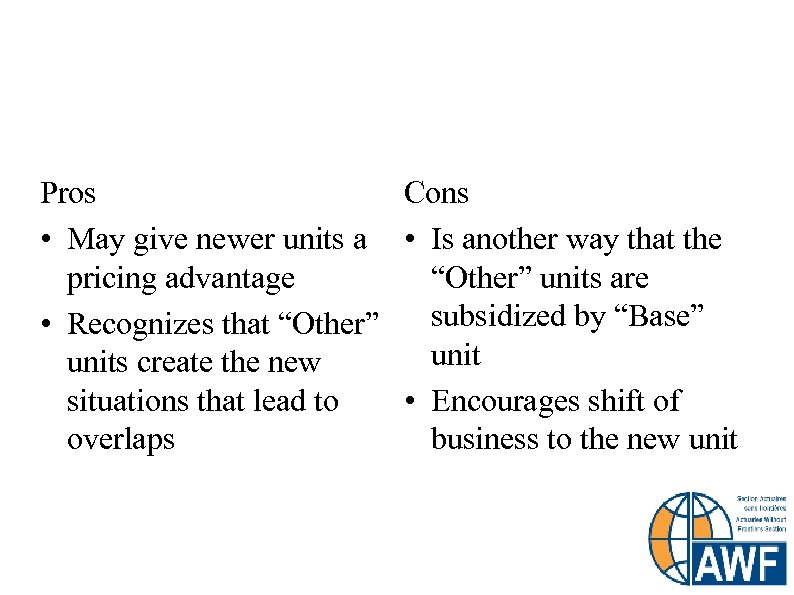 Marginal Allocation “Other” Units get overlap Pros Cons • May give newer units a • Is another way that the pricing advantage “Other” units are subsidized by “Base” • Recognizes that “Other” units create the new situations that lead to • Encourages shift of overlaps business to the new unit 131
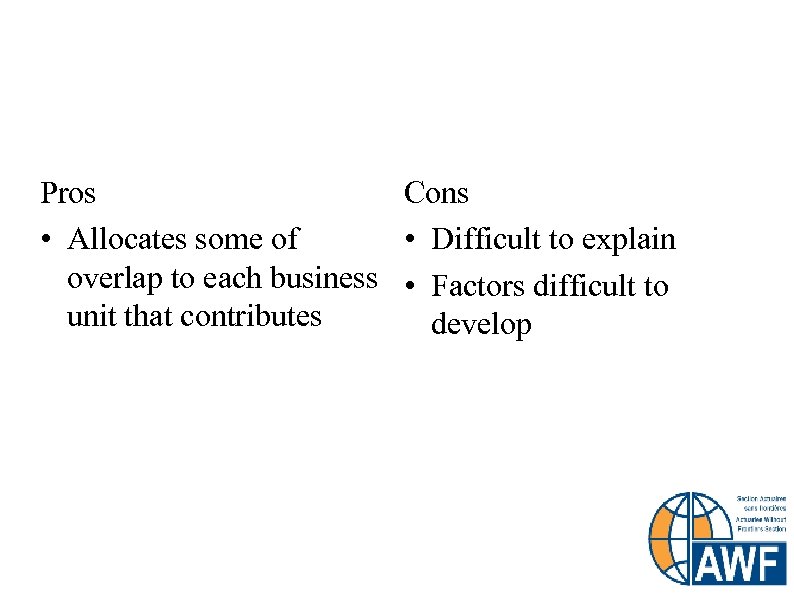 Marginal Allocation Marginal Factors by Risk Pros Cons • Allocates some of • Difficult to explain overlap to each business • Factors difficult to unit that contributes develop 132
 Face Capital Allocation Methods of Allocations Offset against “Overlap” and use overlap allocation techniques Corporate keeps Face Capital 133
 Free Capital Retained Earnings approach Units keep what they earn regardless of short term needs usually a long term expectation of need Sometimes followed by international firms where moving capital is difficult Profits Released approach all free capital flows to corporate for reallocation 134
 Investing Capital Many firms let unit management determine investment strategy for assets backing capital Firm can use investment strategy as a major Risk Management tool Can be especially effective if all capital is used may want to use a “transfer pricing” approach to allocate investment results back to units 135
 136
136