


 Скачать презентацию Enterprise Resource Planning Systems ERP Systems 1 1
56eda5a8a36862c87e739b5beb758bfe.ppt
- Количество слайдов: 55
 Enterprise Resource Planning Systems ERP Systems 1. 1
 Enterprise Resource Planning Systems Instructor: Muhammad Asjad Saleem Contact: Phone: (051) 9047 589 E-mail: muhammad. asjad@uettaxila. edu. pk Text: Laudon and Laudon, Essentials of Management Information Systems - Managing the Digital Firm, 8 th Edition. 1. 2
 Enterprise Resource Planning Systems • Information System: Interrelated components working together to collect, process, store and disseminate information to support decision making, coordination, control, analysis, and visualization in any organization. e. g. Management Information System (MIS): The study of information systems focusing on their use in business and management. e. g. Enterprise Resource Planning System (ERPS): 1. 3
 Enterprise Resource Planning Systems • Enterprise resource planning (ERP) System: Enterprise resource planning (ERP) is the industry term used to describe a broad set of activities supported by multi-module application software that helps a manufacturer or other business manage the important parts of its business. These parts can include product planning, parts purchasing, maintaining inventories, interacting with suppliers, providing customer service, and tracking orders. ERP can also include application modules for the finance and human resources aspects of a business. • Some of the bigger players in the ERP outsourcing market are SAP, Peoplesoft, and J. D. Edwards. New comers include Oracle, IBM, and Microsoft. 1. 4
 Enterprise Resource Planning Systems • The growth of the internet, the globalization of trade, and the rise of information economies have recast the role of information systems (IS) in business and management. • Internet technology is supplying the foundation for new business models, new business processes, and new ways of distributing knowledge. 1. 5 • Companies are using internet technology to drive their businesses. Companies are relying on internet and networking technology to conduct more of their work electronically, seamlessly linking factories, offices, and sales forces around the globe.
 Enterprise Resource Planning Systems • Leading-edge firms, such as Cisco Systems, Dell Computers, and Procter & Gamble, are extending these networks to suppliers, customers, and other groups outside the organization so they can react instantly to customer demands and market shifts. • Cisco Systems corporate managers can use IS to generate financial statements based on up-to-the –minute figures on orders, discounts, revenue, product margins, and staffing expenses. 1. 6 • Executives can constantly analyze performance at all levels of the organization. This digital integration is changing how we organize and manage a business firm.
 Enterprise Resource Planning Systems • Ultimately, these changes are leading to fully digital firms where all internal business processes and relationships with customers and suppliers are digitally enabled. • In digital firms, information to support business decisions is available any time and anywhere in the organization. 1. 7
 Enterprise Resource Planning Systems MANAGING THE DIGITAL FIRM 1. 8
 Enterprise Resource Planning Systems OBJECTIVES • What is the role of information systems in today’s competitive business environment? • What exactly is an information system? What do managers need to know about information systems? • How are information systems transforming organizations and management? 1. 9
 Management Information Systems 8/e Chapter 1 Managing the Digital Firm Enterprise Resource Planning Systems OBJECTIVES • How has the Internet and Internet technology transformed business? • What are the major management challenges to building and using information systems? 1. 10
 Enterprise Resource Planning Systems MANAGEMENT CHALLENGES 1. Design competitive and effective systems 2. Understand system requirements of global business environment 3. Create information architecture that supports organization’s goal 1. 11
 Enterprise Resource Planning Systems MANAGEMENT CHALLENGES 4. Determine business value of information systems 5. Design systems people can control, understand use in a socially, ethically responsible manner 1. 12
 Enterprise Resource Planning Systems WHY INFORMATION SYSTEMS? The Competitive Business Environment and the Emerging Digital Firm Four powerful worldwide changes that have altered the business environment: 1. 2. 3. 4. 1. 13 Emergence of the Global Economy Transformation of Industrial Economies Transformation of the Business Enterprise The Emerging Digital Firm
 Enterprise Resource Planning Systems WHY INFORMATION SYSTEMS? The Competitive Business Environment and the Emerging Digital Firm Emergence of the Global Economy • • 1. 14 Management and control in a global marketplace Competition in world markets Global work groups Global delivery systems
 Enterprise Resource Planning Systems WHY INFORMATION SYSTEMS? The Competitive Business Environment and the Emerging Digital Firm Transformation of Industrial Economies • • Productivity • New products and services • 1. 15 Knowledge- and information-based economies Knowledge: a central productive and strategic asset
 Enterprise Resource Planning Systems WHY INFORMATION SYSTEMS? The Competitive Business Environment and the Emerging Digital Firm Transformation of Industrial Economies • • Shorter product life • Turbulent environment • 1. 16 Time-based competition Limited employee knowledge base
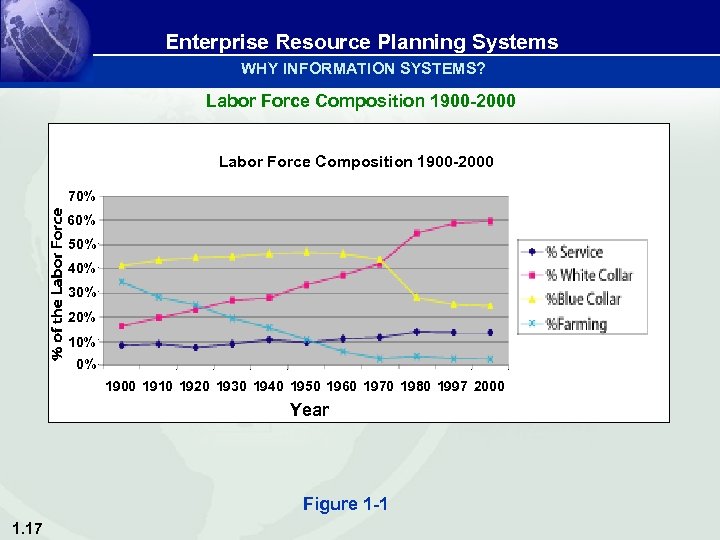 Enterprise Resource Planning Systems WHY INFORMATION SYSTEMS? Labor Force Composition 1900 -2000 70% 60% 50% 40% 30% 20% 10% 0% 1900 1910 1920 1930 1940 1950 1960 1970 1980 1997 2000 Year Figure 1 -1 1. 17
 Enterprise Resource Planning Systems WHY INFORMATION SYSTEMS? The Competitive Business Environment and the Emerging Digital Firm Transformation of the Business Enterprise • • 1. 18 Flattening Decentralization Flexibility Location independence Low transaction and coordination costs Empowerment Collaborative work and teamwork
 Enterprise Resource Planning Systems WHY INFORMATION SYSTEMS? The Competitive Business Environment and the Emerging Digital Firm Emergence of the Digital Firm • • 1. 19 Digitally-enabled relationships with customers, suppliers, and employees Core business processes accomplished via digital networks Digital management of key corporate assets Rapid sensing and responding to environmental changes
 Enterprise Resource Planning Systems WHY INFORMATION SYSTEMS? The Competitive Business Environment and the Emerging Digital Firm 4 Major Systems Defining the Digital Firm • Supply chain management systems • Customer relationship management systems • Enterprise systems • Knowledge management systems 1. 20
 Enterprise Resource Planning Systems WHY INFORMATION SYSTEMS? What Is an Information System? A set of interrelated components that collect (or retrieve), process, store, and distribute information to support decision making and control in an organization -IS operate on information about significant people, places, and things within the org or in the environment surrounding it. 1. 21
 Enterprise Resource Planning Systems WHY INFORMATION SYSTEMS? What Is an Information System? • Data: Streams of raw facts representing events such as business transactions • Information: Clusters of facts that are meaningful and useful to human beings in the processes such as making decisions 1. 22
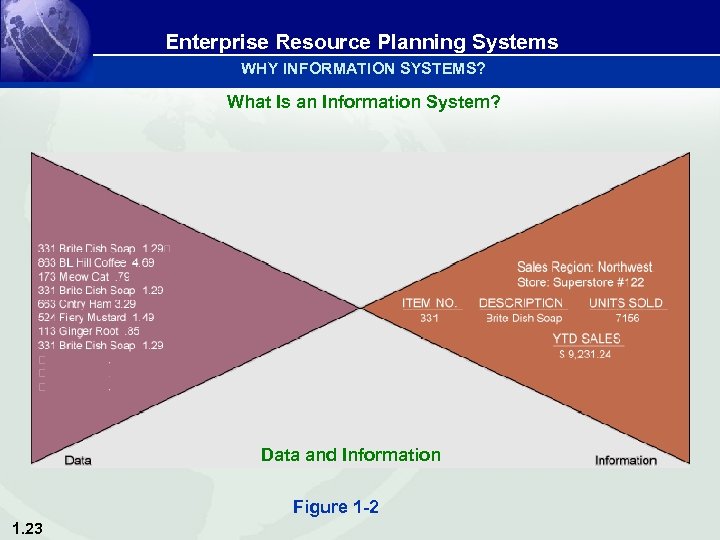 Enterprise Resource Planning Systems WHY INFORMATION SYSTEMS? What Is an Information System? Data and Information Figure 1 -2 1. 23
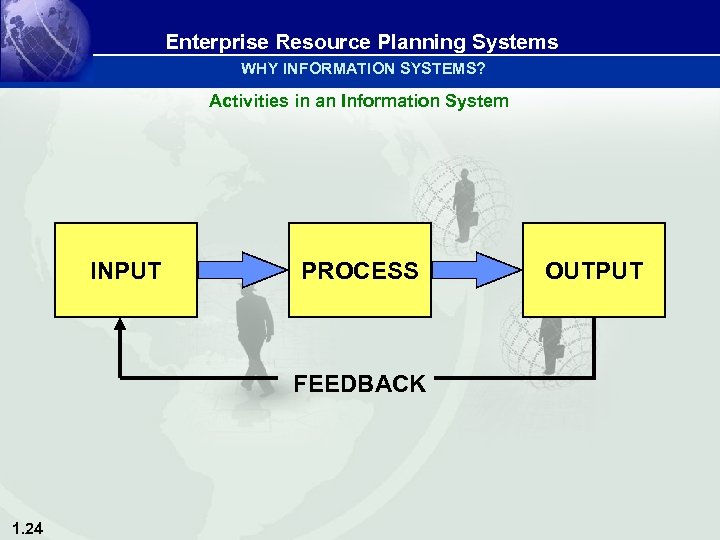 Enterprise Resource Planning Systems WHY INFORMATION SYSTEMS? Activities in an Information System INPUT PROCESS FEEDBACK 1. 24 OUTPUT
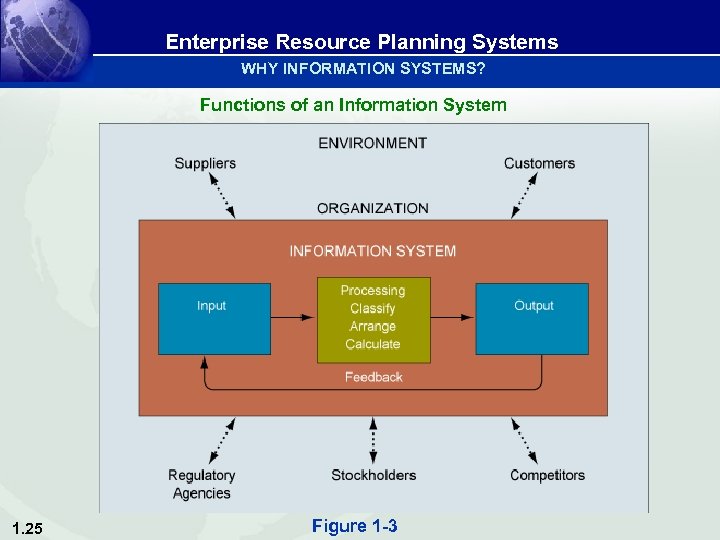 Enterprise Resource Planning Systems WHY INFORMATION SYSTEMS? Functions of an Information System 1. 25 Figure 1 -3
 Enterprise Resource Planning Systems WHY INFORMATION SYSTEMS? • Our interest will remain limited to formal, organizational computerbased information systems (CBIS) 1. 26
 Enterprise Resource Planning Systems WHY INFORMATION SYSTEMS? Computer-Based Information System (CBIS) • Rely on computer hardware and software • Processing and disseminating information 1. 27
 Enterprise Resource Planning Systems WHY INFORMATION SYSTEMS? Formal Systems • Fixed definitions of data, procedures • Collecting, storing, processing, disseminating, using data • May be computer-based or manual 1. 28
 Enterprise Resource Planning Systems WHY INFORMATION SYSTEMS? A Business Perspective on Information Systems • An organizational and management solution based on information technology to a challenge posed by the environment • An important instrument for creating value for the organization • Stages in the business information value chain add value to information 1. 29
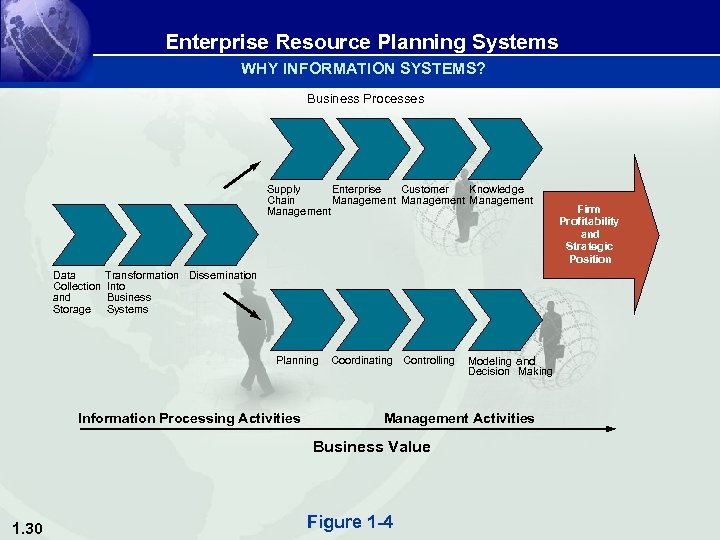 Enterprise Resource Planning Systems WHY INFORMATION SYSTEMS? Business Processes Supply Enterprise Customer Knowledge Chain Management Data Collection and Storage Transformation Dissemination Into Business Systems Planning Information Processing Activities Coordinating Controlling Management Activities Business Value 1. 30 Modeling and Decision Making Figure 1 -4 Firm Profitability and Strategic Position
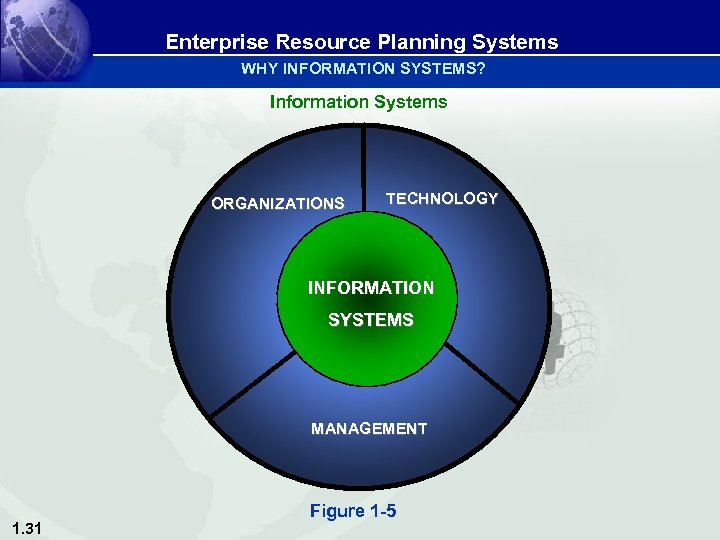 Enterprise Resource Planning Systems WHY INFORMATION SYSTEMS? Information Systems ORGANIZATIONS TECHNOLOGY INFORMATION SYSTEMS MANAGEMENT 1. 31 Figure 1 -5
 Enterprise Resource Planning Systems WHY INFORMATION SYSTEMS? A Business Perspective on Information Systems • Information systems literacy: Broad- based understanding of information systems that includes behavioral knowledge about organizations and individuals using information systems and technical knowledge about computers. • Computer literacy: Knowledge about information technology, focusing on understanding how computer-based technologies work 1. 32
 Enterprise Resource Planning Systems WHY INFORMATION SYSTEMS? Major Business Functions • Sales and marketing • Manufacturing and production • Finance • Accounting • Human resources 1. 33
 Enterprise Resource Planning Systems WHY INFORMATION SYSTEMS? Major Business Functions • • • Sales and marketing Manufacturing and production Finance: Managing the org’s financial assets (cash, stocks, bonds, etc. ) • Accounting: Maintaining the org’s financial records (receipts, disbursements, paychecks, etc. ) • Human resources: Attracting, developing, and maintaining the org’s labor force; maintaining employee records. 1. 34
 Enterprise Resource Planning Systems WHY INFORMATION SYSTEMS? Organizations Key Elements: • People: Managers, knowledge workers, data workers, production or service workers • Structure: Organization chart , groups of specialists, products, geography 1. 35
 Enterprise Resource Planning Systems WHY INFORMATION SYSTEMS? Organizations • Operating procedures: Standard operating procedures (SOP, rules for action) • Politics: Different levels and specialties in an org create different interests and viewpoints. These views often conflict. Conflict is the basis for org politics. • Culture: Each org has a unique culture, or fundamental set of assumptions, values, and ways of doing things, that has been accepted by most of its members. 1. 36
 Enterprise Resource Planning Systems WHY INFORMATION SYSTEMS? Management Levels: • Senior managers: make long-range strategic decisions about products and services – people occupying the top most hierarchy in an org. • Middle managers: Carry out the programs and plans of senior management- middle of org hierarchy. • Operational managers: monitor the firm’s daily activities. 1. 37
 Enterprise Resource Planning Systems WHY INFORMATION SYSTEMS? Computer Technology Tools managers use to cope with change • Hardware: Physical equipment • Software: Detailed preprogrammed instructions • Storage: Physical media for storing data and the software 1. 38
 Enterprise Resource Planning Systems WHY INFORMATION SYSTEMS? Computer Technology • Communications Technology: transfers data from one physical location to another • Networks: link computers to share data or resources 1. 39
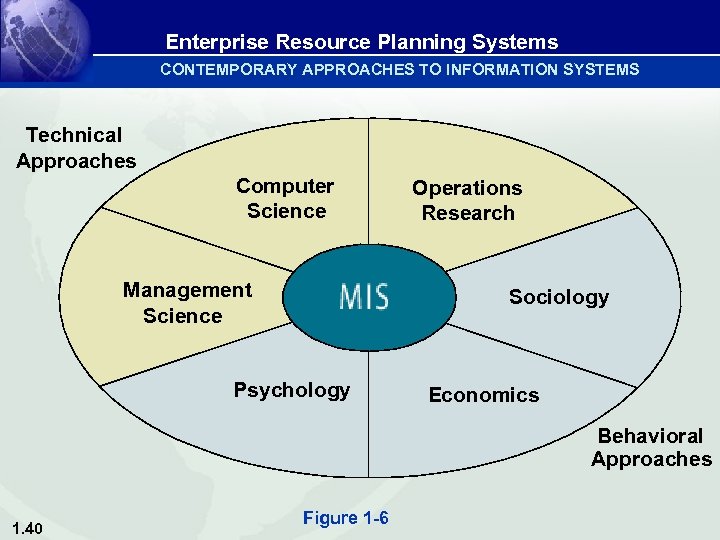 Enterprise Resource Planning Systems CONTEMPORARY APPROACHES TO INFORMATION SYSTEMS Technical Approaches Computer Science Management Science Operations Research Sociology Psychology Economics Behavioral Approaches 1. 40 Figure 1 -6
 Enterprise Resource Planning Systems CONTEMPORARY APPROACHES TO INFORMATION SYSTEMS Socio-Technical Systems Optimize systems performance: • Technology and organization • Organizations mutually adjust to one another until fit is satisfactory 1. 41
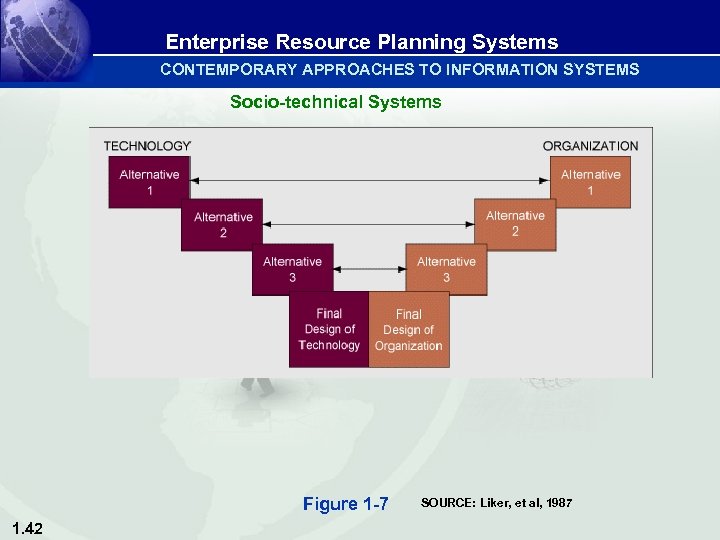 Enterprise Resource Planning Systems CONTEMPORARY APPROACHES TO INFORMATION SYSTEMS Socio-technical Systems Figure 1 -7 1. 42 SOURCE: Liker, et al, 1987
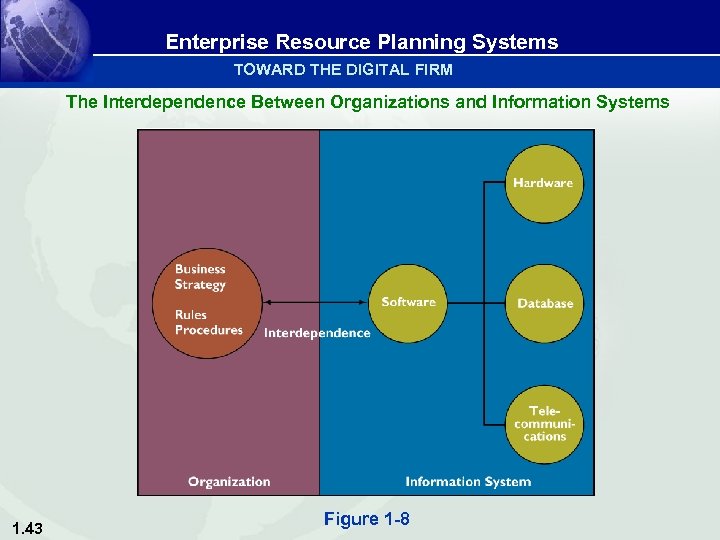 Enterprise Resource Planning Systems TOWARD THE DIGITAL FIRM The Interdependence Between Organizations and Information Systems 1. 43 Figure 1 -8
 Enterprise Resource Planning Systems TOWARD THE DIGITAL FIRM The Widening Scope of Information Systems • 1950 s: Technical changes • 1960 s-70 s: Managerial controls • 1980 s-90 s: Institutional core activities • Today: Digital information webs extending beyond the enterprise 1. 44
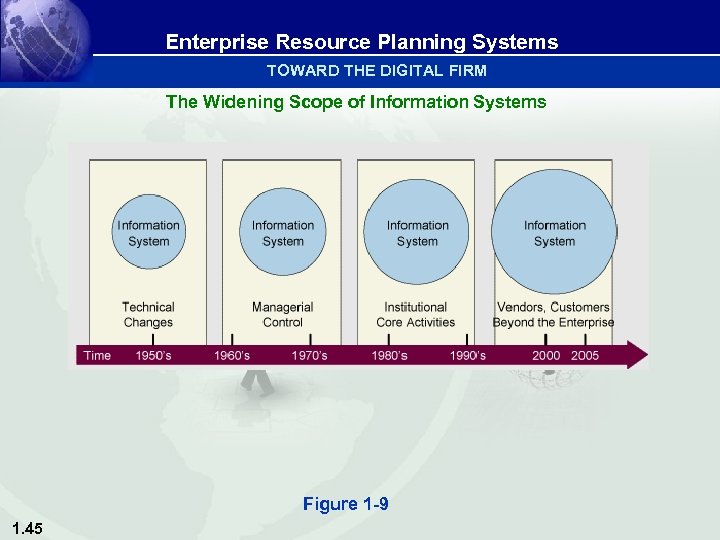 Enterprise Resource Planning Systems TOWARD THE DIGITAL FIRM The Widening Scope of Information Systems Figure 1 -9 1. 45
 Enterprise Resource Planning Systems TOWARD THE DIGITAL FIRM The Internet • International network of networks • Universal technology platform: Any computer can communicate with any other computer • World Wide Web and Web sites 1. 46
 Enterprise Resource Planning Systems TOWARD THE DIGITAL FIRM What You Can Do on the Internet? • Communicate and collaborate • Access information • Participate in discussions • Supply information • Find entertainment • Exchange business transactions 1. 47
 Enterprise Resource Planning Systems TOWARD THE DIGITAL FIRM New Options for Organizational Design • Flattening organizations • Separating work from location • Reorganizing work-flows • Increasing flexibility • Redefining organizational boundaries 1. 48
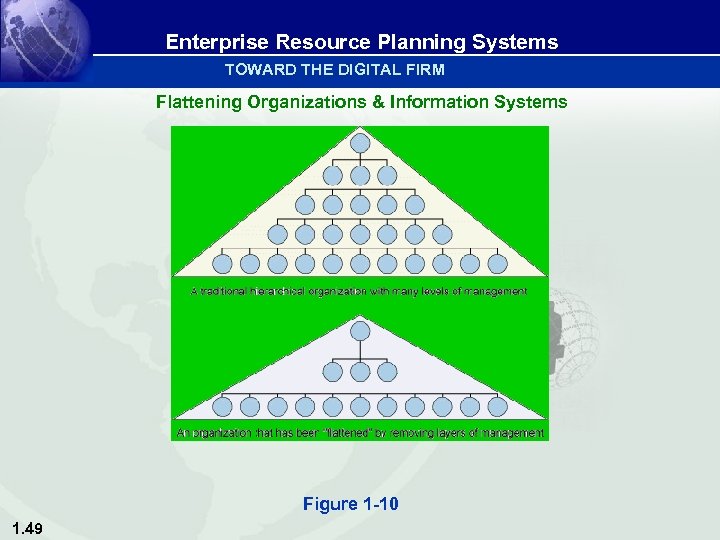 Enterprise Resource Planning Systems TOWARD THE DIGITAL FIRM Flattening Organizations & Information Systems Figure 1 -10 1. 49
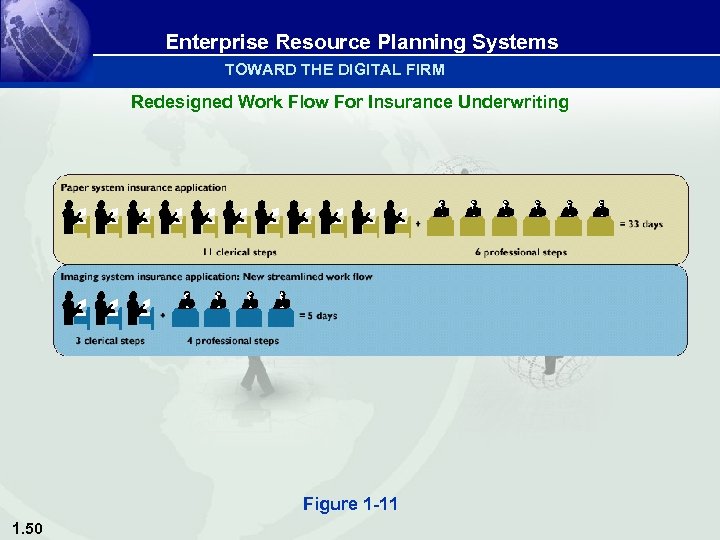 Enterprise Resource Planning Systems TOWARD THE DIGITAL FIRM Redesigned Work Flow For Insurance Underwriting Figure 1 -11 1. 50
 Enterprise Resource Planning Systems TOWARD THE DIGITAL FIRM The Digital Firm • Electronic commerce • Electronic business • Digital market: Information systems links, buyers and sellers to exchange information, products, services, payments 1. 51
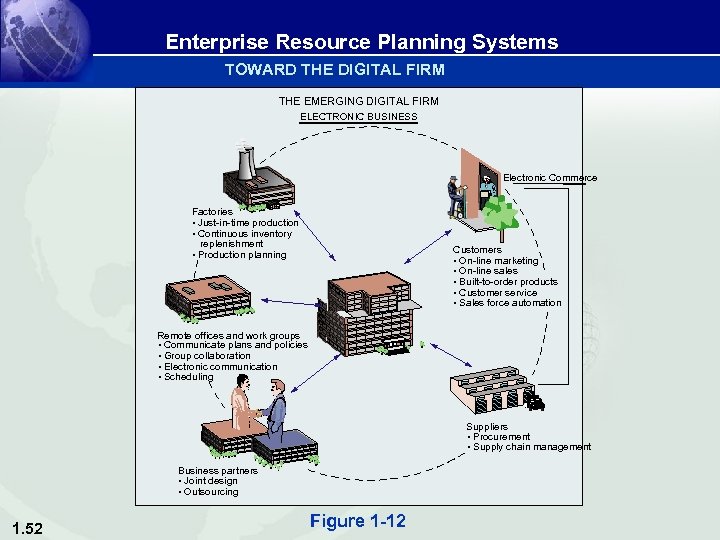 Enterprise Resource Planning Systems TOWARD THE DIGITAL FIRM THE EMERGING DIGITAL FIRM ELECTRONIC BUSINESS Electronic Commerce Factories • Just-in-time production • Continuous inventory replenishment • Production planning Customers • On-line marketing • On-line sales • Built-to-order products • Customer service • Sales force automation Remote offices and work groups • Communicate plans and policies • Group collaboration • Electronic communication • Scheduling Suppliers • Procurement • Supply chain management Business partners • Joint design • Outsourcing 1. 52 Figure 1 -12
 Enterprise Resource Planning Systems TOWARD THE DIGITAL FIRM Electronic Commerce • Internet links buyers, sellers • Lower transaction costs • Goods and services advertised, bought, exchanged worldwide • Business-to-business transactions increasing 1. 53
 Enterprise Resource Planning Systems TOWARD THE DIGITAL FIRM Electronic Business • Electronic Business: Executing all the firm’s business processes with Internet technology • Intranet: Business builds private, secure network based on Internet technology • Extranet: Extension of intranet to authorized external users 1. 54
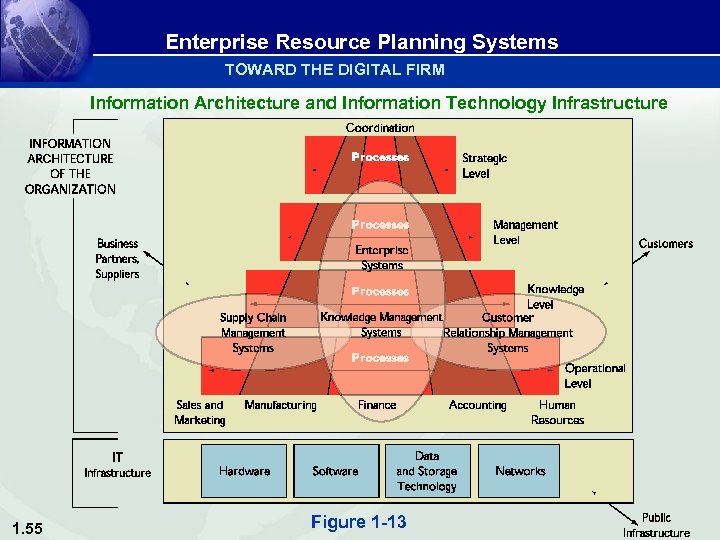 Enterprise Resource Planning Systems TOWARD THE DIGITAL FIRM Information Architecture and Information Technology Infrastructure 1. 55 Figure 1 -13