


 Скачать презентацию Enterprise IT Automation Technologies Dejan Milojicic dejan hpl hp
68e888a01be4e8e77a3da9710763b731.ppt
- Количество слайдов: 20
 Enterprise IT Automation Technologies Dejan Milojicic, dejan@hpl. hp. com HP Laboratories GGF 16, Athens, Greece, February 2006 © 2004 Hewlett-Packard Development Company, L. P. The information contained herein is subject to change without notice
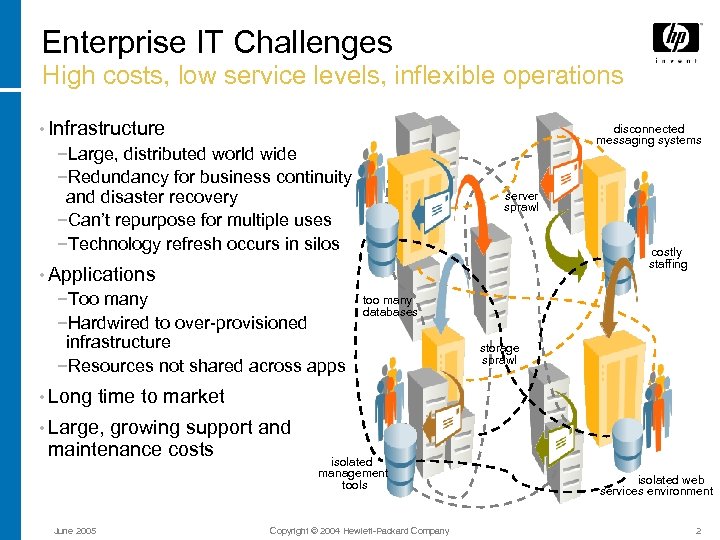 Enterprise IT Challenges High costs, low service levels, inflexible operations • Infrastructure disconnected messaging systems −Large, distributed world wide −Redundancy for business continuity and disaster recovery −Can’t repurpose for multiple uses −Technology refresh occurs in silos server sprawl costly staffing • Applications −Too many −Hardwired to over-provisioned infrastructure −Resources not shared across apps • Long too many databases storage sprawl time to market • Large, growing support and maintenance costs June 2005 isolated management tools Copyright © 2004 Hewlett-Packard Company isolated web services environment 2
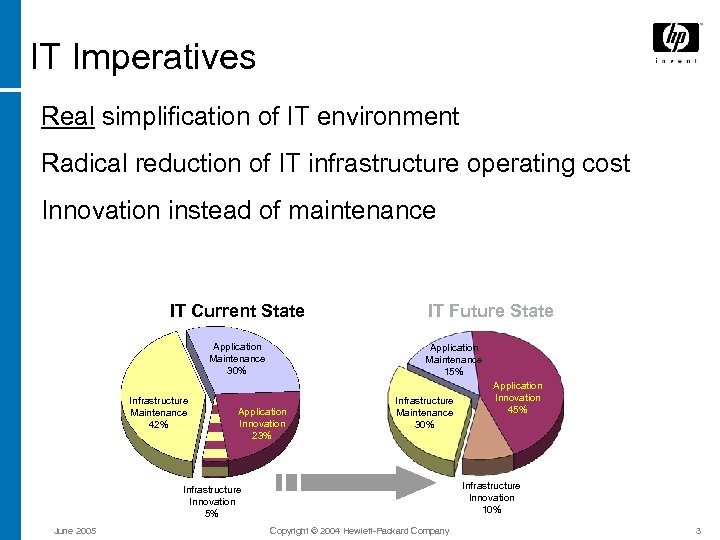 IT Imperatives • Real simplification of IT environment • Radical reduction of IT infrastructure operating cost • Innovation instead of maintenance IT Current State Application Maintenance 30% Infrastructure Maintenance 42% IT Future State Application Maintenance 15% Application Innovation 23% Infrastructure Maintenance 30% Infrastructure Innovation 10% Infrastructure Innovation 5% June 2005 Application Innovation 45% Copyright © 2004 Hewlett-Packard Company 3
 Outline of the Talk • Horizontal Technologies − Adaptive Monitoring − Statistical Learning and Inference Control − Quartermaster (provisioning, capacity mgmt) • Relationship to Grids and GGF • Summary June 2005 Copyright © 2004 Hewlett-Packard Company 4
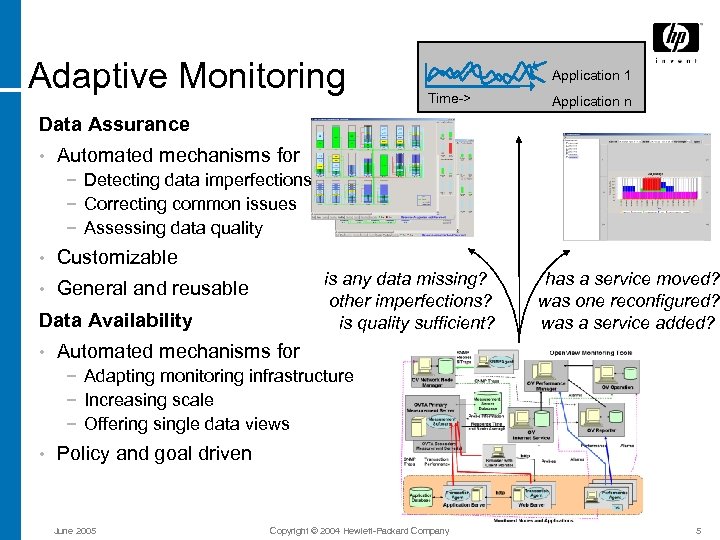 Adaptive Monitoring Application 1 Time-> Application n Data Assurance • Automated mechanisms for − Detecting data imperfections − Correcting common issues − Assessing data quality • Customizable • General and reusable is any data missing? other imperfections? is quality sufficient? Data Availability • has a service moved? was one reconfigured? was a service added? Automated mechanisms for − Adapting monitoring infrastructure − Increasing scale − Offering single data views • Policy and goal driven June 2005 Copyright © 2004 Hewlett-Packard Company 5
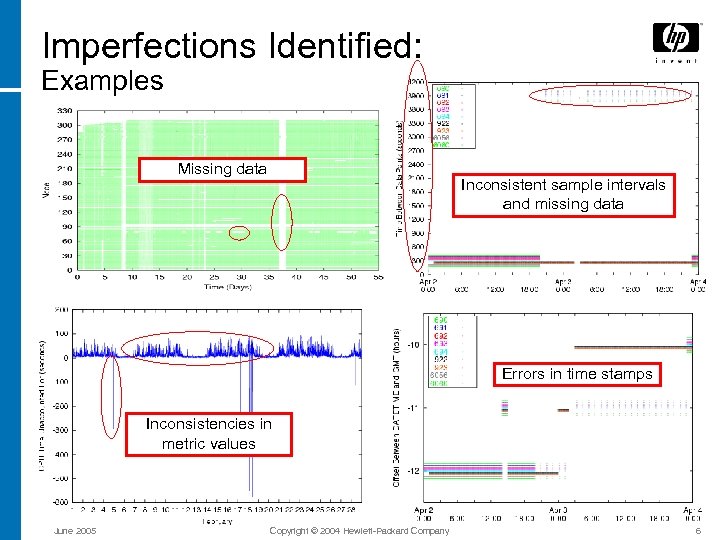 Imperfections Identified: Examples Missing data Inconsistent sample intervals and missing data Errors in time stamps Inconsistencies in metric values June 2005 Copyright © 2004 Hewlett-Packard Company 6
 Adaptive Monitoring: Key Points • Extensions to existing monitoring systems to better meet the data needs of IT control and management functions − Economic (automated): minimizes time spent by system admins and users to configure data collection, manage monitoring infrastructure, and prepare data for end use − Adaptive: adapts to the changes that occur in IT computing environments that are enabled by virtualization and automation; customizable to specific data needs − Scalable: works for IT environments from small to large, crossgeographies • Quality data is essential for any automation June 2005 Copyright © 2004 Hewlett-Packard Company 7
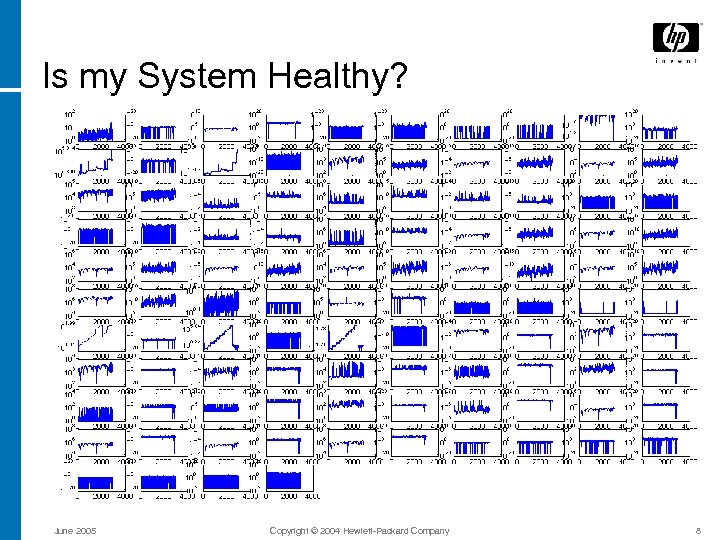 Is my System Healthy? June 2005 Copyright © 2004 Hewlett-Packard Company 8
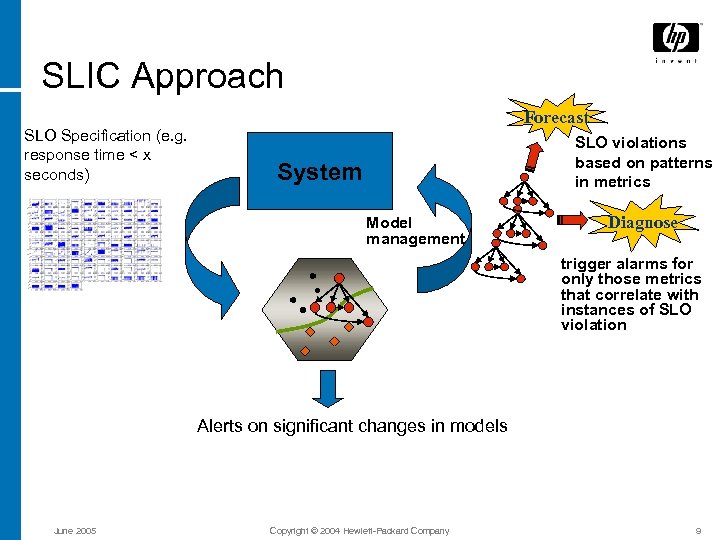 SLIC Approach Forecast SLO Specification (e. g. response time < x seconds) SLO violations based on patterns in metrics System Model management Diagnose trigger alarms for only those metrics that correlate with instances of SLO violation Alerts on significant changes in models June 2005 Copyright © 2004 Hewlett-Packard Company 9
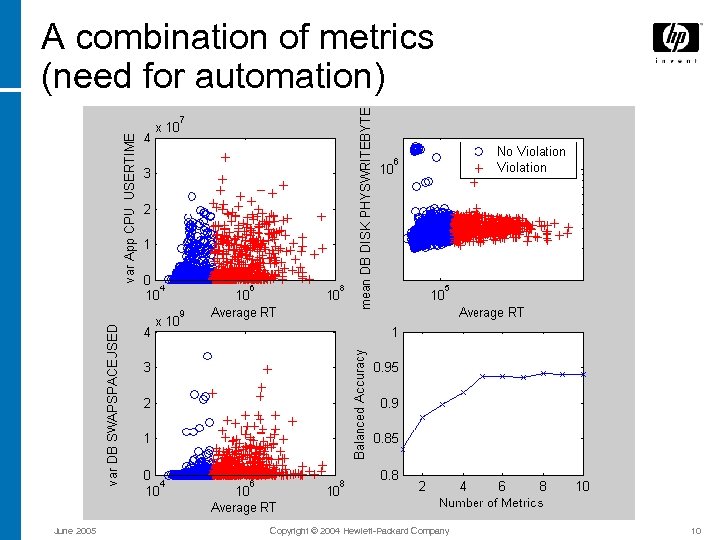 A combination of metrics (need for automation) June 2005 Copyright © 2004 Hewlett-Packard Company 10
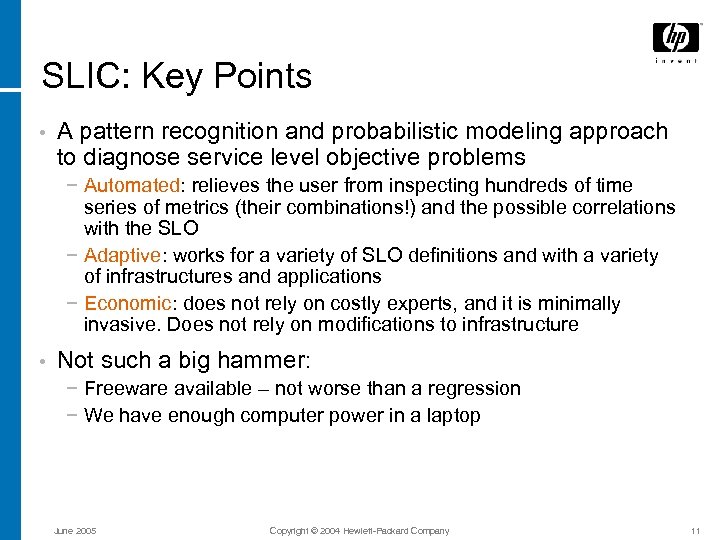 SLIC: Key Points • A pattern recognition and probabilistic modeling approach to diagnose service level objective problems − Automated: relieves the user from inspecting hundreds of time series of metrics (their combinations!) and the possible correlations with the SLO − Adaptive: works for a variety of SLO definitions and with a variety of infrastructures and applications − Economic: does not rely on costly experts, and it is minimally invasive. Does not rely on modifications to infrastructure • Not such a big hammer: − Freeware available – not worse than a regression − We have enough computer power in a laptop June 2005 Copyright © 2004 Hewlett-Packard Company 11
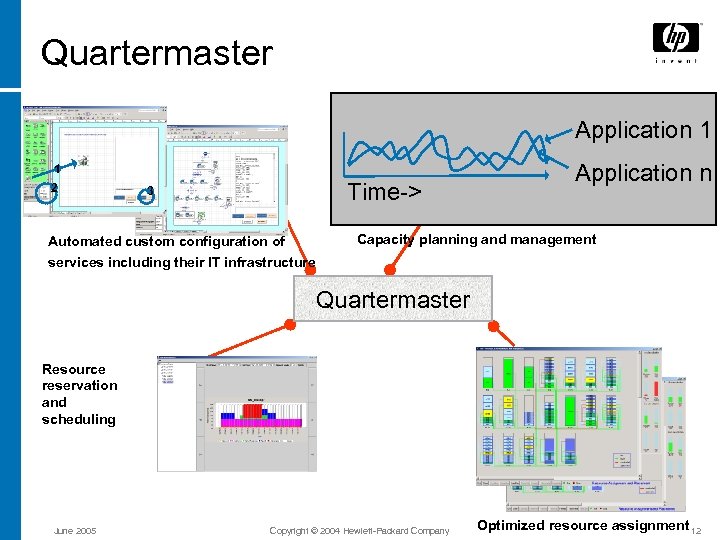 Quartermaster Application 1 1 2 Time-> 3 Automated custom configuration of services including their IT infrastructure Application n Capacity planning and management Quartermaster Resource reservation and scheduling June 2005 Copyright © 2004 Hewlett-Packard Company Optimized resource assignment 12
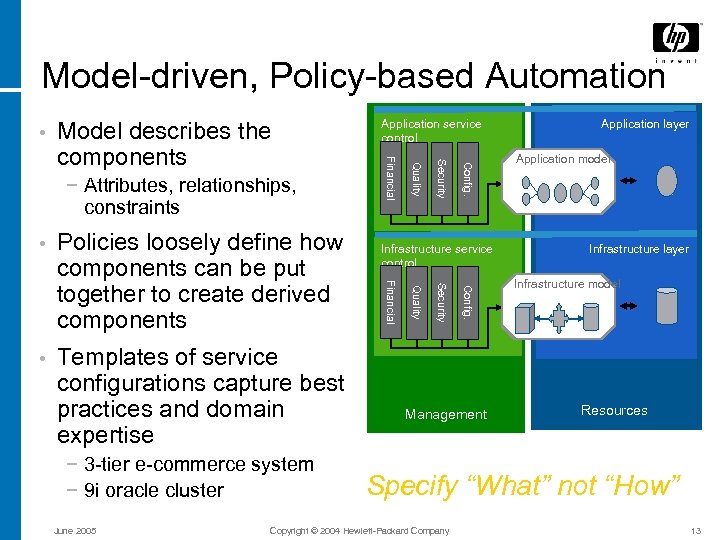 Model-driven, Policy-based Automation • Config. June 2005 Security − 3 -tier e-commerce system − 9 i oracle cluster Quality Templates of service configurations capture best practices and domain expertise Infrastructure service control Financial • Policies loosely define how components can be put together to create derived components Security • Quality − Attributes, relationships, constraints Application service control Financial Model describes the components Management Application layer Application model Infrastructure layer Infrastructure model Resources Specify “What” not “How” Copyright © 2004 Hewlett-Packard Company 13
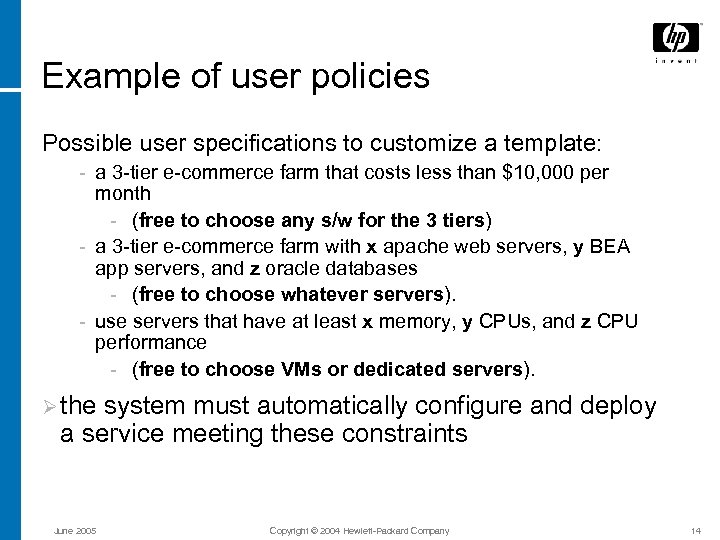 Example of user policies Possible user specifications to customize a template: - a 3 -tier e-commerce farm that costs less than $10, 000 per month - (free to choose any s/w for the 3 tiers) - a 3 -tier e-commerce farm with x apache web servers, y BEA app servers, and z oracle databases - (free to choose whatever servers). - use servers that have at least x memory, y CPUs, and z CPU performance - (free to choose VMs or dedicated servers). Ø the system must automatically configure and deploy a service meeting these constraints June 2005 Copyright © 2004 Hewlett-Packard Company 14
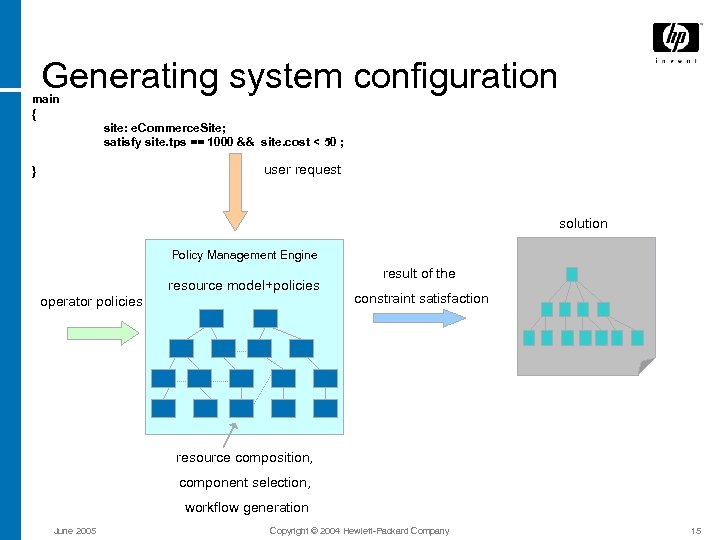 Generating system configuration main { site: e. Commerce. Site; satisfy site. tps == 1000 && site. cost < 50 ; } user request solution Policy Management Engine resource model+policies operator policies result of the constraint satisfaction resource composition, component selection, workflow generation June 2005 Copyright © 2004 Hewlett-Packard Company 15
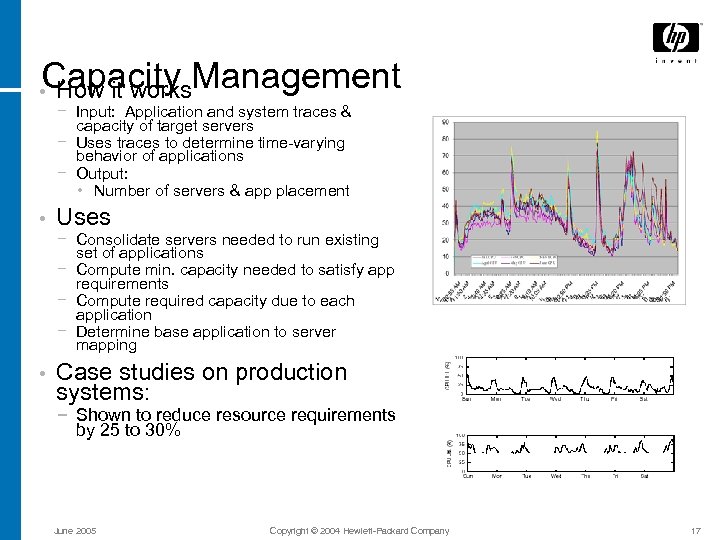 Capacity Management How it works • − Input: Application and system traces & capacity of target servers − Uses traces to determine time-varying behavior of applications − Output: • Number of servers & app placement • Uses − Consolidate servers needed to run existing set of applications − Compute min. capacity needed to satisfy app requirements − Compute required capacity due to each application − Determine base application to server mapping • Case studies on production systems: − Shown to reduce resource requirements by 25 to 30% June 2005 Copyright © 2004 Hewlett-Packard Company 17
 Quartermaster: Key Points • Model-driven, policy based system for designing service configuration and capacity and resource management of virtual resource pools − Automated: automates design and deployment of complex service configurations and the capacity management and allocation of resources which cant be done manually for large scale systems − Adaptive: works on a variety of virtualized systems with heterogeneous resources and with various application domains − Economic: leverages best practices and domain expertise to rapidly provide error-free, policy compliant service configurations • Cannot build large scale utility computing systems without this June 2005 Copyright © 2004 Hewlett-Packard Company 18
 Relationship to Grids and GGF • We primarily focus on enterprise • We demonstrate solution generality in Grid space − GRC in Calgary, China. Grid, Our. Grid, etc. • We transfer our experience back to community − WS-Agreement, Jim Pruyne co-chair, Quartermaster − CDDLM, Dejan Milojicic, co-chair, Smart. Frog − OASIS WSDM, W. Vambenepe and B. Murray, WSMF − etc. June 2005 Copyright © 2004 Hewlett-Packard Company 19
 Summary • Foundational research on technologies to manage and control large scale utility computing systems − Adaptive Monitoring: Data Assurance, and Delivery − SLIC: Automated diagnosis and forecasting − Quartermaster: Automated design, allocation, capacity mgmt • State-of-the-art demonstrators − Working with HP Business units and end Customers • Develop technologies, apply them to production systems June 2005 Copyright © 2004 Hewlett-Packard Company 20
 June 2005 Copyright © 2004 Hewlett-Packard Company 21