


 Скачать презентацию Enterprise Intelligence Jean Vieille 05 2010 www controlchainmanagement net
450baab9ec13e01932460aadb5b488c9.ppt
- Количество слайдов: 45
 Enterprise Intelligence Jean Vieille 05/2010 www. controlchainmanagement. net info@controlchainmanagement. net Creative Commons licence
 Agenda ■ ■ ■ Introduction Information hierarchies Biological and artificial computing Intelligence and complexity Enterprise IQ and performance Enterprise Intelligence Creative Commons licence 2
 Introduction ■ ■ ■ Intelligence is a subjective and scalable topic. Ø A simple computation linking the detection of an event to a subsequent appropriate action can be considered an elementary intelligent behaviour Ø Consciousness, wisdom qualify much higher levels that are currently unattainable by machines This study discusses Ø General aspects of intelligence § Applicable in the context of the industrial enterprise and specifically its manufacturing operations Ø Its relationship with Performance The following documents are prerequisite references for this study Ø Enterprise. System. Upper. Level. Model_en. pptx Ø Science for Enterprise Systems. pptx Enterprise Intelligence Creative Commons licence 3
 Agenda ■ ■ ■ Introduction Information hierarchies Biological and artificial computing Intelligence and complexity Enterprise IQ and performance Enterprise Intelligence Creative Commons licence 4
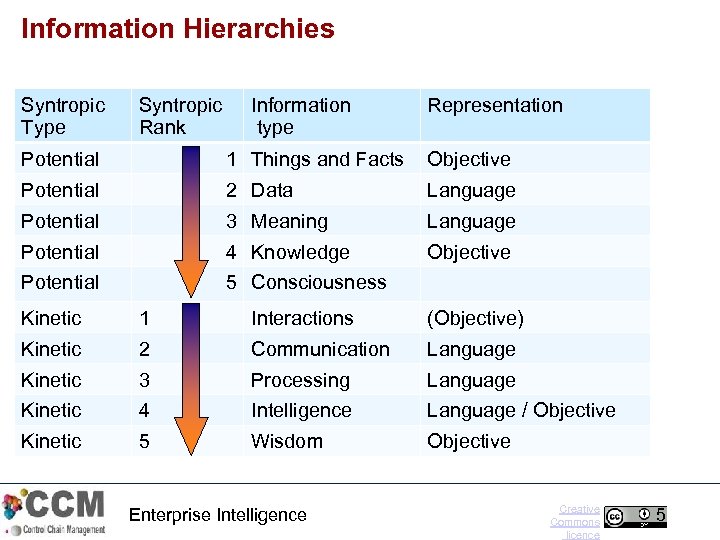 Information Hierarchies Syntropic Type Syntropic Rank Information type Representation Potential 1 Things and Facts Objective Potential 2 Data Language Potential 3 Meaning Language Potential 4 Knowledge Objective Potential 5 Consciousness Kinetic 1 Interactions (Objective) Kinetic 2 Communication Language Kinetic 3 Processing Language Kinetic 4 Intelligence Language / Objective Kinetic 5 Wisdom Objective Enterprise Intelligence Creative Commons licence 5
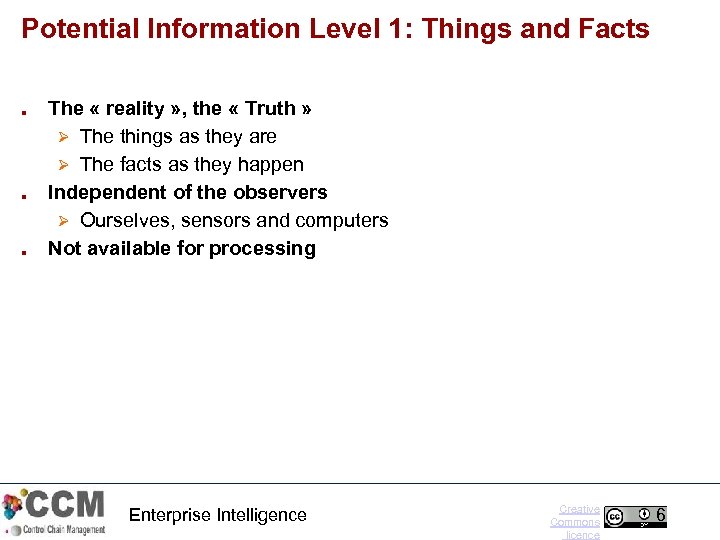 Potential Information Level 1: Things and Facts ■ ■ ■ The « reality » , the « Truth » Ø The things as they are Ø The facts as they happen Independent of the observers Ø Ourselves, sensors and computers Not available for processing Enterprise Intelligence Creative Commons licence 6
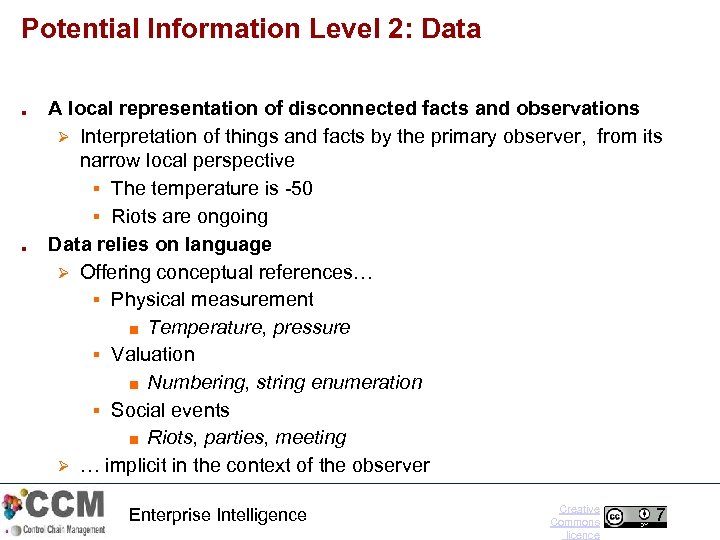 Potential Information Level 2: Data ■ ■ A local representation of disconnected facts and observations Ø Interpretation of things and facts by the primary observer, from its narrow local perspective § The temperature is -50 § Riots are ongoing Data relies on language Ø Offering conceptual references… § Physical measurement ■ Temperature, pressure § Valuation ■ Numbering, string enumeration § Social events ■ Riots, parties, meeting Ø … implicit in the context of the observer Enterprise Intelligence Creative Commons licence 7
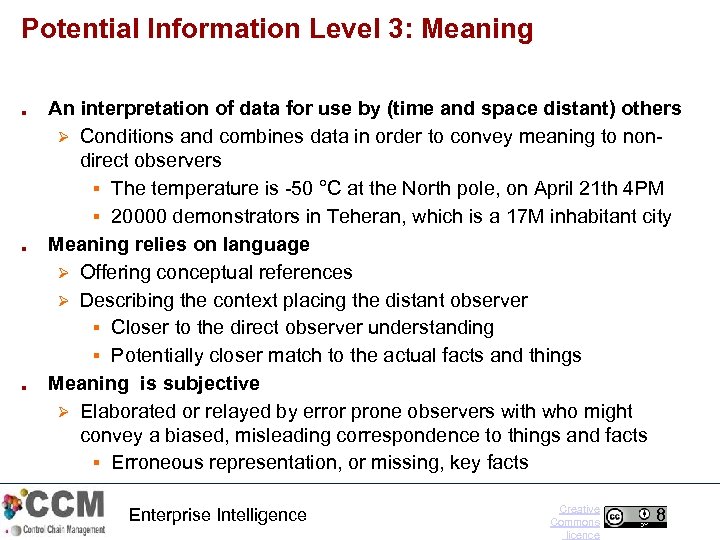 Potential Information Level 3: Meaning ■ ■ ■ An interpretation of data for use by (time and space distant) others Ø Conditions and combines data in order to convey meaning to nondirect observers § The temperature is -50 °C at the North pole, on April 21 th 4 PM § 20000 demonstrators in Teheran, which is a 17 M inhabitant city Meaning relies on language Ø Offering conceptual references Ø Describing the context placing the distant observer § Closer to the direct observer understanding § Potentially closer match to the actual facts and things Meaning is subjective Ø Elaborated or relayed by error prone observers with who might convey a biased, misleading correspondence to things and facts § Erroneous representation, or missing, key facts Enterprise Intelligence Creative Commons licence 8
 Potential Information Level 4 : Knowledge ■ ■ Knowledge is an objective state of understanding Ø In the form of experiences, theories, practices explaining the Reality: § Looking for the “truth” based on cross meaningful observations Ø Can be § Explicit: materialized in books, files, painting, artefacts… § Implicit : resident in people’ minds It is independent of its subjective usage Ø Any entity influences its behaviour in dealing with actual things and facts by interpreting, understanding and applying this knowledge Is continually developed / improved Ø The general tendency of Mankind Ø Occasional losses Variable domain space Ø private, shared or publicly exposed Enterprise Intelligence Creative Commons licence 9
 Potential Information Level 5: Consciousness ■ ■ ■ Consciousness is a lasting issue for philosopher Dictionaries discard IT - Oxford: Ø “the state of being conscious. The fact of awareness by the mind of itself and the world. One's awareness or perception of something” Consciousness relates to “irrational principles” Ø Cannot be deductible from / linked to knowledge Ø Culture, Traditions, Beliefs, Ego Enterprise Intelligence Creative Commons licence 10
 Kinetic information Level 1: Interactions ■ ■ The dynamics of the world results of inter-actions Ø Actions are triggered by other actions Ø Any happening results of a network of interactions § Including in brain’s synapses § Where / when / why the initial trigger fired? Interactions media have many forms Ø Different “forces” at the molecular, atomic and subatomic levels, to build more complex material structures Ø More tangible materials and energetic interactions § Chemical, mechanical, electrical, thermal. . . Ø Multimedia interactions between people through available senses: : § Sound, vision, smell, touch, taste, 6 th sense Enterprise Intelligence Creative Commons licence 11
 Kinetic information Level 2: Communication ■ ■ Communication is the abstraction of interactions, making possible Ø To implement artificial interactions § Not naturally occurring Ø To link separate, distant (in space and time) entities Ø To link dissimilar entities ( people and machines) Communication relies on language Ø Only meaningful interactions are useful Ø Language offers conceptual references for a shared understanding Enterprise Intelligence Creative Commons licence 12
 Kinetic information Level 3: Processing ■ ■ Processing applies existing knowledge Ø To understand act on he Reality Information « flows » through systems’ components Ø Communication exchanges « meaning » between thinking / processing bodies / black boxes Ø What happen inside brains and computers is « processing » § Which itself results of interacting synapses in gray matter, gates in integrated circuits, interfaces between networked applications Ø IQ tests measure processing / cognitive capabilities, not intelligence Processing relies on language Ø Biological cognition as well as artificial computing Some local, low-level, basic processing relies on direct interactions Ø No language is required for walking or to the automated refill of a WC water bin after a flush Enterprise Intelligence Creative Commons licence 13
 Kinetic information Level 4: Intelligence possible attributes An intelligence system ■ Makes a critical use of knowledge: Ø challenges existing beliefs and theories § Learning from experience : trial and error confronting theories and reality § Being creative, imagining new or amended theories § Including its owns: auto-critics Ø Suggests improvement to existing theories, develops new theories § Intelligence builds knowledge - Processing sucks! ■ Focuses the limited thinking / processing capabilities Ø Toward reaching conscious goals Ø Beyond unconscious survival and reproduction ■ Decides and acts Ø Takes initiative, Ø Quickly adapts one's self to circumstances, leverages opportunities Enterprise Intelligence Creative Commons licence 14
 Kinetic information Level 4: Intelligence and language ■ ■ As a higher processing ability, language is generally involved Ø “Artificial intelligence”, Ø Mental representations of knowledge for cognition “Intuitive” behavior results of an inner appropriation of knowledge Ø Realizes a short cut from knowledge to a action / decision Ø Language might be only involved at the last stage Enterprise Intelligence Creative Commons licence 15
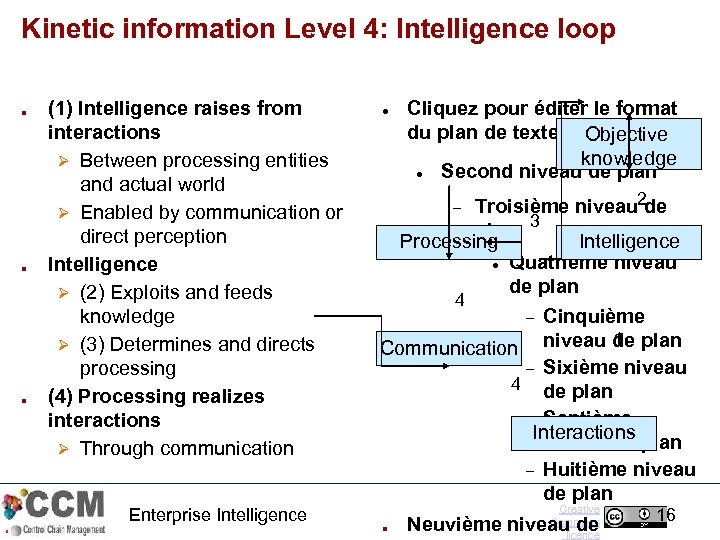 Kinetic information Level 4: Intelligence loop ■ ■ ■ (1) Intelligence raises from interactions Ø Between processing entities and actual world Ø Enabled by communication or direct perception Intelligence Ø (2) Exploits and feeds knowledge Ø (3) Determines and directs processing (4) Processing realizes interactions Ø Through communication Enterprise Intelligence Cliquez pour éditer le format du plan de texte Objective knowledge Second niveau de plan 2 Troisième niveau de plan 3 Processing Intelligence Quatrième niveau de plan 4 Cinquième 1 Communication niveau de plan Sixième niveau 4 de plan Septième Interactions niveau de plan Huitième niveau de plan ■ Creative Commons licence Neuvième niveau de 16
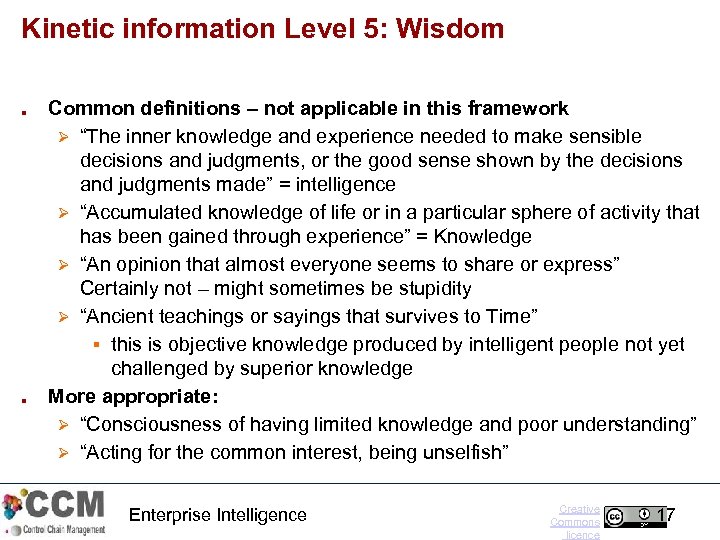 Kinetic information Level 5: Wisdom ■ ■ Common definitions – not applicable in this framework Ø “The inner knowledge and experience needed to make sensible decisions and judgments, or the good sense shown by the decisions and judgments made” = intelligence Ø “Accumulated knowledge of life or in a particular sphere of activity that has been gained through experience” = Knowledge Ø “An opinion that almost everyone seems to share or express” Certainly not – might sometimes be stupidity Ø “Ancient teachings or sayings that survives to Time” § this is objective knowledge produced by intelligent people not yet challenged by superior knowledge More appropriate: Ø “Consciousness of having limited knowledge and poor understanding” Ø “Acting for the common interest, being unselfish” Enterprise Intelligence Creative Commons licence 17
 Agenda ■ ■ ■ Introduction Information hierarchies Biological and artificial computing Intelligence and complexity Enterprise IQ and performance Enterprise Intelligence Creative Commons licence 18
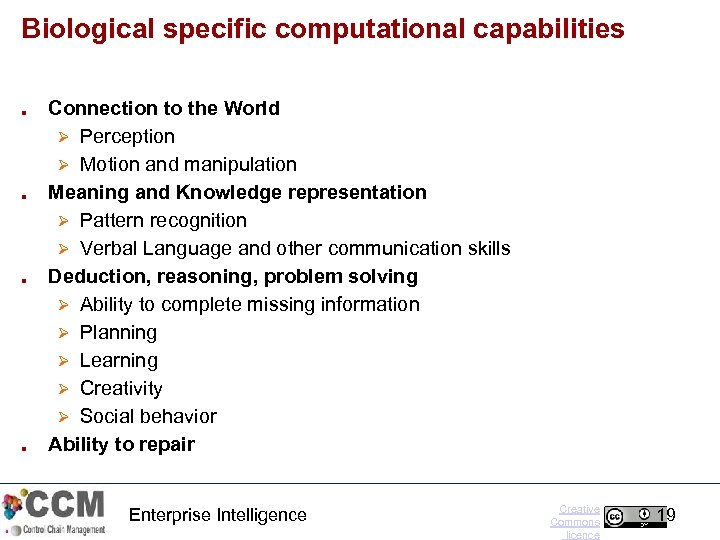 Biological specific computational capabilities ■ ■ Connection to the World Ø Perception Ø Motion and manipulation Meaning and Knowledge representation Ø Pattern recognition Ø Verbal Language and other communication skills Deduction, reasoning, problem solving Ø Ability to complete missing information Ø Planning Ø Learning Ø Creativity Ø Social behavior Ability to repair Enterprise Intelligence Creative Commons licence 19
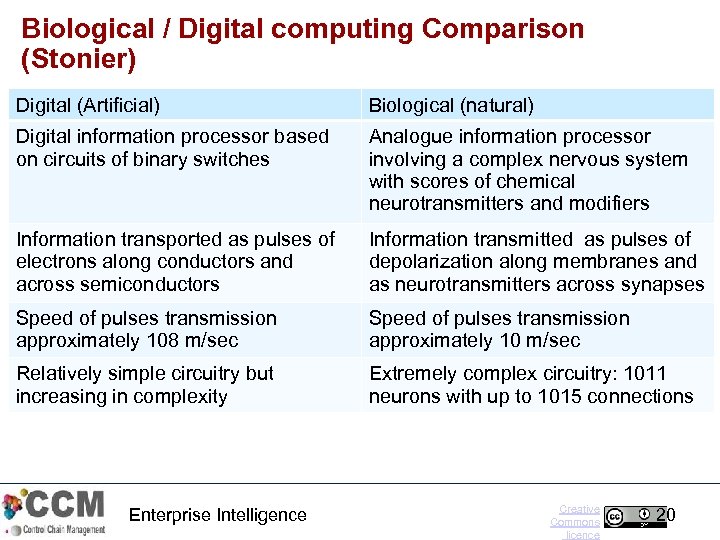 Biological / Digital computing Comparison (Stonier) Digital (Artificial) Biological (natural) Digital information processor based on circuits of binary switches Analogue information processor involving a complex nervous system with scores of chemical neurotransmitters and modifiers Information transported as pulses of electrons along conductors and across semiconductors Information transmitted as pulses of depolarization along membranes and as neurotransmitters across synapses Speed of pulses transmission approximately 108 m/sec Speed of pulses transmission approximately 10 m/sec Relatively simple circuitry but increasing in complexity Extremely complex circuitry: 1011 neurons with up to 1015 connections Enterprise Intelligence Creative Commons licence 20
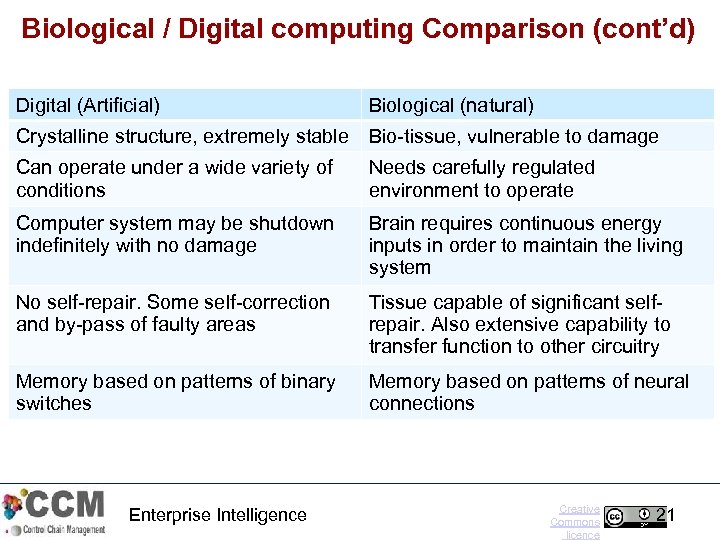 Biological / Digital computing Comparison (cont’d) Digital (Artificial) Biological (natural) Crystalline structure, extremely stable Bio-tissue, vulnerable to damage Can operate under a wide variety of conditions Needs carefully regulated environment to operate Computer system may be shutdown indefinitely with no damage Brain requires continuous energy inputs in order to maintain the living system No self-repair. Some self-correction and by-pass of faulty areas Tissue capable of significant selfrepair. Also extensive capability to transfer function to other circuitry Memory based on patterns of binary switches Memory based on patterns of neural connections Enterprise Intelligence Creative Commons licence 21
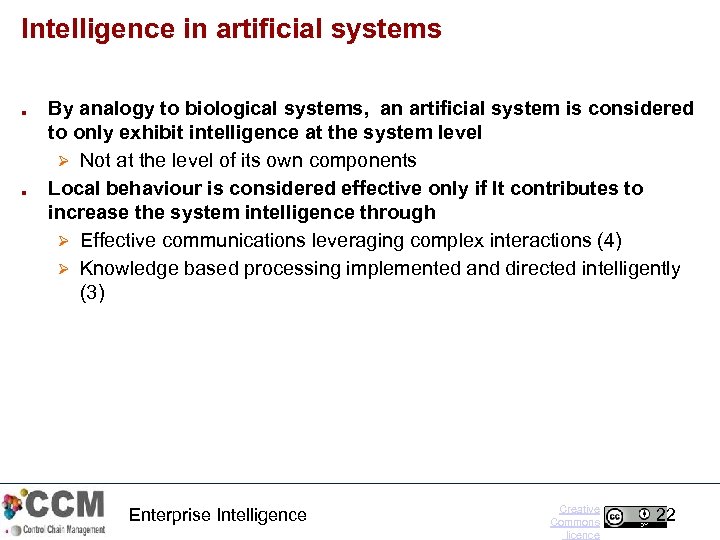 Intelligence in artificial systems ■ ■ By analogy to biological systems, an artificial system is considered to only exhibit intelligence at the system level Ø Not at the level of its own components Local behaviour is considered effective only if It contributes to increase the system intelligence through Ø Effective communications leveraging complex interactions (4) Ø Knowledge based processing implemented and directed intelligently (3) Enterprise Intelligence Creative Commons licence 22
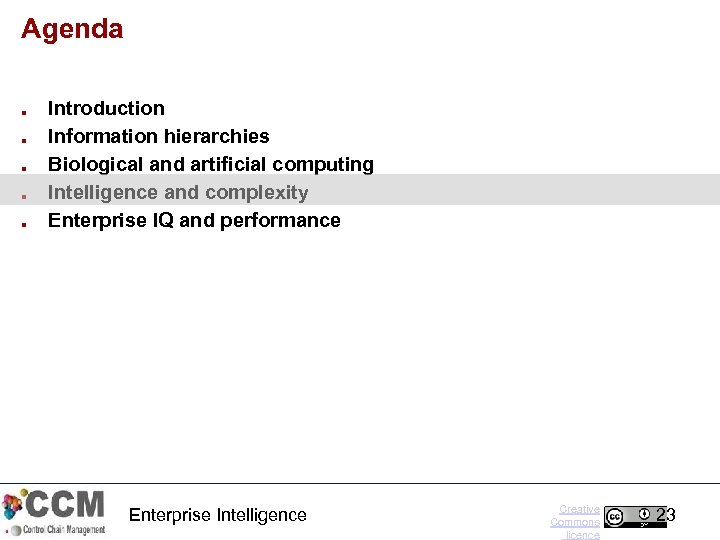 Agenda ■ ■ ■ Introduction Information hierarchies Biological and artificial computing Intelligence and complexity Enterprise IQ and performance Enterprise Intelligence Creative Commons licence 23
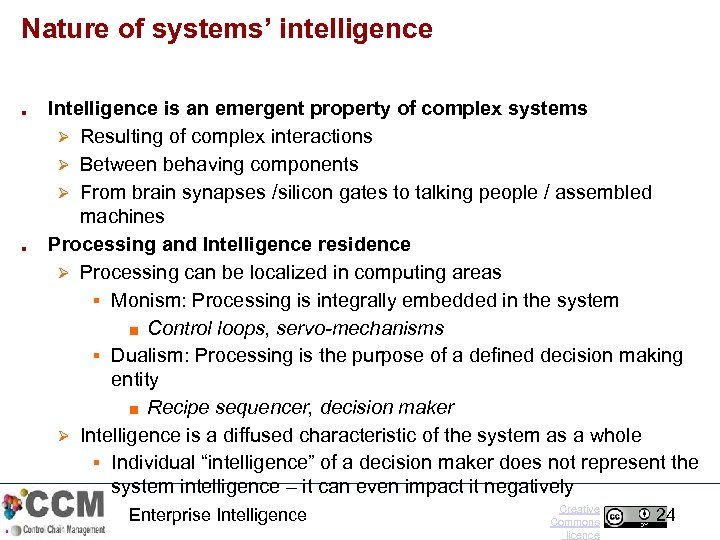 Nature of systems’ intelligence ■ ■ Intelligence is an emergent property of complex systems Ø Resulting of complex interactions Ø Between behaving components Ø From brain synapses /silicon gates to talking people / assembled machines Processing and Intelligence residence Ø Processing can be localized in computing areas § Monism: Processing is integrally embedded in the system ■ Control loops, servo-mechanisms § Dualism: Processing is the purpose of a defined decision making entity ■ Recipe sequencer, decision maker Ø Intelligence is a diffused characteristic of the system as a whole § Individual “intelligence” of a decision maker does not represent the system intelligence – it can even impact it negatively Enterprise Intelligence Creative Commons licence 24
 Feedback ■ ■ Interactions imply that sub-systems Ø Capture meaning from other sub-systems / environment Ø Process information locally to perform their role Ø Provide meaning to / act on other sub-systems / environment The sub-system being « complicatedly coupled » , Its action Ø spreads to many other sub-systems directly/indirectly, themselves processing and spreading this information Ø Hits it back at some point Ø Intelligence results of these complex interactions of local processing Positive feedback loops Ø Example: Productivity enhancement, bankruptcy Negative feedback loops Ø Example: Traffic control, resistance to change Enterprise Intelligence Creative Commons licence 25
 Conflicts ■ ■ Conflicts raise from interactions between sub-systems Ø Some of them being complex systems (i. e. Individuals, teams) § Having individual references, goals, and motivation § Having a certain level of autonomy with Internal priorities regarding other components and environment, within a given decision hierarchy Conflicts are inevitable Ø A perfectly stable system may be immune for some time Ø Any change may trigger conflicts Ø Any conflict may trigger changes Ø Survival has timing and altruistic dimensions: § One specific component’s interest may contradict other components' / system’s Enterprise Intelligence Creative Commons licence 26
 Conflicts, cooperation ■ ■ ■ Conflicts represent ineffective, negative interactions Ø Communication issues, Ø Structural and behavioural unfit Ø System / Subsystems goals mismatch Conversely, cooperation is linked to efficient, positive interaction Ø Hypercritical positive feedback: improved cooperation increases intelligence which falls back to sub-systems and favours further cooperation Conflict resolution and smooth cooperation are critical intelligence enablers Ø Revealers of interactions quality Enterprise Intelligence Creative Commons licence 27
 Uncertainty ■ ■ ■ Systems are subject to perturbations that can be guessed Ø Within standard Gaussian deviations Ø Future is somewhat predictable, Exceptions are rare or of limited impact (i. e. seasonal market demand) Extreme events can arise without computable probability Ø The modern World tends to offer more and more of these Intelligence implies Ø The knowledge of the real Gaussian domains § Exercising reasonable forecasts and prudent classic risk mitigation management Ø The consciousness of the lack of knowledge of the uncertainty § Be ready to address unpredictable, likely possible and potentially large impact events ■ Bad : be ready to fight for survival ■ Good : seize the opportunities Enterprise Intelligence Creative Commons licence 28
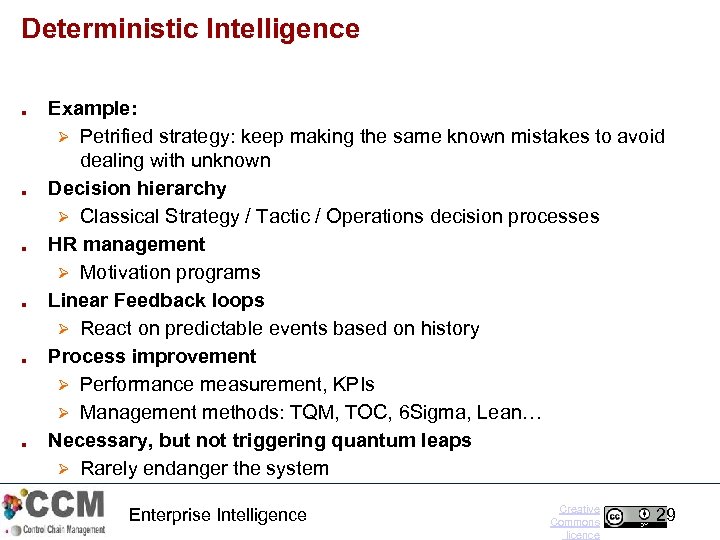 Deterministic Intelligence ■ ■ ■ Example: Ø Petrified strategy: keep making the same known mistakes to avoid dealing with unknown Decision hierarchy Ø Classical Strategy / Tactic / Operations decision processes HR management Ø Motivation programs Linear Feedback loops Ø React on predictable events based on history Process improvement Ø Performance measurement, KPIs Ø Management methods: TQM, TOC, 6 Sigma, Lean… Necessary, but not triggering quantum leaps Ø Rarely endanger the system Enterprise Intelligence Creative Commons licence 29
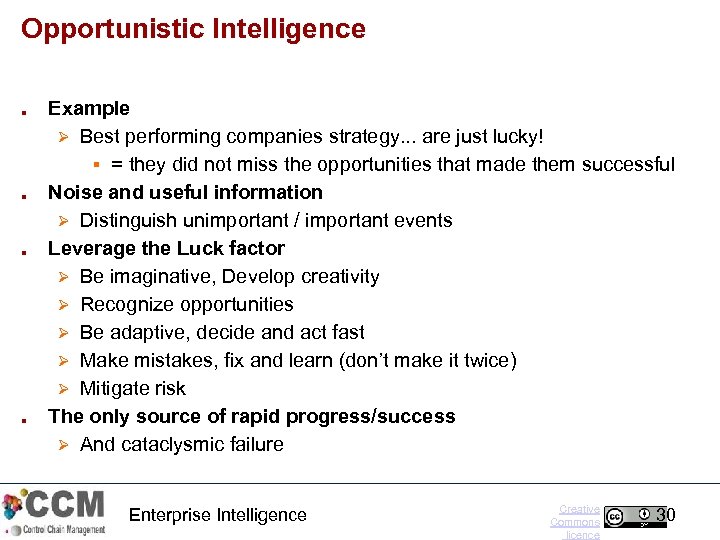 Opportunistic Intelligence ■ ■ Example Ø Best performing companies strategy. . . are just lucky! § = they did not miss the opportunities that made them successful Noise and useful information Ø Distinguish unimportant / important events Leverage the Luck factor Ø Be imaginative, Develop creativity Ø Recognize opportunities Ø Be adaptive, decide and act fast Ø Make mistakes, fix and learn (don’t make it twice) Ø Mitigate risk The only source of rapid progress/success Ø And cataclysmic failure Enterprise Intelligence Creative Commons licence 30
 Agenda ■ ■ ■ Introduction Information hierarchies Biological and artificial computing Intelligence and complexity Enterprise IQ and assessment Enterprise Intelligence Creative Commons licence 31
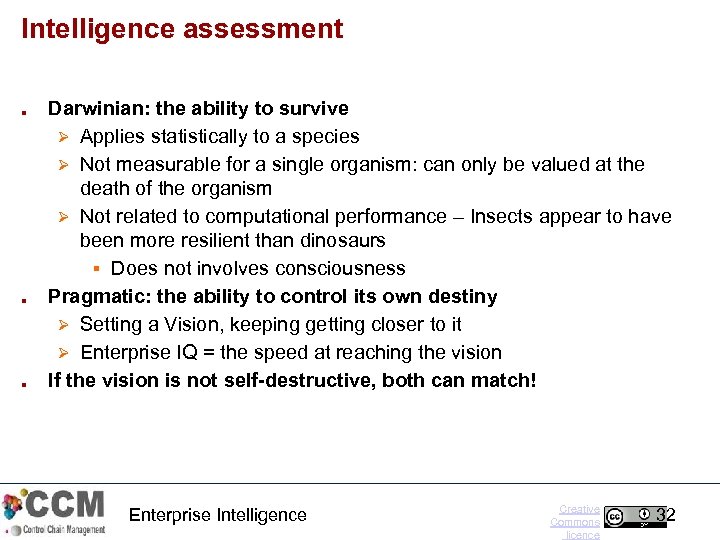 Intelligence assessment ■ ■ ■ Darwinian: the ability to survive Ø Applies statistically to a species Ø Not measurable for a single organism: can only be valued at the death of the organism Ø Not related to computational performance – Insects appear to have been more resilient than dinosaurs § Does not involves consciousness Pragmatic: the ability to control its own destiny Ø Setting a Vision, keeping getting closer to it Ø Enterprise IQ = the speed at reaching the vision If the vision is not self-destructive, both can match! Enterprise Intelligence Creative Commons licence 32
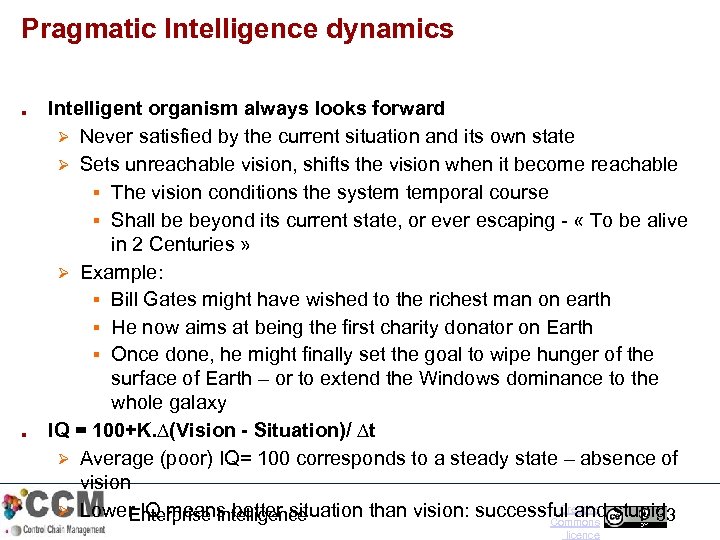 Pragmatic Intelligence dynamics ■ ■ Intelligent organism always looks forward Ø Never satisfied by the current situation and its own state Ø Sets unreachable vision, shifts the vision when it become reachable § The vision conditions the system temporal course § Shall be beyond its current state, or ever escaping - « To be alive in 2 Centuries » Ø Example: § Bill Gates might have wished to the richest man on earth § He now aims at being the first charity donator on Earth § Once done, he might finally set the goal to wipe hunger of the surface of Earth – or to extend the Windows dominance to the whole galaxy IQ = 100+K. ∆(Vision - Situation)/ ∆t Ø Average (poor) IQ= 100 corresponds to a steady state – absence of vision Creative Ø Lower IQ means better situation than vision: successful and stupid Enterprise Intelligence 33 Commons licence
 Expressing Enterprise Vision ■ ■ Vision is traditionally a high level, pompous, abstract, nonactionable statement Ø Called “Vision”, “Mission”, “Goal”, “Objectives”, “Target”, “Draw”, “Think” depending on the strategic planning method Vision needs to be expressed in specific topics according to the I/Os and parties involved in enterprise exter-actions Based on the CCM enterprise system upper level model, these topics can be precisely focused As a result: Ø Vision can be expressed in expressive, detailed and extensive goals Ø Measuring Vision fulfillment – pragmatic IQ becomes possible Ø Strategy definition and implementation benefit of a formal guidance Enterprise Intelligence Creative Commons licence 34
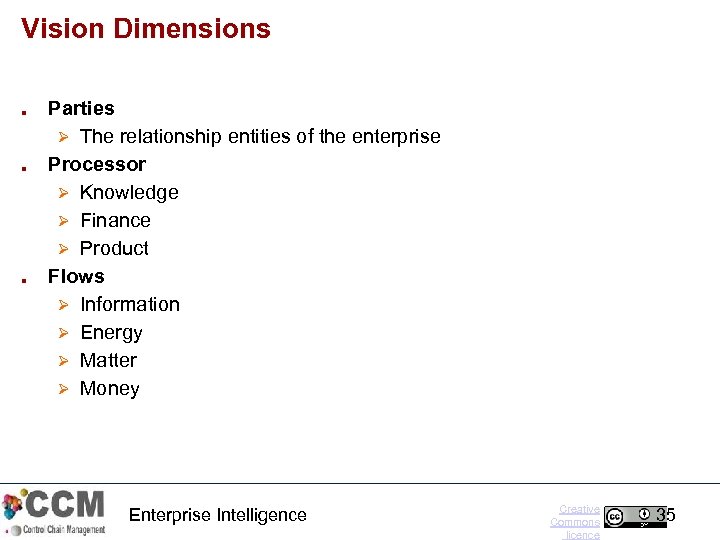 Vision Dimensions ■ ■ ■ Parties Ø The relationship entities of the enterprise Processor Ø Knowledge Ø Finance Ø Product Flows Ø Information Ø Energy Ø Matter Ø Money Enterprise Intelligence Creative Commons licence 35
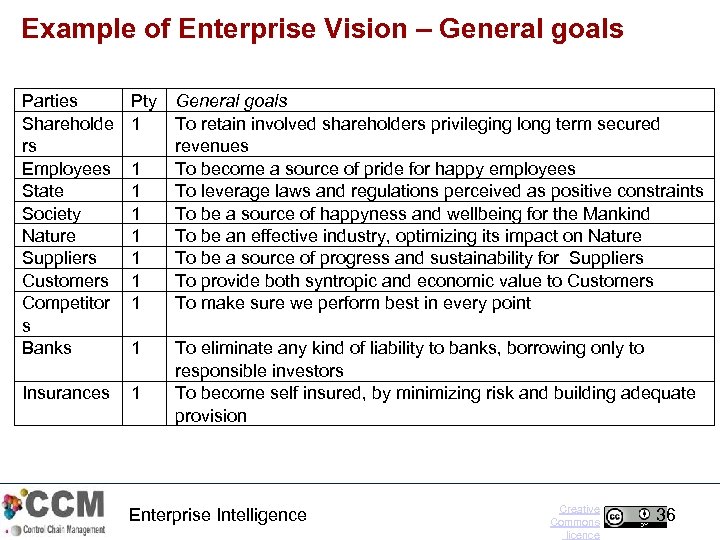 Example of Enterprise Vision – General goals Parties Shareholde rs Employees State Society Nature Suppliers Customers Competitor s Banks Pty General goals 1 To retain involved shareholders privileging long term secured revenues 1 To become a source of pride for happy employees 1 To leverage laws and regulations perceived as positive constraints 1 To be a source of happyness and wellbeing for the Mankind 1 To be an effective industry, optimizing its impact on Nature 1 To be a source of progress and sustainability for Suppliers 1 To provide both syntropic and economic value to Customers 1 To make sure we perform best in every point Insurances 1 1 To eliminate any kind of liability to banks, borrowing only to responsible investors To become self insured, by minimizing risk and building adequate provision Enterprise Intelligence Creative Commons licence 36
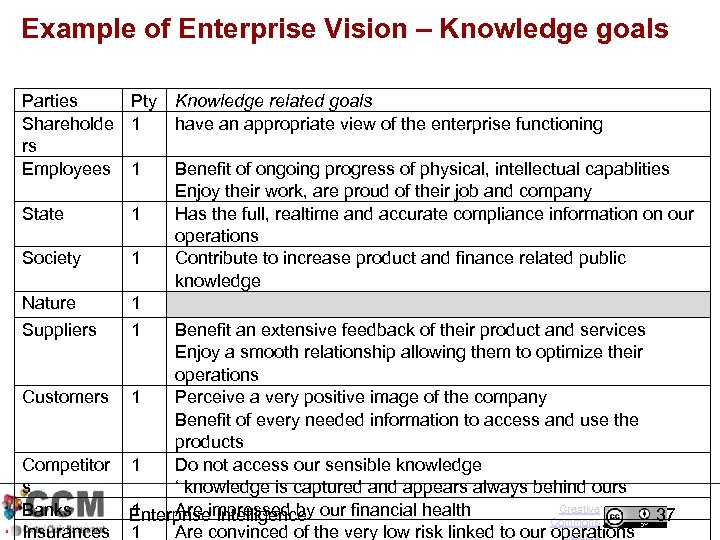 Example of Enterprise Vision – Knowledge goals Parties Pty Knowledge related goals Shareholde 1 have an appropriate view of the enterprise functioning rs Employees 1 Benefit of ongoing progress of physical, intellectual capablities Enjoy their work, are proud of their job and company State 1 Has the full, realtime and accurate compliance information on our operations Society 1 Contribute to increase product and finance related public knowledge Nature 1 Suppliers 1 Benefit an extensive feedback of their product and services Enjoy a smooth relationship allowing them to optimize their operations Customers 1 Perceive a very positive image of the company Benefit of every needed information to access and use the products Competitor 1 Do not access our sensible knowledge s ‘ knowledge is captured and appears always behind ours Creative Banks 1 Are impressed by our financial health Enterprise Intelligence 37 Commons Insurances 1 Are convinced of the very low risk linked to our operations licence
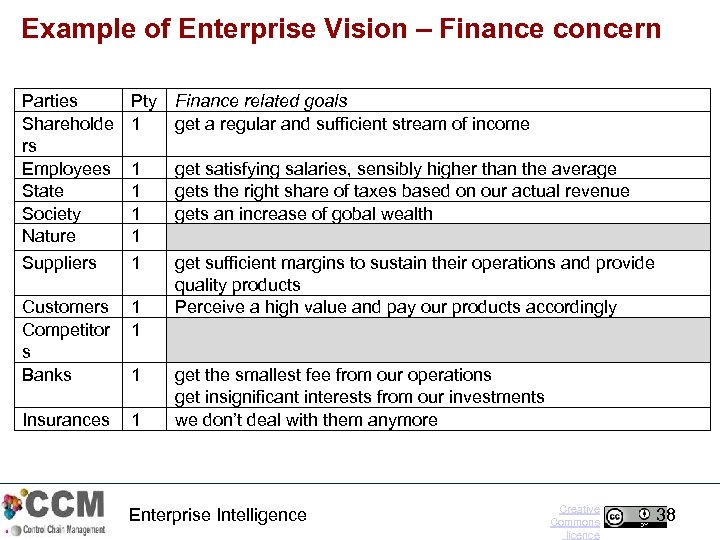 Example of Enterprise Vision – Finance concern Parties Shareholde rs Employees State Society Nature Suppliers Pty Finance related goals 1 get a regular and sufficient stream of income Customers Competitor s Banks 1 1 Insurances 1 1 1 1 get satisfying salaries, sensibly higher than the average gets the right share of taxes based on our actual revenue gets an increase of gobal wealth get sufficient margins to sustain their operations and provide quality products Perceive a high value and pay our products accordingly get the smallest fee from our operations get insignificant interests from our investments we don’t deal with them anymore Enterprise Intelligence Creative Commons licence 38
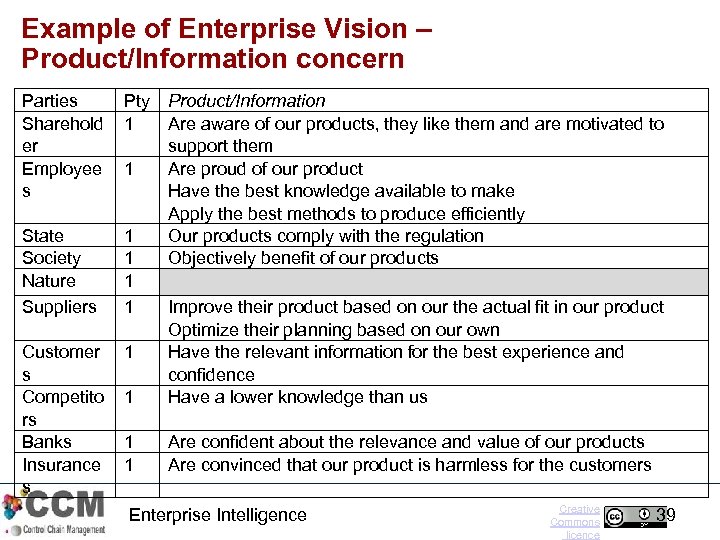 Example of Enterprise Vision – Product/Information concern Parties Sharehold er Employee s State Society Nature Suppliers Customer s Competito rs Banks Insurance s Pty Product/Information 1 Are aware of our products, they like them and are motivated to support them 1 Are proud of our product Have the best knowledge available to make Apply the best methods to produce efficiently 1 Our products comply with the regulation 1 Objectively benefit of our products 1 1 Improve their product based on our the actual fit in our product Optimize their planning based on our own 1 Have the relevant information for the best experience and confidence 1 Have a lower knowledge than us 1 1 Are confident about the relevance and value of our products Are convinced that our product is harmless for the customers Enterprise Intelligence Creative Commons licence 39
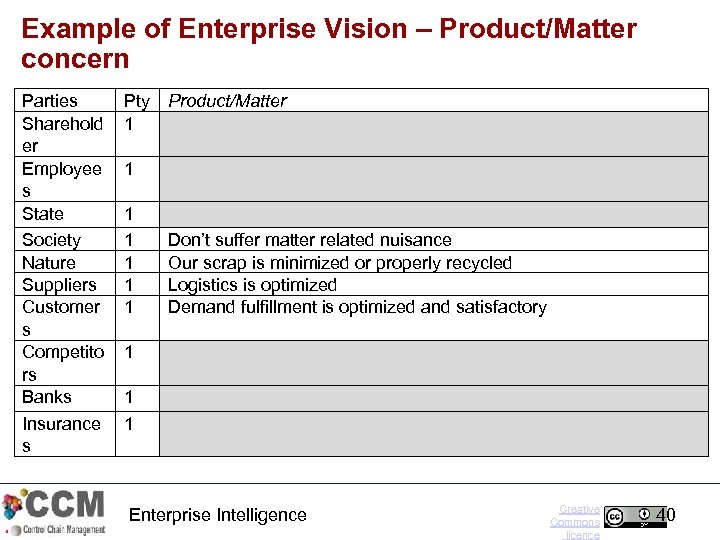 Example of Enterprise Vision – Product/Matter concern Parties Sharehold er Employee s State Society Nature Suppliers Customer s Competito rs Banks Insurance s Pty Product/Matter 1 1 1 1 Don’t suffer matter related nuisance Our scrap is minimized or properly recycled Logistics is optimized Demand fulfillment is optimized and satisfactory 1 1 1 Enterprise Intelligence Creative Commons licence 40
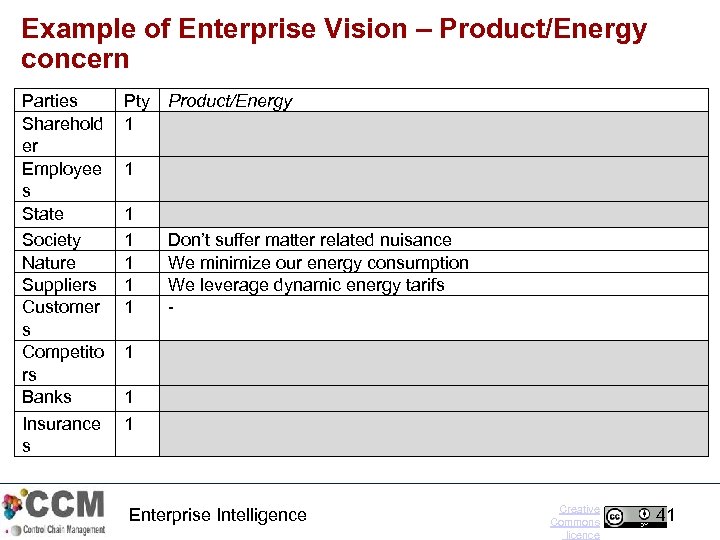 Example of Enterprise Vision – Product/Energy concern Parties Sharehold er Employee s State Society Nature Suppliers Customer s Competito rs Banks Insurance s Pty Product/Energy 1 1 1 1 Don’t suffer matter related nuisance We minimize our energy consumption We leverage dynamic energy tarifs - 1 1 1 Enterprise Intelligence Creative Commons licence 41
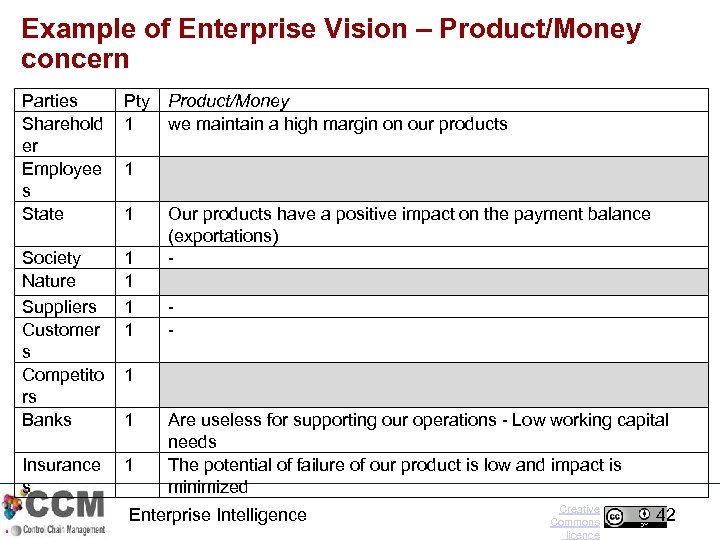 Example of Enterprise Vision – Product/Money concern Parties Sharehold er Employee s State Pty Product/Money 1 we maintain a high margin on our products Society Nature Suppliers Customer s Competito rs Banks 1 1 Insurance s 1 1 1 Our products have a positive impact on the payment balance (exportations) - - 1 1 Are useless for supporting our operations - Low working capital needs The potential of failure of our product is low and impact is minimized Enterprise Intelligence Creative Commons licence 42
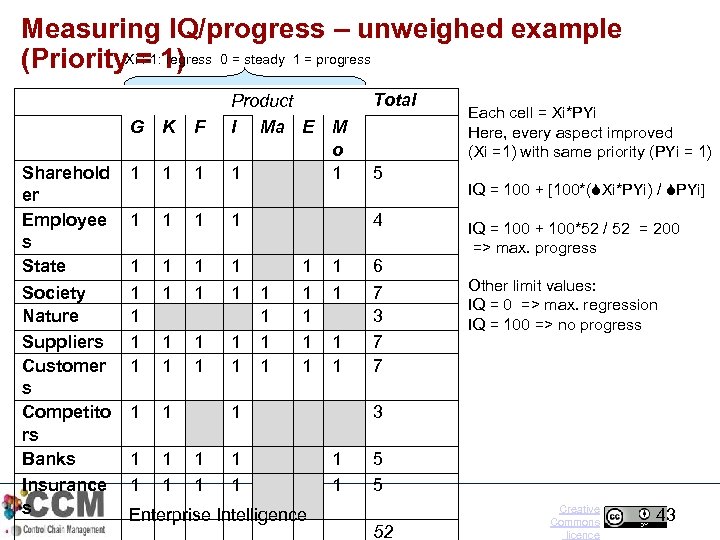 Measuring IQ/progress – unweighed example Xi : -1: regress 0 = steady 1 = progress (Priority = 1) G K F Product I Ma E Sharehold 1 1 er Employee 1 1 s State 1 1 1 Society 1 1 1 Nature 1 1 1 Suppliers 1 1 1 Customer 1 1 1 s Competito 1 1 1 rs Banks 1 1 Insurance 1 1 s Enterprise Intelligence Total M o 1 5 4 1 1 6 7 3 7 7 Each cell = Xi*PYi Here, every aspect improved (Xi =1) with same priority (PYi = 1) IQ = 100 + [100*( Xi*PYi) / PYi] IQ = 100 + 100*52 / 52 = 200 => max. progress Other limit values: IQ = 0 => max. regression IQ = 100 => no progress 3 1 1 5 5 52 Creative Commons licence 43
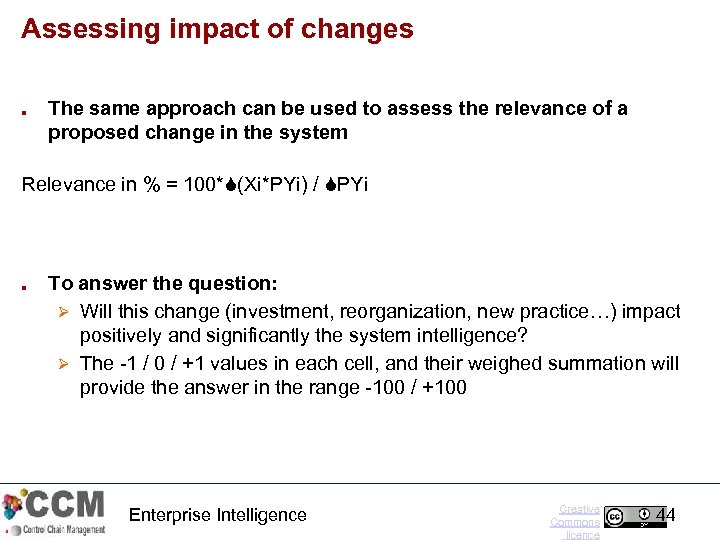 Assessing impact of changes ■ The same approach can be used to assess the relevance of a proposed change in the system Relevance in % = 100* (Xi*PYi) / PYi ■ To answer the question: Ø Will this change (investment, reorganization, new practice…) impact positively and significantly the system intelligence? Ø The -1 / 0 / +1 values in each cell, and their weighed summation will provide the answer in the range -100 / +100 Enterprise Intelligence Creative Commons licence 44
 Thank You ! Enterprise Intelligence Creative Commons licence 45