


 Скачать презентацию Enter Shakespeare HUM 2052 Civilization II Spring 2012
cb1d3a6c69dc76be7fa9d937c5b35f28.ppt
- Количество слайдов: 17
 Enter Shakespeare. HUM 2052: Civilization II Spring 2012 Dr. Perdigao January 27 -February 1, 2012
 Establishing Shakespeare • Born 1564 in Stratford-on-Avon; father a glove-maker • Social mobility possible; merchant class could sell goods for money for land; father becomes prominent in town council but later goes bankrupt • Early life, during father’s success, probably attended town grammar school, learning Latin, history, classical literature; did not attend college but well-educated • • Shakespeare started writing plays in 1590, mostly comedies and histories 1600 -1611, mostly tragedies and romances • Successful in his time; regarded in 1600 as best playwright; earns money, buys father coat of arms and largest house in Stratford • Stops writing in 1611, goes home; dies in 1616 • 1558: Elizabeth became queen (1558 -1593) • Question of female ruler after Mary • Long period of peace, avoided wars, prosperity • Shakespeare’s works reflecting state of the country with change in genres
 Framing • With Reformation, increase in literacy, popularity of plays • Period of colonization—danger, fear, change, and hope in plays • Changes in beliefs, science • 1576—first theatre built in London • Fear of influence of plays, regulations • Ideas of women, thought to be dangerous and wild, not allowed to perform in plays • Idea of “society, a polis, going to pieces—or even more, with its realization that it has already gone to pieces” (2407). • “sense of disenchantment, ” idea of adopting an “individual code of conduct” (2409), connection to DQ
 Re-readings • Use of language to convey complex opinions and feelings • Use of metaphors, images, and created fast-changing English vocabulary with new words invented • Question if Shakespeare wrote Hamlet • Different readings of Shakespeare: • Deconstruction: language lacks coherent meaning, no final sense to be made; “Death of the author” Marxism: ideas about class, politics; question if Shakespeare was politically conservative Feminist theory: patriarchal society with little freedom for women • •
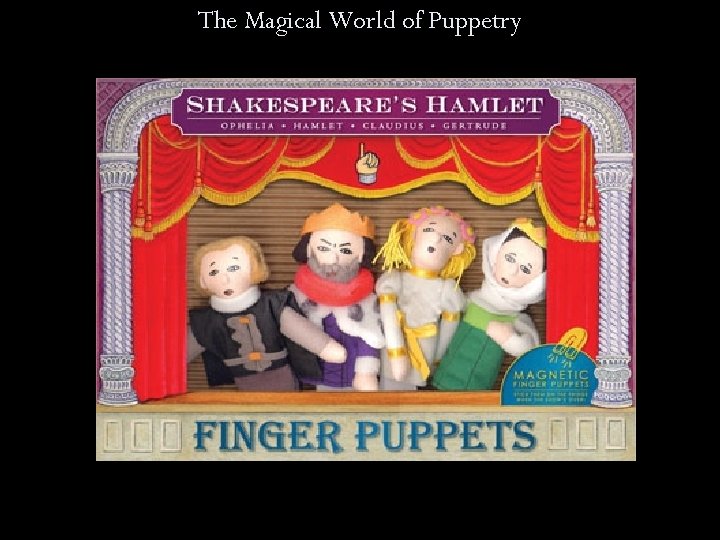 The Magical World of Puppetry
 Poor Shakespeare
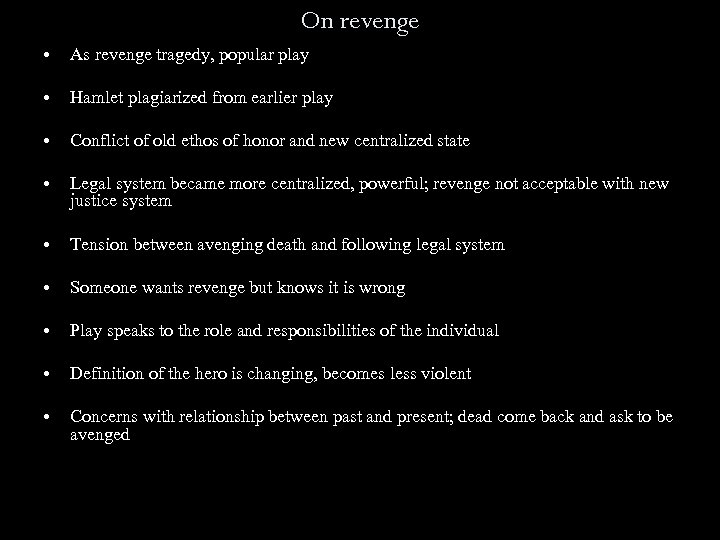 On revenge • As revenge tragedy, popular play • Hamlet plagiarized from earlier play • Conflict of old ethos of honor and new centralized state • Legal system became more centralized, powerful; revenge not acceptable with new justice system • Tension between avenging death and following legal system • Someone wants revenge but knows it is wrong • Play speaks to the role and responsibilities of the individual • Definition of the hero is changing, becomes less violent • Concerns with relationship between past and present; dead come back and ask to be avenged
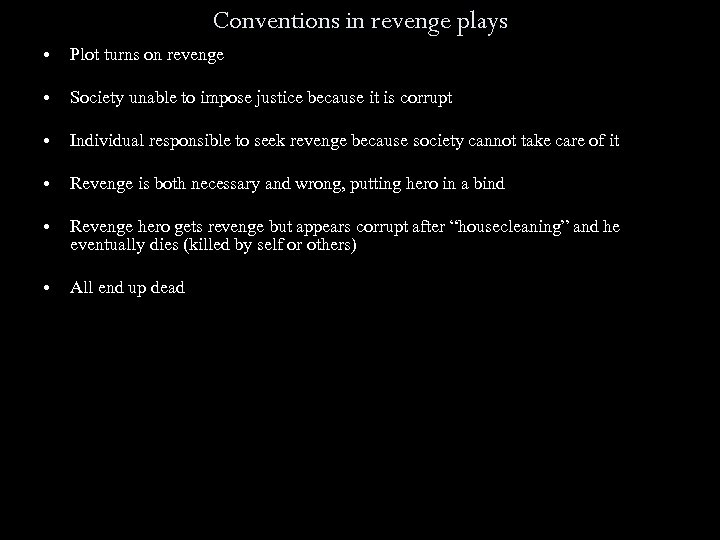 Conventions in revenge plays • Plot turns on revenge • Society unable to impose justice because it is corrupt • Individual responsible to seek revenge because society cannot take care of it • Revenge is both necessary and wrong, putting hero in a bind • Revenge hero gets revenge but appears corrupt after “housecleaning” and he eventually dies (killed by self or others) • All end up dead
 Themes • Renaissance outlook—positive view of human achievement vs. the negative view (melancholy, sense of void and purposelessness) (2407) • Disenchantment with the world in which he lives; “Ideals that once had power and freshness have lost their vigor under the impact of satiety, doubt, and melancholy” (2409) • Influence of Machiavelli—idea of sneaky, scheming characters, using poison; hero becoming Machiavellian; acquisition and maintenance of power, investigation of means to that end (murder plots) • Malcontent—character feels wronged, abused by system • Metadrama—calls attention to the fact that it is a play; plays within the play to act out plot • Life as permeable, play between reality and illusion • Seeming to be versus being
 Themes • Structure of play and language • Spying and acting, reason versus emotion (as justification for action) • Family relationships and psychology • Gertrude and Ophelia • Death
 Acts I and II, Acting 101 • Play between inside/outside (scene 1 to scene 2) • Place of corruption • Sons avenging fathers • Presence of the ghost, supernatural; idea of “unnatural” • Claudius’ treatment of the “Norway problem” versus Old Hamlet’s • Question if people are good on the inside or corruptible from the outside • Spying • Reynaldo on Laertes; King and Polonius on Ophelia; Ophelia on Hamlet; delegates in Denmark • Spying—within, between families, foreign policies • Denmark—unstable, lack of trust • Appearance versus reality—hiding, exposure
 Acts I and II, Acting 101 • On Gertrude’s actions (I. 2, 130) • Marcellus: “Something is rotten in the state of Denmark” (I. 4, 91) • Ghost: “Mark me” (I. 5, 2); “remember me” (I. 5, 90) • Idea of what is “unnatural” • “whole ear of Denmark” (I. 5, 36)
 Act III, if he chooses • Discussion of madness between King, Queen, Rosencrantz, Guildenstern, Polonius, and Ophelia (II. 2, 93) • “To be, or not to be” (III. 1, 56): http: //www. youtube. com/watch? v=YHMYk. Ur. V 7 A • http: //www. youtube. com/watch? v=07 IQp 9 ua. IWg&feature=related • The Mousetrap (III. 2) • In the bedroom, enter Freud (III. 4, 53)
 To act or not to act • Idea of acting—as doing something or pretending to do something • Actors as “players” • Relation of action and emotion • Delays—Hamlet as not emotional, coward, doesn’t know if ghost is telling the truth • Laertes—moves immediately to revenge, as foil to Hamlet • But uses dishonorable method for “honorable” actions • Laertes’ change of heart—Claudius to blame, not honorable actions
 Gender divides • By act III, all original patriarchs are dead • Sons left to avenge deaths, idealize fathers after death • Identities of sons in crisis • Polonius’ death—lives and dies behind façade • Ophelia, Gertrude—weak, passive • Characters disgusted by power women have over them, power struggle • No strong male figure • What’s rotten in Denmark? Hamlet: women; Hamlet’s attitude toward women • Difficult to discern Shakespeare’s attitude because thoughts and actions given to characters
 Death, death, more death • Spirituality, idea of fate • Hamlet praying • Skulls in graveyard • Death as both joke and tragedy • Words to Horatio • Retelling of story • http: //www. youtube. com/watch? v=ds 5 nh. GEk 0 Bc
 Civilization and Youtube (thanks to Brittany) • http: //www. youtube. com/watch? v=Apcrd. I-XPd. U -- Band of Brothers St. Crispin's Day Speech • http: //www. youtube. com/watch? v=ow. W 4 pa. F 6 l. SQ -- Hamlet Rap • http: //www. youtube. com/watch? v=9 i. M 1 kb 3 b 9 t 8 -- Melvin trying to read Hamlet • http: //www. youtube. com/watch? v=PRXa 6 q. Gg. TZ 8&p=92 AA 609 ABDE 3 D 793 -- Starts teaching Hamlet and assigning parts