


 Скачать презентацию Enron Corp Steve Kean Executive Vice President Chief
5d9d46ed1e372d4671bcbdf850eb1f23.ppt
- Количество слайдов: 81
 Enron Corp. Steve Kean Executive Vice President Chief of Staff Rice University Jones Graduate School Houston, Texas November 14, 2000
 Agenda • Overview • Liberalization in the Energy Industry • Enron’s Business Model • Conclusion ã 2000 SK-Rice-1100 -2
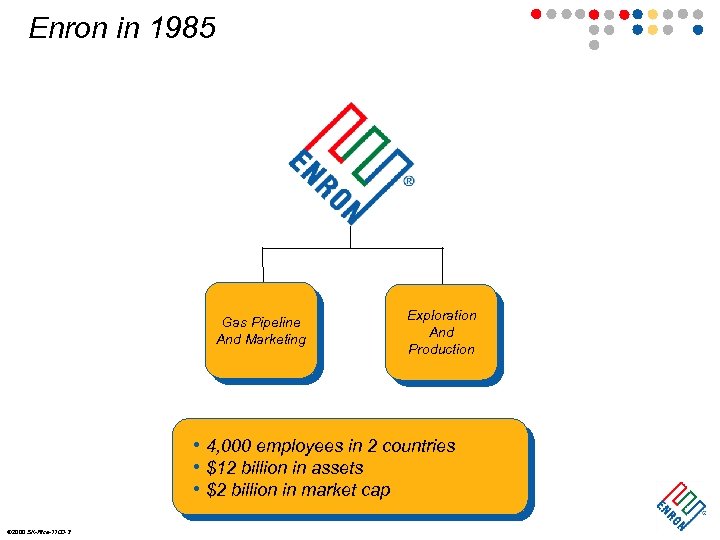 Enron in 1985 Gas Pipeline And Marketing Exploration And Production • 4, 000 employees in 2 countries • $12 billion in assets • $2 billion in market cap ã 2000 SK-Rice-1100 -3
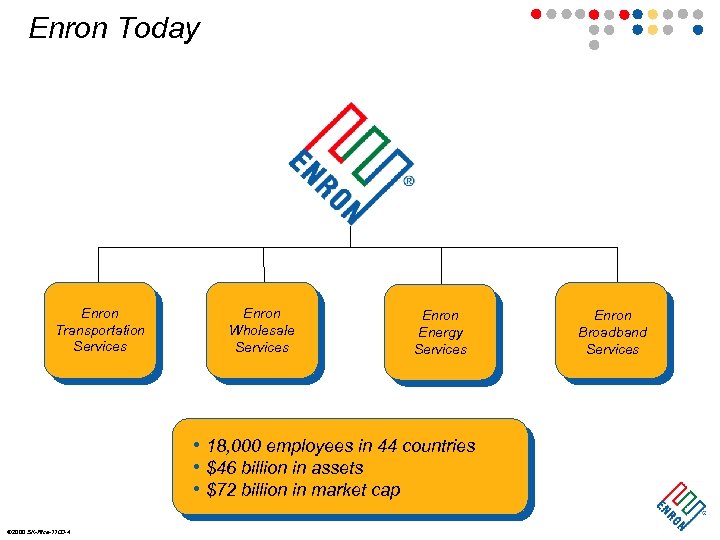 Enron Today Enron Transportation Services Enron Wholesale Services Enron Energy Services • 18, 000 employees in 44 countries • $46 billion in assets • $72 billion in market cap ã 2000 SK-Rice-1100 -4 Enron Broadband Services
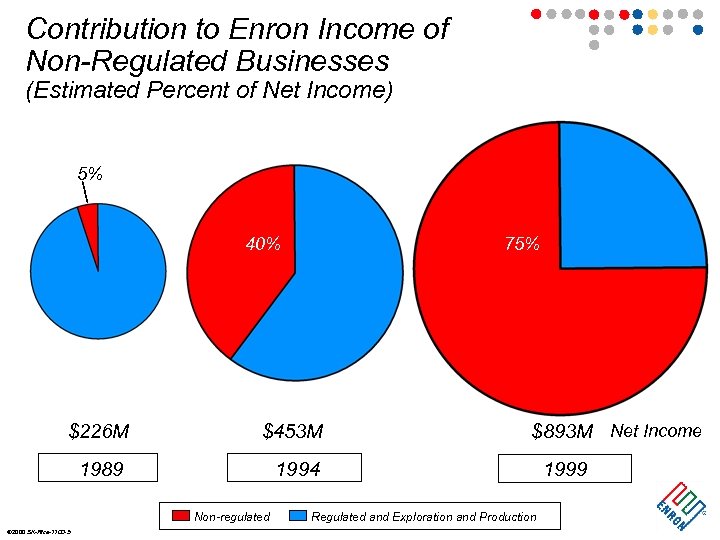 Contribution to Enron Income of Non-Regulated Businesses (Estimated Percent of Net Income) 5% 40% 75% $226 M $453 M 1989 1994 Non-regulated ã 2000 SK-Rice-1100 -5 $893 M Net Income Regulated and Exploration and Production 1999
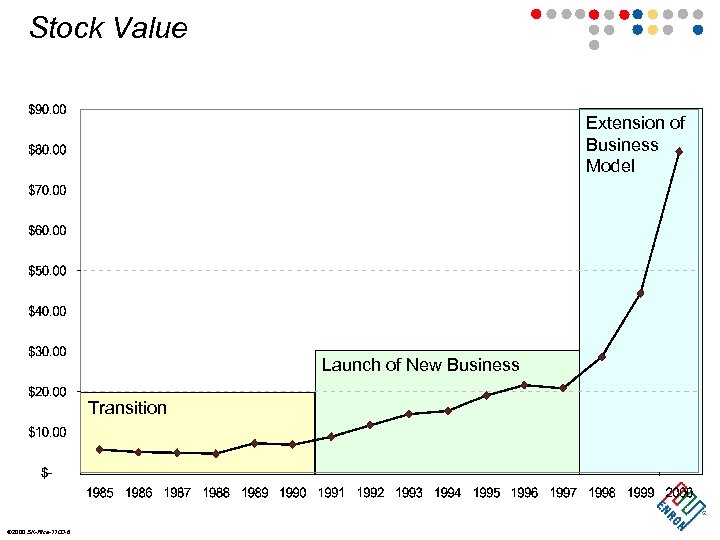 Stock Value Extension of Business Model Launch of New Business Transition ã 2000 SK-Rice-1100 -6
 Liberalization of Energy Markets ã 2000 SK-Rice-1100 -7
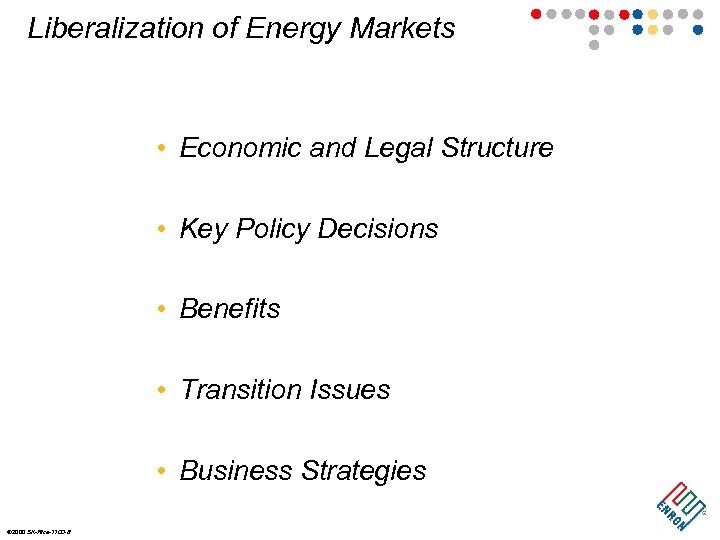 Liberalization of Energy Markets • Economic and Legal Structure • Key Policy Decisions • Benefits • Transition Issues • Business Strategies ã 2000 SK-Rice-1100 -8
 Overview of U. S. Industry • Network industry - Multi-party ownership of interconnected grids - Mix of "natural monopoly" and competitive business • Dual jurisdiction - Federal: interstate transmission; wholesales - State: local distribution; retail sales • Increasingly continental in scope ã 2000 SK-Rice-1100 -9
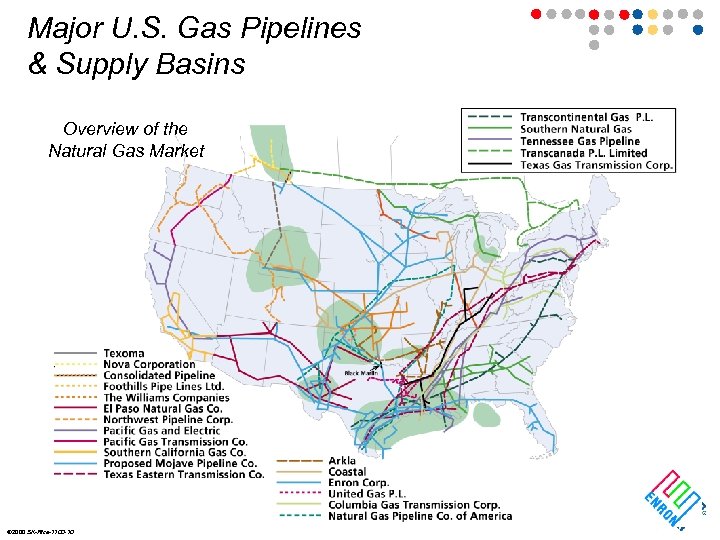 Major U. S. Gas Pipelines & Supply Basins Overview of the Natural Gas Market ã 2000 SK-Rice-1100 -10
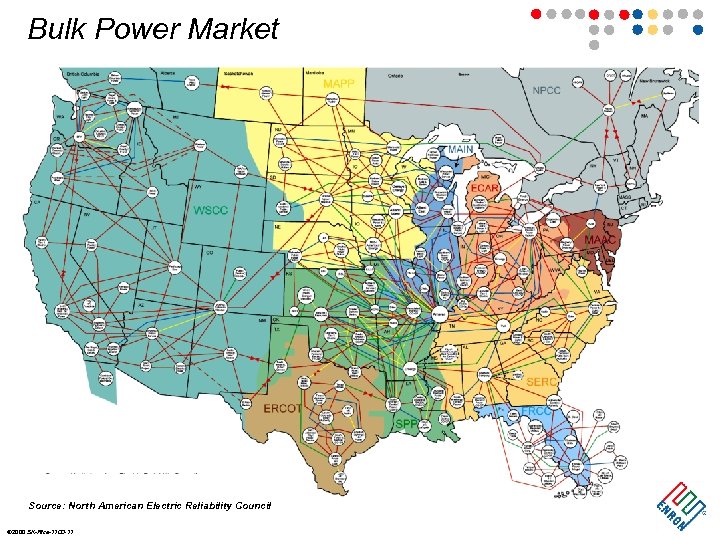 Bulk Power Market Source: North American Electric Reliability Council ã 2000 SK-Rice-1100 -11
 Key Characteristics of U. S. Energy Market and Regulation • Primary reliance on private companies under regulatory supervision • Regulatory responsibility split between state and federal authorities - Wholesale - federal - Retail - state • Increase reliance on open markets over last two decades ã 2000 SK-Rice-1100 -12
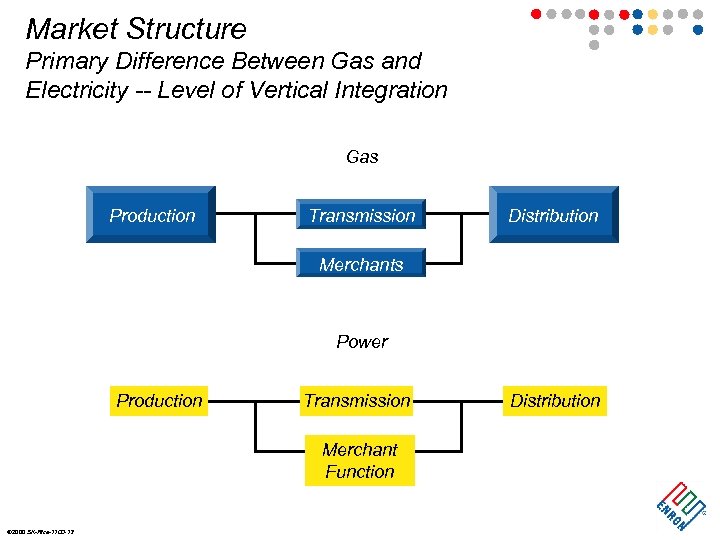 Market Structure Primary Difference Between Gas and Electricity -- Level of Vertical Integration Gas Production Transmission Distribution Merchants Power Production Transmission Merchant Function ã 2000 SK-Rice-1100 -13 Distribution
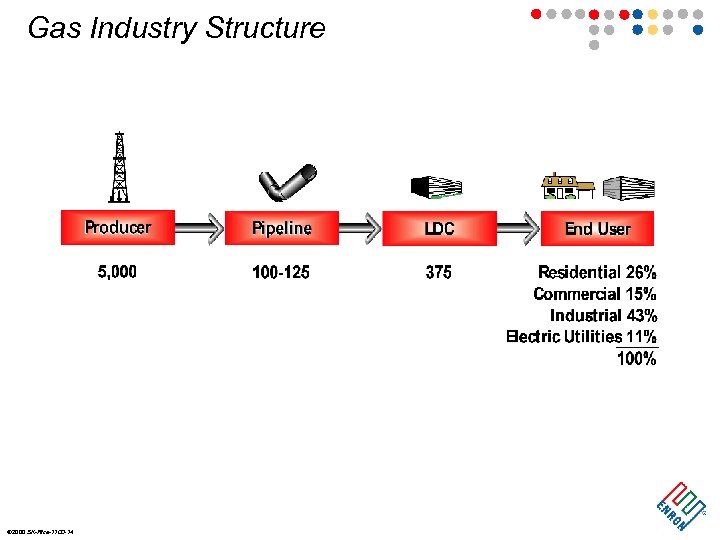 Gas Industry Structure ã 2000 SK-Rice-1100 -14
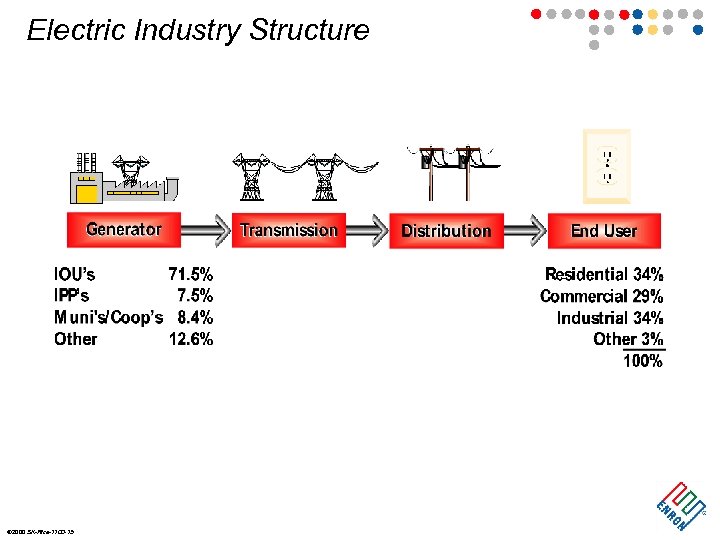 Electric Industry Structure ã 2000 SK-Rice-1100 -15
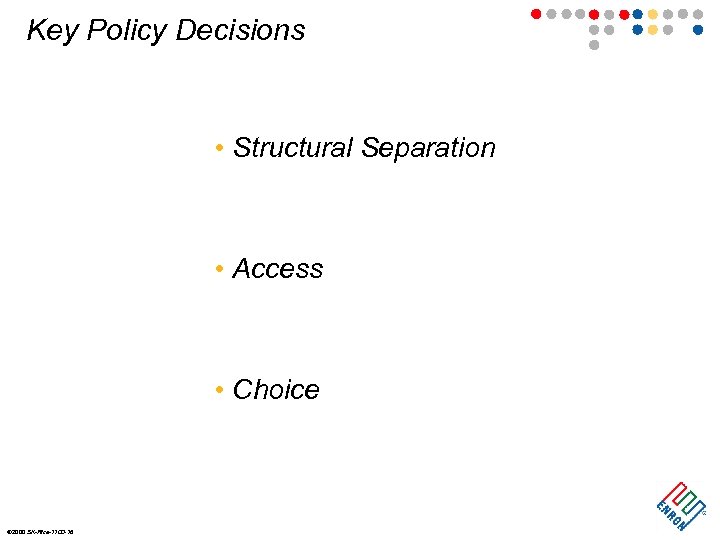 Key Policy Decisions • Structural Separation • Access • Choice ã 2000 SK-Rice-1100 -16
 Key Policy Decisions • Structure – Independent regulator – Separation of natural monopoly functions – Regulation focused on access to monopoly services • Access – Equal access to transmission and distribution services through nondiscriminatory tariffs – separation of costs – separation of transmission/distribution from sales service – Interconnection on nondiscriminatory terms • Choice – Deregulation of transaction terms and prices for competitive services (sales) ã 2000 SK-Rice-1100 -17
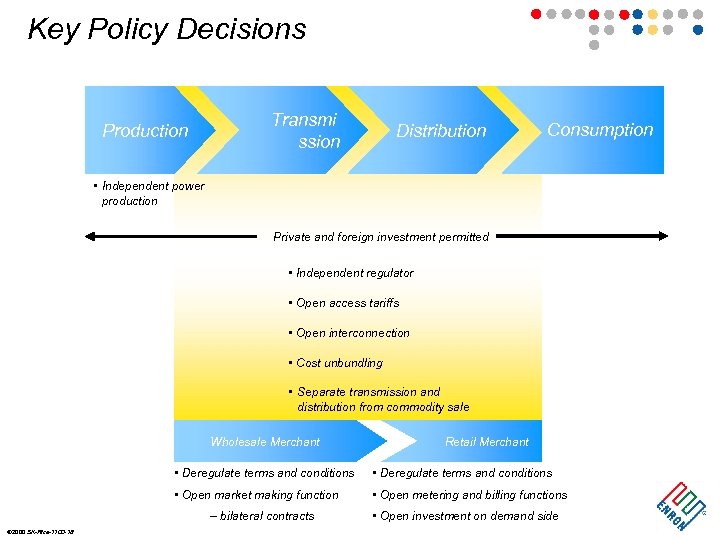 Key Policy Decisions Production Transmi ssion Distribution Consumption • Independent power production Private and foreign investment permitted • Independent regulator • Open access tariffs • Open interconnection • Cost unbundling • Separate transmission and distribution from commodity sale Wholesale Merchant Retail Merchant • Deregulate terms and conditions • Open market making function • Open metering and billing functions – bilateral contracts ã 2000 SK-Rice-1100 -18 • Open investment on demand side
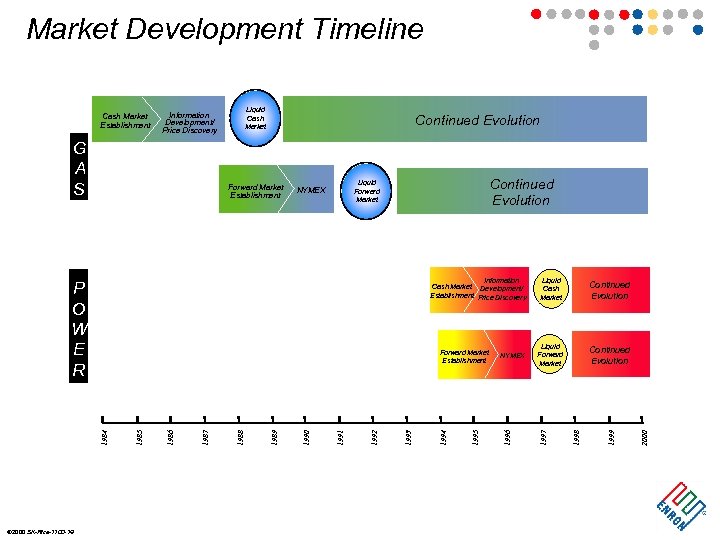 Market Development Timeline Continued Evolution Liquid Forward Market NYMEX Information Cash Market Development/ Establishment Price Discovery ã 2000 SK-Rice-1100 -19 1995 1994 1993 1992 1991 1990 1989 1988 1987 1986 1985 1984 Forward Market Establishment NYMEX 1996 P P O W W E E R R Liquid Cash Market Continued Evolution Liquid Forward Market Continued Evolution 2000 Forward Market Establishment 1999 G A S S Liquid Cash Market 1998 Information Development/ Price Discovery 1997 Cash Market Establishment
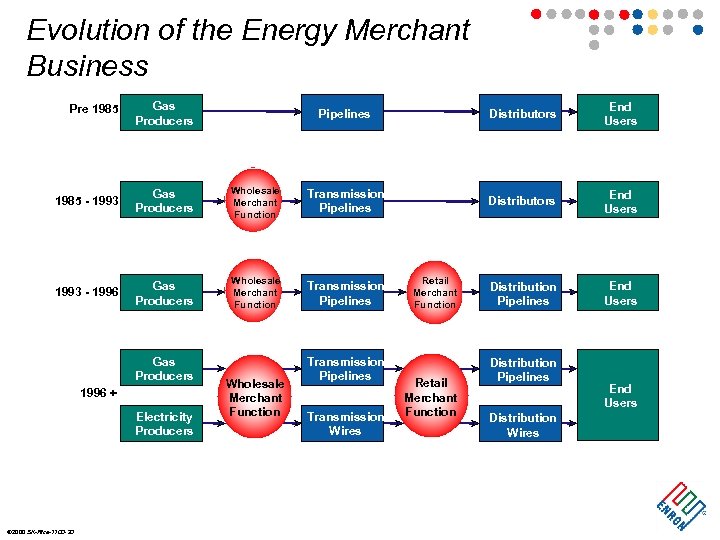 Evolution of the Energy Merchant Business Pre 1985 Gas Producers 1985 - 1993 Gas Producers 1993 - 1996 Gas Producers 1996 + Electricity Producers ã 2000 SK-Rice-1100 -20 Pipelines Distributors End Users Wholesale Merchant Function Transmission Pipelines Distribution Pipelines End Users Wholesale Merchant Function Transmission Pipelines Transmission Wires Retail Merchant Function Distribution Pipelines Distribution Wires End Users
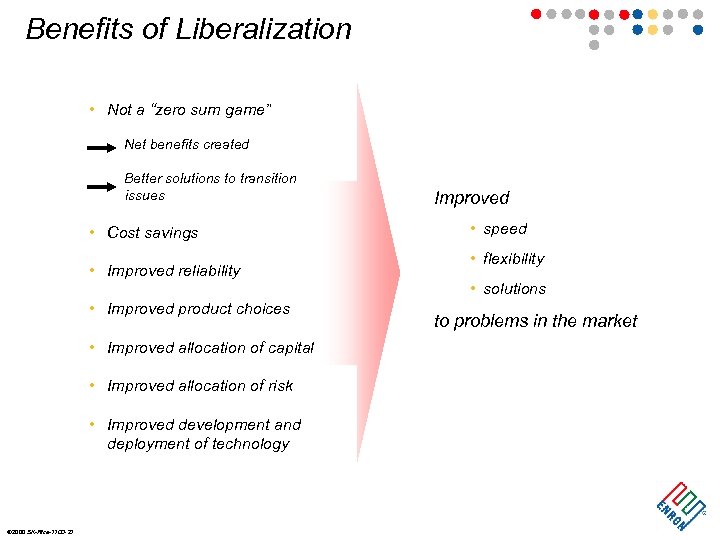 Benefits of Liberalization • Not a “zero sum game” Net benefits created Better solutions to transition issues • Cost savings • Improved reliability • Improved product choices • Improved allocation of capital • Improved allocation of risk • Improved development and deployment of technology ã 2000 SK-Rice-1100 -21 Improved • speed • flexibility • solutions to problems in the market
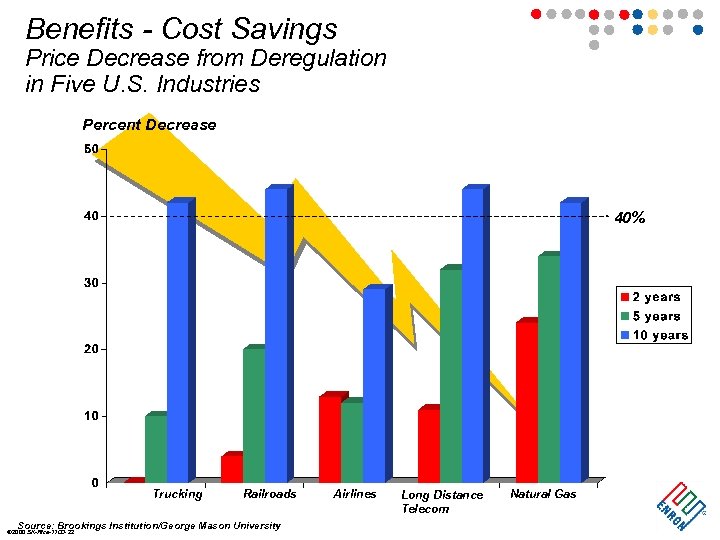 Benefits - Cost Savings Price Decrease from Deregulation in Five U. S. Industries Percent Decrease 40% Trucking Railroads Source: Brookings Institution/George Mason University ã 2000 SK-Rice-1100 -22 Airlines Long Distance Telecom Natural Gas
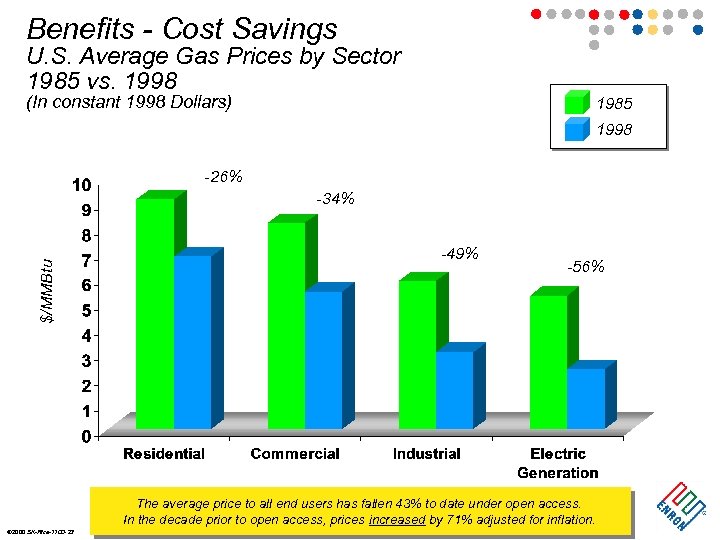 Benefits - Cost Savings U. S. Average Gas Prices by Sector 1985 vs. 1998 (In constant 1998 Dollars) 1985 1998 -26% $/MMBtu -34% -49% -56% The average price to all end users has fallen 43% to date under open access. In the decade prior to open access, prices increased by 71% adjusted for inflation. ã 2000 SK-Rice-1100 -23
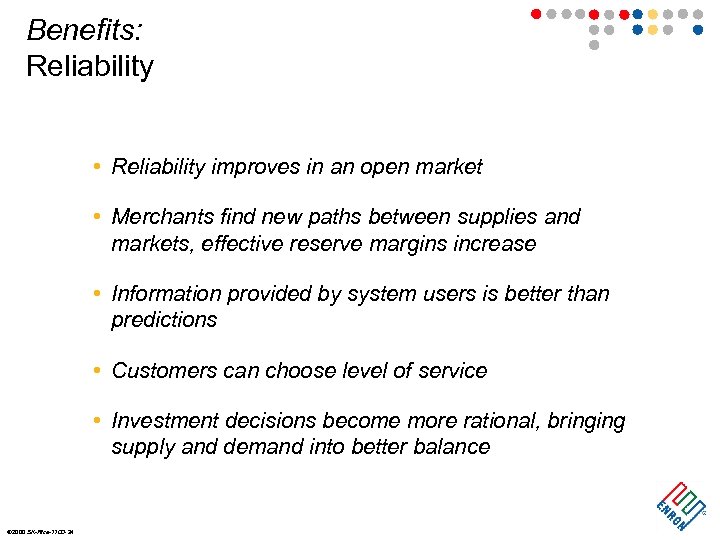 Benefits: Reliability • Reliability improves in an open market • Merchants find new paths between supplies and markets, effective reserve margins increase • Information provided by system users is better than predictions • Customers can choose level of service • Investment decisions become more rational, bringing supply and demand into better balance ã 2000 SK-Rice-1100 -24
 Benefits: Product Choice • Electrons are fungible but contract terms and contracting parties are not • Physical product differentiation – quantity – delivery terms - firm, nonfirm and everything in between – flexibility to changes in load requirements (timing) – flexibility in take obligations - equipment – ease -- combining services ã 2000 SK-Rice-1100 -25
 Benefits: Efficiency in Capital Investment (avoiding future stranded costs) • Open market produces forward price signals – market-driven, not projections – signals producers whether investment in new facilities will be supported by the market • Open market forces producers to find lowest cost solution – enhancements to existing facilities – conservation, DSM investments – “debottlenecking” of existing system • Forward market makes it possible to finance long term investments more economically ã 2000 SK-Rice-1100 -26
 Benefits: More efficient allocation of risk • Price volatility imposes costs separate and apart from price level – investors – manufacturers • Today, risks of price volatility are allocated to those who are least able to handle them - end users • In an open market, risk is allocated to those in the best position to manage it - intermediaries ã 2000 SK-Rice-1100 -27
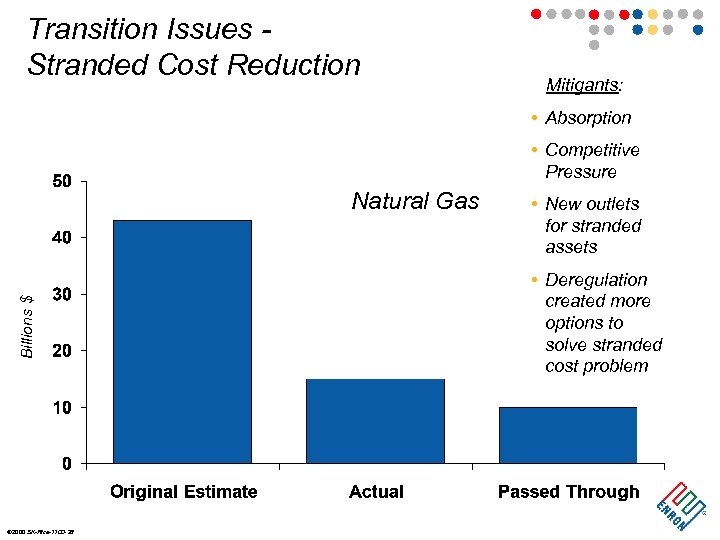 Transition Issues Stranded Cost Reduction Mitigants: • Absorption • Competitive Pressure Billions $ Natural Gas ã 2000 SK-Rice-1100 -28 • New outlets for stranded assets • Deregulation created more options to solve stranded cost problem
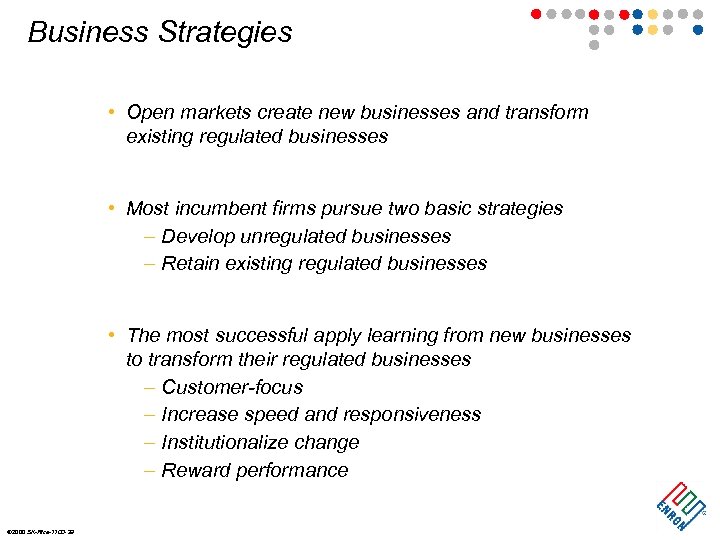 Business Strategies • Open markets create new businesses and transform existing regulated businesses • Most incumbent firms pursue two basic strategies – Develop unregulated businesses – Retain existing regulated businesses • The most successful apply learning from new businesses to transform their regulated businesses – Customer-focus – Increase speed and responsiveness – Institutionalize change – Reward performance ã 2000 SK-Rice-1100 -29
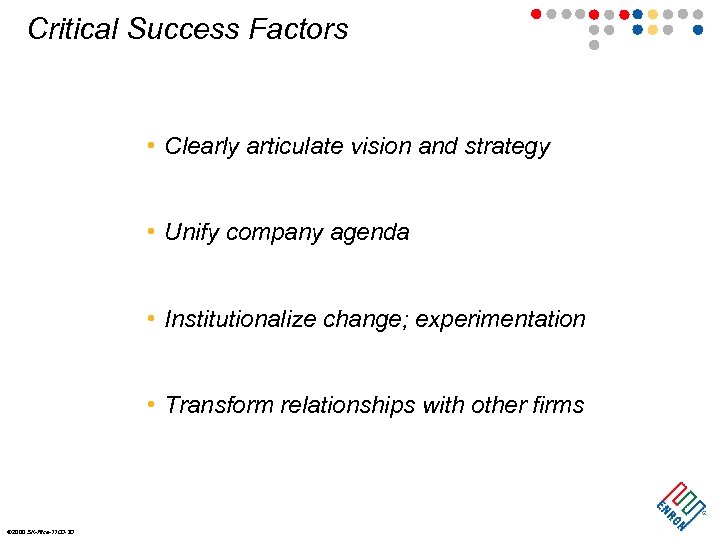 Critical Success Factors • Clearly articulate vision and strategy • Unify company agenda • Institutionalize change; experimentation • Transform relationships with other firms ã 2000 SK-Rice-1100 -30
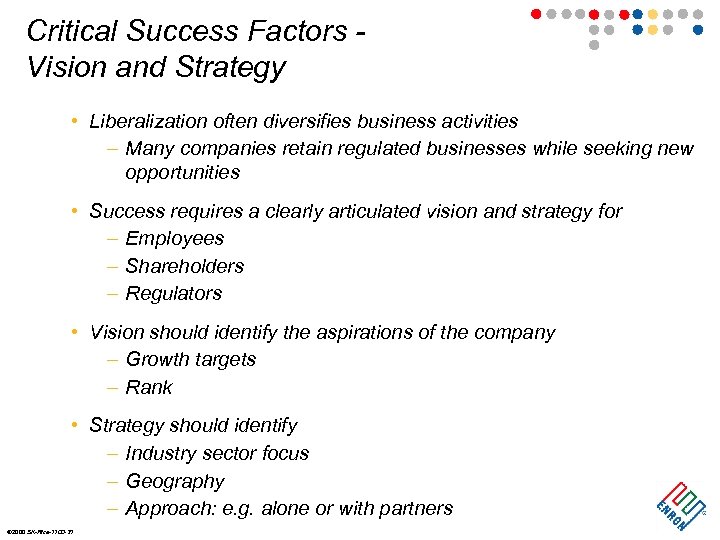 Critical Success Factors Vision and Strategy • Liberalization often diversifies business activities – Many companies retain regulated businesses while seeking new opportunities • Success requires a clearly articulated vision and strategy for – Employees – Shareholders – Regulators • Vision should identify the aspirations of the company – Growth targets – Rank • Strategy should identify – Industry sector focus – Geography – Approach: e. g. alone or with partners ã 2000 SK-Rice-1100 -31
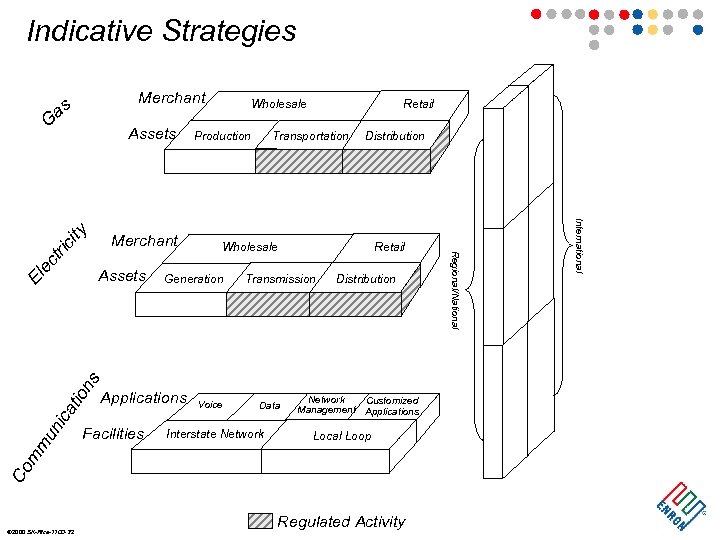 Indicative Strategies Merchant as G ec Facilities Retail Wholesale Generation Applications Distribution Voice Transmission Data Interstate Network Distribution Network Customized Management Applications Local Loop Co m m un ica tio ns El Assets Transportation ã 2000 SK-Rice-1100 -32 Regulated Activity Regional/National tri cit Merchant Production International y Assets Retail Wholesale
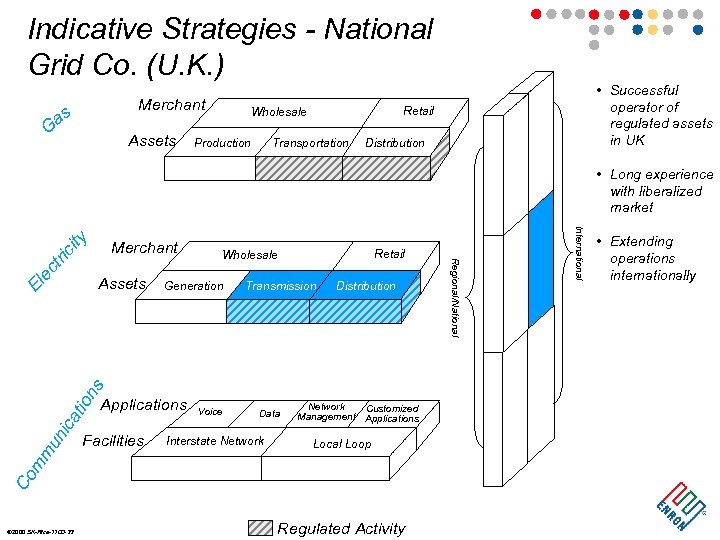 Indicative Strategies - National Grid Co. (U. K. ) Merchant as G Assets Retail Wholesale Production • Successful operator of regulated assets in UK Transportation Distribution ec Generation Transmission Distribution Applications Facilities Voice Data Interstate Network Customized Management Applications Local Loop Co m m un ica tio ns El Assets Retail Wholesale ã 2000 SK-Rice-1100 -33 Regulated Activity Regional/National tri Merchant International cit y • Long experience with liberalized market • Extending operations internationally
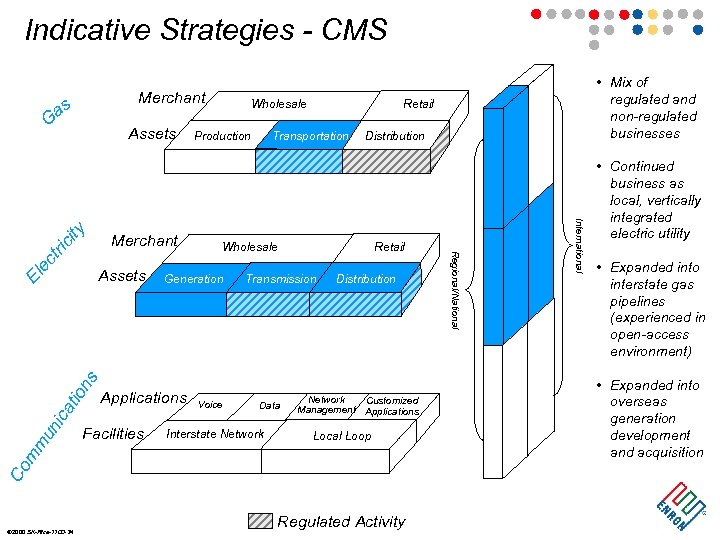 Indicative Strategies - CMS Merchant as G tri cit Facilities Distribution Retail Wholesale Generation Applications Transportation Voice Transmission Data Interstate Network Distribution Network Customized Management Applications Local Loop Co m m un ica tio ns El Assets Production ã 2000 SK-Rice-1100 -34 Regulated Activity Regional/National ec Merchant Retail Wholesale International y Assets • Mix of regulated and non-regulated businesses • Continued business as local, vertically integrated electric utility • Expanded into interstate gas pipelines (experienced in open-access environment) • Expanded into overseas generation development and acquisition
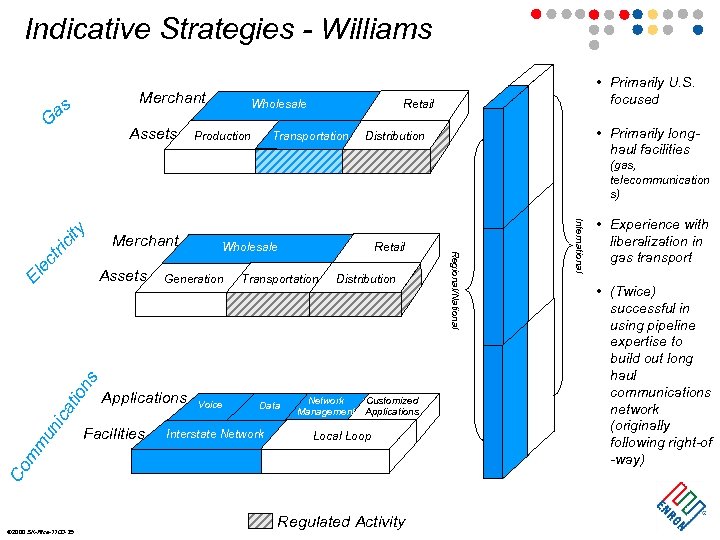 Indicative Strategies - Williams Merchant as G Assets Retail Wholesale Production • Primarily U. S. focused Transportation • Primarily longhaul facilities Distribution tri cit Generation Applications Facilities Voice Transportation Data Interstate Network Distribution Network Customized Management Applications Local Loop Co m m un ica tio ns El Assets Retail Wholesale ã 2000 SK-Rice-1100 -35 Regulated Activity Regional/National ec Merchant International y (gas, telecommunication s) • Experience with liberalization in gas transport • (Twice) successful in using pipeline expertise to build out long haul communications network (originally following right-of -way)
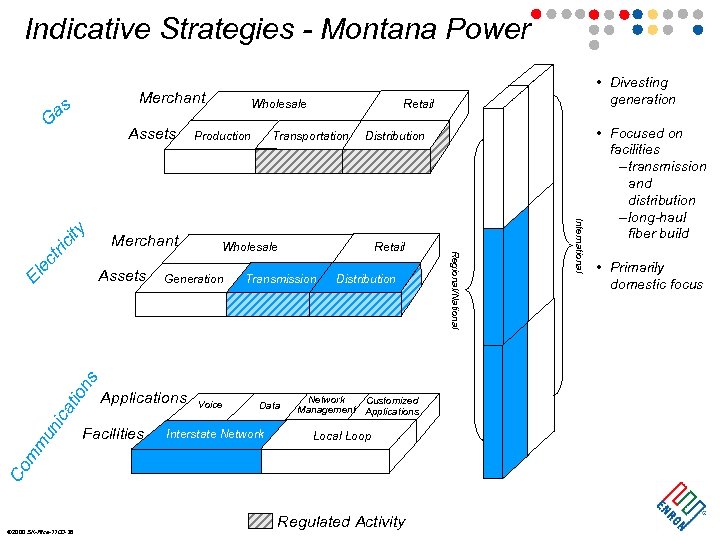 Indicative Strategies - Montana Power Merchant as G tri cit Facilities Distribution Retail Wholesale Generation Applications Transportation Voice Transmission Data Interstate Network Distribution Network Customized Management Applications Local Loop Co m m un ica tio ns El Assets Production ã 2000 SK-Rice-1100 -36 Regulated Activity Regional/National ec Merchant Retail Wholesale International y Assets • Divesting generation • Focused on facilities – transmission and distribution – long-haul fiber build • Primarily domestic focus
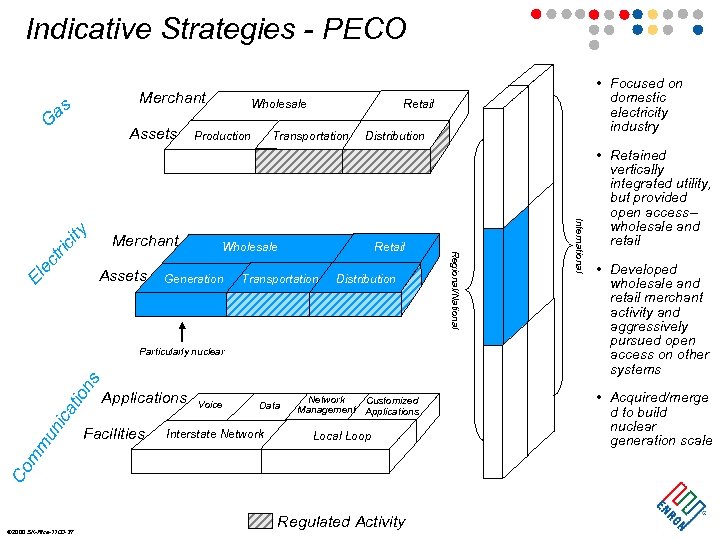 Indicative Strategies - PECO Merchant as G ec El Assets Production Transportation Distribution Retail Wholesale Generation Transportation Distribution Applications Facilities Voice Data Interstate Network Customized Management Applications Local Loop Co m m un ica tio ns Particularly nuclear ã 2000 SK-Rice-1100 -37 Regulated Activity Regional/National tri cit Merchant Retail Wholesale International y Assets • Focused on domestic electricity industry • Retained vertically integrated utility, but provided open access-wholesale and retail • Developed wholesale and retail merchant activity and aggressively pursued open access on other systems • Acquired/merge d to build nuclear generation scale
 Critical Success Factors Unifying Company Agenda • Because liberalization takes place in public arena, incumbent firms must take a position • For employees, regulators, shareholders and customers a consistent, clear message is essential • Those who elect to participate in new businesses enabled by liberalization most often position themselves in favor of liberalization – Reconcile internal conflicts between existing and new businesses – Direct existing, regulated businesses to a new vision -selling transmission/delivery service rather than selling commodity • Many companies elect to exit the commodity business ã 2000 SK-Rice-1100 -38
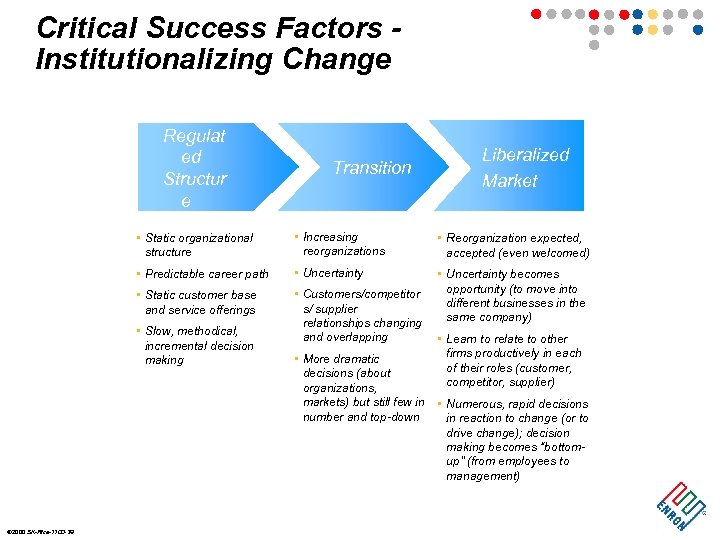 Critical Success Factors Institutionalizing Change Regulat ed Structur e Transition Liberalized Market • Static organizational structure • Increasing reorganizations • Reorganization expected, accepted (even welcomed) • Predictable career path • Uncertainty • Static customer base and service offerings • Customers/competitor s/ supplier relationships changing and overlapping • Uncertainty becomes opportunity (to move into different businesses in the same company) • Slow, methodical, incremental decision making ã 2000 SK-Rice-1100 -39 • More dramatic decisions (about organizations, markets) but still few in number and top-down • Learn to relate to other firms productively in each of their roles (customer, competitor, supplier) • Numerous, rapid decisions in reaction to change (or to drive change); decision making becomes “bottomup” (from employees to management)
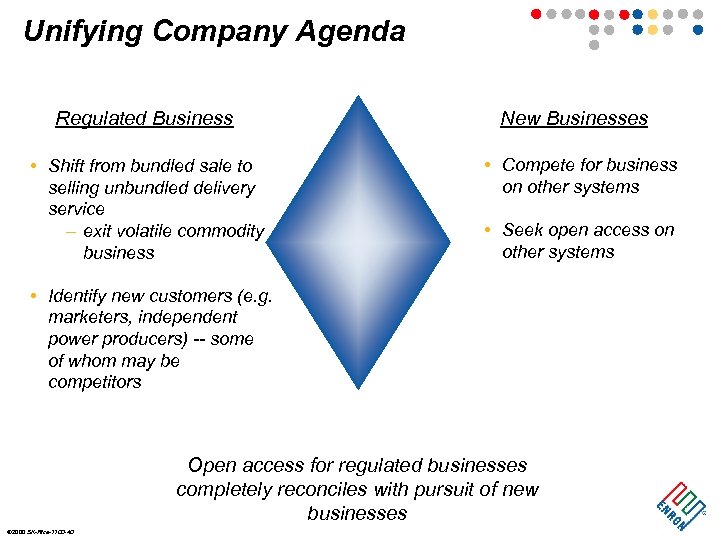 Unifying Company Agenda Regulated Business • Shift from bundled sale to selling unbundled delivery service – exit volatile commodity business New Businesses • Compete for business on other systems • Seek open access on other systems • Identify new customers (e. g. marketers, independent power producers) -- some of whom may be competitors Open access for regulated businesses completely reconciles with pursuit of new businesses ã 2000 SK-Rice-1100 -40
 Critical Success Factors - Transform Relationships with Other Firms • As roles change within industry former customers and suppliers may become competitors • Initially, relationships tense • As company articulates a vision/strategy/organization the company begins to relate to other companies productively regardless of their role (“compartmentalize” relationships) – Customer – Supplier – Competitor – Joint venture partner ã 2000 SK-Rice-1100 -41
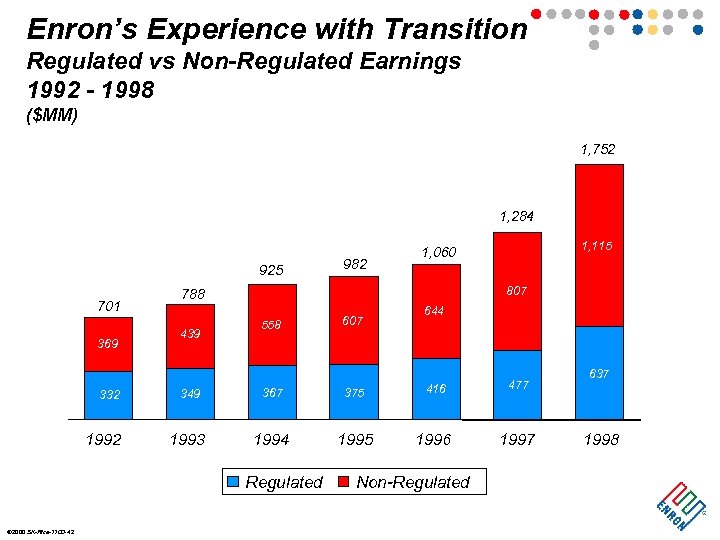 Enron’s Experience with Transition Regulated vs Non-Regulated Earnings 1992 - 1998 ($MM) 1, 752 1, 284 925 701 369 332 1992 807 788 439 558 607 644 349 367 375 416 477 1993 1994 1995 1996 1997 Regulated ã 2000 SK-Rice-1100 -42 982 1, 115 1, 060 Non-Regulated 637 1998
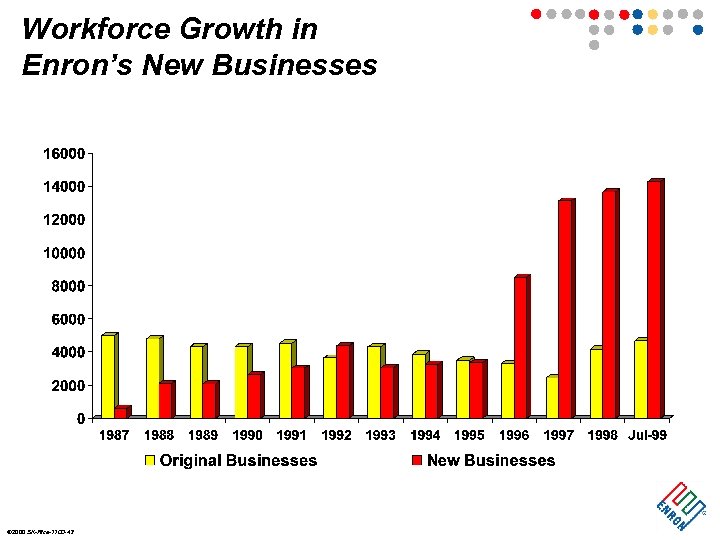 Workforce Growth in Enron’s New Businesses ã 2000 SK-Rice-1100 -43
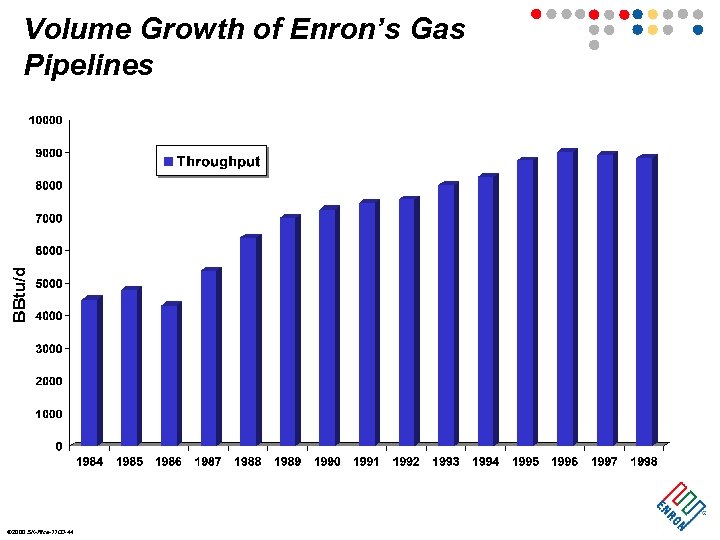 BBtu/d Volume Growth of Enron’s Gas Pipelines ã 2000 SK-Rice-1100 -44
 Enron Business Model ã 2000 SK-Rice-1100 -45
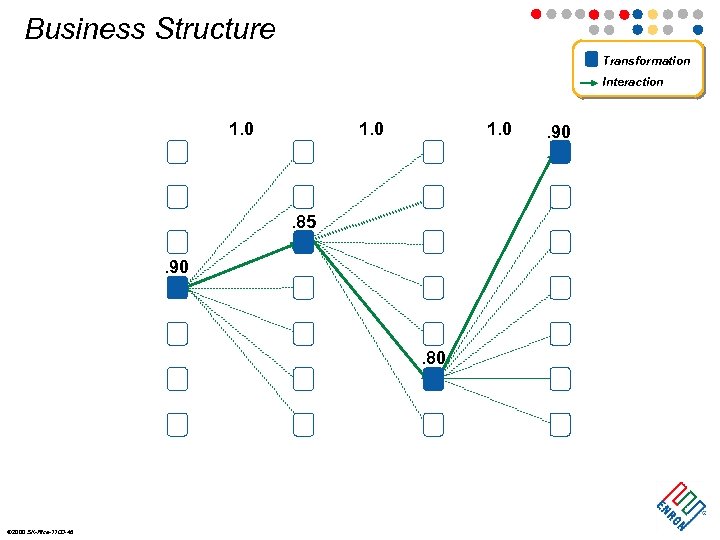 Business Structure Transformation Interaction 1. 0 . 85. 90 . 80 ã 2000 SK-Rice-1100 -46 . 90
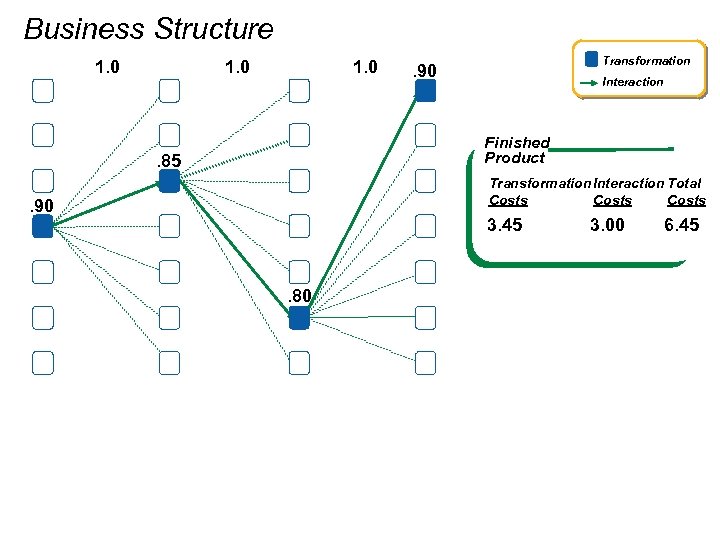 Business Structure 1. 0 Transformation . 90 Interaction Finished Product . 85 Transformation Interaction Total Costs . 90 3. 45 . 80 3. 00 6. 45
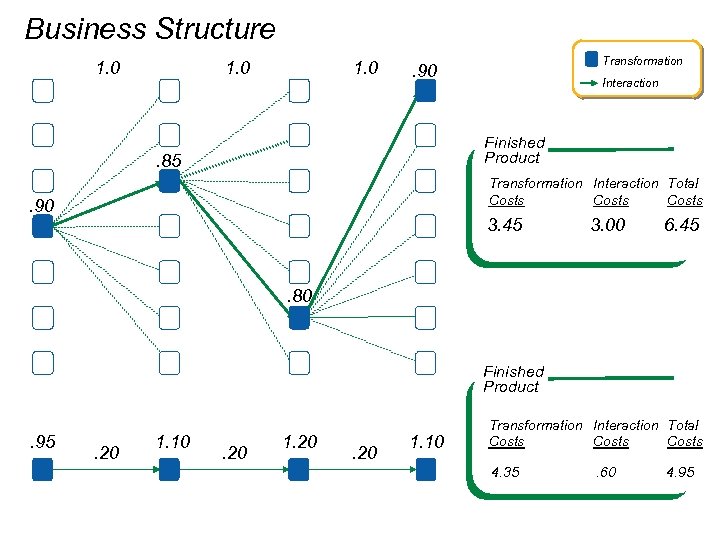 Business Structure 1. 0 Transformation . 90 Interaction Finished Product . 85 Transformation Interaction Total Costs . 90 3. 45 3. 00 6. 45 . 80 Finished Product . 95 . 20 1. 10 Transformation Interaction Total Costs 4. 35 . 60 4. 95
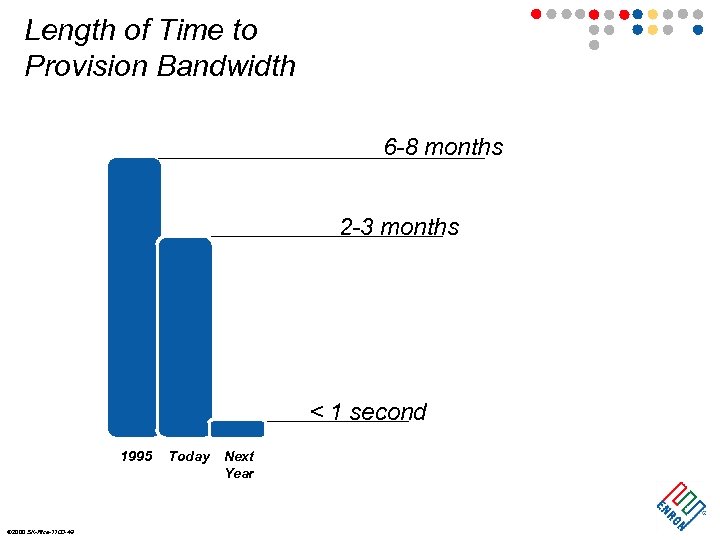 Length of Time to Provision Bandwidth 6 -8 months 2 -3 months < 1 second 1995 ã 2000 SK-Rice-1100 -49 Today Next Year
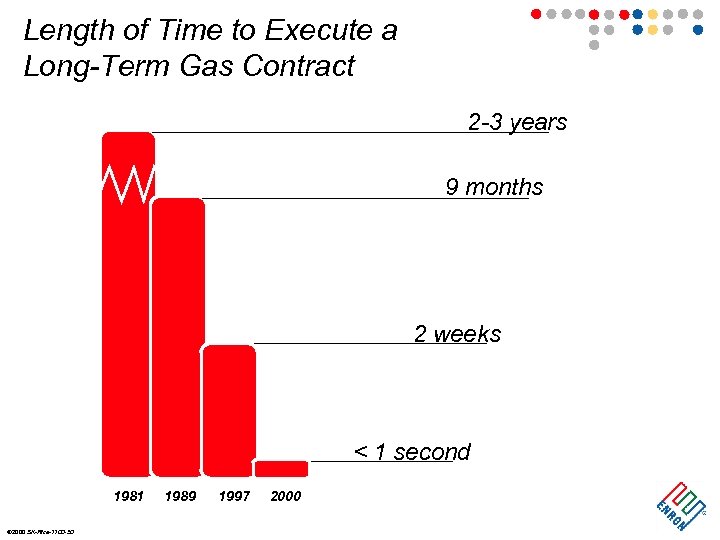 Length of Time to Execute a Long-Term Gas Contract 2 -3 years 9 months 2 weeks < 1 second 1981 ã 2000 SK-Rice-1100 -50 1989 1997 2000
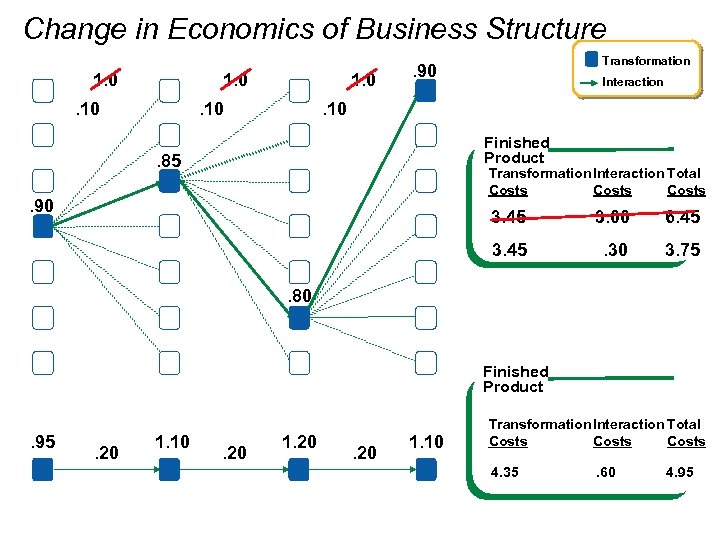 Change in Economics of Business Structure 1. 0 . 10 Transformation . 90 Interaction . 10 Finished Product . 85 Transformation Interaction Total Costs . 90 3. 45 3. 00 6. 45 3. 45 . 30 3. 75 . 80 Finished Product . 95 . 20 1. 10 Transformation Interaction Total Costs 4. 35 . 60 4. 95
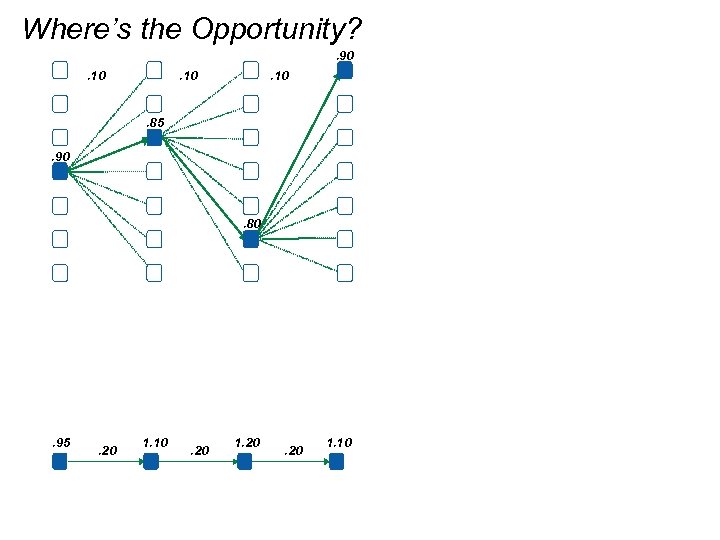 Where’s the Opportunity? . 90. 10 . 85. 90 . 80 . 95 . 20 1. 10
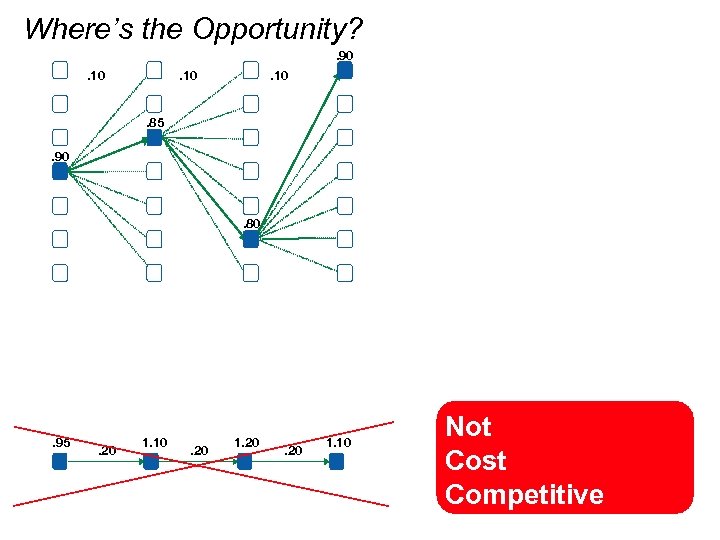 Where’s the Opportunity? . 90. 10 . 85. 90 . 80 . 95 . 20 1. 10 Not Cost Competitive
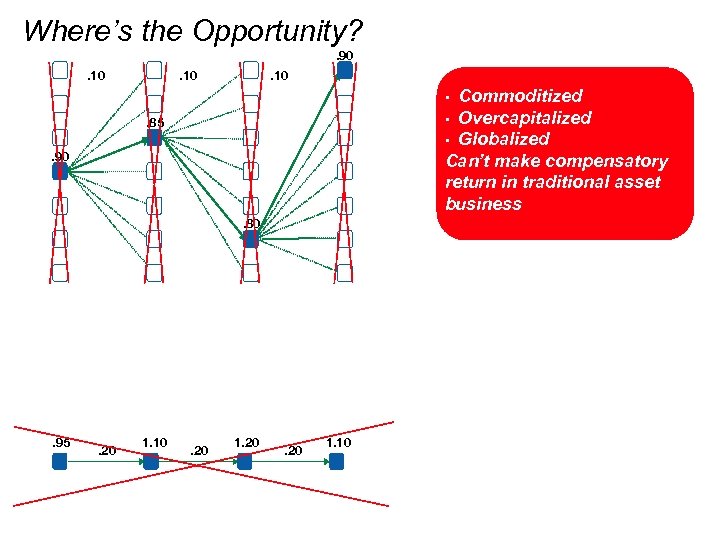 Where’s the Opportunity? . 90. 10 Commoditized • Overcapitalized • Globalized Can’t make compensatory return in traditional asset business • . 85. 90 . 80 . 95 . 20 1. 10
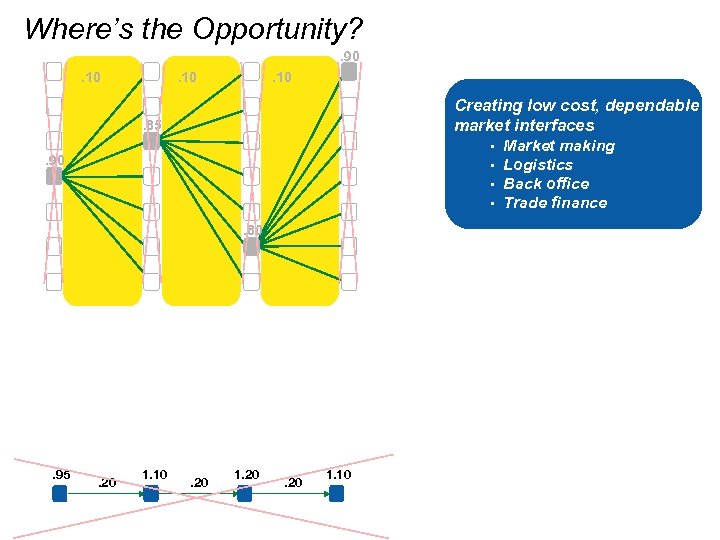 Where’s the Opportunity? . 90. 10 Creating low cost, dependable market interfaces . 85 • . 90 • • • . 80 . 95 . 20 1. 10 Market making Logistics Back office Trade finance
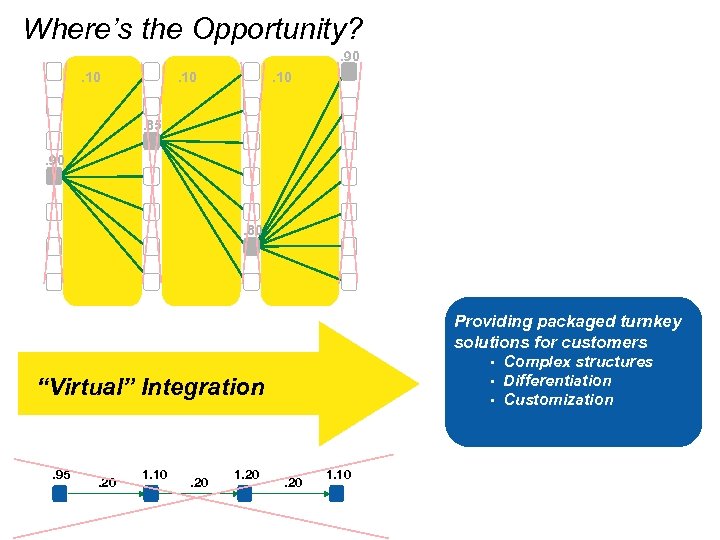 Where’s the Opportunity? . 90. 10 . 85. 90 . 80 Providing packaged turnkey solutions for customers • “Virtual” Integration . 95 . 20 1. 10 . 20 1. 20 • • . 20 1. 10 Complex structures Differentiation Customization
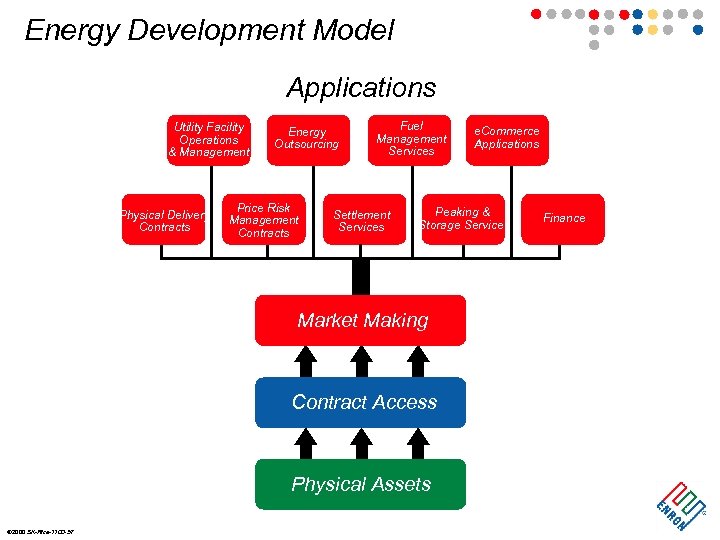 Energy Development Model Applications Utility Facility Operations & Management Physical Delivery Contracts Energy Outsourcing Price Risk Management Contracts Fuel Management Services Settlement Services Peaking & Storage Services Market Making Contract Access Physical Assets ã 2000 SK-Rice-1100 -57 e. Commerce Applications Finance
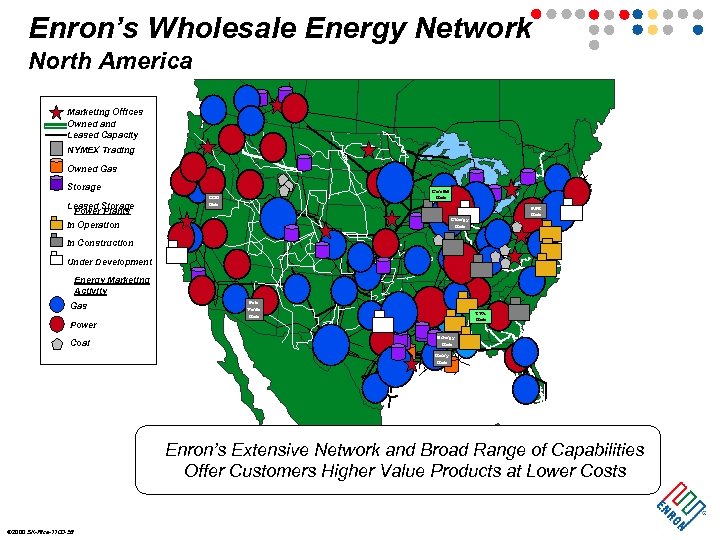 Enron’s Wholesale Energy Network North America Marketing Offices Owned and Leased Capacity NYMEX Trading Owned Gas Storage Leased Storage Power Plants COB Hub Com. Ed Hub PJM Hub Cinergy Hub In Operation In Construction Under Development Energy Marketing Activity Gas Palo Verde Hub TVA Hub Power Coal Entergy Hub Henry Hub Enron’s Extensive Network and Broad Range of Capabilities Offer Customers Higher Value Products at Lower Costs ã 2000 SK-Rice-1100 -58
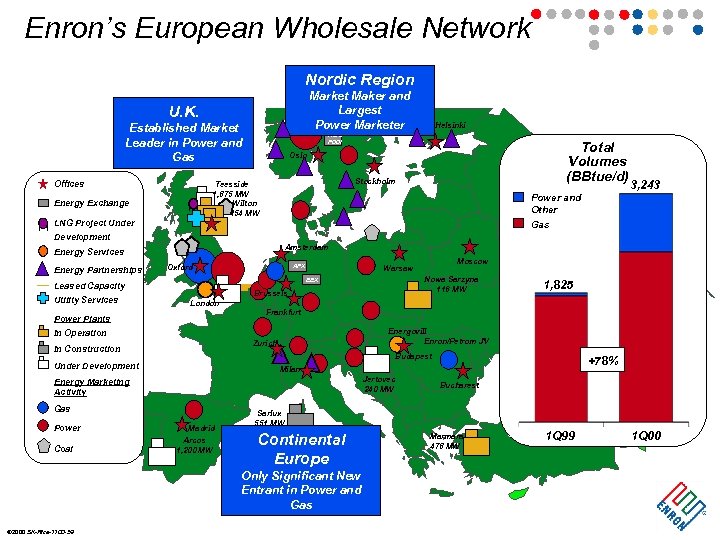 Enron’s European Wholesale Network Nordic Region Market Maker and Largest Power Marketer U. K. Established Market Leader in Power and Gas Offices Total Volumes (BBtue/d) Oslo Stockholm Teesside 1, 875 MW Wilton 154 MW Energy Exchange Helsinki Nord Pool 3, 243 Power and Other LNG Project Under Gas Development Amsterdam Energy Services Energy Partnerships Power Plants Energovill Enron/Petrom JV Zurich In Construction Budapest Under Development Jertovec 240 MW Gas Madrid Arcos 1, 200 MW Bucharest Sarlux 551 MW Continental Europe Only Significant New Entrant in Power and Gas ã 2000 SK-Rice-1100 -59 +78% Milan Energy Marketing Activity Coal 1, 825 Frankfurt In Operation Power Nowa Sarzyna 116 MW Brussels London Moscow Warsaw EEX Leased Capacity Utility Services APX Oxford Marmara 478 MW 1 Q 99 1 Q 00
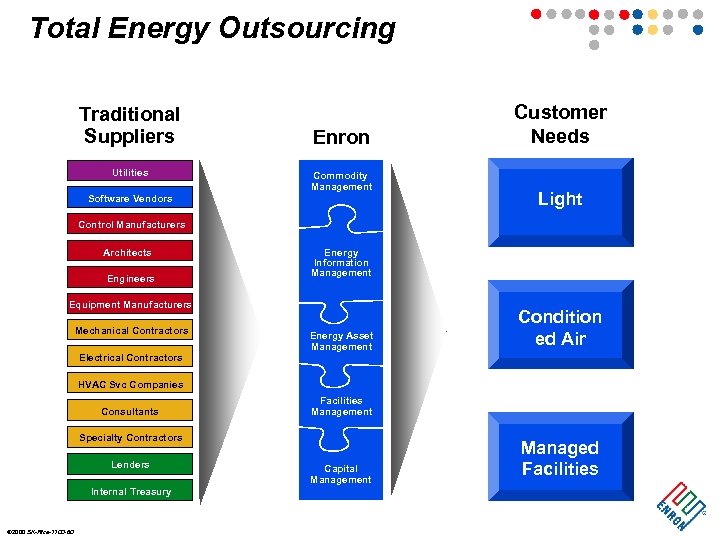 Total Energy Outsourcing Traditional Suppliers Utilities Enron Commodity Management Software Vendors Customer Needs Light Control Manufacturers Architects Engineers Energy Information Management Equipment Manufacturers Mechanical Contractors Energy Asset Management Condition ed Air Electrical Contractors HVAC Svc Companies Consultants Facilities Management Specialty Contractors Lenders Internal Treasury ã 2000 SK-Rice-1100 -60 Capital Management Managed Facilities
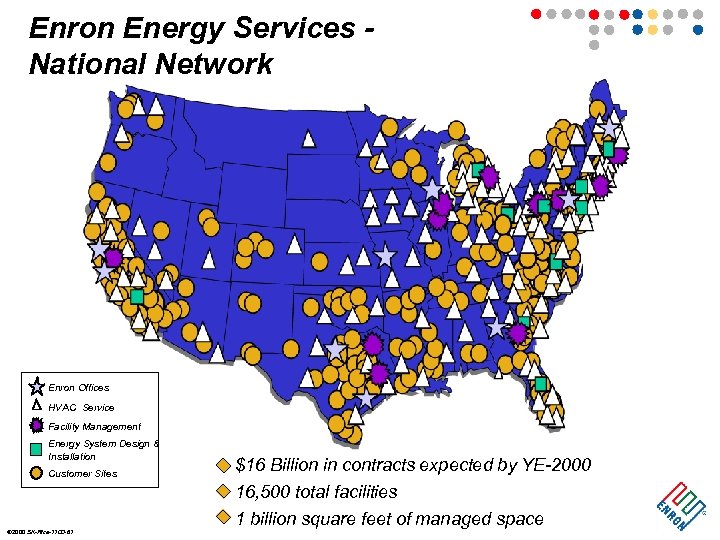 Enron Energy Services National Network Enron Offices HVAC Service Facility Management Energy System Design & Installation Customer Sites ã 2000 SK-Rice-1100 -61 $16 Billion in contracts expected by YE-2000 16, 500 total facilities 1 billion square feet of managed space
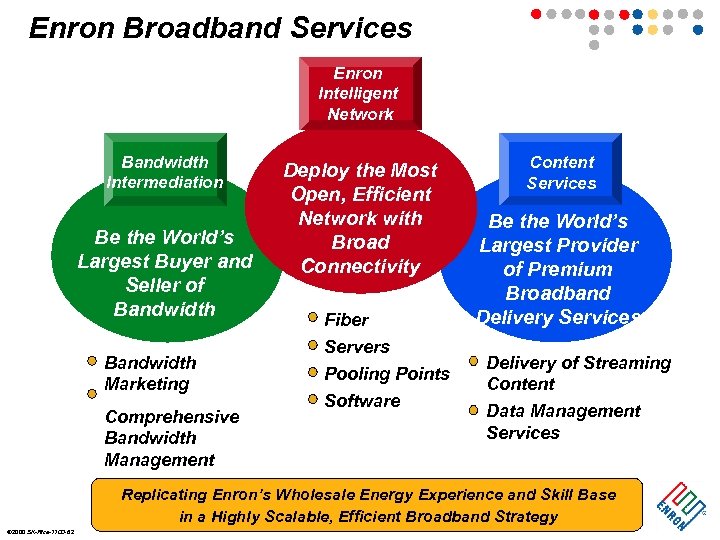 Enron Broadband Services Enron Intelligent Network Bandwidth Intermediation Be the World’s Largest Buyer and Seller of Bandwidth Marketing Comprehensive Bandwidth Management Deploy the Most Open, Efficient Network with Broad Connectivity Fiber Servers Pooling Points Software Content Services Be the World’s Largest Provider of Premium Broadband Delivery Services Delivery of Streaming Content Data Management Services Replicating Enron’s Wholesale Energy Experience and Skill Base in a Highly Scalable, Efficient Broadband Strategy ã 2000 SK-Rice-1100 -62
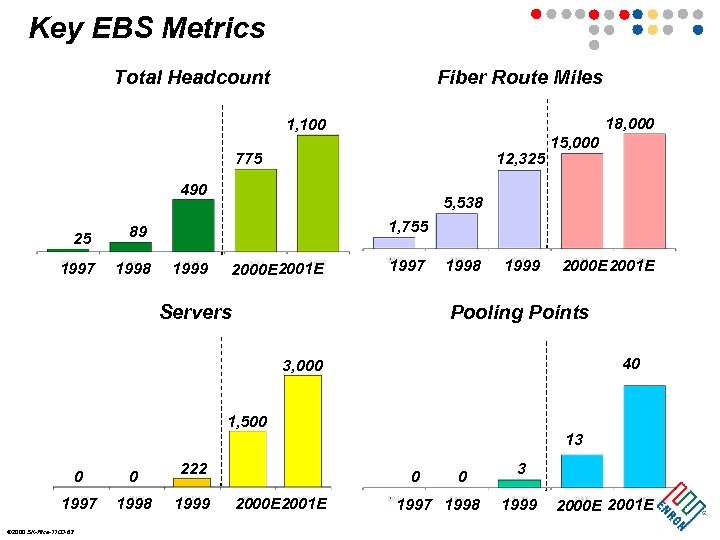 Key EBS Metrics Fiber Route Miles Total Headcount 18, 000 1, 100 775 12, 325 490 25 1998 5, 538 1, 755 89 1997 15, 000 1999 2000 E 2001 E 1997 Servers 1998 1999 2000 E 2001 E Pooling Points 40 3, 000 1, 500 13 0 0 1997 1998 ã 2000 SK-Rice-1100 -63 222 1999 0 2000 E 2001 E 0 1997 1998 3 1999 2000 E 2001 E
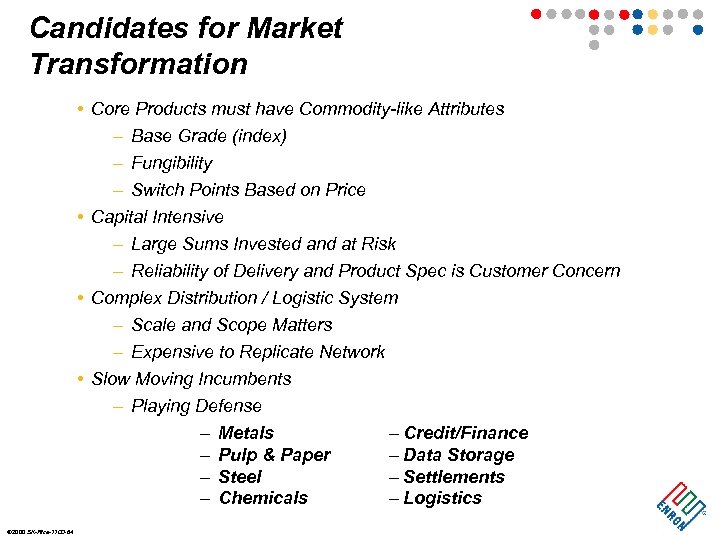 Candidates for Market Transformation • Core Products must have Commodity-like Attributes – Base Grade (index) – Fungibility – Switch Points Based on Price • Capital Intensive – Large Sums Invested and at Risk – Reliability of Delivery and Product Spec is Customer Concern • Complex Distribution / Logistic System – Scale and Scope Matters – Expensive to Replicate Network • Slow Moving Incumbents – Playing Defense – Metals – Credit/Finance – Pulp & Paper – Data Storage – Steel – Settlements – Chemicals – Logistics ã 2000 SK-Rice-1100 -64
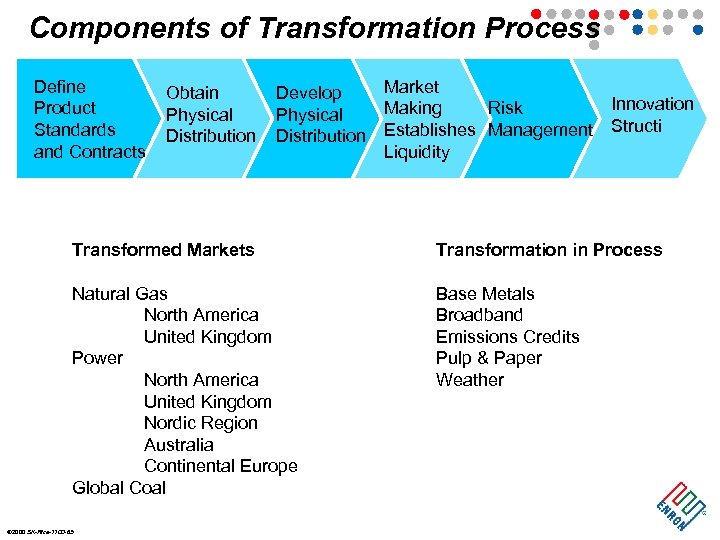 Components of Transformation Process Define Product Standards and Contracts Obtain Physical Distribution Market Develop Risk Making Physical Distribution Establishes Management Liquidity Innovation Structi Transformed Markets Transformation in Process Natural Gas North America United Kingdom Power North America United Kingdom Nordic Region Australia Continental Europe Global Coal Base Metals Broadband Emissions Credits Pulp & Paper Weather ã 2000 SK-Rice-1100 -65
 Putting the Energy into e-commerce™ ã 2000 SK-Rice-1100 -66
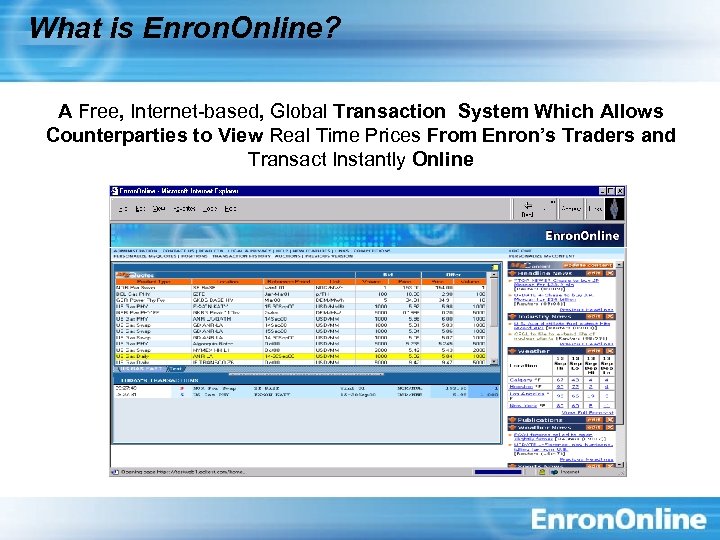 What is Enron. Online? A Free, Internet-based, Global Transaction System Which Allows Counterparties to View Real Time Prices From Enron’s Traders and Transact Instantly Online ã 2000 SK-Rice-1100 -67
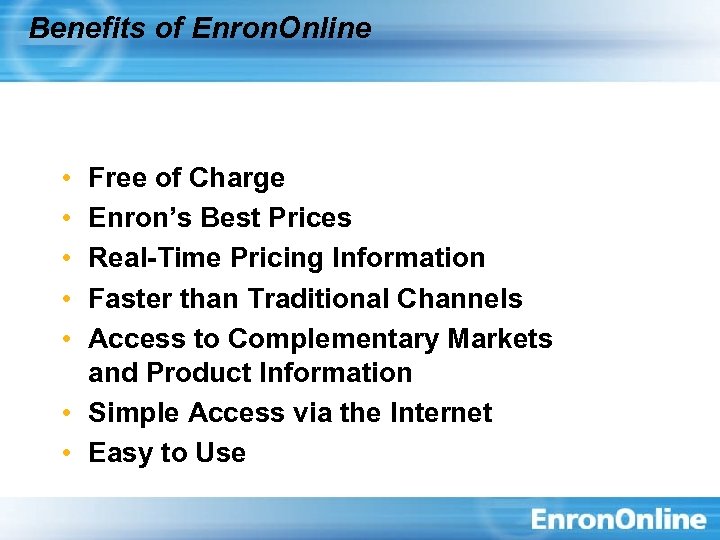 Benefits of Enron. Online • • • Free of Charge Enron’s Best Prices Real-Time Pricing Information Faster than Traditional Channels Access to Complementary Markets and Product Information • Simple Access via the Internet • Easy to Use ã 2000 SK-Rice-1100 -68
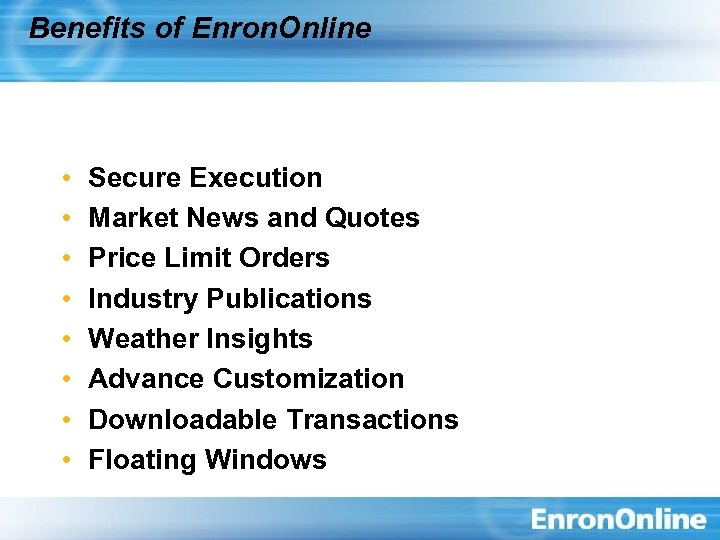 Benefits of Enron. Online • • ã 2000 SK-Rice-1100 -69 Secure Execution Market News and Quotes Price Limit Orders Industry Publications Weather Insights Advance Customization Downloadable Transactions Floating Windows
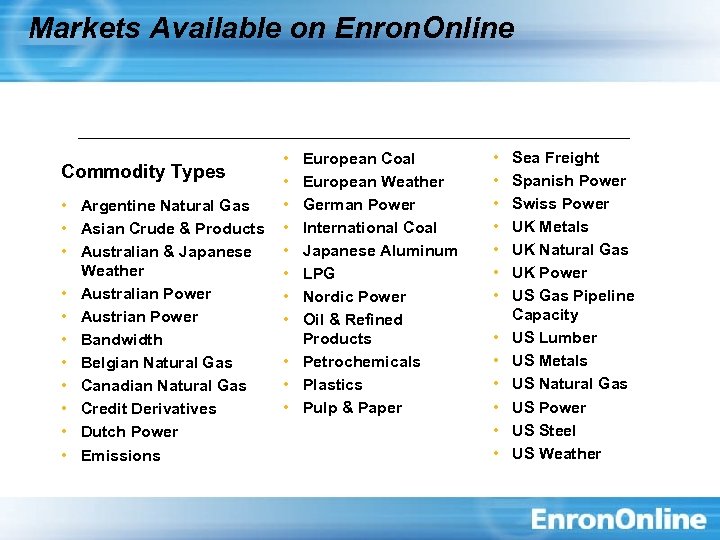 Markets Available on Enron. Online Commodity Types • Argentine Natural Gas • Asian Crude & Products • Australian & Japanese Weather • Australian Power • Austrian Power • Bandwidth • Belgian Natural Gas • Canadian Natural Gas • Credit Derivatives • Dutch Power • Emissions ã 2000 SK-Rice-1100 -70 • • European Coal European Weather German Power International Coal Japanese Aluminum LPG Nordic Power Oil & Refined Products • Petrochemicals • Plastics • Pulp & Paper • • • • Sea Freight Spanish Power Swiss Power UK Metals UK Natural Gas UK Power US Gas Pipeline Capacity US Lumber US Metals US Natural Gas US Power US Steel US Weather
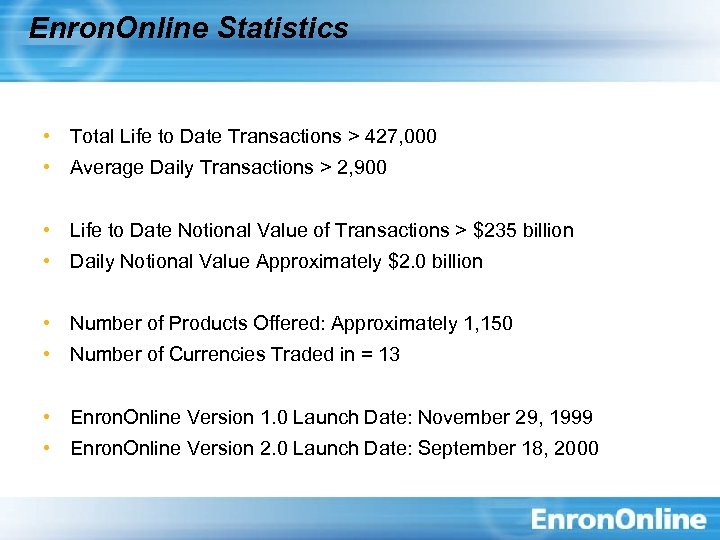 Enron. Online Statistics • Total Life to Date Transactions > 427, 000 • Average Daily Transactions > 2, 900 • Life to Date Notional Value of Transactions > $235 billion • Daily Notional Value Approximately $2. 0 billion • Number of Products Offered: Approximately 1, 150 • Number of Currencies Traded in = 13 • Enron. Online Version 1. 0 Launch Date: November 29, 1999 • Enron. Online Version 2. 0 Launch Date: September 18, 2000 ã 2000 SK-Rice-1100 -71
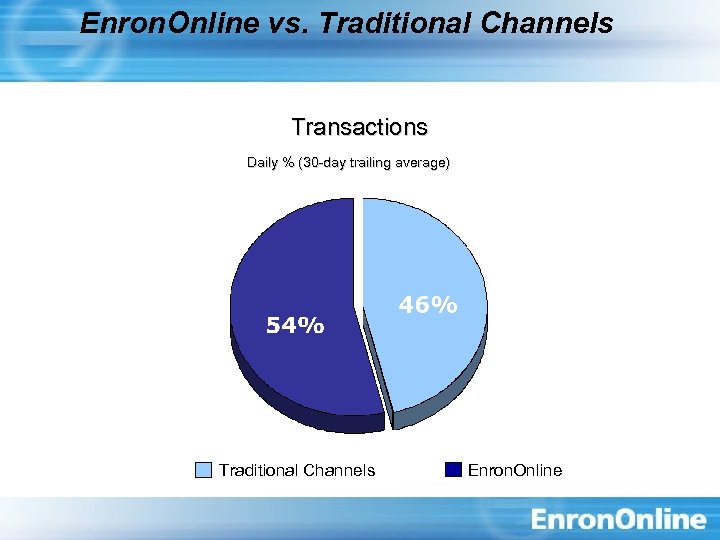 Enron. Online vs. Traditional Channels Transactions Daily % (30 -day trailing average) Traditional Channels ã 2000 SK-Rice-1100 -72 Enron. Online
 Conclusion ã 2000 SK-Rice-1100 -73
 Conclusion • Culture • Controls • Management Systems ã 2000 SK-Rice-1100 -74
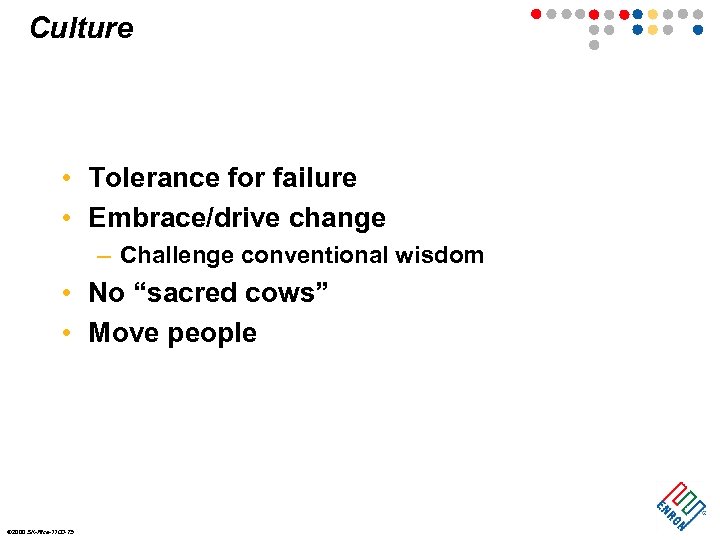 Culture • Tolerance for failure • Embrace/drive change – Challenge conventional wisdom • No “sacred cows” • Move people ã 2000 SK-Rice-1100 -75
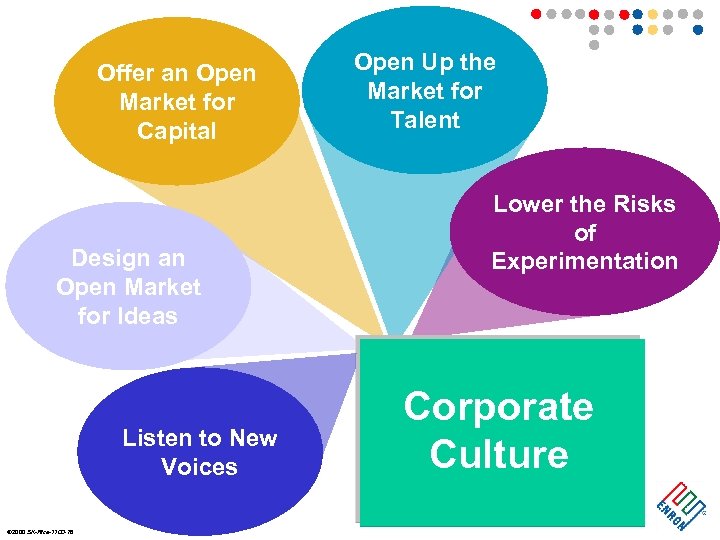 Offer an Open Market for Capital Design an Open Market for Ideas Listen to New Voices ã 2000 SK-Rice-1100 -76 Open Up the Market for Talent Lower the Risks of Experimentation Corporate Culture
 Control: Tight and Loose Tight Controls – Financial accounting – Risk management – Performance reviews – Legal obligations Loose Controls – Organization – Creativity/new business ideas – Work schedules – Working environment • Dress code • Floor design ã 2000 SK-Rice-1100 -77
 Management Systems • Recruiting – A/A program • Performance evaluation • Compensation ã 2000 SK-Rice-1100 -78
 Pay Your Innovators Well -Really Well • Base salary and benefits: industry average • Bonus: pay for performance • Equity: company ownership/long term [Enron] has created a custom-made compensation scheme that gives the startup team an outsized stake in the new venture’s success. It is not unusual for a young team member to end up with $1 million in Enron stock for helping to build a new business. - Gary Hamel, Fortune ã 2000 SK-Rice-1100 -79
 The Challenge of Tomorrow “Somewhere out there is a bullet with your company’s name on it. Somewhere out there is a competitor, unborn and unknown, that will render your strategy obsolete. You can’t dodge the bullet— you’re going to have to shoot first. You’re going to have to out-innovate the innovators. ” Gary Hamel, Leading the Revolution ã 2000 SK-Rice-1100 -80
 ã 2000 SK-Rice-1100 -81