


 Скачать презентацию enrollment mst edu Task Force on Student Educational
0dbbc98e2155bc3c7bad1f2dac44d0d0.ppt
- Количество слайдов: 61
 enrollment. mst. edu Task Force on Student Educational Capacity OPEN FORUM – November 18, 2010 Founded 1870 | Rolla, Missouri
 Task Force Charge § Assess whether the fall 2009 student population was at, below, or above the university’s capacity to provide each student with a quality education.
 2009‐ 10 TASK FORCE MEMBERS § Venkat Allada – Vice Provost for Graduate Studies § SN Balakrishnan – Professor of Aerospace Engineering § Steve Raper – Associate Professor of Engineering Management § Margaret Cline – Chief Information Officer § Stephanie Rostad – President of Student Council § Caroline Fisher – Professor and Department Chair of § Business and Information Technology § § § § § Samuel Frimpong – Robert H. Quenon Chair of Mining Engineering Jay Goff – Vice Provost and Dean for Enrollment Management, Task Force Chair Technology Coordinator Ted Ruth – Assistant Director of Physical Facilities Debra Schatz – Assistant Director of Admissions for Transfer Students § Robert Schwartz – Vice Provost for Academic Affairs § Tina Sheppard – Director of Residential Life § Larry Gragg – Curators Teaching Professor of History and Department Chair § Leon Hall – Professor and Department Chair of Math and Director of Institute for Applied Mathematics § Carol Heddinghaus – Director of Budget Office § Thulasi Kumar – Director of Institutional Research § Rance Larsen – Director of Admission Brad Starbuck – Enrollment Management Communications Specialist F. Scott Miller – Associate Teaching Professor and § Director of Advanced Materials Character § Henry Wiebe – Vice Provost for Global Learning Shannon Stites – Enrollment Management Administrative Assistant, Task Force Secretary Laura Stoll – Registrar Jennifer Thorpe – Assistant Registrar Philip Whitefield – Professor and Department Chair of Chemistry W. Kent Wray – Provost, Ex‐Officio Member
 Forum Agenda § Review Task Force charge and membership § Overview of Task Force reports: – General Observations – Capacity Definitions, Key Factors & Assessments § Sub‐committee Findings – Chair Reports § Overall Conclusion & Recommendations § Open Discussion
 Enrollment Update
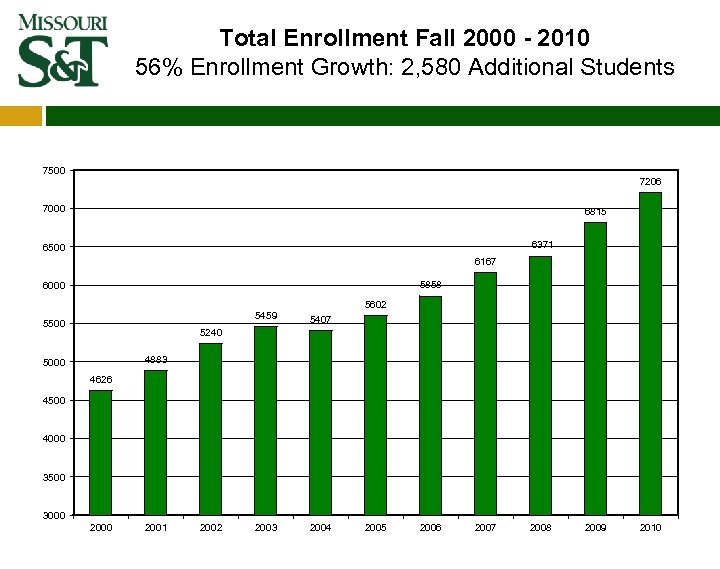 Total Enrollment Fall 2000 - 2010 56% Enrollment Growth: 2, 580 Additional Students 7500 7206 7000 6815 6371 6500 6167 5858 6000 5602 5459 5500 5407 2003 2004 5240 4883 5000 4626 4500 4000 3500 3000 2001 2002 2005 2006 2007 2008 2009 2010
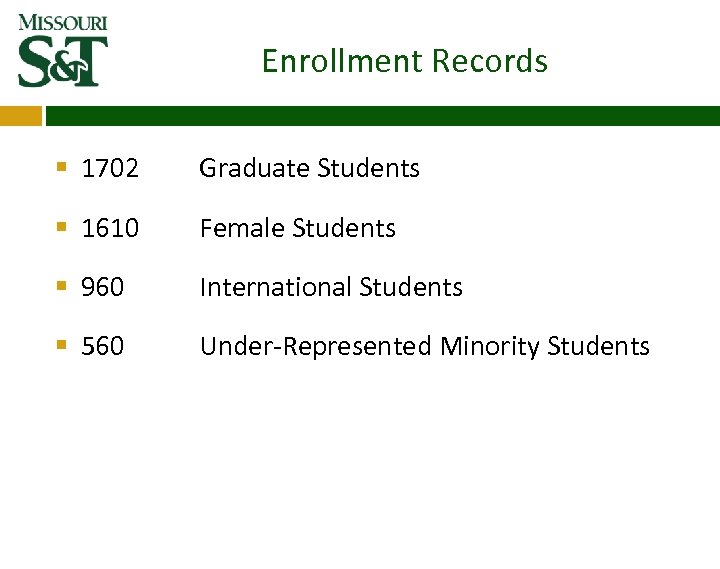 Enrollment Records § 1702 Graduate Students § 1610 Female Students § 960 International Students § 560 Under‐Represented Minority Students
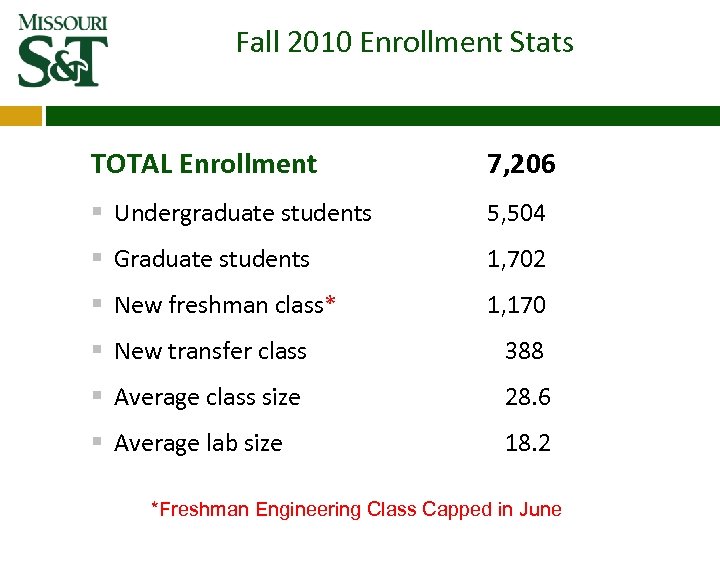 Fall 2010 Enrollment Stats TOTAL Enrollment § Undergraduate students 7, 206 5, 504 § Graduate students 1, 702 § New freshman class* 1, 170 § New transfer class 388 § Average class size 28. 6 § Average lab size 18. 2 *Freshman Engineering Class Capped in June
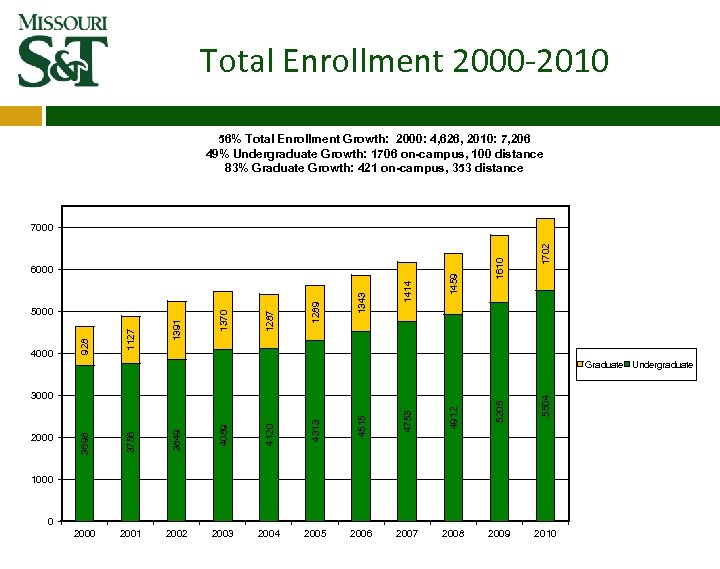 Total Enrollment 2000‐ 2010 56% Total Enrollment Growth: 2000: 4, 626, 2010: 7, 206 49% Undergraduate Growth: 1706 on-campus, 100 distance 83% Graduate Growth: 421 on-campus, 353 distance 1414 1343 1289 1287 1391 1127 4000 928 5000 1370 1702 1610 6000 1459 7000 4753 4912 2003 2004 2005 2006 2007 2008 5504 4515 2002 4313 2001 4120 3849 2000 4089 3756 2000 3698 3000 5205 Graduate Undergraduate 1000 0 2009 2010
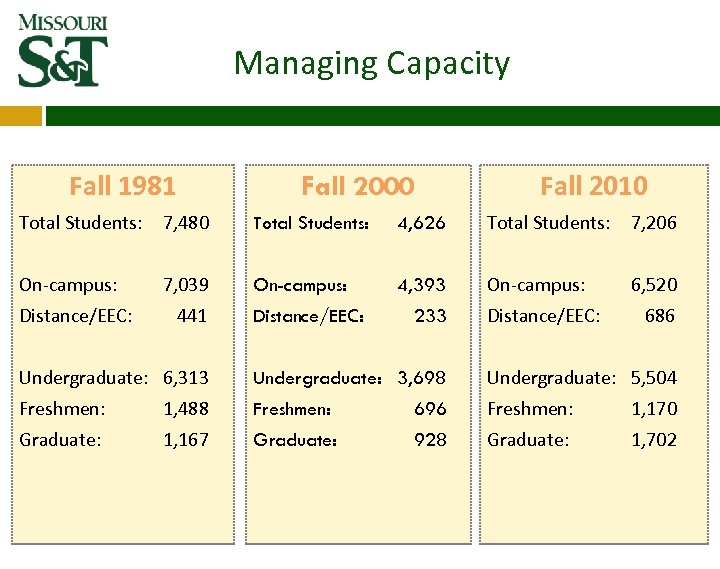 Managing Capacity Fall 1981 Fall 2000 Fall 2010 Total Students: 7, 480 Total Students: 4, 626 Total Students: 7, 206 On‐campus: 7, 039 On-campus: 4, 393 On‐campus: 6, 520 Distance/EEC: 441 Distance/EEC: 686 233 Undergraduate: 6, 313 Undergraduate: 3, 698 Undergraduate: 5, 504 Freshmen: 1, 488 Freshmen: 696 Freshmen: 1, 170 Graduate: 1, 167 Graduate: 928 Graduate: 1, 702
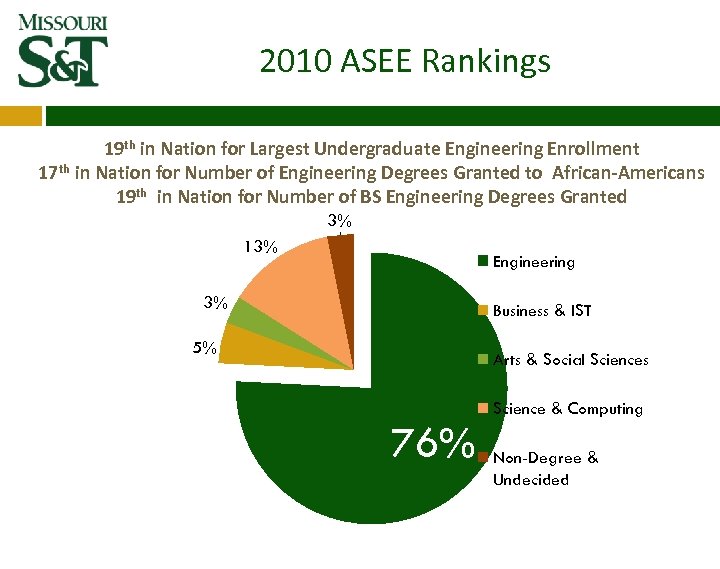 2010 ASEE Rankings 19 th in Nation for Largest Undergraduate Engineering Enrollment 17 th in Nation for Number of Engineering Degrees Granted to African‐Americans 19 th in Nation for Number of BS Engineering Degrees Granted 3% 13% Engineering 3% Business & IST 5% Arts & Social Sciences 76% Science & Computing Non-Degree & Undecided
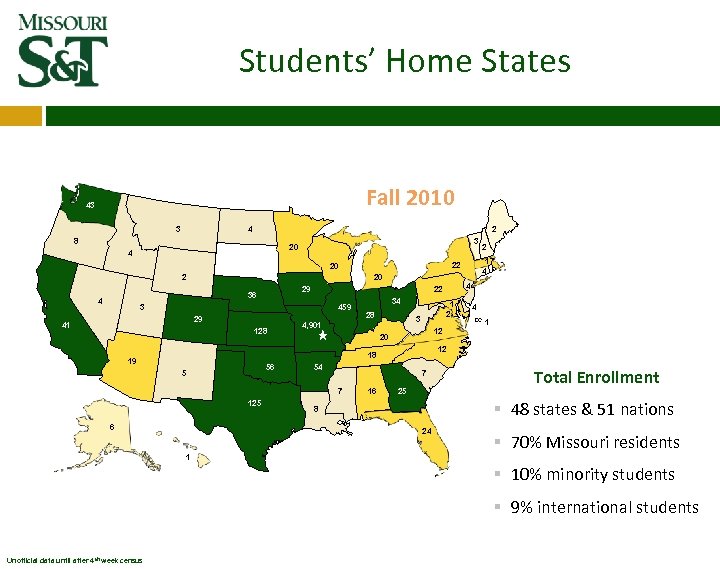 Students’ Home States Fall 2010 43 3 4 2 8 3 20 4 20 29 36 4 459 29 128 34 28 1 2 3 4, 901 12 20 56 5 54 7 7 125 6 16 4 DC 1 12 18 19 4 22 3 41 17 4 22 20 2 2 25 Total Enrollment § 48 states & 51 nations 8 24 § 70% Missouri residents 1 § 10% minority students § 9% international students Unofficial data until after 4 th week census
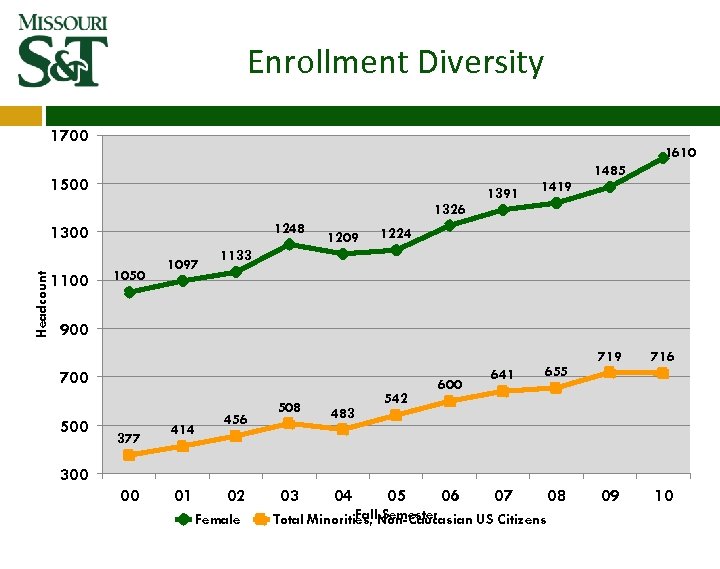 Enrollment Diversity 1700 1610 1500 1326 1248 Headcount 1300 1100 1050 1097 1209 1391 1419 641 655 07 08 1485 1224 1133 900 700 500 377 414 456 508 483 03 04 542 600 719 716 09 10 300 00 01 02 Female 05 06 Fall Semester Total Minorities, Non-Caucasian US Citizens
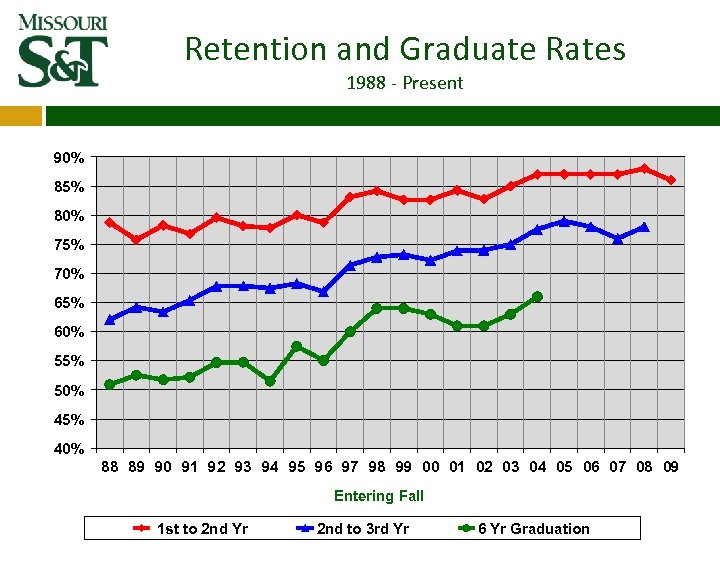 Retention and Graduate Rates 1988 ‐ Present 90% 85% 80% 75% 70% 65% 60% 55% 50% 45% 40% 88 89 90 91 92 93 94 95 96 97 98 99 00 01 02 03 04 05 06 07 08 09 Entering Fall 1 st to 2 nd Yr 2 nd to 3 rd Yr 6 Yr Graduation
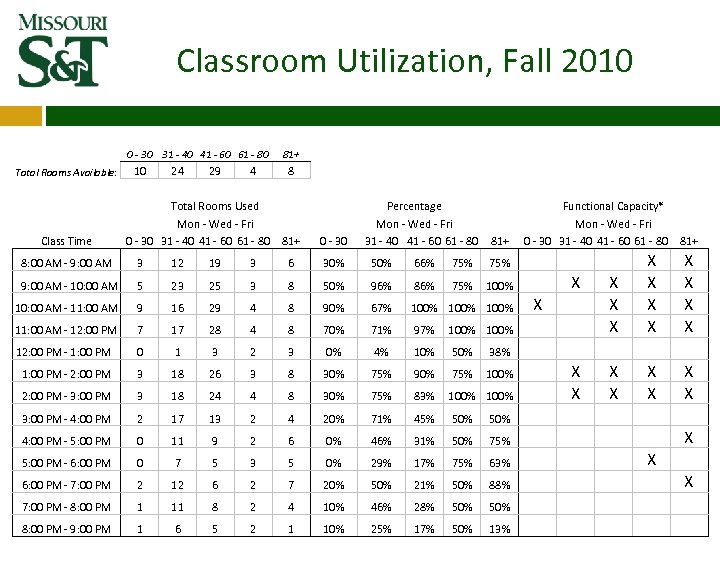 Classroom Utilization, Fall 2010 0 - 30 31 - 40 41 - 60 61 - 80 Total Rooms Available: Class Time 10 24 29 4 Total Rooms Used Mon ‐ Wed ‐ Fri 0 ‐ 30 31 ‐ 40 41 ‐ 60 61 ‐ 80 81+ 8 81+ 0 ‐ 30 Percentage Mon ‐ Wed ‐ Fri 31 ‐ 40 41 ‐ 60 61 ‐ 80 81+ 8: 00 AM ‐ 9: 00 AM 3 12 19 3 6 30% 50% 66% 75% 9: 00 AM ‐ 10: 00 AM 5 23 25 3 8 50% 96% 86% 75% 100% 10: 00 AM ‐ 11: 00 AM 9 16 29 4 8 90% 67% 100% 11: 00 AM ‐ 12: 00 PM 7 17 28 4 8 70% 71% 97% 100% 12: 00 PM ‐ 1: 00 PM 0 1 3 2 3 0% 4% 10% 50% 38% 1: 00 PM ‐ 2: 00 PM 3 18 26 3 8 30% 75% 90% 75% 100% 2: 00 PM ‐ 3: 00 PM 3 18 24 4 8 30% 75% 83% 100% 3: 00 PM ‐ 4: 00 PM 2 17 13 2 4 20% 71% 45% 50% 4: 00 PM ‐ 5: 00 PM 0 11 9 2 6 0% 46% 31% 50% 75% 5: 00 PM ‐ 6: 00 PM 0 7 5 3 5 0% 29% 17% 75% 63% 6: 00 PM ‐ 7: 00 PM 2 12 6 2 7 20% 50% 21% 50% 88% 7: 00 PM ‐ 8: 00 PM 1 11 8 2 4 10% 46% 28% 50% 8: 00 PM ‐ 9: 00 PM 1 6 5 2 1 10% 25% 17% 50% 13% Functional Capacity* Mon ‐ Wed ‐ Fri 0 ‐ 30 31 ‐ 40 41 ‐ 60 61 ‐ 80 X X X X X X X X X 81+ X X X X
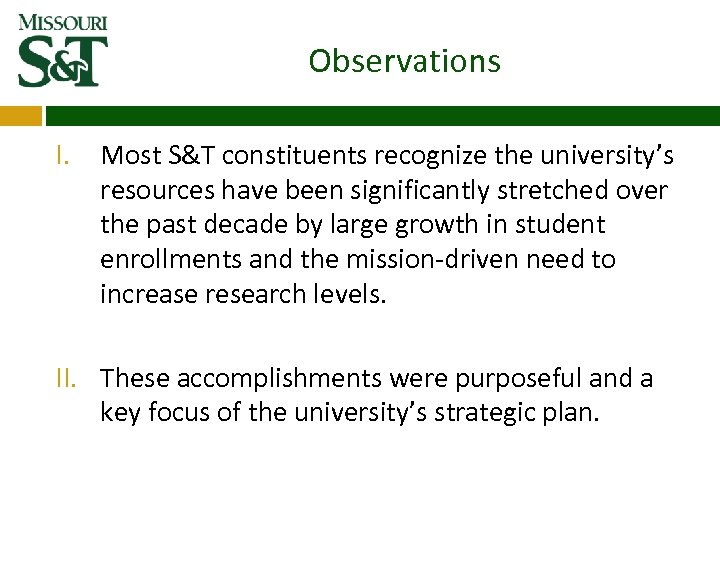 Observations I. Most S&T constituents recognize the university’s resources have been significantly stretched over the past decade by large growth in student enrollments and the mission‐driven need to increase research levels. II. These accomplishments were purposeful and a key focus of the university’s strategic plan.
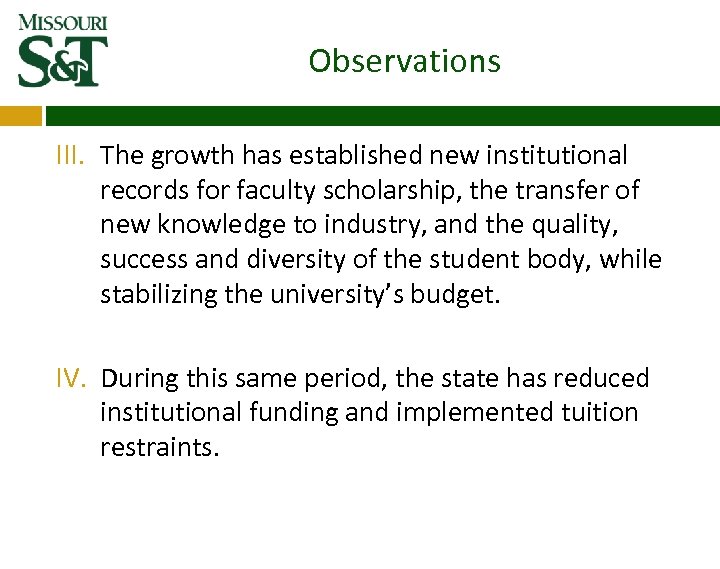 Observations III. The growth has established new institutional records for faculty scholarship, the transfer of new knowledge to industry, and the quality, success and diversity of the student body, while stabilizing the university’s budget. IV. During this same period, the state has reduced institutional funding and implemented tuition restraints.
 Observations IV. The Task Force recognizes that quality instruction and course access issues are developing largely due to the lack of funding available for: 1. replacing departed faculty 2. expanding and maintaining academic facilities 3. growing compliance and need‐based financial aid requirements 4. developing alternative instructional delivery methods
 Defining Capacity § Educational capacity is a complex management issue and incorporates many variables for a residential research university. § Capacity ultimately is a planning and quality assurance concept. § Generally defined: – “Educational capacity is the university’s ability to receive, enroll, house, feed, and properly educate students in an appropriate time period. ”
 Key Factors in Determining Capacity § Quality Teaching and Learning § Enrollment and Research Growth § Teaching Loads & Instructional Faculty Numbers § Instructional and Laboratory Space § Student Financial Assistance Resources § Student and Campus Support Resources § Housing, Dining and Parking Volume
 2004 Capacity Assessment § Established set of short‐term strategic enrollment goals and quality student profiles for both undergraduate and graduate populations § Objectives: 1. achieve optimum enrollments by filling excess capacity 2. focus on achieving quality learning outcomes 3. minimize the average costs per student
 2009 Capacity Assessment § Due to the 2004 enrollment goals being exceeded in fall 2009 (45% increase over 1999) and some departments struggling to meet instructional needs of larger enrollments and increased research levels, capacity must be assessed in terms of the sum of many crucial factors. § Capacity could not be based exclusively upon the percentage of occupied seats in classrooms, beds in residence halls or spaces in campus parking lots.
 Capacity Assessments by Unit Leaders § The 2009‐ 10 Task Force had to employ a myriad of definitions and datasets to determine capacity. § Due to the complexity of the issue, each department chair and unit director was asked to assess the capacity of their departments.
 2009‐ 01 Capacity Sub‐committees 1. Campus housing, dining and parking – Chair: Tina Sheppard 2. Student financial aid and scholarships – Chair: Rance Larsen 3. Campus and student support services – Chair: Margaret Cline 4. Faculty and academic instructional space – Chair: Larry Gragg
 Campus housing, dining and parking Chair: Tina Sheppard
 Housing, Dining, and Parking Committee § § § Patti Frisbee Rachel Morris Ted Ruth Debbie Schatz Tina Sheppard Jay Goff
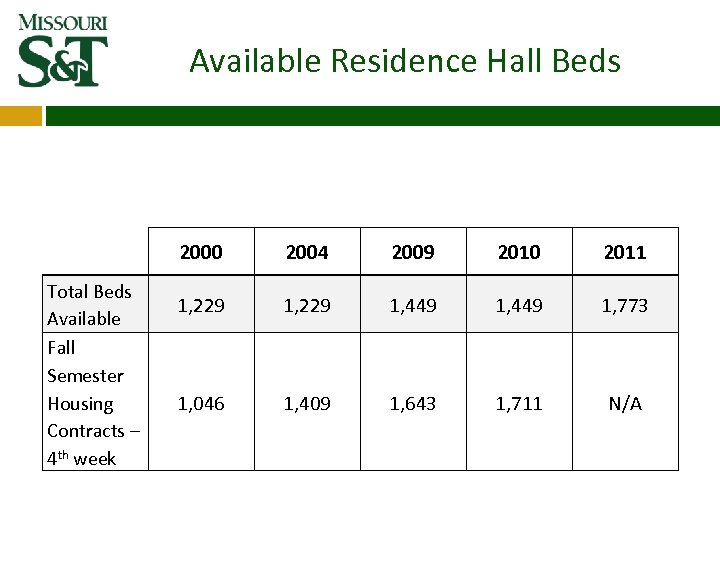 Available Residence Hall Beds 2000 Total Beds Available Fall Semester Housing Contracts – 4 th week 2004 2009 2010 2011 1, 229 1, 449 1, 773 1, 046 1, 409 1, 643 1, 711 N/A
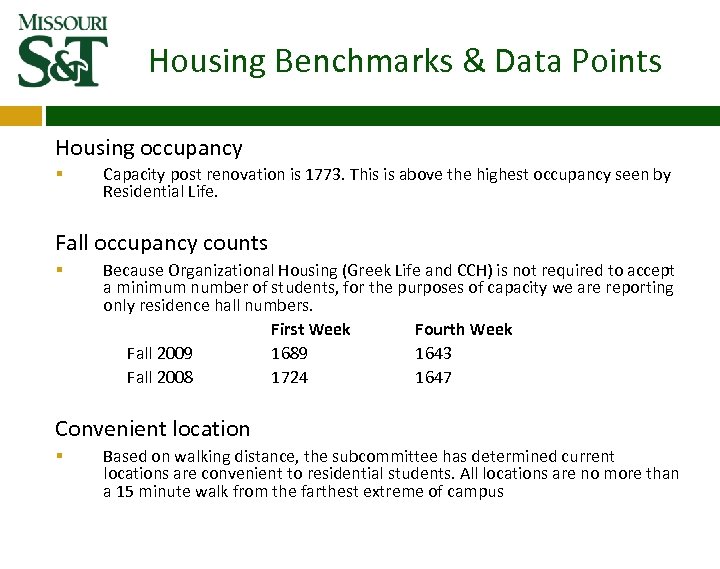 Housing Benchmarks & Data Points Housing occupancy § Capacity post renovation is 1773. This is above the highest occupancy seen by Residential Life. Fall occupancy counts § Because Organizational Housing (Greek Life and CCH) is not required to accept a minimum number of students, for the purposes of capacity we are reporting only residence hall numbers. First Week Fourth Week Fall 2009 1689 1643 Fall 2008 1724 1647 Convenient location § Based on walking distance, the subcommittee has determined current locations are convenient to residential students. All locations are no more than a 15 minute walk from the farthest extreme of campus
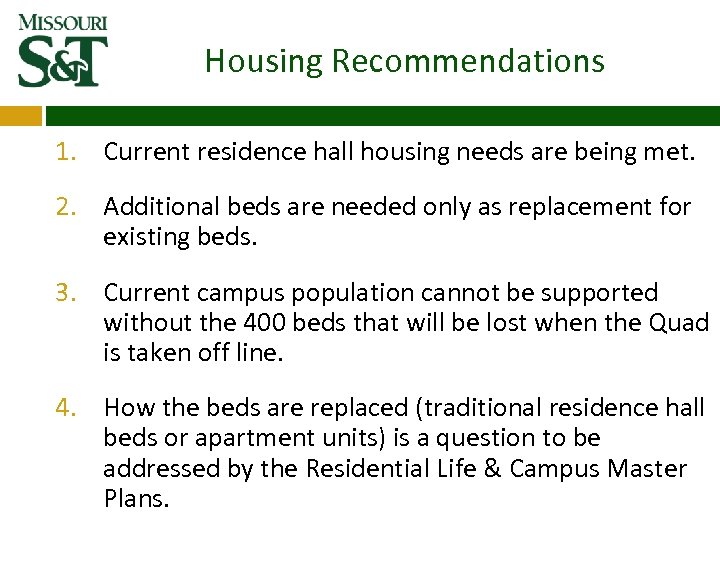 Housing Recommendations 1. Current residence hall housing needs are being met. 2. Additional beds are needed only as replacement for existing beds. 3. Current campus population cannot be supported without the 400 beds that will be lost when the Quad is taken off line. 4. How the beds are replaced (traditional residence hall beds or apartment units) is a question to be addressed by the Residential Life & Campus Master Plans.
 Dining Benchmarks & Data Points Seating and Design Capacity § § § Thomas Jefferson design capacity ‐ 366 Rayl (Quad) design capacity ‐ 307 Havener design capacity ‐ 456 Number of Diners § Lunch meals have the greatest participation numbers. Service (Convenient dining locations and quality of food) § § Based on walking distance (Chart 1), current locations are convenient to diners. Based on data from two surveys, most diners rate quality at or above average.
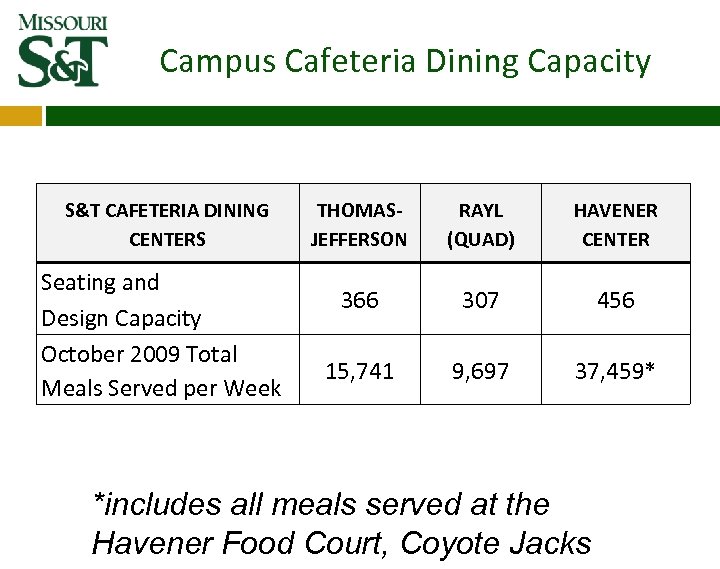 Campus Cafeteria Dining Capacity S&T CAFETERIA DINING CENTERS Seating and Design Capacity October 2009 Total Meals Served per Week THOMAS‐ JEFFERSON RAYL (QUAD) HAVENER CENTER 366 307 456 15, 741 9, 697 37, 459* *includes all meals served at the Havener Food Court, Coyote Jacks
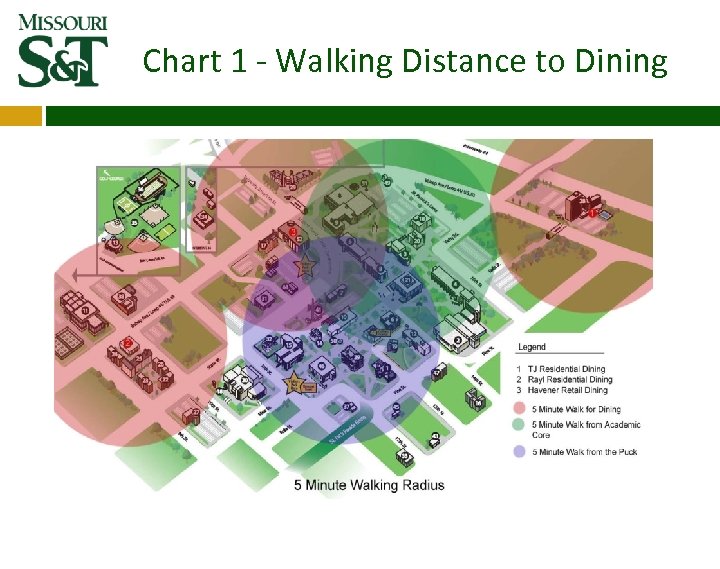 Chart 1 ‐ Walking Distance to Dining
 Dining Observations & Considerations § The campus’s overall dining capacity is about 1130 seats with about 1180 to 1340 patrons served per meal. § The Rayl Cafeteria’s physical infrastructure is in very poor condition and likely needs to be replaced before 2015. § Future students are more likely to be residential and more will be from low income families. § Havener capacity is exceeded Monday and Wednesdays, 11: 50 a. m. – 12: 20 p. m. during the common lunch hour. See Chart 2.
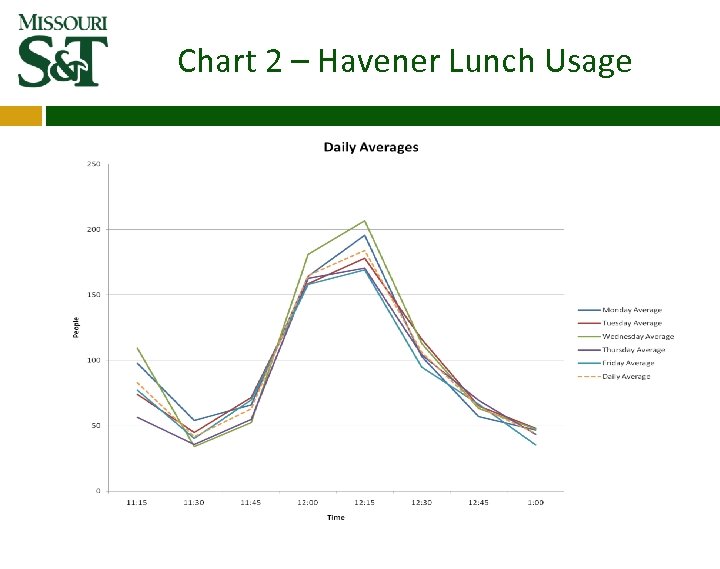 Chart 2 – Havener Lunch Usage
 Dining Recommendations 1. Replacing Rayl cafeteria will be critical in the next three – five years. The current campus population cannot be supported without the 307 seats that will be lost when Rayl is taken off line. 2. Resist expanding the food court style dining options in the future as both low income and male students tend to prefer the traditional cafeteria all you care to eat dining option. 3. Should the academic free hour be removed, dining capacity concerns in Havener would be eliminated.
 Parking Benchmarks & Data Points § § Availability of parking in desired locations § Number of parking spaces assigned Number of parking spaces available – 2330
 Parking Observations/Considerations § The dashboard usage reports indicate the campus’s overall parking capacity is about 2330 § Upon investigation by committee, we learned no data points existing to direct a recommendation to this task force.
 Parking Recommendations § New Police Chief and Parking Committee investigate the parking issues and deliver data points on - § Availability of parking in desired locations Number of parking spaces available Number of parking spaces assigned Continue to develop parking spaces to replace any parking removed
 Student financial aid and scholarships Chair: Rance Larsen
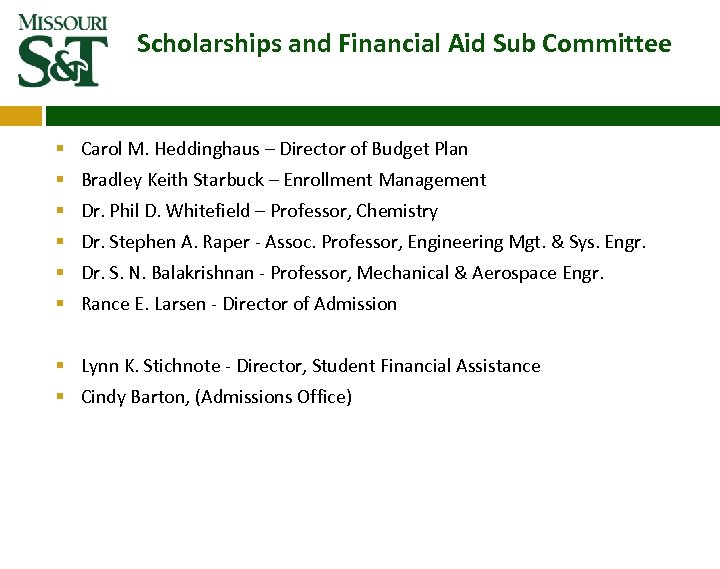 Scholarships and Financial Aid Sub Committee § Carol M. Heddinghaus – Director of Budget Plan § Bradley Keith Starbuck – Enrollment Management § Dr. Phil D. Whitefield – Professor, Chemistry § Dr. Stephen A. Raper ‐ Assoc. Professor, Engineering Mgt. & Sys. Engr. § Dr. S. N. Balakrishnan ‐ Professor, Mechanical & Aerospace Engr. § Rance E. Larsen ‐ Director of Admission § Lynn K. Stichnote ‐ Director, Student Financial Assistance § Cindy Barton, (Admissions Office)
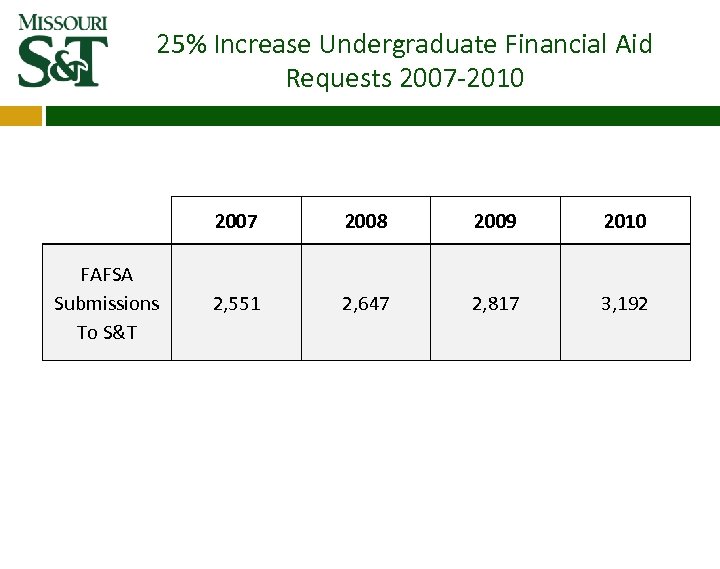 25% Increase Undergraduate Financial Aid Requests 2007‐ 2010 2007 FAFSA Submissions To S&T 2008 2009 2010 2, 551 2, 647 2, 817 3, 192
 Scholarships and Financial Aid Committee § With current enrollment goals and changes to the federal and state student assistance programs, the level of financial aid resources at Missouri S&T is at or above capacity to meet campus strategic plan goals.
 “Capacity” in terms of financial assistance is difficult to define. § Given currently‐available G. O. & endowment funds, S&T is at an equilibrium point in its ability to attract desired number of students at preferred quality while meeting our land‐grant mission. § The subcommittee agreed, however, that being “at capacity” means S&T has no reserve capacity and is at risk of deterioration in student quality and/or decreased enrollments.
 Benchmarks
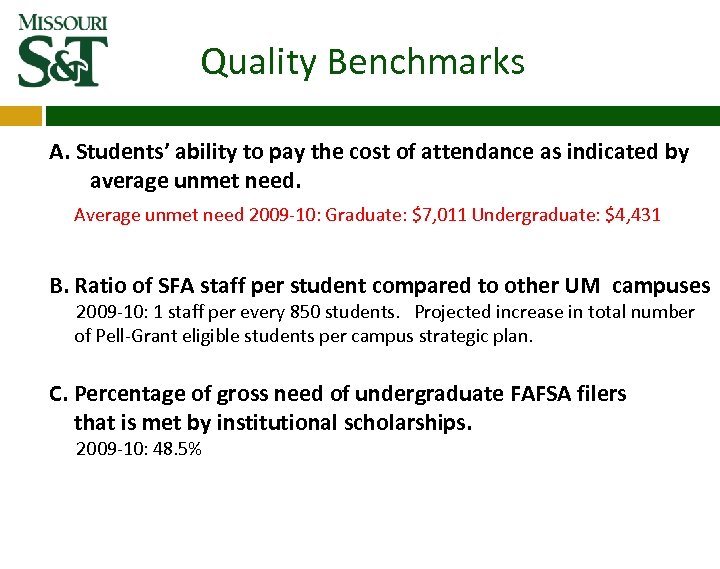 Quality Benchmarks A. Students’ ability to pay the cost of attendance as indicated by average unmet need. Average unmet need 2009‐ 10: Graduate: $7, 011 Undergraduate: $4, 431 B. Ratio of SFA staff per student compared to other UM campuses 2009‐ 10: 1 staff per every 850 students. Projected increase in total number of Pell‐Grant eligible students per campus strategic plan. C. Percentage of gross need of undergraduate FAFSA filers that is met by institutional scholarships. 2009‐ 10: 48. 5%
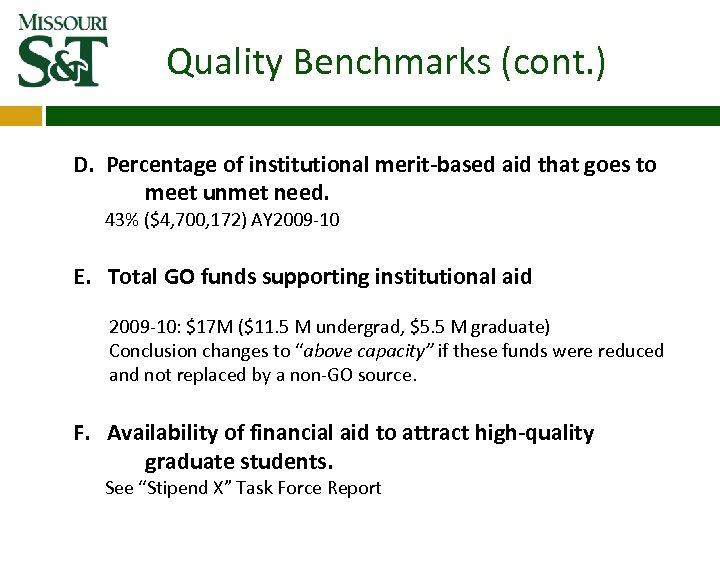 Quality Benchmarks (cont. ) D. Percentage of institutional merit‐based aid that goes to meet unmet need. 43% ($4, 700, 172) AY 2009‐ 10 E. Total GO funds supporting institutional aid 2009‐ 10: $17 M ($11. 5 M undergrad, $5. 5 M graduate) Conclusion changes to “above capacity” if these funds were reduced and not replaced by a non‐GO source. F. Availability of financial aid to attract high‐quality graduate students. See “Stipend X” Task Force Report
 Campus and student support services Chair: Margaret Cline
 STAFFING FOR CAMPUS AND STUDENT SUPPORT SERVICES § Assessing the staffing and support resources based on agreed upon benchmarks proved to be difficult. § Each unit’s self‐assessments indicated that most service areas are lightly staffed and struggling to balance the resources allocated.
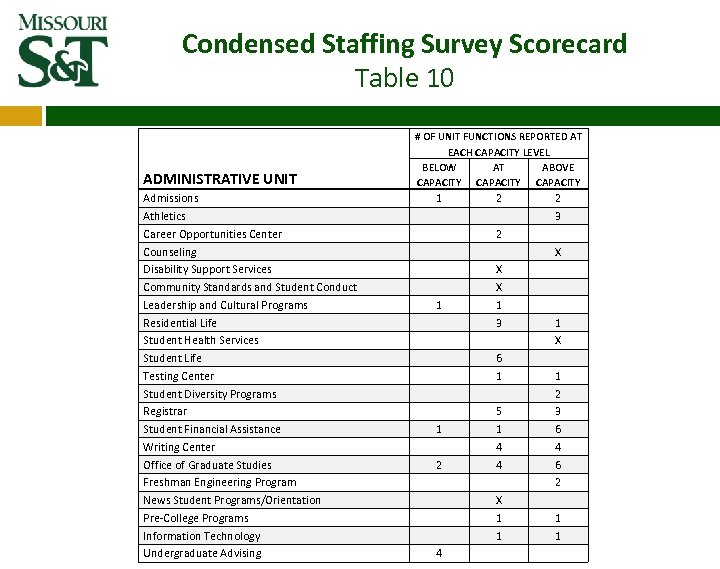 Condensed Staffing Survey Scorecard Table 10 ADMINISTRATIVE UNIT Admissions Athletics Career Opportunities Center Counseling Disability Support Services Community Standards and Student Conduct Leadership and Cultural Programs Residential Life Student Health Services Student Life Testing Center Student Diversity Programs Registrar Student Financial Assistance Writing Center Office of Graduate Studies Freshman Engineering Program News Student Programs/Orientation Pre‐College Programs Information Technology Undergraduate Advising # OF UNIT FUNCTIONS REPORTED AT EACH CAPACITY LEVEL BELOW AT ABOVE CAPACITY 1 1 2 4 2 2 X X 1 3 6 1 5 1 4 4 X 1 1 2 3 X 1 2 3 6 4 6 2 1 1
 Faculty & academic instructional space Chair: Larry Gragg
 Critical Warning Signs § Chairs’ Perceptions: • “It is likely the learning experience already is more impersonal than it was a decade ago. ” • The enrollment burden “is very demoralizing for faculty with serious research ambitions. ”
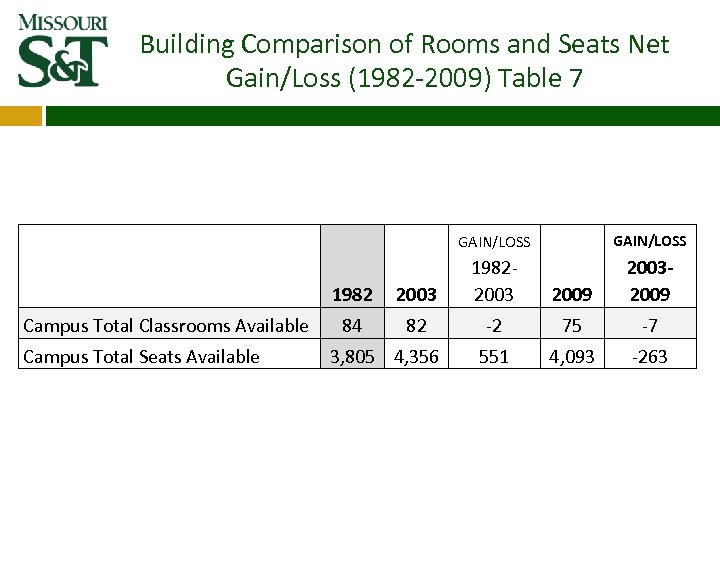 Building Comparison of Rooms and Seats Net Gain/Loss (1982‐ 2009) Table 7 GAIN/LOSS 2009 2003‐ 2009 1982 Campus Total Classrooms Available Campus Total Seats Available 2003 1982‐ 2003 84 82 ‐ 2 75 ‐ 7 551 4, 093 ‐ 263 3, 805 4, 356
 Overall Committee Recommendation The entire campus, not just the academic departments, must engage in a serious dialog in an effort to shape our recruitment and retention efforts.
 Findings & Recommendations
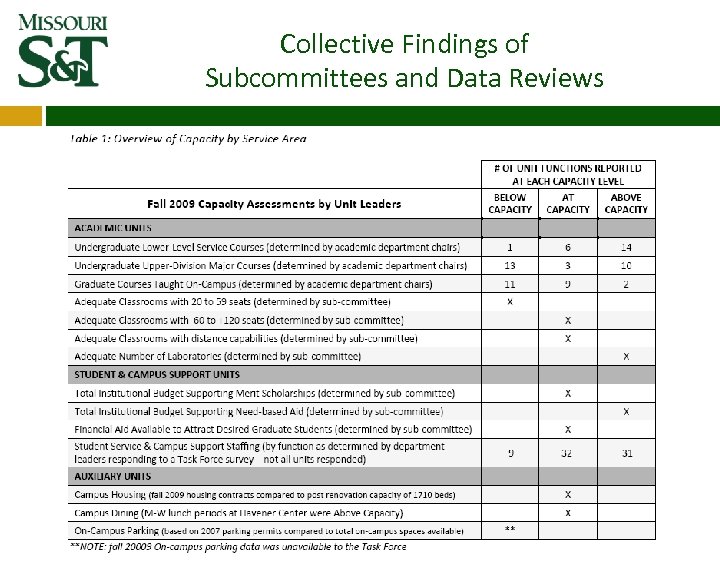 Collective Findings of Subcommittees and Data Reviews
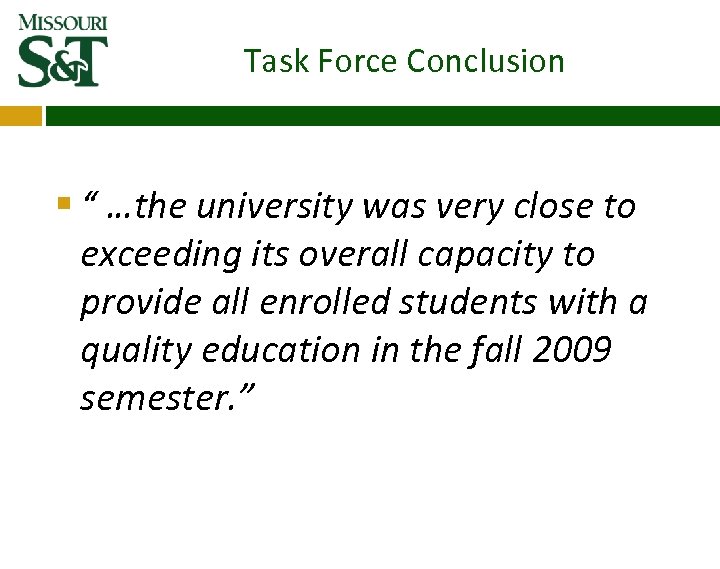 Task Force Conclusion § “ …the university was very close to exceeding its overall capacity to provide all enrolled students with a quality education in the fall 2009 semester. ”
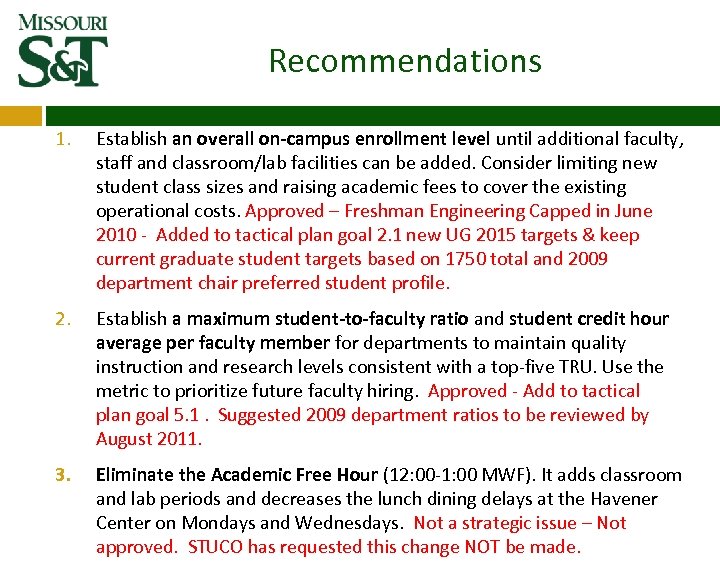 Recommendations 1. Establish an overall on‐campus enrollment level until additional faculty, staff and classroom/lab facilities can be added. Consider limiting new student class sizes and raising academic fees to cover the existing operational costs. Approved – Freshman Engineering Capped in June 2010 ‐ Added to tactical plan goal 2. 1 new UG 2015 targets & keep current graduate student targets based on 1750 total and 2009 department chair preferred student profile. 2. Establish a maximum student‐to‐faculty ratio and student credit hour average per faculty member for departments to maintain quality instruction and research levels consistent with a top‐five TRU. Use the metric to prioritize future faculty hiring. Approved ‐ Add to tactical plan goal 5. 1. Suggested 2009 department ratios to be reviewed by August 2011. 3. Eliminate the Academic Free Hour (12: 00‐ 1: 00 MWF). It adds classroom and lab periods and decreases the lunch dining delays at the Havener Center on Mondays and Wednesdays. Not a strategic issue – Not approved. STUCO has requested this change NOT be made.
 Recommendations 4. Develop plans for additional general‐use classrooms that includes at least four 65‐seat CLC distance education classrooms , two +150‐seat auditoriums and a +350 seat space that can be configured for testing and smaller classes. Approved ‐ Added to tactical goal 5. 4 – Specific space needs will be considered in the development of Schenk Hall Renovation‐Addition 5. Provide appropriate staffing in the Student Financial Assistance office to manage large increases in student aid requests and the more complex compliance standards. Approved August 2010 – Search for two positions underway
 Recommendations 6. Develop fundraising goals and execution plans for need‐based student financial aid and graduate assistantships. Approved ‐ Added to tactical goal 4. 1 7. Review the current student quality profiles to assess the strategic value achieved in relation to the institutional scholarship expense. The graduate/undergraduate ratio should also be considered to completed by September 2011. Approved ‐ Added to tactical plan goal 2. 1 8. Develop a plan for the replacement of the Quadrangle Complex and Rayl cafeteria facilities by 2014. Approved ‐ Added to tactical plan goal 5. 4
 Recommendations 8. Revisit the quality benchmarking and operational capacity of other student support units on a regular basis. Recognized – Ongoing in Strategic Planning Process 9. Establish more online and blended e‐learning options at the undergraduate level. Include both lower level service and upper level major courses. Approved ‐ added to tactical plan goal 2. 2 10. University Police should establish a tracking system for parking space and permit availability. Addressed September 2010
 OPEN DISCUSSION