


 Скачать презентацию Enriching OWL with Instance Recognition Semantics for Automated
9fbd7b2b3bafba9c7a57295ff0fbc083.ppt
- Количество слайдов: 20
 Enriching OWL with Instance Recognition Semantics for Automated Semantic Annotation Stephen W. Liddle Information Systems Department Yihong Ding & David W. Embley Computer Science Department Brigham Young University, Provo, Utah
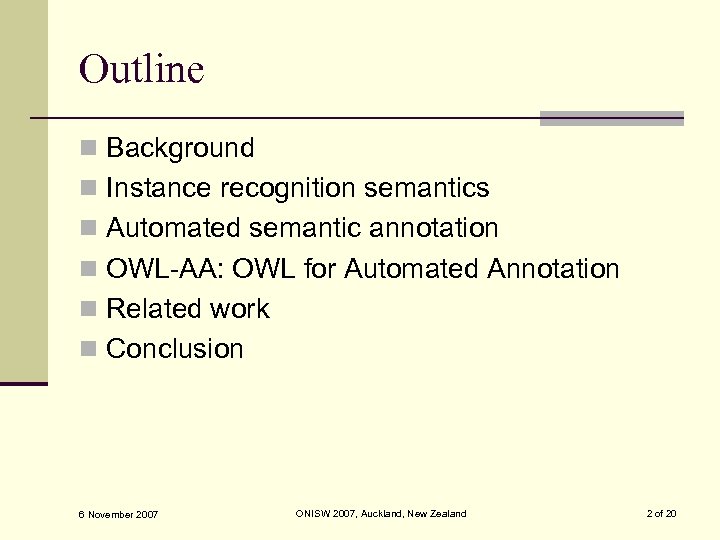 Outline n Background n Instance recognition semantics n Automated semantic annotation n OWL-AA: OWL for Automated Annotation n Related work n Conclusion 6 November 2007 ONISW 2007, Auckland, New Zealand 2 of 20
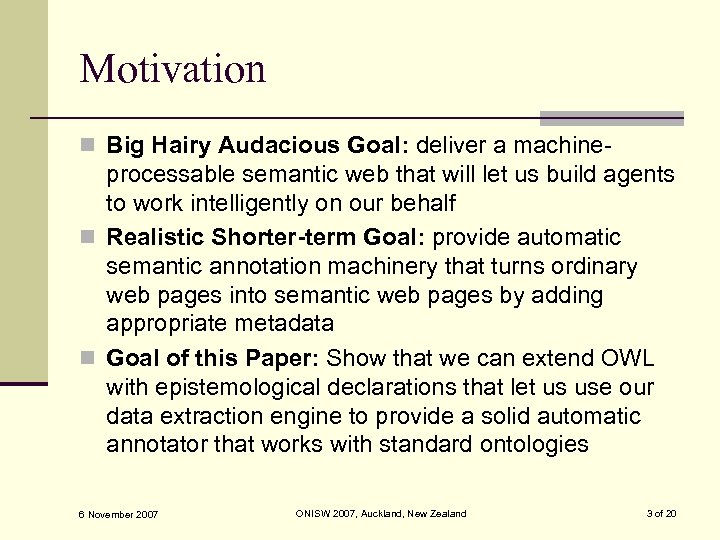 Motivation n Big Hairy Audacious Goal: deliver a machine- processable semantic web that will let us build agents to work intelligently on our behalf n Realistic Shorter-term Goal: provide automatic semantic annotation machinery that turns ordinary web pages into semantic web pages by adding appropriate metadata n Goal of this Paper: Show that we can extend OWL with epistemological declarations that let us use our data extraction engine to provide a solid automatic annotator that works with standard ontologies 6 November 2007 ONISW 2007, Auckland, New Zealand 3 of 20
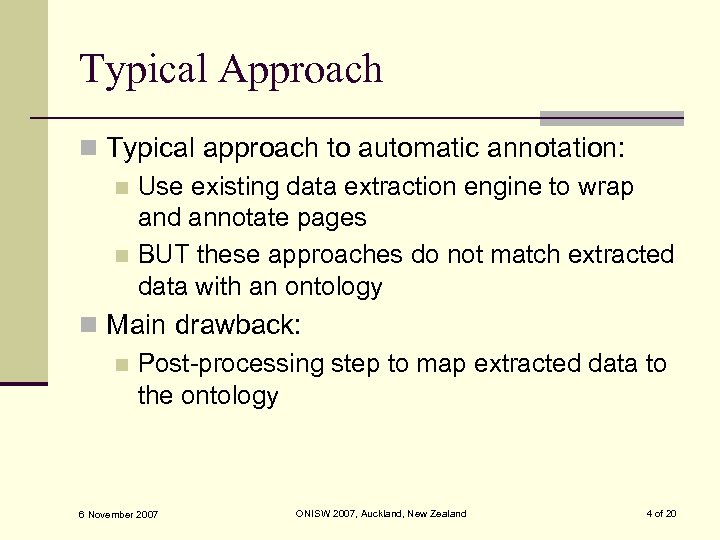 Typical Approach n Typical approach to automatic annotation: n Use existing data extraction engine to wrap and annotate pages n BUT these approaches do not match extracted data with an ontology n Main drawback: n Post-processing step to map extracted data to the ontology 6 November 2007 ONISW 2007, Auckland, New Zealand 4 of 20
 Our Approach n Our data extraction engine is ontology based and does not need a post-processing alignment step We have demonstrated that our approach works (Ding/Embley/Liddle 2006, LNCS 4185) n But our ontology language is not a W 3 C standard n n OWL is a standard (W 3 C recommendation) n But lacks sufficient declarative instancerecognition semantics for automatic annotation 6 November 2007 ONISW 2007, Auckland, New Zealand 5 of 20
 A Solution n Extend OWL with declarative instance- recognition semantics n Call this OWL for Automated Annotation (OWL -AA) n OWL-AA extension is epistemological in nature Ontological definitions should be independent of the form of knowledge representation n Epistemological definitions may be sensitive to the form of knowledge representation n 6 November 2007 ONISW 2007, Auckland, New Zealand 6 of 20
 Our Contributions n OWL-AA extends OWL to provide for automated semantic annotation that Embeds instance-recognition semantics declarations in ontologies and data extraction tools n Provides enhanced knowledge sharing and reuse via semantic web n Separates domain knowledge creation from semantic annotation process n n 6 November 2007 Thus maintaining separation between concerns of domain experts and software developers ONISW 2007, Auckland, New Zealand 7 of 20
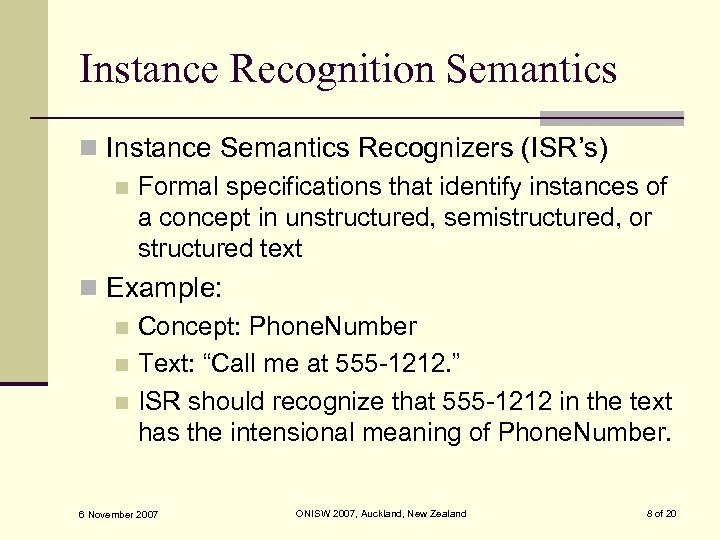 Instance Recognition Semantics n Instance Semantics Recognizers (ISR’s) n Formal specifications that identify instances of a concept in unstructured, semistructured, or structured text n Example: n Concept: Phone. Number n Text: “Call me at 555 -1212. ” n ISR should recognize that 555 -1212 in the text has the intensional meaning of Phone. Number. 6 November 2007 ONISW 2007, Auckland, New Zealand 8 of 20
![ISR Declarations in Data Frames Bedroom. Nr internal representation: Integer external representation: [1 -9]|10](https://present5.com/presentation/9fbd7b2b3bafba9c7a57295ff0fbc083/image-9.jpg "ISR Declarations in Data Frames Bedroom. Nr internal representation: Integer external representation: [1 -9]|10") ISR Declarations in Data Frames Bedroom. Nr internal representation: Integer external representation: [1 -9]|10 left context phrase: b right context phrase: . *r(oo)? ms? exception phrase: s. *ba(th)? s? b. *r(oo)? ms? context keywords: b(r|d)s? |bdrms? |bed(rooms? )? . . . Less. Than(p 1: Price, p 2: Price) returns (Boolean) context keywords: less than|<|or less|fewer|. . . end Feature external representation: Apartment. Feature. lexicon. . . end 6 November 2007 ONISW 2007, Auckland, New Zealand 9 of 20
ISR Declarations in Data Frames Bedroom. Nr internal representation: Integer external representation: [1 -9]|10 left context phrase: b right context phrase: . *r(oo)? ms? exception phrase: s. *ba(th)? s? b. *r(oo)? ms? context keywords: b(r|d)s? |bdrms? |bed(rooms? )? . . . Less. Than(p 1: Price, p 2: Price) returns (Boolean) context keywords: less than|<|or less|fewer|. . . end Feature external representation: Apartment. Feature. lexicon. . . end 6 November 2007 ONISW 2007, Auckland, New Zealand 9 of 20
 Resiliency n There are no document layout dependencies in our ISR declarations n Other approaches typically use page layout information for extraction n Layout independence (resiliency) is a major benefit Page layouts change periodically on the web n Different publishers in the same domain generally use different page layouts n Rewriting wrappers is costly n 6 November 2007 ONISW 2007, Auckland, New Zealand 10 of 20
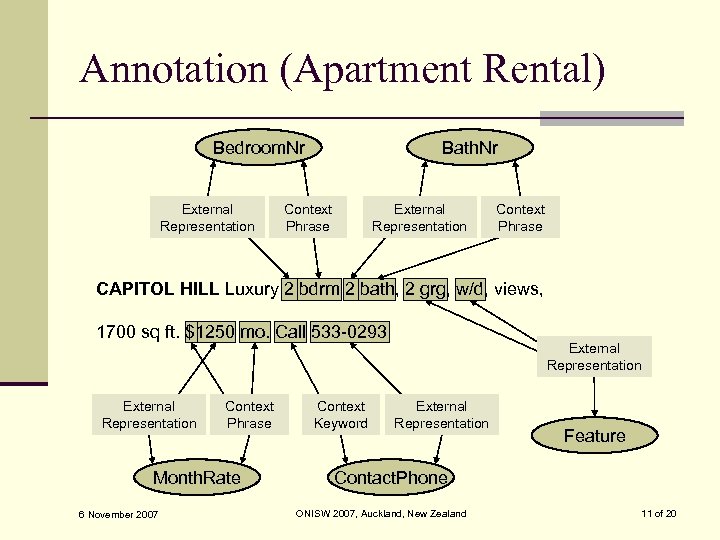 Annotation (Apartment Rental) Bedroom. Nr External Representation Bath. Nr Context Phrase External Representation Context Phrase CAPITOL HILL Luxury 2 bdrm 2 bath, 2 grg, w/d, views, 1700 sq ft. $1250 mo. Call 533 -0293 External Representation Context Phrase Month. Rate 6 November 2007 Context Keyword External Representation Feature Contact. Phone ONISW 2007, Auckland, New Zealand 11 of 20
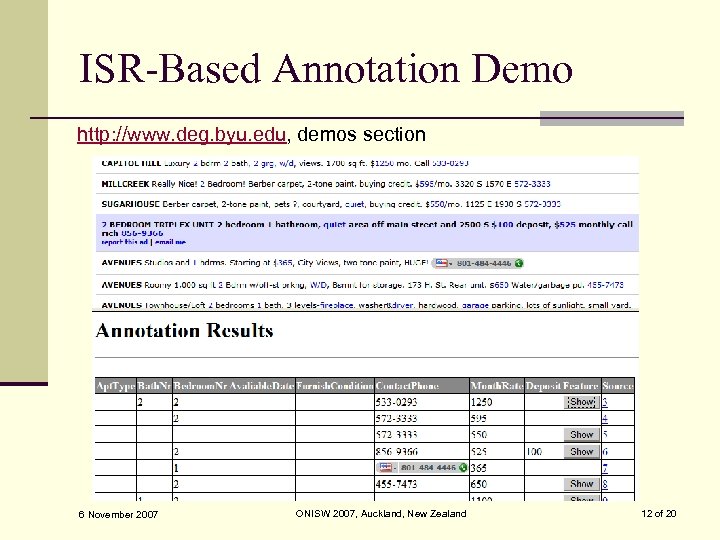 ISR-Based Annotation Demo http: //www. deg. byu. edu, demos section 6 November 2007 ONISW 2007, Auckland, New Zealand 12 of 20
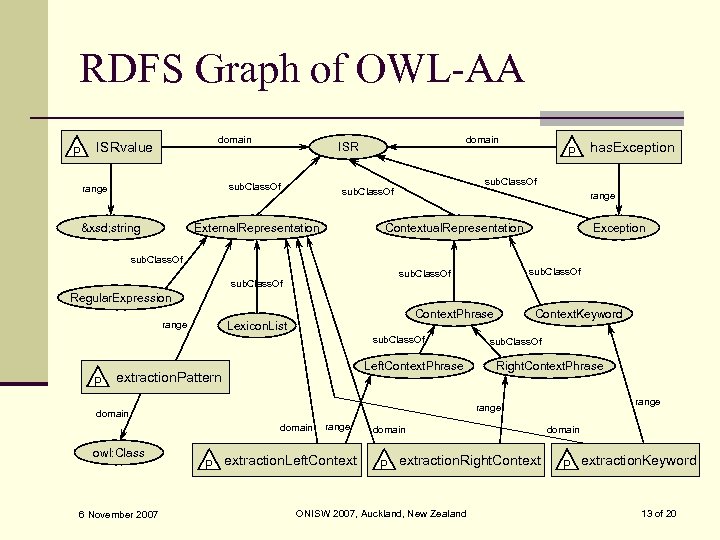 RDFS Graph of OWL-AA P domain ISRvalue sub. Class. Of range &xsd; string domain ISR has. Exception sub. Class. Of External. Representation P range Exception Contextual. Representation sub. Class. Of Regular. Expression Context. Phrase Lexicon. List range sub. Class. Of P Left. Context. Phrase extraction. Pattern domain 6 November 2007 sub. Class. Of Right. Context. Phrase range domain owl: Class Context. Keyword range P extraction. Left. Context domain P extraction. Right. Context ONISW 2007, Auckland, New Zealand domain P extraction. Keyword 13 of 20
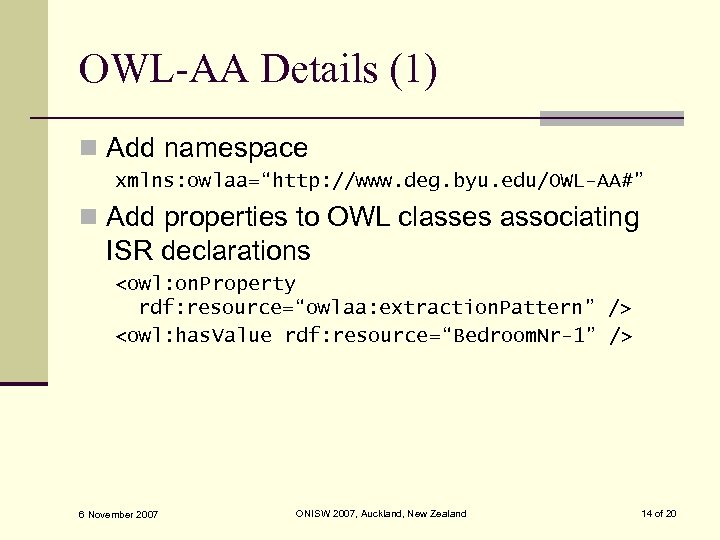 OWL-AA Details (1) n Add namespace xmlns: owlaa=“http: //www. deg. byu. edu/OWL-AA#” n Add properties to OWL classes associating ISR declarations
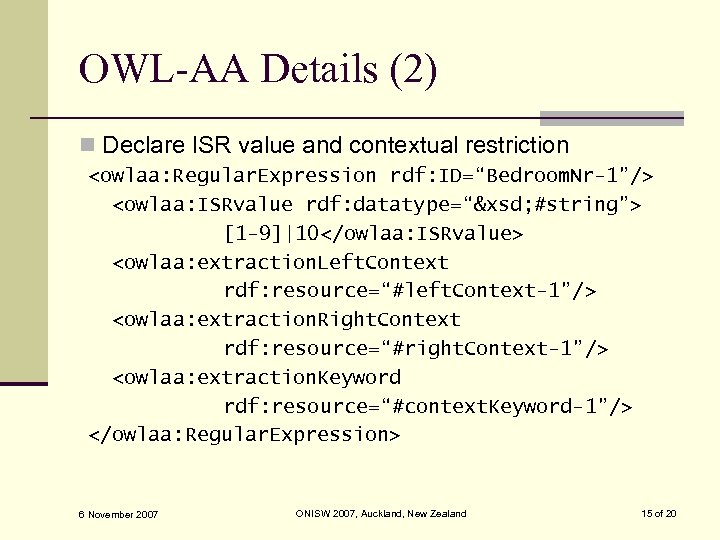 OWL-AA Details (2) n Declare ISR value and contextual restriction
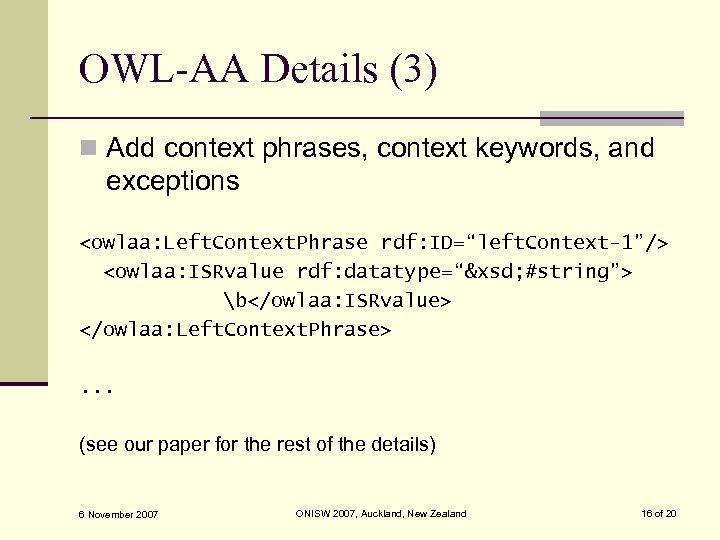 OWL-AA Details (3) n Add context phrases, context keywords, and exceptions
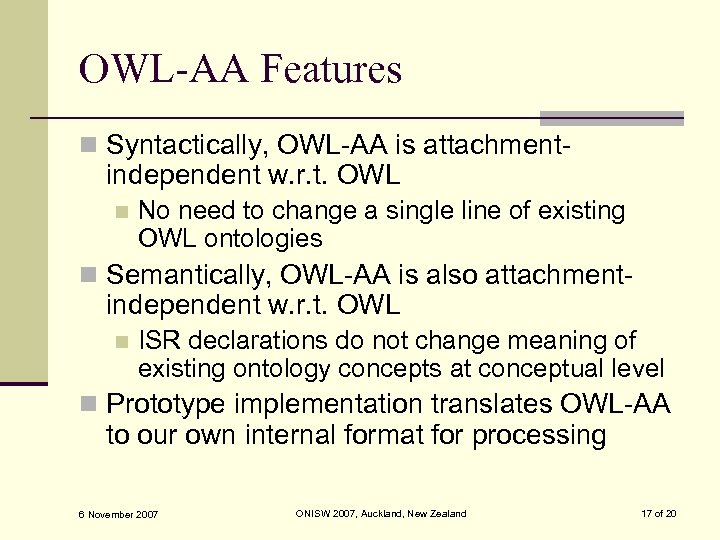 OWL-AA Features n Syntactically, OWL-AA is attachment- independent w. r. t. OWL n No need to change a single line of existing OWL ontologies n Semantically, OWL-AA is also attachment- independent w. r. t. OWL n ISR declarations do not change meaning of existing ontology concepts at conceptual level n Prototype implementation translates OWL-AA to our own internal format for processing 6 November 2007 ONISW 2007, Auckland, New Zealand 17 of 20
 Related Work n We aren’t the first to work on ISR declarations n IBM’s Unstructured Information Management Architecture n There are many proposals for extending OWL n Two extensions related to ours n Context OWL (C-OWL) n Extension for ontology mapping that localizes ontology content for global visibility n OWL-Eu n Extension that enriches OWL with customized datatypes, a significant need n Not attachment-independent, unfortunately n But our approach is compatible with OWL-Eu too 6 November 2007 ONISW 2007, Auckland, New Zealand 18 of 20
 Conclusion n Automated semantic annotation is an important and fundamental problem for the semantic web n Key to automated annotation is ISR declaration n Our epistemological OWL-AA extension augments OWL to formalize ISR declarations 6 November 2007 ONISW 2007, Auckland, New Zealand 19 of 20
 Conclusion (cont. ) n OWL-AA is fully compatible with ordinary OWL n Attachable/detachable n OWL-AA does not introduce complexity or decidability issues into OWL n Prototype implementation demonstrates that our approach works well n Embedding epistemological declarations in OWL is a fruitful area meriting further research 6 November 2007 ONISW 2007, Auckland, New Zealand 20 of 20