


 Скачать презентацию ENRICHING KNOWLEDGE FOR THE HEALTH MANAGEMENT AND SOCIAL
ff1fda78919ce323ca6cc22f3bb27d4e.ppt
- Количество слайдов: 20
 ENRICHING KNOWLEDGE FOR THE HEALTH MANAGEMENT AND SOCIAL CARE CURRICULUM SERIES (13) : HEALTH AND SOCIAL CARE ISSUES ( ELECTIVE PART) (REFRESHED) 6 MAY 2015 P. M. Ageing Population Booklet 15 A
 2 Compulsory 2 B Contemporary issues of vulnerability(2) Ageing problems Elective Extended Study on Health Promotion and Health Maintenance Services - e. g. health promotion and care services for elderly e. g. health promotion for middle adulthood Extended Study on Community and Social Care Services Ageing population - e. g. elderly services / community care for elderly Current Issues of Health and Social Care - e. g. ageing population / healthcare reform / silver market
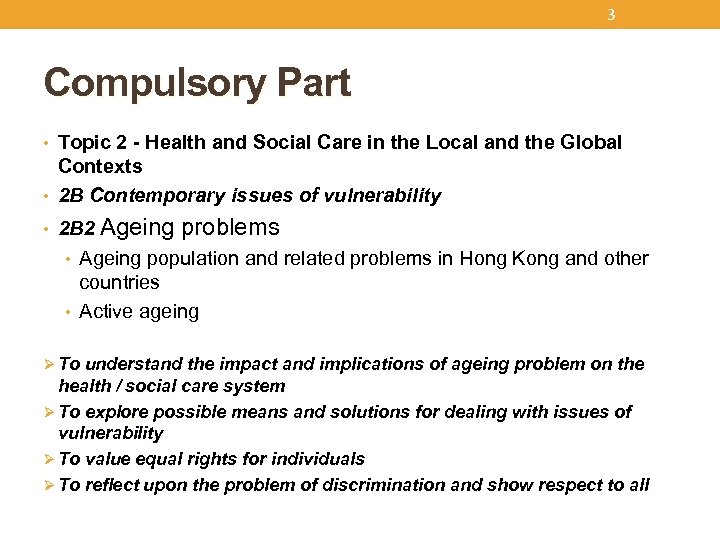 3 Compulsory Part • Topic 2 - Health and Social Care in the Local and the Global Contexts • 2 B Contemporary issues of vulnerability • 2 B 2 Ageing problems • Ageing population and related problems in Hong Kong and other countries • Active ageing Ø To understand the impact and implications of ageing problem on the health / social care system Ø To explore possible means and solutions for dealing with issues of vulnerability Ø To value equal rights for individuals Ø To reflect upon the problem of discrimination and show respect to all
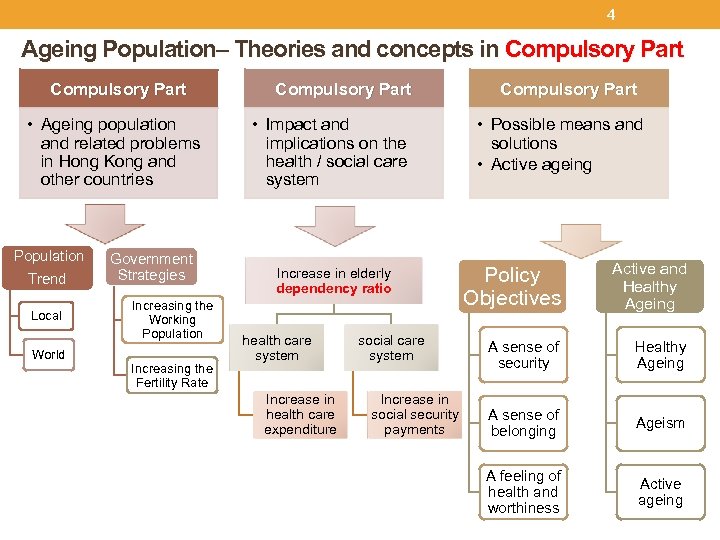 4 Ageing Population– Theories and concepts in Compulsory Part • Ageing population and related problems in Hong Kong and other countries Population Trend Local World Government Strategies Increasing the Working Population Increasing the Fertility Rate Compulsory Part • Impact and implications on the health / social care system Increase in elderly dependency ratio health care system Increase in health care expenditure social care system Increase in social security payments Compulsory Part • Possible means and solutions • Active ageing Policy Objectives Active and Healthy Ageing A sense of security Healthy Ageing A sense of belonging Ageism A feeling of health and worthiness Active ageing
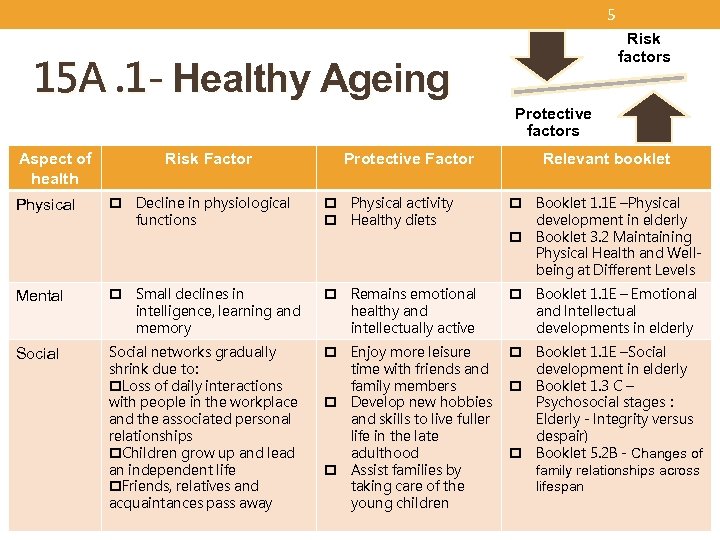 5 Risk factors 15 A. 1 - Healthy Ageing Protective factors Aspect of health Risk Factor Protective Factor Relevant booklet Physical p Decline in physiological functions p Physical activity p Healthy diets p Booklet 1. 1 E –Physical development in elderly p Booklet 3. 2 Maintaining Physical Health and Wellbeing at Different Levels Mental p Small declines in intelligence, learning and memory p Remains emotional healthy and intellectually active p Booklet 1. 1 E – Emotional and Intellectual developments in elderly Social networks gradually shrink due to: p. Loss of daily interactions with people in the workplace and the associated personal relationships p. Children grow up and lead an independent life p. Friends, relatives and acquaintances pass away p Enjoy more leisure time with friends and family members p Develop new hobbies and skills to live fuller life in the late adulthood p Assist families by taking care of the young children p Booklet 1. 1 E –Social development in elderly p Booklet 1. 3 C – Psychosocial stages: Elderly - Integrity versus despair) p Booklet 5. 2 B - Changes of family relationships across lifespan
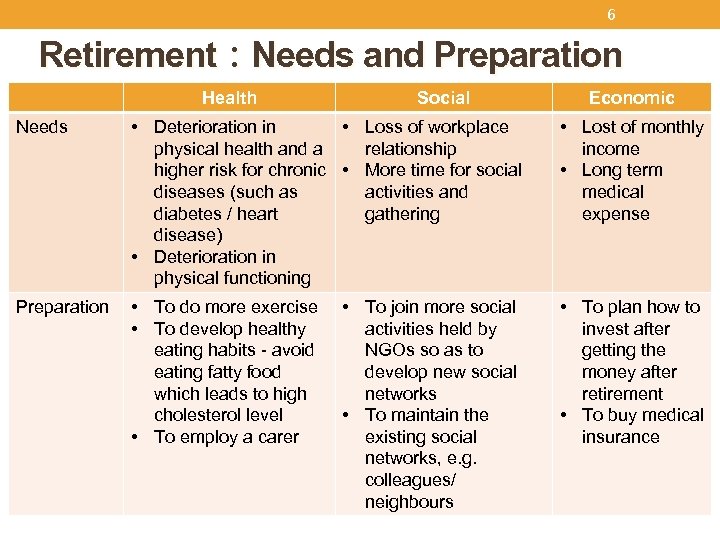 6 Retirement:Needs and Preparation Health Social Economic Needs • Deterioration in • Loss of workplace physical health and a relationship higher risk for chronic • More time for social diseases (such as activities and diabetes / heart gathering disease) • Deterioration in physical functioning • Lost of monthly income • Long term medical expense Preparation • To do more exercise • To develop healthy eating habits - avoid eating fatty food which leads to high cholesterol level • To employ a carer • To plan how to invest after getting the money after retirement • To buy medical insurance • To join more social activities held by NGOs so as to develop new social networks • To maintain the existing social networks, e. g. colleagues/ neighbours
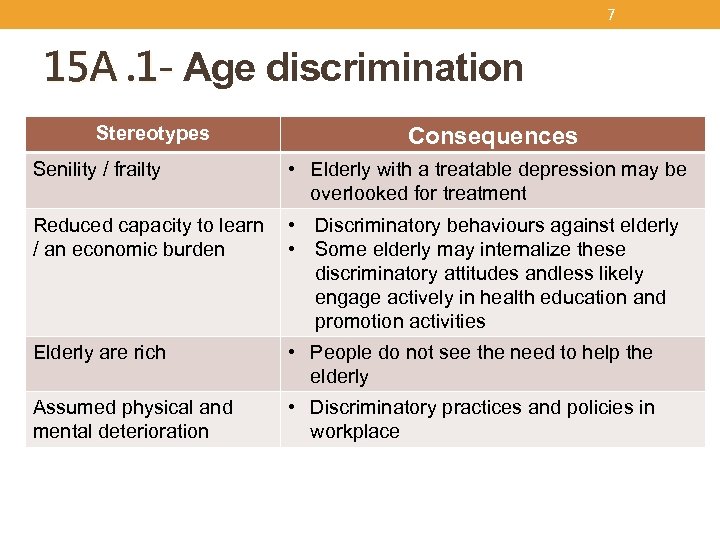 7 15 A. 1 - Age discrimination Stereotypes Consequences Senility / frailty • Elderly with a treatable depression may be overlooked for treatment Reduced capacity to learn / an economic burden • Discriminatory behaviours against elderly • Some elderly may internalize these discriminatory attitudes andless likely engage actively in health education and promotion activities Elderly are rich • People do not see the need to help the elderly Assumed physical and mental deterioration • Discriminatory practices and policies in workplace
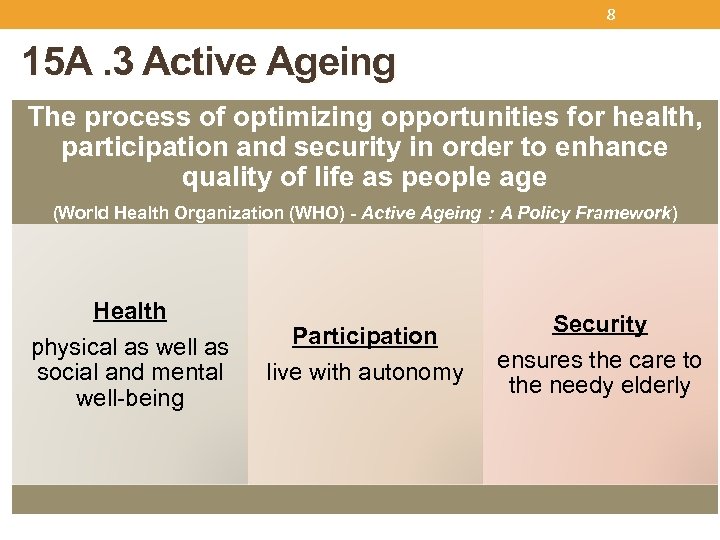 8 15 A. 3 Active Ageing The process of optimizing opportunities for health, participation and security in order to enhance quality of life as people age (World Health Organization (WHO) - Active Ageing:A Policy Framework) Health physical as well as social and mental well-being Participation live with autonomy Security ensures the care to the needy elderly
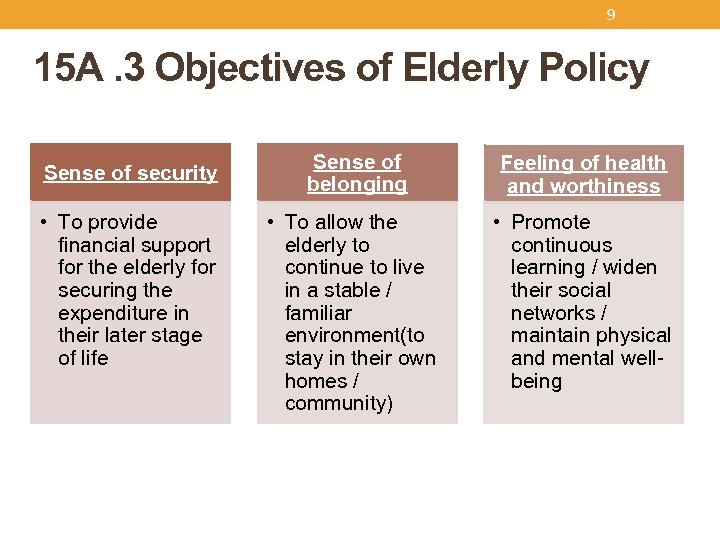 9 15 A. 3 Objectives of Elderly Policy Sense of security • To provide financial support for the elderly for securing the expenditure in their later stage of life Sense of belonging Feeling of health and worthiness • To allow the elderly to continue to live in a stable / familiar environment(to stay in their own homes / community) • Promote continuous learning / widen their social networks / maintain physical and mental wellbeing
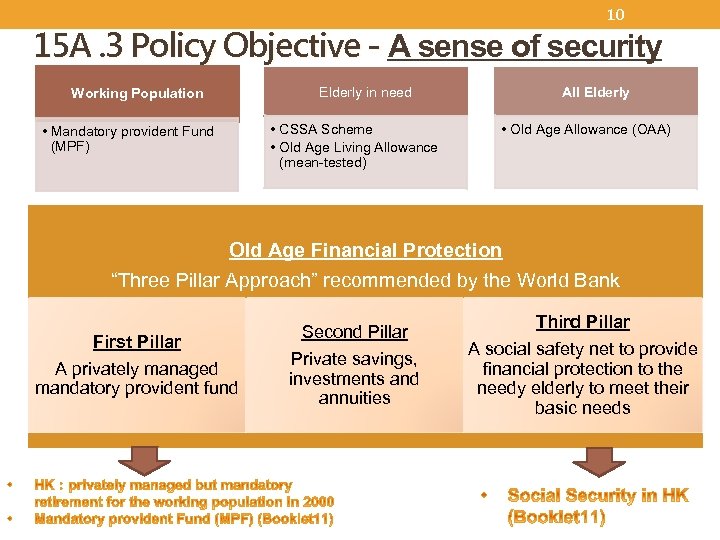 10 15 A. 3 Policy Objective - A sense of security Working Population • Mandatory provident Fund (MPF) Elderly in need • CSSA Scheme • Old Age Living Allowance (mean-tested) All Elderly • Old Age Allowance (OAA) Old Age Financial Protection “Three Pillar Approach” recommended by the World Bank First Pillar A privately managed mandatory provident fund Second Pillar Private savings, investments and annuities Third Pillar A social safety net to provide financial protection to the needy elderly to meet their basic needs
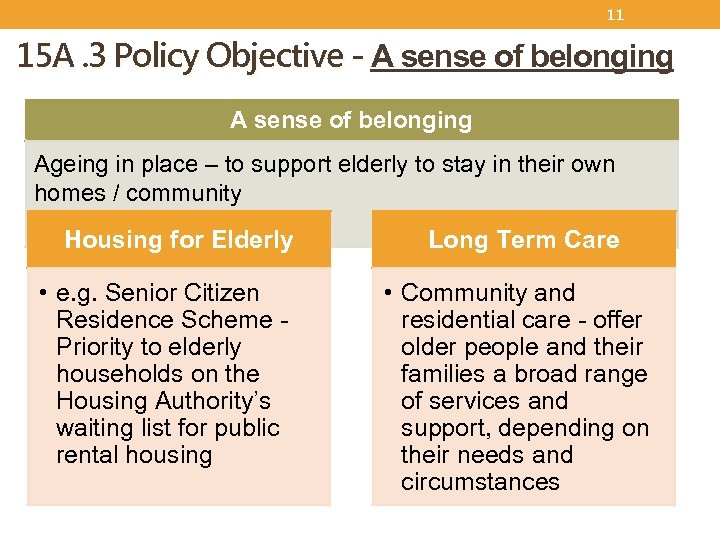 11 15 A. 3 Policy Objective - A sense of belonging Ageing in place – to support elderly to stay in their own homes / community Housing for Elderly • e. g. Senior Citizen Residence Scheme Priority to elderly households on the Housing Authority’s waiting list for public rental housing Long Term Care • Community and residential care - offer older people and their families a broad range of services and support, depending on their needs and circumstances
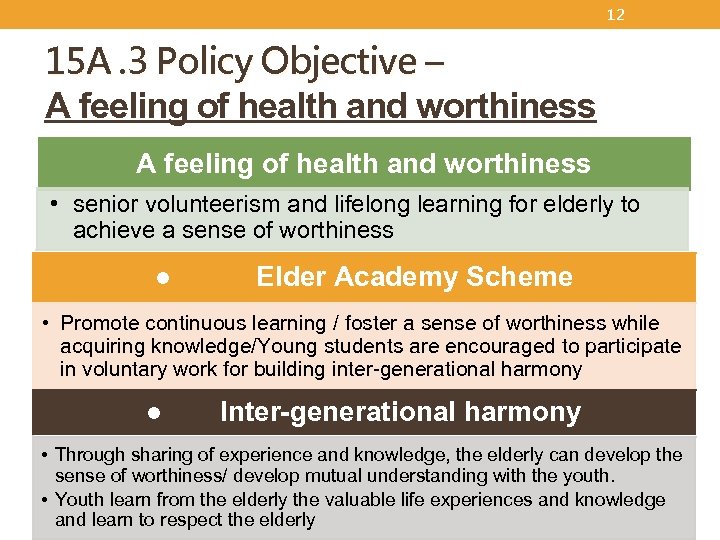 12 15 A. 3 Policy Objective – A feeling of health and worthiness • senior volunteerism and lifelong learning for elderly to achieve a sense of worthiness Elder Academy Scheme • Promote continuous learning / foster a sense of worthiness while acquiring knowledge/Young students are encouraged to participate in voluntary work for building inter-generational harmony Inter-generational harmony • Through sharing of experience and knowledge, the elderly can develop the sense of worthiness/ develop mutual understanding with the youth. • Youth learn from the elderly the valuable life experiences and knowledge and learn to respect the elderly
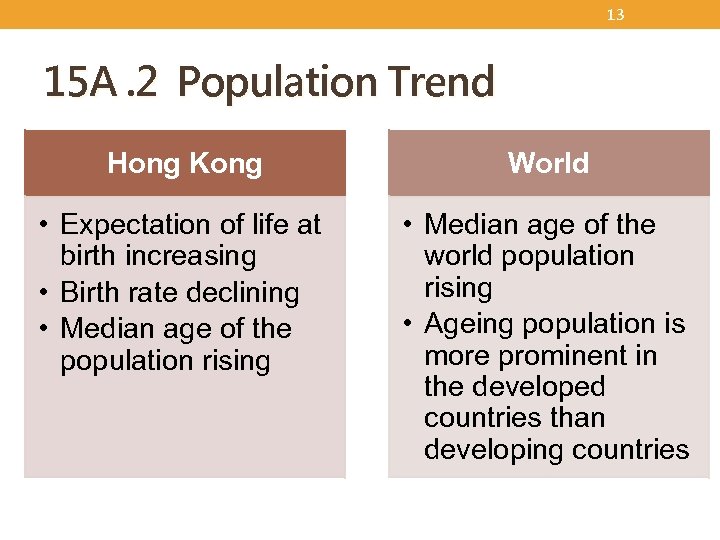 13 15 A. 2 Population Trend Hong Kong World • Expectation of life at birth increasing • Birth rate declining • Median age of the population rising • Median age of the world population rising • Ageing population is more prominent in the developed countries than developing countries
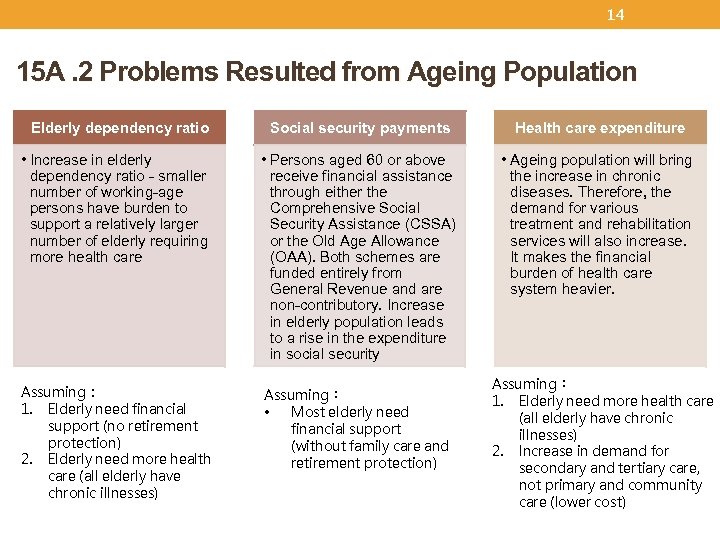 14 15 A. 2 Problems Resulted from Ageing Population Elderly dependency ratio Social security payments Health care expenditure • Increase in elderly dependency ratio - smaller number of working-age persons have burden to support a relatively larger number of elderly requiring more health care • Persons aged 60 or above receive financial assistance through either the Comprehensive Social Security Assistance (CSSA) or the Old Age Allowance (OAA). Both schemes are funded entirely from General Revenue and are non-contributory. Increase in elderly population leads to a rise in the expenditure in social security • Ageing population will bring the increase in chronic diseases. Therefore, the demand for various treatment and rehabilitation services will also increase. It makes the financial burden of health care system heavier. Assuming: 1. Elderly need financial support (no retirement protection) 2. Elderly need more health care (all elderly have chronic illnesses) Assuming: • Most elderly need financial support (without family care and retirement protection) Assuming: 1. Elderly need more health care (all elderly have chronic illnesses) 2. Increase in demand for secondary and tertiary care, not primary and community care (lower cost)
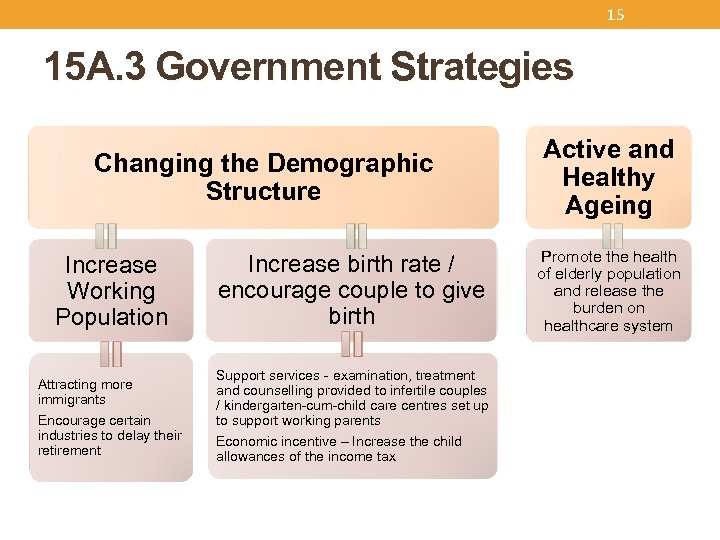 15 15 A. 3 Government Strategies Changing the Demographic Structure Increase Working Population Increase birth rate / encourage couple to give birth Attracting more immigrants Encourage certain industries to delay their retirement Support services - examination, treatment and counselling provided to infertile couples / kindergarten-cum-child care centres set up to support working parents Economic incentive – Increase the child allowances of the income tax Active and Healthy Ageing Promote the health of elderly population and release the burden on healthcare system
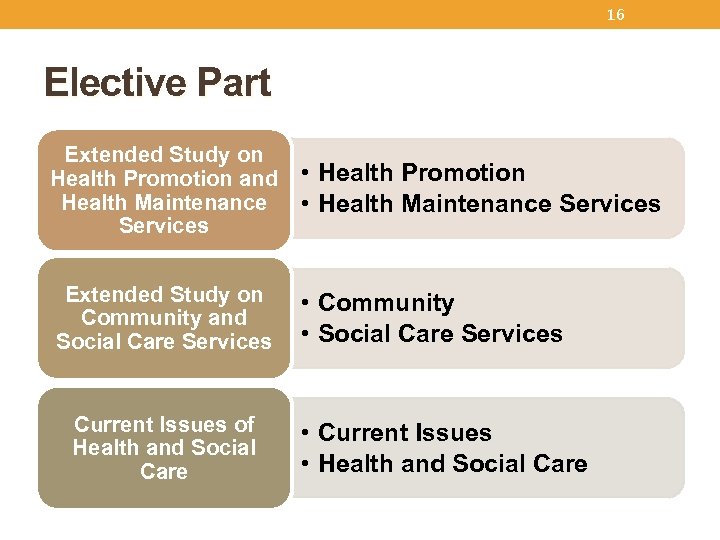 16 Elective Part Extended Study on Health Promotion and • Health Promotion Health Maintenance • Health Maintenance Services Extended Study on Community and Social Care Services Current Issues of Health and Social Care • Community • Social Care Services • Current Issues • Health and Social Care
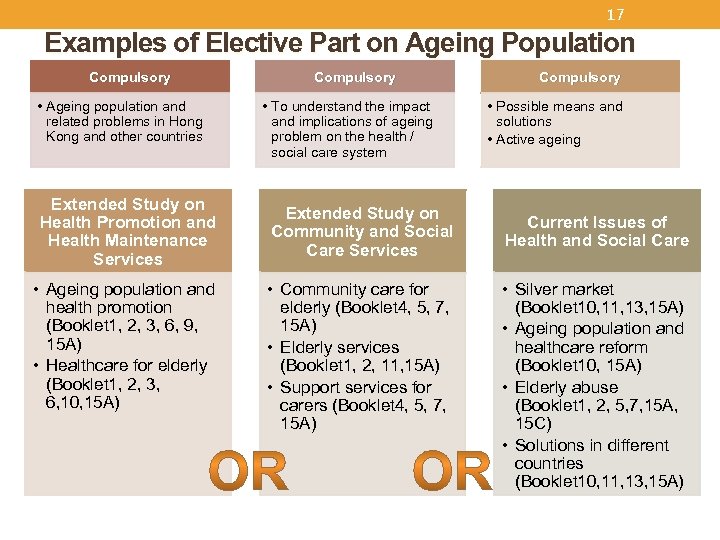 17 Examples of Elective Part on Ageing Population Compulsory • Ageing population and related problems in Hong Kong and other countries Extended Study on Health Promotion and Health Maintenance Services • Ageing population and health promotion (Booklet 1, 2, 3, 6, 9, 15 A) • Healthcare for elderly (Booklet 1, 2, 3, 6, 10, 15 A) Compulsory • To understand the impact and implications of ageing problem on the health / social care system Extended Study on Community and Social Care Services • Community care for elderly (Booklet 4, 5, 7, 15 A) • Elderly services (Booklet 1, 2, 11, 15 A) • Support services for carers (Booklet 4, 5, 7, 15 A) Compulsory • Possible means and solutions • Active ageing Current Issues of Health and Social Care • Silver market (Booklet 10, 11, 13, 15 A) • Ageing population and healthcare reform (Booklet 10, 15 A) • Elderly abuse (Booklet 1, 2, 5, 7, 15 A, 15 C) • Solutions in different countries (Booklet 10, 11, 13, 15 A)
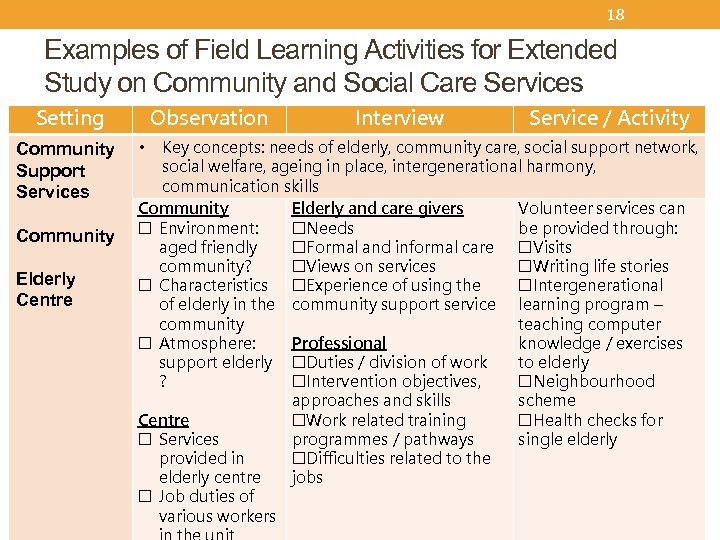 18 Examples of Field Learning Activities for Extended Study on Community and Social Care Services Setting Community Support Services Community Elderly Centre Observation Interview Service / Activity Key concepts: needs of elderly, community care, social support network, social welfare, ageing in place, intergenerational harmony, communication skills Community Elderly and care givers Volunteer services can Environment: Needs be provided through: aged friendly Formal and informal care Visits community? Views on services Writing life stories Characteristics Experience of using the Intergenerational of elderly in the community support service learning program – community teaching computer Atmosphere: Professional knowledge / exercises support elderly Duties / division of work to elderly ? Intervention objectives, Neighbourhood approaches and skills scheme Centre Work related training Health checks for Services programmes / pathways single elderly provided in Difficulties related to the elderly centre jobs Job duties of various workers •
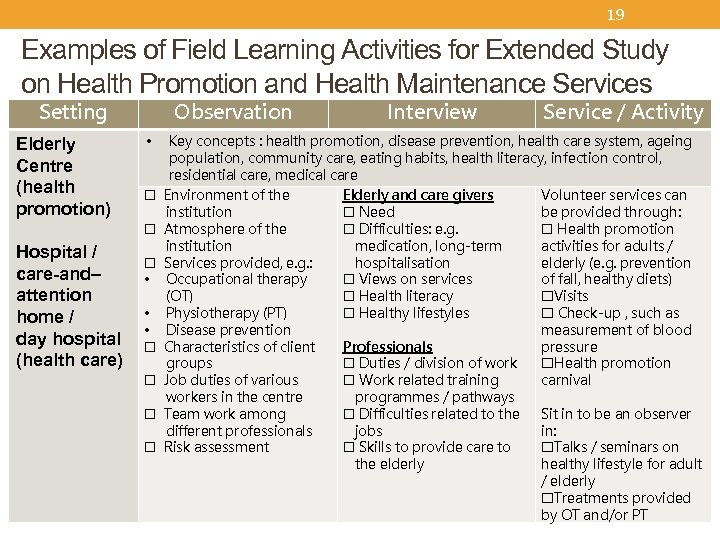 19 Examples of Field Learning Activities for Extended Study on Health Promotion and Health Maintenance Services Setting Elderly Centre (health promotion) Observation • Hospital / care-and– attention home / day hospital (health care) • • • Interview Service / Activity Key concepts : health promotion, disease prevention, health care system, ageing population, community care, eating habits, health literacy, infection control, residential care, medical care Environment of the Elderly and care givers Volunteer services can institution Need be provided through: Atmosphere of the Difficulties: e. g. Health promotion institution medication, long-term activities for adults / Services provided, e. g. : hospitalisation elderly (e. g. prevention Occupational therapy Views on services of fall, healthy diets) (OT) Health literacy Visits Physiotherapy (PT) Healthy lifestyles Check-up , such as Disease prevention measurement of blood Characteristics of client Professionals pressure groups Duties / division of work Health promotion Job duties of various Work related training carnival workers in the centre programmes / pathways Team work among Difficulties related to the Sit in to be an observer different professionals jobs in: Risk assessment Skills to provide care to Talks / seminars on the elderly healthy lifestyle for adult / elderly Treatments provided by OT and/or PT
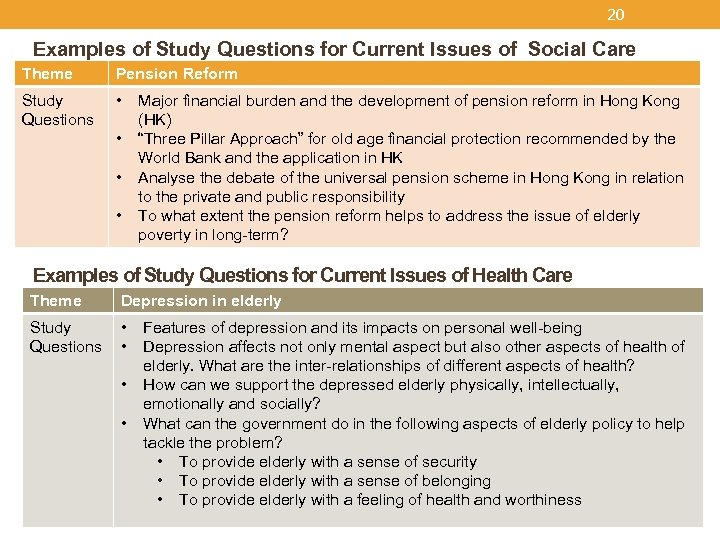 20 Examples of Study Questions for Current Issues of Social Care Theme Pension Reform Study Questions • • Major financial burden and the development of pension reform in Hong Kong (HK) “Three Pillar Approach” for old age financial protection recommended by the World Bank and the application in HK Analyse the debate of the universal pension scheme in Hong Kong in relation to the private and public responsibility To what extent the pension reform helps to address the issue of elderly poverty in long-term? Examples of Study Questions for Current Issues of Health Care Theme Depression in elderly Study Questions • • Features of depression and its impacts on personal well-being Depression affects not only mental aspect but also other aspects of health of elderly. What are the inter-relationships of different aspects of health? How can we support the depressed elderly physically, intellectually, emotionally and socially? What can the government do in the following aspects of elderly policy to help tackle the problem? • To provide elderly with a sense of security • To provide elderly with a sense of belonging • To provide elderly with a feeling of health and worthiness