


 Скачать презентацию Enriching Knowledge for the Health Management and Social
bce28bcab60dfb636137cec05cdac50c.ppt
- Количество слайдов: 44
 Enriching Knowledge for the Health Management and Social Care Curriculum Series (11) : Community Health (Compulsory Part) (Refreshed) 12 Mar 2015 p. m. Health Care System Booklet 10 1
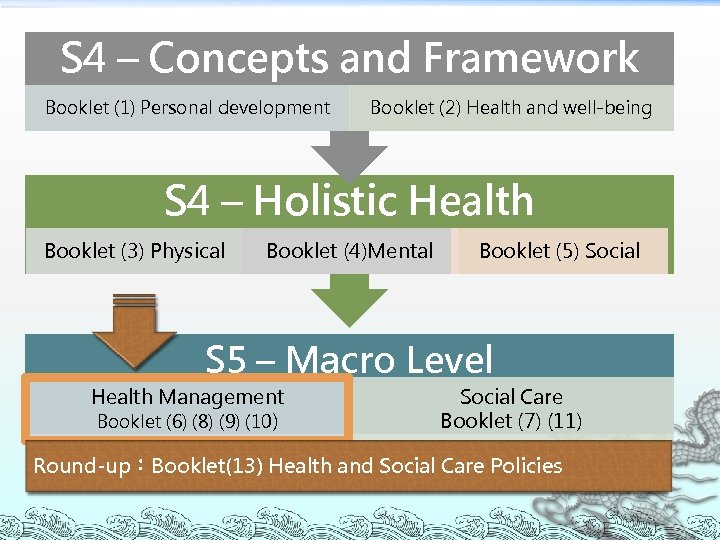 S 4 – Concepts and Framework Booklet (1) Personal development Booklet (2) Health and well-being S 4 – Holistic Health Booklet (3) Physical Booklet (4)Mental Booklet (5) Social S 5 – Macro Level Health Management Booklet (6) (8) (9) (10) Social Care Booklet (7) (11) Round-up:Booklet(13) Health and Social Care Policies
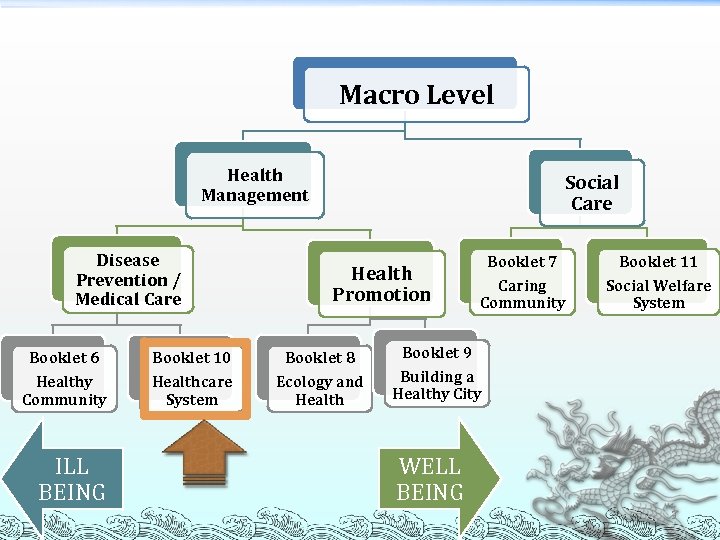 Macro Level Health Management Disease Prevention / Medical Care Social Care Health Promotion Booklet 6 Booklet 10 Booklet 8 Healthy Community Healthcare System Ecology and Health ILL BEING Booklet 7 Booklet 11 Caring Community Social Welfare System Booklet 9 Building a Healthy City WELL BEING 3
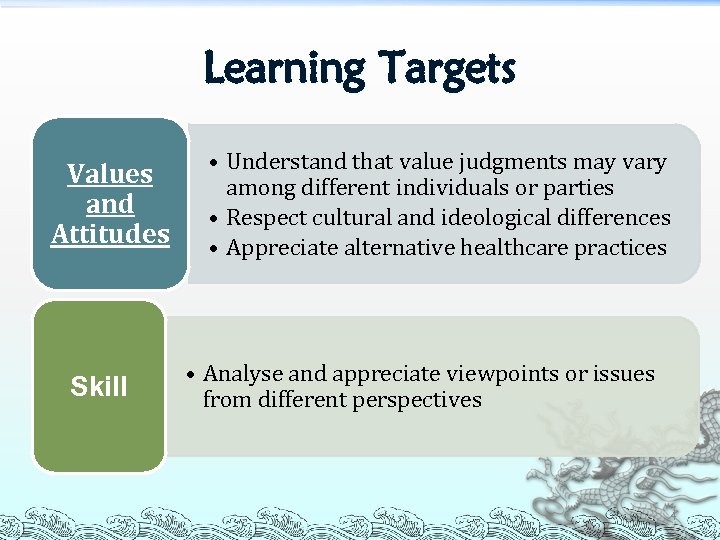 Learning Targets Values and Attitudes Skill • Understand that value judgments may vary among different individuals or parties • Respect cultural and ideological differences • Appreciate alternative healthcare practices • Analyse and appreciate viewpoints or issues from different perspectives 4
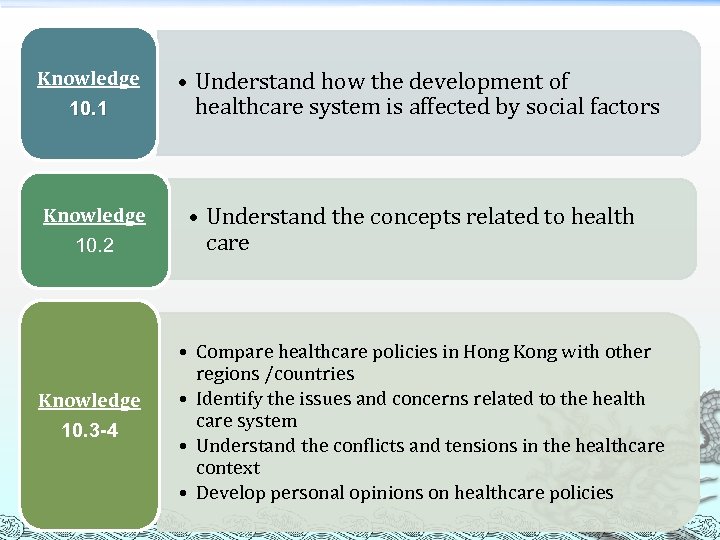 Knowledge 10. 1 Knowledge 10. 2 Knowledge 10. 3 -4 • Understand how the development of healthcare system is affected by social factors • Understand the concepts related to health care • Compare healthcare policies in Hong Kong with other regions /countries • Identify the issues and concerns related to the health care system • Understand the conflicts and tensions in the healthcare context • Develop personal opinions on healthcare policies 5
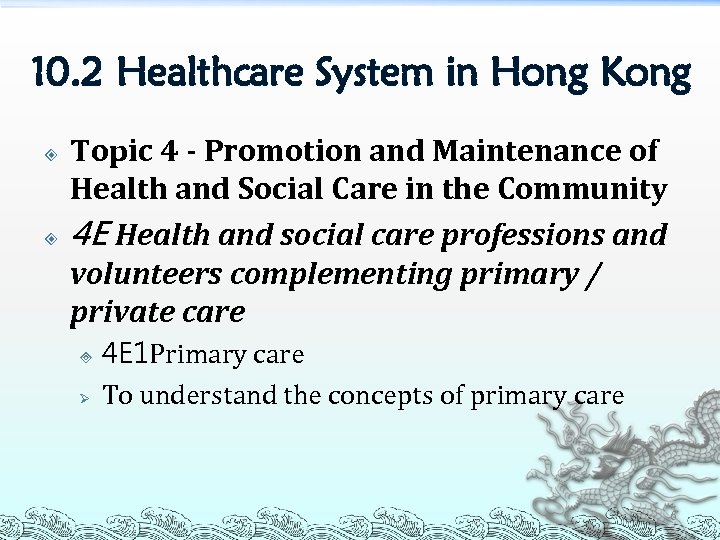 10. 2 Healthcare System in Hong Kong Topic 4 - Promotion and Maintenance of Health and Social Care in the Community 4 E Health and social care professions and volunteers complementing primary / private care ³ Ø 4 E 1 Primary care To understand the concepts of primary care 6
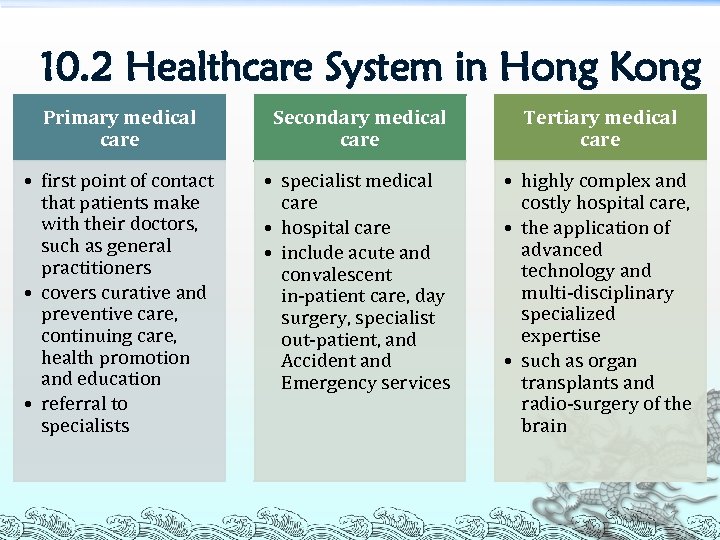 10. 2 Healthcare System in Hong Kong Primary medical care Secondary medical care Tertiary medical care • first point of contact that patients make with their doctors, such as general practitioners • covers curative and preventive care, continuing care, health promotion and education • referral to specialists • specialist medical care • hospital care • include acute and convalescent in‐patient care, day surgery, specialist out‐patient, and Accident and Emergency services • highly complex and costly hospital care, • the application of advanced technology and multi‐disciplinary specialized expertise • such as organ transplants and radio‐surgery of the brain 7
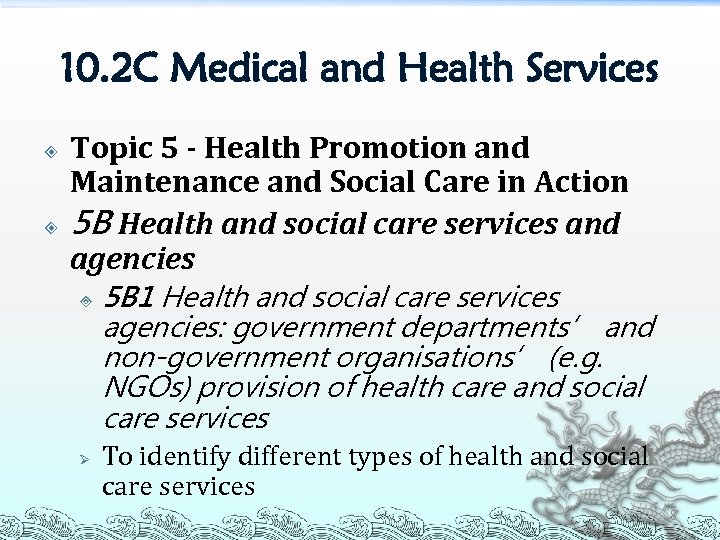 10. 2 C Medical and Health Services Topic 5 - Health Promotion and Maintenance and Social Care in Action 5 B Health and social care services and agencies ³ Ø 5 B 1 Health and social care services agencies: government departments’ and non-government organisations’ (e. g. NGOs) provision of health care and social care services To identify different types of health and social care services 8
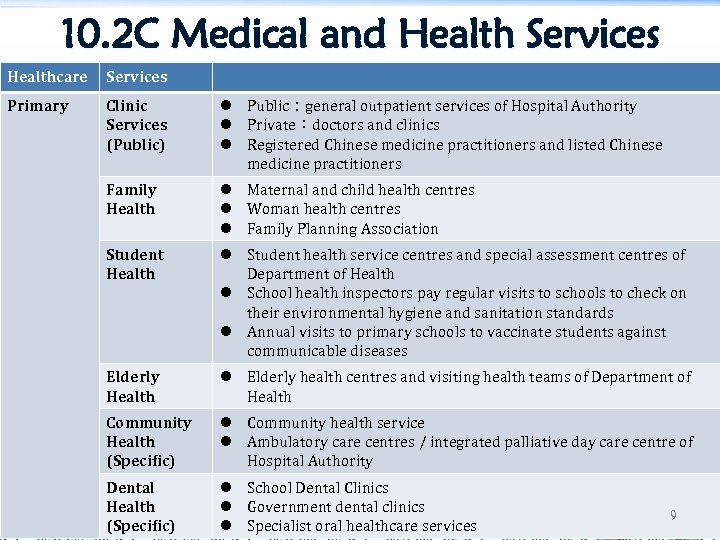 10. 2 C Medical and Health Services Healthcare Services Primary Clinic Services (Public) l Public:general outpatient services of Hospital Authority l Private:doctors and clinics l Registered Chinese medicine practitioners and listed Chinese medicine practitioners Family Health l Maternal and child health centres l Woman health centres l Family Planning Association Student Health l Student health service centres and special assessment centres of Department of Health l School health inspectors pay regular visits to schools to check on their environmental hygiene and sanitation standards l Annual visits to primary schools to vaccinate students against communicable diseases Elderly Health l Elderly health centres and visiting health teams of Department of Health Community Health (Specific) l Community health service l Ambulatory care centres / integrated palliative day care centre of Hospital Authority Dental Health (Specific) l School Dental Clinics l Government dental clinics l Specialist oral healthcare services 9
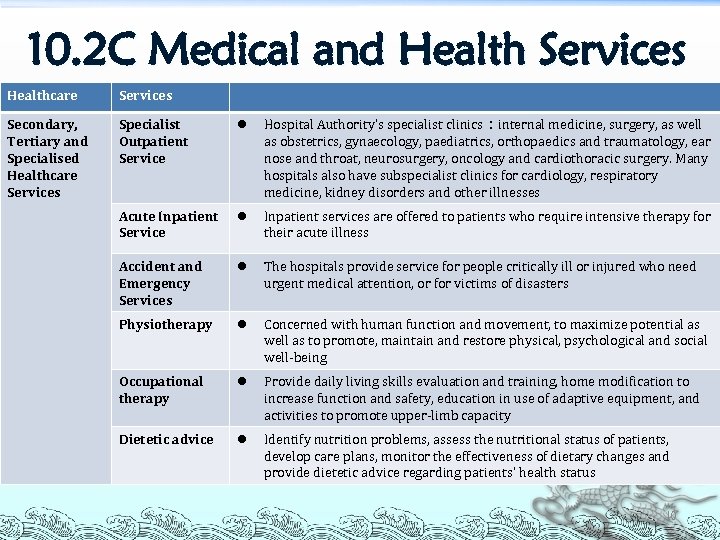 10. 2 C Medical and Health Services Healthcare Services Secondary, Tertiary and Specialised Healthcare Services Specialist Outpatient Service l Hospital Authority’s specialist clinics:internal medicine, surgery, as well as obstetrics, gynaecology, paediatrics, orthopaedics and traumatology, ear nose and throat, neurosurgery, oncology and cardiothoracic surgery. Many hospitals also have subspecialist clinics for cardiology, respiratory medicine, kidney disorders and other illnesses Acute Inpatient Service l Inpatient services are offered to patients who require intensive therapy for their acute illness Accident and Emergency Services l The hospitals provide service for people critically ill or injured who need urgent medical attention, or for victims of disasters Physiotherapy l Concerned with human function and movement, to maximize potential as well as to promote, maintain and restore physical, psychological and social well‐being Occupational therapy l Provide daily living skills evaluation and training, home modification to increase function and safety, education in use of adaptive equipment, and activities to promote upper‐limb capacity Dietetic advice l Identify nutrition problems, assess the nutritional status of patients, develop care plans, monitor the effectiveness of dietary changes and provide dietetic advice regarding patients’ health status 10
 10. 2 D Alternative Healthcare Practices Topic 4 - Promotion and Maintenance of Health and Social Care in the Community 4 A Disease prevention (primary, secondary and tertiary) and using precautions in our daily living patterns and lifestyles ³ Ø 4 A 6 Options for alternative health care practices and services, e. g. traditional Chinese medicine, acupuncture, naturopathy To appreciate alternative health care practices 11
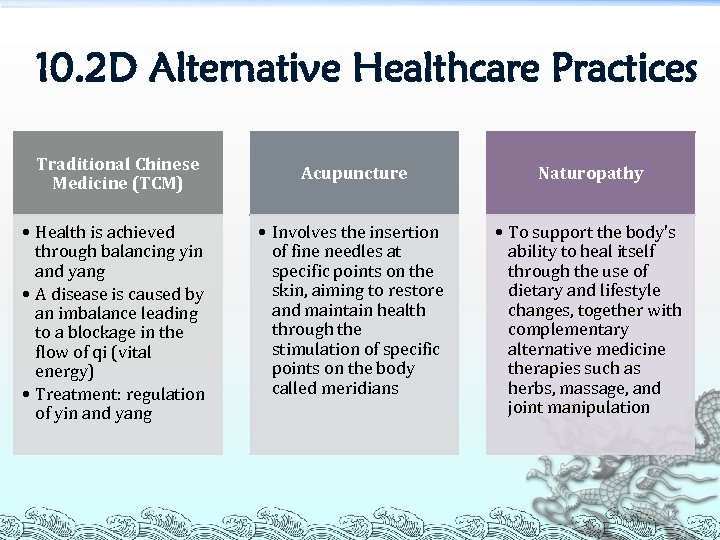 10. 2 D Alternative Healthcare Practices Traditional Chinese Medicine (TCM) • Health is achieved through balancing yin and yang • A disease is caused by an imbalance leading to a blockage in the flow of qi (vital energy) • Treatment: regulation of yin and yang Acupuncture Naturopathy • Involves the insertion of fine needles at specific points on the skin, aiming to restore and maintain health through the stimulation of specific points on the body called meridians • To support the body's ability to heal itself through the use of dietary and lifestyle changes, together with complementary alternative medicine therapies such as herbs, massage, and joint manipulation 12
 10. 2 Healthcare System in Hong Kong • • • Topic 3 – Responding to the Needs in the Areas of Health (care, promotion and maintenance) and Social Care 3 C Implementing health and social care policies 3 C 2 Public and private sectors and their roles in care services 3 C 3 Responsibilities, financing and structure of public agencies Ø To explain the health care system of Hong Kong and comment on its role in policy implementation 13
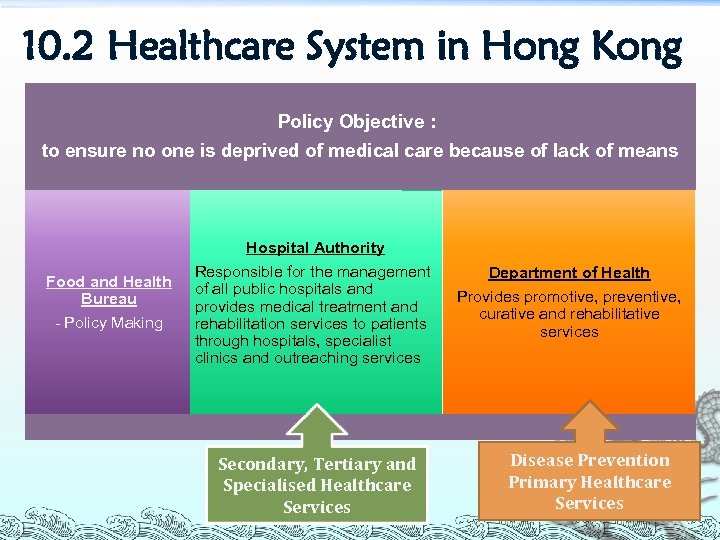 10. 2 Healthcare System in Hong Kong Policy Objective: to ensure no one is deprived of medical care because of lack of means Food and Health Bureau - Policy Making Hospital Authority Responsible for the management of all public hospitals and provides medical treatment and rehabilitation services to patients through hospitals, specialist clinics and outreaching services Secondary, Tertiary and Specialised Healthcare Services Department of Health Provides promotive, preventive, curative and rehabilitative services Disease Prevention Primary Healthcare Services 14
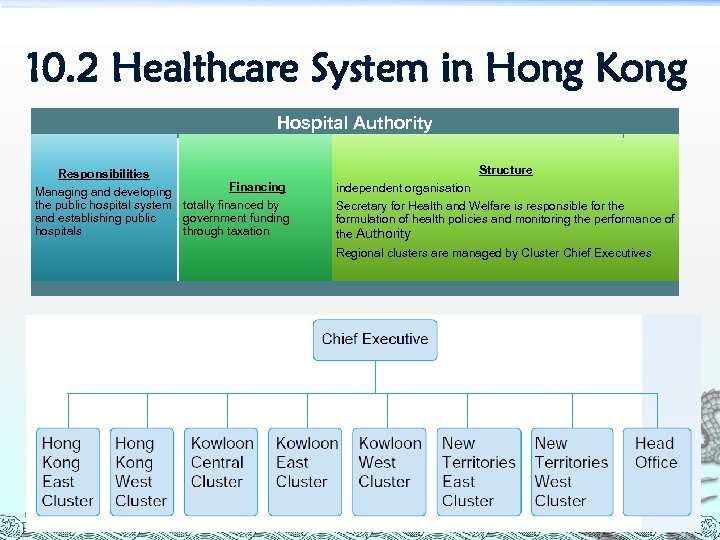 10. 2 Healthcare System in Hong Kong Hospital Authority Responsibilities Financing Managing and developing the public hospital system totally financed by and establishing public government funding hospitals through taxation Structure independent organisation Secretary for Health and Welfare is responsible for the formulation of health policies and monitoring the performance of the Authority Regional clusters are managed by Cluster Chief Executives 15
 10. 3 F Public and Private Sectors and their Roles in Healthcare Services Topic 3 – Responding to the Needs in the Areas of Health (care, promotion and maintenance) and Social Care 3 C Implementing health and social care policies ³ Ø 3 C 2 Public and private sectors and their roles in care services To explain the health care system of Hong Kong and comment on its role in policy implementation 16
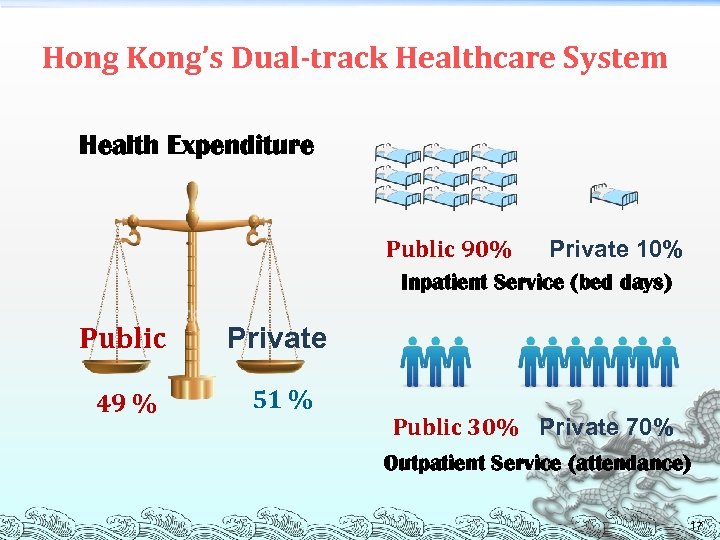 Hong Kong’s Dual-track Healthcare System Health Expenditure Public 90% Private 10% Inpatient Service (bed days) Public Private 49 % 51 % Public 30% Private 70% Outpatient Service (attendance) 17
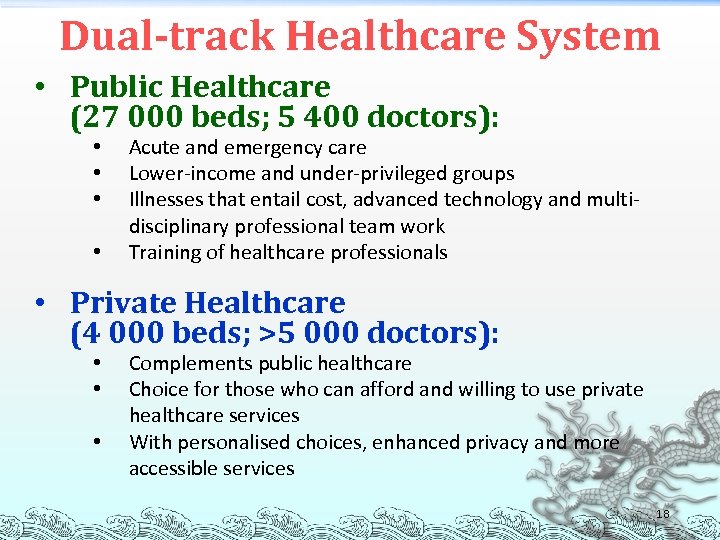 Dual-track Healthcare System • Public Healthcare (27 000 beds; 5 400 doctors): • • Acute and emergency care Lower-income and under-privileged groups Illnesses that entail cost, advanced technology and multidisciplinary professional team work Training of healthcare professionals • Private Healthcare (4 000 beds; >5 000 doctors): • • • Complements public healthcare Choice for those who can afford and willing to use private healthcare services With personalised choices, enhanced privacy and more accessible services 18
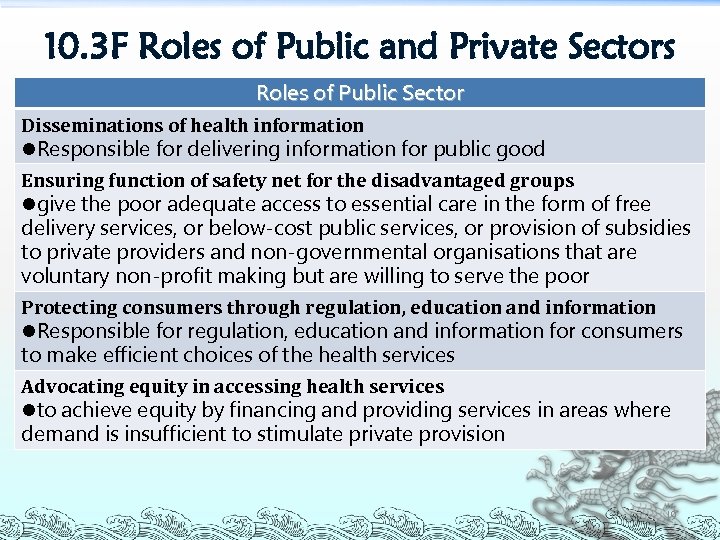 10. 3 F Roles of Public and Private Sectors Roles of Public Sector Disseminations of health information l. Responsible for delivering information for public good Ensuring function of safety net for the disadvantaged groups lgive the poor adequate access to essential care in the form of free delivery services, or below-cost public services, or provision of subsidies to private providers and non-governmental organisations that are voluntary non-profit making but are willing to serve the poor Protecting consumers through regulation, education and information l. Responsible for regulation, education and information for consumers to make efficient choices of the health services Advocating equity in accessing health services lto achieve equity by financing and providing services in areas where demand is insufficient to stimulate private provision 19
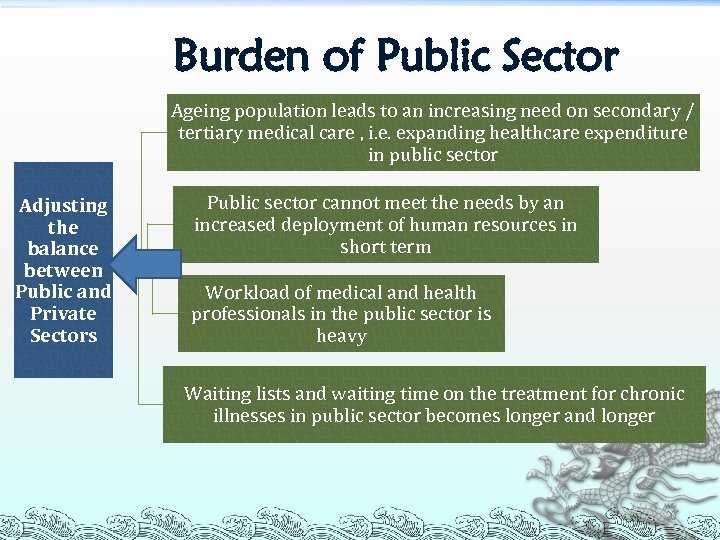 Burden of Public Sector Ageing population leads to an increasing need on secondary / tertiary medical care , i. e. expanding healthcare expenditure in public sector Adjusting the balance between Public and Private Sectors Public sector cannot meet the needs by an increased deployment of human resources in short term Workload of medical and health professionals in the public sector is heavy Waiting lists and waiting time on the treatment for chronic illnesses in public sector becomes longer and longer 20
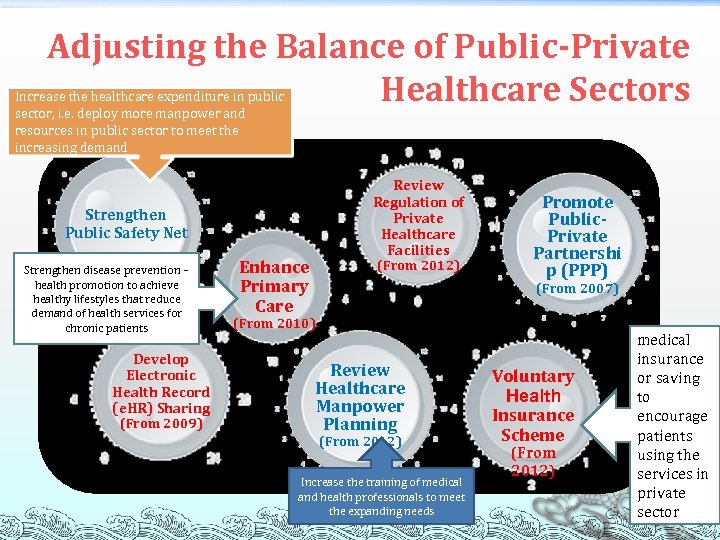 Adjusting the Balance of Public-Private Healthcare Sectors Increase the healthcare expenditure in public sector, i. e. deploy more manpower and resources in public sector to meet the increasing demand Review Regulation of Private Healthcare Facilities Strengthen Public Safety Net Strengthen disease prevention – health promotion to achieve healthy lifestyles that reduce demand of health services for chronic patients Develop Electronic Health Record (e. HR) Sharing (From 2009) Enhance Primary Care (From 2012) Promote Public. Private Partnershi p (PPP) (From 2007) (From 2010) Review Healthcare Manpower Planning (From 2012) Increase the training of medical and health professionals to meet the expanding needs Voluntary Health Insurance Scheme (From 2012) medical insurance or saving to encourage patients using the services in private sector 21
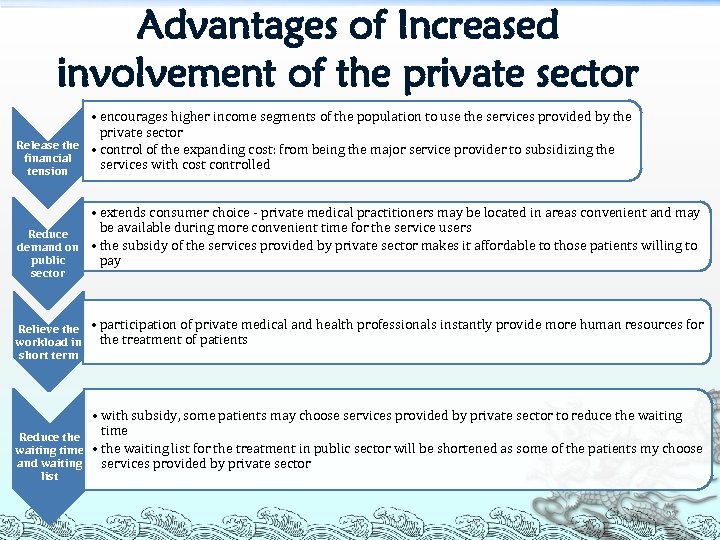 Advantages of Increased involvement of the private sector • encourages higher income segments of the population to use the services provided by the private sector Release the • control of the expanding cost: from being the major service provider to subsidizing the financial services with cost controlled tension • extends consumer choice ‐ private medical practitioners may be located in areas convenient and may be available during more convenient time for the service users Reduce demand on • the subsidy of the services provided by private sector makes it affordable to those patients willing to public pay sector Relieve the workload in short term • participation of private medical and health professionals instantly provide more human resources for the treatment of patients • with subsidy, some patients may choose services provided by private sector to reduce the waiting time Reduce the waiting time • the waiting list for the treatment in public sector will be shortened as some of the patients my choose and waiting services provided by private sector list 22
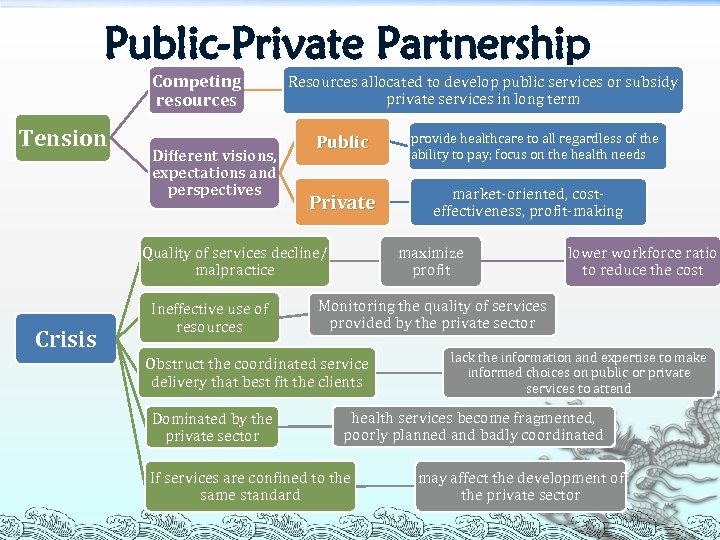 Public-Private Partnership Competing resources Tension Different visions, expectations and perspectives Resources allocated to develop public services or subsidy private services in long term Public Private Crisis lower workforce ratio to reduce the cost Monitoring the quality of services provided by the private sector Obstruct the coordinated service delivery that best fit the clients Dominated by the private sector market‐oriented, cost‐ effectiveness, profit‐making maximize profit Quality of services decline/ malpractice Ineffective use of resources provide healthcare to all regardless of the ability to pay; focus on the health needs lack the information and expertise to make informed choices on public or private services to attend health services become fragmented, poorly planned and badly coordinated If services are confined to the same standard may affect the development of the private sector
 10. 1 Development of Healthcare System in Hong Kong Topic 2 - Health and Social Care in the Local and the Global Contexts 2 D Developments in the health and care industries ³ Ø 2 D 6 Changing infrastructure of health care To understand how the development of health and care industries are affected by the systemic factors, issues and concerns 24
 10. 1 Development of Healthcare System in Hong Kong Topic 3 – Responding to the Needs in the Areas of Health (care, promotion and maintenance) and Social Care 3 C Implementing health and social care policies ³ Ø 3 C 1 Development of the health care system in Hong Kong To explain the health care system of Hong Kong and comment on its role in policy implementation 25
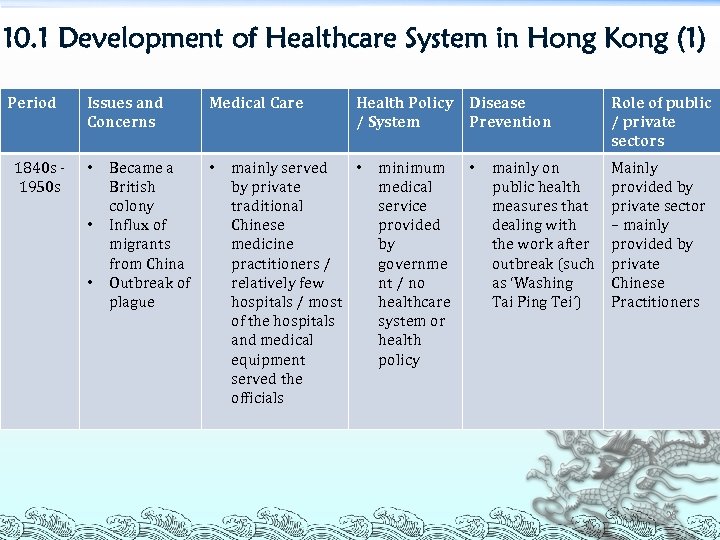 10. 1 Development of Healthcare System in Hong Kong (1) Period 1840 s ‐ 1950 s Issues and Concerns • • • Became a British colony Influx of migrants from China Outbreak of plague Medical Care • Health Policy / System mainly served • by private traditional Chinese medicine practitioners / relatively few hospitals / most of the hospitals and medical equipment served the officials minimum medical service provided by governme nt / no healthcare system or health policy Disease Prevention • mainly on public health measures that dealing with the work after outbreak (such as ‘Washing Tai Ping Tei’) Role of public / private sectors Mainly provided by private sector – mainly provided by private Chinese Practitioners 26
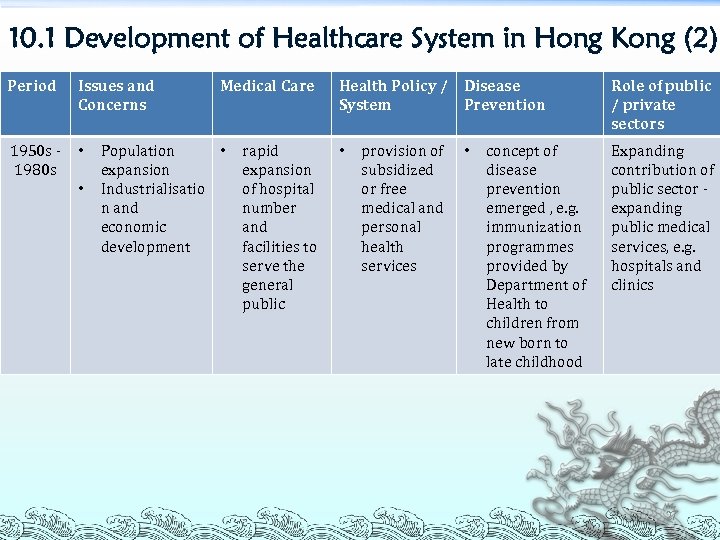 10. 1 Development of Healthcare System in Hong Kong (2) Period Issues and Concerns 1950 s ‐ 1980 s • • Medical Care Population • expansion Industrialisatio n and economic development rapid expansion of hospital number and facilities to serve the general public Health Policy / Disease System Prevention • provision of subsidized or free medical and personal health services • concept of disease prevention emerged , e. g. immunization programmes provided by Department of Health to children from new born to late childhood Role of public / private sectors Expanding contribution of public sector ‐ expanding public medical services, e. g. hospitals and clinics 27
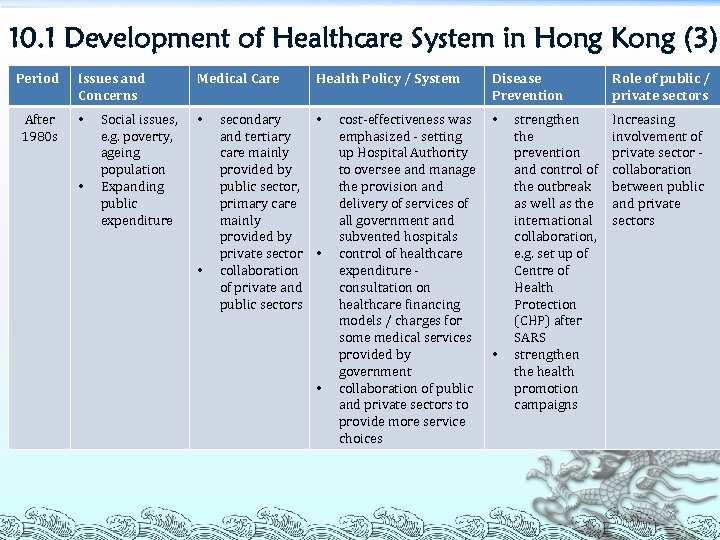 10. 1 Development of Healthcare System in Hong Kong (3) Period After 1980 s Issues and Concerns • • Social issues, e. g. poverty, ageing population Expanding public expenditure Medical Care • • Health Policy / System secondary • and tertiary care mainly provided by public sector, primary care mainly provided by private sector • collaboration of private and public sectors • cost‐effectiveness was emphasized ‐ setting up Hospital Authority to oversee and manage the provision and delivery of services of all government and subvented hospitals control of healthcare expenditure ‐ consultation on healthcare financing models / charges for some medical services provided by government collaboration of public and private sectors to provide more service choices Disease Prevention • • strengthen the prevention and control of the outbreak as well as the international collaboration, e. g. set up of Centre of Health Protection (CHP) after SARS strengthen the health promotion campaigns Role of public / private sectors Increasing involvement of private sector ‐ collaboration between public and private sectors 28
 10. 3 Healthcare Reforms u u • Ø Ø Topic 2 - Health and Social Care in the Local and the Global Contexts 2 D Developments in the health and care industries 2 D 6 Changing infrastructure of social and health care e. g. Introduction of the health financing model To analyse the viewpoints or issues from different perspectives To understand that value judgments may vary among different individuals or parties 29
 10. 3 Healthcare Reforms Topic 3 – Responding to the Needs in the Areas of Health (care, promotion and maintenance) and Social Care 3 C Implementing health and social care policies ³ Ø 3 C 1 Development of the health care system in Hong Kong To express personal opinions on health care policies 30
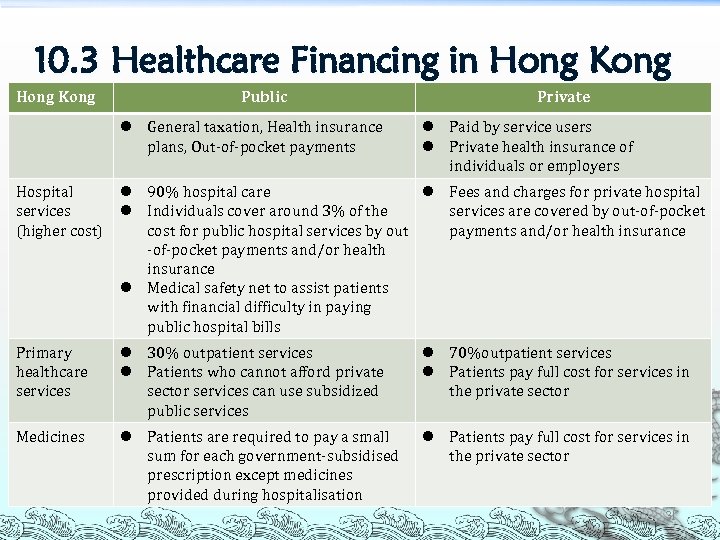 10. 3 Healthcare Financing in Hong Kong Public l General taxation, Health insurance plans, Out‐of‐pocket payments Private l Paid by service users l Private health insurance of individuals or employers Hospital services (higher cost) l 90% hospital care l Fees and charges for private hospital l Individuals cover around 3% of the services are covered by out‐of‐pocket cost for public hospital services by out payments and/or health insurance ‐of‐pocket payments and/or health insurance l Medical safety net to assist patients with financial difficulty in paying public hospital bills Primary healthcare services l 30% outpatient services l Patients who cannot afford private sector services can use subsidized public services l 70%outpatient services l Patients pay full cost for services in the private sector Medicines l Patients are required to pay a small sum for each government‐subsidised prescription except medicines provided during hospitalisation l Patients pay full cost for services in the private sector 31
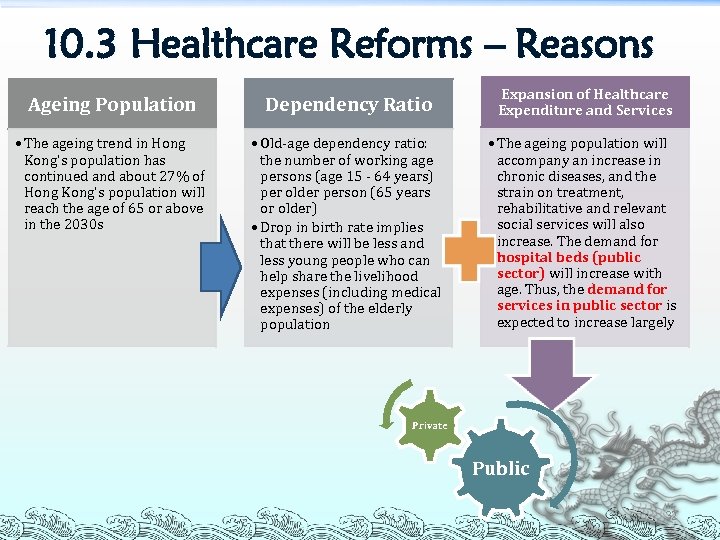 10. 3 Healthcare Reforms – Reasons Ageing Population Dependency Ratio Expansion of Healthcare Expenditure and Services • The ageing trend in Hong Kong's population has continued and about 27% of Hong Kong's population will reach the age of 65 or above in the 2030 s • Old‐age dependency ratio: the number of working age persons (age 15 ‐ 64 years) per older person (65 years or older) • Drop in birth rate implies that there will be less and less young people who can help share the livelihood expenses (including medical expenses) of the elderly population • The ageing population will accompany an increase in chronic diseases, and the strain on treatment, rehabilitative and relevant social services will also increase. The demand for hospital beds (public sector) will increase with age. Thus, the demand for services in public sector is expected to increase largely Private Public 32
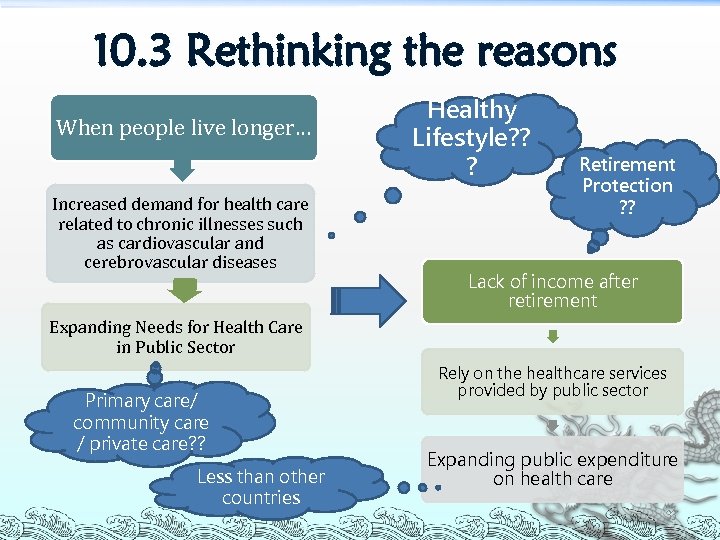 10. 3 Rethinking the reasons When people live longer… Increased demand for health care related to chronic illnesses such as cardiovascular and cerebrovascular diseases Healthy Lifestyle? ? ? Retirement Protection ? ? Lack of income after retirement Expanding Needs for Health Care in Public Sector Primary care/ community care / private care? ? Less than other countries Rely on the healthcare services provided by public sector Expanding public expenditure on health care 33
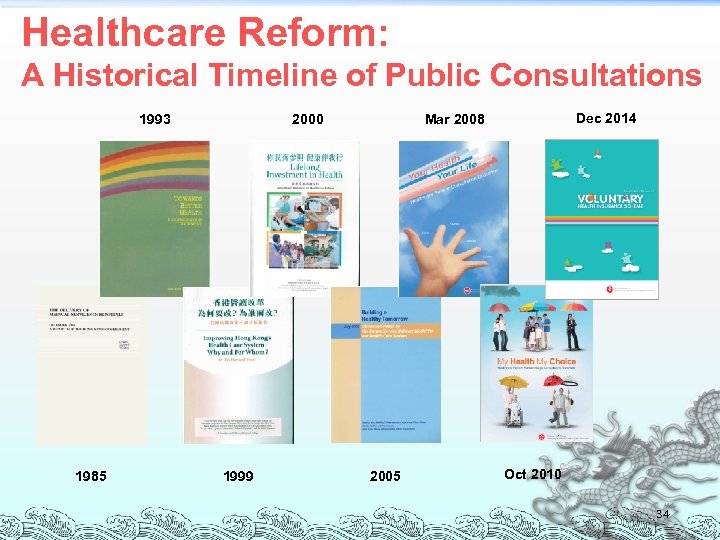 Healthcare Reform: A Historical Timeline of Public Consultations 1993 1985 2000 1999 Dec 2014 Mar 2008 2005 Oct 2010 34
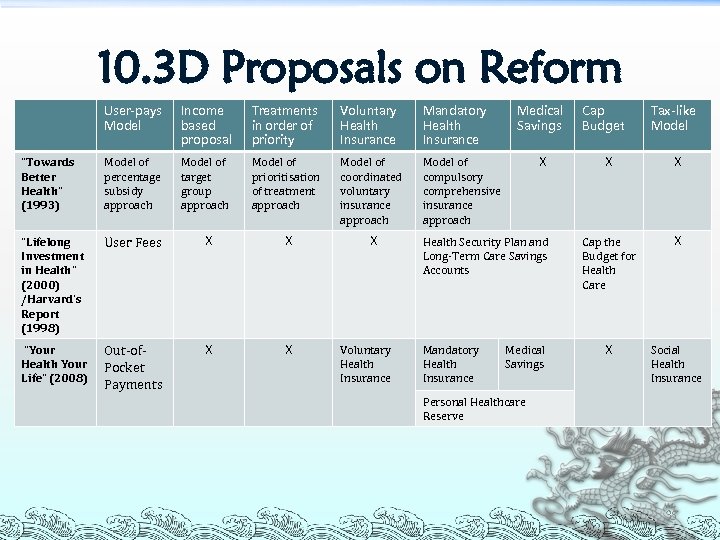 10. 3 D Proposals on Reform User-pays Model Income based proposal Treatments in order of priority Voluntary Health Insurance Mandatory Health Insurance “Towards Better Health” (1993) Model of percentage subsidy approach Model of target group approach Model of prioritisation of treatment approach Model of coordinated voluntary insurance approach Model of compulsory comprehensive insurance approach “Lifelong Investment in Health” (2000) /Harvard’s Report (1998) User Fees X X X “Your Health Your Life” (2008) Out‐of‐ Pocket Payments X X Voluntary Health Insurance Medical Savings X Health Security Plan and Long‐Term Care Savings Accounts Mandatory Health Insurance Medical Savings Cap Budget Tax-like Model X X Cap the Budget for Health Care X X Social Health Insurance Personal Healthcare Reserve 35
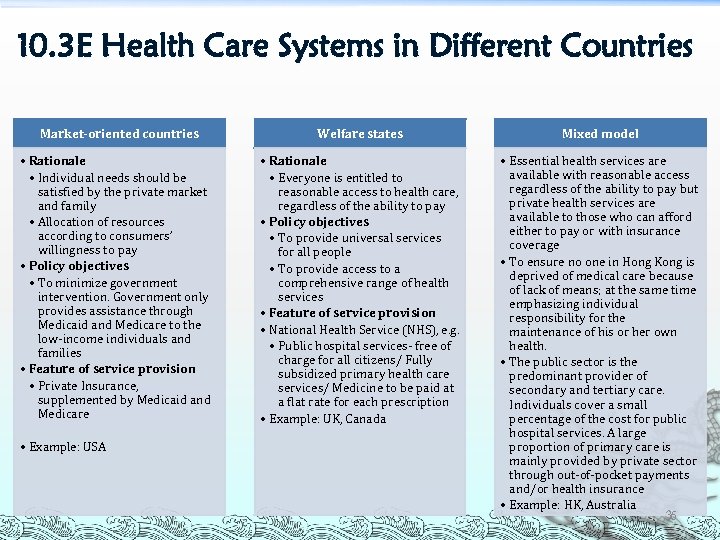 10. 3 E Health Care Systems in Different Countries Market-oriented countries • Rationale • Individual needs should be satisfied by the private market and family • Allocation of resources according to consumers’ willingness to pay • Policy objectives • To minimize government intervention. Government only provides assistance through Medicaid and Medicare to the low‐income individuals and families • Feature of service provision • Private Insurance, supplemented by Medicaid and Medicare • Example: USA Welfare states Mixed model • Rationale • Everyone is entitled to reasonable access to health care, regardless of the ability to pay • Policy objectives • To provide universal services for all people • To provide access to a comprehensive range of health services • Feature of service provision • National Health Service (NHS), e. g. • Public hospital services‐ free of charge for all citizens/ Fully subsidized primary health care services/ Medicine to be paid at a flat rate for each prescription • Example: UK, Canada • Essential health services are available with reasonable access regardless of the ability to pay but private health services are available to those who can afford either to pay or with insurance coverage • To ensure no one in Hong Kong is deprived of medical care because of lack of means; at the same time emphasizing individual responsibility for the maintenance of his or her own health. • The public sector is the predominant provider of secondary and tertiary care. Individuals cover a small percentage of the cost for public hospital services. A large proportion of primary care is mainly provided by private sector through out‐of‐pocket payments and/or health insurance • Example: HK, Australia 36
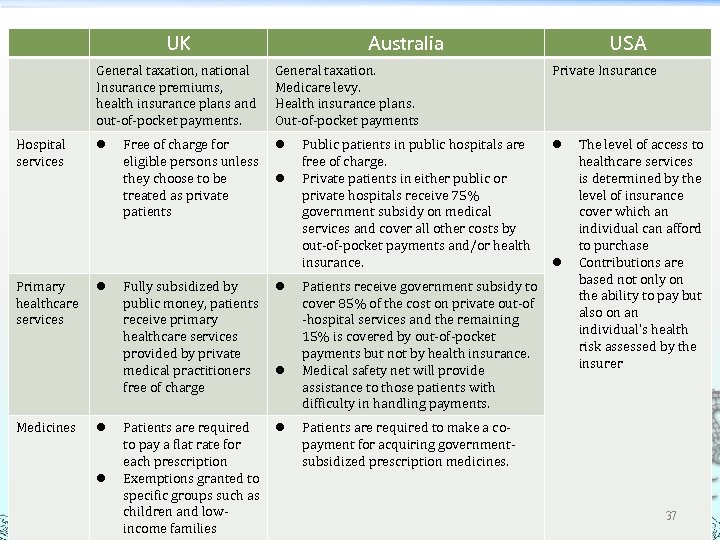 UK General taxation, national Insurance premiums, health insurance plans and out‐of‐pocket payments. Hospital services Primary healthcare services Medicines l l Free of charge for eligible persons unless they choose to be treated as private patients Australia General taxation. Medicare levy. Health insurance plans. Out‐of‐pocket payments l l Fully subsidized by public money, patients receive primary healthcare services provided by private medical practitioners free of charge l Patients are required to pay a flat rate for each prescription Exemptions granted to specific groups such as children and low‐ income families l l Public patients in public hospitals are free of charge. Private patients in either public or private hospitals receive 75% government subsidy on medical services and cover all other costs by out‐of‐pocket payments and/or health insurance. Patients receive government subsidy to cover 85% of the cost on private out‐of ‐hospital services and the remaining 15% is covered by out‐of‐pocket payments but not by health insurance. Medical safety net will provide assistance to those patients with difficulty in handling payments. USA Private Insurance l l The level of access to healthcare services is determined by the level of insurance cover which an individual can afford to purchase Contributions are based not only on the ability to pay but also on an individual’s health risk assessed by the insurer Patients are required to make a co‐ payment for acquiring government‐ subsidized prescription medicines. 37
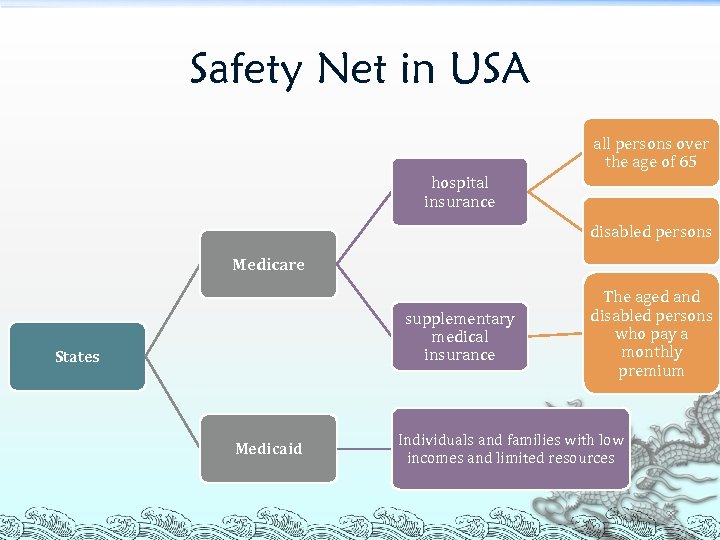 Safety Net in USA all persons over the age of 65 hospital insurance disabled persons Medicare supplementary medical insurance States Medicaid The aged and disabled persons who pay a monthly premium Individuals and families with low incomes and limited resources 38
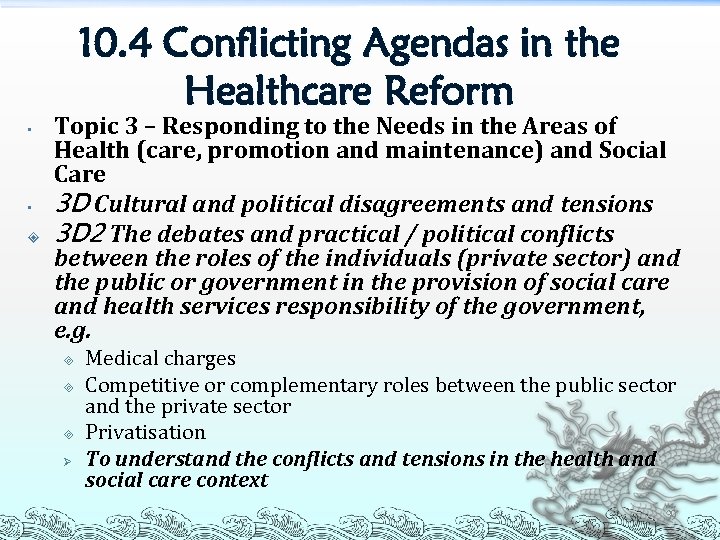 10. 4 Conflicting Agendas in the Healthcare Reform • • Topic 3 – Responding to the Needs in the Areas of Health (care, promotion and maintenance) and Social Care 3 D Cultural and political disagreements and tensions 3 D 2 The debates and practical / political conflicts between the roles of the individuals (private sector) and the public or government in the provision of social care and health services responsibility of the government, e. g. ³ ³ ³ Ø Medical charges Competitive or complementary roles between the public sector and the private sector Privatisation To understand the conflicts and tensions in the health and social care context 39
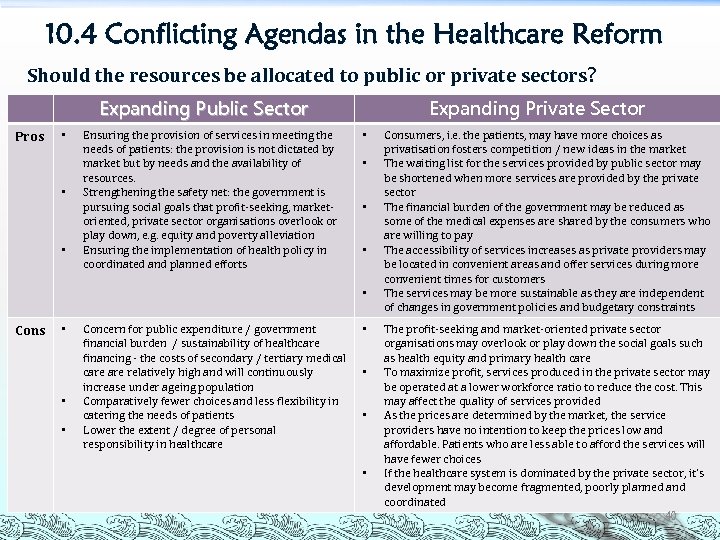 10. 4 Conflicting Agendas in the Healthcare Reform Should the resources be allocated to public or private sectors? Expanding Public Sector Pros • • • Ensuring the provision of services in meeting the needs of patients: the provision is not dictated by market but by needs and the availability of resources. Strengthening the safety net: the government is pursuing social goals that profit‐seeking, market‐ oriented, private sector organisations overlook or play down, e. g. equity and poverty alleviation Ensuring the implementation of health policy in coordinated and planned efforts Expanding Private Sector • • • Cons • • • Concern for public expenditure / government financial burden / sustainability of healthcare financing ‐ the costs of secondary / tertiary medical care relatively high and will continuously increase under ageing population Comparatively fewer choices and less flexibility in catering the needs of patients Lower the extent / degree of personal responsibility in healthcare • • Consumers, i. e. the patients, may have more choices as privatisation fosters competition / new ideas in the market The waiting list for the services provided by public sector may be shortened when more services are provided by the private sector The financial burden of the government may be reduced as some of the medical expenses are shared by the consumers who are willing to pay The accessibility of services increases as private providers may be located in convenient areas and offer services during more convenient times for customers The services may be more sustainable as they are independent of changes in government policies and budgetary constraints The profit‐seeking and market‐oriented private sector organisations may overlook or play down the social goals such as health equity and primary health care To maximize profit, services produced in the private sector may be operated at a lower workforce ratio to reduce the cost. This may affect the quality of services provided As the prices are determined by the market, the service providers have no intention to keep the prices low and affordable. Patients who are less able to afford the services will have fewer choices If the healthcare system is dominated by the private sector, it’s development may become fragmented, poorly planned and coordinated 40
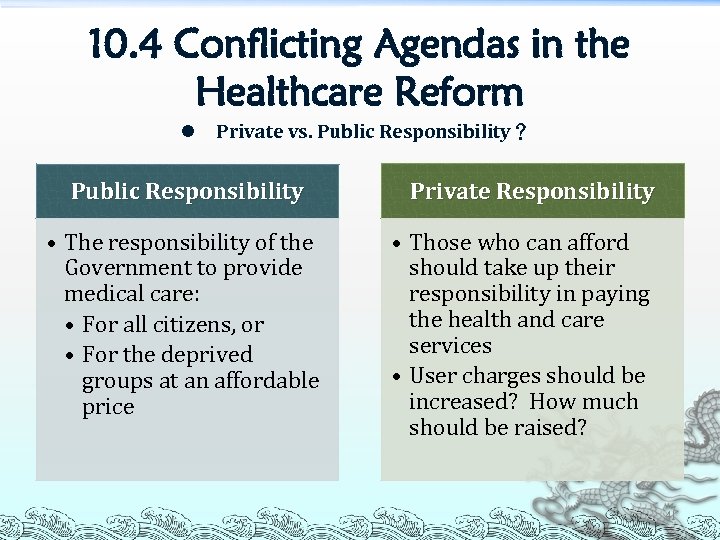 10. 4 Conflicting Agendas in the Healthcare Reform l Private vs. Public Responsibility? Public Responsibility • The responsibility of the Government to provide medical care: • For all citizens, or • For the deprived groups at an affordable price Private Responsibility • Those who can afford should take up their responsibility in paying the health and care services • User charges should be increased? How much should be raised? 41
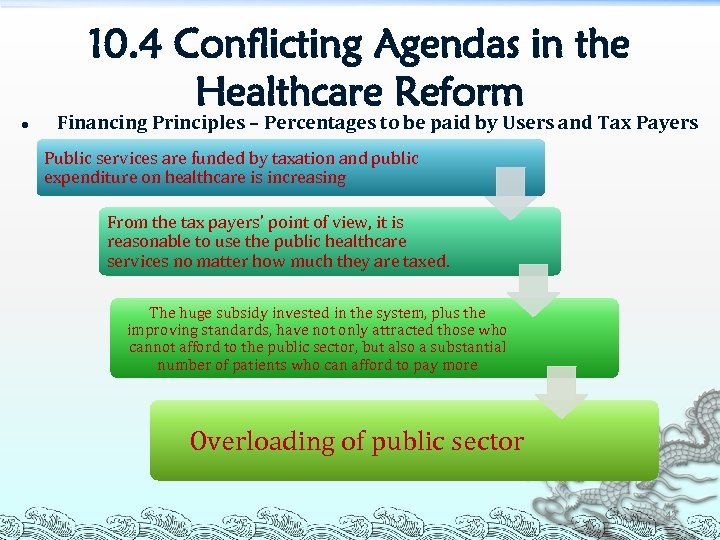 10. 4 Conflicting Agendas in the Healthcare Reform l Financing Principles – Percentages to be paid by Users and Tax Payers Public services are funded by taxation and public expenditure on healthcare is increasing From the tax payers’ point of view, it is reasonable to use the public healthcare services no matter how much they are taxed. The huge subsidy invested in the system, plus the improving standards, have not only attracted those who cannot afford to the public sector, but also a substantial number of patients who can afford to pay more Overloading of public sector 42
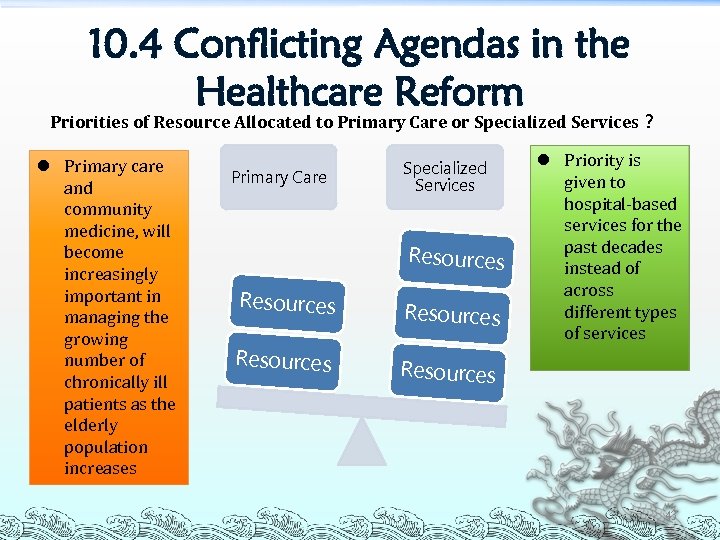 10. 4 Conflicting Agendas in the Healthcare Reform Priorities of Resource Allocated to Primary Care or Specialized Services? l Primary care and community medicine, will become increasingly important in managing the growing number of chronically ill patients as the elderly population increases Primary Care Specialized Services Resources l Priority is given to hospital‐based services for the past decades instead of across different types of services Resources 43
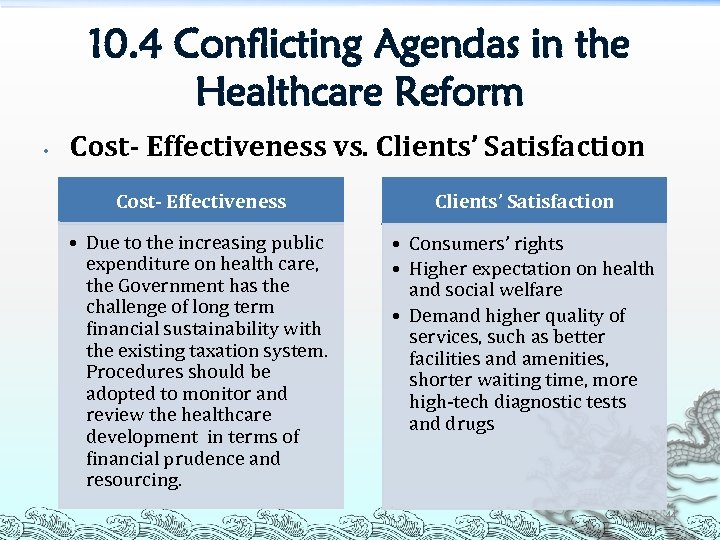 10. 4 Conflicting Agendas in the Healthcare Reform • Cost- Effectiveness vs. Clients’ Satisfaction Cost- Effectiveness Clients’ Satisfaction • Due to the increasing public expenditure on health care, the Government has the challenge of long term financial sustainability with the existing taxation system. Procedures should be adopted to monitor and review the healthcare development in terms of financial prudence and resourcing. • Consumers’ rights • Higher expectation on health and social welfare • Demand higher quality of services, such as better facilities and amenities, shorter waiting time, more high‐tech diagnostic tests and drugs 44