


 Скачать презентацию Enhancing Access to Justice for the Self-Represented Linda
bfde3b2183b54405efada03ec813426e.ppt
- Количество слайдов: 30
 Enhancing Access to Justice for the Self-Represented Linda Rexer Executive Director Michigan State Bar Foundation Presentation to SBM CJI – 10/2/09
 Topics to be covered n Introductory information about pro se n Pro se as part of a continuum of services n MSBF pro se study/recommendations n Past SBM-ATJ-JI pro se work n National pro se efforts and resources n Current MI pro se efforts/plans n Pro se issues and CJI discussion
 Questions to be thinking about n What are benefits of more support for pro se? n What cautions should those working on pro se keep in mind? n What issues related to pro se have the CJI Initiatives encountered? n What roles could CJI play re pro se? n What other suggestions do folks have?
 Introductory Information n What we know about self-represented litigants (J. Greacen MJI training 3/09) Majority are poor n Majority are women n Majority are petitioners, not respondents n Majority have a high school education n High percentage have Internet access n
 What we know, continued n Top reasons given for proceeding pro se: n “I can’t afford to hire a lawyer. ” n “My case is simple enough to handle myself. ” n Likelihood of prevailing is more related to procedural complexity than substantive complexity of the matter n High satisfaction by the self-represented n Increased frequency of self-representation
 What we know continued n Grand Rapids Legal Assistance Center - 2008 n 58% = household incomes under $20, 000 n 14% = household incomes over $40, 000 n 18% = less than high school education n 35% = high school completion n 32% = some college but no degree n 16% = college degree n Funding is combination of public/private money n 3. 5 FTE paid staff + 3. 0 volunteers
 What we know continued n Grand Rapids LAC 2008 n 34, 000+ patrons served in 2008 (up 4, 000) n 75% needed court forms n 72% needed help completing court forms n 9% had employment, immigration other needs n 4% had housing issues (7% of phone patrons) n 3% had consumer problems (5% phone) n 78% had family law issues (50% phone)
 What we know continued n Berrien County Legal Resource Center 2009 n n n n n Opened 4/09; served 1300+ thru 9/09 39% needed forms; 25% general legal info 23% needed help completing court forms 10% = housing issues; 5% consumer, other 66% had family law issues + 10% PPOs 17% < high school; 39% graduated h. s. 25% some college; 19% graduated college 44% <$10 K/yr; 64% <$20 K/yr; 12%>$40 K/yr Public/private $; 1. 0 FTE paid staff + volunteers
 What we know continued n Illinois Legal Aid Online ( state, web based) n Popular automated documents and resources n Uncontested divorce n Small estate n Child support modification n Order of protection n Guardianship n Stop wage assignment, other letters to creditors n Durable power of attorney (property, health care) n Unemployment benefits
 Continuum of Service n Pro se is not “instead” of full representation by a lawyer n Some cases resolved efficiently by pro se n Others need Advice and/or limited legal assistance n Mediation n Full Representation n
 Continuum continued n Courts report high numbers of self-represented; not tracked statewide by SCAO in MI 1999 SBM survey of many (not all ) MI courts showed many courts with over 40% pro se litigants, with a number of courts over 70% n Examples from other states n CA: 67% divorce petitioners, 80% at dissolution n MA: >75% family, probate cases = at least 1 party n Fl: 1 party pro se up from 66% (99) to 73% (01) n NY Times Article, April, 2009: n “In a Downturn, More Act as Their Own Lawyers”
 MSBF Pro Se Study n Increased interest by courts in self-help to deal with reality of large numbers of unrepresented n Increased number of duplicative requests for clinics and self-help/other materials n Increased number of grant requests for self-help centers n Start up funding for: Grand Rapids, Lansing (now closed), Washtenaw County, Berrien (Another new program = Oakland Co. Court Help Desk)
 MSBF Study continued n Only about 180 legal aid lawyers in MI n One legal aid lawyer for every 17, 666 lowincome persons (<200% FPL) n 3. 1 million low-income people in Michigan below 200% FPL; includes 40% of MI kids n 200% FPL = $29, 140 for a family of 2 n Modest income persons just above >200% FPL also feel they cannot afford a lawyer
 MSBF Study continued MSBF hired Court Management Associates to compile information about existing self-help programs, materials and technology in Michigan, articulate findings from the study and make recommendations. This information will help the Foundation make wise grant decisions as well as identify opportunities that may assist the Foundation, its grantees and others in maximizing and coordinating self-help systems in Michigan.
 MSBF Study continued n Types of resources identified n Web-based resources n Court-related resources n Legal aid clinics and other pro se support n Self-help centers n Local bar associations n Faith-based programs
 MSBF Study continued n Websites in MI offering self-help support n 294 web sites identified, including courts, legal assistance centers and legal aid n Of these 158 offered some form of self-help n n n Only 42% of these linked to SCAO self-help page Only 26% linked to any other self-help page 23 represented a program which a patron could access in person and 1 was a telephone hotline 8% with program; 92% website only Many sites were unintuitive; many links were broken; many materials were not up to date
 MSBF Study continued n Web sites continued n SCAO self-help web site is fairly extensive and can access SCAO forms which are fillable; it is a “drill down” PDF-laden site n www. michiganlegalaid. org also has a fair amount of content and has a range of fillable PDF SCAO forms n State Bar self help site has a range of content mixed with state bar entity information, most PDF-driven n Some legal assistance centers, legal aid programs and court sites have good content
 MSBF Study continued n Websites continued n Of 103 FOC & Circuit Court sites n n n 27 had own step by step family law procedures 37 had own family law forms on their sites Of 158 web sites offering self help resources n n n 38 provided information on housing 62 provided information on family law 52 had information on consumer law
 MSBF Study continued n Illinois Legal Aid Online statewide web site § Legal resources written for lower-literacy users § Legal information in 25 areas of law § Easy-to-use interactive forms (56) with non-legal terms for questions that automatically populate forms § Spanish resources § Self-help instructions for common legal problems § Multimedia training, video tutorials & live chat help § Powerful user-friendly search engine § Referrals to legal and other services § Web site is basis for local legal assistance centers § >1 million users per year
 MSBF Study continued n MJI offers judges, court staff pro se training n Collected 9 pages of questions from court clerks listing questions pro se people ask them n Collected bar, court, legal aid and legal assistance center self-help materials Hard copies collected fill three 5 inch binders n Many additional web links without hard copies n Hundreds of brochures/packets collected with many duplicate materials produced by multiple entities, e. g. divorce without children n
 MSBF Study continued n Findings Highlights n n n 1. Large numbers of people represent themselves, and most do not have any assistance with doing so. Moreover, this need has not yet been quantified because generally courts do not track this information. 2. Existing court forms and procedures are not easily understood by self-represented individuals, particularly those with literacy, language, and other barriers. Forms and instructions are written for lawyers in legalese, not to help lay persons. Document assembly resources, which can assist in reducing this barrier to self-representation, are few and limited. 3. There is a lack of uniformity in forms and procedures among jurisdictions. This impedes development of centralized resources to support self-represented litigants.
 MSBF Study continued n Findings Highlights continued n n n 4. Some judges and court staff are responsive to the needs of self-represented litigants and some training has been made available to them. However, there is no comprehensive training program for judges and court staff to help them work more effectively with the self-represented. This promotes a wide disparity of treatment of selfrepresented litigants from jurisdiction to jurisdiction. 5. There are some good web resources available to assist self-represented individuals, but many web resources are incomplete, ineffective, and not well- maintained. 6. A wide range of self-help resources exist, including brochures, forms packets, websites, court staff assistance with procedures, self-help clinics, self-help centers, and legal aid programs providing limited assistance. However, there are gaps and duplication in these resources The content and quality are not uniform, and materials are not collected in a central place, which impedes sharing of them.
 MSBF Study continued n Findings Highlights continued n n 7. Michigan ethics standards do not facilitate unbundling because they do not clearly specify the extent to which and the conditions when discrete task representation is OK. 8. Where staffed self-help centers exist, many more selfrepresented individuals are able to receive assistance, reducing court time in working with the self-represented and increasing satisfaction among court personnel as well as the self represented. However, only a few staffed self-help centers exist in Michigan, with little support available for jurisdictions which want to develop a self-help center. 9. There is no established network for collaboration, planning, and support for those providing self-help assistance in Michigan. 10. There is a serious funding challenge, and those Michigan jurisdictions which have been successful in establishing selfhelp centers have had to draw upon a variety of funding resources, public and private. .
 MSBF Study continued n Selected Recommendations n Enhance substance and availability of web-based resources for the self-represented n n Improve understandability, accessibility and ease of use of frequently-used forms n n Develop a plan to integrate court, legal aid and bar web self-help resources. Conduct a pilot to test "virtual" or "remote" self-help assistance via phone, chat, other means. Conduct a pilot for a centralized public web portal, starting with frequently needed areas. Conduct a forms pilot identifying substantive areas where current state of frequently-used forms is causing problems and test improvements in a small number of courts (address Plain English, low literacy and language proficiency issues). Encourage acceptance of SCAO forms in all jurisdictions
 MSBF Study continued n Selected Recommendations continued n n Support design of pilot for more comprehensive curricula on services & responsiveness to the self-represented: for judges, court staff and self-help assistance providers Collect existing self-help packets and materials from around the state n n Ask committees of subject area experts (e. g. family law practitioners) to review materials/packets collected and recommended uniform packets for use on centralized web site Support interaction and collaboration among those working to assist self-help n n n Establish a Michigan Self-Help Providers listserv and/or a Wiki Hold meetings/trainings for self-help providers and others to share resources. Assist groups interested in establishing local self-help centers
 Moving Forward n Initial meeting to discuss pro se issues MSBF, SBM, MJI, SCAO and MSC n SPB has discussed pro se n Now CJI is discussing pro se n SBM Crossroads Task Force ATJ Subcommittee will discuss pro se n MSBF will issue RFP for web site pilot n MJI does judicial, court staff pro se training n Stakeholders need to coordinate all of this
 MI State Plan 2000 vs Now n From Unbundled work group: n unbundling of legal services should be expressly authorized in Michigan n Status: not completed; lawyer and client may agree on limited scope of representation for non-litigation matters, but attorney is on the hook for the entire representation in litigation unless a judge allows withdrawal MCR 2. 117(C)(2) n From Self-Help work group: n Develop “hallmarks” for self-help programs, protocols for courts for assisting pro se litigants, enforce use of standardized forms n Status: not completed but some work done
 National Resources n ABA – Bob Echols, ATJ Support Center n www. selfhelpsupport. org n n n Partners include NCSC and State Justice Inst. Library contains information from states that are ahead of MI in advancing self-help Expert consultants to train in or assist states n n MJI uses consultants for MI judges, court staff pro se training Examples of resources for courts/others are n n n Self-help best practices guide National training modules and tips for judges to be responsive and help self-represented while maintaining neutrality National self-help bench book
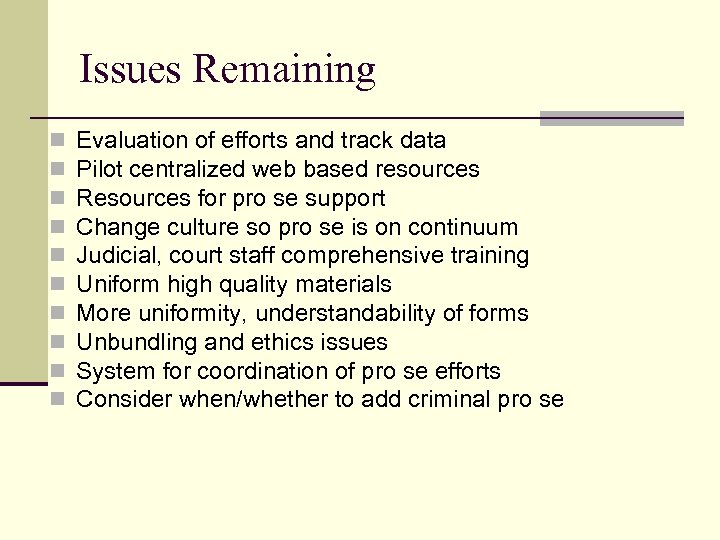 Issues Remaining n n n n n Evaluation of efforts and track data Pilot centralized web based resources Resources for pro se support Change culture so pro se is on continuum Judicial, court staff comprehensive training Uniform high quality materials More uniformity, understandability of forms Unbundling and ethics issues System for coordination of pro se efforts Consider when/whether to add criminal pro se
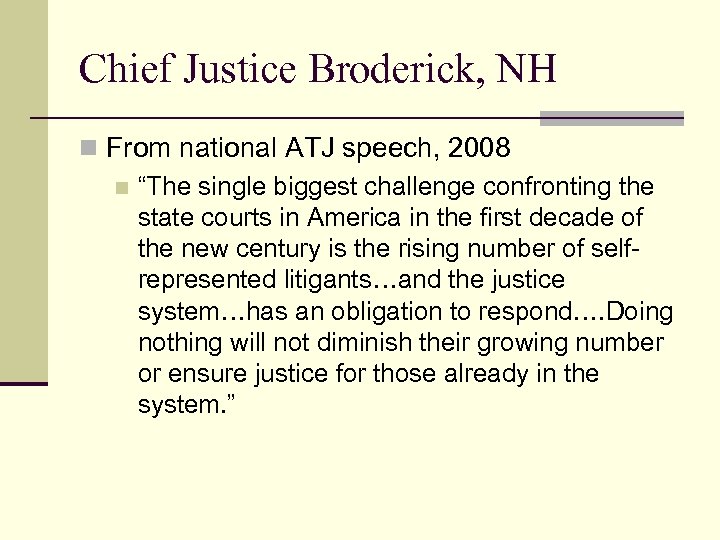 Chief Justice Broderick, NH n From national ATJ speech, 2008 n “The single biggest challenge confronting the state courts in America in the first decade of the new century is the rising number of selfrepresented litigants…and the justice system…has an obligation to respond…. Doing nothing will not diminish their growing number or ensure justice for those already in the system. ”