 Скачать презентацию Enhancement of OECD Unit Labour Cost 3 December
50c90749e0d6885a5390516d38af9a14.ppt
- Количество слайдов: 13



Enhancement of OECD Unit Labour Cost 3 December 2010 Eun-Pyo HONG and Frédéric PARROT Competitiveness Indicators Unit
Contents • Objectives • Definition • Comparison with existing ULCs • Data availability and Timeliness • Methods to cope with missing data • EEQ UCLs • Remaining issues and challenges
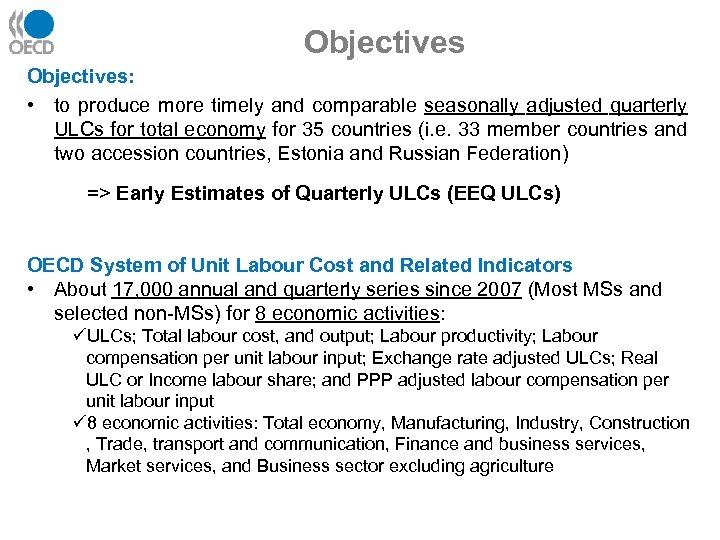
Objectives: • to produce more timely and comparable seasonally adjusted quarterly ULCs for total economy for 35 countries (i. e. 33 member countries and two accession countries, Estonia and Russian Federation) => Early Estimates of Quarterly ULCs (EEQ ULCs) OECD System of Unit Labour Cost and Related Indicators • About 17, 000 annual and quarterly series since 2007 (Most MSs and selected non-MSs) for 8 economic activities: üULCs; Total labour cost, and output; Labour productivity; Labour compensation per unit labour input; Exchange rate adjusted ULCs; Real ULC or Income labour share; and PPP adjusted labour compensation per unit labour input ü 8 economic activities: Total economy, Manufacturing, Industry, Construction , Trade, transport and communication, Finance and business services, Market services, and Business sector excluding agriculture
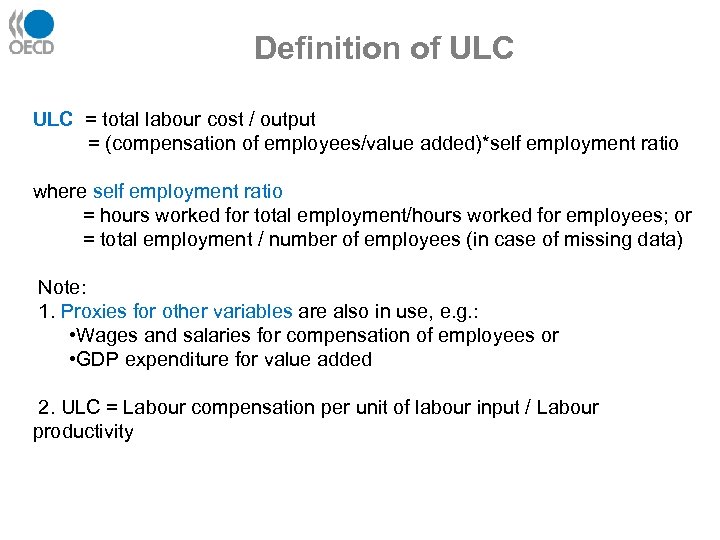
Definition of ULC = total labour cost / output = (compensation of employees/value added)*self employment ratio where self employment ratio = hours worked for total employment/hours worked for employees; or = total employment / number of employees (in case of missing data) Note: 1. Proxies for other variables are also in use, e. g. : • Wages and salaries for compensation of employees or • GDP expenditure for value added 2. ULC = Labour compensation per unit of labour input / Labour productivity
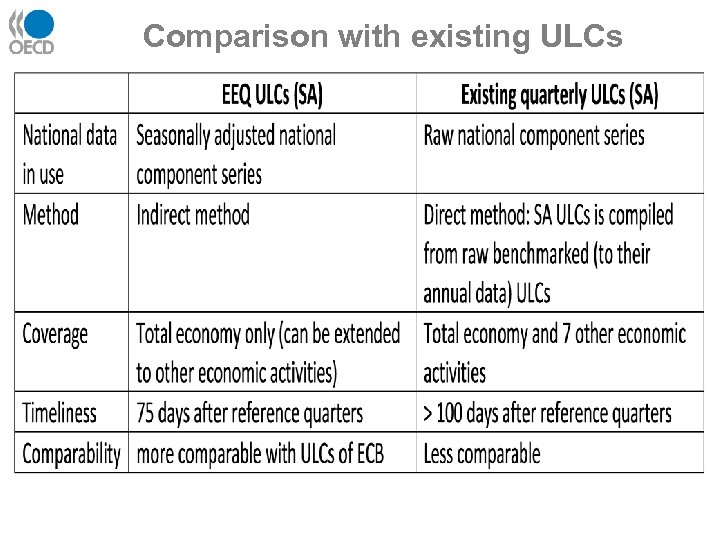
Comparison with existing ULCs
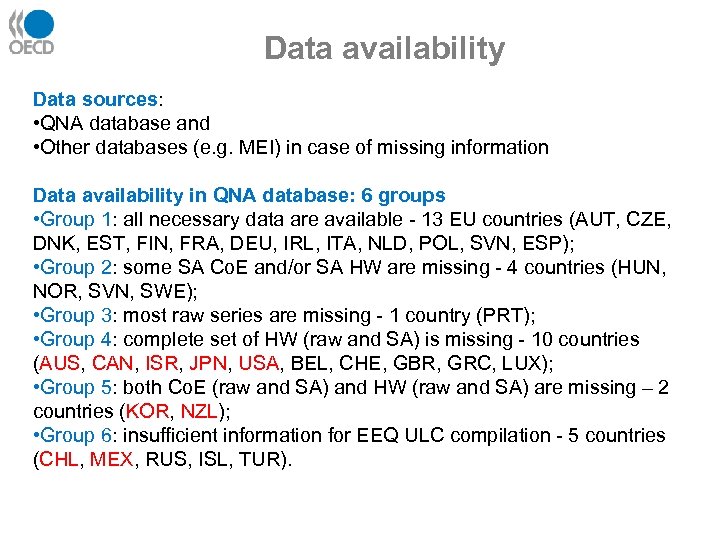
Data availability Data sources: • QNA database and • Other databases (e. g. MEI) in case of missing information Data availability in QNA database: 6 groups • Group 1: all necessary data are available - 13 EU countries (AUT, CZE, DNK, EST, FIN, FRA, DEU, IRL, ITA, NLD, POL, SVN, ESP); • Group 2: some SA Co. E and/or SA HW are missing - 4 countries (HUN, NOR, SVN, SWE); • Group 3: most raw series are missing - 1 country (PRT); • Group 4: complete set of HW (raw and SA) is missing - 10 countries (AUS, CAN, ISR, JPN, USA, BEL, CHE, GBR, GRC, LUX); • Group 5: both Co. E (raw and SA) and HW (raw and SA) are missing – 2 countries (KOR, NZL); • Group 6: insufficient information for EEQ ULC compilation - 5 countries (CHL, MEX, RUS, ISL, TUR).
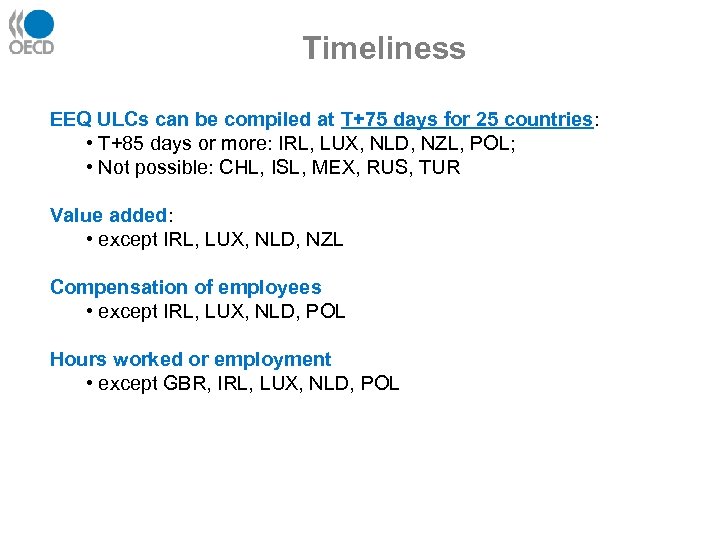
Timeliness EEQ ULCs can be compiled at T+75 days for 25 countries: • T+85 days or more: IRL, LUX, NLD, NZL, POL; • Not possible: CHL, ISL, MEX, RUS, TUR Value added: • except IRL, LUX, NLD, NZL Compensation of employees • except IRL, LUX, NLD, POL Hours worked or employment • except GBR, IRL, LUX, NLD, POL
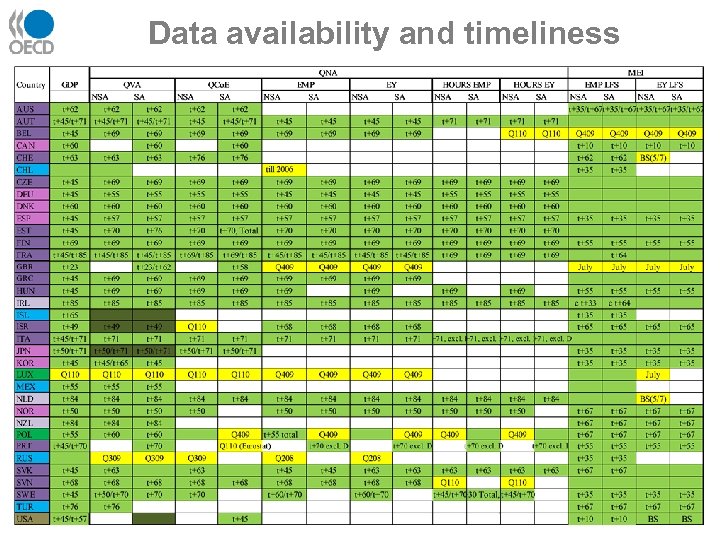
Data availability and timeliness
Methods to cope with missing data (1) • UK: Labour Force Survey data are used instead of QNA employment data • Belgium, Greece and Slovenia: QNA employment & employees in persons used instead of QNA hours worked • Hungary: ULC Unit performed SA on QNA hours worked • Norway and Sweden: ULC Unit performed SA on QNA Co. E and QNA employees' hours worked • Australia and Canada: LFS SA Civilian employment & employees used for QNA labour input • Japan: GDP was used for constant price value added and also used LFS Civilian employment & employees (SA by Labour Unit) • USA: LFS SA Civilian employment & BS SA Employees used for QNA labour input. • Korea: National quarterly proxy earnings series for QNA Co. E; LFS civilian employment & employees; SA by ULC Unit of national quarterly earnings series, nsa
Methods to cope with missing data (2) • Israel: QNA chained volume GDP by expenditure used instead of unavailable constant price gross value added; QNA Co. E, nsa available until 2010 Q 1, 2010 Q 2 estimated by ULC Unit and SA by ULC unit until 2010 Q 2; QNA employment & employees in persons • New Zealand: National quarterly proxy earnings series for QNA Co. E; LFS civilian employment & employees; SA by ULC unit of national quarterly earnings series, nsa • Switzerland: 2010 Q 2 for BS employees has been estimated by ULC Unit; then SA by ULC unit until 2010 Q 2; LFS Civilian employment used for QNA labour input • Portugal: Co. E total economy from Eurostat until 2010 Q 1 and that of 2010 Q 2 was estimated by ULC Unit and SA by ULC Unit until 2010 Q 2
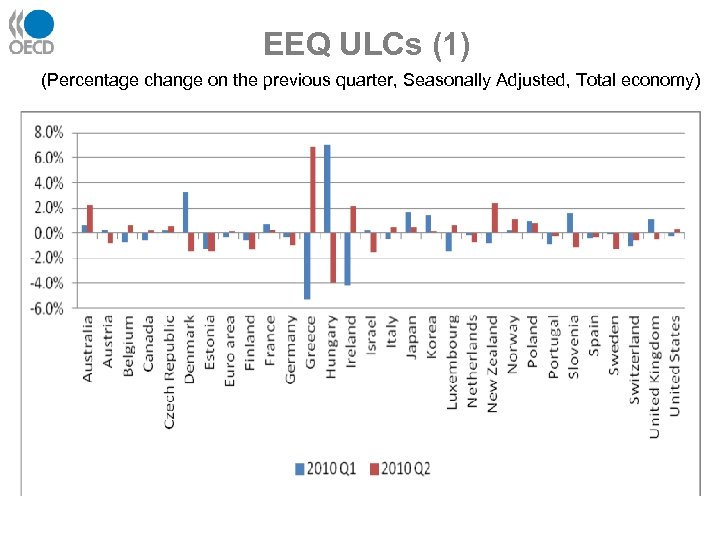
EEQ ULCs (1) (Percentage change on the previous quarter, Seasonally Adjusted, Total economy)
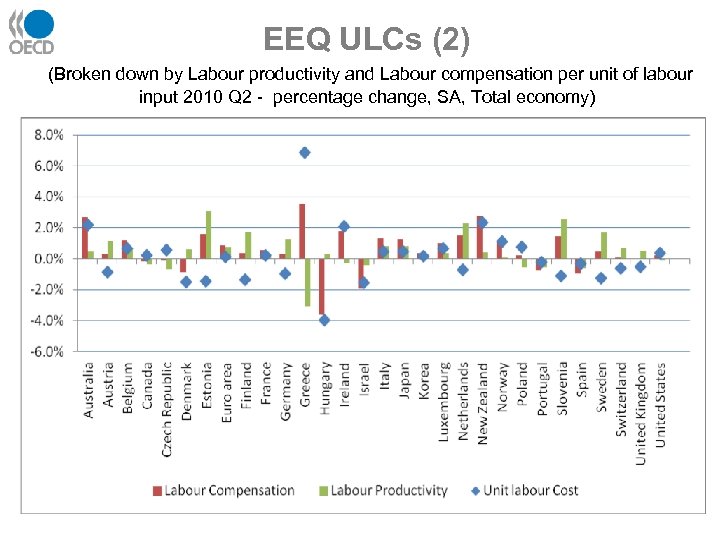
EEQ ULCs (2) (Broken down by Labour productivity and Labour compensation per unit of labour input 2010 Q 2 - percentage change, SA, Total economy)
Issues and challenges • Availability of: – – quarterly hours worked for all countries except 13 EU member countries seasonally adjusted data at NSOs: direct vs. indirect SA quarterly VA and Co. E for some countries Timely data for some countries • Development of ULCs for: – all new OECD MSs, i. e. Chile and Israel – all G 20 countries, i. e. BRIICS, Saudi Arabia and Argentina – quarterly media release • Creation of proper procedures and database to facilitate production and dissemination of EEQ ULC
Скачать презентацию Enhancement of OECD Unit Labour Cost 3 December
50c90749e0d6885a5390516d38af9a14.ppt