


 Скачать презентацию Enhanced Head-Up Display for General Aviation For the
e04c024ca2c019ae92a08290b9b12579.ppt
- Количество слайдов: 31
 Enhanced Head-Up Display for General Aviation For the Quarterly Review of the NASA/FAA Joint University Program for Air Transportation Research Wednesday October 10 th, 2001 • Presented By: Douglas Burch • Principal Investigator: Dr. Michael Braasch Avionics Engineering Center Ohio University, Athens Project Sponsor: Joint University Program 1
 Introduction • General Aviation Instrumentation has undergone little change in the past 50 years. • In 1999, 73% of the fatal accidents were caused by night Instrument Meteorological Conditions (IMC). • IFR traffic is expected to increase by 2. 5 percent per year over the next decade. • Increase in IFR traffic might lead to a possible increase in GA accidents. 2
 Overview • Motivation Behind e. HUD • Pseudo-Attitude Determination • Current e. HUD System Overview • Flight Test • Performance Requirement Analysis • e. HUD Architectural Overhaul • Future Upgrades 3
 Motivation Behind e. HUD • Provide Visual Cues in IMC. • Increase Situational Awareness in IMC. • Reduce pilot training and recurrency requirements for flight in IMC. • Keep the pilot looking out the window at the same time they are flying the instrument approach. • Cost effective Head-Up Display. 4
 Attitude The Merriam-Webster Dictionary defines attitude as the position of an aircraft or spacecraft determined by the relationship between its axes and a reference datum. Traditional Attitude: • Three GPS Receivers, three Antennas. • Expensive and Computationally Intensive. Pseudo-Attitude (Velocity Vector Based Attitude): • Observable from a single GPS antenna. • Cost effective to purchase and install. 5
 Pseudo-Attitude Determination (Velocity Vector Based Attitude Determination) Developed at the Massachusetts Institute of Technology by: • Dr. Richard P. Kornfeld • Dr. R. John Hansman • Dr. John J. Deyst The information on the following slides, regarding Velocity Based Attitude, was taken from “The Impact of GPS Velocity Based Flight Control on Flight Instrumentation Architecture” Report No. ICAT-99 -5, June 1999. 6
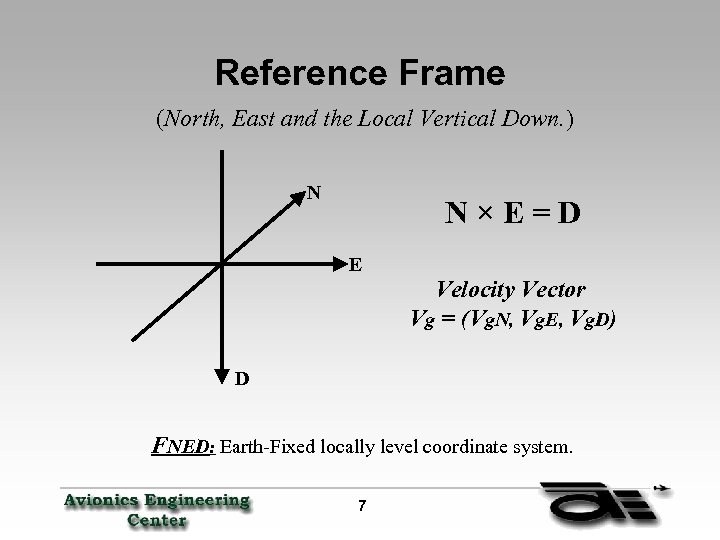 Reference Frame (North, East and the Local Vertical Down. ) N N×E=D E Velocity Vector Vg = (Vg. N, Vg. E, Vg. D) D FNED: Earth-Fixed locally level coordinate system. 7
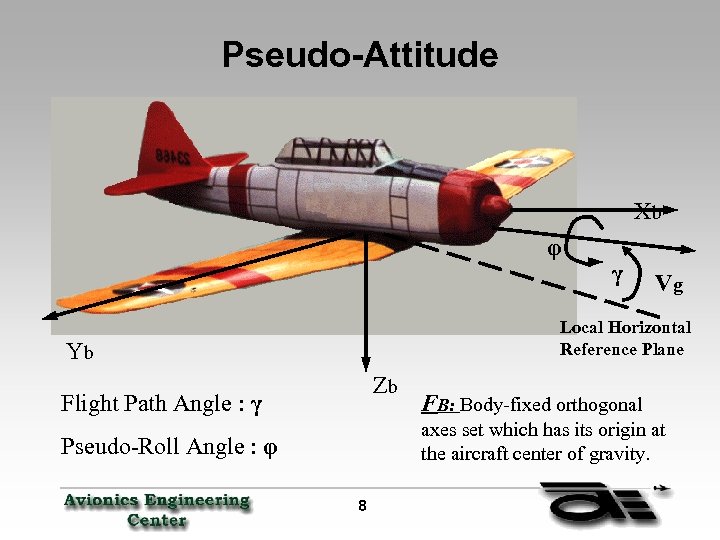 Pseudo-Attitude Xb φ γ Vg Local Horizontal Reference Plane Yb Zb Flight Path Angle : γ FB: Body-fixed orthogonal axes set which has its origin at the aircraft center of gravity. Pseudo-Roll Angle : φ 8
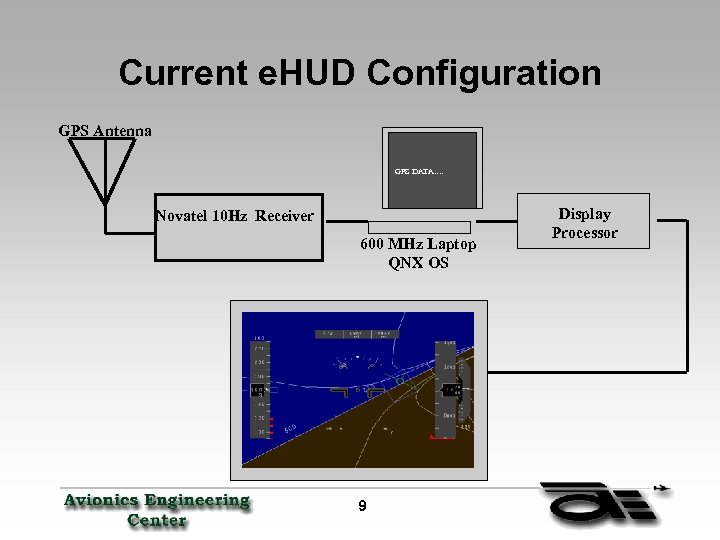 Current e. HUD Configuration GPS Antenna GPS DATA…. Novatel 10 Hz Receiver 600 MHz Laptop QNX OS 9 Display Processor
 GPS Receiver Novatel 10 Hz • 10 Hz Velocity Data Receiver • 5 Hz Position Data • RS-232 serial port GPS Receiver provides position and velocity information to the real-time processor for Pseudo-Attitude Determination. 10
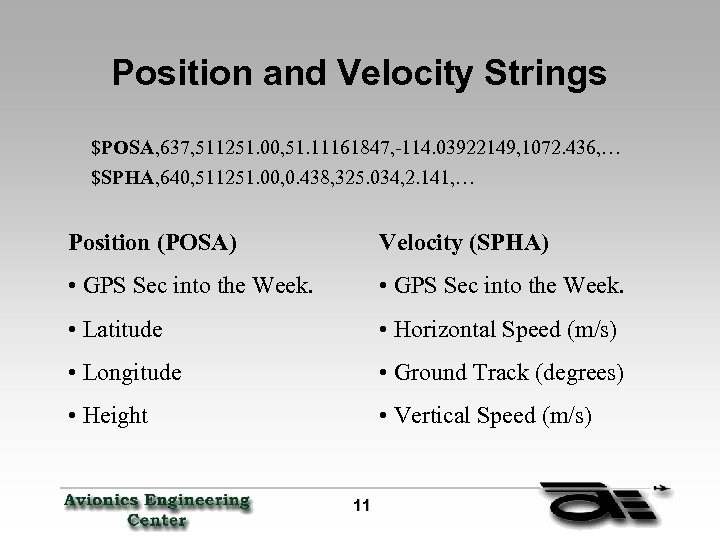 Position and Velocity Strings $POSA, 637, 511251. 00, 51. 11161847, -114. 03922149, 1072. 436, … $SPHA, 640, 511251. 00, 0. 438, 325. 034, 2. 141, … Position (POSA) Velocity (SPHA) • GPS Sec into the Week. • Latitude • Horizontal Speed (m/s) • Longitude • Ground Track (degrees) • Height • Vertical Speed (m/s) 11
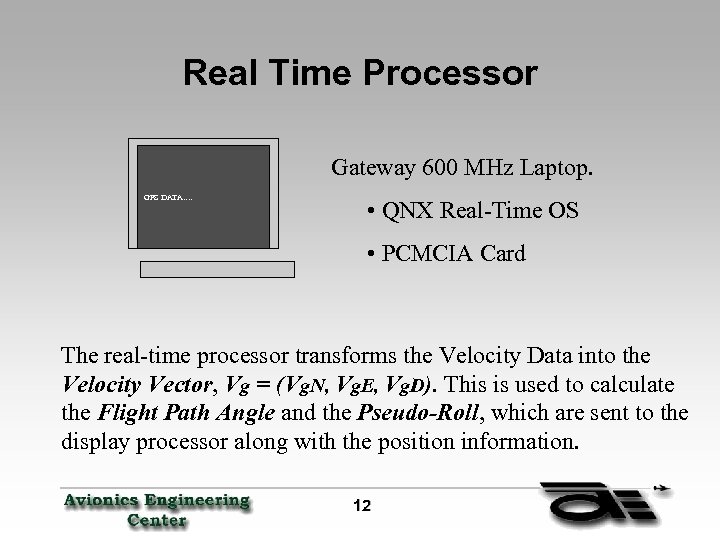 Real Time Processor Gateway 600 MHz Laptop. GPS DATA…. • QNX Real-Time OS • PCMCIA Card The real-time processor transforms the Velocity Data into the Velocity Vector, Vg = (Vg. N, Vg. E, Vg. D). This is used to calculate the Flight Path Angle and the Pseudo-Roll, which are sent to the display processor along with the position information. 12
 DELPHINS Display Processor • “Tunnel-In-The-Sky” Display Technology. • Pioneered by Erik Theunissen at the Delft University of Technology, The Netherlands. • Three-Dimensional representation of the outside world. 13
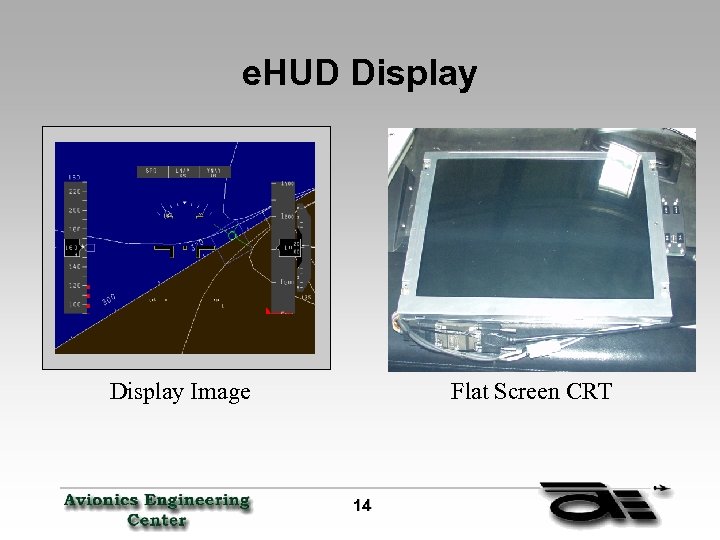 e. HUD Display Image Flat Screen CRT 14
 Flight Test Scenario: • Last Flight Test was June 8, 2001. • Wind conditions were a concern. • Consisted of two approaches on UNI runway 25. • GPS Antenna mounted approximately above aircraft center of gravity. 15
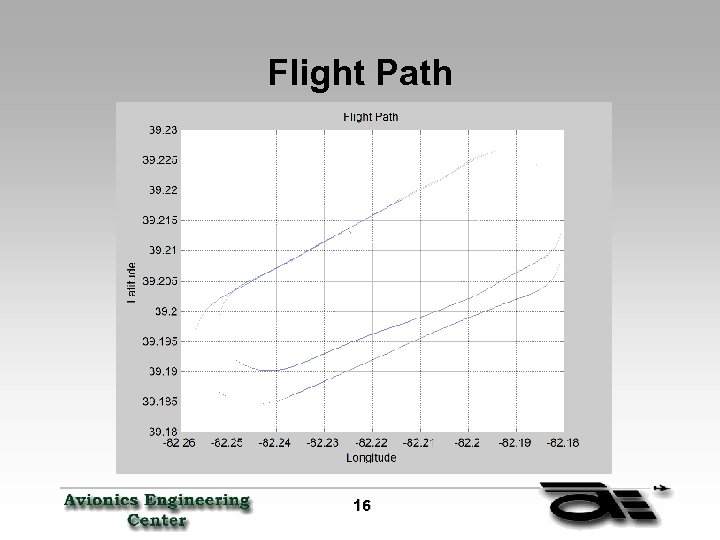 Flight Path 16
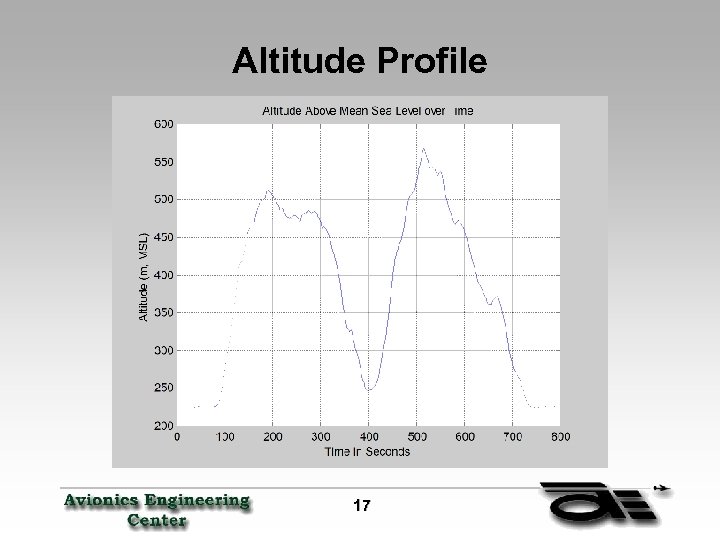 Altitude Profile 17
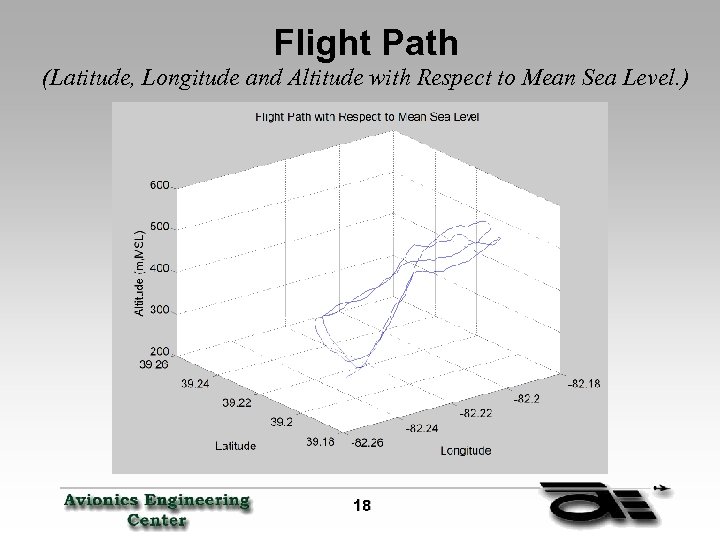 Flight Path (Latitude, Longitude and Altitude with Respect to Mean Sea Level. ) 18
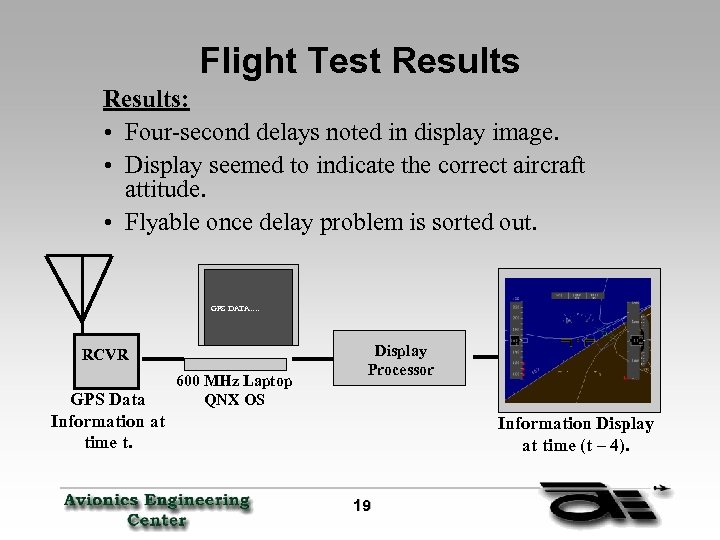 Flight Test Results: • Four-second delays noted in display image. • Display seemed to indicate the correct aircraft attitude. • Flyable once delay problem is sorted out. GPS DATA…. RCVR GPS Data Information at time t. 600 MHz Laptop QNX OS Display Processor Information Display at time (t – 4). 19
 Project Transition • Have a system that demonstrates initial proof of concept. • Have solid test data. • Have a four-second delay problem. • Conduct Performance Requirement Analysis. Check List: ü Novatel Receiver. Real time Processing of Velocity Vector. ü DELPHINS Display Processor and Imaging. 20
 Problem Analysis • Need: Increase in the number of GA accidents due to flying instrument approaches in IMC conditions. • Goal: GA display that will help to mitigate problems associated with flying in IMC conditions by enhancing pilot’s situational awareness. • Objective: - Must give proper representation of aircraft attitude. - Must be easy to interpret (Human Factors). - Must be cost effective (Single GPS unit). - Must keep pilot looking “out the window” (Human Factors). - Must be easy to mount in any GA aircraft. 21
 Problem Analysis Continued • Constraints: - Less than 500 ms delay for initial proof of concept. (Ultimately 100 ms delay or less. ) - Image must be displayed with zero distortion. - Display size will be 22” by 22” for proof of concept. 22
 e. HUD Architectural Overhaul Phase 1: • Update GPS Receiver to a Novatel OEM 4 with 20 Hz position and velocity data (completed). • Gather flight data with new receiver. Phase 2: • Re-write Velocity Vector Attitude Determination code to insure timing issues are understood while processing the velocity vector. Phase 3: • Find an alternative means to display attitude and position information to the pilot. 23
 Phase One • Gather test data with new Novatel OEM 4 20 Hz GPS Receiver. • Verify flight data to insure a sufficient amount has been gathered before the winter arrives. • Have two or three unique flight profiles to test against Real-Time Processor and what ever display option is used. Novatel 20 Hz OEM 4 Receiver 24
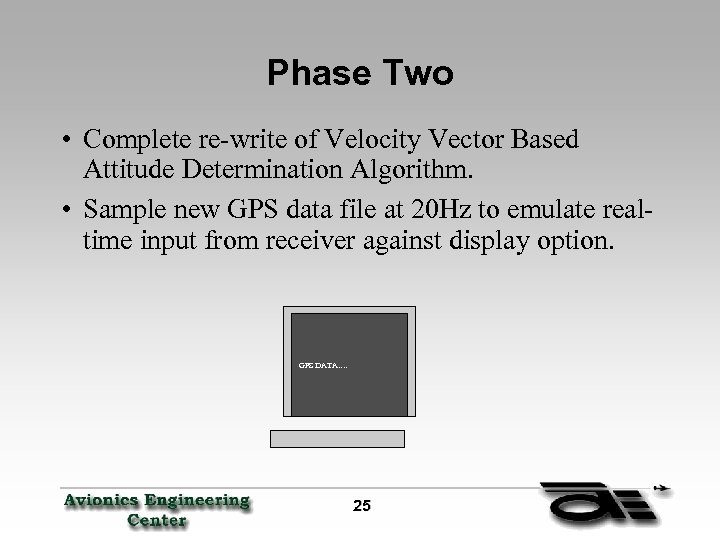 Phase Two • Complete re-write of Velocity Vector Based Attitude Determination Algorithm. • Sample new GPS data file at 20 Hz to emulate realtime input from receiver against display option. GPS DATA…. 25
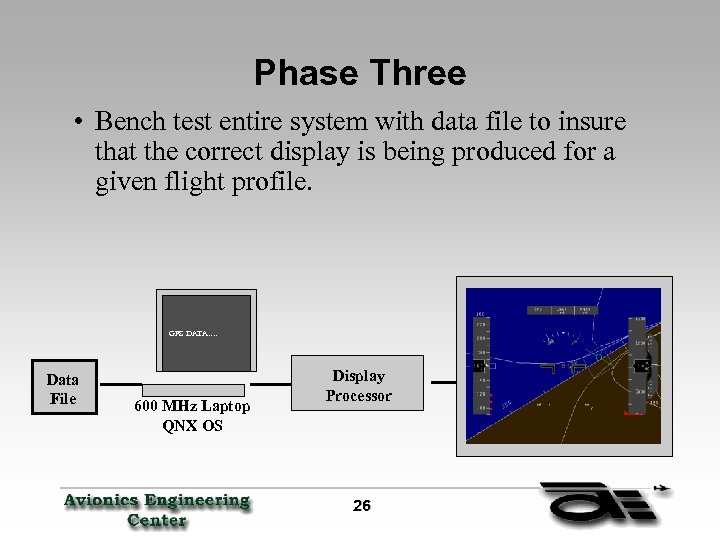 Phase Three • Bench test entire system with data file to insure that the correct display is being produced for a given flight profile. GPS DATA…. Data File 600 MHz Laptop QNX OS Display Processor 26
 Future Plans • Implement phases one, two and three. • Keep the development of the e. HUD completely inhouse. Use tools that will allow us to personally develop graphical displays, projection, etc. and not depend on others to make modifications. • Update the Pilot Display to a modern implementation of Head-Up Displays. 27
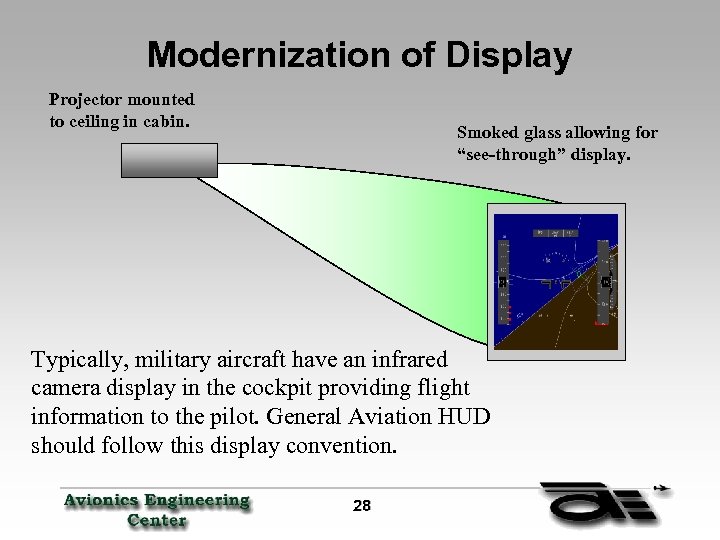 Modernization of Display Projector mounted to ceiling in cabin. Smoked glass allowing for “see-through” display. Typically, military aircraft have an infrared camera display in the cockpit providing flight information to the pilot. General Aviation HUD should follow this display convention. 28
 Contact Information Research Associate: Douglas Burch douglasburch@ieee. org Principal Investigator: Dr. Michael Braasch mbraasch@oucsace. cs. ohiou. edu 29
 30
30
 References • Kornfeld, R. P. , Hansman, R. J. , Deyst, J. J. , The Impact of GPS Velocity Based Flight Control on Flight Instrumentation Architecture. MIT International Center for Air Transportation, Cambridge, MA. Report No. ICAT-99 -5, June 1999. • Eric Theunissen. Integrated Design of Man-Machine Interface for 4 -D Navigation (1997) Delft University Press, Mekelweg 4 2628 CD Delft, The Eric’s Web page: www. tunnel-in-the-sky. tudelft. nl. 31