


 Скачать презентацию ENGS 112 Lecture 2 HTML Primer See text
28b857eb6a289fcca4eba2187c7274e9.ppt
- Количество слайдов: 25
 ENGS 112 Lecture 2 HTML Primer See text or web for more information and examples.
 HTML is Hyper. Tex Markup Language HTML is a “specialization” of SGML HTML is a language for describing how web pages should look. HTML has some constructions forms, frames, etc that make it a bit more dynamic. HTML is very simple. . we’re going to go over only the basics. . . other sources: - Dietel - read the source of other pages - web HTML manuals and how-tos
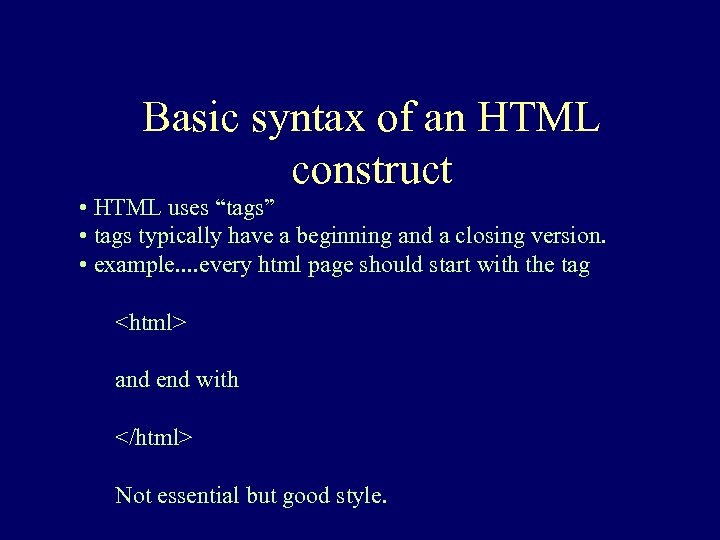 Basic syntax of an HTML construct • HTML uses “tags” • tags typically have a beginning and a closing version. • example. . every html page should start with the tag and end with Not essential but good style.
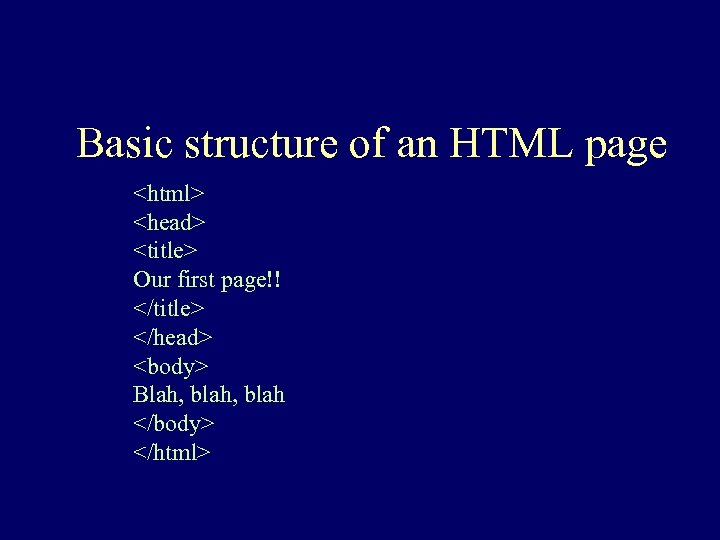 Basic structure of an HTML page
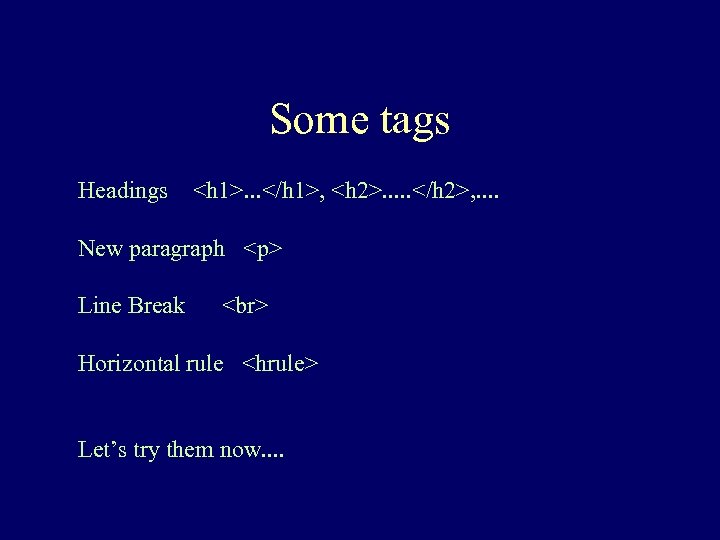 Some tags Headings
Line Break Horizontal rule
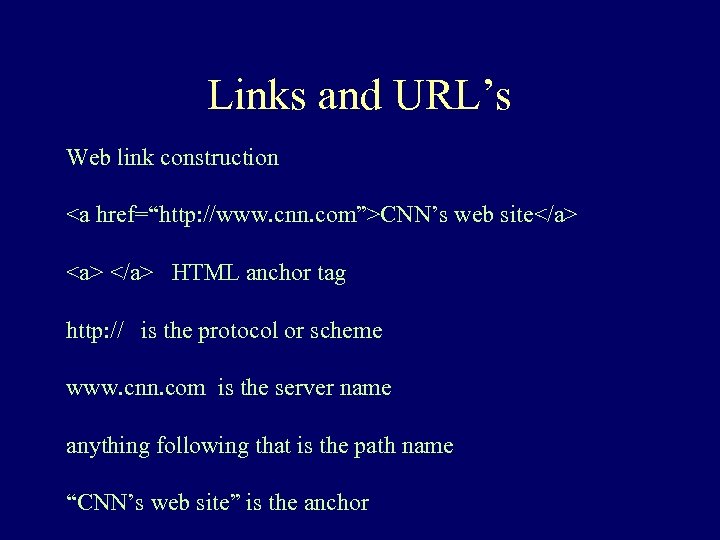 Links and URL’s Web link construction CNN’s web site HTML anchor tag http: // is the protocol or scheme www. cnn. com is the server name anything following that is the path name “CNN’s web site” is the anchor
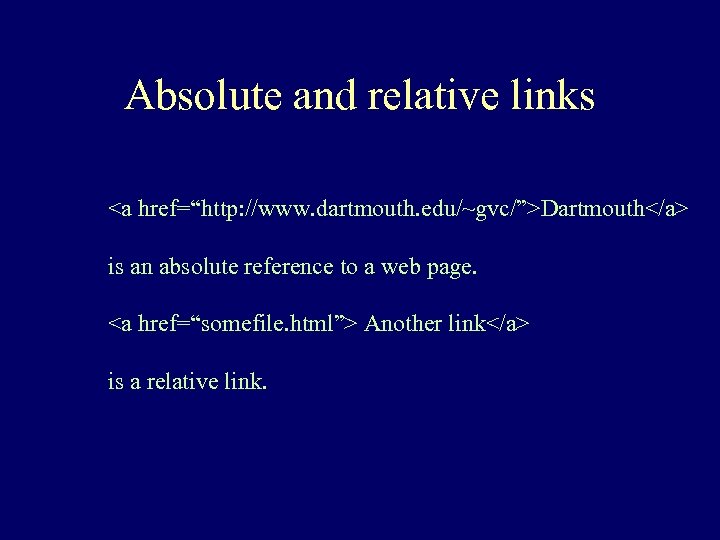 Absolute and relative links Dartmouth is an absolute reference to a web page. Another link is a relative link.
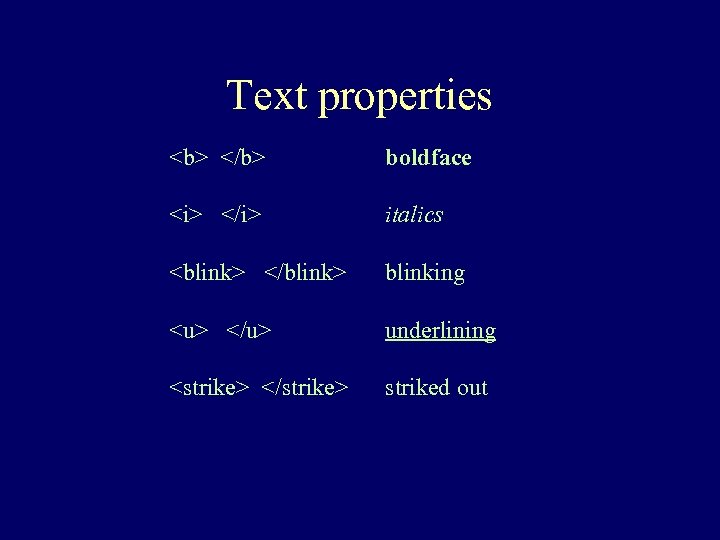 Text properties boldface italics blinking underlining
 striked out
 Backgrounds
 Adding images Image formats most browsers can view jpeg, jpg Joint Picture Experts Group tif gif. . . etc
 Images as anchors for links
 Let’s do an example. . .
 URL’s and Internet Names, addresses, etc www. dartmouth. edu is the name of a server The name is for human consumption. . . the internet uses a four number address to identify all “hosts” on the internet. 129. 170. 16. 79 Each number is between 0 and 255.
 Let’s buy an internet domain name!!! Visit www. nsi. com to see what names are taken, who owns a particular name, or buy a name for yourself!!!
 Domain names are hot commodities. . ebay auction Name brands and common words are all taken. All two and three letter combinations are gone. This is the “real estate” of cyberspace!!!
 Networked Services Applications WWW Streaming data – audio and video Internet telephony and videoconferences Networked games Client/server Sensor networks Broadcast TV – video on demand
 Quality of Service (Qo. S) Constant bit rate (CBR) Variable bit rate (VBR) End-to-end delays, latency Bit error rates Admission policy and blocking probabilities
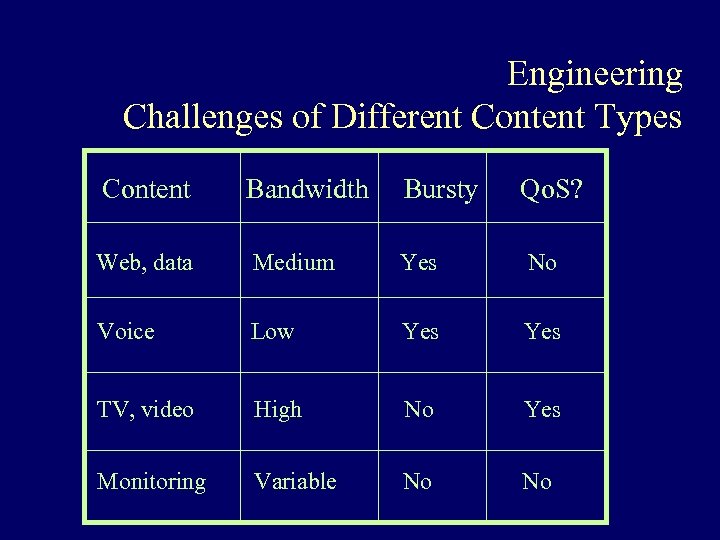 Engineering Challenges of Different Content Types Content Bandwidth Bursty Qo. S? Web, data Medium Yes No Voice Low Yes TV, video High No Yes Monitoring Variable No No
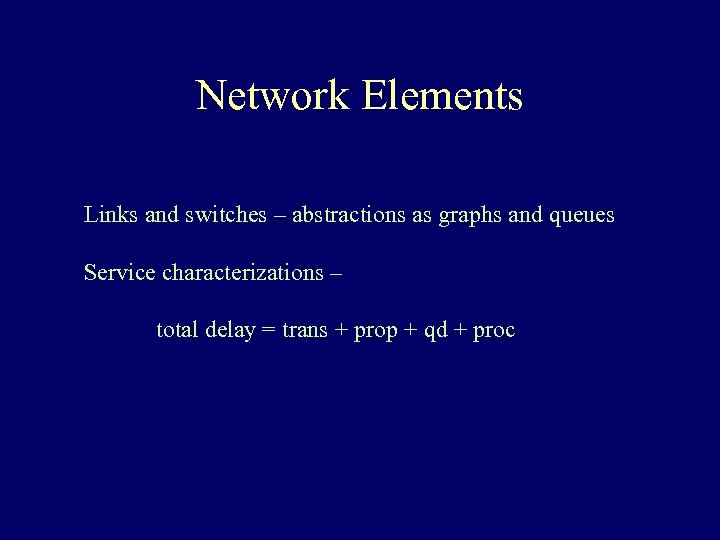 Network Elements Links and switches – abstractions as graphs and queues Service characterizations – total delay = trans + prop + qd + proc
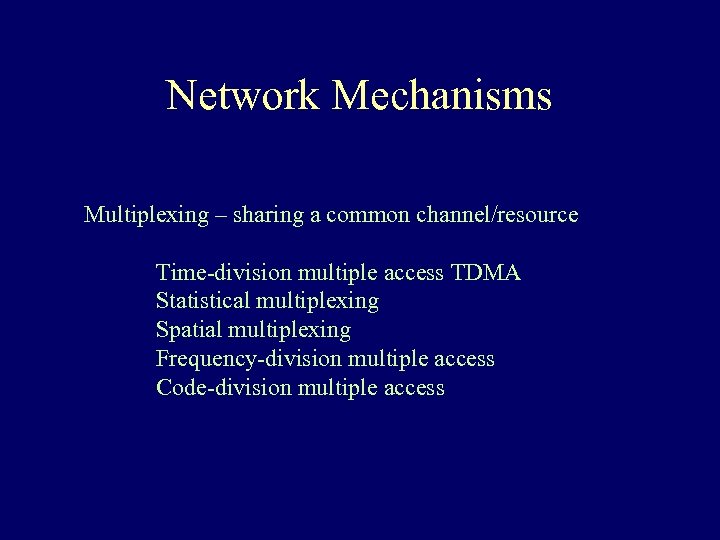 Network Mechanisms Multiplexing – sharing a common channel/resource Time-division multiple access TDMA Statistical multiplexing Spatial multiplexing Frequency-division multiple access Code-division multiple access
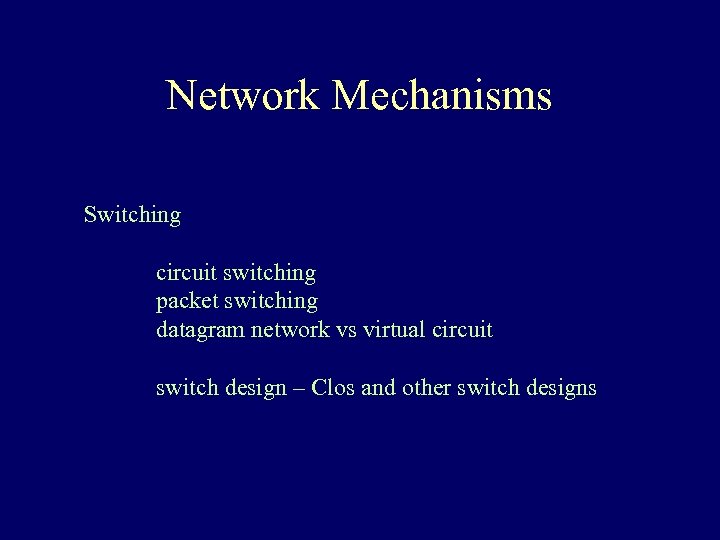 Network Mechanisms Switching circuit switching packet switching datagram network vs virtual circuit switch design – Clos and other switch designs
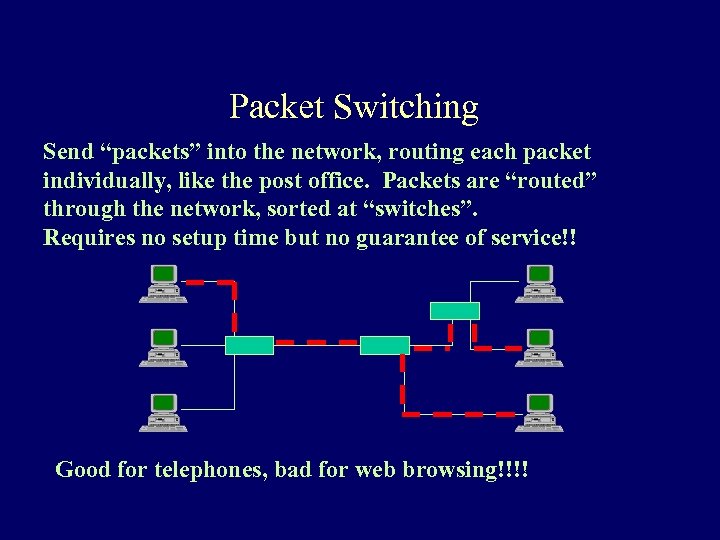 Packet Switching Send “packets” into the network, routing each packet individually, like the post office. Packets are “routed” through the network, sorted at “switches”. Requires no setup time but no guarantee of service!! Good for telephones, bad for web browsing!!!!
 Network Mechanisms Error control - detection vs correction parity bits cyclic redundancy codes replication for error correction BCH and Reed-Solomon codes error detection and correction protocols retransmission protocols
 Network Mechanisms Flow control Congestion control problems with long haul, high speed networks rate control (open loop) Resource allocation
 Why is “convergence” a challenge? Convergence of entertainment, telecommunications and computing industries. Telecom is set up for voice. Entertainment requiries audio and video Qo. S. Computer communication is based on packet switching.
 OEE (Due Friday, April 14) Walrand page 93+ 1. 3. 4. 12. 16. 20. 25.