


 Скачать презентацию English Welsh Scottish Railway Holdings Ltd EWS
cd5c11e1650c7a03b32ef2f77954ac77.ppt
- Количество слайдов: 19
 English Welsh & Scottish Railway Holdings Ltd (“EWS”)/ Marcroft Holdings Ltd Adam Land Director of Remedies and Business Analysis Usual disclaimer: Personal views, not to be taken to indicate Competition Commission endorsement
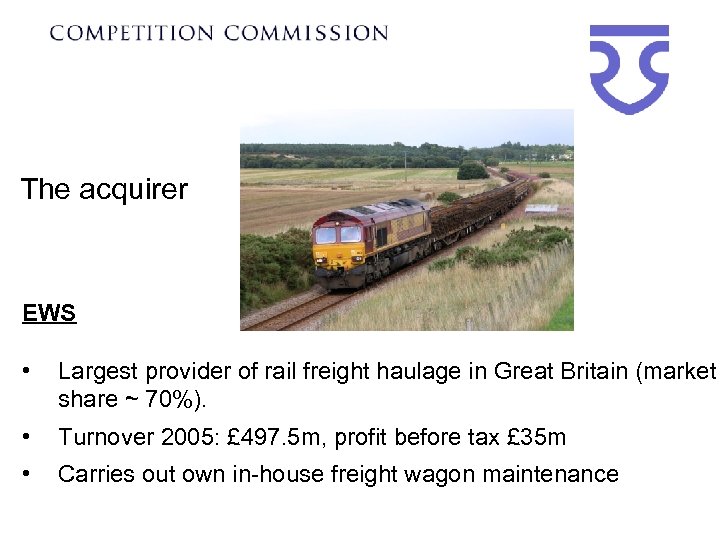 The acquirer EWS • Largest provider of rail freight haulage in Great Britain (market share ~ 70%). • Turnover 2005: £ 497. 5 m, profit before tax £ 35 m • Carries out own in-house freight wagon maintenance
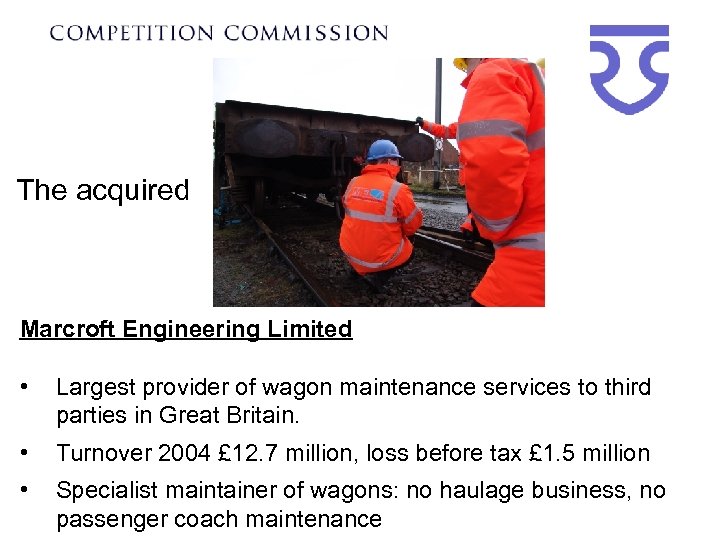 The acquired Marcroft Engineering Limited • Largest provider of wagon maintenance services to third parties in Great Britain. • Turnover 2004 £ 12. 7 million, loss before tax £ 1. 5 million • Specialist maintainer of wagons: no haulage business, no passenger coach maintenance
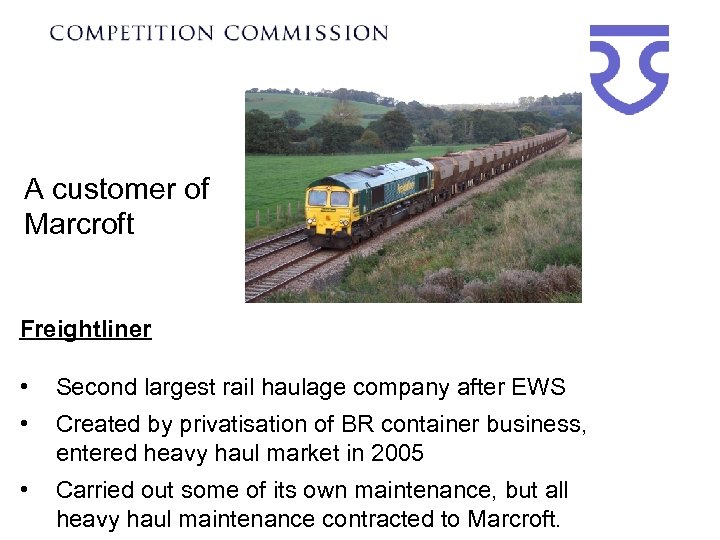 A customer of Marcroft Freightliner • Second largest rail haulage company after EWS • Created by privatisation of BR container business, entered heavy haul market in 2005 • Carried out some of its own maintenance, but all heavy haul maintenance contracted to Marcroft.
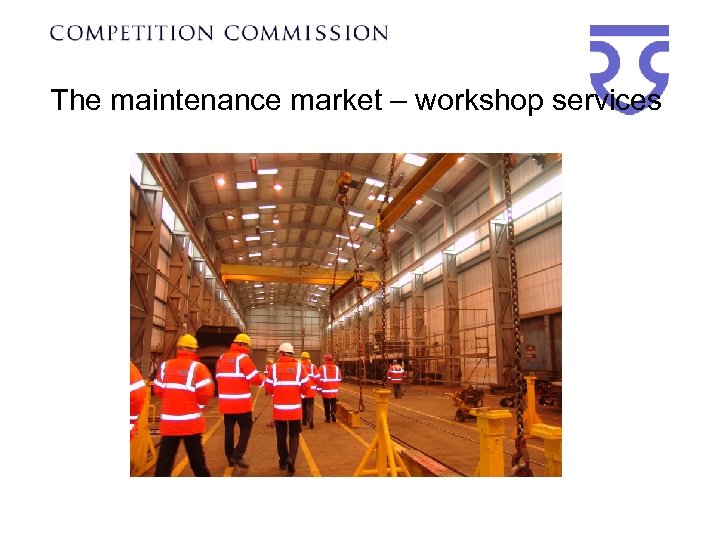 The maintenance market – workshop services
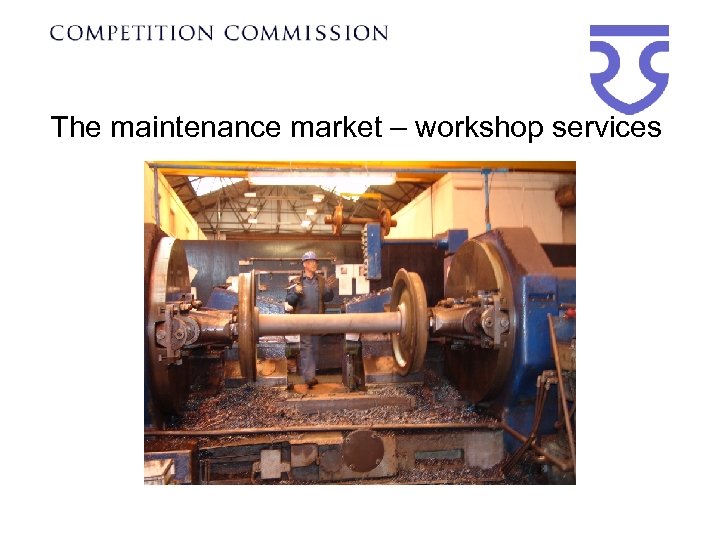 The maintenance market – workshop services
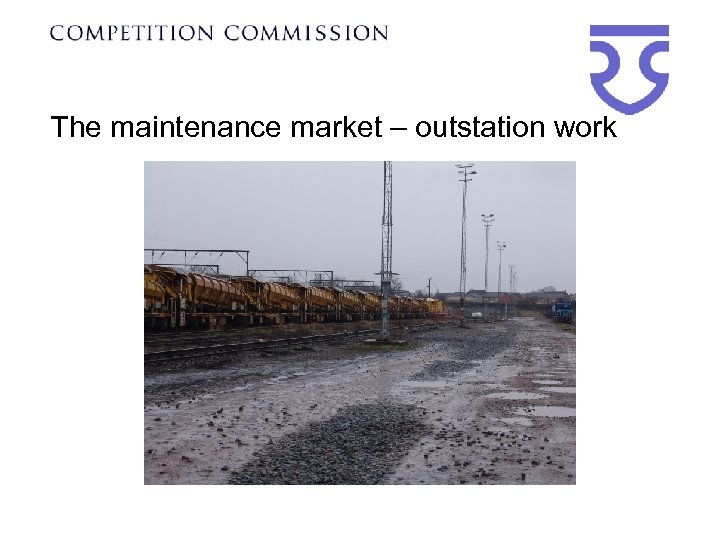 The maintenance market – outstation work
 The merger • Agreement for EWS to acquire Marcroft announced 4 November 2005, merger completed on 1 February 2006 • OFT referred the merger to the CC on 6 February 2006; • Interim undertakings accepted by CC on 13 March 2006 to prevent further integration.
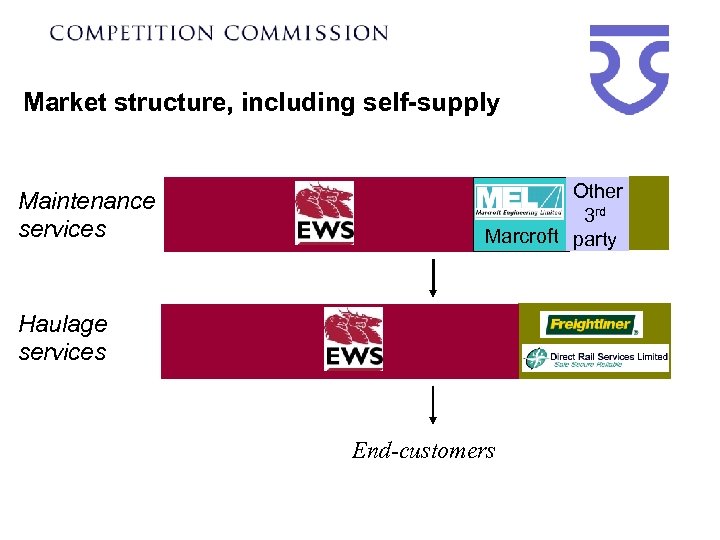 Market structure, including self-supply Maintenance services Other 3 rd Marcroft party Haulage services End-customers
 Market definition • Product market: Wagon maintenance services • Geographic market: Great Britain • Is self-supply in the same market as third-party?
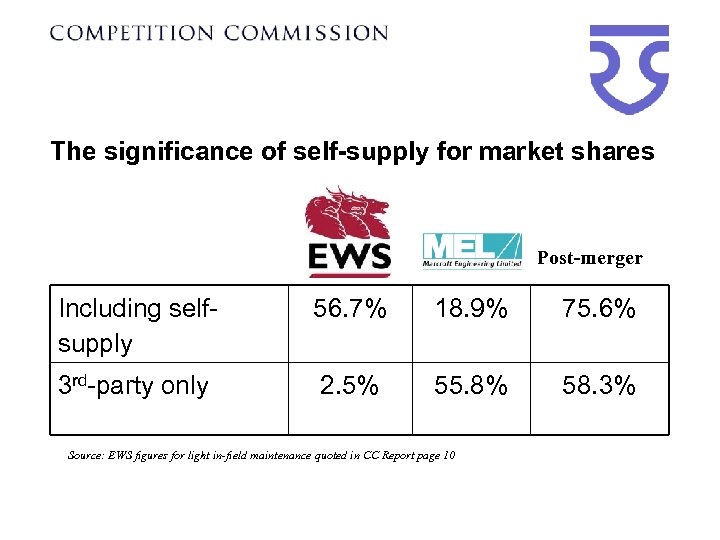 The significance of self-supply for market shares Post-merger Including selfsupply 56. 7% 18. 9% 75. 6% 3 rd-party only 2. 5% 55. 8% 58. 3% Source: EWS figures for light in-field maintenance quoted in CC Report page 10
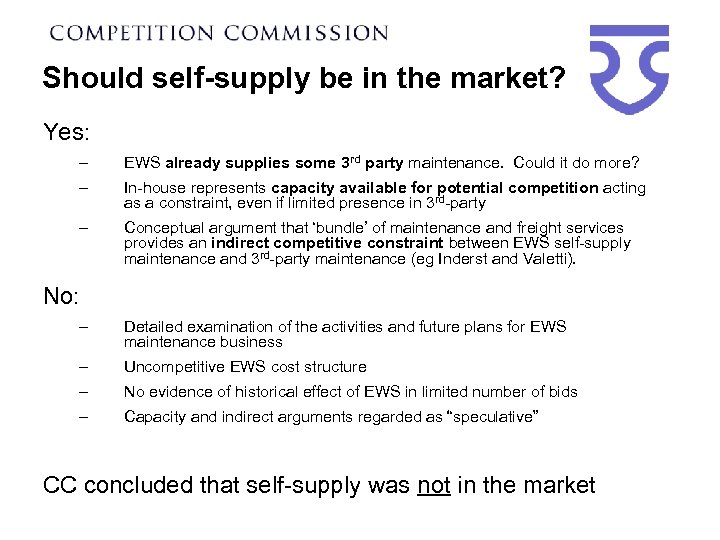 Should self-supply be in the market? Yes: – EWS already supplies some 3 rd party maintenance. Could it do more? – In-house represents capacity available for potential competition acting as a constraint, even if limited presence in 3 rd-party – Conceptual argument that ‘bundle’ of maintenance and freight services provides an indirect competitive constraint between EWS self-supply maintenance and 3 rd-party maintenance (eg Inderst and Valetti). No: – Detailed examination of the activities and future plans for EWS maintenance business – Uncompetitive EWS cost structure – No evidence of historical effect of EWS in limited number of bids – Capacity and indirect arguments regarded as “speculative” CC concluded that self-supply was not in the market
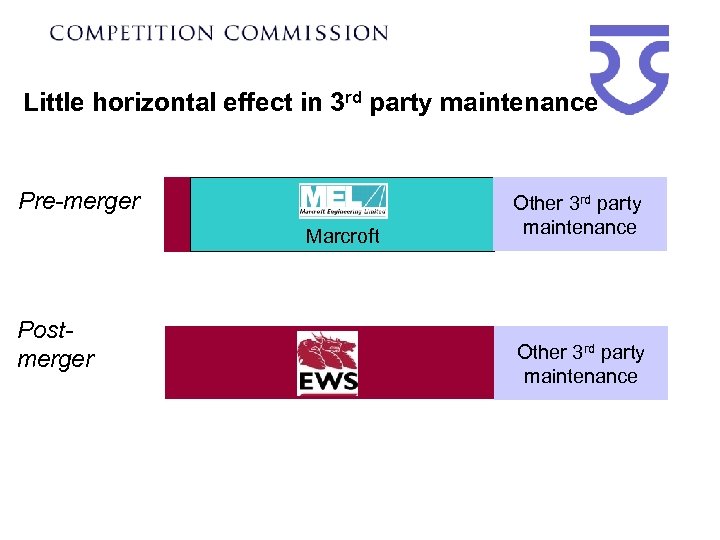 Little horizontal effect in 3 rd party maintenance Pre-merger Marcroft Postmerger Other 3 rd party maintenance
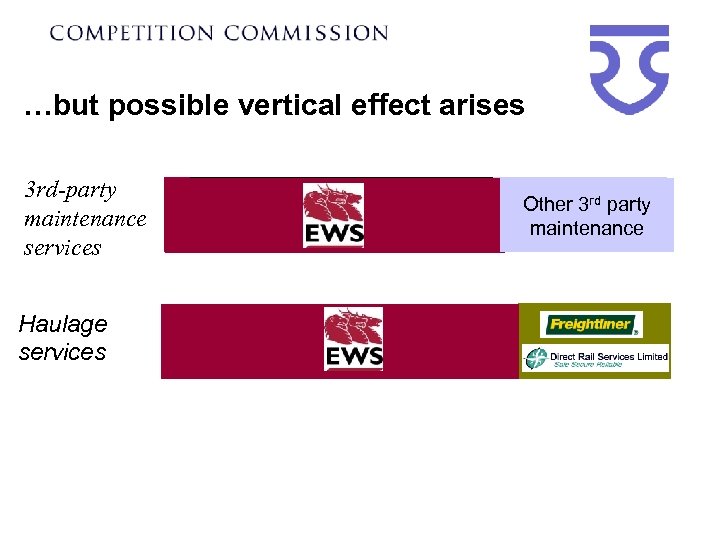 …but possible vertical effect arises 3 rd-party maintenance services Haulage services Marcroft Other 3 rd party maintenance
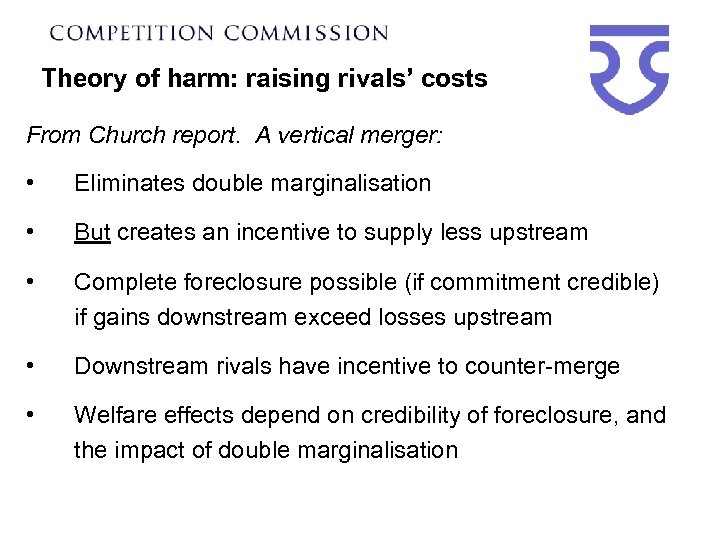 Theory of harm: raising rivals’ costs From Church report. A vertical merger: • Eliminates double marginalisation • But creates an incentive to supply less upstream • Complete foreclosure possible (if commitment credible) if gains downstream exceed losses upstream • Downstream rivals have incentive to counter-merge • Welfare effects depend on credibility of foreclosure, and the impact of double marginalisation
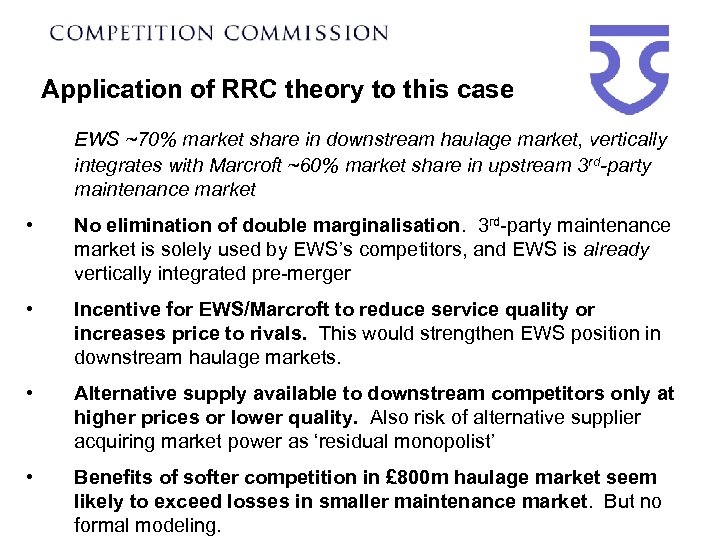 Application of RRC theory to this case EWS ~70% market share in downstream haulage market, vertically integrates with Marcroft ~60% market share in upstream 3 rd-party maintenance market • No elimination of double marginalisation. 3 rd-party maintenance market is solely used by EWS’s competitors, and EWS is already vertically integrated pre-merger • Incentive for EWS/Marcroft to reduce service quality or increases price to rivals. This would strengthen EWS position in downstream haulage markets. • Alternative supply available to downstream competitors only at higher prices or lower quality. Also risk of alternative supplier acquiring market power as ‘residual monopolist’ • Benefits of softer competition in £ 800 m haulage market seem likely to exceed losses in smaller maintenance market. But no formal modeling.
 Conclusions on vertical theory of harm • EWS already had market power in rail haulage (supported after report by finding of abuse of dominant position) • Merged entity would have market power in 3 rd party maintenance • Cost/benefit trade-off of foreclosure was good for EWS/Marcroft: reduced quality significantly diminishes competition downstream for little financial loss upstream • No benefit from elimination of double-marginalisation • CC considered that competition law (eg Article 82 EC) would make it less likely that EWS/Marcroft would foreclose, but not so much as to overcome incentive and ability Ø Substantial Lessening of Competition finding, leading to remedies
 Remedies Behavioural remedies – Offered but not considered effective – How could you prevent a fall in service quality? Structural remedies – No need to divest workshop – Full divestment of outstation business would be effective; – Partial divestment of outstation business could also be effective. Challenges for partial divestment – Purchaser risks (eg competition problems, capability) – Composition risk (is a viable business being sold? ) Ø A partial divestment was (eventually) made to Davis, a small competitor in 3 rd party maintenance
 Reflections • Role of market definition in framing theories of harm: – If narrow 3 rd party maintenance market, concerns about vertical Raising Rivals Costs theory – If wider maintenance market, potential concerns about horizontal concentration • Indirect constraint argument – when should it apply? • Vertical theories difficult for non-economist decisionmakers and advisors (Church report = 382 pages) • Vertical theories of harm can create requirements for assessment of other markets (eg haulage) • Challenges of remedying completed mergers