 Скачать презентацию English Vocabulary in ME period Loan words in
English Vocabulary in ME period.pptx
- Количество слайдов: 15



English Vocabulary in ME period. Loan words in English. By Bazarbek Yerkezhan
Plan: • • 1. Dialects in early and late ME periods. 2. Evolution of English after Norman Conquest. 3. Vocabulary in ME period. 4. Loan words in Me period.
• An analysis of the vocabulary in the Middle English period shows great instability and constant and rapid change. Many words became obsolete, and if preserved, then only in some dialects; many more appeared in the rapidly developing language to reflect the ever -changing life of the speakers and under the influence of contacts with other nations
• The principal means of enriching vocabulary in Middle English are not internal, but external borrowings.
• Two languages in succession enriched the vocabulary of the English language of the time - the Scandinavian language and the French language, the nature of the borrowings and their amount reflecting the conditions of the contacts between the English and these languages.
Scandinavians and the Englishspeaking people many words were borrowed from the Scandinavian language, for example:
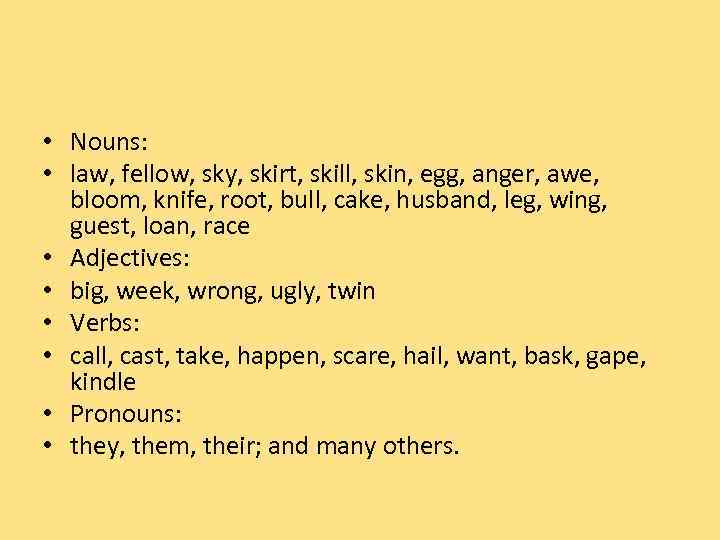
• Nouns: • law, fellow, sky, skirt, skill, skin, egg, anger, awe, bloom, knife, root, bull, cake, husband, leg, wing, guest, loan, race • Adjectives: • big, week, wrong, ugly, twin • Verbs: • call, cast, take, happen, scare, hail, want, bask, gape, kindle • Pronouns: • they, them, their; and many others.
• Sometimes an English word and its Scandinavian doublet were the same in meaning but slightly different phonetically, and the phonetic form of the Scandinavian borrowing is preserved in the English language, having ousted the English counterpart.
• For example, Modern English to give, to get come from the Scandinavian gefa, geta,
• The Norman conquest and the subsequent history of the country left deep traces in the English language, mainly in the form of borrowings in words connected with such spheres of social and political activity where French-speaking Normans had occupied for a long time all places of importance.
• • • • For example: - government and legislature: government, noble, baron, prince, duke, court, justice, judge, crime, prison, condemn, sentence, parliament, etc. - military life: army, battle, peace, banner, victory, general, colonel, lieutenant, major, etc. - religion: religion, sermon, pray, saint, charity - city crafts: painter, tailor, carpenter (but country occupations remained English: shepherd, smith) - pleasure and entertainment: music, art, feast, pleasure, leisure, supper, dinner, pork, beef, mutton (but the corresponding names of domestic animals remained English: pig, cow, sheep) - words of everyday life: air, place, river, large, age, boil, branch, brush, catch, chain, chair, table, choice, cry, cost - relationship: aunt, uncle, nephew, cousin.


Literature • 1. Расторгуева Т. А. История английского языка М. , 2003 • 2. Ильиш Б. А. История английского языка Л. , 1972 • 3. Иванова И. П. и др. История английского языка СМб – 1999 • 4. Аракин В. Д. История английского языка М. , 2003
 Скачать презентацию English Vocabulary in ME period Loan words in
English Vocabulary in ME period.pptx