


 Скачать презентацию ENGLISH PUNCTUATION part 2 Tuvina Evgeniya Group II-112
Punction p2.pptx
- Количество слайдов: 21
 ENGLISH PUNCTUATION part 2 Tuvina Evgeniya Group II-112
 Punctuation marks: 1. Apostrophe ' 2. Parentheses ( ) 3. Colon : 4. Hyphen 5. Dash —
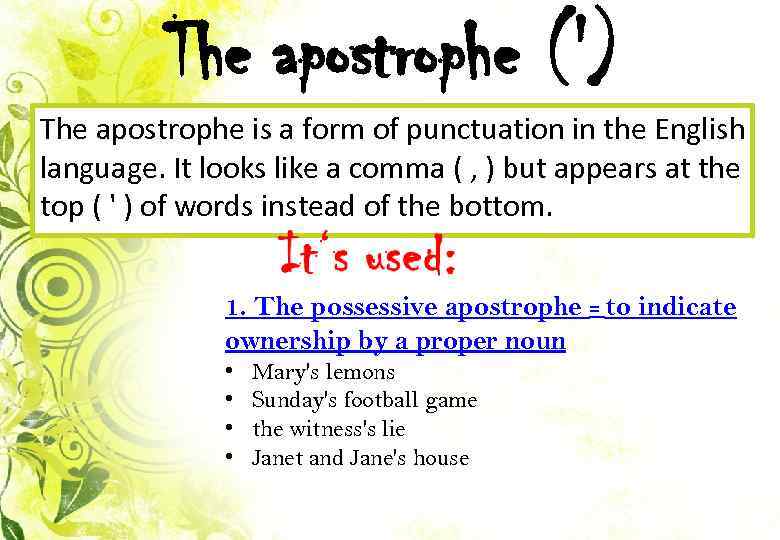 The apostrophe (') The apostrophe is a form of punctuation in the English language. It looks like a comma ( , ) but appears at the top ( ' ) of words instead of the bottom. 1. The possessive apostrophe = to indicate ownership by a proper noun • • Mary's lemons Sunday's football game the witness's lie Janet and Jane's house
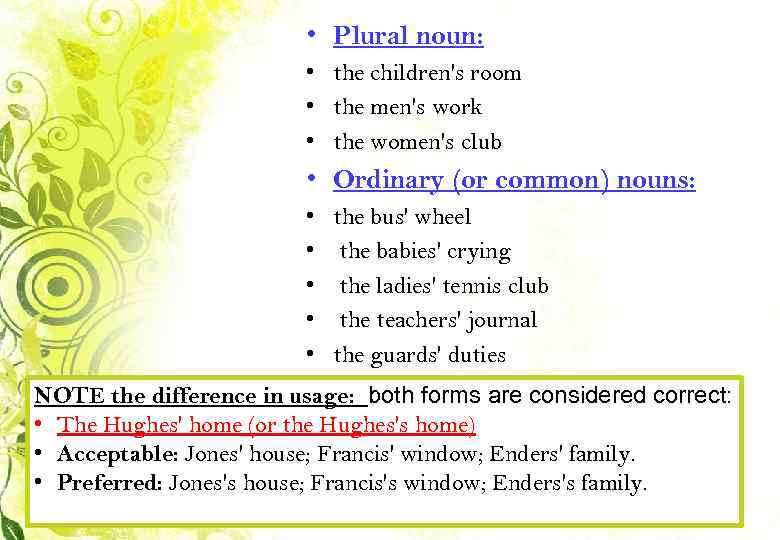 • Plural noun: • the children's room • the men's work • the women's club • Ordinary (or common) nouns: • • • the bus' wheel the babies' crying the ladies' tennis club the teachers' journal the guards' duties NOTE the difference in usage: both forms are considered correct: • The Hughes' home (or the Hughes's home) • Acceptable: Jones' house; Francis' window; Enders' family. • Preferred: Jones's house; Francis's window; Enders's family.
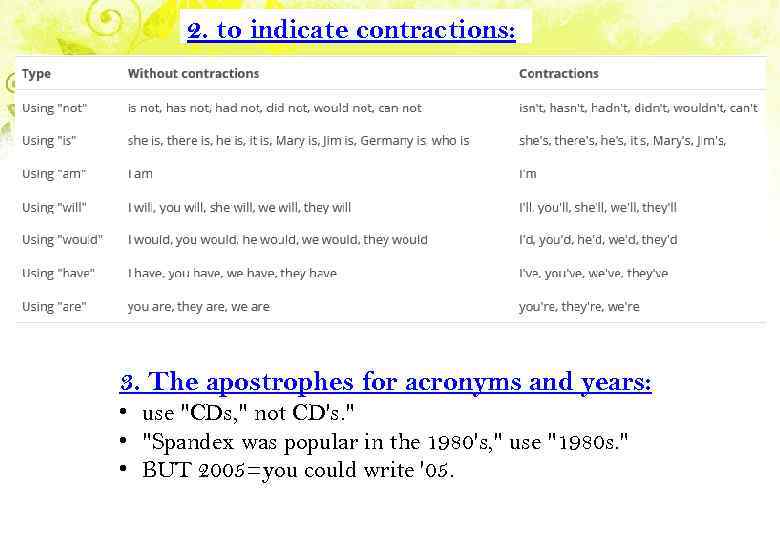 2. to indicate contractions: 3. The apostrophes for acronyms and years: • use "CDs, " not CD's. " • "Spandex was popular in the 1980's, " use "1980 s. " • BUT 2005=you could write '05.
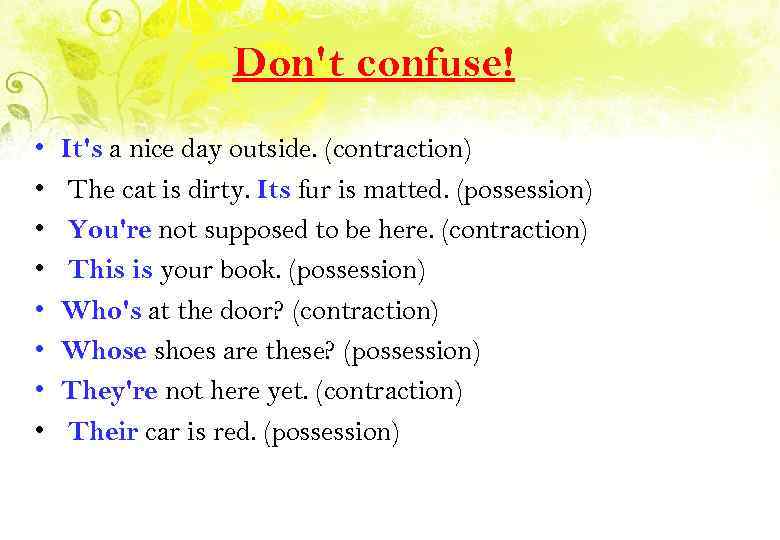 Don't confuse! • • It's a nice day outside. (contraction) The cat is dirty. Its fur is matted. (possession) You're not supposed to be here. (contraction) This is your book. (possession) Who's at the door? (contraction) Whose shoes are these? (possession) They're not here yet. (contraction) Their car is red. (possession)
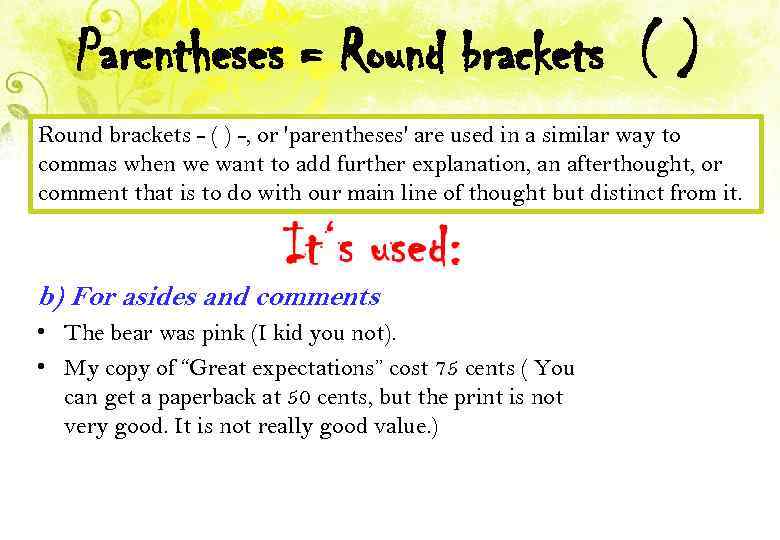 Parentheses = Round brackets ( ) Round brackets - ( ) -, or 'parentheses' are used in a similar way to commas when we want to add further explanation, an afterthought, or comment that is to do with our main line of thought but distinct from it. b) For asides and comments 1. for additional information or explanation • The bear was pink (I kid you not). a) My copy of “Great expectations” cost 75 cents ( You To clarify or inform. • • Jamie's bike was redat 50 cents, but theyellowis not can get a paperback (bright red) with a print stripe. • My sister (andis not really good value. ) very good. It she is past thirty)
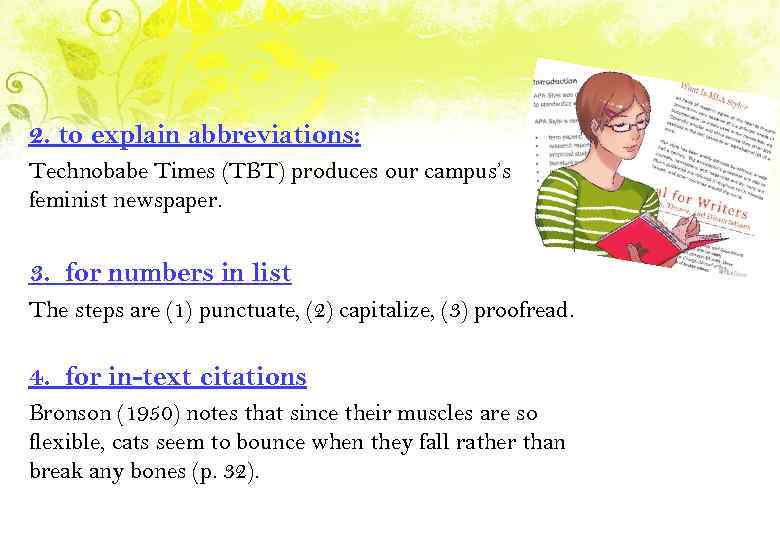 2. to explain abbreviations: Technobabe Times (TBT) produces our campus’s feminist newspaper. 3. for numbers in list The steps are (1) punctuate, (2) capitalize, (3) proofread. 4. for in-text citations Bronson (1950) notes that since their muscles are so flexible, cats seem to bounce when they fall rather than break any bones (p. 32).
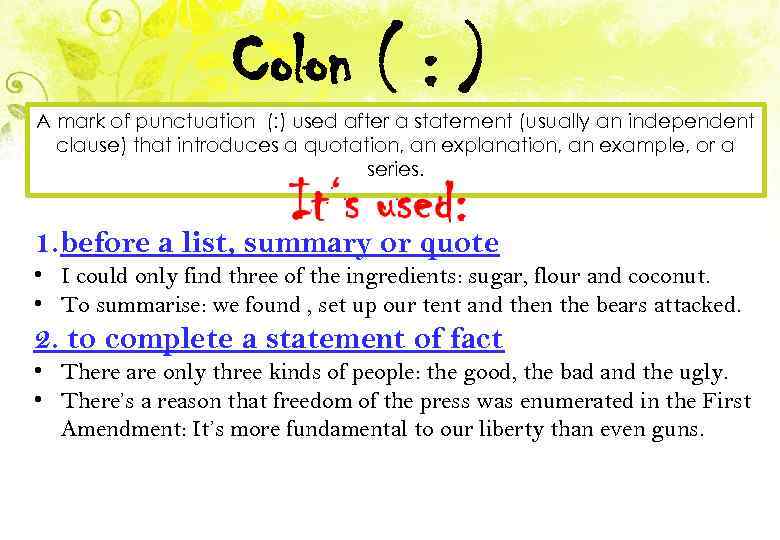 Colon ( : ) A mark of punctuation (: ) used after a statement (usually an independent clause) that introduces a quotation, an explanation, an example, or a series. 1. before a list, summary or quote • I could only find three of the ingredients: sugar, flour and coconut. • To summarise: we found , set up our tent and then the bears attacked. 2. to complete a statement of fact • There are only three kinds of people: the good, the bad and the ugly. • There’s a reason that freedom of the press was enumerated in the First Amendment: It’s more fundamental to our liberty than even guns.
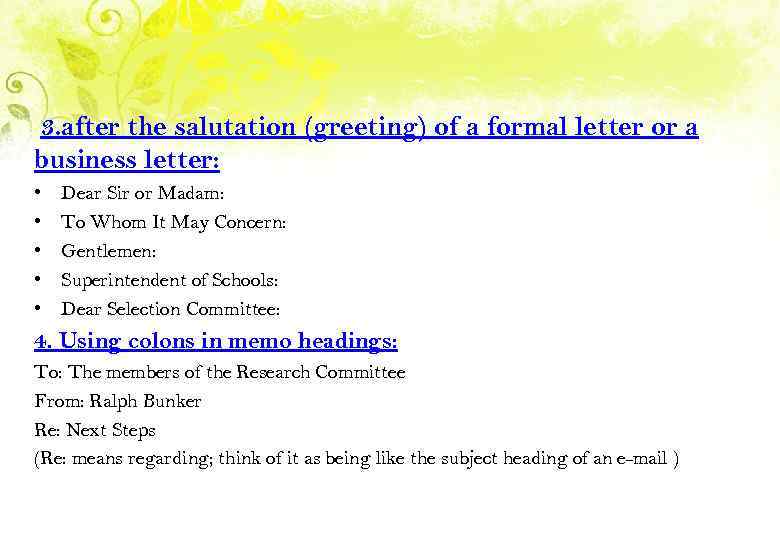 3. after the salutation (greeting) of a formal letter or a business letter: • • • Dear Sir or Madam: To Whom It May Concern: Gentlemen: Superintendent of Schools: Dear Selection Committee: 4. Using colons in memo headings: To: The members of the Research Committee From: Ralph Bunker Re: Next Steps (Re: means regarding; think of it as being like the subject heading of an e-mail )
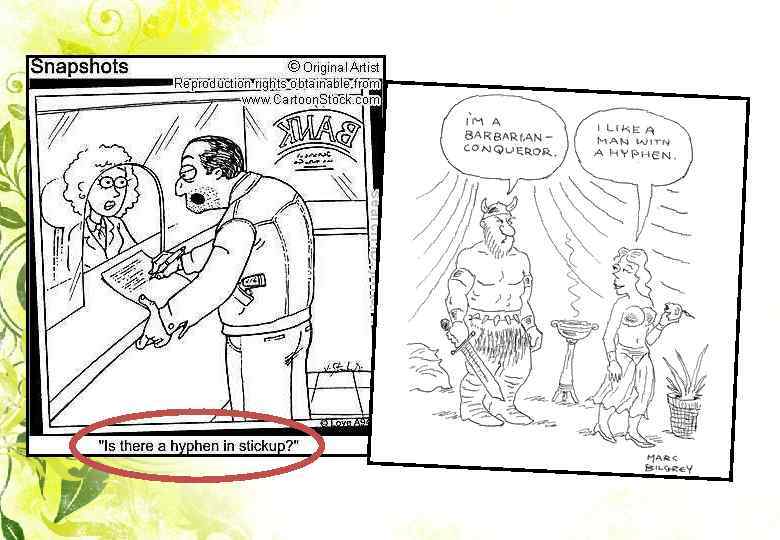
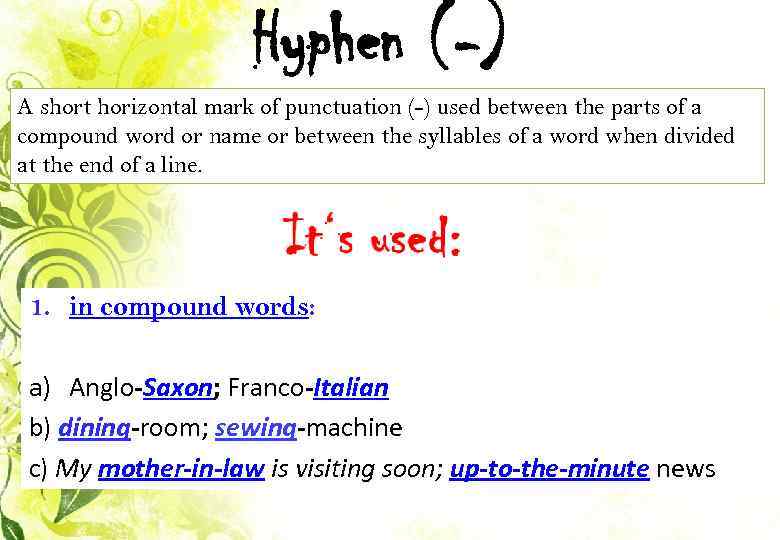 Hyphen (-) A short horizontal mark of punctuation (-) used between the parts of a compound word or name or between the syllables of a word when divided at the end of a line. 1. in compound words: a) Anglo-Saxon; Franco-Italian b) dining-room; sewing-machine c) My mother-in-law is visiting soon; up-to-the-minute news
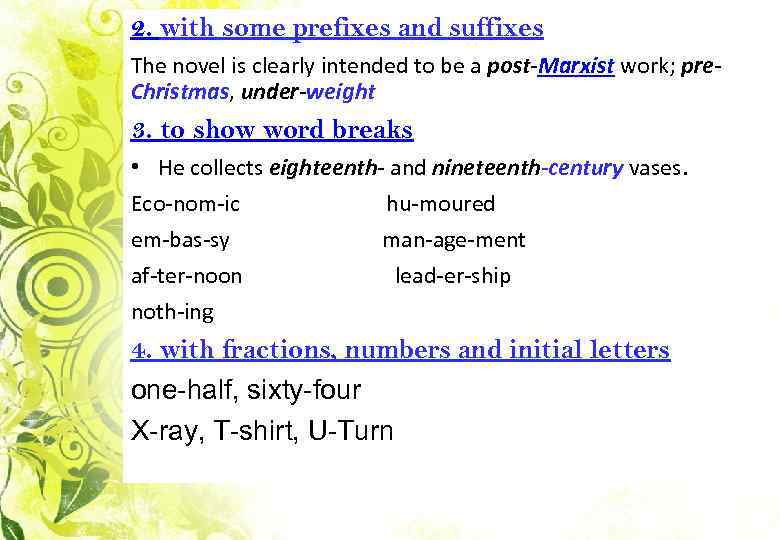 2. with some prefixes and suffixes The novel is clearly intended to be a post-Marxist work; pre. Christmas, under-weight 3. to show word breaks • He collects eighteenth- and nineteenth-century vases. Eco-nom-ic hu-moured em-bas-sy man-age-ment af-ter-noon lead-er-ship noth-ing 4. with fractions, numbers and initial letters one-half, sixty-four X-ray, T-shirt, U-Turn
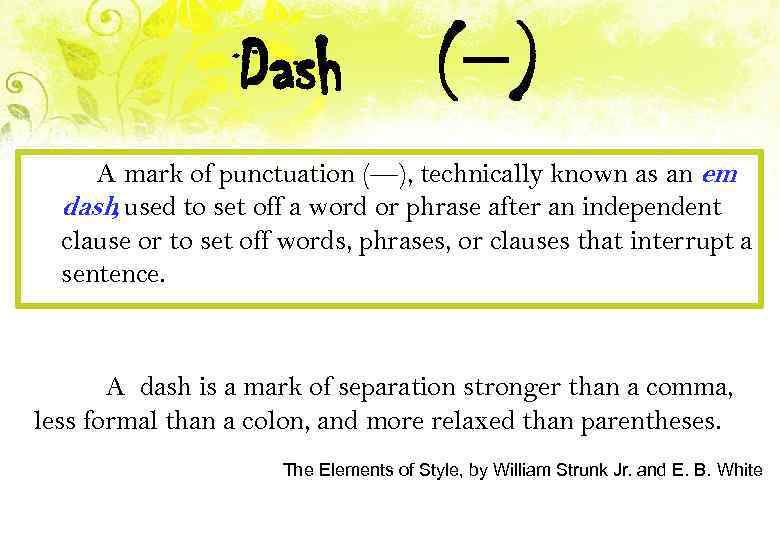 Dash ( ) A mark of punctuation (—), technically known as an em dash, used to set off a word or phrase after an independent clause or to set off words, phrases, or clauses that interrupt a sentence. A dash is a mark of separation stronger than a comma, less formal than a colon, and more relaxed than parentheses. The Elements of Style, by William Strunk Jr. and E. B. White
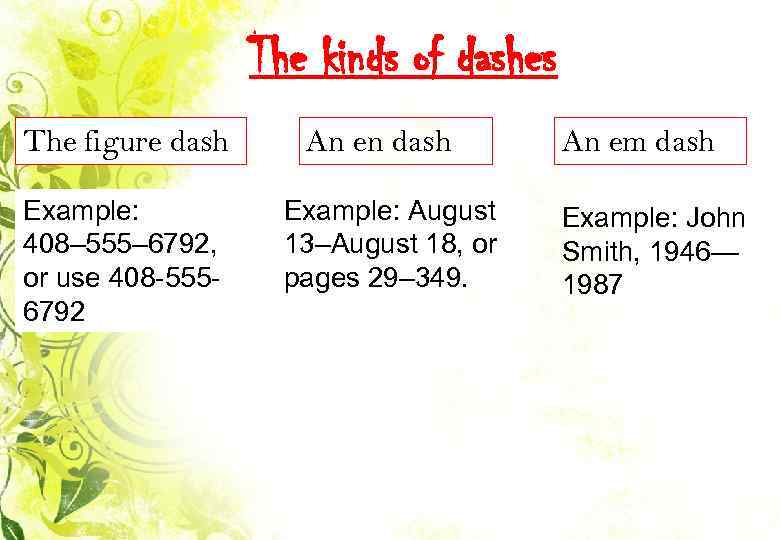 The kinds of dashes The figure dash Example: 408‒ 555‒ 6792, or use 408 -5556792 An en dash Example: August 13–August 18, or pages 29– 349. An em dash Example: John Smith, 1946— 1987
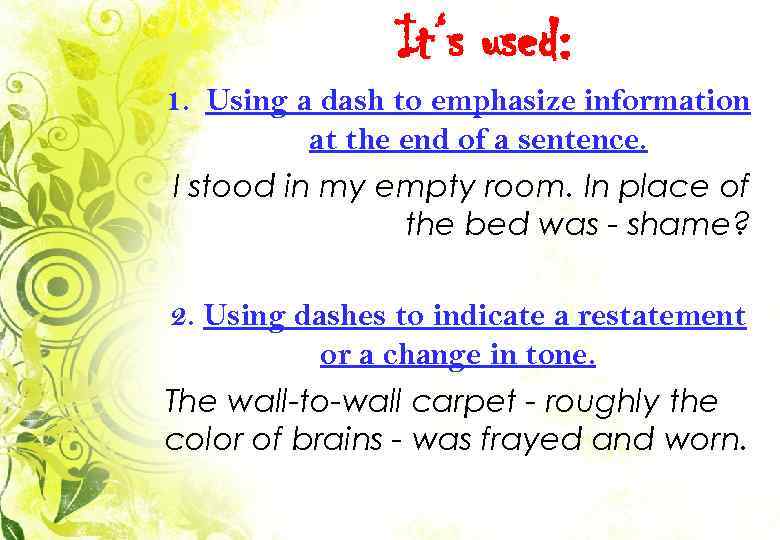 It‘s used: 1. Using a dash to emphasize information at the end of a sentence. I stood in my empty room. In place of the bed was - shame? 2. Using dashes to indicate a restatement or a change in tone. The wall-to-wall carpet - roughly the color of brains - was frayed and worn.
 3. Using dashes to set off explanatory information Markets full of live animals - rabbits, chickens, lambs, and cows - were part of our lives 4. Using dashes to show hesitation in speech. Roger Toynbee was sitting upright in his leather chair - dead.
 Hyphens and Dashes Keep in mind these differences between hyphens and dashes: ü hyphens are shorter than dashes; ü hyphens are used in between words and parts of words; ü dashes are used between phrases and sentences. Don't confuse the dash with the hyphen (-).
 Remember: Punctuation is being governed two-thirds by rule and one-third by personal taste And don't forget that proper punctuation is 5% of your IELTS score
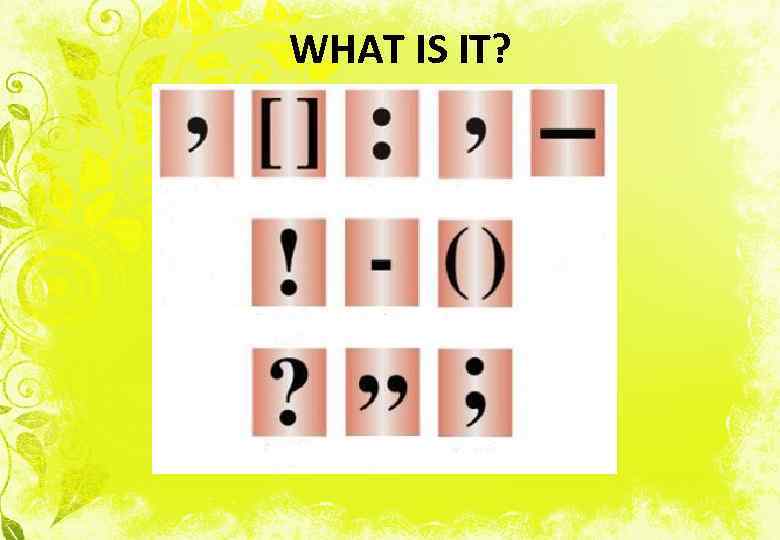 WHAT IS IT?
 Thanks for your attention!!!