



 English phonetics Vowels in English
 VOWELS ►A vowel phoneme is a speech sound in the pronunciation of which an air stream passes freely through the mouth cavity. ► The difference in the position of the tongue and lips, the stability and the length of articulation give such a great variety of English vowels, illustrated in the following table.
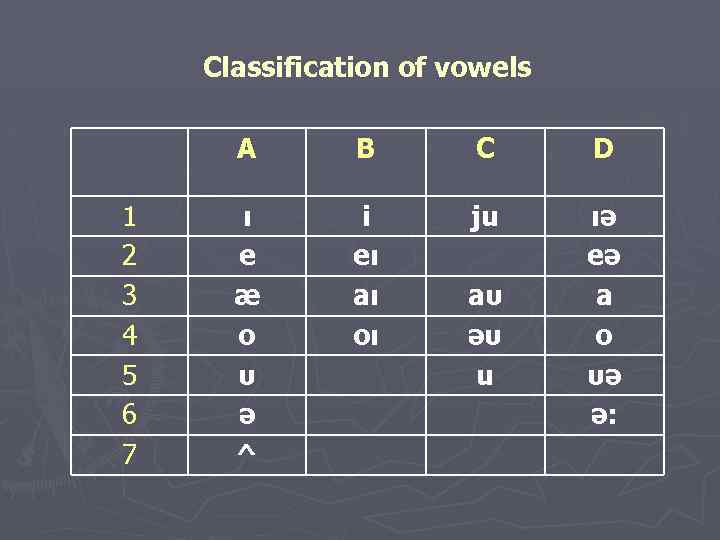 Classification of vowels A 1 2 3 4 5 6 7 B C D ı e æ o υ ə ^ i eı aı oı ju ıə eə a o υə ə: aυ əυ u
 Column A ► contains so called ‘short’ vowels. Since they are of varying length and ‘æ‘, especially; they are frequent ly longer than some of the so called ‘long’ vowels; it's bet ter to avoid using such general categories which look rather traditional than present real facts. All vowels in column A share one common distributional character, namely, none of them can appear in a stressed monosyllable not closed by a consonant. The final ‘ə’ can only occur in unstressed sylla bles.
 Column В ► hows the front closing vowels. When followed by another vowel in column D they are often realized with a slight glide as in ‘bi: 1 ı ŋ’.
 Column C ► contains the back closing vowels. When followed by another vowel in column D, they are realized with a slight /w/ glide as in ‘kju: w ı ŋ’.
 Column D ► Most of the words containing the vowels in column D have the sign 'r' in the spelling which is of course pronounced in r pronouncing accents of English. ► When followed immediate ly by another vowel the vowels in column D are normally separated by an ‘r’ glide when there is an r in spelling.
 Column D ► When there is no r in spelling the speaker has a choice: ► (a) pronouncing a liason ‘idea of /aı dıərəv/’; ► (b)interrupting a vowel sequence with a glottal stop /? / as in / aı dıə? əv /; or ► (с)introducing a /w/ glide if the vowel concerned has strong lip rounding
 Column D ► (consider the following example ‘law and order/’ ► /low ən o: də/; ► or /lo: n o: d ə / allowing the two vowels to coalesce into one vowel; ► Some speakers make use of this last option even when there is an ‘r’ in the spelling as in 'far away' /fa: weı /.
 Duration of vowels ► The essential contrast of vowel length occurs in different distributional context. ► Thus, in the open syllable position any vowel has the longest articulation, it is pronounced less long before a voiced consonant (and sonorants) and the shortest duration of vowel is in vowels followed by a voiceless consonant. Consequently, we may not use sign /: / to differentiate between long and short vowels.
 Duration of vowels ► Vowels in column A never occur in the longest vowel position, i. e. in an open syllable, and as a result they do not possess the longest variants. Examples: ► m æ p ► t e n ► k i d ► s ^ n ► p υ t ► b ı g
 Duration of vowels ► In addition it is necessary to make a particular comment on a vowel /æ/. ► This vowel is quite long, strikingly longer than /i/ or /e/ for instance. ► Before voiced consonants it is often diphthongized as in 'bad' /b æ ə d/. ► The other long vowel is /o/, which is also diphthongized as in 'board' /b o ə d /.
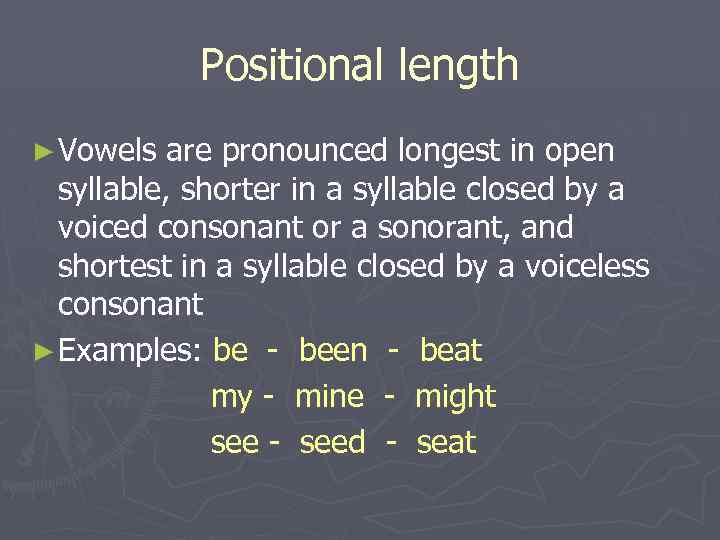 Positional length ► Vowels are pronounced longest in open syllable, shorter in a syllable closed by a voiced consonant or a sonorant, and shortest in a syllable closed by a voiceless consonant ► Examples: be been beat my mine might seed seat
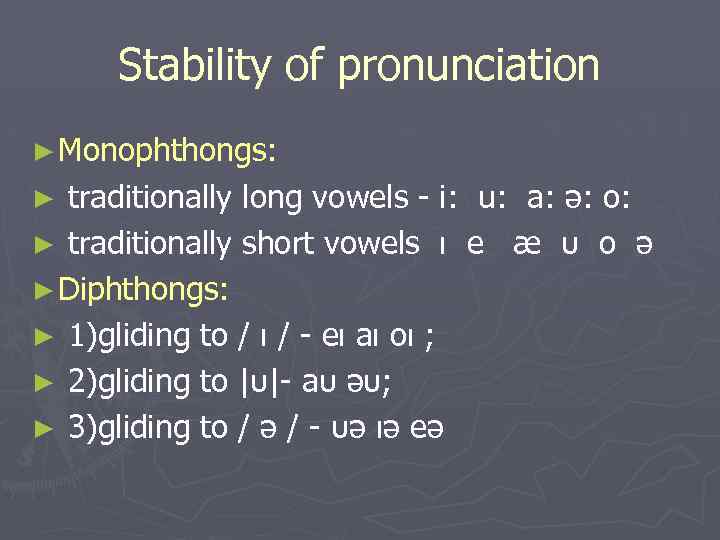 Stability of pronunciation ► Monophthongs: traditionally long vowels i: u: a: ə: o: ► traditionally short vowels ı e æ υ o ə ► Diphthongs: ► 1)gliding to / ı / eı aı oı ; ► 2)gliding to |υ| aυ əυ; ► 3)gliding to / ə / υə ıə eə ►
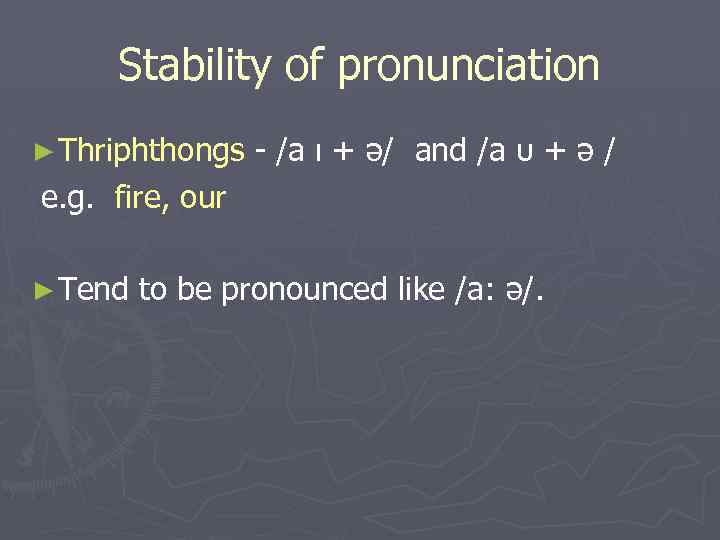 Stability of pronunciation ► Thriphthongs /a ı + ə/ and /a υ + ə / e. g. fire, our ► Tend to be pronounced like /a: ə/.