 Скачать презентацию ENGLISH N 4 2013 HOBBY OF STAMP COLLECTING Text
Hobby of Stamp Collecting.ppt
- Количество слайдов: 13



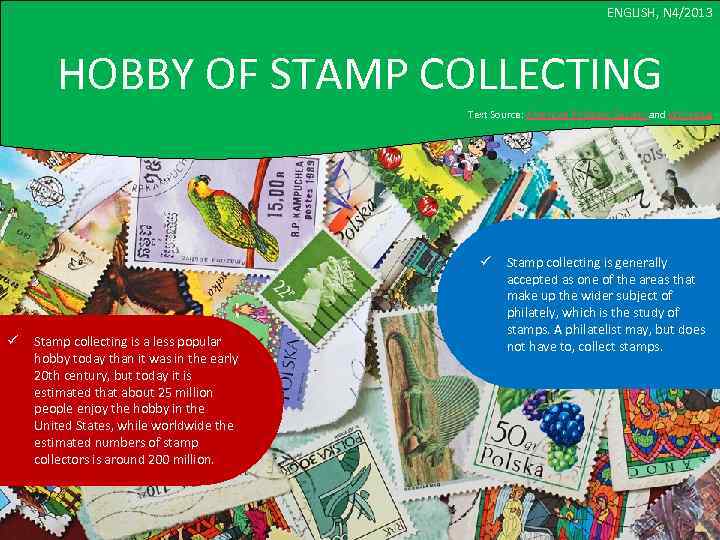
ENGLISH, N 4/2013 HOBBY OF STAMP COLLECTING Text Source: American Philatelic Society and Wikipedia ü ü Stamp collecting is a less popular hobby today than it was in the early 20 th century, but today it is estimated that about 25 million people enjoy the hobby in the United States, while worldwide the estimated numbers of stamp collectors is around 200 million. Stamp collecting is generally accepted as one of the areas that make up the wider subject of philately, which is the study of stamps. A philatelist may, but does not have to, collect stamps.
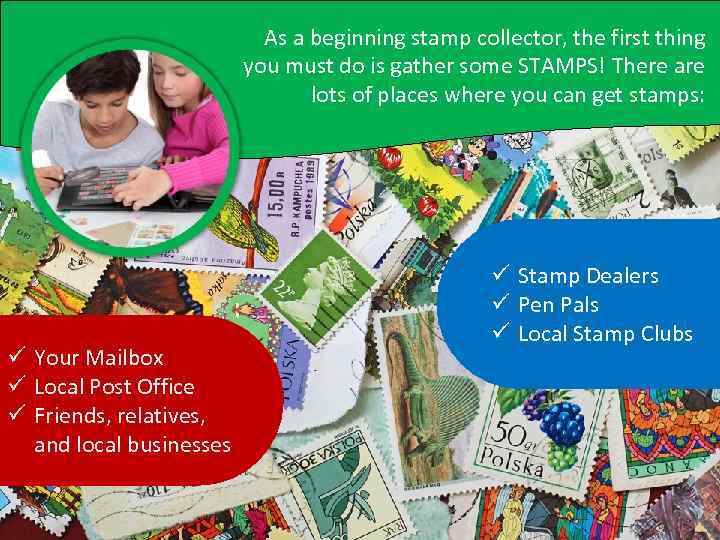
As a beginning stamp collector, the first thing you must do is gather some STAMPS! There are lots of places where you can get stamps: ü Your Mailbox ü Local Post Office ü Friends, relatives, and local businesses ü Stamp Dealers ü Pen Pals ü Local Stamp Clubs
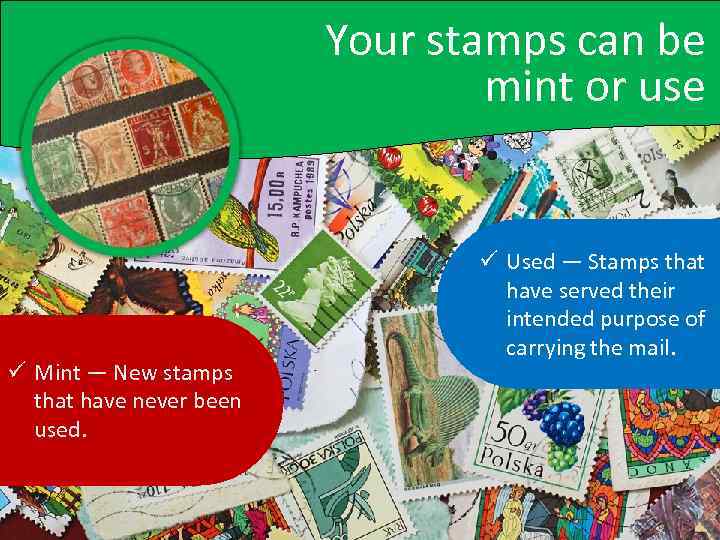
Your stamps can be mint or use ü Mint — New stamps that have never been used. ü Used — Stamps that have served their intended purpose of carrying the mail.
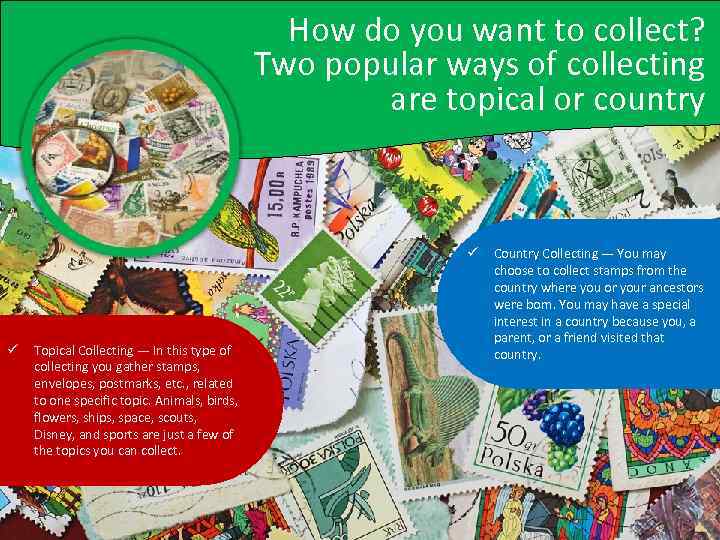
How do you want to collect? Two popular ways of collecting are topical or country ü ü Topical Collecting — In this type of collecting you gather stamps, envelopes, postmarks, etc. , related to one specific topic. Animals, birds, flowers, ships, space, scouts, Disney, and sports are just a few of the topics you can collect. Country Collecting — You may choose to collect stamps from the country where you or your ancestors were born. You may have a special interest in a country because you, a parent, or a friend visited that country.
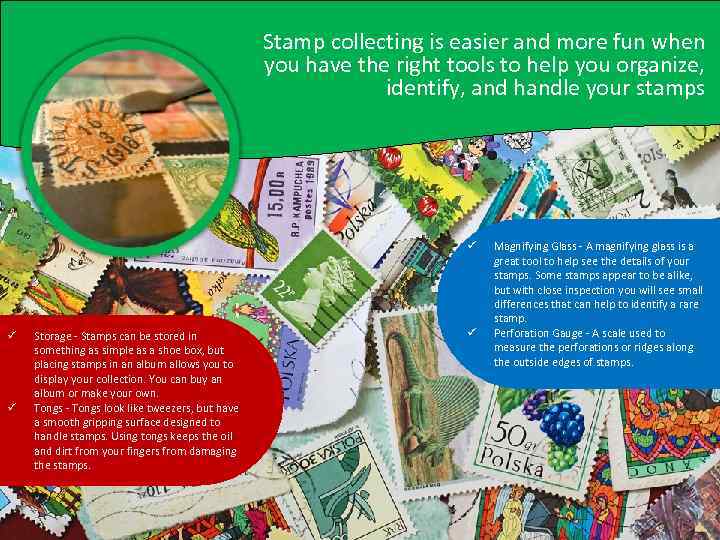
Stamp collecting is easier and more fun when you have the right tools to help you organize, identify, and handle your stamps ü ü ü Storage Stamps can be stored in something as simple as a shoe box, but placing stamps in an album allows you to display your collection. You can buy an album or make your own. Tongs look like tweezers, but have a smooth gripping surface designed to handle stamps. Using tongs keeps the oil and dirt from your fingers from damaging the stamps. ü Magnifying Glass A magnifying glass is a great tool to help see the details of your stamps. Some stamps appear to be alike, but with close inspection you will see small differences that can help to identify a rare stamp. Perforation Gauge A scale used to measure the perforations or ridges along the outside edges of stamps.
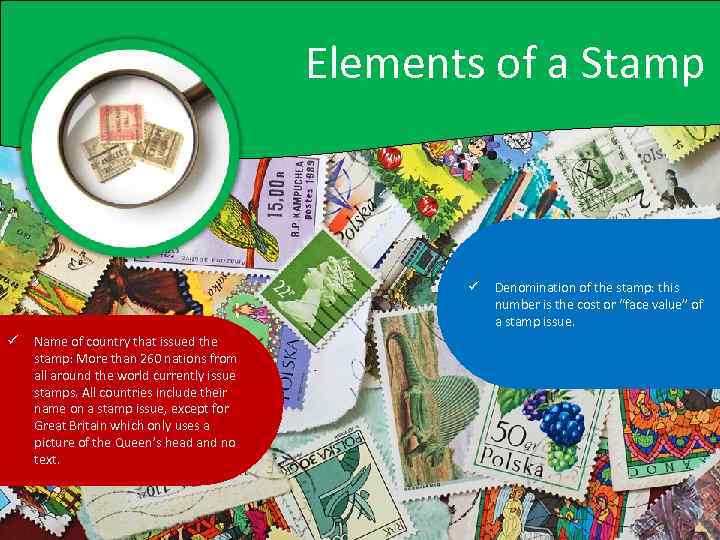
Elements of a Stamp ü ü Name of country that issued the stamp: More than 260 nations from all around the world currently issue stamps. All countries include their name on a stamp issue, except for Great Britain which only uses a picture of the Queen’s head and no text. Denomination of the stamp: this number is the cost or “face value” of a stamp issue.
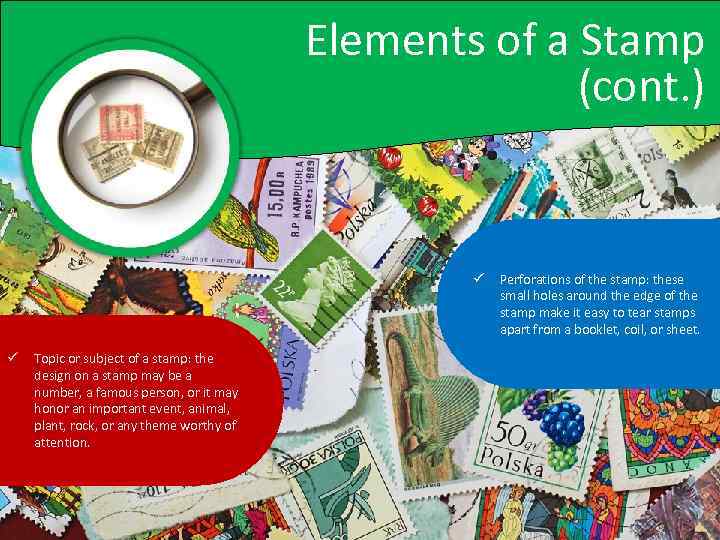
Elements of a Stamp (cont. ) ü ü Topic or subject of a stamp: the design on a stamp may be a number, a famous person, or it may honor an important event, animal, plant, rock, or any theme worthy of attention. Perforations of the stamp: these small holes around the edge of the stamp make it easy to tear stamps apart from a booklet, coil, or sheet.
Elements of a Stamp (cont. ) ü ü Topic or subject of a stamp: the design on a stamp may be a number, a famous person, or it may honor an important event, animal, plant, rock, or any theme worthy of attention. Perforations of the stamp: these small holes around the edge of the stamp make it easy to tear stamps apart from a booklet, coil, or sheet.
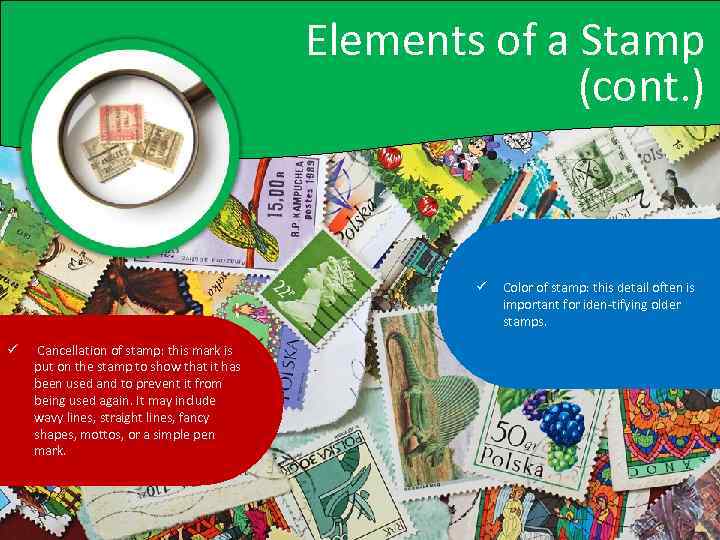
Elements of a Stamp (cont. ) ü ü Cancellation of stamp: this mark is put on the stamp to show that it has been used and to prevent it from being used again. It may include wavy lines, straight lines, fancy shapes, mottos, or a simple pen mark. Color of stamp: this detail often is important for iden tifying older stamps.
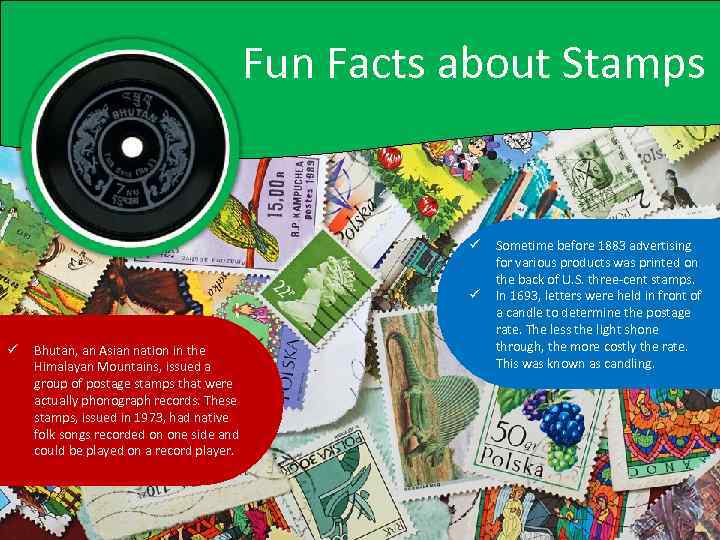
Fun Facts about Stamps ü ü ü Bhutan, an Asian nation in the Himalayan Mountains, issued a group of postage stamps that were actually phonograph records. These stamps, issued in 1973, had native folk songs recorded on one side and could be played on a record player. Sometime before 1883 advertising for various products was printed on the back of U. S. three cent stamps. In 1693, letters were held in front of a candle to determine the postage rate. The less the light shone through, the more costly the rate. This was known as candling.
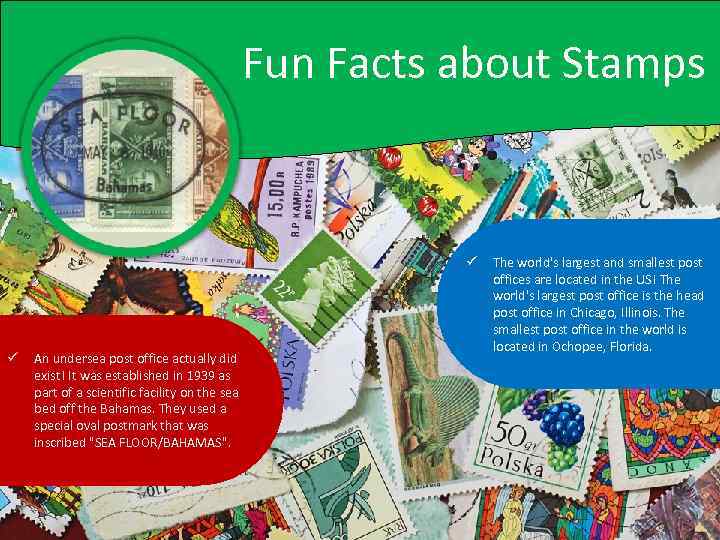
Fun Facts about Stamps ü ü An undersea post office actually did exist! It was established in 1939 as part of a scientific facility on the sea bed off the Bahamas. They used a special oval postmark that was inscribed "SEA FLOOR/BAHAMAS". The world's largest and smallest post offices are located in the US! The world's largest post office is the head post office in Chicago, Illinois. The smallest post office in the world is located in Ochopee, Florida.
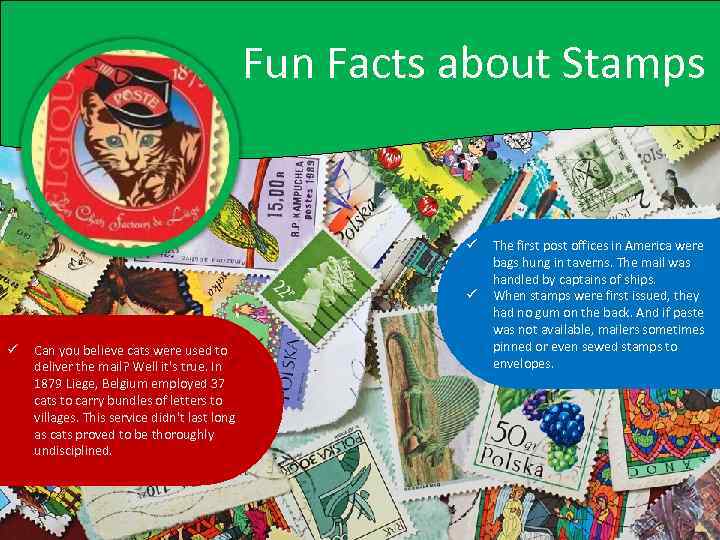
Fun Facts about Stamps ü ü ü Can you believe cats were used to deliver the mail? Well it's true. In 1879 Liege, Belgium employed 37 cats to carry bundles of letters to villages. This service didn't last long as cats proved to be thoroughly undisciplined. The first post offices in America were bags hung in taverns. The mail was handled by captains of ships. When stamps were first issued, they had no gum on the back. And if paste was not available, mailers sometimes pinned or even sewed stamps to envelopes.
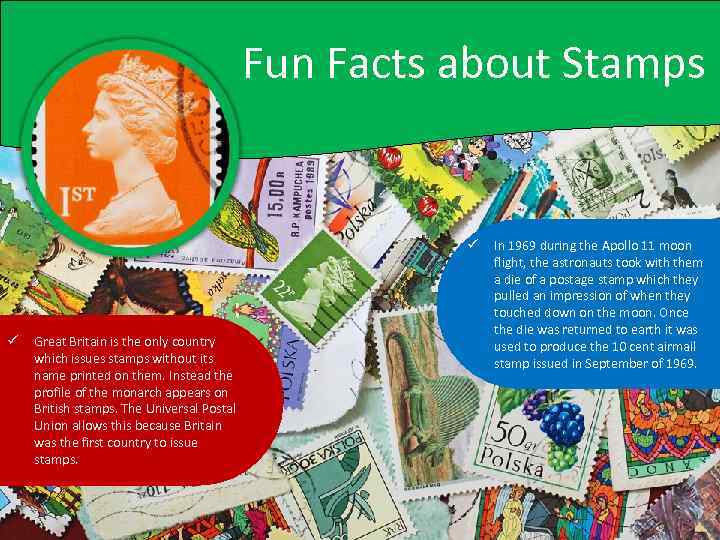
Fun Facts about Stamps ü ü Great Britain is the only country which issues stamps without its name printed on them. Instead the profile of the monarch appears on British stamps. The Universal Postal Union allows this because Britain was the first country to issue stamps. In 1969 during the Apollo 11 moon flight, the astronauts took with them a die of a postage stamp which they pulled an impression of when they touched down on the moon. Once the die was returned to earth it was used to produce the 10 cent airmail stamp issued in September of 1969.
Скачать презентацию ENGLISH N 4 2013 HOBBY OF STAMP COLLECTING Text
Hobby of Stamp Collecting.ppt