 Скачать презентацию English Grammar 2 1名词的分类 名词可以分为专有名词 Proper Nouns 和普通名词 Common
b44ac779ffe79ce42cdd65e9e2d84d82.ppt
- Количество слайдов: 26



English Grammar
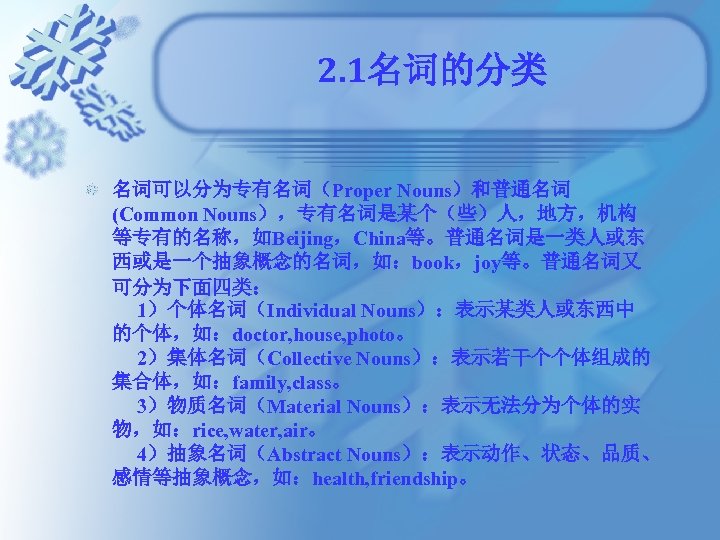
2. 1名词的分类 名词可以分为专有名词(Proper Nouns)和普通名词 (Common Nouns),专有名词是某个(些)人,地方,机构 等专有的名称,如Beijing,China等。普通名词是一类人或东 西或是一个抽象概念的名词,如:book,joy等。普通名词又 可分为下面四类: 1)个体名词(Individual Nouns):表示某类人或东西中 的个体,如:doctor, house, photo。 2)集体名词(Collective Nouns):表示若干个个体组成的 集合体,如:family, class。 3)物质名词(Material Nouns):表示无法分为个体的实 物,如:rice, water, air。 4)抽象名词(Abstract Nouns):表示动作、状态、品质、 感情等抽象概念,如:health, friendship。
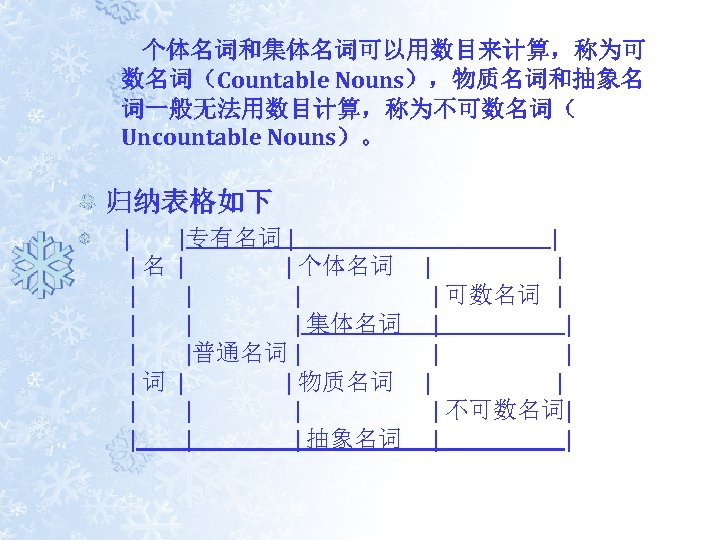
个体名词和集体名词可以用数目来计算,称为可 数名词(Countable Nouns),物质名词和抽象名 词一般无法用数目计算,称为不可数名词( Uncountable Nouns)。 归纳表格如下 | |专有名词 | | | 名 | | 个体名词 | | | | | 可数名词 | | | | 集体名词 | | | |普通名词 | | | 词 | | 物质名词 | | | | | 不可数名词| | | | 抽象名词 | |
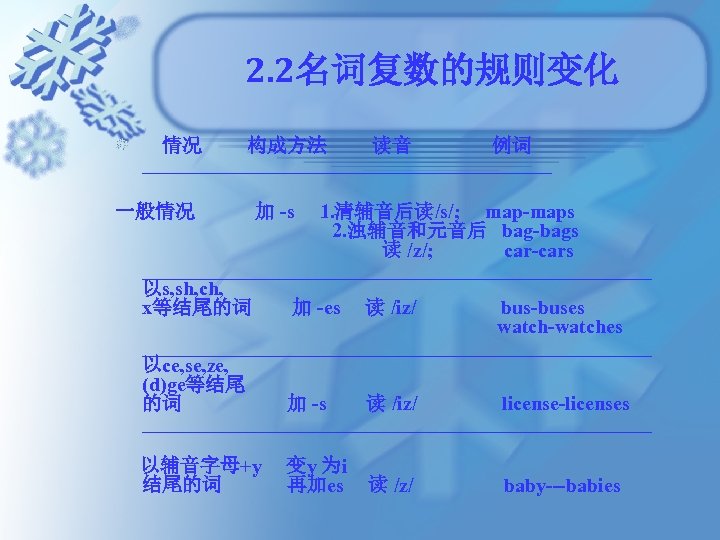
2. 2名词复数的规则变化 情况 构成方法 读音 例词 _____________________ 一般情况 加 -s 1. 清辅音后读/s/; map-maps 2. 浊辅音和元音后 bag-bags 读 /z/; car-cars __________________________ 以s, sh, ch, x等结尾的词 加 -es 读 /iz/ bus-buses watch-watches __________________________ 以ce, se, ze, (d)ge等结尾 的词 加 -s 读 /iz/ license-licenses __________________________ 以辅音字母+y 变y 为i 结尾的词 再加es 读 /z/ baby---babies
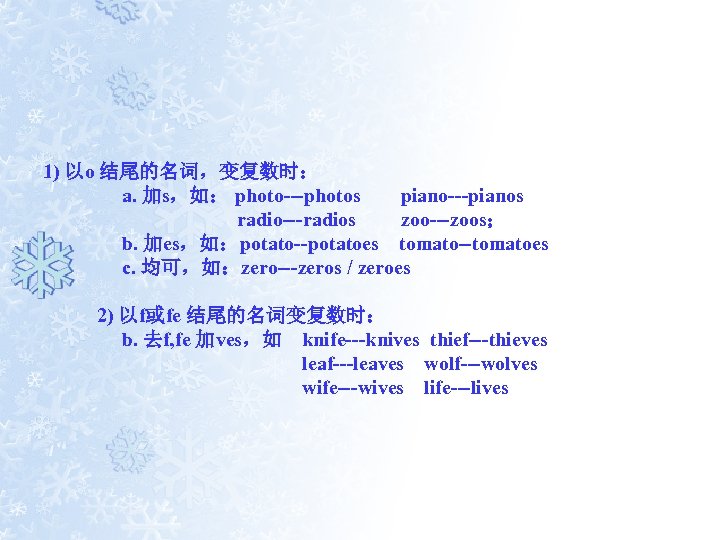
1) 以o 结尾的名词,变复数时: a. 加s,如: photo---photos piano---pianos radio---radios zoo---zoos; b. 加es,如:potato--potatoes tomato--tomatoes c. 均可,如:zero---zeros / zeroes 2) 以f或fe 结尾的名词变复数时: b. 去f, fe 加ves,如 knife---knives thief---thieves leaf---leaves wolf---wolves wife---wives life---lives
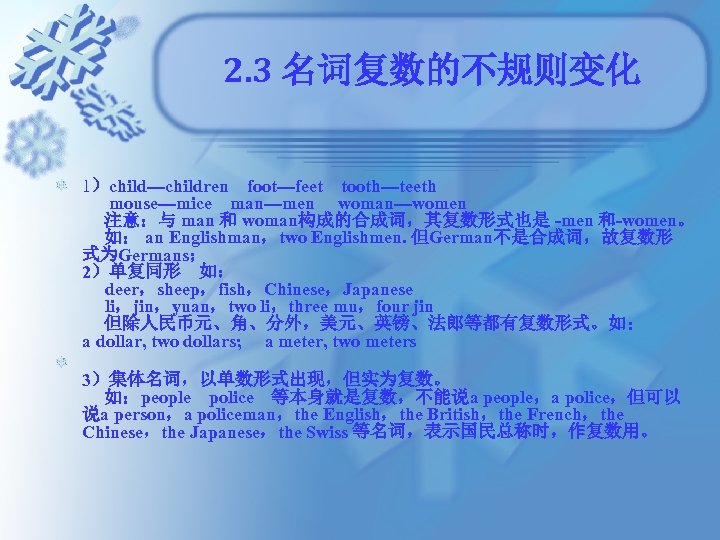
2. 3 名词复数的不规则变化 1)child---children foot---feet tooth---teeth mouse---mice man---men woman---women 注意:与 man 和 woman构成的合成词,其复数形式也是 -men 和-women。 如: an Englishman,two Englishmen. 但German不是合成词,故复数形 式为Germans; 2)单复同形 如: deer,sheep,fish,Chinese,Japanese li,jin,yuan,two li,three mu,four jin 但除人民币元、角、分外,美元、英镑、法郎等都有复数形式。如: a dollar, two dollars; a meter, two meters 3)集体名词,以单数形式出现,但实为复数。 如:people police 等本身就是复数,不能说a people,a police,但可以 说a person,a policeman,the English,the British,the French,the Chinese,the Japanese,the Swiss 等名词,表示国民总称时,作复数用。
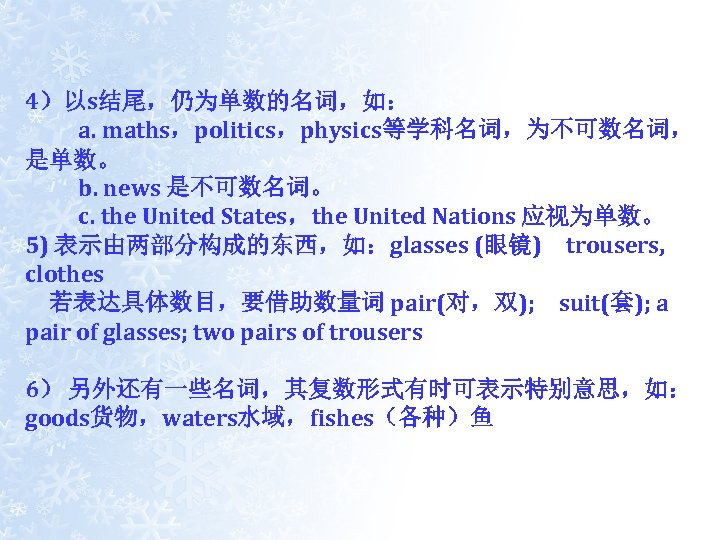
4)以s结尾,仍为单数的名词,如: a. maths,politics,physics等学科名词,为不可数名词, 是单数。 b. news 是不可数名词。 c. the United States,the United Nations 应视为单数。 5) 表示由两部分构成的东西,如:glasses (眼镜) trousers, clothes 若表达具体数目,要借助数量词 pair(对,双); suit(套); a pair of glasses; two pairs of trousers 6) 另外还有一些名词,其复数形式有时可表示特别意思,如: goods货物,waters水域,fishes(各种)鱼
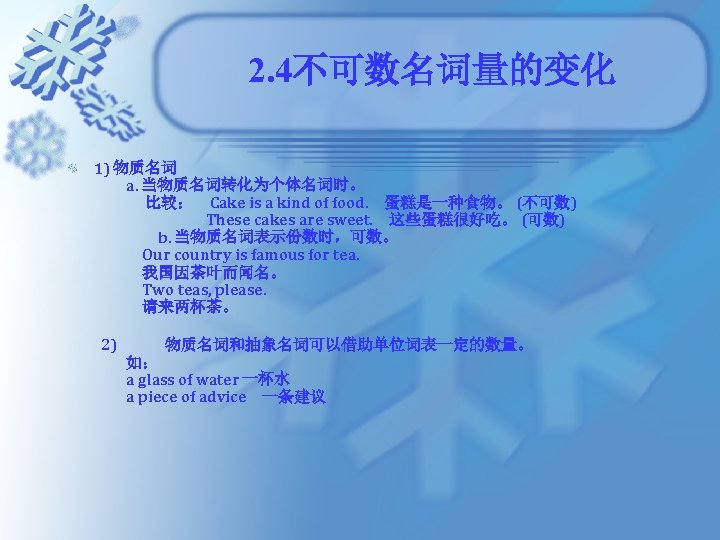
2. 4不可数名词量的变化 1) 物质名词 a. 当物质名词转化为个体名词时。 比较: Cake is a kind of food. 蛋糕是一种食物。 (不可数) These cakes are sweet. 这些蛋糕很好吃。 (可数) b. 当物质名词表示份数时,可数。 Our country is famous for tea. 我国因茶叶而闻名。 Two teas, please. 请来两杯茶。 2) 物质名词和抽象名词可以借助单位词表一定的数量。 如: a glass of water 一杯水 a piece of advice 一条建议
2. In the coming summer holidays, my family _____ going to take a one-week trip to Qingdao. A. is B. are C. was D. were
3. ---There ____ no milk in the fridge. Could you get some for me, Dick? ---All right, Mum. A. is B. are C. was D. were
5. A few _____ are playing under the tree. A. boy B. boys C. chids D. child
7. It’s a beautiful, sunny day! There _____ many people here on vacation. A. be B. am C. is D. are
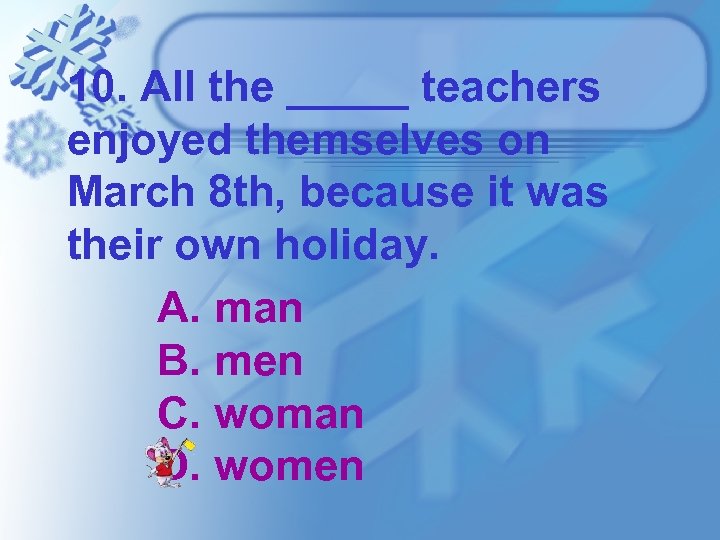
10. All the _____ teachers enjoyed themselves on March 8 th, because it was their own holiday. A. man B. men C. woman D. women
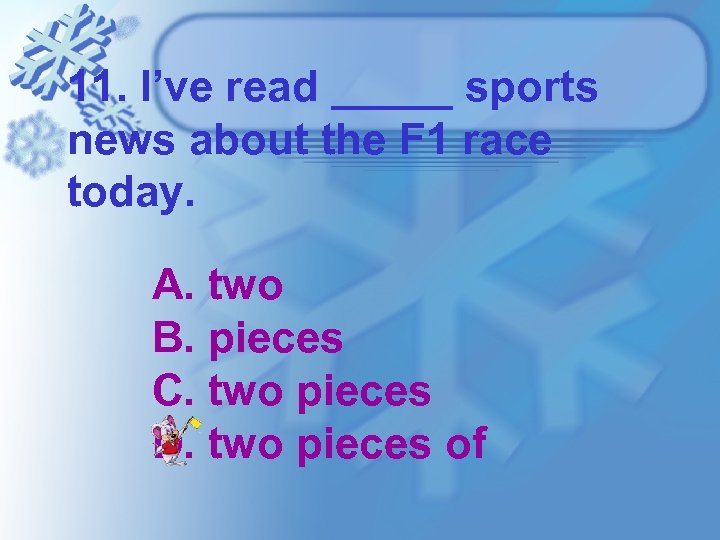
11. I’ve read _____ sports news about the F 1 race today. A. two B. pieces C. two pieces D. two pieces of
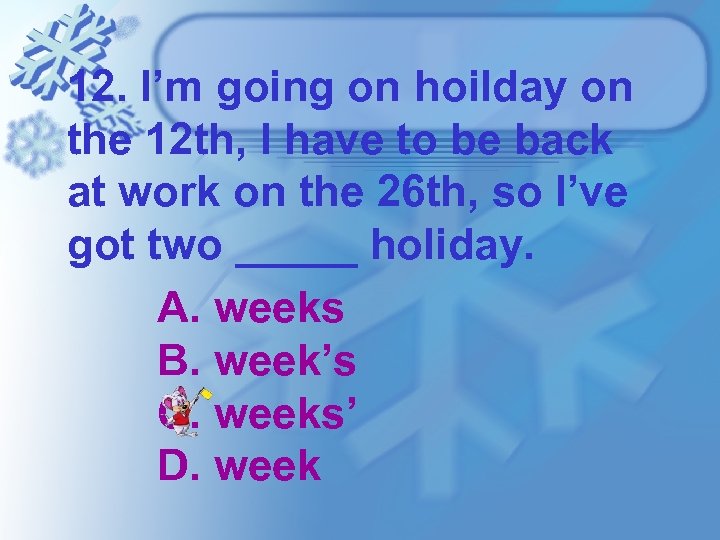
12. I’m going on hoilday on the 12 th, I have to be back at work on the 26 th, so I’ve got two _____ holiday. A. weeks B. week’s C. weeks’ D. week
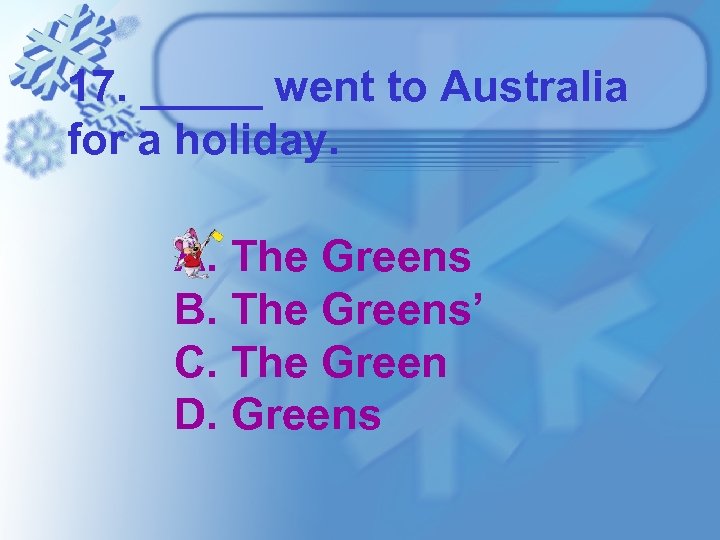
17. _____ went to Australia for a holiday. A. The Greens B. The Greens’ C. The Green D. Greens
23. 选出与句中画线部分意思 相同或相近的选项。 The Smiths are watching the men’s table tennis match after dinner. A. Mr Smith B. The Smith C. Smiths D. The Smith family
25. Please give me two _____ milk. A. glass B. glass of C. glasses D. glasses of
28. How many _____ are there in the international village? A. Chinese B. Russian C. American
31. Bob couldn’t buy the dictionary because he had _____ money with him. A. a few B. few C. a little D. little
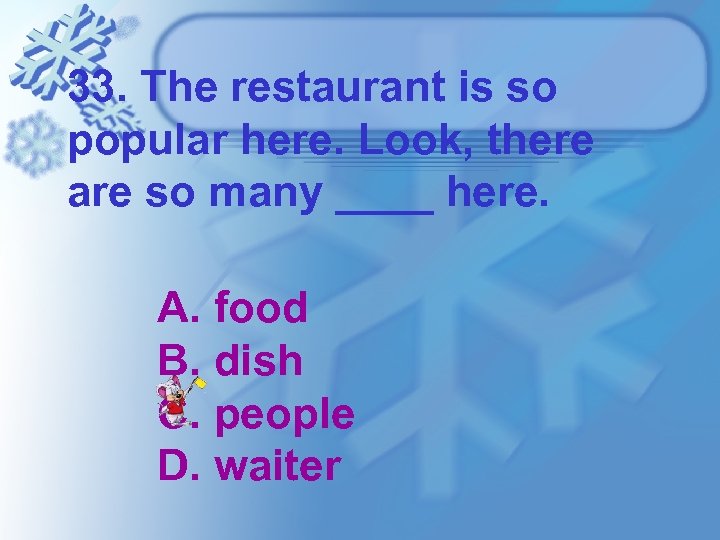
33. The restaurant is so popular here. Look, there are so many ____ here. A. food B. dish C. people D. waiter
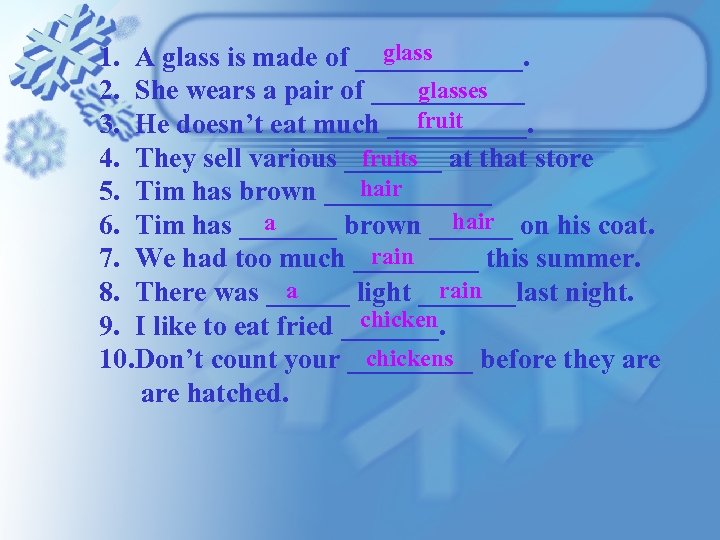
glass 1. A glass is made of ______. glasses 2. She wears a pair of ______ fruit 3. He doesn’t eat much _____. fruits 4. They sell various _______ at that store hair 5. Tim has brown ______ hair a 6. Tim has _______ brown ______ on his coat. rain 7. We had too much _____ this summer. a rain 8. There was ______ light _______last night. chicken 9. I like to eat fried _______. chickens 10. Don’t count your _____ before they are hatched.
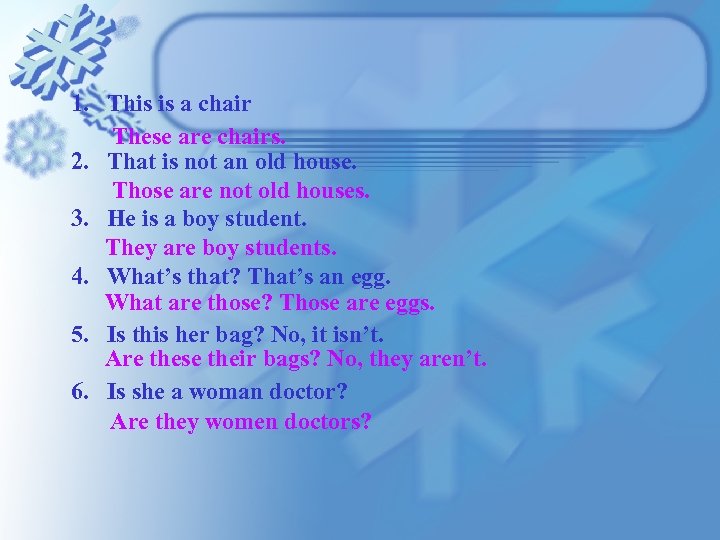
1. This is a chair These are chairs. 2. That is not an old house. Those are not old houses. 3. He is a boy student. They are boy students. 4. What’s that? That’s an egg. What are those? Those are eggs. 5. Is this her bag? No, it isn’t. Are these their bags? No, they aren’t. 6. Is she a woman doctor? Are they women doctors?
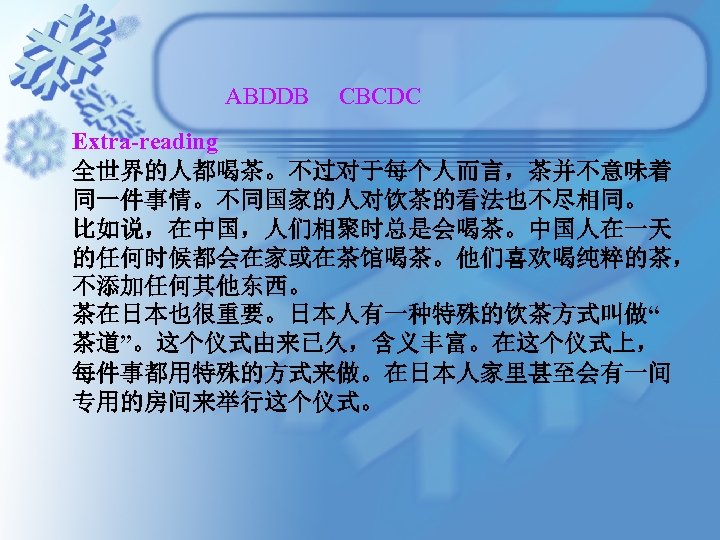
ABDDB CBCDC Extra-reading 全世界的人都喝茶。不过对于每个人而言,茶并不意味着 同一件事情。不同国家的人对饮茶的看法也不尽相同。 比如说,在中国,人们相聚时总是会喝茶。中国人在一天 的任何时候都会在家或在茶馆喝茶。他们喜欢喝纯粹的茶, 不添加任何其他东西。 茶在日本也很重要。日本人有一种特殊的饮茶方式叫做“ 茶道”。这个仪式由来已久,含义丰富。在这个仪式上, 每件事都用特殊的方式来做。在日本人家里甚至会有一间 专用的房间来举行这个仪式。
另一个饮茶的国家是英国。在英国,下午的晚些时候 是下午茶时间。在那时,几乎每个人都会喝一杯茶。 英国人通常是把茶放在茶壶里,喝时加奶,加糖。 在喝下午茶的时候,他们吃些蛋糕,饼干和小三明治。 在美国,人们往往在早餐时或饭后喝茶。美国人通常 用袋泡茶。袋泡茶比用茶壶泡茶更快,更简单。在夏 天,很多美国喝冷的茶-冰茶。有时候他们喝罐装冰茶, 象苏打水。 CABDDC
I. AABBBA II. 1. 2. 3. 4. 5. 6. These are , stories. We, some knives are some tomatoes, basket(s) That child is man has, a This cup, tea is mine. III. Chinese, sheep, teeth, tomatoes, leaves, car IV. BDADB V. five, thirty, having, supper, three knives, Help, yourself, Thank, you
Скачать презентацию English Grammar 2 1名词的分类 名词可以分为专有名词 Proper Nouns 和普通名词 Common
b44ac779ffe79ce42cdd65e9e2d84d82.ppt