


 Скачать презентацию English country architecture The architecture of
English country architecture.pptx
- Количество слайдов: 9
 English country architecture
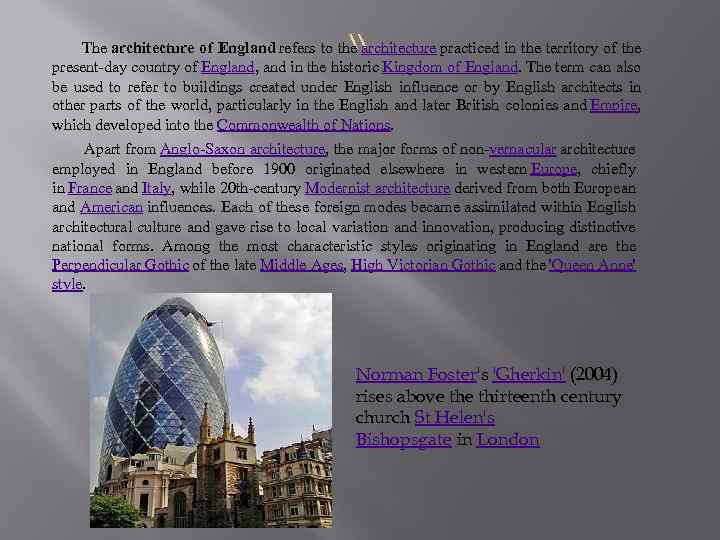 \ The architecture of England refers to the architecture practiced in the territory of the present-day country of England, and in the historic Kingdom of England. The term can also be used to refer to buildings created under English influence or by English architects in other parts of the world, particularly in the English and later British colonies and Empire, which developed into the Commonwealth of Nations. Apart from Anglo-Saxon architecture, the major forms of non-vernacular architecture employed in England before 1900 originated elsewhere in western Europe, chiefly in France and Italy, while 20 th-century Modernist architecture derived from both European and American influences. Each of these foreign modes became assimilated within English architectural culture and gave rise to local variation and innovation, producing distinctive national forms. Among the most characteristic styles originating in England are the Perpendicular Gothic of the late Middle Ages, High Victorian Gothic and the 'Queen Anne' style. Norman Foster's 'Gherkin' (2004) rises above thirteenth century church St Helen's Bishopsgate in London
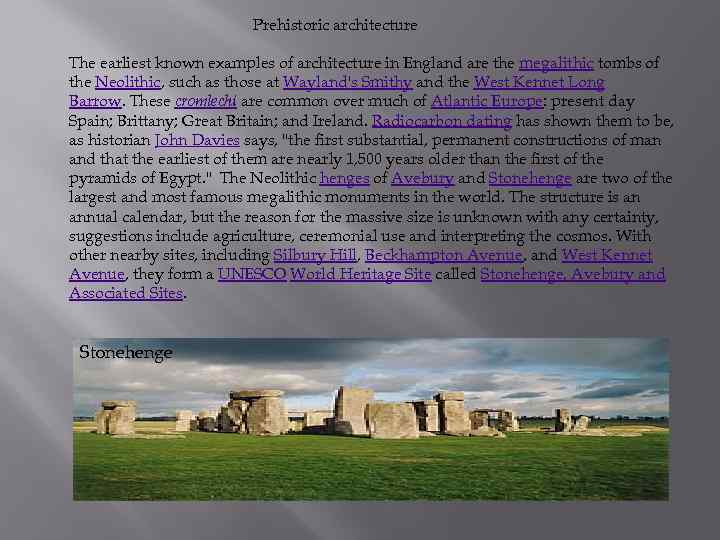 Prehistoric architecture The earliest known examples of architecture in England are the megalithic tombs of the Neolithic, such as those at Wayland's Smithy and the West Kennet Long Barrow. These cromlechi are common over much of Atlantic Europe: present day Spain; Brittany; Great Britain; and Ireland. Radiocarbon dating has shown them to be, as historian John Davies says, "the first substantial, permanent constructions of man and that the earliest of them are nearly 1, 500 years older than the first of the pyramids of Egypt. " The Neolithic henges of Avebury and Stonehenge are two of the largest and most famous megalithic monuments in the world. The structure is an annual calendar, but the reason for the massive size is unknown with any certainty, suggestions include agriculture, ceremonial use and interpreting the cosmos. With other nearby sites, including Silbury Hill, Beckhampton Avenue, and West Kennet Avenue, they form a UNESCO World Heritage Site called Stonehenge, Avebury and Associated Sites. Stonehenge
 Anglo-Saxon architecture Architecture of the Anglo-Saxon period exists only in the form of churches, the only structures commonly built in stone apart from fortifications. The earliest examples date from the 7 th century, notably at. Bradwell-on-Sea and Escomb, but the majority from the 10 th and 11 th centuries. Due to the systematic destruction and replacement of English cathedrals and monasteries by the Normans, no major Anglo-Saxon churches survive; the largest extant example is at Brixworth The main material is ashlar masonry, sometimes accompanied by details in reused Roman brick. Anglo-Saxon churches are typically high and narrow and consist of a nave and a narrower chancel; these are often accompanied by a west tower. Some feature porticus (projecting chambers) to the west or to the north and south, creating a cruciform plan. The commonest form of external decoration is lesene strips (thin vertical or horizontal strips of projecting stone), typically combined with blind arcading. Notable examples of this exist at Earls Barton, Bradford-on. Avon and Barton-upon-Humber. All Saints' Church, Earls Barton
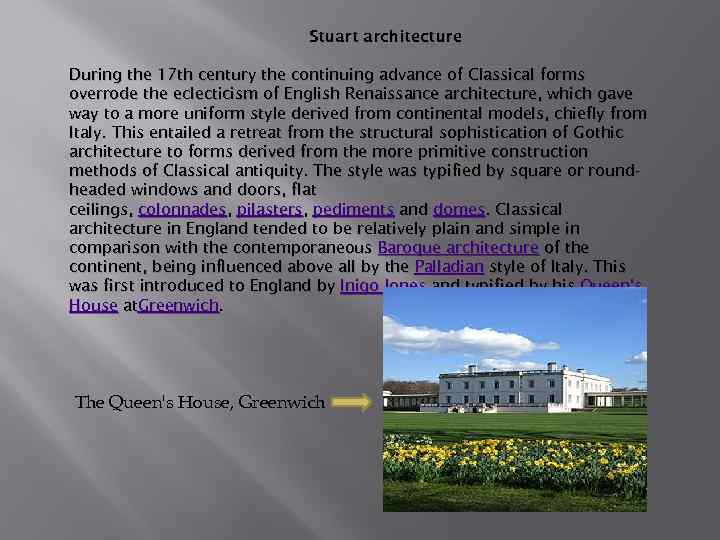 Stuart architecture During the 17 th century the continuing advance of Classical forms overrode the eclecticism of English Renaissance architecture, which gave way to a more uniform style derived from continental models, chiefly from Italy. This entailed a retreat from the structural sophistication of Gothic architecture to forms derived from the more primitive construction methods of Classical antiquity. The style was typified by square or roundheaded windows and doors, flat ceilings, colonnades, pilasters, pediments and domes. Classical architecture in England tended to be relatively plain and simple in comparison with the contemporaneous Baroque architecture of the continent, being influenced above all by the Palladian style of Italy. This was first introduced to England by Inigo Jones and typified by his Queen's House at. Greenwich. The Queen's House, Greenwich
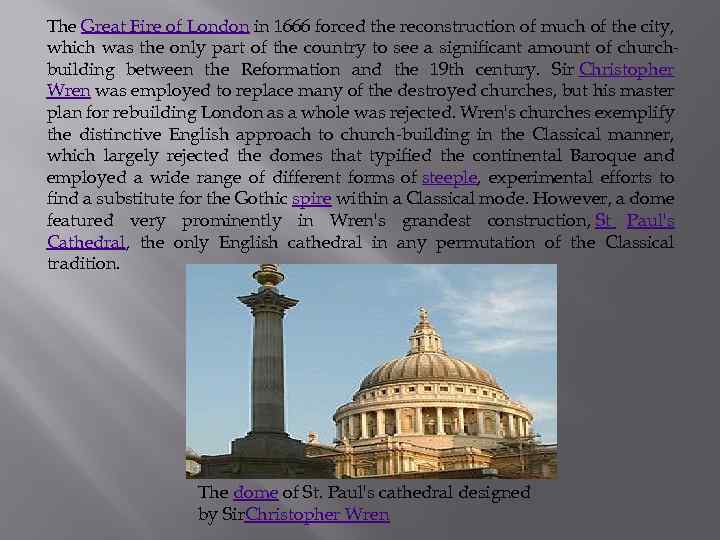 The Great Fire of London in 1666 forced the reconstruction of much of the city, which was the only part of the country to see a significant amount of churchbuilding between the Reformation and the 19 th century. Sir Christopher Wren was employed to replace many of the destroyed churches, but his master plan for rebuilding London as a whole was rejected. Wren's churches exemplify the distinctive English approach to church-building in the Classical manner, which largely rejected the domes that typified the continental Baroque and employed a wide range of different forms of steeple, experimental efforts to find a substitute for the Gothic spire within a Classical mode. However, a dome featured very prominently in Wren's grandest construction, St Paul's Cathedral, the only English cathedral in any permutation of the Classical tradition. The dome of St. Paul's cathedral designed by Sir. Christopher Wren
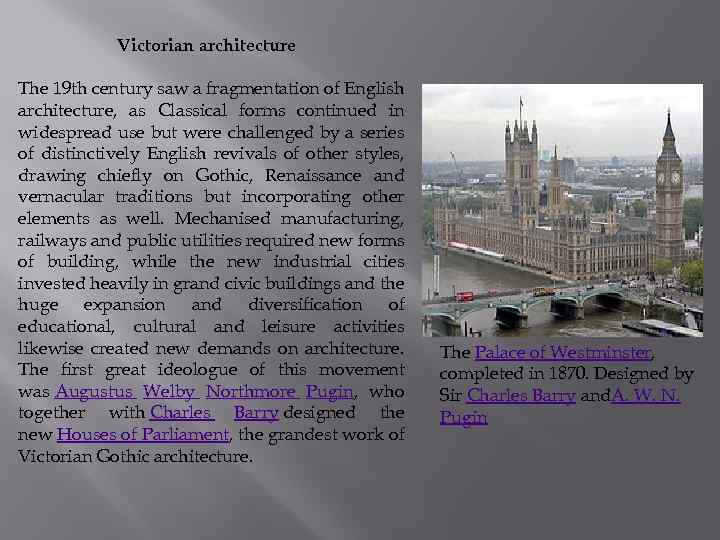 Victorian architecture The 19 th century saw a fragmentation of English architecture, as Classical forms continued in widespread use but were challenged by a series of distinctively English revivals of other styles, drawing chiefly on Gothic, Renaissance and vernacular traditions but incorporating other elements as well. Mechanised manufacturing, railways and public utilities required new forms of building, while the new industrial cities invested heavily in grand civic buildings and the huge expansion and diversification of educational, cultural and leisure activities likewise created new demands on architecture. The first great ideologue of this movement was Augustus Welby Northmore Pugin, who together with Charles Barry designed the new Houses of Parliament, the grandest work of Victorian Gothic architecture. The Palace of Westminster, completed in 1870. Designed by Sir Charles Barry and. A. W. N. Pugin
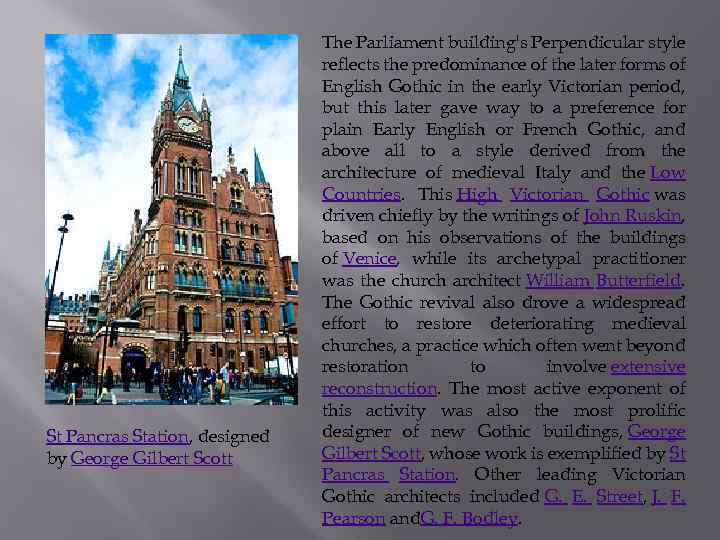 St Pancras Station, designed by George Gilbert Scott The Parliament building's Perpendicular style reflects the predominance of the later forms of English Gothic in the early Victorian period, but this later gave way to a preference for plain Early English or French Gothic, and above all to a style derived from the architecture of medieval Italy and the Low Countries. This High Victorian Gothic was driven chiefly by the writings of John Ruskin, based on his observations of the buildings of Venice, while its archetypal practitioner was the church architect William Butterfield. The Gothic revival also drove a widespread effort to restore deteriorating medieval churches, a practice which often went beyond restoration to involve extensive reconstruction. The most active exponent of this activity was also the most prolific designer of new Gothic buildings, George Gilbert Scott, whose work is exemplified by St Pancras Station. Other leading Victorian Gothic architects included G. E. Street, J. F. Pearson and. G. F. Bodley.
 Historical styles in the 20 th century The last great exponent of late Victorian free Renaissance eclecticism was Edwin Lutyens, and his shift into the Classical mode after 1900 symbolised a wider retreat from the stylistic ferment of the 19 th century to a plain and homogenous Classicism based on Georgian exemplars, an approach followed by many architects of the early 20 th century, notably Herbert Baker and Reginald Blomfield. This Neo-Georgian manner, while not greatly favoured in later decades by the architectural profession or architecture critics, has remained popular with clients and conservative commentators, notably Charles, Prince of Wales. Domestic architecture throughout the 20 th century and beyond has continued to be strongly influenced by a homogenised version of Victorian vernacular revival styles. Some architects responded to modernism, and economic circumstances, by producing stripped down versions of traditional styles; the work of Giles Gilbert Scottillustrates this well.