


 Скачать презентацию English 1 Common English Запоминать слова нужно
1 занятие.pptx
- Количество слайдов: 33
 English 1 Common English
 Запоминать слова нужно в составе фразы. На вопрос What is your name? Вы ведь не задумываясь ответите: My name is _____ а если спросят Where are You from? то сразу гордо пульнете: I'm from Russia! ну а если, в очередной раз спросят What do you know about London? вы как молния блеснете энциклопедическими знаниями: London is the capital of Great Britain.
 Еще аргумент в пользу освоения целых фраз: Зависимость от контекста. Связь, как мы знаем из рекламы NOKIA, будет - connection. Но в нашем случае это знание бесполезно. Т. к. в нашем случае нужно использовать слово - relation - которое тоже означает связь, но не в смысле соединения проводами, а в смысле взаимодействия, взаимоотношения. Другой пример: Решать - decide, но решать проблему solve проблему. It’s rather difficult to decide between these two films The judge decided for the prisoner The voters decided on Barack Obama Relax, darling. Our problem is soon to be solved.
 И еще один аргумент в пользу освоения целых фраз: Фразовые глаголы. В общем, интуитивно понятные преобразования смыслов, но иногда настолько удивительные смены, что диву даешься. Примеры: set - устанавливать, но set off - отправляться (например в путь) We’re going to set off for Europe next summer. put - класть, но put out – тратить, вытягивать, (и внезапно) тушить I can't put out that much money each month. keep - держать, хранить, но keep on - продолжать (делать что делал) Keep on with your work, however hard it seems to be. hang - вешать, подвешивать, но hang around - бездельничать, слоняться Anzhella and Salvador usually hang around the beach after dinner. get - получить, но get through - пройти через что-то, в смысле – пережить It's hard to get through to Tuzikov because his telephone line is always busy.
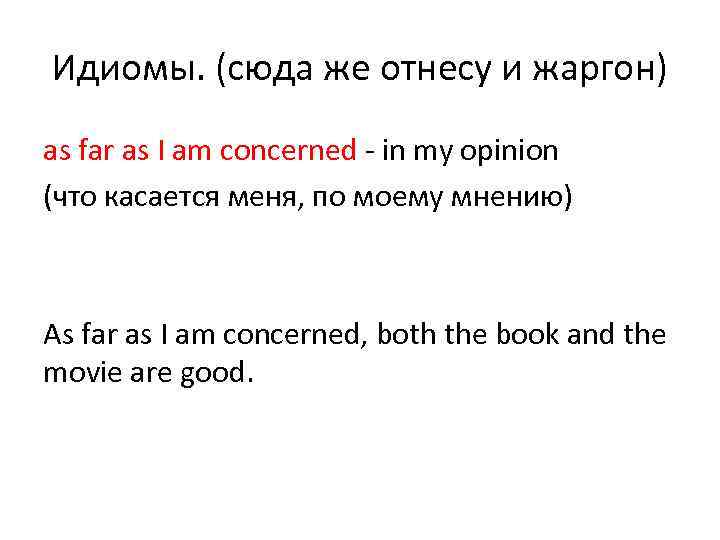 Идиомы. (сюда же отнесу и жаргон) as far as I am concerned - in my opinion (что касается меня, по моему мнению) As far as I am concerned, both the book and the movie are good.
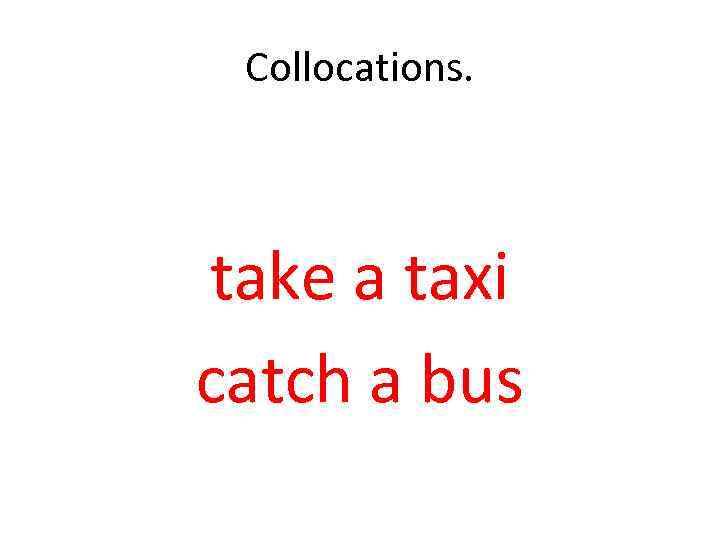 Collocations. take a taxi catch a bus
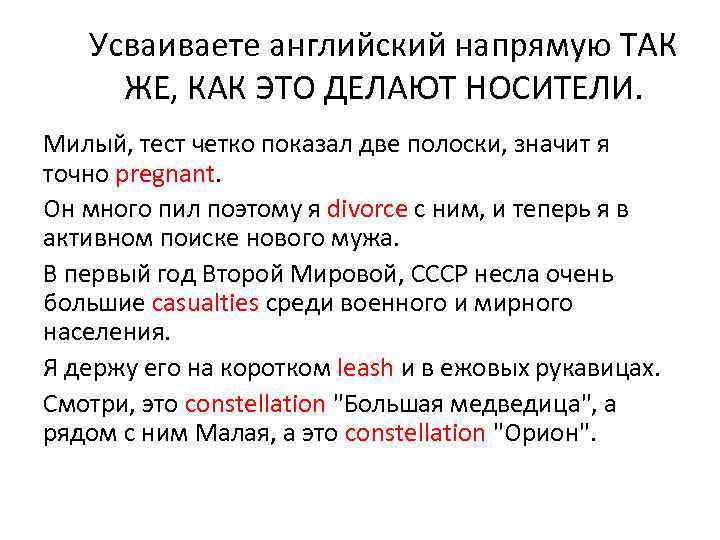 Усваиваете английский напрямую ТАК ЖЕ, КАК ЭТО ДЕЛАЮТ НОСИТЕЛИ. Милый, тест четко показал две полоски, значит я точно pregnant. Он много пил поэтому я divorce с ним, и теперь я в активном поиске нового мужа. В первый год Второй Мировой, СССР несла очень большие casualties среди военного и мирного населения. Я держу его на коротком leash и в ежовых рукавицах. Смотри, это constellation "Большая медведица", а рядом с ним Малая, а это constellation "Орион".
 TO BE OR NOT TO BE http: //www. youtube. com/watch? v=Kn. Hx. OWZ_b 9 U
 Reading http: //www. youtube. com/watch? v=A-1 v. LTVxa 20
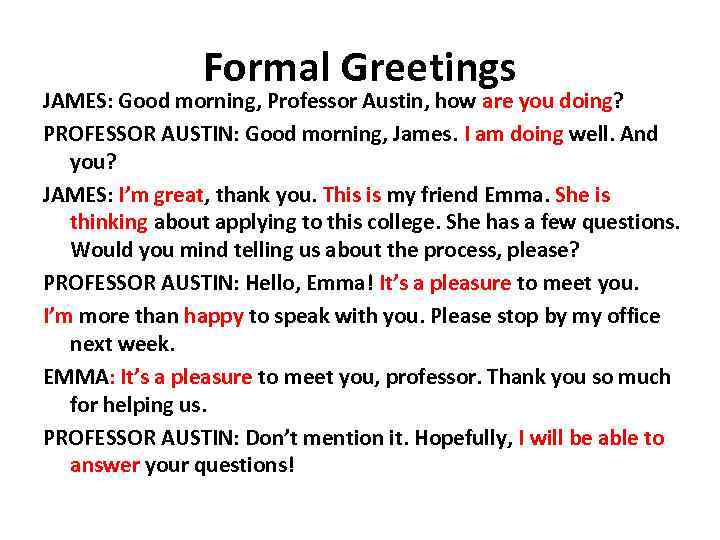 Formal Greetings JAMES: Good morning, Professor Austin, how are you doing? PROFESSOR AUSTIN: Good morning, James. I am doing well. And you? JAMES: I’m great, thank you. This is my friend Emma. She is thinking about applying to this college. She has a few questions. Would you mind telling us about the process, please? PROFESSOR AUSTIN: Hello, Emma! It’s a pleasure to meet you. I’m more than happy to speak with you. Please stop by my office next week. EMMA: It’s a pleasure to meet you, professor. Thank you so much for helping us. PROFESSOR AUSTIN: Don’t mention it. Hopefully, I will be able to answer your questions!
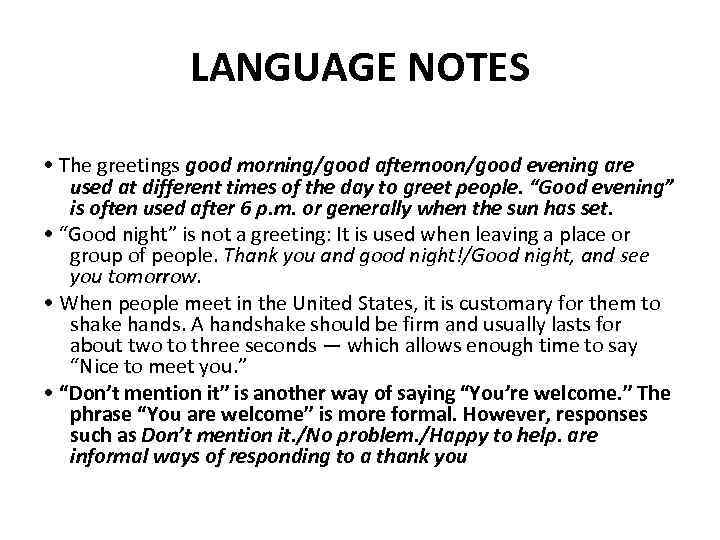 LANGUAGE NOTES • The greetings good morning/good afternoon/good evening are used at different times of the day to greet people. “Good evening” is often used after 6 p. m. or generally when the sun has set. • “Good night” is not a greeting: It is used when leaving a place or group of people. Thank you and good night!/Good night, and see you tomorrow. • When people meet in the United States, it is customary for them to shake hands. A handshake should be firm and usually lasts for about two to three seconds — which allows enough time to say “Nice to meet you. ” • “Don’t mention it” is another way of saying “You’re welcome. ” The phrase “You are welcome” is more formal. However, responses such as Don’t mention it. /No problem. /Happy to help. are informal ways of responding to a thank you
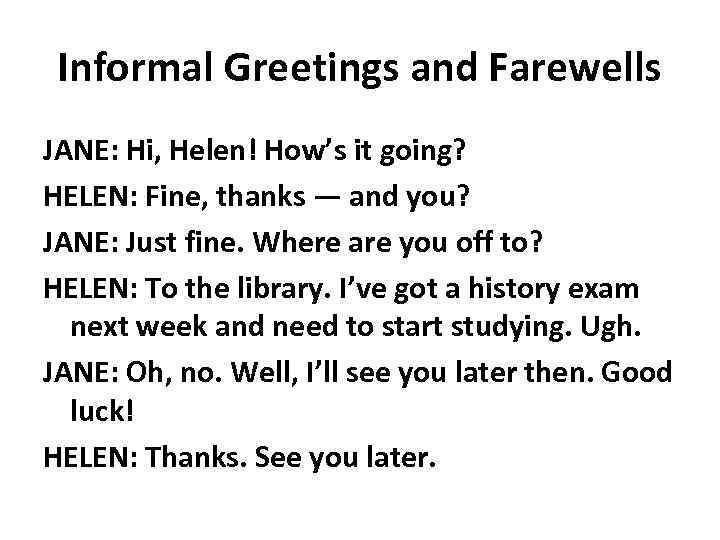 Informal Greetings and Farewells JANE: Hi, Helen! How’s it going? HELEN: Fine, thanks — and you? JANE: Just fine. Where are you off to? HELEN: To the library. I’ve got a history exam next week and need to start studying. Ugh. JANE: Oh, no. Well, I’ll see you later then. Good luck! HELEN: Thanks. See you later.
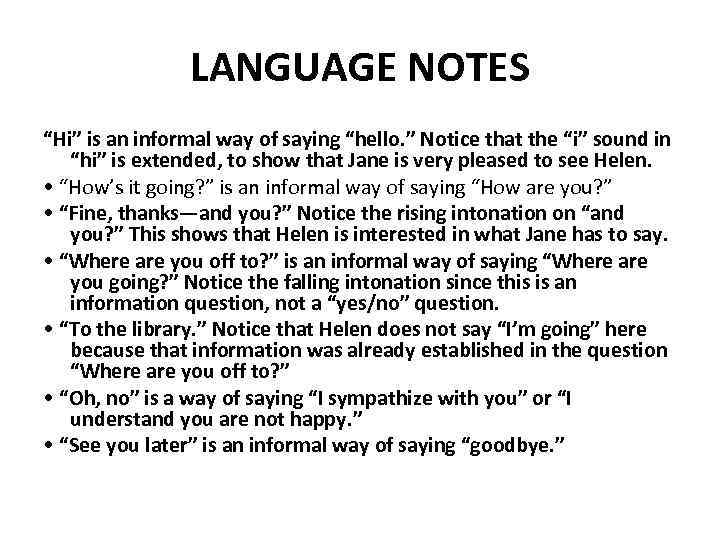 LANGUAGE NOTES “Hi” is an informal way of saying “hello. ” Notice that the “i” sound in “hi” is extended, to show that Jane is very pleased to see Helen. • “How’s it going? ” is an informal way of saying “How are you? ” • “Fine, thanks—and you? ” Notice the rising intonation on “and you? ” This shows that Helen is interested in what Jane has to say. • “Where are you off to? ” is an informal way of saying “Where are you going? ” Notice the falling intonation since this is an information question, not a “yes/no” question. • “To the library. ” Notice that Helen does not say “I’m going” here because that information was already established in the question “Where are you off to? ” • “Oh, no” is a way of saying “I sympathize with you” or “I understand you are not happy. ” • “See you later” is an informal way of saying “goodbye. ”
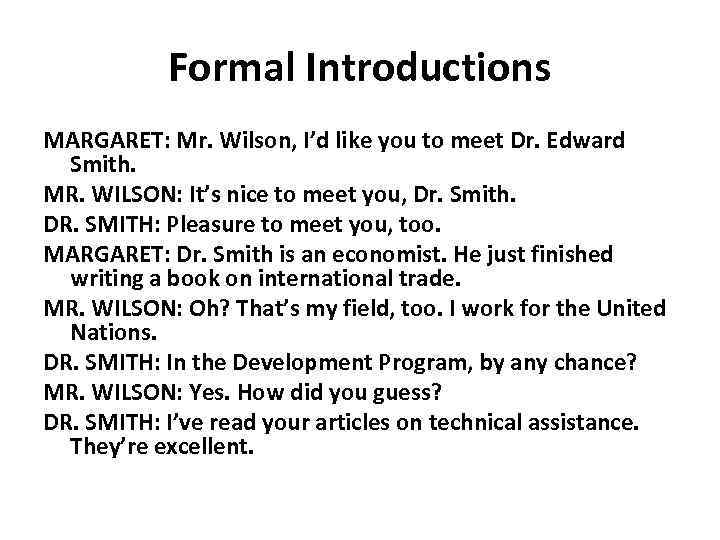 Formal Introductions MARGARET: Mr. Wilson, I’d like you to meet Dr. Edward Smith. MR. WILSON: It’s nice to meet you, Dr. Smith. DR. SMITH: Pleasure to meet you, too. MARGARET: Dr. Smith is an economist. He just finished writing a book on international trade. MR. WILSON: Oh? That’s my field, too. I work for the United Nations. DR. SMITH: In the Development Program, by any chance? MR. WILSON: Yes. How did you guess? DR. SMITH: I’ve read your articles on technical assistance. They’re excellent.
 LANGUAGE NOTES Mr. Wilson, I’d like you … Notice the rising intonation on “Mr. Wilson, ” which is used to address someone. Listen for the “d” in “I’d like. ” This means I would like, which is very different from I like. (“I’d like” means the same as “I would like” or “I want. ”) • Dr. Smith is an economist. Notice the stress on “economist. ” This content word has new information, so it is emphasized. There are four syllables in “economist, ” with the stress on the second syllable (e-CON-o-mist). • He just finished writing … “just” means the very recent past. “Just” is usually used with a simple past verb because the action is complete. However, it can also be used with the present perfect (He’s just finished writing …). • Development program. Since these two words make a compound noun, the main stress falls on “development. ” • By any chance? Means the same as “possibly. ” Notice the rising intonation, which is used in yes/no questions to confirm that something is true.
 Informal Introductions JIM: Who’s the tall woman next to Barbara? CHARLES: That’s her friend Mary. Didn’t you meet her at Steve’s party? JIM: No, I wasn’t at Steve’s party. CHARLES: Oh! Then let me introduce you to her now. Mary, this is my friend Jim. MARY: Hi, Jim. Nice to meet you. JIM: You, too. Would you like a drink? MARY: Sure, let’s go get one.
 LANGUAGE NOTES “Who’s” is the contracted form of who is. It is pronounced the same way as “whose” (/huwz/), but the meaning is different. • Didn’t you meet her …? Notice that this is a negative question. Charles thought that Jim had met Mary before. He is now surprised that Jim does not know Mary, and so he uses a negative question to show his surprise. • I wasn’t at Steve’s party. Notice that the emphasis here is on “at” although prepositions normally have weak stress. In this case, “at” means “there” (I wasn’t there). • Mary, this is my friend Jim. This is a friendly way to introduce two people. It’s common to follow this with “Jim, this is Mary. ” In this case, Mary says “Hi, Jim” first. • Nice to meet you. This is a typical response after you’ve been introduced to someone. • “Sure” is often used in informal conversation to mean “yes. ”
 Conversation Skills http: //www. youtube. com/watch? v=MBb. Aj. Or. M QB 8&list=PLp. LRk 365 gb. Pb 1 Tn. ZNv. DIu. XP 3 t. De. Ic u 8 k. B&index=4 conversation has died shy embarrass native
 Test If you do not know a word that someone has said, you should ask what it means. true false
 You can learn new vocabulary by talking to people. true false
 Some people are stupid, so you should be careful who you learn from. true false
 _______ does that mean? What's What How When So
 _____ do you say. . . ? What's What How Whaa Hop
 If you forget a word in English, you should try to guess it. true false
 English speakers forget words, too. true false
 "What's XXXXXXX? " and "What does XXXX mean? " are questions that have basically the same meaning. true false
 If you forget a word in the middle of a conversation, you should: try to describe the word so that the listener can help you make up a new word look down and stop talking go home run look it up on the internet
 You can still continue a conversation even if you do not know an English word. true false
 Shape of My Heart
 And if I told you that I loved you You'd maybe think there's something wrong Если бы я сказал, что люблю, Ты б подумала, что-то неладно. Вот эта маленькая буковка d (сокращение от would), прилепившаяся к you, и означает «бы» .
 Данный шедевр изобилует настоящим временем. Такая подача помогает ярче нарисовать в воображении картину жизни нашего игрока (хоть там уже присутствуют готовые кадры из фильма). Вот посмотрите, во всех примерах глагол стоит в настоящем времени: He deals (сдает) the cards And those he plays (играет) never suspect He doesn't play for respect (не играет) I know (знаю) that the spades are the swords of a soldier The mask I wear (ношу) is (является) one While the memory of it fades (скрывает, тает) Diamonds mean (значат) money for this art

 Freinds http: //fenglish. ru/serial-friends-druzya-naanglijskom-yazyke-s-subtitrami/