


 Скачать презентацию Engineering Systems for Emergency Preparedness Class 4 Systems
ec5ad1066c8d647515625878db80139b.ppt
- Количество слайдов: 25
 Engineering Systems for Emergency Preparedness Class 4: Systems and Services 04/09/2015 Jon Gabay Presented by:
 Today we will look at Individual systems we can design or buy for Life support and heat, water, electricity, refrigeration, cooking, and more. Evaluating your needs. Examples of some manufactured and repurposed systems we can use in a pinch. Examples of improvised systems that work. Industry solutions and assorted products. Next generation needs and requirements. How con artists have embraced the concept of emergency preparedness. Presented by: 2
 A view from the top Our federal government has several agencies that are there to protect us, inform us, and help us help ourselves. Homeland Security - http: //www. ready. gov/ CDC - http: //emergency. cdc. gov/ Red Cross - http: //www. redcross. org/what-we-do/international-services/disaster-preparedness FEMA - http: //www. fema. gov/ In addition, states have their own systems and services. Some examples are: Washington DC - http: //dc. gov/page/emergency-preparedness Hawaii - http: //www. scd. hawaii. gov/preparedness. html California - http: //www. calema. ca. gov/Pages/default. aspx Delaware - http: //dema. delaware. gov/services/disaster_prep. shtml But – It is up to us to be prepared and survive until help comes, -- if it comes. Presented by: 3
 Know in Advance With warning comes the opportunity to prepare. Often times, advanced warning will take place while systems are operational. Be aware and alert. After an incident or disaster, the systems we count on may go down. This is when : • Knowing who to contact • Knowing alternate ways to contact them • What to expect • What timeframe to expect it in is good information to have going into a situation. Be Prepared. It’s that simple. Communications systems are key. Apps can let you know as soon as possible if dangers exist. But, you can’t count on cellular, POTS, or internet based communications when things get bad. Presented by: 4
 Civil Response Since 9/11 and hurricane Katrina, FCC has been bolstering its infrastructure to try and make it more interoperability and reliability in the wake of disasters. This is primarily for responders. But what about citizen alerting? Older established techniques used to be effective. The Emergency Broadcasts Systems (EBS) and Emergency Alert System (AES) could interrupt all broadcasts in real time and let citizens know critical information. With digital media, streaming, stored content, and entertainment systems in use constantly, very few are connected to a common citizen alerting system. Instead, social media is the new civil response with ISPs in between. The emergency sirens and civil defense infrastructure and citizen awareness are a thing of the past. Do you know where a fallout shelter is? Presented by: 5
 Two Way Communications The type and magnitude of a disaster will determine the level of communications possible locally and long distance. Self contained radio transceivers may be the only way to effectively communicate in a prolonged and severe emergency. • Most legacy style two way radios, HT’s, and self contained transceivers have dwindled since cellular phones were introduced. • In the past, Ham radio operators were the only non law enforcement or military groups able to have constant connectivity from a self contained radio link that could link to a public communications infrastructure like the telephone network. • While ham radio still exists, interest and popularity are waning since modern smart phones, tablets, and computers can do so much wirelessly. • Most people will not become licensed ham radio operators but there may be one in your neighborhood and community. A low cost alternative could be a Citizen’s Band (CB) radio. While the number of manufacturers and products are less than in yesteryears, they are still available at fairly low cost, and easy to use. Engineering these systems for homeowner emergency preparedness is an untapped market. Presented by: 6
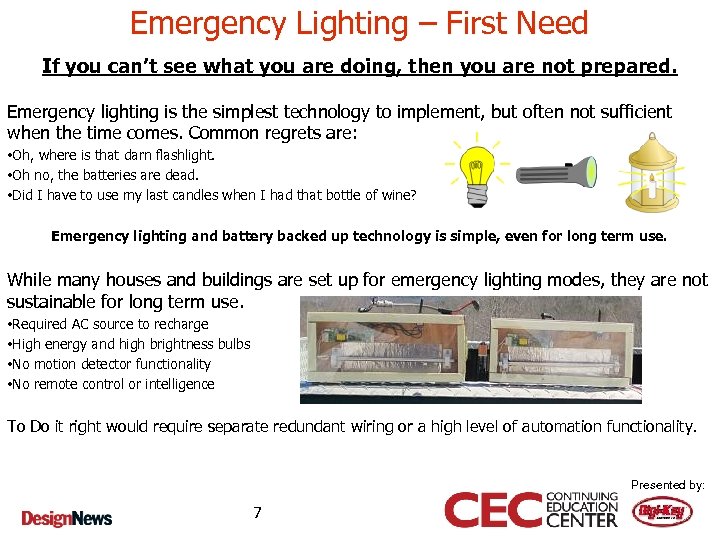 Emergency Lighting – First Need If you can’t see what you are doing, then you are not prepared. Emergency lighting is the simplest technology to implement, but often not sufficient when the time comes. Common regrets are: • Oh, where is that darn flashlight. • Oh no, the batteries are dead. • Did I have to use my last candles when I had that bottle of wine? Emergency lighting and battery backed up technology is simple, even for long term use. While many houses and buildings are set up for emergency lighting modes, they are not sustainable for long term use. • Required AC source to recharge • High energy and high brightness bulbs • No motion detector functionality • No remote control or intelligence To Do it right would require separate redundant wiring or a high level of automation functionality. Presented by: 7
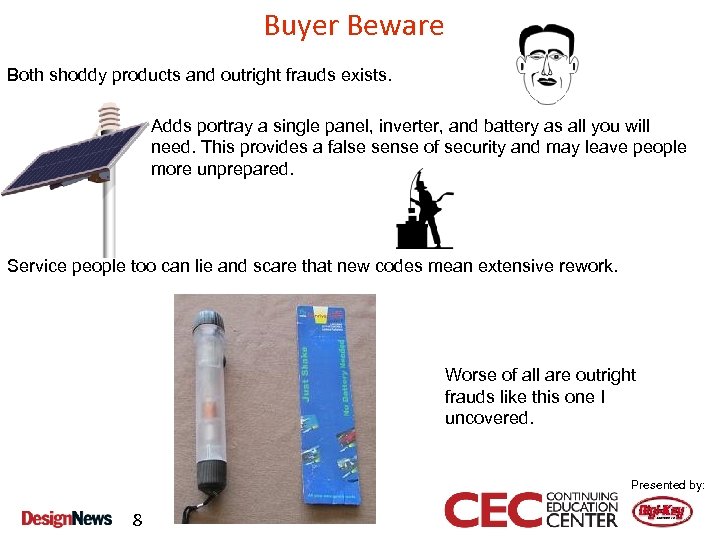 Buyer Beware Both shoddy products and outright frauds exists. Adds portray a single panel, inverter, and battery as all you will need. This provides a false sense of security and may leave people more unprepared. Service people too can lie and scare that new codes mean extensive rework. Worse of all are outright frauds like this one I uncovered. Presented by: 8
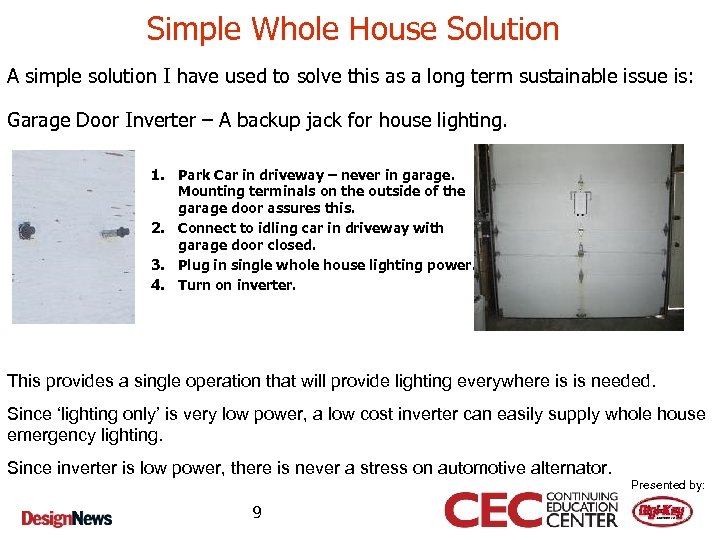 Simple Whole House Solution A simple solution I have used to solve this as a long term sustainable issue is: Garage Door Inverter – A backup jack for house lighting. 1. Park Car in driveway – never in garage. Mounting terminals on the outside of the garage door assures this. 2. Connect to idling car in driveway with garage door closed. 3. Plug in single whole house lighting power. 4. Turn on inverter. This provides a single operation that will provide lighting everywhere is is needed. Since ‘lighting only’ is very low power, a low cost inverter can easily supply whole house emergency lighting. Since inverter is low power, there is never a stress on automotive alternator. Presented by: 9
 But not yet engineered for emergency preparedness Many standard off the shelf inverters are advertised for use in emergencies but are not really well enough engineered for the average person in an emergency situation. Features to include and design in are : • Under-Over voltage-current safeties (most have) • Circuit Breaker protections (most have) • Temperature protections (most have) • Simple fault free user interface (some have) • Polarity protections • Soft Start Functionality • Inductive Load Matching • Phase angle control • Embedded Intelligence Presented by: 10
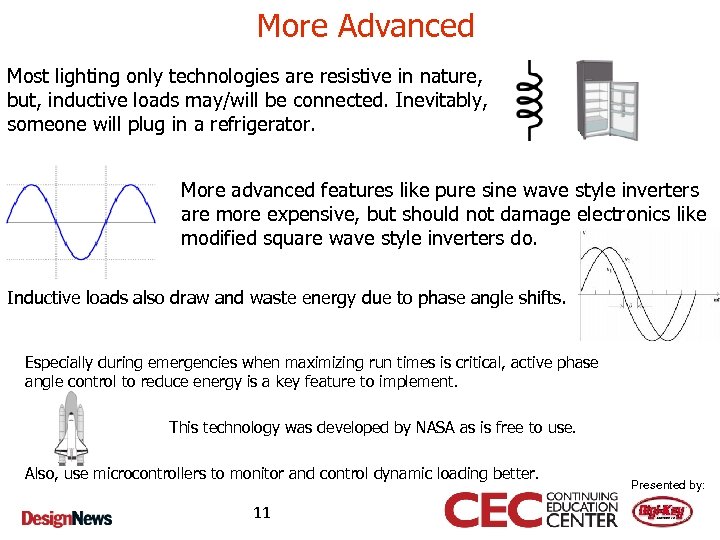 More Advanced Most lighting only technologies are resistive in nature, but, inductive loads may/will be connected. Inevitably, someone will plug in a refrigerator. More advanced features like pure sine wave style inverters are more expensive, but should not damage electronics like modified square wave style inverters do. Inductive loads also draw and waste energy due to phase angle shifts. Especially during emergencies when maximizing run times is critical, active phase angle control to reduce energy is a key feature to implement. This technology was developed by NASA as is free to use. Also, use microcontrollers to monitor and control dynamic loading better. 11 Presented by:
 Local Controller Connectivity Next generation emergency preparedness systems should take advantage of modern day connectivity and trends. Modern communications is basically free. Everyone has Wi. Fi and Bluetooth on their phones and tablets locally. Manufacturers can save cost by reducing a user interfaces on devices and allowing directly tethered point to point (or broadcast) to smart phones to alert of statuses. This is not only an idea for inverters. Generators, heaters, battery banks, UPS’s, charger stations, water systems, and communications hubs can all use modern connectivity to keep us better informed and in control locally and on site during emergencies. Even if there are no data services or ISPs, as long as you can recharge a phone (car, solar, inverter), it can serve as the facility controller. Would make a great app. Presented by: 12
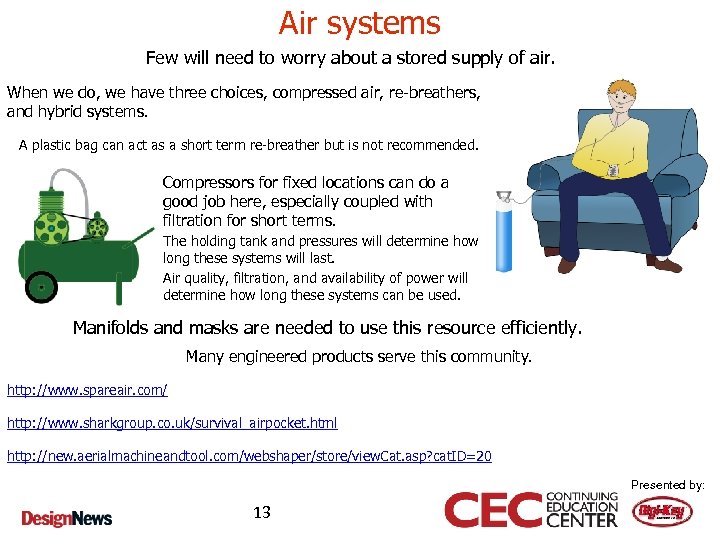 Air systems Few will need to worry about a stored supply of air. When we do, we have three choices, compressed air, re-breathers, and hybrid systems. A plastic bag can act as a short term re-breather but is not recommended. Compressors for fixed locations can do a good job here, especially coupled with filtration for short terms. The holding tank and pressures will determine how long these systems will last. Air quality, filtration, and availability of power will determine how long these systems can be used. Manifolds and masks are needed to use this resource efficiently. Many engineered products serve this community. http: //www. spareair. com/ http: //www. sharkgroup. co. uk/survival_airpocket. html http: //new. aerialmachineandtool. com/webshaper/store/view. Cat. asp? cat. ID=20 Presented by: 13
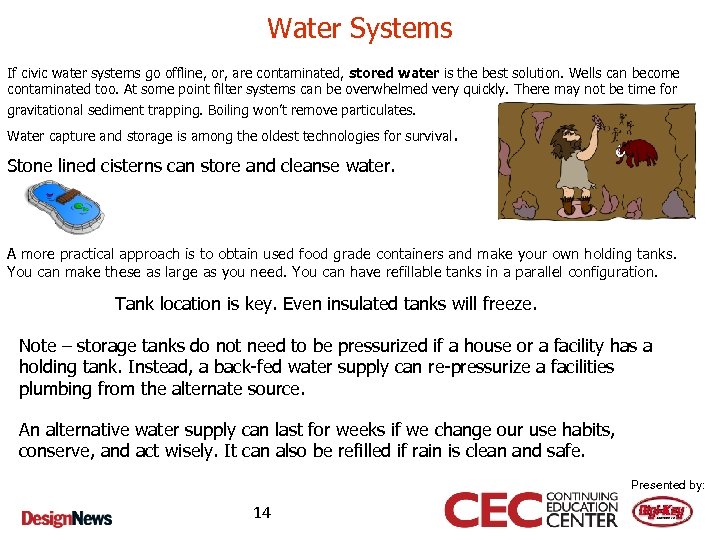 Water Systems If civic water systems go offline, or, are contaminated, stored water is the best solution. Wells can become contaminated too. At some point filter systems can be overwhelmed very quickly. There may not be time for gravitational sediment trapping. Boiling won’t remove particulates. Water capture and storage is among the oldest technologies for survival. Stone lined cisterns can store and cleanse water. A more practical approach is to obtain used food grade containers and make your own holding tanks. You can make these as large as you need. You can have refillable tanks in a parallel configuration. Tank location is key. Even insulated tanks will freeze. Note – storage tanks do not need to be pressurized if a house or a facility has a holding tank. Instead, a back-fed water supply can re-pressurize a facilities plumbing from the alternate source. An alternative water supply can last for weeks if we change our use habits, conserve, and act wisely. It can also be refilled if rain is clean and safe. Presented by: 14
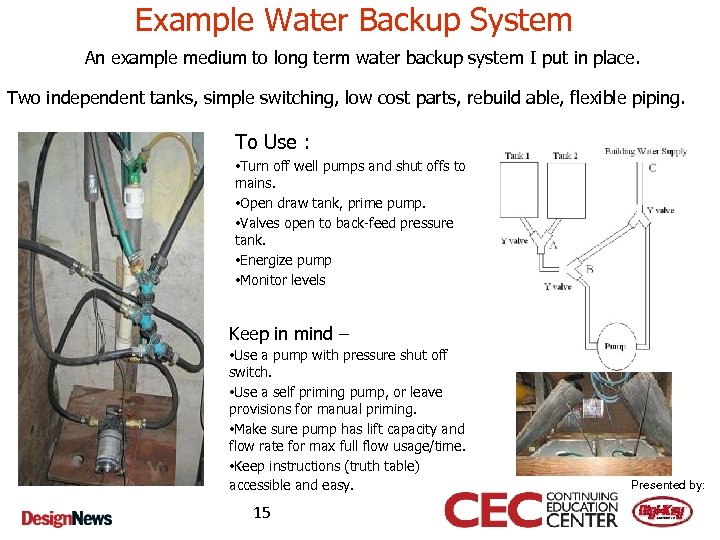 Example Water Backup System An example medium to long term water backup system I put in place. Two independent tanks, simple switching, low cost parts, rebuild able, flexible piping. To Use : • Turn off well pumps and shut offs to mains. • Open draw tank, prime pump. • Valves open to back-feed pressure tank. • Energize pump • Monitor levels Keep in mind – • Use a pump with pressure shut off switch. • Use a self priming pump, or leave provisions for manual priming. • Make sure pump has lift capacity and flow rate for max full flow usage/time. • Keep instructions (truth table) accessible and easy. 15 Presented by:
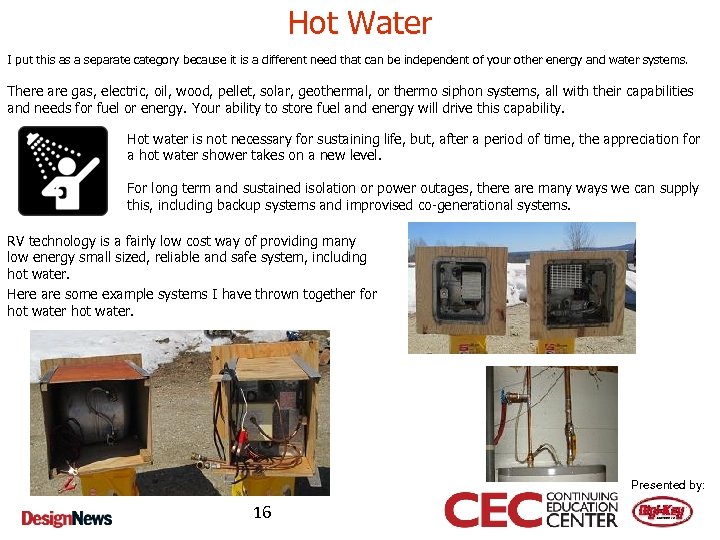 Hot Water I put this as a separate category because it is a different need that can be independent of your other energy and water systems. There are gas, electric, oil, wood, pellet, solar, geothermal, or thermo siphon systems, all with their capabilities and needs for fuel or energy. Your ability to store fuel and energy will drive this capability. Hot water is not necessary for sustaining life, but, after a period of time, the appreciation for a hot water shower takes on a new level. For long term and sustained isolation or power outages, there are many ways we can supply this, including backup systems and improvised co-generational systems. RV technology is a fairly low cost way of providing many low energy small sized, reliable and safe system, including hot water. Here are some example systems I have thrown together for hot water. Presented by: 16
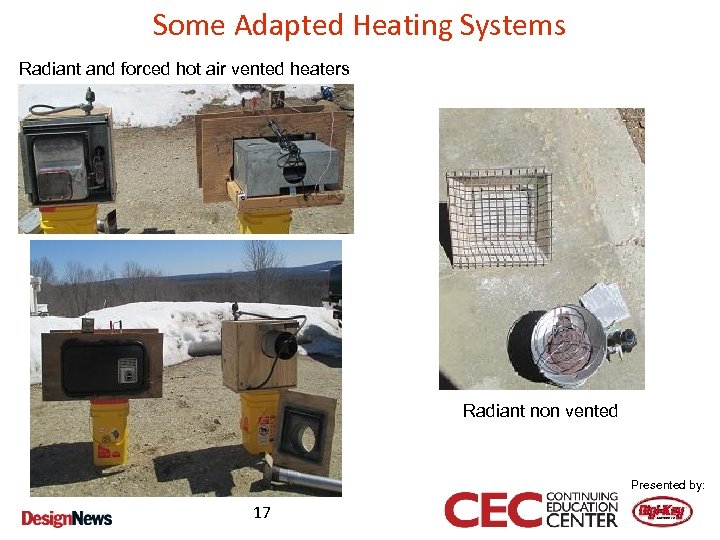 Some Adapted Heating Systems Radiant and forced hot air vented heaters Radiant non vented Presented by: 17
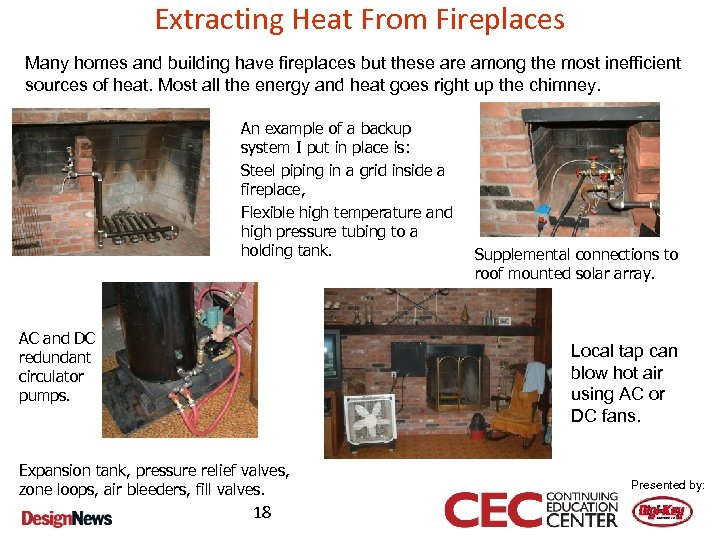 Extracting Heat From Fireplaces Many homes and building have fireplaces but these are among the most inefficient sources of heat. Most all the energy and heat goes right up the chimney. An example of a backup system I put in place is: Steel piping in a grid inside a fireplace, Flexible high temperature and high pressure tubing to a holding tank. AC and DC redundant circulator pumps. Supplemental connections to roof mounted solar array. Local tap can blow hot air using AC or DC fans. Expansion tank, pressure relief valves, zone loops, air bleeders, fill valves. 18 Presented by:
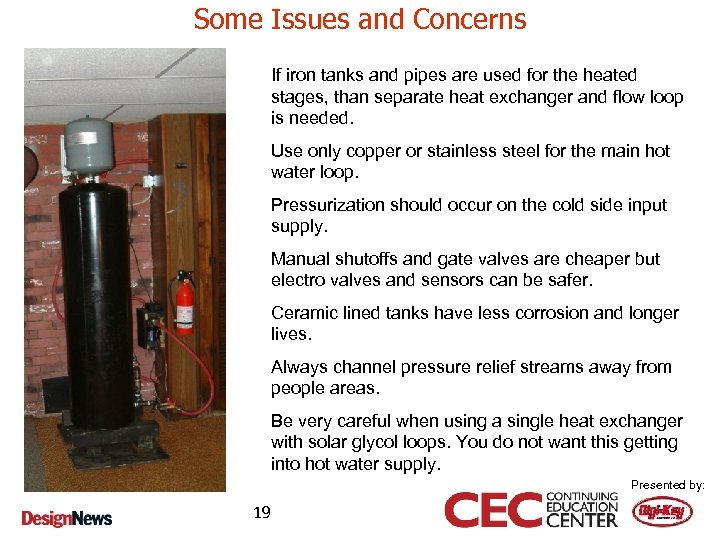 Some Issues and Concerns If iron tanks and pipes are used for the heated stages, than separate heat exchanger and flow loop is needed. Use only copper or stainless steel for the main hot water loop. Pressurization should occur on the cold side input supply. Manual shutoffs and gate valves are cheaper but electro valves and sensors can be safer. Ceramic lined tanks have less corrosion and longer lives. Always channel pressure relief streams away from people areas. Be very careful when using a single heat exchanger with solar glycol loops. You do not want this getting into hot water supply. Presented by: 19
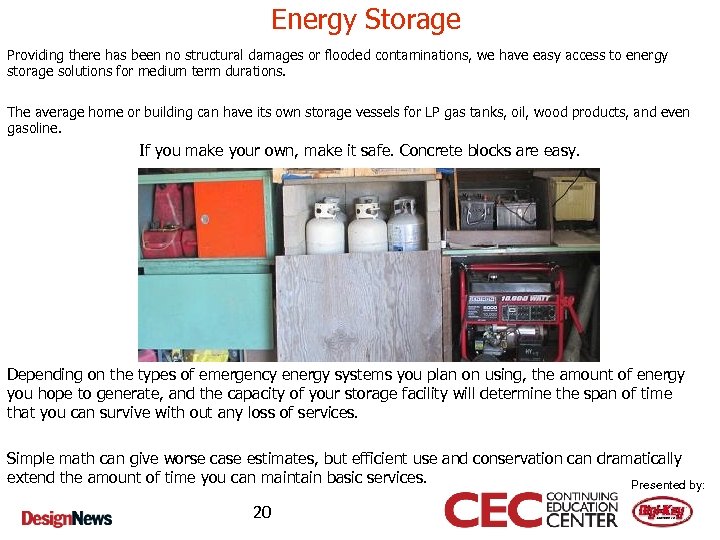 Energy Storage Providing there has been no structural damages or flooded contaminations, we have easy access to energy storage solutions for medium term durations. The average home or building can have its own storage vessels for LP gas tanks, oil, wood products, and even gasoline. If you make your own, make it safe. Concrete blocks are easy. Depending on the types of emergency energy systems you plan on using, the amount of energy you hope to generate, and the capacity of your storage facility will determine the span of time that you can survive with out any loss of services. Simple math can give worse case estimates, but efficient use and conservation can dramatically extend the amount of time you can maintain basic services. Presented by: 20
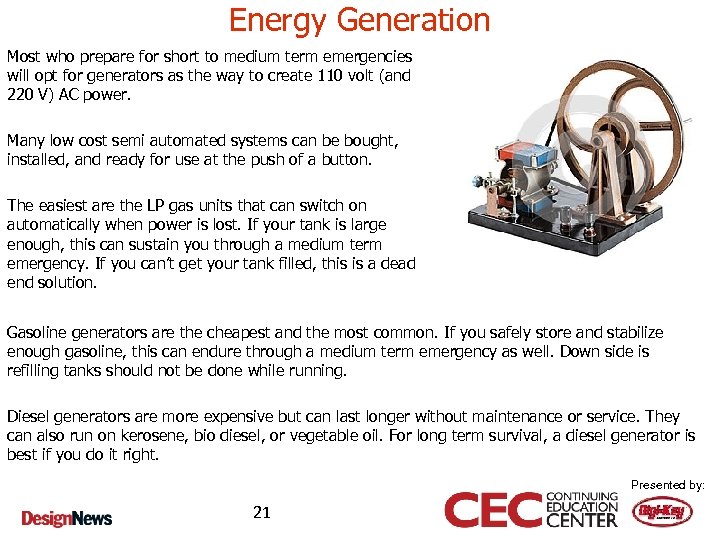 Energy Generation Most who prepare for short to medium term emergencies will opt for generators as the way to create 110 volt (and 220 V) AC power. Many low cost semi automated systems can be bought, installed, and ready for use at the push of a button. The easiest are the LP gas units that can switch on automatically when power is lost. If your tank is large enough, this can sustain you through a medium term emergency. If you can’t get your tank filled, this is a dead end solution. Gasoline generators are the cheapest and the most common. If you safely store and stabilize enough gasoline, this can endure through a medium term emergency as well. Down side is refilling tanks should not be done while running. Diesel generators are more expensive but can last longer without maintenance or service. They can also run on kerosene, bio diesel, or vegetable oil. For long term survival, a diesel generator is best if you do it right. Presented by: 21
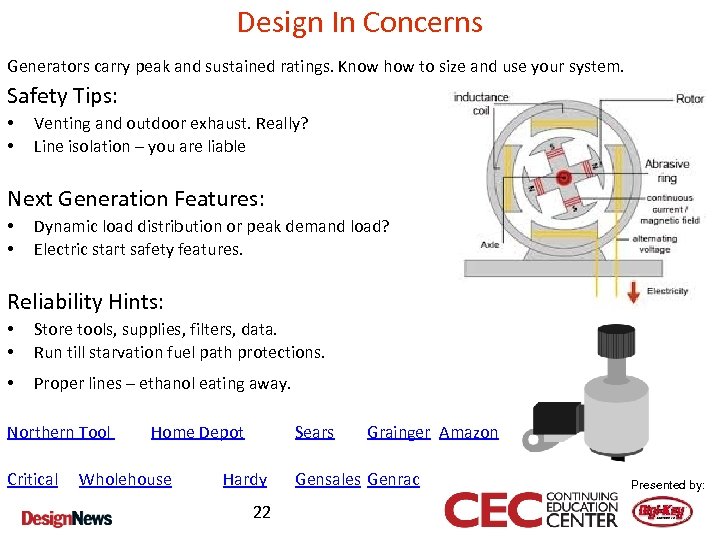 Design In Concerns Generators carry peak and sustained ratings. Know how to size and use your system. Safety Tips: • • Venting and outdoor exhaust. Really? Line isolation – you are liable Next Generation Features: • • Dynamic load distribution or peak demand load? Electric start safety features. Reliability Hints: • • Store tools, supplies, filters, data. Run till starvation fuel path protections. • Proper lines – ethanol eating away. Northern Tool Critical Home Depot Wholehouse Sears Hardy 22 Grainger Amazon Gensales Genrac Presented by:
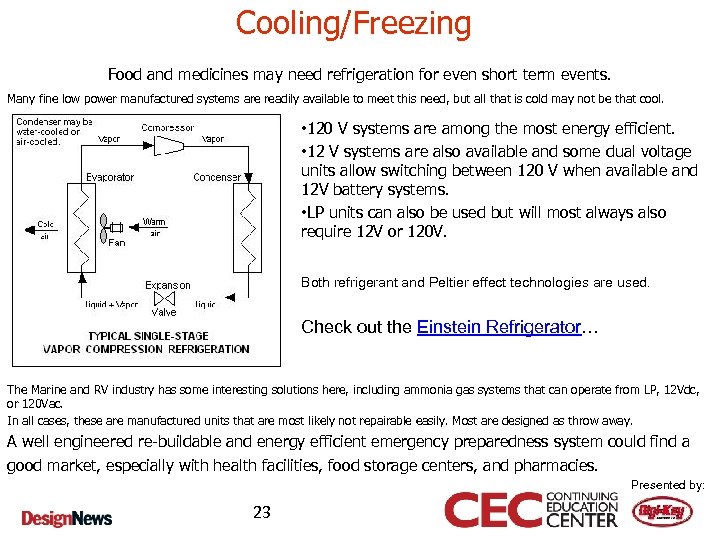 Cooling/Freezing Food and medicines may need refrigeration for even short term events. Many fine low power manufactured systems are readily available to meet this need, but all that is cold may not be that cool. • 120 V systems are among the most energy efficient. • 12 V systems are also available and some dual voltage units allow switching between 120 V when available and 12 V battery systems. • LP units can also be used but will most always also require 12 V or 120 V. Both refrigerant and Peltier effect technologies are used. Check out the Einstein Refrigerator… The Marine and RV industry has some interesting solutions here, including ammonia gas systems that can operate from LP, 12 Vdc, or 120 Vac. In all cases, these are manufactured units that are most likely not repairable easily. Most are designed as throw away. A well engineered re-buildable and energy efficient emergency preparedness system could find a good market, especially with health facilities, food storage centers, and pharmacies. Presented by: 23
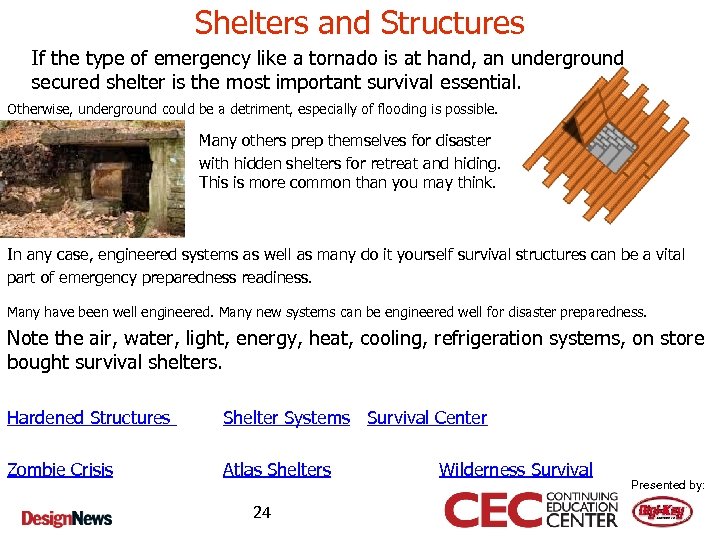 Shelters and Structures If the type of emergency like a tornado is at hand, an underground secured shelter is the most important survival essential. Otherwise, underground could be a detriment, especially of flooding is possible. Many others prep themselves for disaster with hidden shelters for retreat and hiding. This is more common than you may think. In any case, engineered systems as well as many do it yourself survival structures can be a vital part of emergency preparedness readiness. Many have been well engineered. Many new systems can be engineered well for disaster preparedness. Note the air, water, light, energy, heat, cooling, refrigeration systems, on store bought survival shelters. Hardened Structures Shelter Systems Survival Center Zombie Crisis Atlas Shelters 24 Wilderness Survival Presented by:
 Q&A Day 4 Questions and Answers Presented by: 25